Skip to content

Teach Light - Reflection and Refraction in eight steps.

For each idea: show it, ask before you tell, then say one line.

Gather paper, a pencil, a clear drinking glass and water.

Common misconceptions & worked visual for this chapter · 15 practice questions with answers

How to teach it

Reflection and mirrors

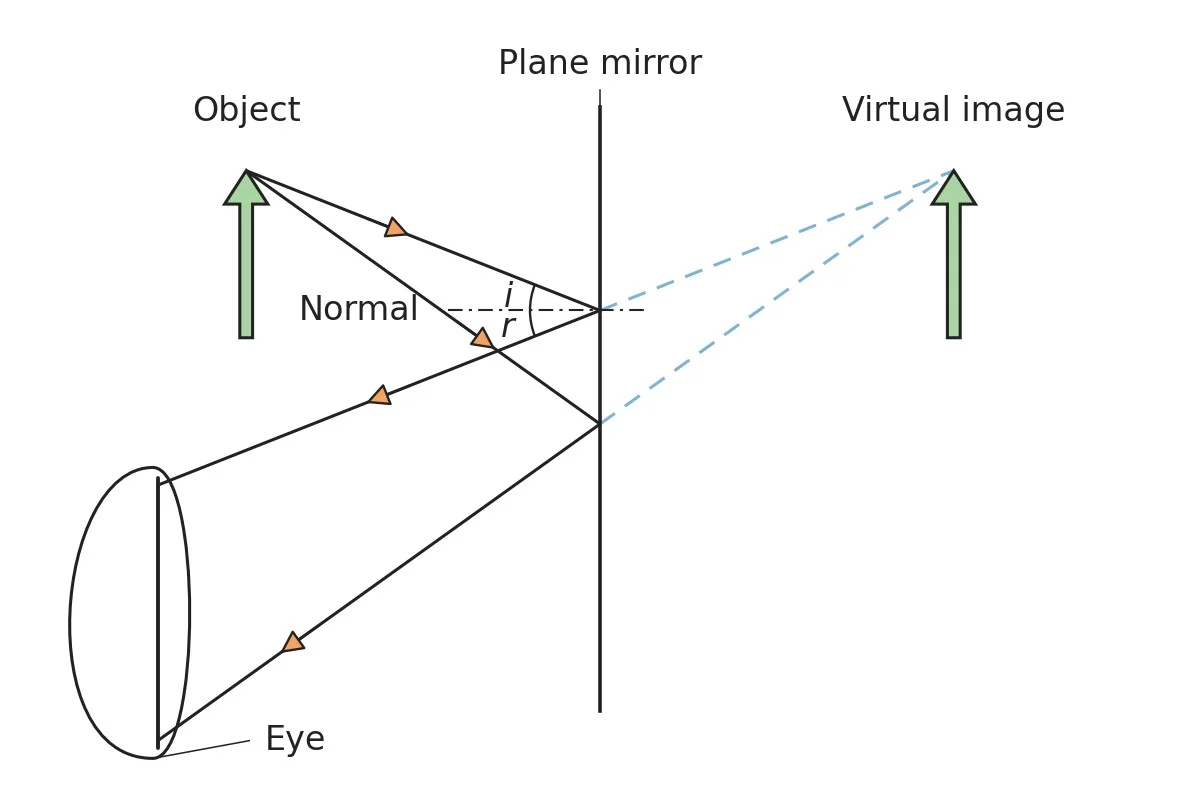
Reflected rays reach an eye; dashed extensions meet behind a plane mirror.

1. Reflection and plane mirrors

Light reflects back; a plane mirror gives a virtual image.

Show
Follow the diagram’s solid rays towards the eye, then their dashed extensions. Compare angles beside the normal.
Ask
Where will the eye seem to see the object?
Say
Light seems to come from behind the mirror. The image stays upright, equally tall and equally distant. Incoming and reflected rays make matching angles with the normal.
Used in
Plane mirrors help us check our appearance.
If your child says…“The mirror image can land on paper.”
Ask
Does the light actually meet behind the mirror, or only seem to?
What’s true
Reflected light only appears to come from behind the mirror, so its image is virtual.
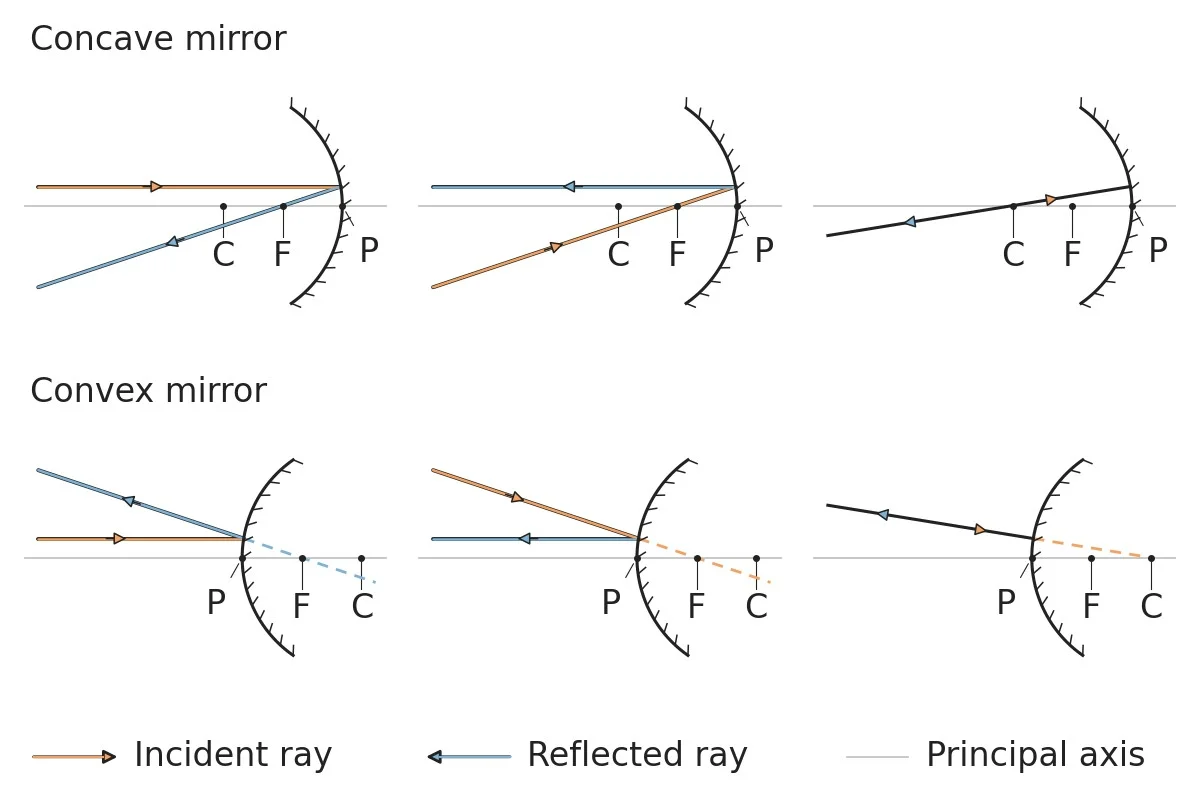
Concave and convex mirrors with parallel, focal and centre-of-curvature ray paths.

2. Spherical mirrors and principal rays

A curved mirror redirects rays according to its shape.

Show
Compare the diagram’s surfaces. Find pole P, focus F and centre C. Follow each ray.
Ask
Where will these mirrors send parallel light?
Say
Parallel light reflects through the concave focus, or seemingly from the convex focus. Reverse these paths: light returns parallel. Light along the C line returns along its incoming path.
Used in
A concave headlight mirror reflects light from its focus into a parallel beam.
If your child says…“The shiny side curves inward, so it is convex.”
Ask
Does the shiny surface curve inward or bulge outward?
What’s true
Name the mirror from its reflecting side: concave curves inward, while convex bulges outward.
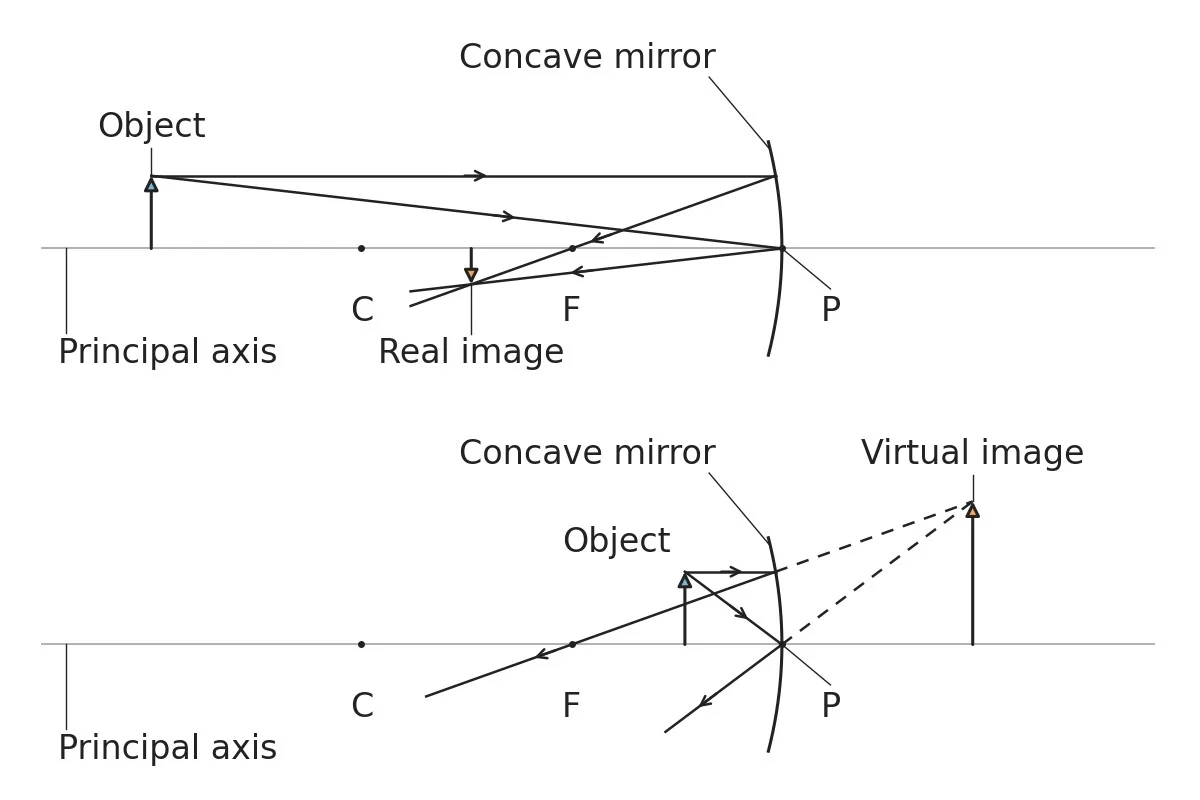
Concave mirror forming a real inverted image and a virtual upright image.

3. Concave-mirror images

An inward-curving mirror gives different images at different object distances.

Show
Compare object positions in the diagram. Follow reflected rays and their dashed extensions.
Ask
How will moving this object inside F change its image?
Say
Beyond C, rays meet, giving a smaller, inverted real image. Inside F, rays spread apart. Their extensions meet behind the mirror, giving an enlarged, upright virtual image.
Used in
A concave shaving mirror enlarges a nearby face, making details easier to see.
If your child says…“A concave mirror always gives an upside-down image.”
Ask
Which image comes from actual ray crossings, and which comes from dashed extensions?
What’s true
An object between the pole and focus produces an upright, virtual image.
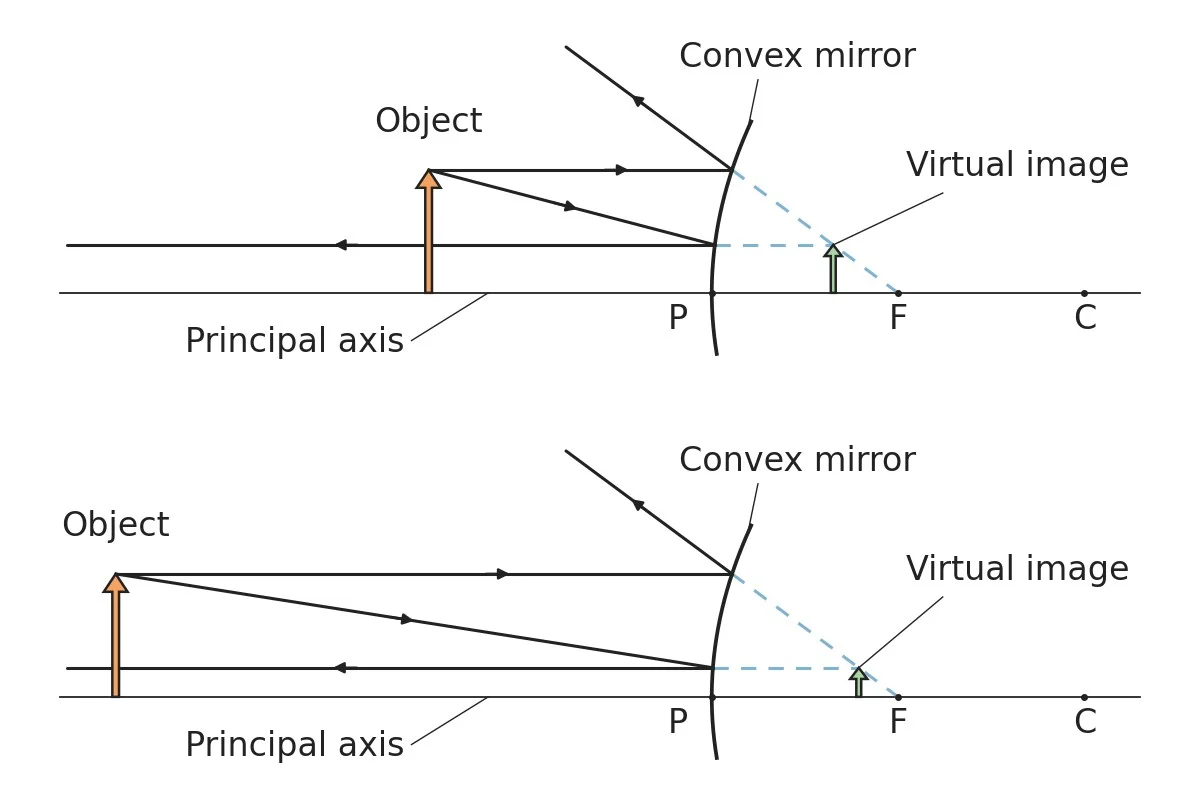
Two object distances produce upright, smaller virtual images behind a convex mirror.

4. Convex-mirror images

An outward-curving mirror gives smaller, upright images and wider views.

Show
Compare the object positions in the two diagram panels. Follow reflected rays and their dashed extensions. Find each image between P and F.
Ask
Looking at these positions, how will moving the object farther away change its image?
Say
Reflected rays spread apart; their backward extensions meet behind the mirror, between P and F. Those crossings give upright, smaller virtual images. The farther object gives a smaller image nearer F.
Used in
Convex vehicle mirrors show a wider area, helping drivers see more traffic behind.
If your child says…“A convex mirror makes things bigger.”
Ask
Which object is farther away, and which image is smaller?
What’s true
A convex mirror always gives an image smaller than the ordinary object in front of it.
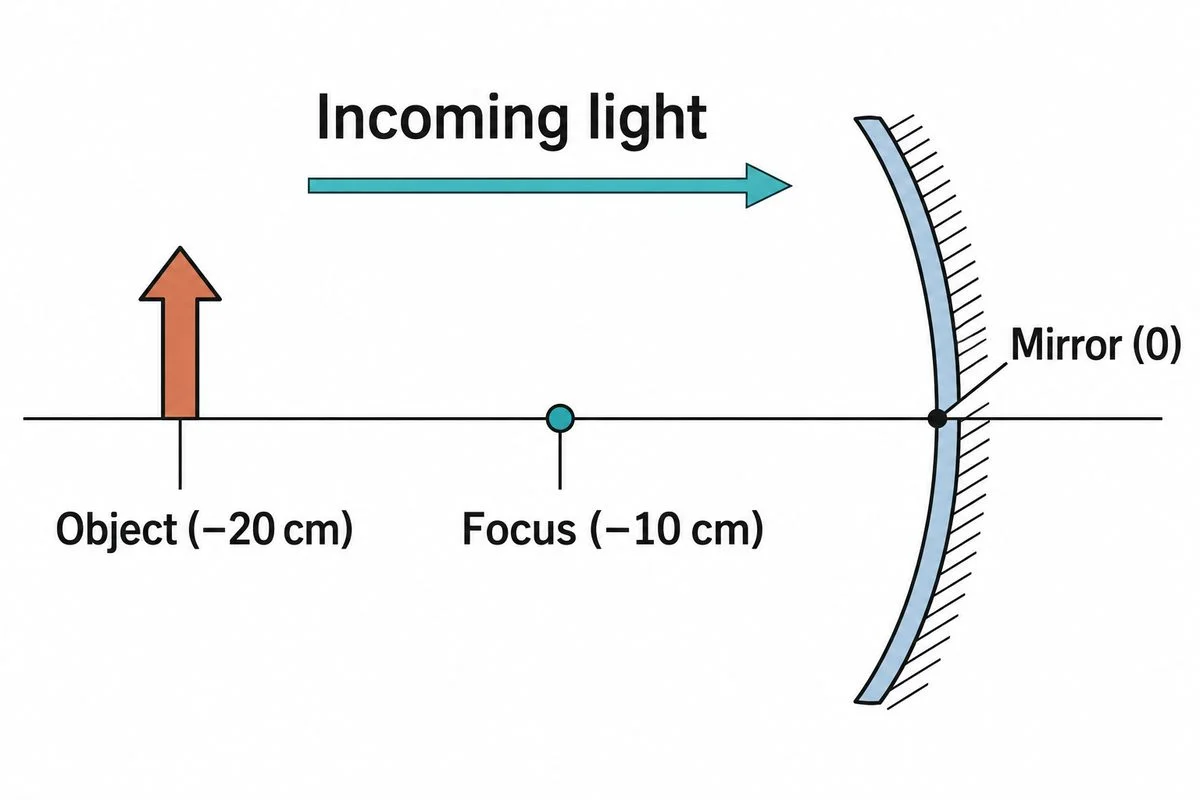
Diagram showing a concave mirror, negative object and focus positions, and incoming light.

5. Mirror formula and magnification

Signed distances predict image positions and sizes.

Show
Find the mirror at zero in the diagram. Locate the focus at −10 cm and the object at −20 cm. Use the incoming-light arrow to explain distance signs before calculating the image position.
Ask
Where will this object’s image form?
Say
Distances from the pole are positive along incoming light and negative against it. Using centimetres, image distance v satisfies 1v=−110+120\frac{1}{v}=-\frac{1}{10}+\frac{1}{20}.
Used in
Reflecting telescopes use concave mirrors to gather light and form images.
If your child says…“I just add the two distances.”
Ask
Would −30 cm give the reciprocal image distance we calculated?
What’s true
Use reciprocal distances with their signs; here, magnification is negative one, meaning equal height and inverted.

Refraction and lenses

Pencil held slantwise above the water in a half-filled drinking glass.

6. Refraction and refractive index

Light changes speed between materials; refractive index compares those speeds.

Show
Hold a pencil slantwise above a glass half-filled with water. After predicting, dip it and look from the side at the waterline. Lift it out to check its shape.
Ask
How will the pencil look where it enters the water?
Say
The pencil looks bent because light changes direction between water and air.
Used in
Refractive index helps us choose suitable glass for lenses.
If your child says…“A higher refractive index means faster light.”
Ask
When you divide the same number by something smaller, what happens to the answer?
What’s true
Dividing light’s vacuum speed by its speed in a material gives a number without units.
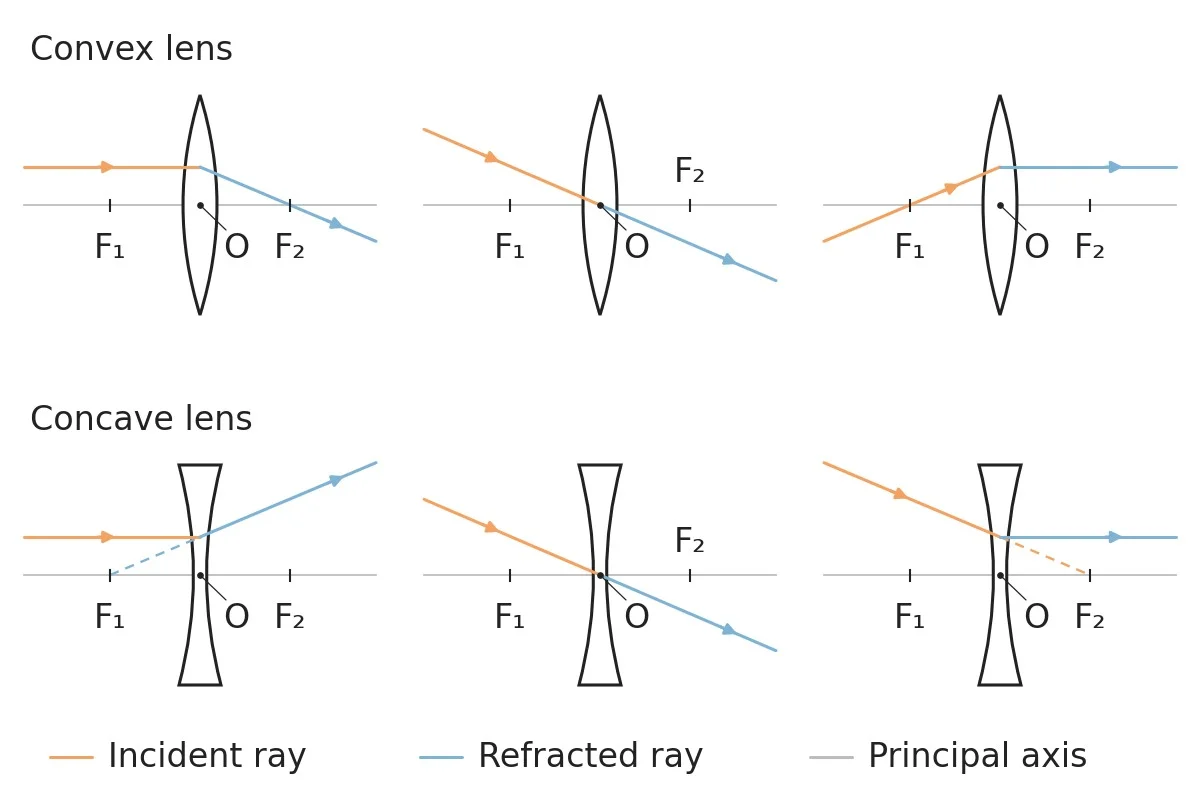
Principal ray paths through convex and concave lenses, including undeviated rays through their centres.

7. Spherical lenses and principal rays

Convex lenses bring parallel rays together; concave lenses spread them.

Show
Compare the diagram’s lens rows. Find centre O and both focuses. Follow each ray.
Ask
Which lens will bring parallel light together?
Say
Convex lenses gather parallel light; concave lenses spread it. Rays through O continue straight. Rays through the near convex focus or towards the far concave focus emerge parallel.
Used in
Magnifying glasses make small print easier to read.
If your child says…“A convex lens spreads light out.”
Ask
After the convex lens, does the parallel ray move towards the axis or away?
What’s true
A convex lens brings parallel light together, while a concave lens spreads it apart.

1v=1f+1u=125−150=150 cm−1\frac{1}{v}=\frac{1}{f}+\frac{1}{u}=\frac{1}{25}-\frac{1}{50}=\frac{1}{50}\,\mathrm{cm}^{-1}

v=+50 cmv=+50\,\mathrm{cm}

8. Lens formula, magnification and power

Lens calculations locate images, compare sizes and measure optical power.

Show
Write these lines. Name focal length f, object distance u and image distance v.
Ask
What power follows from this focal length?
Say
The image forms 50 cm rightwards. Power is one divided by +0.25 metres: +4 dioptres.
Used in
Lens power specifies the strength of spectacle lenses.
If your child says…“I divide by the focal length in centimetres.”
Ask
Which unit must we use before dividing one by the focal length?
What’s true
Convert centimetres to metres before dividing, with convex power positive and concave power negative.

A real problem

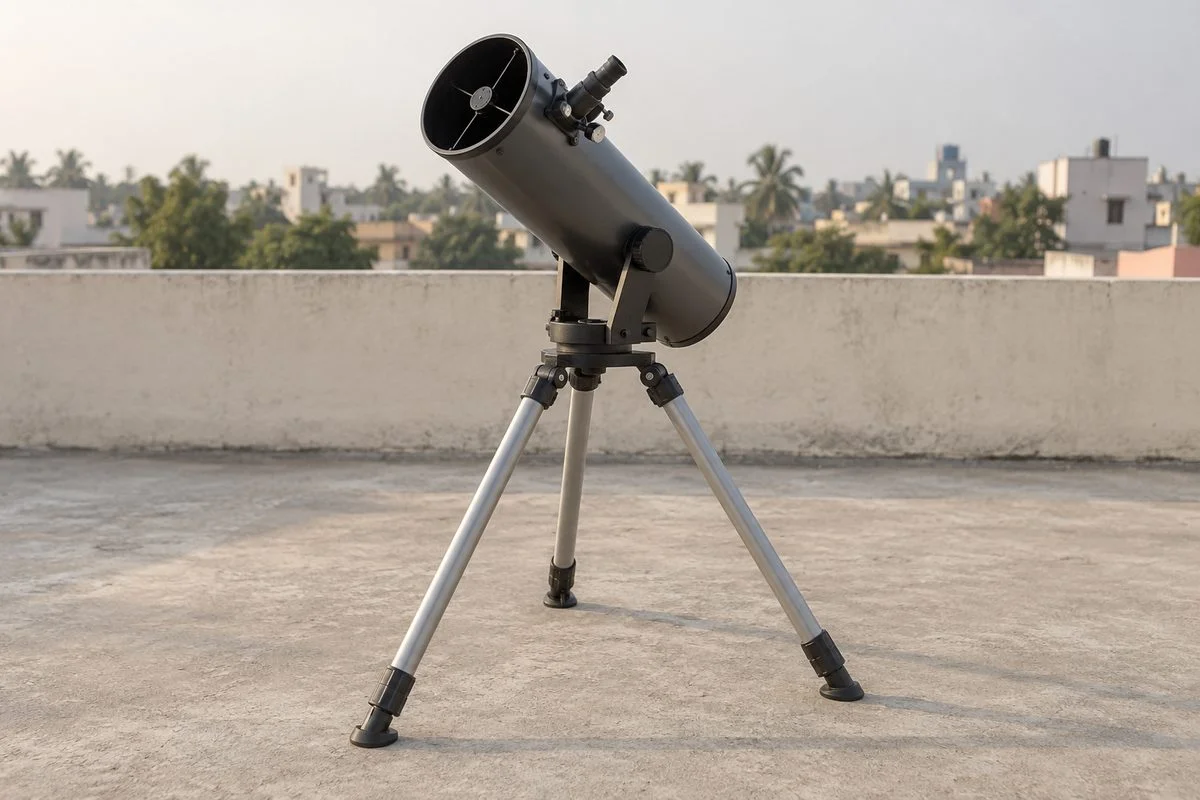
A reflecting telescope avoided colour fringes.

Newton made the Royal Society’s reflecting telescope in 1671.

Its concave mirror gathered light.

Forming the image with that mirror avoided colour distortion called chromatic aberration.

Royal Museums GreenwichScience Museum GroupCambridge University Press

Small reflecting telescope set up on a home terrace.

Concept Lab · Common misconception

The tempting mistake in Light - Reflection and Refraction

Open standalone misconception page →

Does a convex lens always form a real image?

Wrong

A converging lens always projects an image onto a screen.

Why it feels right. I remember the image formed by parallel rays.

Right

Image type depends on the object’s position relative to the focal point.

Worked example

Above: inside the focal length, rays diverge after the lens. Dashed extensions give a virtual image. Below: rays meet at a real image beyond the lens.
  1. A magnifier held close to print forms an upright virtual image.
  2. A distant object can form a real image on a screen.

Ask your child eight quick questions.

One per step. The answer and the reason are given.

  1. Can the pencil’s reflected image be caught on paper?

    No. Its image is virtual; reflected rays only seem to meet behind the mirror.

  2. Rays arrive parallel to the axis. Which mirror reflects them as though from a focus behind?

    A convex mirror. Its outward-curving surface spreads the reflected rays apart.

  3. Where must the pencil stand for its image to be upright and enlarged?

    Between the pole and focus. There, reflected rays spread apart and only appear to meet behind the mirror.

  4. How does the convex-mirror image compare in size with the object itself?

    It is smaller. A convex mirror gives a diminished image of an ordinary object.

  5. Where does the image form when the focus and object are at −10 and −20 cm?

    20 cm before the mirror. The reciprocal calculation gives a negative image distance, on the object’s side.

  6. What happens to light’s speed when its medium’s refractive index increases?

    It decreases. A larger index means the same vacuum speed is divided by a smaller speed.

  7. What happens to initially parallel rays after they cross a convex lens?

    They come together. The convex lens bends these rays towards a common point.

  8. What is the power of a convex lens with focal length 25 cm?

    +4 D. The focal length is +0.25 metres, and its reciprocal is +4.

15 more questions with answers