Skip to content

Teach Magnetic Effects of Electric Current in eight steps.

For each idea: show it, ask before you tell, then say one line.

Gather paper and a pencil.

Common misconceptions & worked visual for this chapter · 15 practice questions with answers

How to teach it

Magnetic fields

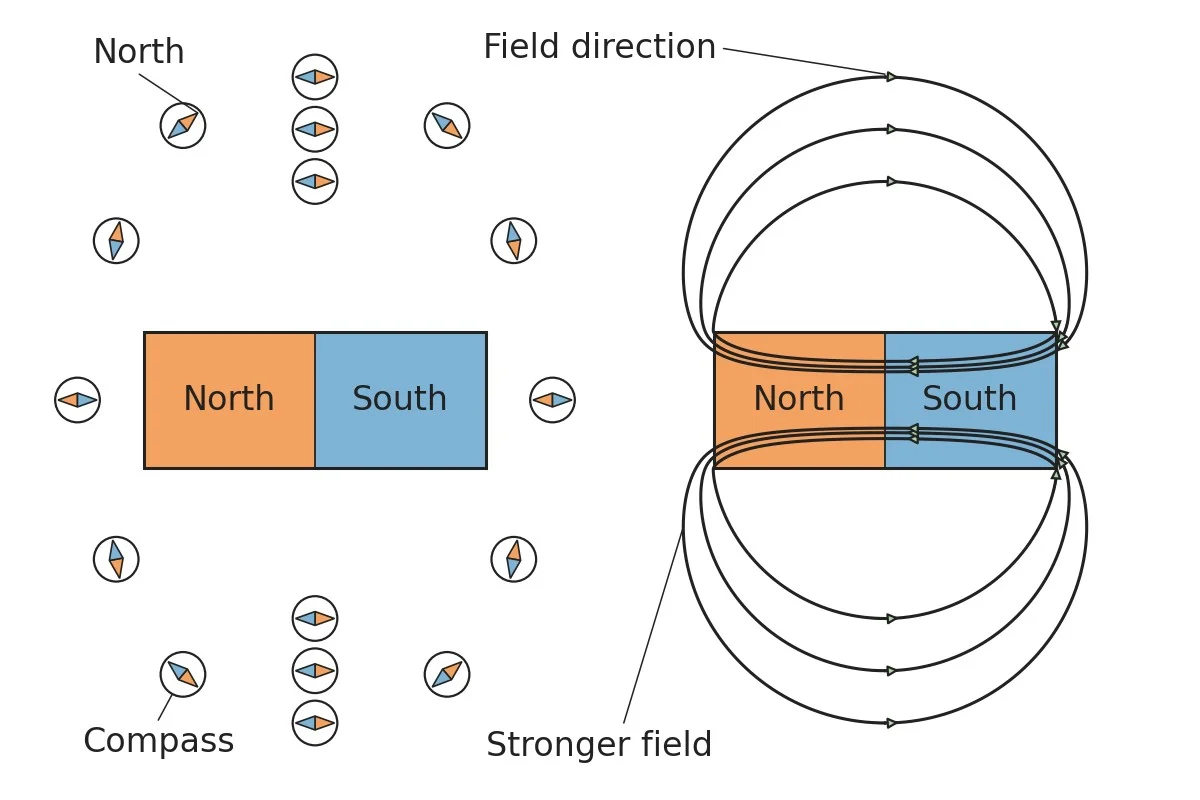
Compass needles beside a bar magnet match closed field loops around another.

1. Magnetic field lines

Drawn lines show magnetic direction and strength.

Show
Look at the diagram's compass needles on the left. Follow the matching loops on the right, including inside the magnet.
Ask
How would a compass's north end line up with the upper loop?
Say
It follows the arrow along the loop. These drawn lines form closed loops and never cross.
Used in
A compass follows Earth's magnetic field, helping walkers find their direction.
If your child says…“Invisible threads pull the needle.”
Ask
Would erasing the drawn lines stop the magnet turning a compass?
What’s true
The lines are drawings, with closer spacing showing stronger fields.
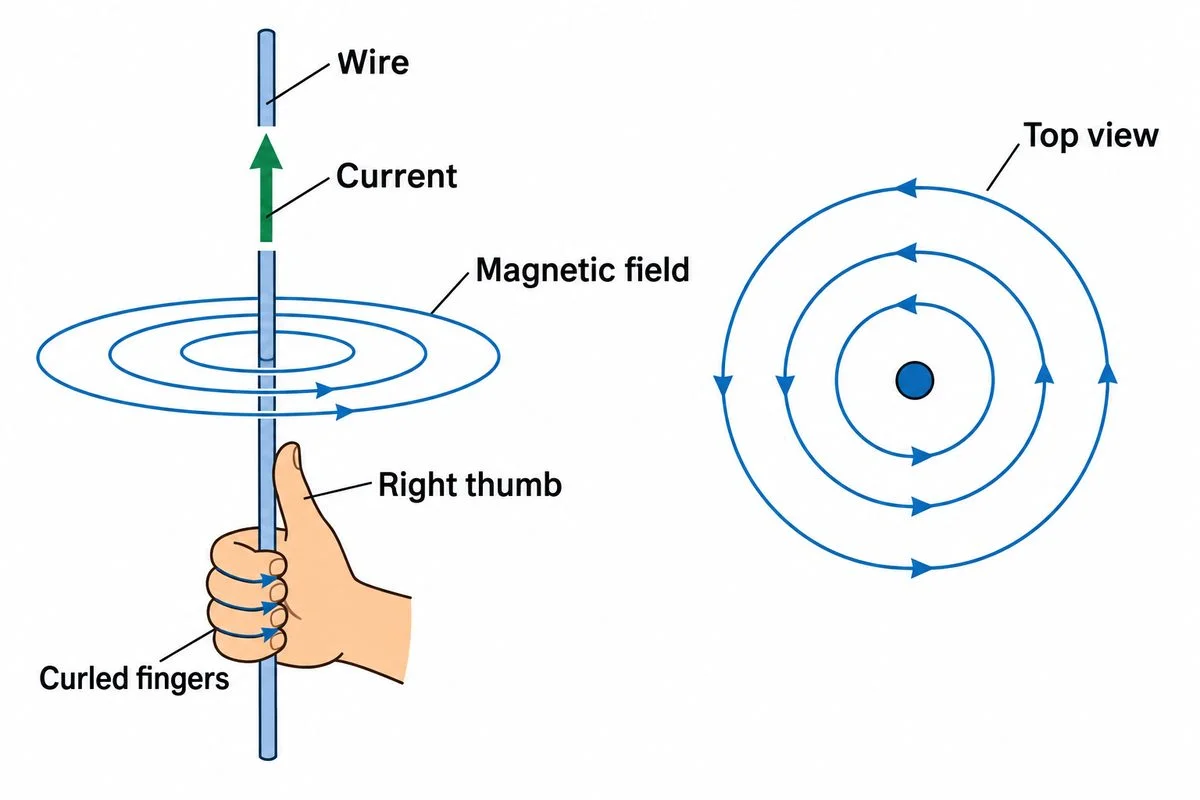
Upward wire current produces anticlockwise field circles when viewed from above.

2. Straight conductor and right-hand thumb rule

Current produces a circular field around a straight wire.

Show
Find the upward current in the diagram. Match your right thumb to it. Follow the circles in the top view.
Ask
Which way would a compass follow the field around this wire, viewed from above?
Say
It follows the circles anticlockwise. Your right thumb shows current, and your curled fingers show field direction.
Used in
Clamp meters sense a wire's magnetic field, letting electricians measure current without disconnecting the wire.
If your child says…“The field follows the wire.”
Ask
Do your curled fingers follow the wire or circle it?
What’s true
The field circles the wire, strengthens with current, and weakens with distance.
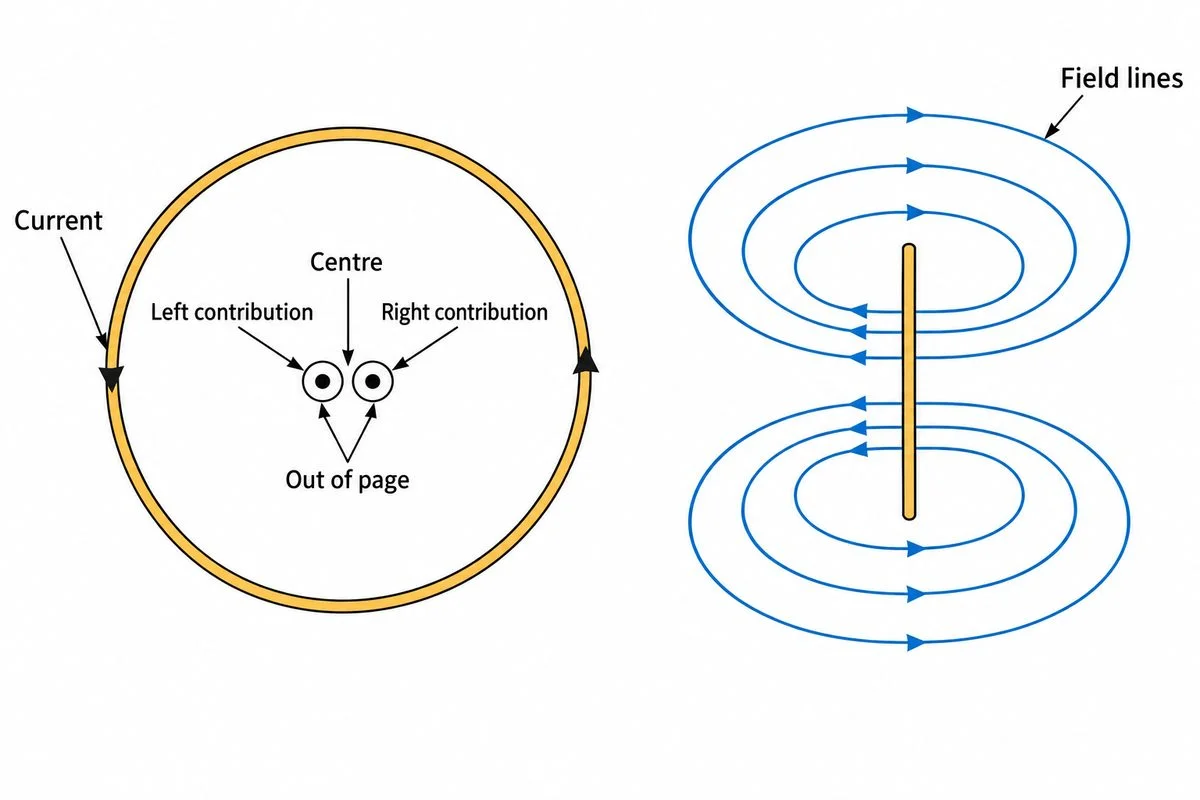
Opposite loop sections contribute matching outward fields at the centre.

3. Magnetic field of a circular current loop

A loop's sections reinforce the field at its centre.

Show
Find the opposite wire sections in the diagram. Compare their field contributions at the centre, then follow the side-view field lines.
Ask
Will the opposite sections' fields cancel or combine at the centre?
Say
They combine because both contributions point out of the page at the centre.
Used in
Extra coil turns strengthen lifting electromagnets at the same current.
If your child says…“Opposite sides cancel each other.”
Ask
Do the two centre symbols show matching or opposite field directions?
What’s true
Each part of the loop produces a field pointing the same way at its centre.
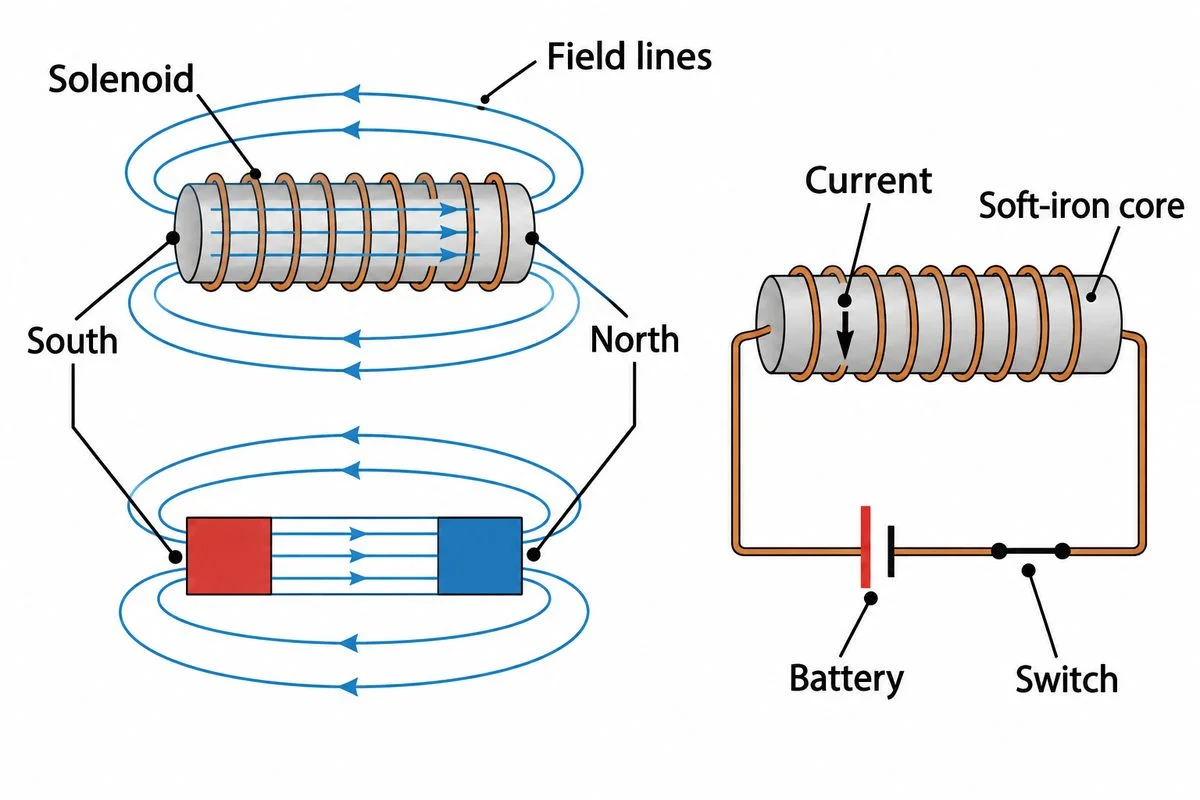
Solenoid and bar magnet have matching fields; a switched coil contains soft iron.

4. Solenoids and electromagnets

A long current-carrying coil behaves like a bar magnet.

Show
Compare the solenoid and bar magnet in the diagram. Follow their internal field lines. Find the soft-iron core in the switched coil.
Ask
Where would the solenoid provide a strong field with nearly the same strength throughout?
Say
Well inside, neighbouring turns reinforce the field. Straight, evenly spaced lines show its nearly uniform strength and direction. A soft-iron core strengthens this field.
Used in
Electromagnets in electric bells pull the striker to make sound.
If your child says…“The hollow centre has no field.”
Ask
Where do the neighbouring turns' fields add together?
What’s true
A solenoid's hollow centre contains a magnetic field when current flows.

Motion and electric current

Opposite currents produce upward and downward forces on the coil's two sides.

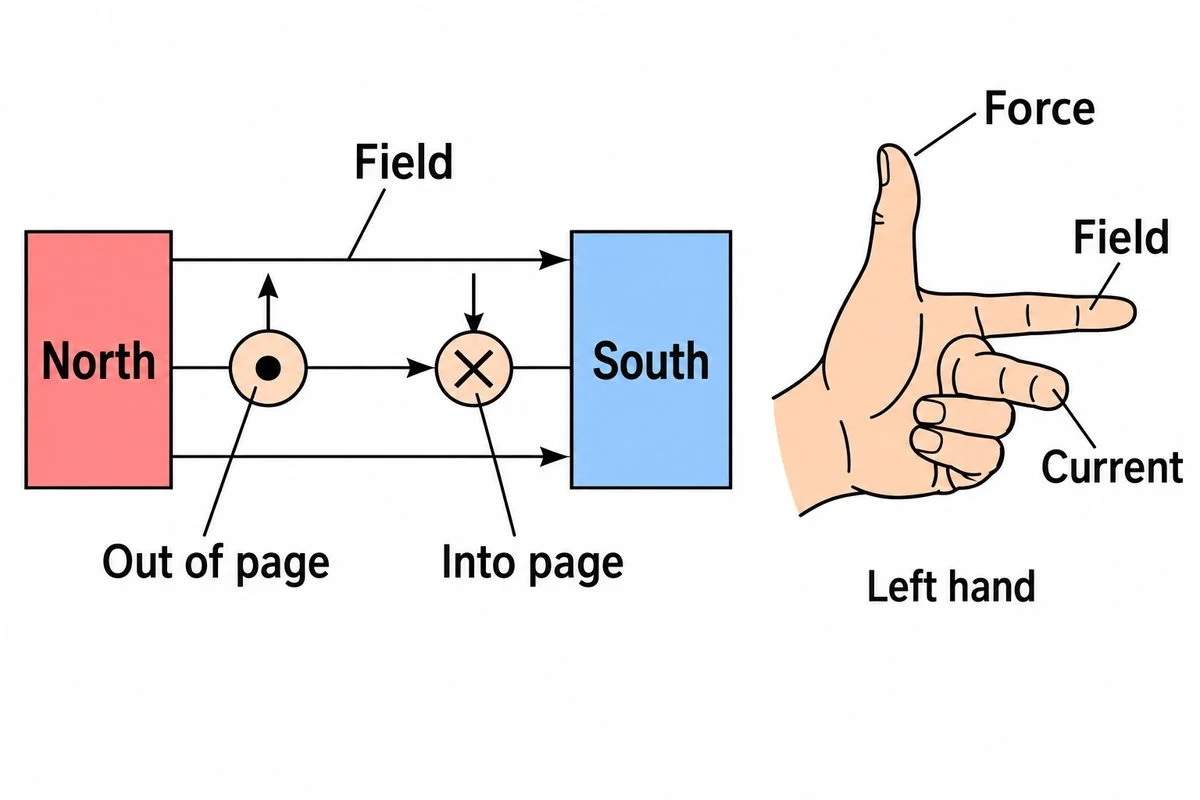
5. Force on a conductor and Fleming's left-hand rule

Magnetic forces on a current-carrying coil can turn it.

Show
Find the coil's two sides in the diagram. Follow the current and force arrows. Match them to the left-hand inset.
Ask
Which way will these forces start turning the coil?
Say
It starts turning clockwise because the forces act on different sides.
Used in
Train motors drive axles using magnetic forces.
If your child says…“Opposite forces always cancel.”
Ask
Do these opposite forces act along the same line?
What’s true
These opposite forces act along different lines, so they turn the coil.
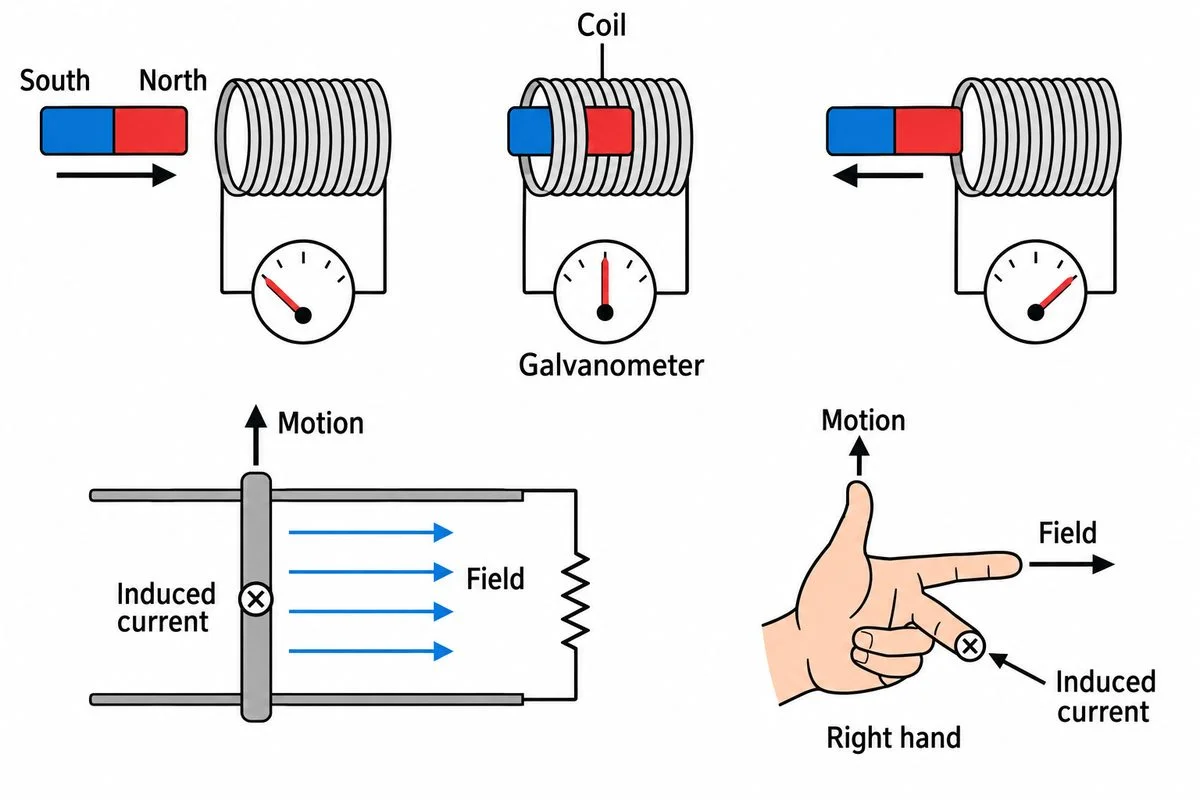
Moving magnets produce opposite meter deflections; a stationary magnet gives no sustained current.

6. Electromagnetic induction and Fleming's right-hand rule

A changing magnetic field can produce current in a closed coil.

Show
Compare the moving and still magnets in the diagram, then the meter needles. Follow the conductor's motion and right-hand inset below.
Ask
What happens to the induced current when the magnet stops inside the coil?
Say
It stops because the field through the closed coil stops changing. Moving the magnet again induces current.
Used in
Generators use induction to produce electric current.
If your child says…“A still magnet keeps current flowing.”
Ask
What does the meter show while the magnet rests inside?
What’s true
A magnet resting inside a stationary coil induces no current because the field stays unchanged.

Electricity at home

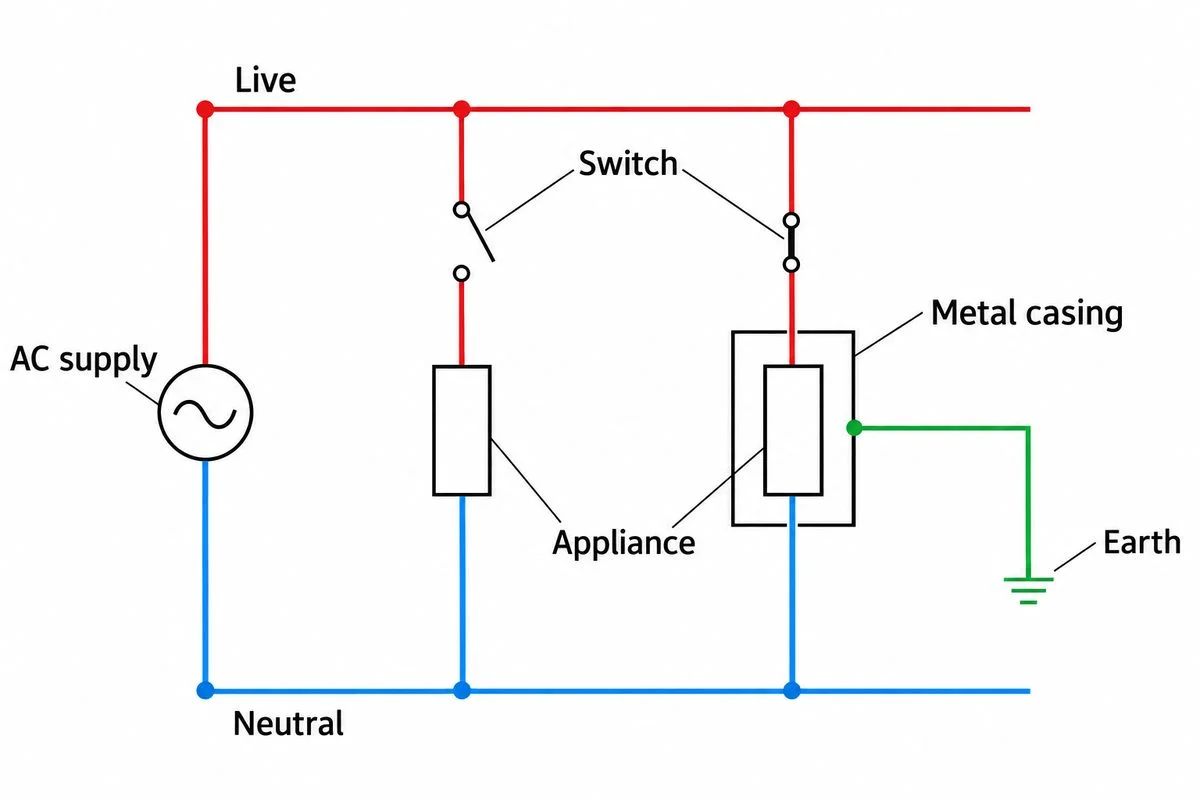
Separate appliance branches share live and neutral; earth connects separately to a metal casing.

7. Domestic supply, parallel circuits and wire roles

Separate parallel paths let appliances work independently.

Show
Trace both appliance branches between live and neutral in the diagram. Find the open switch, then the separate earth connection to the casing.
Ask
Will the appliance on the closed branch still work?
Say
Yes, its path through live and neutral remains complete. Each parallel branch receives mains voltage. Live and neutral carry working current.
Used in
Parallel wiring lets appliances operate independently.
If your child says…“Earth carries the working current.”
Ask
Which wire provides the normal return path: neutral or earth?
What’s true
Earth connects the casing to ground for fault current and normally carries no current.
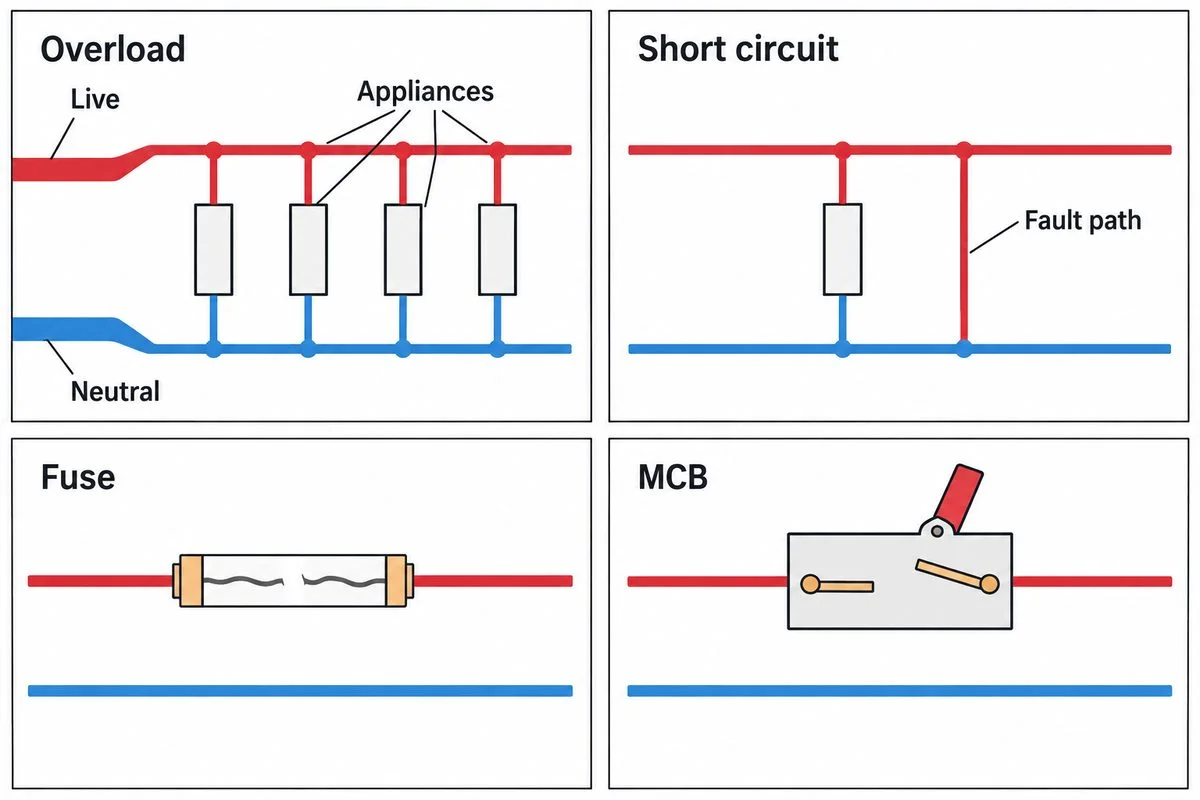
Overloaded branches and a short circuit cause excessive current; protection breaks the live wire.

8. Overloading, short circuits and protection

Overloads and short circuits can cause dangerously large currents.

Show
Compare the appliance branches and fault path in the diagram. Locate the fuse and MCB breaks in the live wire below.
Ask
What could happen to the shared wires before the fuse or MCB disconnects either circuit?
Say
Too many appliances can draw excessive current and overheat the shared wires. A short circuit creates a low-resistance path, also causing excessive current. A correctly rated fuse or MCB breaks the live connection.
Used in
A correctly rated fuse disconnects an unsafe live supply.
If your child says…“Overloading means current stops.”
Ask
Does current stop when appliances overload the circuit, or when the fuse breaks the circuit?
What’s true
Overloading increases current before protection breaks the circuit.

A real problem

Electric trains use magnetic forces to drive their axles.

India's first electric train began running between Bombay and Kurla on 3 February 1925.

Electric traction reduced dependence on steam locomotives.

Traction motors drive the axles of electric locomotives.

These motors produce motion using magnetic forces on wires carrying current.

Indian RailwaysPress Information BureauCaltech

Mumbai suburban electric train beneath overhead wires at a station.

Concept Lab · Common misconception

The tempting mistake in Magnetic Effects of Electric Current

Open standalone misconception page →

Does reversing current reverse the magnetic field?

Wrong

The compass deflects the same way after reversing the current.

Why it feels right. The wire stays in the same position.

Right

The field direction around the wire depends on the direction of current.

Worked example

First trial
Current one way→Compass deflects one way
Second trial
Reverse current→Compass deflects the other way
Reversing current reverses the field direction at the same compass position.
  1. In a supervised low-voltage demonstration, keep the compass fixed and reverse the circuit current.
  2. The wire’s effect on the compass reverses.

Ask your child eight quick questions.

One per step. The answer and the reason are given.

  1. What do magnetic field lines represent?

    The field's direction and strength. They depict a magnetic field; they are not physical threads pulling the needle.

  2. What shape do magnetic field lines make around a straight wire carrying current?

    Circles centred on the wire. The field circles the wire instead of following its length.

  3. At a current loop's centre, how do fields from opposite sections combine?

    They reinforce each other. Their fields point the same way at the centre, so they add.

  4. What is the magnetic field like inside a long solenoid carrying current?

    Strong and nearly uniform. The turns reinforce the field inside, even when the centre is hollow.

  5. What can opposite magnetic forces on different sides of a coil produce?

    A turning effect. Opposite forces can turn the coil when they act along different lines.

  6. What induced current remains after both magnet and coil become stationary?

    None. The magnetic field through the coil is no longer changing.

  7. During normal appliance operation, does the earth wire carry working current?

    No. Earth provides a safety path for fault current, not the appliance's working current.

  8. More identical heaters are switched on in parallel. What happens to the total supply current?

    It increases. The supply carries current for more branches.

15 more questions with answers