Skip to content

Teach Binomial Theorem in eight steps.

For each idea: show it, ask before you tell, then say one line.

Gather paper and a pencil.

Common misconceptions & worked visual for this chapter · 15 practice questions with answers

How to teach it

Build the expansion

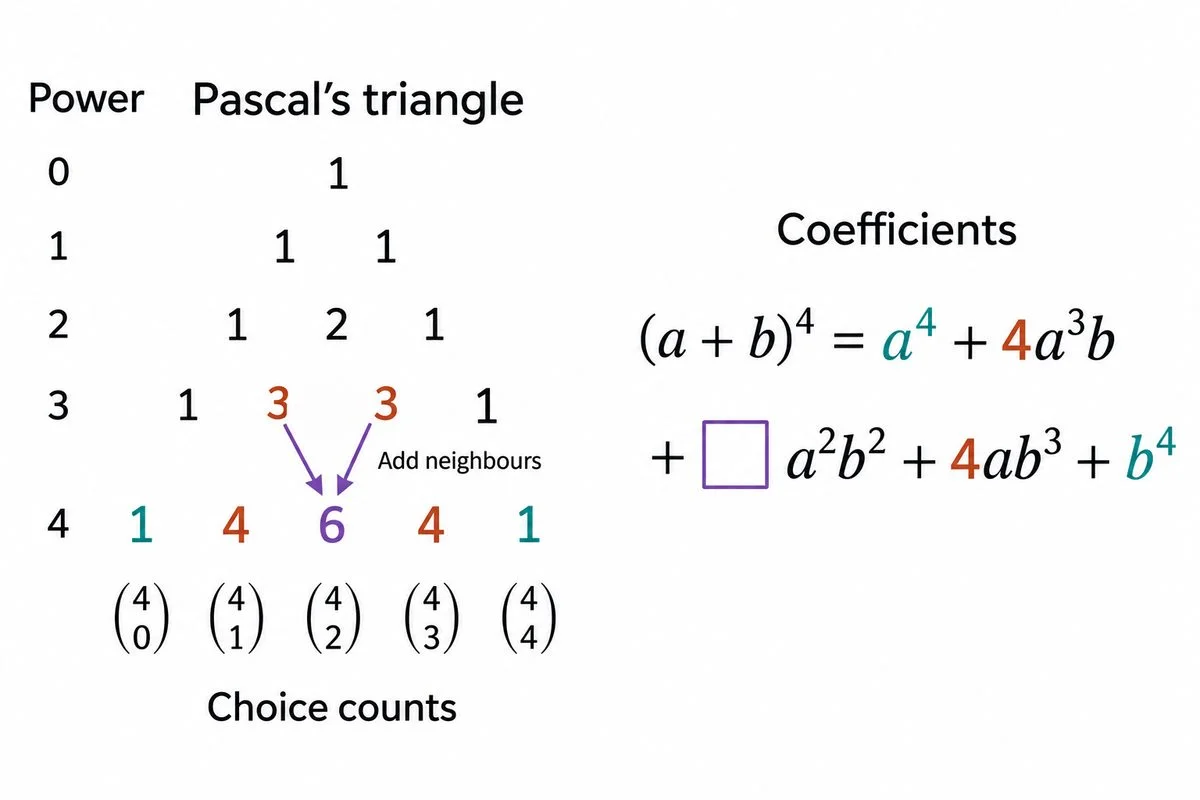
Pascal’s triangle linked to choice counts and a fourth-power expansion with one coefficient missing.

1. Pascal's triangle and binomial coefficients

Neighbouring entries add to give coefficients for the next power.

Show
In the diagram, a and b name quantities. Follow the arrows from the threes. Match the bottom row to the expansion and its choice counts.
Ask
What coefficient fills the gap without multiplying the four brackets?
Say
The missing coefficient is 6, from adding the two threes above. The row supplies exact coefficients without multiplying every bracket. Read the small symbols as 'four choose zero' through 'four choose four'.
Used in
Counting snack selections avoids repeating choices.
If your child says…“Choosing nothing gives zero ways.”
Ask
How many ways can you choose a from every bracket?
What’s true
Choosing no b means choosing a from every bracket: exactly one choice.
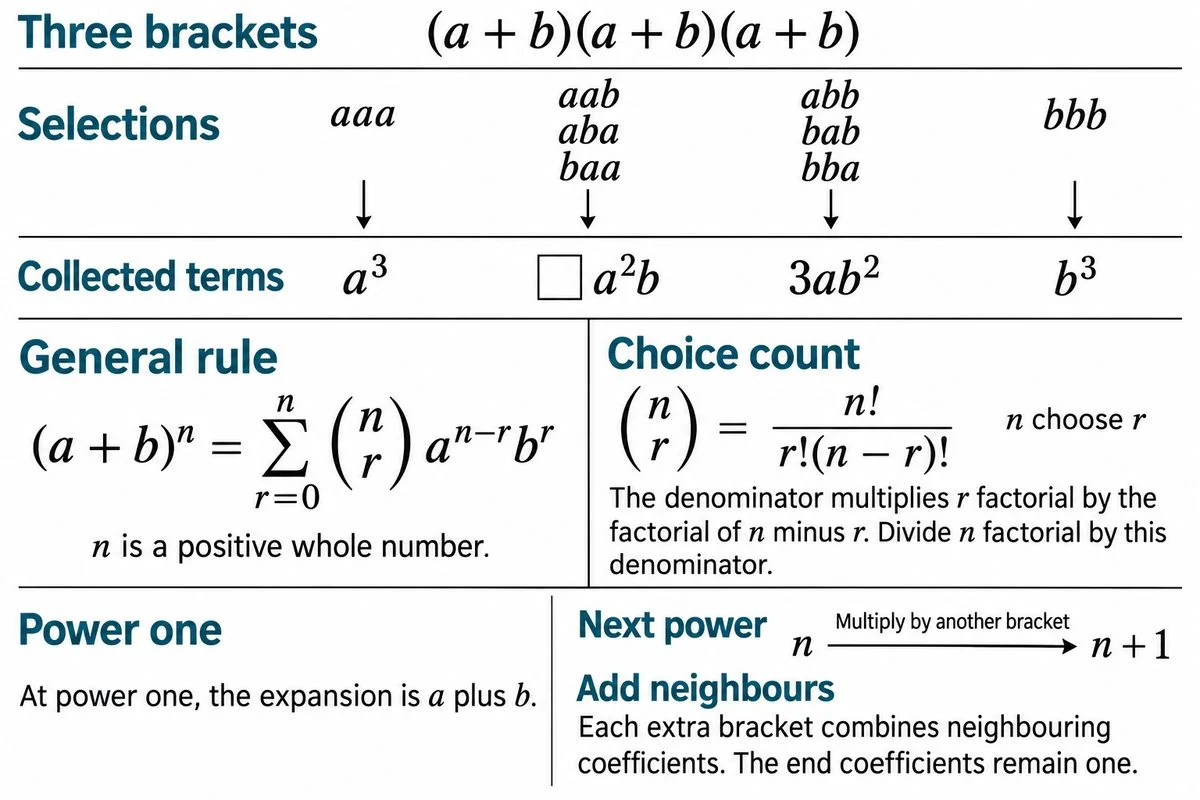
Bracket selections explain coefficients, the general expansion, and the induction step.

2. Binomial theorem for positive integral indices

Count letter selections to find each product’s coefficient.

Show
Follow the diagram from selections to products, then the general rule and induction arrow.
Ask
What coefficient collects selections containing exactly one b?
Say
Three selections give three a squared b. Opposing powers give n plus one terms. From power one, adding brackets combines neighbouring coefficients, proving the rule by induction.
Used in
Repeated percentage growth calculations track savings.
If your child says…“I multiply the coefficient by the a part, then add the b part.”
Ask
In each mixed product, are the a and b factors multiplied or added?
What’s true
Each term multiplies its choice count by both powers.

(1−x)4=(1+(−x))4(1-x)^4=(1+(-x))^4

=1+4(−x)+6(−x)2+4(−x)3+(−x)4=1+4(-x)+6(-x)^2+4(-x)^3+(-x)^4

3. Expansion of (1+x)ⁿ and (1−x)ⁿ

Odd powers change signs, allowing coefficient sums and cancellation.

Show
Write these lines. Say: 'Keep minus x together when raising powers.'
Ask
What simplified expansion follows?
Say
Odd powers change sign: 1−4x+6x2−4x3+x41-4x+6x^2-4x^3+x^4.
Used in
Coefficient sums count coin-toss outcomes to compare chances.
If your child says…“A difference always ends with a minus.”
Ask
What sign comes from multiplying an even number of negative factors?
What’s true
The last written sign is plus for even powers and minus for odd powers.

Use the expansion

(2x+1)3=(2x)3+3(2x)2(1)+3(2x)(1)2+13(2x+1)^3=(2x)^3+3(2x)^2(1)+3(2x)(1)^2+1^3

=8x3+3(4x2)+6x+1=8x^3+3(4x^2)+6x+1

4. Applications of the binomial theorem

Raise each complete quantity.

Show
Write these lines. Say: 'The complete quantities are twice x and one.'
Ask
What simplified cube follows?
Say
Cube the number too: 8x3+12x2+6x+18x^3+12x^2+6x+1.
Used in
Volume formulas with scaled lengths help calculate storage space.
If your child says…“The power changes x, but leaves its number alone.”
Ask
How many factors of 2 does cubing twice x require?
What’s true
A power repeats the whole quantity, including its numerical factor.

113=(10+1)311^3=(10+1)^3

=103+3⋅102+3⋅10+1=10^3+3\cdot10^2+3\cdot10+1

=1000+300+30+1=1000+300+30+1

=1330+1=1330+1

5. Evaluation using the binomial theorem

Split a number to make its power easier to calculate.

Show
Write these lines. Say: 'Ten has easy powers, and the adjustment is small.'
Ask
What exact total goes on the next line?
Say
Keeping every term gives the exact answer: 1331. A round number and a small adjustment make the powers easier.
Used in
Packing calculations use powers to count items arranged in equal rows and layers.
If your child says…“Every way of splitting the number makes the calculation equally easy.”
Ask
What makes the powers of ten in these lines easy?
What’s true
Valid splits give equal answers, but their powers can require different amounts of work.

Compare, divide and estimate

(1.1)10=(1+0.1)10(1.1)^{10}=(1+0.1)^{10}

=1+10(0.1)+R=1+10(0.1)+R

=2+R=2+R

6. Comparison using the binomial theorem

Positive omitted terms make a partial sum a lower bound.

Show
Write these lines for ten successive 10% increases. Call R the sum of all remaining terms.
Ask
Every term in R is positive, so how does the full power compare with 2?
Say
The remaining terms increase the total, so the power exceeds 2. We can settle this comparison without calculating every term.
Used in
Growth comparisons reveal whether repeated price increases pass a limit without calculating the final price.
If your child says…“The terms we leave out might pull the total down.”
Ask
Which factor could make any remaining term negative?
What’s true
Here every coefficient and factor is positive, so every remaining term is positive.

3n−2n=(1+2)n−2n3^n-2n=(1+2)^n-2n

=1+∑r=2n(nr)2r=1+\sum_{r=2}^{n}\binom nr2^r

=1+4∑r=2n(nr)2r−2=1+4\sum_{r=2}^{n}\binom nr2^{r-2}

7. Divisibility using the binomial theorem

Separate a multiple of the divisor from the remainder.

Show
Write these lines for whole-number n at least 2. Say: 'The summation sign adds the indicated terms.'
Ask
What remainder will this expression leave when divided by 4?
Say
The remainder is 1 because everything after it is an integer multiple of 4.
Used in
Remainders tell packers how many items remain after filling equal-sized packets.
If your child says…“The first terms are where the divisibility comes from.”
Ask
After cancellation, which part contains the factor 4?
What’s true
Subtracting cancels the linear term; the later terms contain the factor 4.

(0.99)3=(1−0.01)3(0.99)^3=(1-0.01)^3

=1−3(0.01)+3(0.01)2−(0.01)3=1-3(0.01)+3(0.01)^2-(0.01)^3

=1−0.03+0.0003−0.000001=1-0.03+0.0003-0.000001

≈0.97+0.0003\approx0.97+0.0003

8. Approximation using the binomial theorem

Keep early terms when the omitted total is small enough.

Show
Write these lines for three successive 1% reductions. Say: 'The approximation sign means nearly equal.'
Ask
What three-term approximation goes on the next line?
Say
Keeping the signs gives approximately 0.9703. Omitting the negative final term makes this one millionth above the exact value.
Used in
Approximations help estimate a price after successive discounts.
If your child says…“I can always drop later terms because they are small.”
Ask
How much does dropping this final term change the answer?
What’s true
Check the omitted total against the accuracy needed before dropping it.

A real problem

Pascal's triangle helped solve a fair prize-sharing problem.

An interrupted dice game raised a question: how should its prize money be divided fairly?

Pascal and Fermat exchanged solutions in 1654.

Pascal's solution used his triangle.

University of St AndrewsRoyal HollowayGresham College

Dice and coins beside the blank edge of an unfinished score sheet.

Concept Lab · Common misconception

The tempting mistake in Binomial Theorem

Open standalone misconception page →

Can you raise each part of a sum to a power separately?

Wrong

(x + 1)³ = x³ + 1

Why it feels right. I transfer the rule for powers of products to a sum.

Right

The expansion includes mixed terms.

Worked example

All x
xxx
Two x terms
xx1
x1x
1xx
One x term
x11
1x1
11x
All ones
111
Choose one term from each of the three factors. The mixed products occur in three different positions.
  1. Multiply (x + 1) three times.
  2. There are three ways to choose two x terms and three ways to choose one, giving x³ + 3x² + 3x + 1.

Ask your child eight quick questions.

One per step. The answer and the reason are given.

  1. What is seven choose zero?

    1 There is exactly one selection containing nothing.

  2. Expand a plus b raised to five, with a's powers decreasing. What comes third?

    10a3b210a^3b^2 The coefficient multiplies both powers; the b part is not added separately.

  3. Here x and y name two quantities. What term ends x minus y raised to six?

    +y6+y^6 Six negative factors multiply to give a positive coefficient.

  4. What does twice x, all cubed, become?

    8x38x^3 The factor 2 is multiplied three times, just like x.

  5. Which split of 96 uses a power of ten with the smallest whole-number adjustment?

    100 minus 4 Powers of 100 are easy, and subtracting 4 gives the smallest whole-number adjustment.

  6. Does 2 overestimate or underestimate this power?

    Underestimate. The omitted terms are positive and increase the total.

  7. Take three raised to n, minus twice n. What smallest positive whole number leaves a multiple of 4 when subtracted?

    1 Removing 1 leaves only an integer multiple of 4.

  8. How far above the exact value is this three-term approximation?

    0.000001 The omitted term is negative, so leaving it out raises the result.

15 more questions with answers, 1 with pictures