Skip to content

Teach Limits and Derivatives in eight steps.

For each idea: show it, ask before you tell, then say one line.

Gather paper and a pencil.

Common misconceptions & worked visual for this chapter · 15 practice questions with answers

How to teach it

From changing position to limits

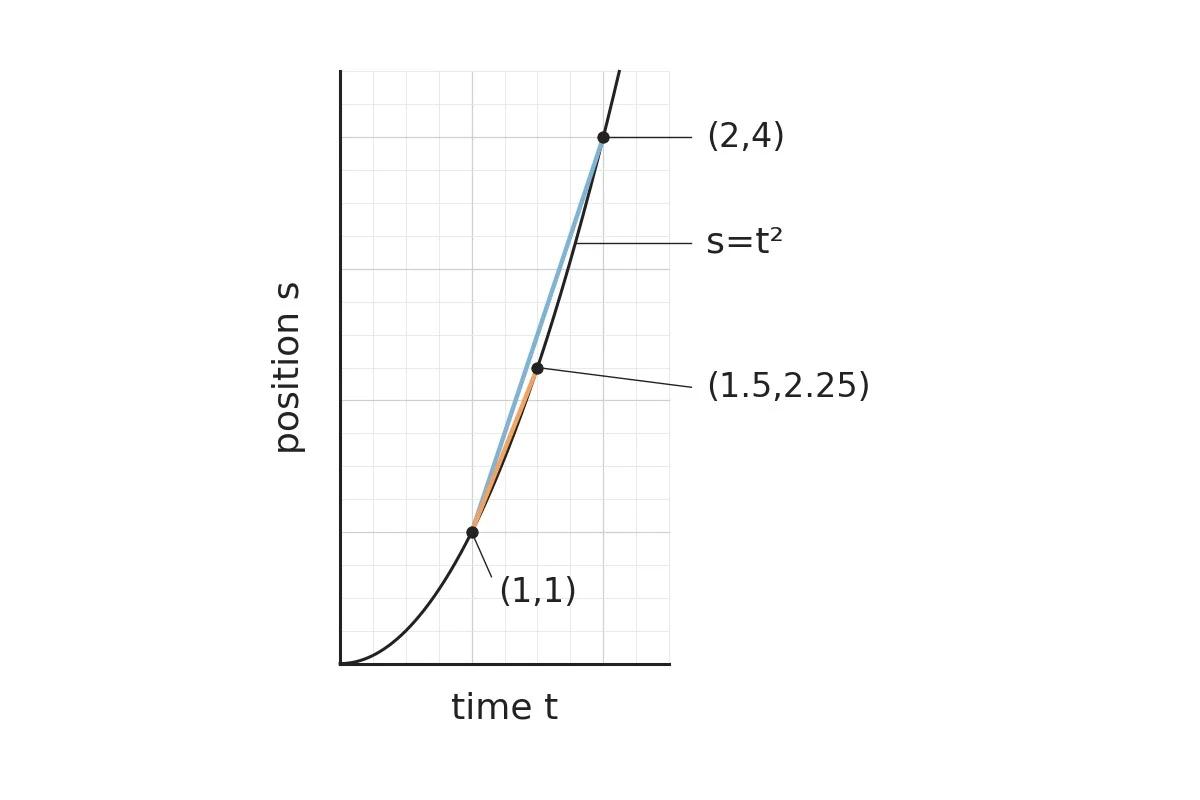
Position–time parabola with labelled points and two joining lines sharing the first point.

1. Intuitive Idea of Derivatives

An instant’s rate comes from shrinking intervals.

Show
Look at the diagram. Call time t and position s. Follow both joining lines from (1,1)(1,1) to the later marked points.
Ask
As the second point approaches the first, what happens to the joining line?
Say
It approaches the tangent, whose slope gives instantaneous velocity when this limit exists.
Used in
A speedometer shows current speed, helping drivers judge their pace.
If your child says…“Any joining line gives the exact speed at the first point.”
Ask
Does the slope change when you move the second point closer?
What’s true
A joining line gives an interval’s average rate.
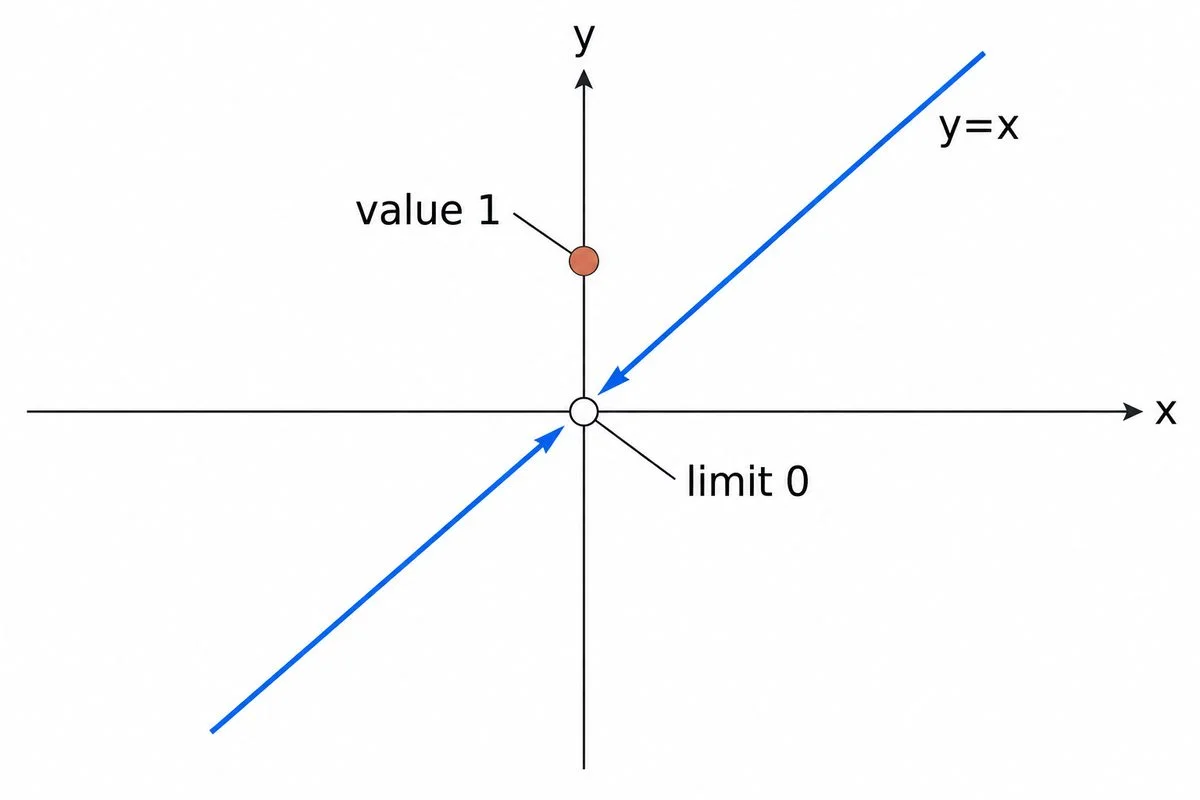
Diagonal approaching a hole at zero, with a separate filled point at height one.

2. Limits

Nearby outputs must approach one value from both sides.

Show
In the diagram, x is the input and y is the output. Follow the diagonal towards the hole from each side. Then find the filled point above it.
Ask
Which height will nearby outputs approach, despite the filled point being at one?
Say
They approach zero from both sides, so the limit is zero. The filled point assigns one only at zero.
Used in
At a billing threshold, one-sided limits distinguish charges just below and above it.
If your child says…“The value at zero is one, so the limit must be one.”
Ask
Do the arrows follow the diagonal towards the hole or towards the filled point?
What’s true
A value assigned at one input does not control nearby outputs.

Calculating limits

L=lim⁡x→1(2x+1)L=\lim_{x\to1}(2x+1)

L=2lim⁡x→1x+lim⁡x→11L=2\lim_{x\to1}x+\lim_{x\to1}1

L=2⋅1+1L=2\cdot1+1

3. Algebra of Limits

Keep arithmetic operations, checking that division remains valid.

Show
Write this line. Say: “L names the limit. Doubling input differences doubles output differences; adding one leaves those differences unchanged. Take the input’s limit, multiply by two, then add one.”
Ask
As x approaches one, what will twice x plus one approach?
Say
The number is three: finite limits keep addition and fixed multipliers.
Used in
Area formulas predict how much flooring a slightly resized room needs.
If your child says…“I can divide the limits even when the bottom approaches zero.”
Ask
Would dividing by zero produce a number?
What’s true
The division rule requires a nonzero limit underneath.

L=lim⁡x→1x2−1x−1L=\lim_{x\to1}\frac{x^2-1}{x-1}

L=lim⁡x→1(x−1)(x+1)x−1L=\lim_{x\to1}\frac{(x-1)(x+1)}{x-1}

L=lim⁡x→1(x+1)L=\lim_{x\to1}(x+1)

L=1+1L=1+1

4. Limits of Polynomials and Rational Functions

Factor first when substitution gives zero over zero.

Show
Write this line. Say: “Substitution gives zero over zero. Factor the top into x minus one times x plus one. Nearby x differs from one, so divide top and bottom by their shared factor. This leaves x plus one.”
Ask
Looking at x plus one, what will it approach as x approaches one?
Say
The number is two: cancellation reveals the nearby values.
Used in
Power-difference limits estimate how changing a container’s size changes its capacity.
If your child says…“Zero over zero means the limit is zero.”
Ask
After cancellation, what does the unchanged nearby expression approach?
What’s true
Zero over zero alone tells us no limit value.
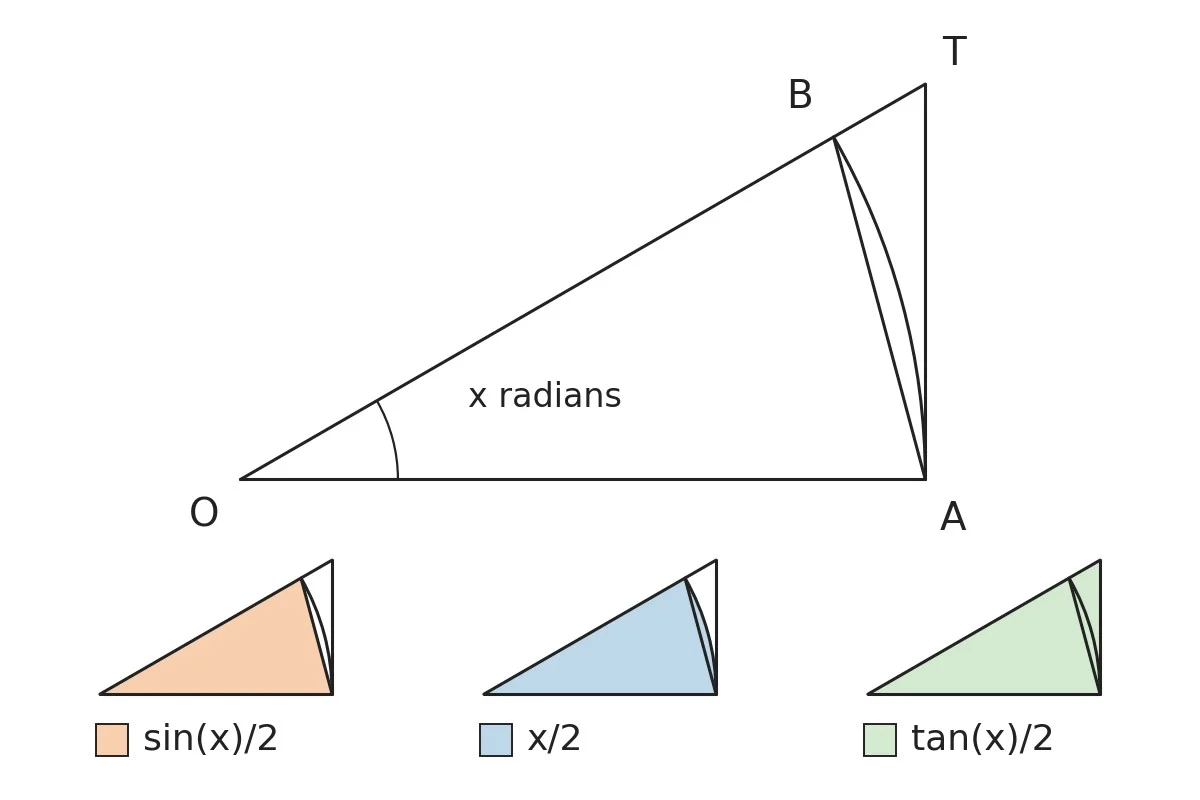
Unit-circle sector between two triangles, with their three areas labelled below.

5. Limits of Trigonometric Functions

Equal limiting bounds fix a limit.

Show
Look at the diagram’s inner triangle, sector and outer triangle, in that order. Compare their labelled areas. Angle x is positive, below half pi, and measured in radians.
Ask
As the angle shrinks towards zero, what will sine divided by its angle approach?
Say
The areas give these bounds: cos⁡x≤sin⁡xx≤1\cos x\le\frac{\sin x}{x}\le1. Both bounds approach one, so the middle does too.
Used in
Small-angle limits simplify tilt calculations.
If your child says…“Any two bounds tell us the middle limit.”
Ask
If the bounds stay apart, what forces the middle towards just one number?
What’s true
The bounds must approach the same number to force one middle limit.

Calculating derivatives

f′(1)=lim⁡h→0(1+h)2−1hf'(1)=\lim_{h\to0}\frac{(1+h)^2-1}{h}

f′(1)=lim⁡h→02h+h2hf'(1)=\lim_{h\to0}\frac{2h+h^2}{h}

f′(1)=lim⁡h→0(2+h)f'(1)=\lim_{h\to0}(2+h)

6. Derivatives

Find a rate by taking the limit of change ratios.

Show
Write this line. Say: “Function f squares its input. The prime marks its derivative, and h is a nonzero input change. Keep the starting input at one. Expand the square, subtract one, then cancel h. This leaves two plus h.”
Ask
What remains as h approaches zero?
Say
Two remains after the input change approaches zero.
Used in
A derivative tracks a tank’s rising water level, helping estimate its remaining filling time.
If your child says…“I should put the input change equal to zero immediately.”
Ask
What happens to the first denominator if you put zero in immediately?
What’s true
Keep the change nonzero during division, then take its limit.

ddx[x(x+1)]=1⋅(x+1)+x⋅1\frac{d}{dx}[x(x+1)]=1\cdot(x+1)+x\cdot1

ddx[x(x+1)]=(x+1)+x\frac{d}{dx}[x(x+1)]=(x+1)+x

7. Algebra of Derivatives

Every changing factor contributes.

Show
Write this line. Say: “The symbol d/dx means differentiate with respect to x. Differentiate each factor in turn, keeping the other unchanged. Each factor’s derivative is one, leaving x plus one and x. Add both contributions.”
Ask
What derivative follows when both factors contribute to the product’s change?
Say
The derivative is twice x plus one: 2x+12x+1.
Used in
An area’s derivative tracks its growth when both length and width change.
If your child says…“I multiply the two derivatives to differentiate a product.”
Ask
Where does the changing size of each factor appear if you multiply only their derivatives?
What’s true
Each changing factor contributes a term while the other factor remains undifferentiated.
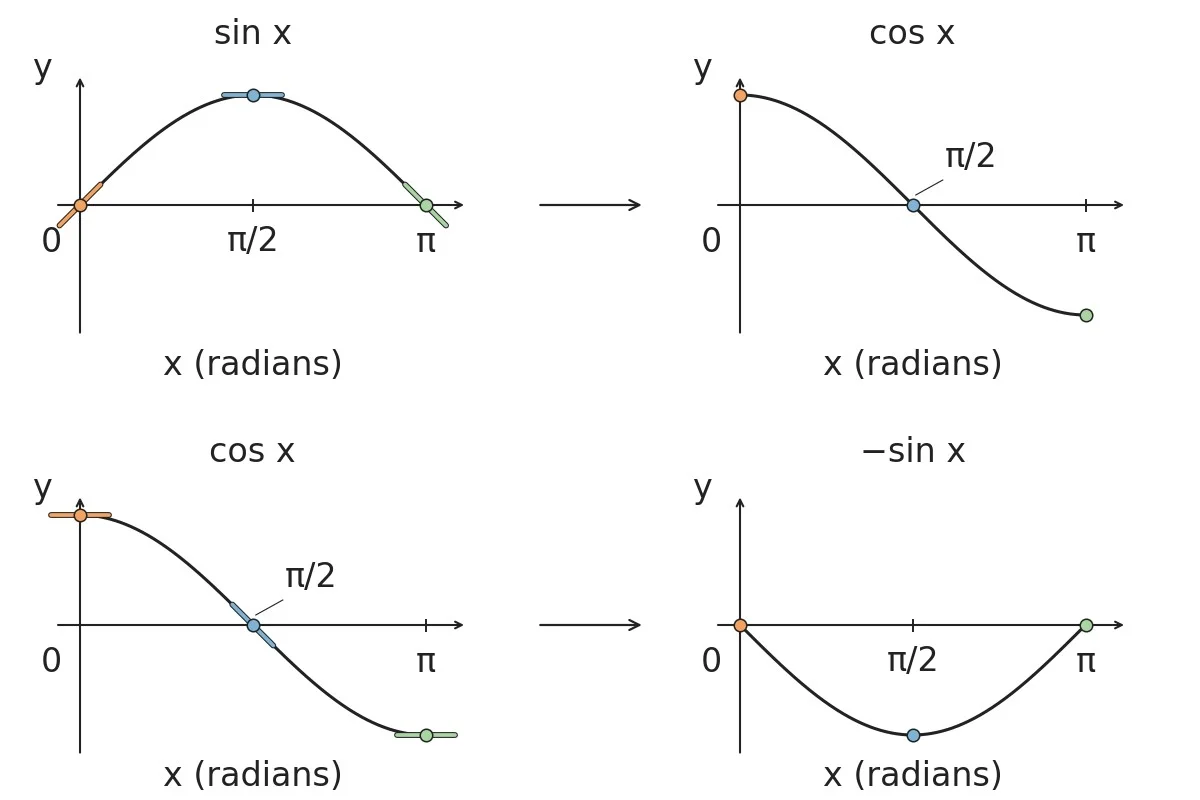
Sine and cosine tangents linked to corresponding values on their derivative graphs.

8. Derivatives of Trigonometric Functions

Sine and cosine have different rates, including cosine’s minus sign.

Show
Look at the diagram’s sine row, then its cosine row. Follow each tangent’s arrow to the matching derivative value. Find cosine’s falling tangent at half pi radians.
Ask
At half pi radians, what sign should cosine’s derivative have?
Say
It is negative because cosine is falling there.
Used in
Trigonometric derivatives help calculate the speeds of points on rotating wheels.
If your child says…“Cosine differentiates to positive sine.”
Ask
Would positive sine match the falling cosine tangent at half pi radians?
What’s true
Cosine’s derivative is minus sine when the angle is measured in radians.

A real problem

Newton’s work explained planetary motion.

Newton’s Principia appeared in 1687.

It resolved major problems about celestial motion.

It used methods involving ever-smaller changes that also helped Newton develop calculus.

Calculus describes how a moving object’s velocity changes with time.

Cambridge University LibraryKansas State UniversityOhio State University

Moon above a residential rooftop at dusk.

Concept Lab · Common misconception

The tempting mistake in Limits and Derivatives

Open standalone misconception page →

Must a limit equal the function value?

Wrong

If f(2) is undefined, the limit as x tends to 2 cannot exist.

Why it feels right. I try to substitute the point immediately.

Right

A limit depends on nearby values.

Worked example

The open point at (2, 4) represents the missing value. The graph approaches that height from both sides.
  1. For x ≠ 2, (x² − 4)/(x − 2) = x + 2.
  2. The limit is 4 even though the original formula is undefined at x = 2.

Ask your child eight quick questions.

One per step. The answer and the reason are given.

  1. What does the slope of this joining line represent?

    The interval’s average rate. Two separate inputs give an interval, rather than a single instant.

  2. What decides this limit: nearby outputs or the assigned value at zero?

    Nearby outputs. Both sides approach zero, despite the separate value assigned at zero.

  3. What must you check before dividing two finite limits?

    The denominator’s limit is nonzero. Division by zero cannot supply a value through this rule.

  4. What is this limit, despite the original fraction being undefined at one?

    Two. The simplified expression has identical nearby values and approaches two.

  5. What must happen to the two bounds before they force a single middle limit?

    They approach the same value. Different limiting bounds leave room for different behaviour between them.

  6. When can you substitute zero for h in these lines?

    After cancelling h. The remaining expression allows substitution without dividing by zero.

  7. What is the derivative of the product shown?

    2x+12x+1. The contributions are x plus one and x; adding gives twice x plus one.

  8. What is cosine’s derivative, with angles in radians?

    Minus sine. Between zero and pi, cosine falls and minus sine is negative.

15 more questions with answers, 3 with pictures