Skip to content

Teach Permutations and Combinations in eight steps.

For each idea: show it, ask before you tell, then say one line.

Gather paper, two different pens, two different pencils and two coins.

Common misconceptions & worked visual for this chapter · 15 practice questions with answers

How to teach it

Count choices

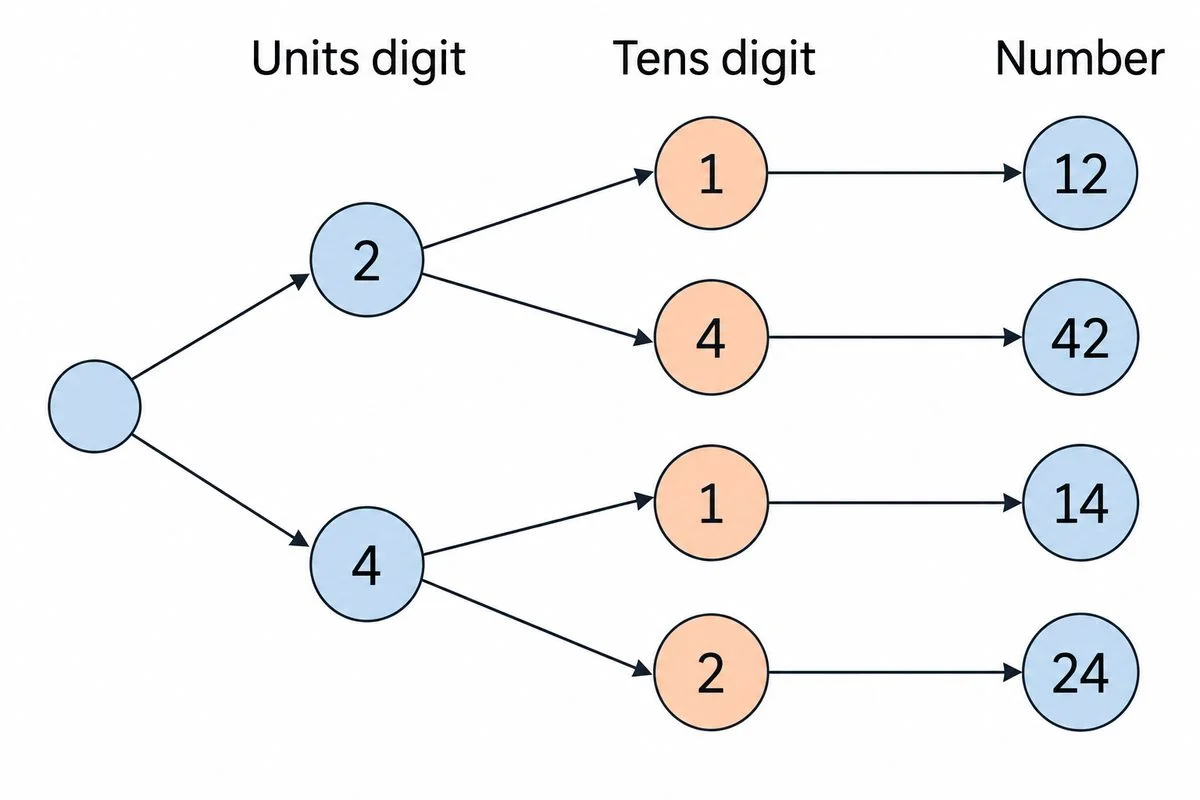
A branching tree counts even numbers from three digits without repetition.

1. Fundamental Principle of Counting

Multiply stage counts when every branch offers equally many next choices.

Show
Look at the diagram and cover the Number column. Follow each units digit to its tens choices. Use digits 1, 2 and 4 without repetition.
Ask
How many even two-digit numbers can these branches make?
Say
Four numbers: each even last digit leaves two choices for the first digit. Multiply because each branch has the same number of completions.
Used in
Counting outfit combinations helps a shop display the choices its clothes offer.
If your child says…“Two choices and two choices always make four by addition.”
Ask
If each last digit allowed three first digits, would adding still count every number?
What’s true
Multiply because each allowed last digit comes with its own complete set of first-digit choices.
Two coins side by side, one showing heads and the other tails.

2. Fundamental Principle of Counting

Multiply successive choice counts; add cases with no shared outcomes.

Show
Place two coins side by side. After predicting, turn them systematically to record HH, HT, TH and TT. Keep their left and right positions fixed.
Ask
Before recording, how many outcomes do you predict will have at most one head?
Say
Either face stays available at each position. Add the separate allowed cases: no heads gives one, and one head gives two, giving three outcomes.
Used in
Counting permitted code patterns helps designers compare how many codes a lock allows.
If your child says…“At most one head means exactly one head.”
Ask
Does TT have more than one head?
What’s true
At most includes smaller counts, while at least includes larger counts within the available total.

Count arrangements

4!=4×3×2×14!=4\times3\times2\times1

4P2=4!2!{}^4P_2=\dfrac{4!}{2!}

4P2=4×3×2!2!{}^4P_2=\dfrac{4\times3\times2!}{2!}

3. Permutations when all the objects are distinct; Factorial notation

Permutations count orders; factorial multiplies whole numbers down to one.

Show
Write these lines. Say, “Four P two counts ordered pairs; the exclamation mark means factorial.”
Ask
How many first-and-second-place results can four runners produce without ties?
Say
There are twelve results: four choices for first leave three for second.
Used in
Counting running orders helps organisers compare possible performance schedules.
If your child says…“Zero factorial must be zero.”
Ask
How many different arrangements remain when no positions need filling?
What’s true
Zero factorial is one because leaving every position empty gives one empty arrangement.
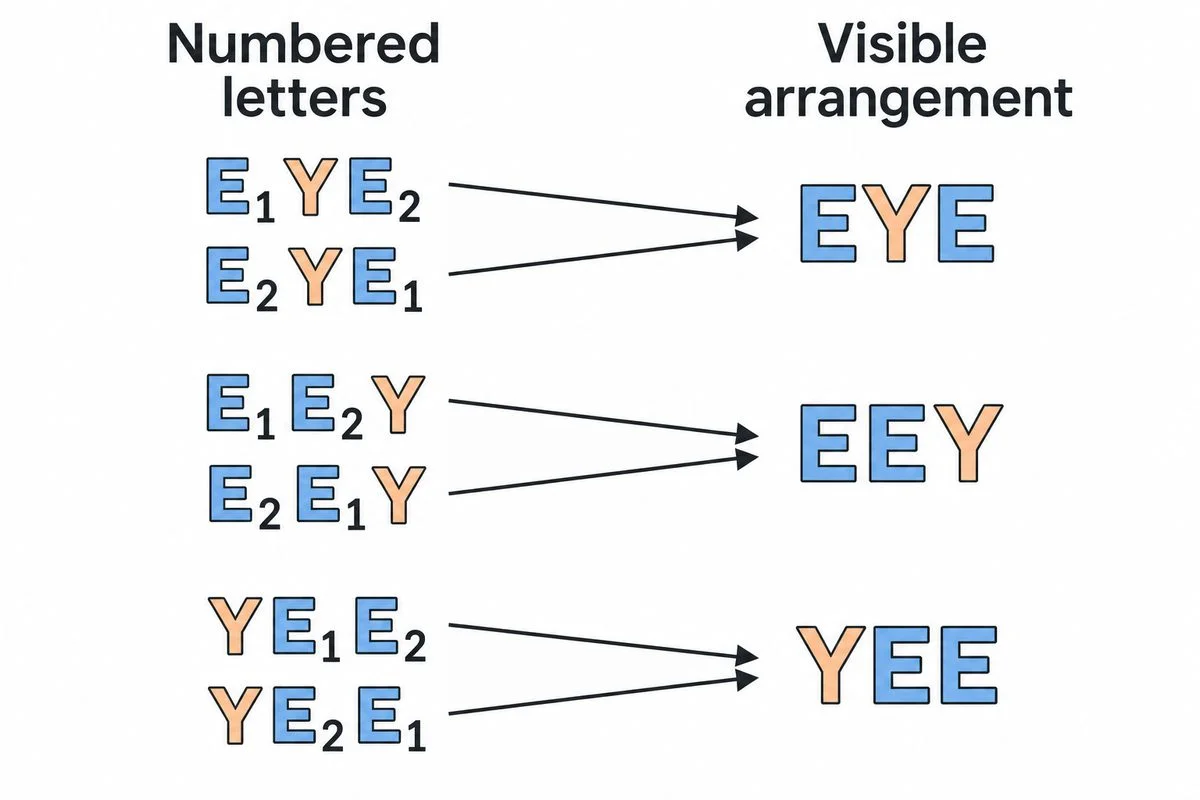
Six numbered arrangements merge into three visibly different arrangements of EYE.

4. Permutations when all the objects are not distinct

Remove duplicate orders caused by identical objects.

Show
Look at the diagram and cover the Visible arrangement column. Compare the numbered Es in each pair. After predicting, uncover the column and follow the arrows.
Ask
How many visibly different arrangements remain when the E numbers disappear?
Say
Three arrangements remain because each appears twice when the Es are numbered.
Used in
Counting repeated letters accurately prevents duplicate entries in word-arrangement puzzles.
If your child says…“Swapping the Es makes another arrangement.”
Ask
Without their numbers, how could you tell the exchanged Es apart?
What’s true
The two Es look identical, so their exchange produces no new letter arrangement.

nP3=6 nP1{}^nP_3=6\,{}^nP_1

n(n−1)(n−2)=6nn(n-1)(n-2)=6n

(n−1)(n−2)=6(n-1)(n-2)=6

(n−4)(n+1)=0(n-4)(n+1)=0

5. Permutations

Expand arrangement counts, cancel shared factors, then check possible counts.

Show
Write these lines. Say, “n counts objects, at least three; n P three counts ordered triples.”
Ask
Which number of available objects fits this relationship?
Say
Four objects fit. The other root, negative one, cannot count available objects.
Used in
An arrangement count can reveal how many distinct items were available.
If your child says…“Both roots answer the counting problem.”
Ask
Could negative one objects supply the three positions?
What’s true
An algebraic root must also satisfy the original limits on available and chosen objects.
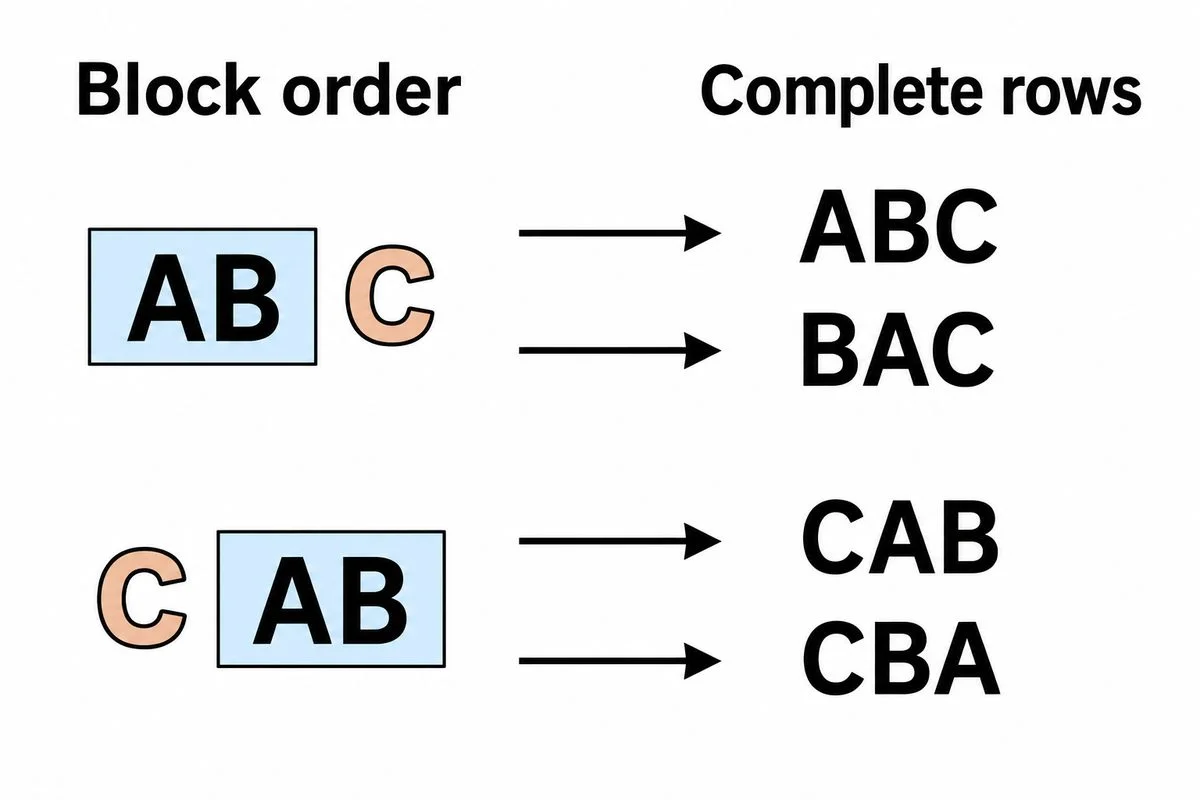
Two block positions each lead to two rows keeping A and B together.

6. Permutations

Keep required neighbours together, then count their internal orders.

Show
Look at the diagram and cover the Complete rows column. Find the AB block before C, then after C. After predicting, uncover the complete rows.
Ask
How many rows of A, B and C keep A and B together?
Say
There are four rows: each block position allows two orders inside the block.
Used in
Counting neighbouring seats helps organisers keep companions together.
If your child says…“The pair counts as one thing, so its inside order never matters.”
Ask
Does swapping A and B change the row while keeping them together?
What’s true
Keeping objects together still allows their internal order to change.

Count selections

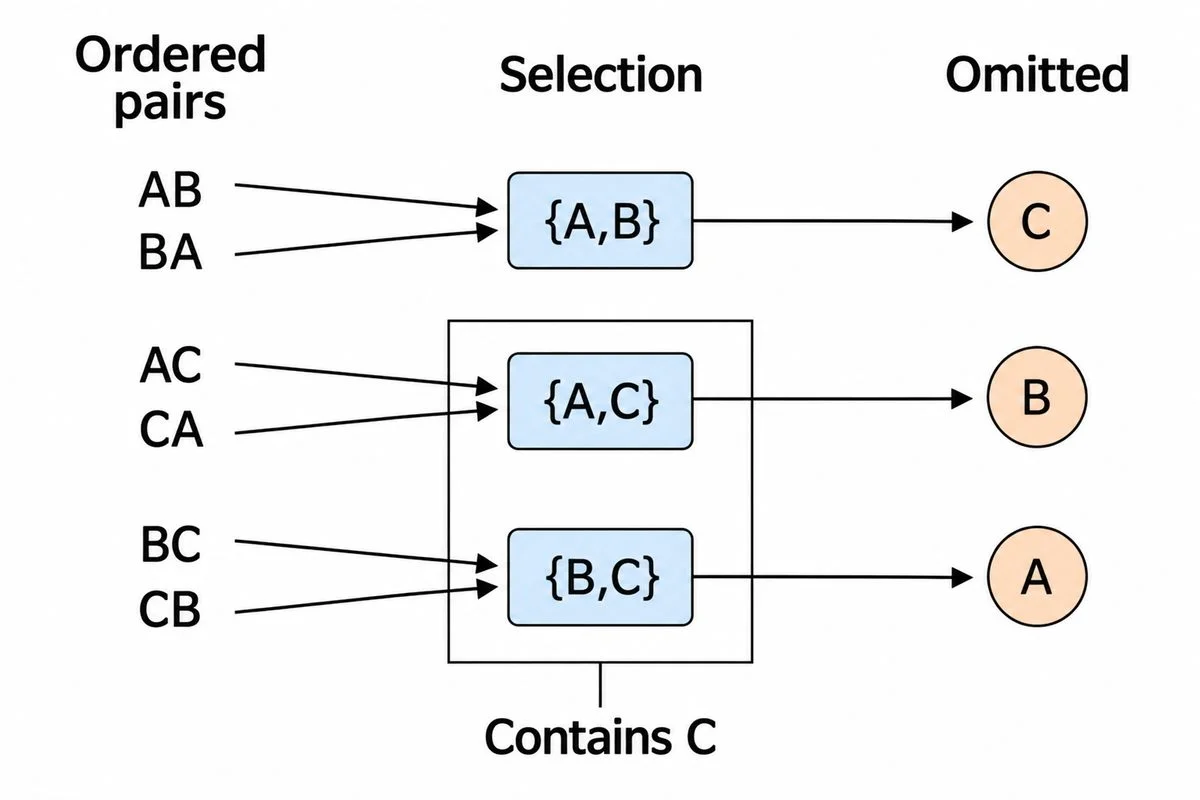
Reversed pairs merge into selections, each matched to its omitted letter.

7. Combinations

Count groups once, regardless of picking order.

Show
Cover the diagram’s last two columns. Compare reversed pairs, then uncover the selections and omitted letters.
Ask
How many groups remain when reversing a pair gives the same members?
Say
Three groups remain: each was counted twice. Each pair identifies one omitted letter. Pairs containing C and pairs without C together give every selection.
Used in
Counting teams this way avoids counting reordered member lists again.
If your child says…“Different group sizes can never give equal selection counts.”
Ask
Does every chosen pair identify exactly one object left behind?
What’s true
From the same pool, equal selection counts require equal sizes or sizes totalling the pool.
Two different pens and two different pencils beside an empty area.

8. Combinations

Multiply required selections, then multiply their orders when positions matter.

Show
Set out two different pens and two different pencils. After predicting, pair each pen with each pencil. Reverse each selected pair to make its other desk row.
Ask
How many desk rows can contain one pen and one pencil?
Say
Two pen choices each match two pencil choices, giving four selections. Each selection has two orders, giving eight rows.
Used in
Separate selection counts help form committees with the required membership from each group.
If your child says…“Choosing the pair already counts every row.”
Ask
Does putting the pencil first give the same row as putting the pen first?
What’s true
Each selected pair makes two rows because exchanging its objects changes their positions.

A real problem

The Bombe helped find secret code settings.

The first Bombe, called Victory, became operational at Bletley Park in March 1940.

Possible wheel orders formed part of the codebreaking calculation.

The Bombe sought daily secret settings needed to decipher intercepted messages.

Welchman’s diagonal board reduced the work needed to break the code.

The National Museum of ComputingThe National Museum of ComputingCrypto Museum

An unbranded combination padlock with rotating wheels.

Concept Lab · Common misconception

The tempting mistake in Permutations and Combinations

Open standalone misconception page →

When does order count?

Wrong

Choosing A then B is always different from choosing B then A.

Why it feels right. The two selection sequences are different.

Right

Order matters only when the outcome distinguishes positions.

Worked example

Committee
AB
President / vice president
AB
BA
A and B make one committee either way. Changing the assignment of two distinct offices creates a second result.
  1. For a two-person committee, AB and BA name the same group.
  2. For president and vice president, reversing the order changes the result.

Ask your child eight quick questions.

One per step. The answer and the reason are given.

  1. Two possible last digits each allow three first digits. How many numbers does that give?

    Six. Each last digit has three completions, so multiply instead of adding.

  2. How many outcomes of these two coins have at most one head?

    Three. TT, HT and TH each qualify.

  3. What is five factorial divided by zero factorial?

    120. Zero factorial equals one, so division leaves five factorial unchanged.

  4. For AAAABB, which repeat counts need factorial divisors?

    Both four and two. Swapping identical As or identical Bs leaves the arrangement unchanged.

  5. Which root must be rejected here?

    Negative one. The original count needs a whole number of objects at least three.

  6. How many rows of A, B and C keep A and B apart?

    Two. Remove the four together rows once from the six possible rows.

  7. Choosing nine or eight from the same pool gives equal counts. How large is the pool?

    Seventeen. The unequal group sizes must be complementary, so they add to seventeen.

  8. Four pen-and-pencil selections are ready. How many ordered rows do they make?

    Eight. Each selection produces two different orders.

15 more questions with answers, 1 with pictures