Skip to content

Teach Straight Lines in eight steps.

For each idea: show it, ask before you tell, then say one line.

Gather paper and a pencil.

Common misconceptions & worked visual for this chapter · 15 practice questions with answers

How to teach it

Measure position and direction

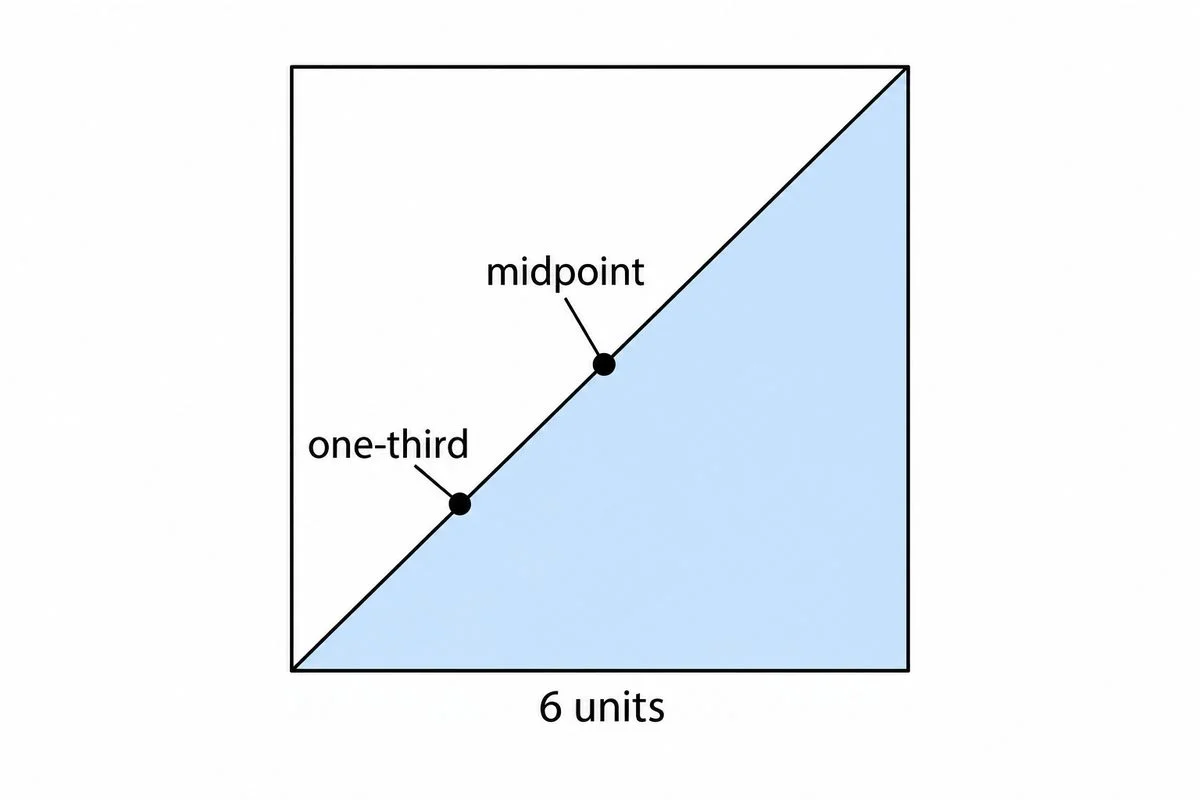
Diagram of a square with diagonal dividing points and one shaded triangular half.

1. Distance formula, section formula, mid-point formula and area of a triangle

Coordinates give lengths, dividing points and areas.

Show
Find the square’s six-unit sides and diagonal in the diagram. Find the diagonal’s dividing points and the shaded half. Use Pythagoras to find the diagonal’s length.
Ask
What area would three diagonal points enclose?
Say
The diagonal measures 626\sqrt{2} units; half the square covers 18 square units. Collinear points enclose zero area.
Used in
Plot areas help estimate paving needs.
If your child says…“Zero area means all the points are the same point.”
Ask
Do the separate points spread away from their shared straight line?
What’s true
Separate points can enclose zero area when they lie along one straight line.
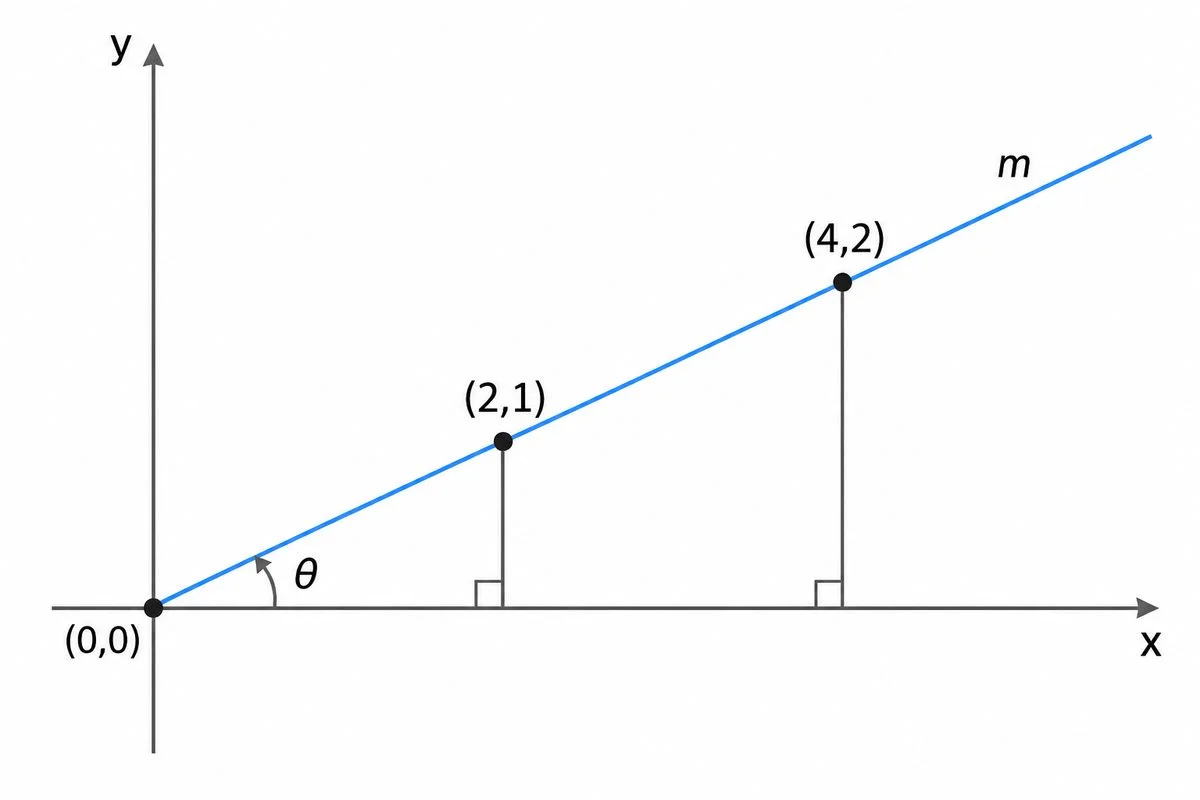
Diagram of a rising line, two right triangles and its marked inclination.

2. Inclination and slope of a line

Slope compares vertical change with horizontal change.

Show
Find the two right triangles sharing the origin in the diagram. Compare their vertical and horizontal changes. Call the marked inclination theta and the slope m.
Ask
What slope will the larger triangle give?
Say
Both give one-half: divide vertical change by horizontal change. This is inclination’s tangent: m=tan⁡θm=\tan\theta.
Used in
Road gradients help planners choose manageable climbs.
If your child says…“An upright line has zero slope.”
Ask
What would you divide by when there is no horizontal change?
What’s true
An upright line has undefined slope because its horizontal change is zero.
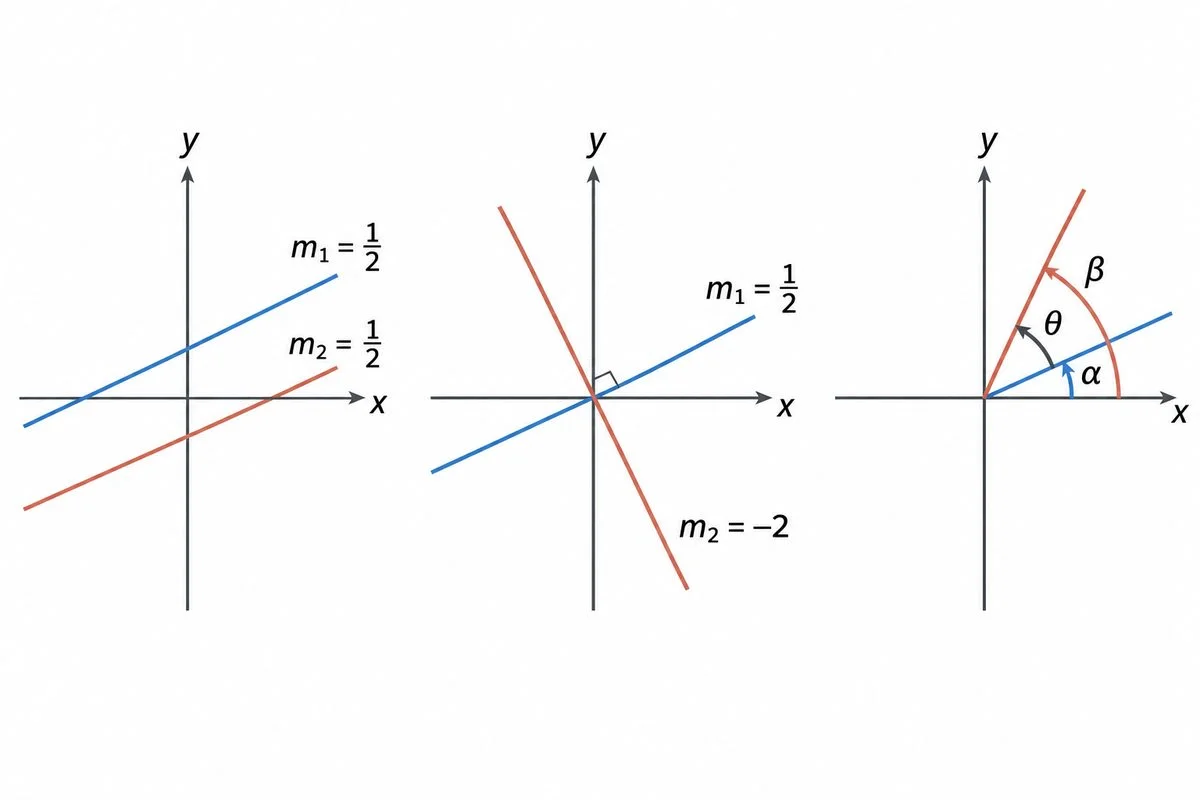
Three panels compare parallel directions, perpendicular directions and the angle between intersecting lines.

3. Conditions for parallelism and perpendicularity; angle between two lines

Slopes compare directions.

Show
Compare the diagram’s panels. Name slopes m-one and m-two, and the smaller angle theta.
Ask
What gives the right-hand angle from the inclinations?
Say
Subtract the inclinations: tan⁡θ=∣m2−m11+m1m2∣\tan\theta=\left|\frac{m_2-m_1}{1+m_1m_2}\right|.
Used in
Right angles help rectangular frames fit.
If your child says…“For a right angle, I only change the slope’s sign.”
Ask
In the centre, does changing only one-half’s sign give the falling line’s slope?
What’s true
A quarter-turn exchanges horizontal and vertical changes and reverses one sign.

Write equations for lines

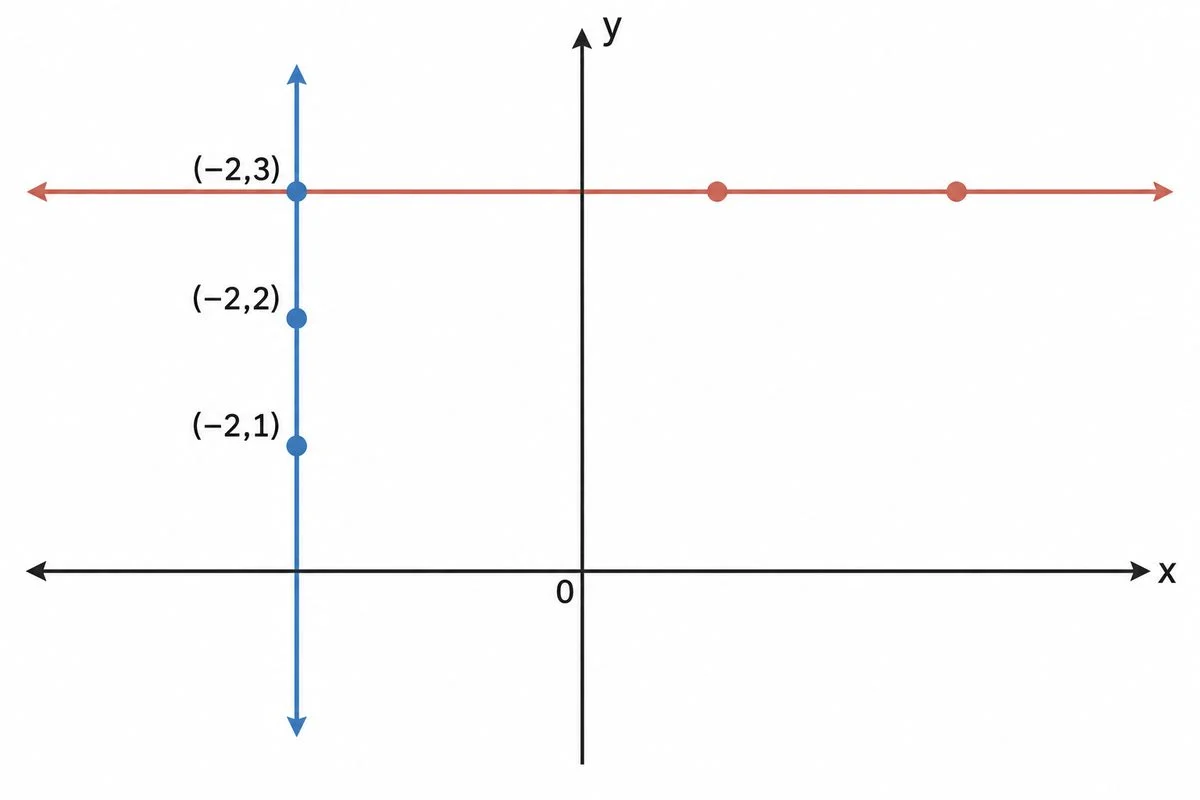
Diagram of an upright line and a horizontal row crossing at (−2,3).

4. Equations of horizontal and vertical lines

Fixing one coordinate leaves a horizontal or vertical line.

Show
Find the three points with x-coordinate minus two in the diagram. Follow the horizontal row through (−2,3). Notice which coordinate stays fixed along each line.
Ask
Which coordinate will stay unchanged as you move along each line?
Say
The upright line keeps x at −2. The horizontal line keeps y at 3.
Used in
A drawing grid locates an entire row with one fixed height.
If your child says…“An equation containing y describes an upright line.”
Ask
Can you move upwards while keeping the same height?
What’s true
The equation names the fixed coordinate, while movement changes the other coordinate.

y−1=5−13−1(x−1)y-1=\frac{5-1}{3-1}(x-1)

y−1=2(x−1)y-1=2(x-1)

5. Point-slope form and two-point form

A point and slope fix a nonvertical line.

Show
Write these lines. Say: “Use (1,1) and (3,5); x and y describe any point.”
Ask
What equation follows when you isolate y?
Say
The equation is y equals twice x minus one. Both forms use vertical change divided by horizontal change.
Used in
Survey drawings extend boundaries from known positions and directions.
If your child says…“I must replace every x and y with the given coordinates.”
Ask
How would an equation without variables describe the other points?
What’s true
The finished equation keeps variables so it describes every point along the line.

x6+y3=1\frac{x}{6}+\frac{y}{3}=1

x+2y=6x+2y=6

x+2y−6=0x+2y-6=0

6. Slope-intercept form, intercept form and general equation of a line

Forms reveal slopes and crossings.

Show
Write these lines. Say: “The crossings are (6,0) and (0,3); x and y are coordinates.”
Ask
What equation follows when you isolate y?
Say
It gives y equals minus half x plus three. The slope is minus one-half; the y-intercept is three.
Used in
Cost graphs separate fixed and per-item charges.
If your child says…“The x-intercept is the number added at the end.”
Ask
At the x-axis crossing, what must y become?
What’s true
The added constant in slope-intercept form gives the y-axis crossing.

Find distances and shared points

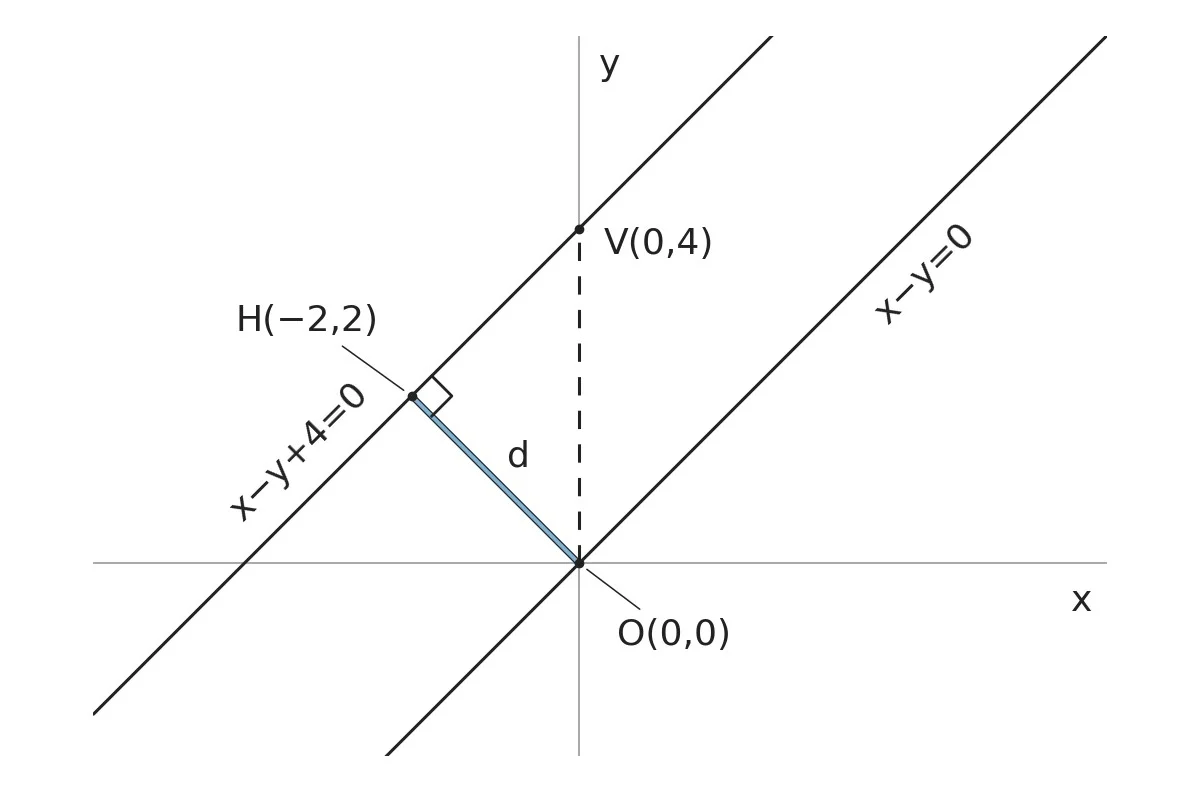
Parallel rising lines with a vertical connector and a shorter perpendicular connector from the origin.

7. Distance of a point from a line; distance between parallel lines

The shortest gap is perpendicular.

Show
In the diagram, compare OV and OH. Call the distance d.
Ask
Which connector gives the shortest distance?
Say
OH gives both distances because it is perpendicular.
Used in
Perpendicular measurements give the width between parallel borders.
If your child says…“The gap between the y-axis crossings is the distance between the lines.”
Ask
Which measured route is shorter: the vertical connector or the perpendicular connector?
What’s true
The vertical gap equals the shortest gap only when the parallel lines are horizontal.
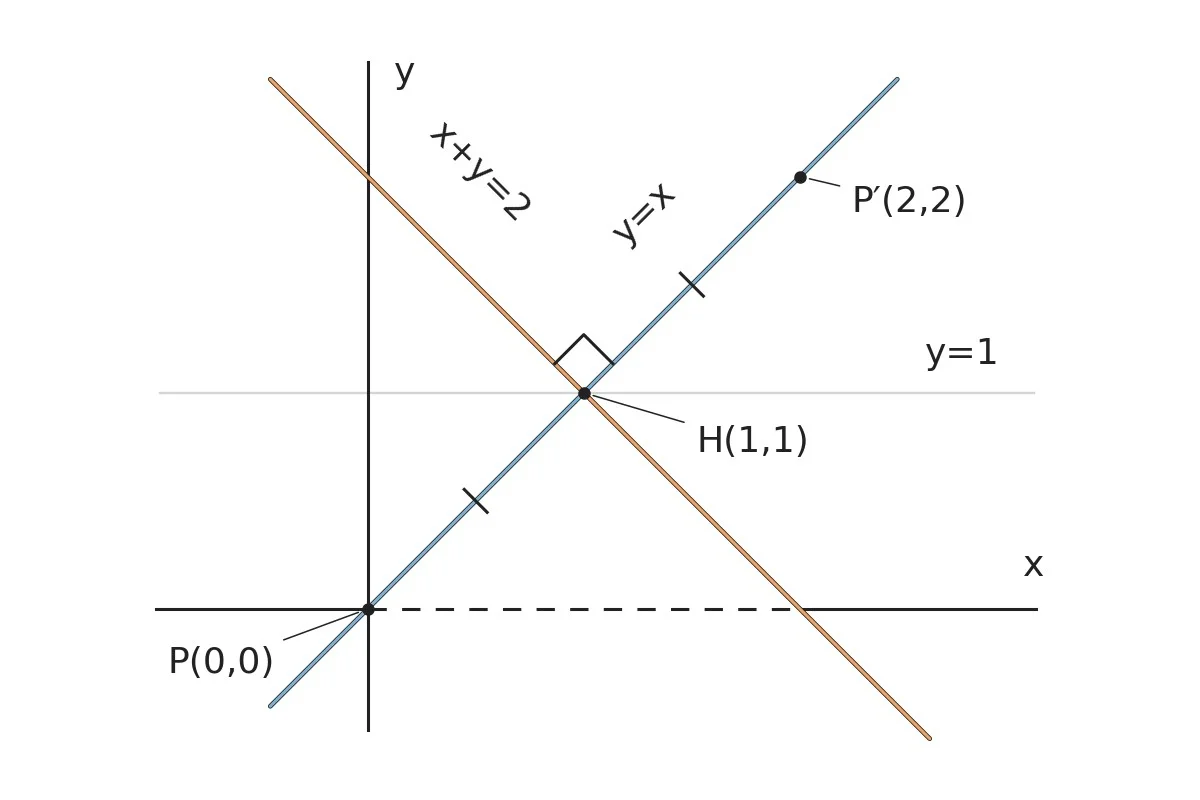
Three lines meet at the perpendicular foot, halfway between a point and its reflection.

8. Point of intersection, concurrency, foot of perpendicular and image of a point

The perpendicular foot is the intersection; the image lies equally far beyond.

Show
In the diagram, follow P through H to P′.
Ask
Where is P’s image?
Say
It is (2,2), equally far beyond perpendicular foot H.
Used in
Reflected positions help check visibility when placing mirrors.
If your child says…“The mirror image stops where the perpendicular reaches the mirror.”
Ask
If the image stopped at H, would the mirror halve the joining segment?
What’s true
The image lies equally far beyond the mirror line along the perpendicular.

A real problem

Loops and zigzags make the railway’s climb less steep.

The Darjeeling Himalayan Railway opened in 1881.

Steep Himalayan slopes made construction difficult.

Loops and zigzags let trains gain height without climbing such steep gradients.

UNESCODarjeeling Himalayan Railway SocietyGoogle Arts & Culture

Passenger train on a railway zigzag across a hillside.

Concept Lab · Common misconception

The tempting mistake in Straight Lines

Open standalone misconception page →

Is the slope of a vertical line zero?

Wrong

A vertical line has slope 0 because there is no horizontal change.

Why it feels right. I remember that zero change can produce zero slope and use the run in place of the rise.

Right

Slope is rise divided by run. A vertical line has zero run, so its slope is undefined.

Worked example

Vertical line: run is zero. Horizontal line: rise is zero.
  1. On x = 2, going from (2, 1) to (2, 5) gives 4 ÷ 0, which is undefined.
  2. On y = 2, going from (1, 2) to (5, 2) gives 0 ÷ 4 = 0.

Ask your child eight quick questions.

One per step. The answer and the reason are given.

  1. What area do three separate points on the diagonal enclose?

    Zero square units. Their separation gives length but no width.

  2. What slope does an upright line have?

    Undefined. Its horizontal change is zero, so the required division is undefined.

  3. What slope meets a line of slope one-half at a right angle?

    −2. The slopes must multiply to −1, so changing only the sign is insufficient.

  4. Which direction does the line y=3y=3 run?

    Horizontally. Every point has the same height, while its horizontal position can change.

  5. Which letters remain variable in the finished line equation?

    x and y. They describe any point on the line, not just the given point.

  6. Which axis does this line cross at 3?

    The y-axis. Setting x to zero leaves y equal to 3.

  7. What is the shortest gap between these two lines?

    222\sqrt{2} units. The perpendicular connector is shorter than the four-unit vertical connector.

  8. Across this mirror line, where is the origin’s image?

    (2,2). The mirror line halves the perpendicular segment joining the origin and its image.

15 more questions with answers, 11 with pictures