Skip to content

Teach Introduction to Three Dimensional Geometry in eight steps.

For each idea: show it, ask before you tell, then say one line.

Gather paper and a pencil.

Common misconceptions & worked visual for this chapter · 15 practice questions with answers

How to teach it

Locating points

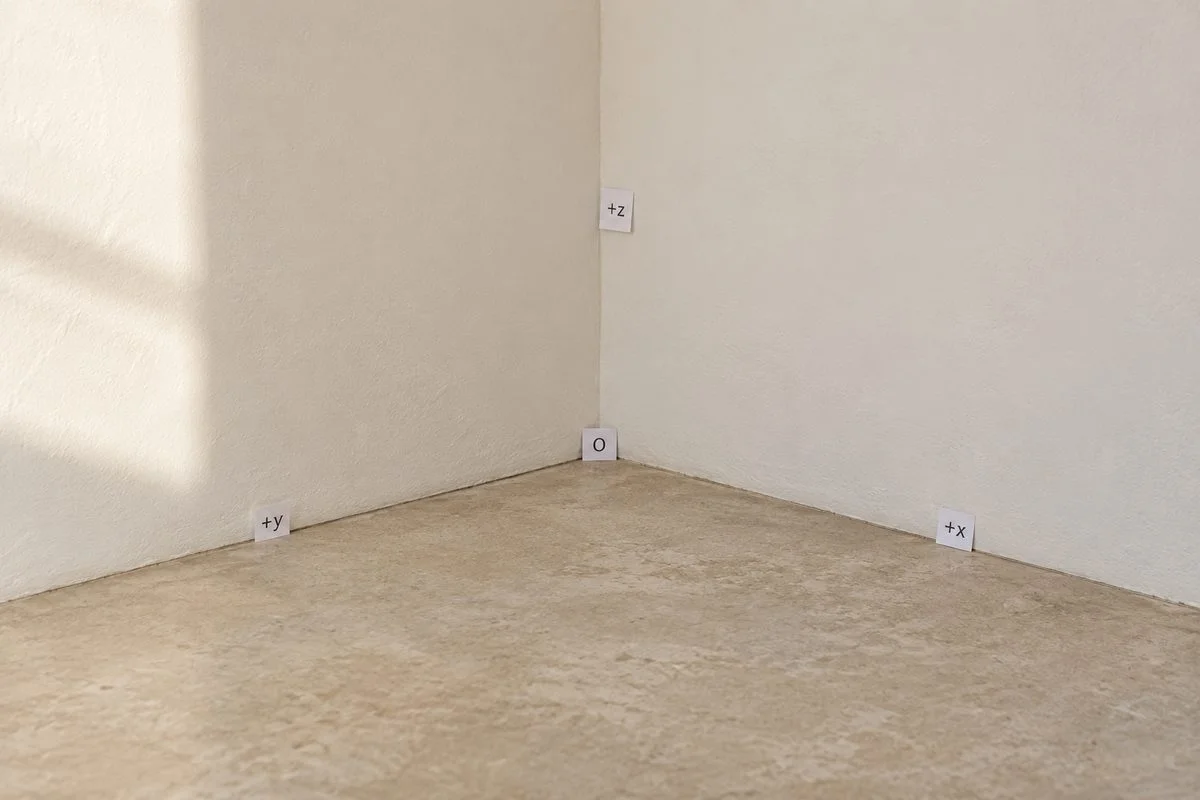
Floor and two walls meeting at a room corner.

1. Coordinate axes and coordinate planes

Axes meet at the origin; pairs of axes name planes.

Show
Label a room corner O. Label its floor edges +x and +y, and its upright edge +z. Trace the floor, then each wall.
Ask
What name will the wall containing y and z have?
Say
Call it the YZ-plane because y and z run along it.
Used in
Building plans use perpendicular directions to place walls and floors accurately.
If your child says…“A plane takes the name of the axis sticking out.”
Ask
Does z run along the floor or stick out from it?
What’s true
The plane's name comes from the axes running along its surface.
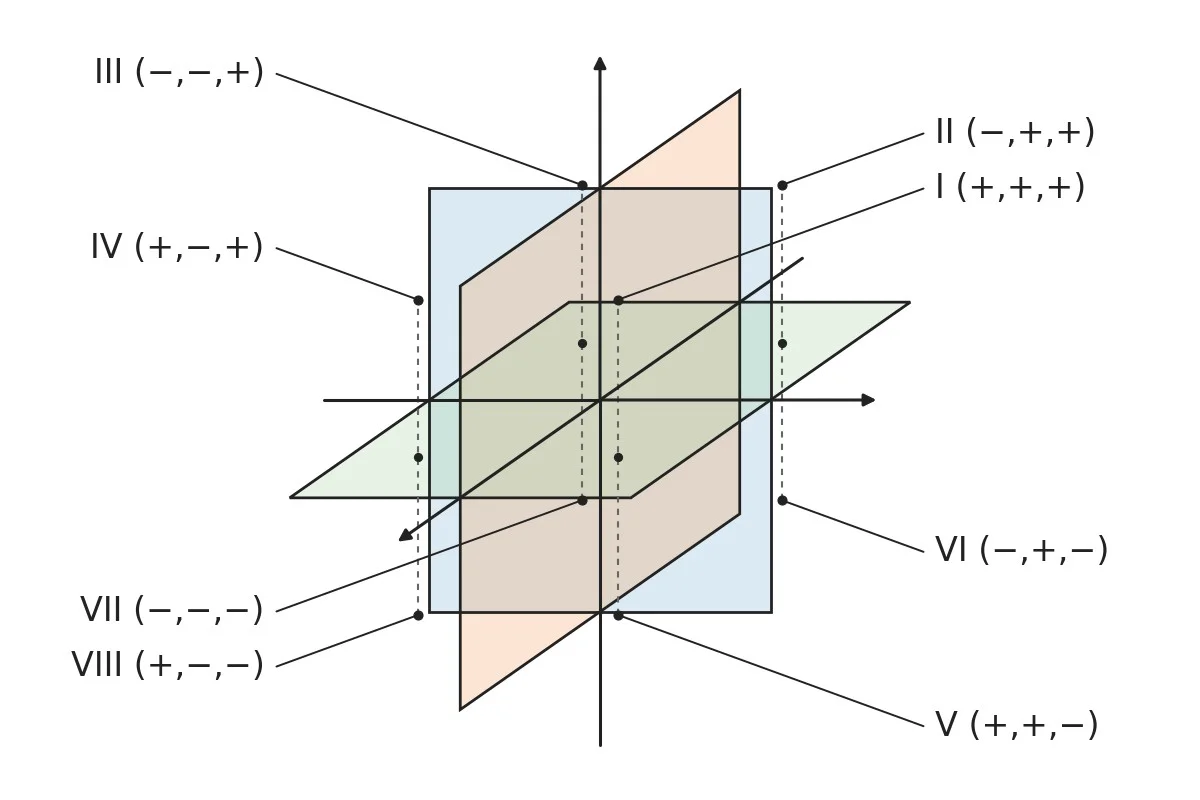
Three coordinate planes divide space into eight octants labelled with their coordinate signs.

2. Octants

Three coordinate planes divide space into eight regions.

Show
Look at the diagram's four regions above the horizontal XY-plane and four below. Find II and compare its signs with VI.
Ask
Which coordinate changes sign when a point crosses from II into VI?
Say
Only z changes sign because the point crosses the XY-plane. The other signs stay unchanged.
Used in
Computer models use coordinate signs to distinguish positions on opposite sides of reference planes.
If your child says…“Negative x tells me the octant.”
Ask
Both II and VI have negative x, so which sign distinguishes them?
What’s true
An octant needs the signs of x, y and z together.
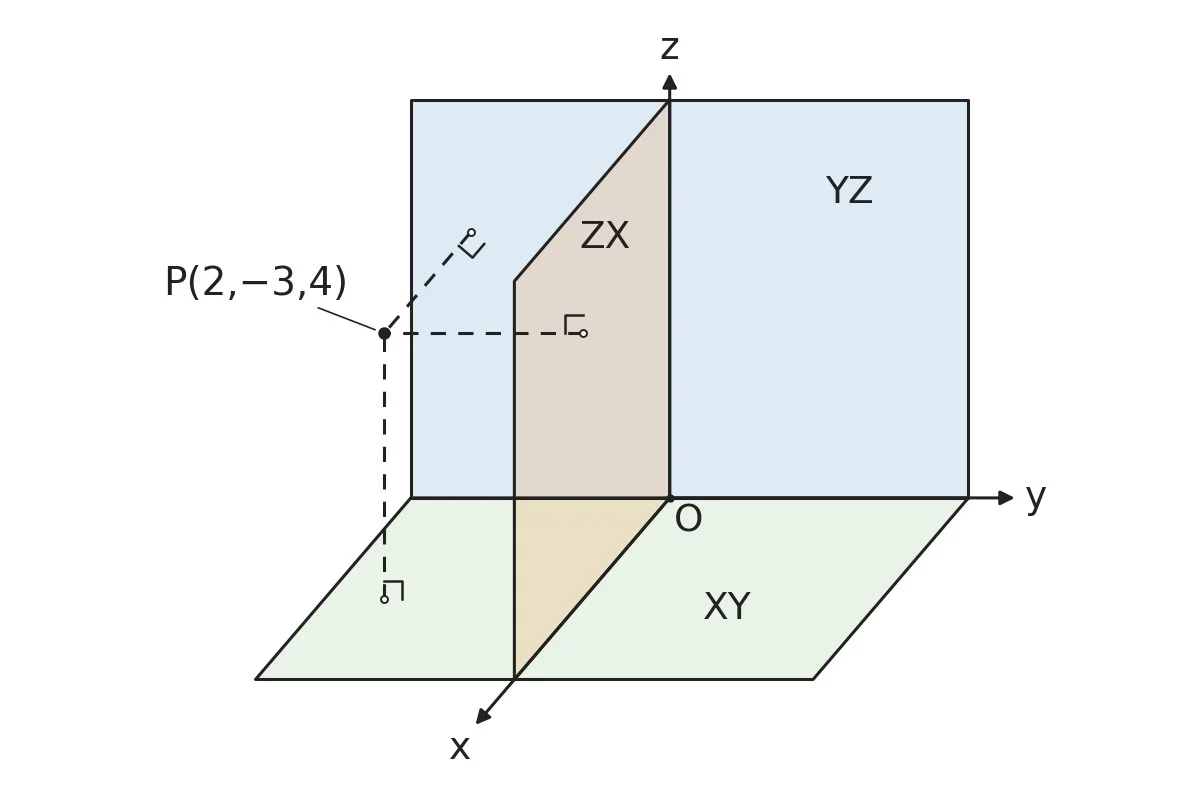
Point P with perpendicular segments to three coordinate planes and right angles at their feet.

3. Coordinates of a point in space

Coordinates record perpendicular distances from planes, with signs showing sides.

Show
Follow P's perpendiculars to YZ, ZX and XY in the diagram.
Ask
How far is P from each plane?
Say
The distances are 2, 3 and 4 units. The feet are (0,−3,4), (2,0,4) and (2,−3,0).
Used in
Survey measurements locate a building point relative to reference planes, including its height.
If your child says…“Reaching an axis makes just one coordinate zero.”
Ask
On the x-axis, what distances remain from the XY- and ZX-planes?
What’s true
An axis requires both coordinates belonging to the other axes to be zero.

Measuring and identifying shapes

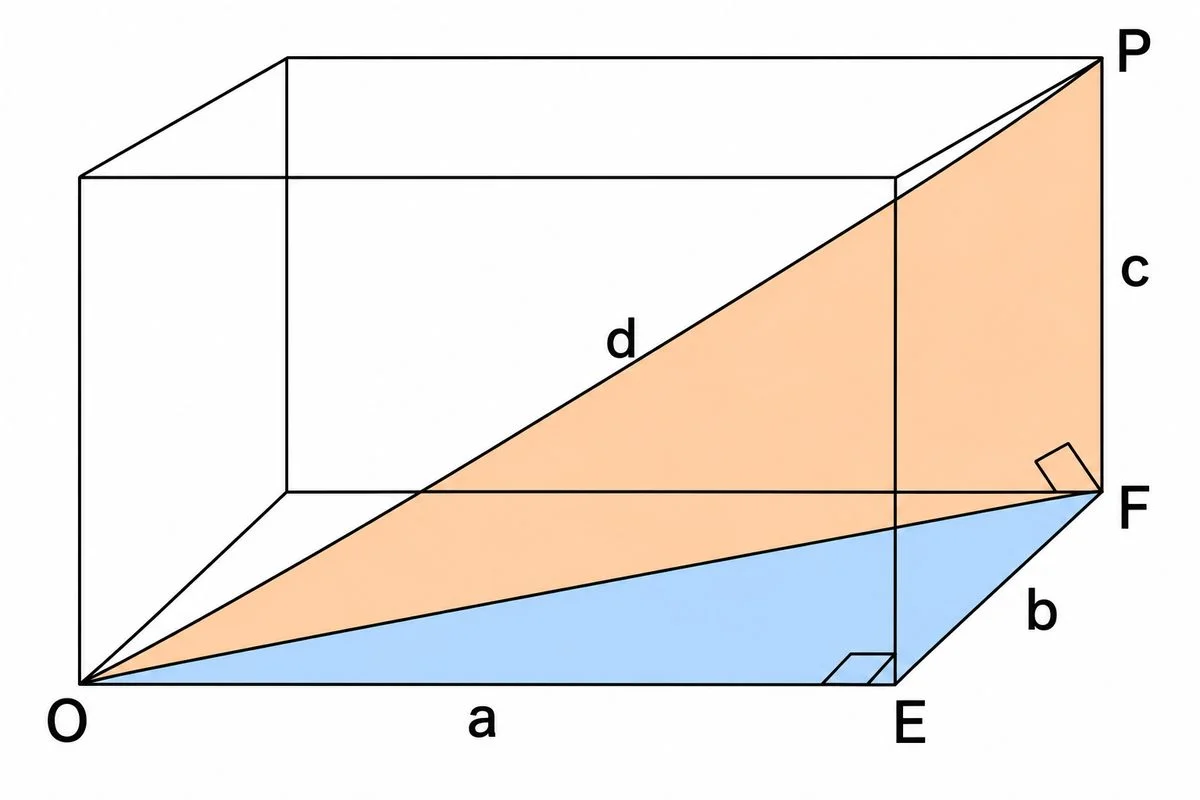
A rectangular prism shows two right triangles linking perpendicular edge gaps to its space diagonal.

4. Distance between two points

Straight distance combines all three perpendicular coordinate gaps.

Show
Look at the diagram. Trace triangles OEF and OFP, noting their right angles. Read a, b and c as perpendicular coordinate gaps, and d as the straight distance.
Ask
What expression for d will these two right triangles give?
Say
Pythagoras adds the base-edge squares, then the height square. Take the square root to get the straight distance: d=a2+b2+c2d=\sqrt{a^2+b^2+c^2}.
Used in
Packing uses a box's inside diagonal to check whether a straight object fits.
If your child says…“I add the three gaps to get the distance.”
Ask
Does OP follow the edges through E and F?
What’s true
Adding edge lengths measures a bent route rather than the straight connection.

PR=22+22+22PR=\sqrt{2^2+2^2+2^2}

PR=23PR=2\sqrt{3}

PR=3+3PR=\sqrt{3}+\sqrt{3}

5. Applications of the distance formula: collinearity

Lengths test straightness; squared lengths test a right angle.

Show
Write these lines for P(0,0,0), Q(1,1,1) and R(2,2,2). Say: “PQ and QR each measure the square root of three.”
Ask
What comes next when you replace those two lengths with their segment names?
Say
The lengths add without a bend: PR=PQ+QRPR=PQ+QR.
Used in
Surveyors compare distances to check whether boundary markers lie along one straight line.
If your child says…“Adding squared lengths tests whether points are collinear.”
Ask
Along a straight ruler, do lengths add or do their squares add?
What’s true
Collinearity needs lengths themselves to add; the square test checks a right angle.
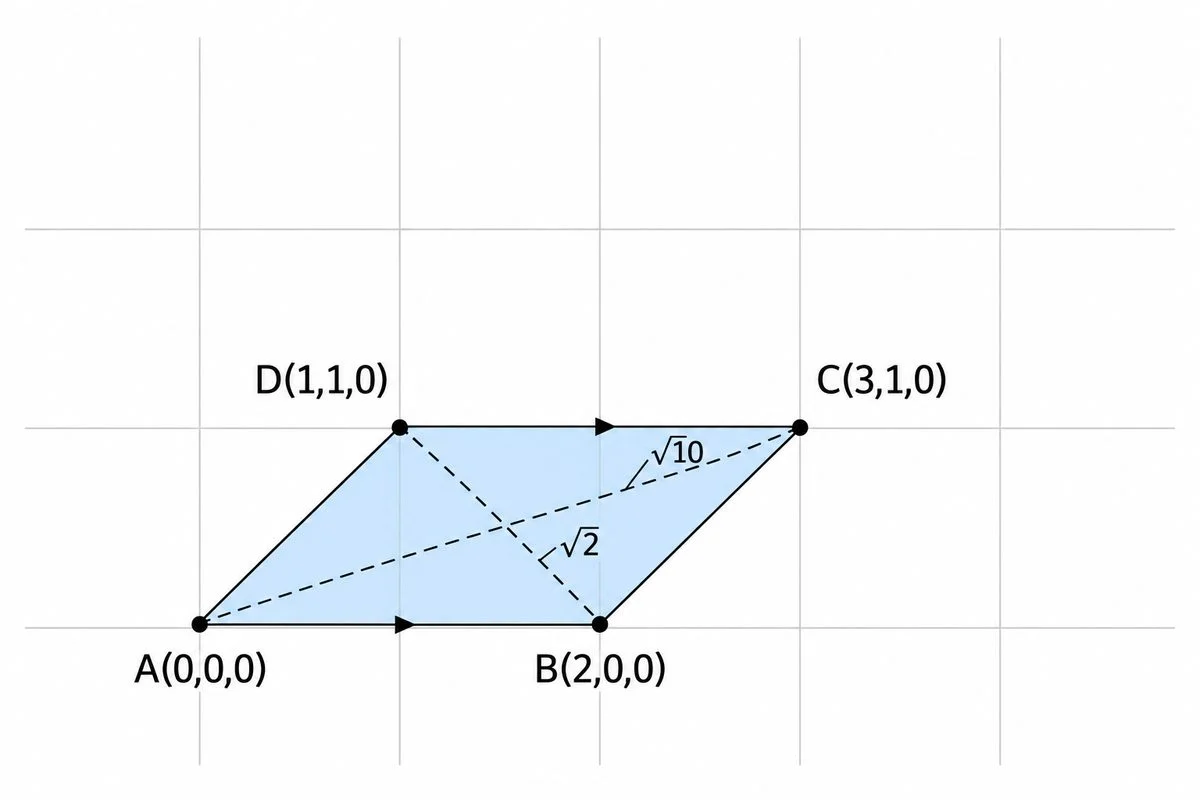
Labelled parallelogram on a square grid with matching side arrows and unequal diagonals.

6. Applications of the distance formula: parallelogram

Repeated moves find corners; side and diagonal lengths identify shapes.

Show
Find A, B, C and D in the diagram. Compare the moves from A to B and D to C. Then compare the diagonals.
Ask
With diagonals measuring 10\sqrt{10} and 2\sqrt{2}, will this parallelogram be a rectangle?
Say
Repeating the move gives C=B+D−AC=B+D-A. No, because equal diagonals would make this parallelogram a rectangle.
Used in
Checking a rectangular frame's diagonals helps builders detect a slant.
If your child says…“Equal opposite sides make it a rectangle.”
Ask
Are this shape's diagonals equal?
What’s true
For a simple quadrilateral in one plane, equal opposite sides establish only a parallelogram.

Finding points from conditions

PA2=PB2PA^2=PB^2

(x+1)2+y2+z2=(x−1)2+y2+z2(x+1)^2+y^2+z^2=(x-1)^2+y^2+z^2

4x=04x=0

7. Equation of a set of points

A distance condition can describe a whole plane of positions.

Show
Write these lines for A(−1,0,0), B(1,0,0) and P(x,y,z). Say: “PA and PB are distances.”
Ask
What equation describes all these equally distant positions?
Say
Dividing by four gives x as zero.
Used in
Equidistant positions help planners locate a facility equally far from two fixed sites.
If your child says…“Equal distances from two points make a sphere.”
Ask
Can P move along the YZ-plane while remaining equally far from A and B?
What’s true
A sphere fixes distance from one centre; here, the equal distances can vary.
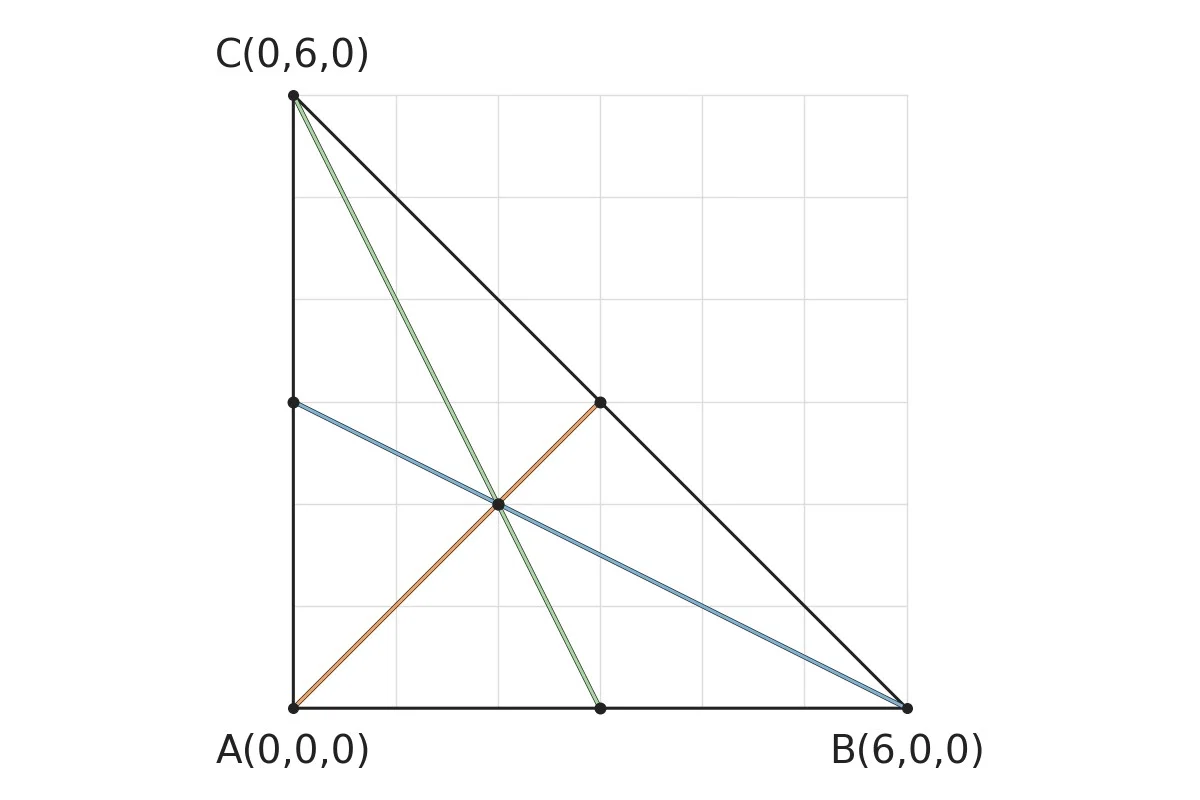
Labelled triangle on a square grid with three medians meeting inside.

8. Centroid of a triangle

The medians meet where each coordinate averages all three vertices.

Show
Find the three vertices and their opposite midpoints in the diagram. Trace the medians to where they meet.
Ask
What coordinates will you get by averaging the vertices, and where will that point lie?
Say
Averaging gives (2,2,0), where the medians meet.
Used in
Designers use centroids to position supports under uniform triangular panels.
If your child says…“The centroid is halfway between two vertices.”
Ask
Do all the medians meet at AB's midpoint?
What’s true
Every vertex contributes equally to the centroid's x-, y- and z-coordinates.

A real problem

GAGAN was designed to guide aircraft towards precise runway landings.

GAGAN was launched in 2015.

It corrects distortions in GPS signals used to locate aircraft.

A measured satellite distance places the receiver on a sphere. That distance is the sphere's radius.

The New Indian ExpressNDTVEuropean Space Agency

Unbranded passenger aircraft approaching a runway with landing gear extended.

Concept Lab · Common misconception

The tempting mistake in Introduction to Three Dimensional Geometry

Open standalone misconception page →

Is the xy-plane where x and y are zero?

Wrong

The xy-plane is defined by x = y = 0.

Why it feels right. Its name seems to tell me which coordinates vanish.

Right

The xy-plane has z = 0.

Worked example

The marked point is in the xy-plane, where z = 0. The vertical z-axis has x = y = 0.
  1. The point (2, 3, 0) lies on the xy-plane.
  2. Points with x = y = 0 lie on the z-axis.

Ask your child eight quick questions.

One per step. The answer and the reason are given.

  1. Which axis stands perpendicular to the XY-plane?

    The z-axis. The x- and y-axes run along that plane.

  2. Which octant has negative x, positive y and negative z?

    Octant VI. It lies below octant II, so only the z-sign changes.

  3. Where does the perpendicular from (3,4,5) meet the x-axis?

    (3,0,0). The x-coordinate stays; y and z become zero.

  4. What straight distance comes from perpendicular gaps of 3, 4 and 12?

    13. Their squares total 169; its square root is 13.

  5. Which equality shows these points lie on one straight line?

    PQ+QR=PRPQ+QR=PR. The shorter lengths together equal the longest length.

  6. What must be true of this parallelogram's diagonal lengths for it to be a rectangle?

    They must be equal. Equal opposite sides alone allow sloping parallelograms.

  7. What is the set of all points equally far from these A and B?

    The YZ-plane. Only x is fixed; y and z can take any values.

  8. What is the centroid of the triangle shown?

    (2,2,0). Average all three values for each coordinate, including z.

15 more questions with answers, 2 with pictures