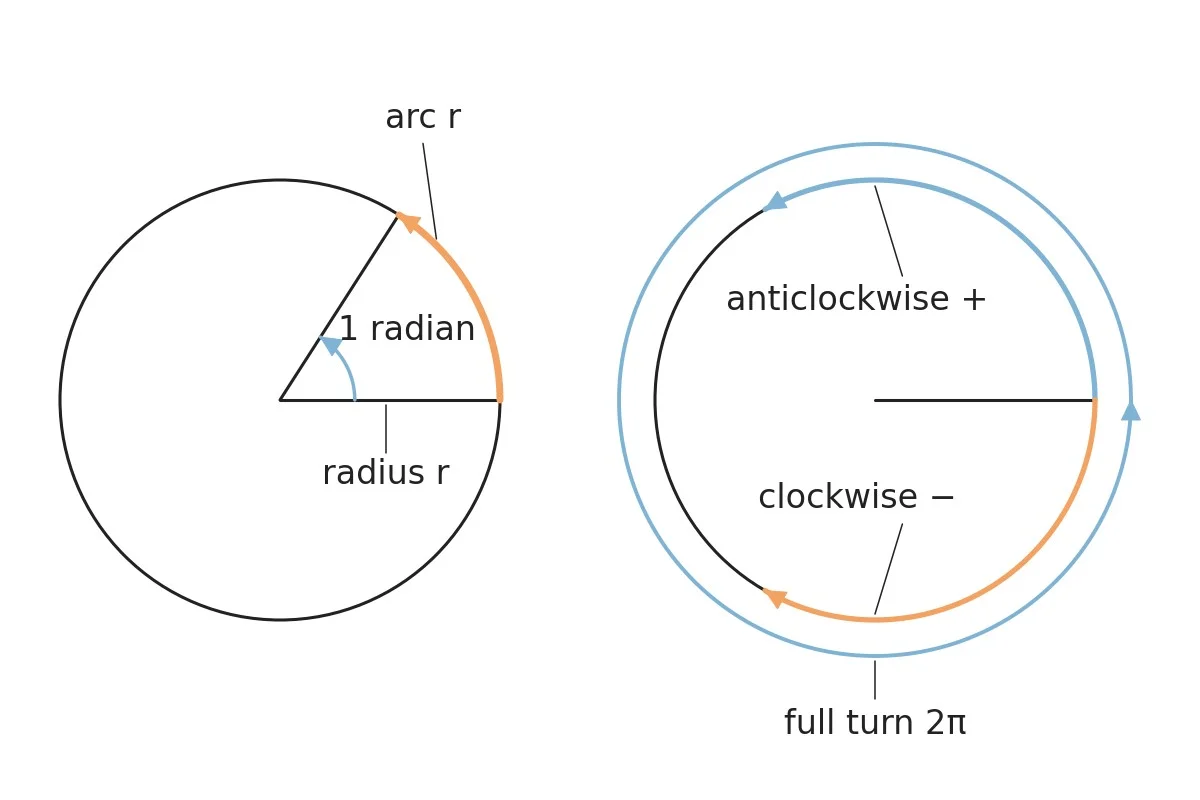
Divide arc by radius; give clockwise turns a negative sign.
Show
In the diagram, compare arc and radius. Follow the direction arrows.
Ask
How many radius-lengths does this arc contain?
Say
One, so this angle measures one radian.
Used in
Arc lengths tell a craftsperson how much edging a circular opening needs.
If your child says…“The turn count starts again when I pass the starting point.”
Ask
After a full turn, has the distance travelled around the circle disappeared?
What’s true
For anticlockwise travel, arc length equals radius times radian measure, including complete turns.
2. Relation between degree and radian
Degrees and radians give different numbers for the same turn.
Show
Write these lines. Say, 'Pi radians and 180 degrees describe the same half-turn.'
Ask
What fraction remains after cancelling 60 in the last line?
Say
Sixty degrees is one-third of a half-turn: .
Used in
Drawing software converts angle units so measurements can be used consistently.
If your child says…“To change degrees into radians, I multiply by 180 over pi.”
Ask
Which multiplier changes 180 degrees into pi radians?
What’s true
One degree is a small fraction of a radian, so use pi divided by 180.
Reading trigonometric values
3. Trigonometric functions and quadrantal angles
Cosine reads across the unit circle; sine reads up or down.
Show
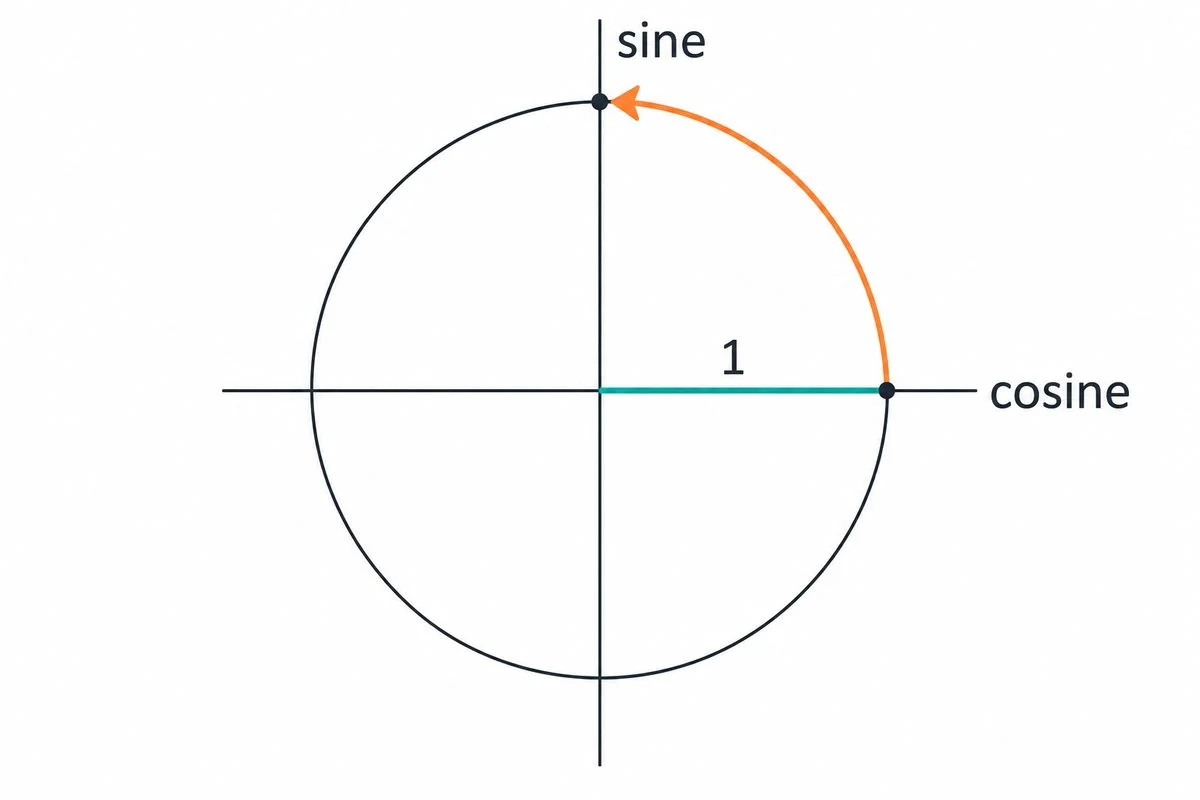
Find the radius marked one in the diagram. Trace anticlockwise from the rightmost point to the top.
Ask
After another whole turn, what will cosine and sine be?
Say
After the full turn, cosine returns to zero and sine returns to one.
Used in
Animation uses circular coordinates to move objects around a centre.
If your child says…“A half-turn brings back the same sine and cosine.”
Ask
After half a turn from the top, is the point above or below the centre?
What’s true
A half-turn reaches the opposite point and reverses both coordinate signs.
4. Trigonometric ratios, identities and standard values
Triangle ratios and Pythagoras explain standard values and connected identities.
Show
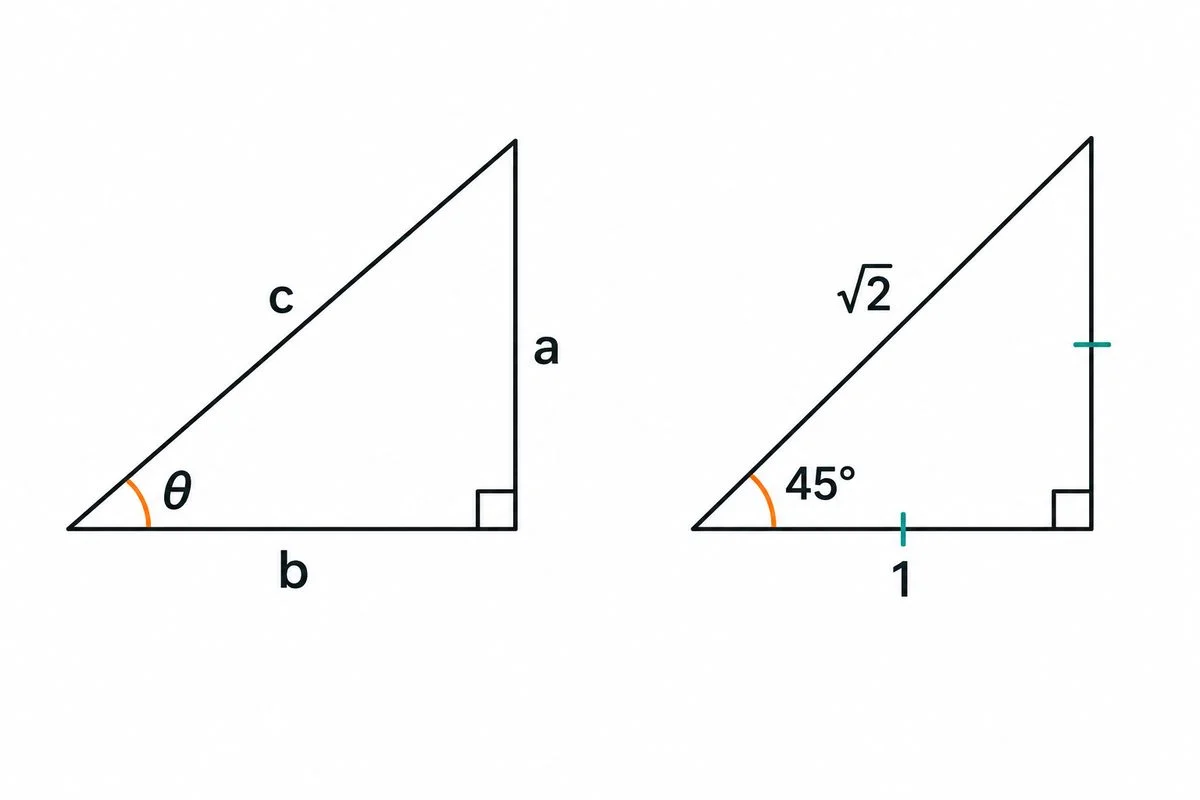
In the diagram, find the equal legs and hypotenuse.
Ask
What are sine and cosine at 45 degrees?
Say
Both equal one over root two: divide each leg by the hypotenuse.
Used in
Surveying uses trigonometric ratios to calculate heights without climbing.
If your child says…“One plus cotangent squared equals secant squared.”
Ask
When dividing by sine squared, does the right side become secant squared or cosecant squared?
What’s true
Cotangent divides cosine by sine; cosecant is sine’s reciprocal, and zero denominators are excluded.
5. Sign, domain and range of trigonometric functions
Coordinates give signs and possible values. Zero denominators exclude some angles.
Show
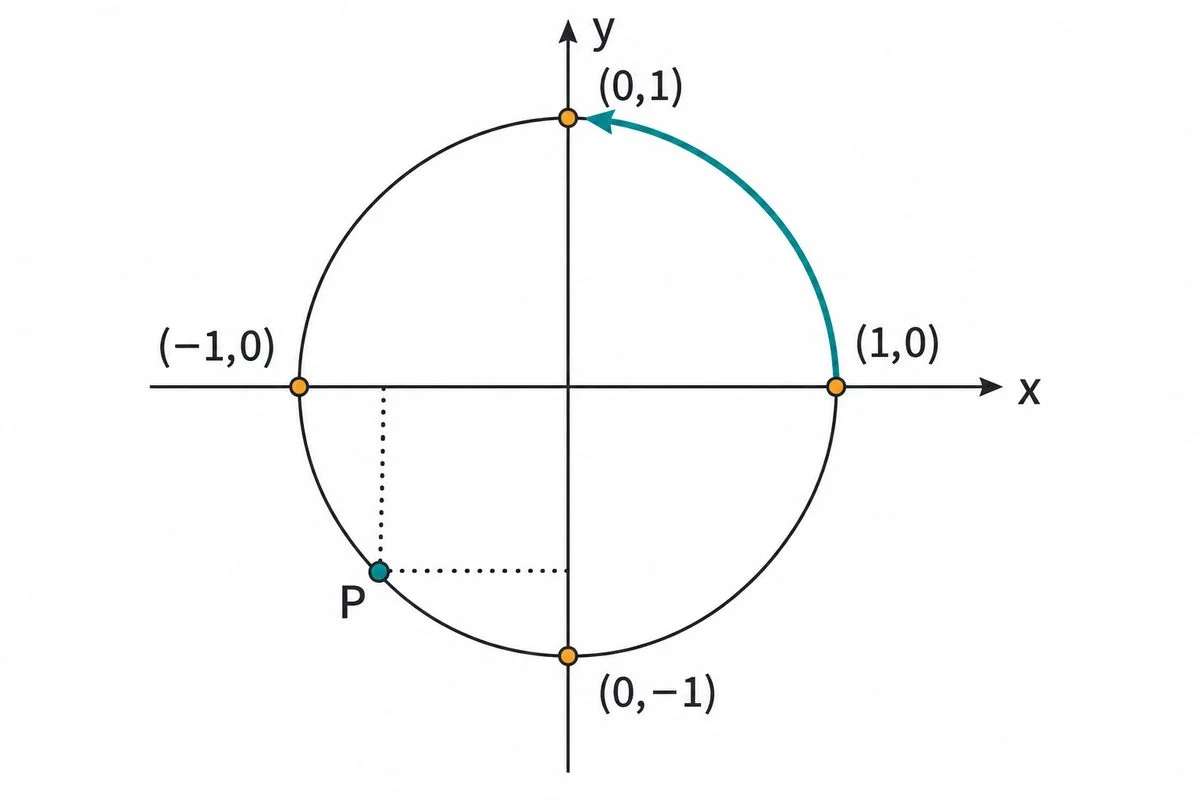
In the diagram, follow P around the circle.
Ask
Which values can its height reach?
Say
Sine reaches every value from minus one to one. Every real angle works, but the circle limits its height.
Used in
Navigation uses signed values to distinguish northward movement from southward movement.
If your child says…“Sine can give any real number because every angle works.”
Ask
Where could P sit on this circle for its height to exceed one?
What’s true
Accepting every angle does not let a coordinate extend beyond the unit circle.
Working with angle formulas
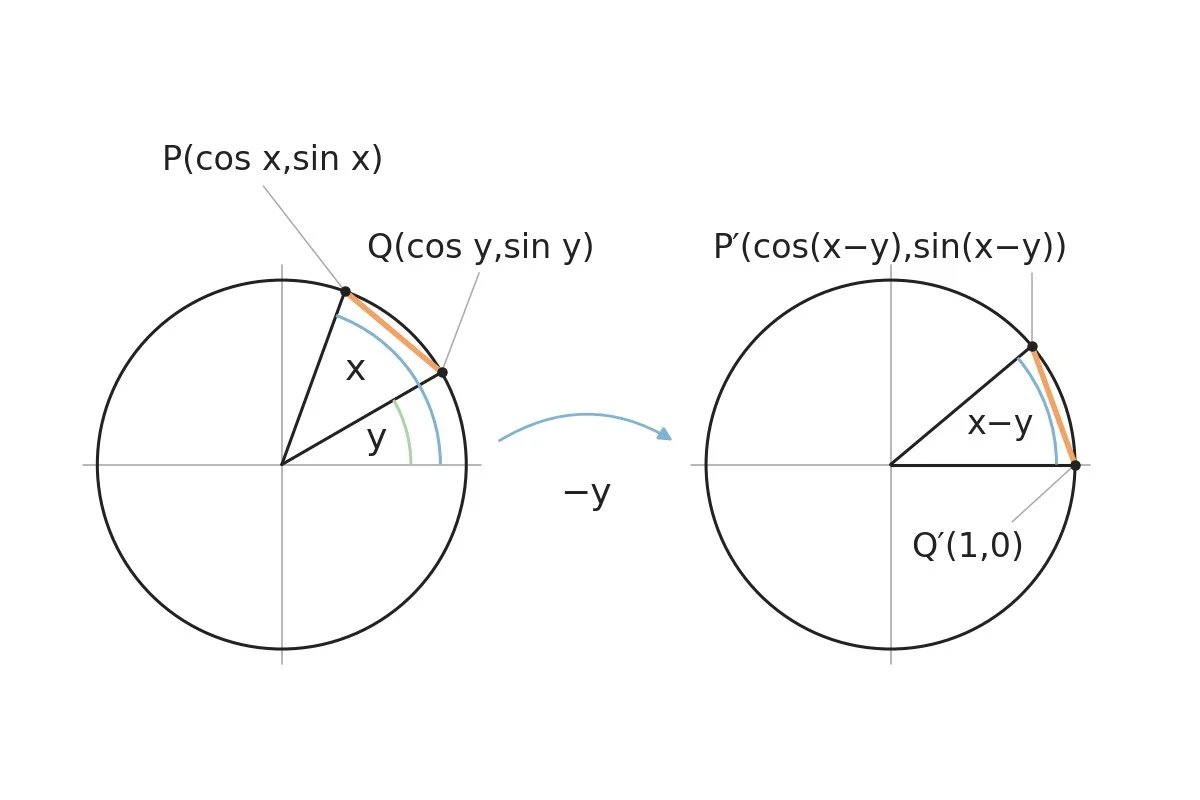
6. Trigonometric functions of sum and difference of two angles
Combining angles mixes sine and cosine values through products.
Show
In the diagram, follow endpoints at angles x and y through the clockwise rotation.
Ask
How could these equal chords connect the angles’ cosines?
Say
Rotation preserves chord length. Equating squared distances gives cosine of the difference through coordinate products: .
Used in
Computer graphics combines rotations to turn objects on screen.
If your child says…“Cosine of a sum is just the two cosines added.”
Ask
At two zero angles, would adding their cosines still give cosine of zero?
What’s true
Squaring coordinate differences produces products, so cosine cannot be split across addition.
7. Trigonometric functions of multiples and submultiples of angles
Sum formulas also connect doubled, tripled and halved angles.
Show
Write these lines. Say: Add angle x to itself; replace sine squared using Pythagoras.
Ask
What remains after removing brackets?
Say
Collecting gives .
Used in
Pattern design uses half-angles to divide circular designs into equal sections.
If your child says…“The sine version is twice sine squared minus one.”
Ask
At zero, which order gives the cosine value one?
What’s true
The sine version subtracts twice sine squared from one.
8. Transformation of sums into products
Expanding around the middle angle turns trigonometric sums into products.
Show
Write these lines. Call the starting angle t and the sum of the two sines S. Say, 'The middle angle is twice t; the offsets are t in opposite directions.'
Ask
What product do you predict when these two identical terms are collected?
Say
The opposite terms cancel, leaving .
Used in
Combining sound waves as products helps explain alternating loud and quiet beats.
If your child says…“The sine takes half the difference.”
Ask
Which angle remains inside sine after the opposite terms cancel?
What’s true
In this sine sum, the middle angle belongs inside sine.
A real problem
A machine calculated tides for Indian ports.
The machine moved to the Survey of India’s headquarters in Dehradun in 1921.
Scientist Edward Roberts directed its calculations for Indian ports.
Its method added cosine components to represent the tide.
We use cookies, including Meta’s and, if a ChatGPT advert brought
you, OpenAI’s, to see how visitors find us.
They are never used on your child’s screens in the app. You can turn them
off here, and change your mind any time.
Privacy policy