Skip to content

Teach Conic Sections in eight steps.

For each idea: show it, ask before you tell, then say one line.

Gather plain paper, a pencil, ruler, string and adhesive tape.

Common misconceptions & worked visual for this chapter · 15 practice questions with answers

How to teach it

Cone sections and circles

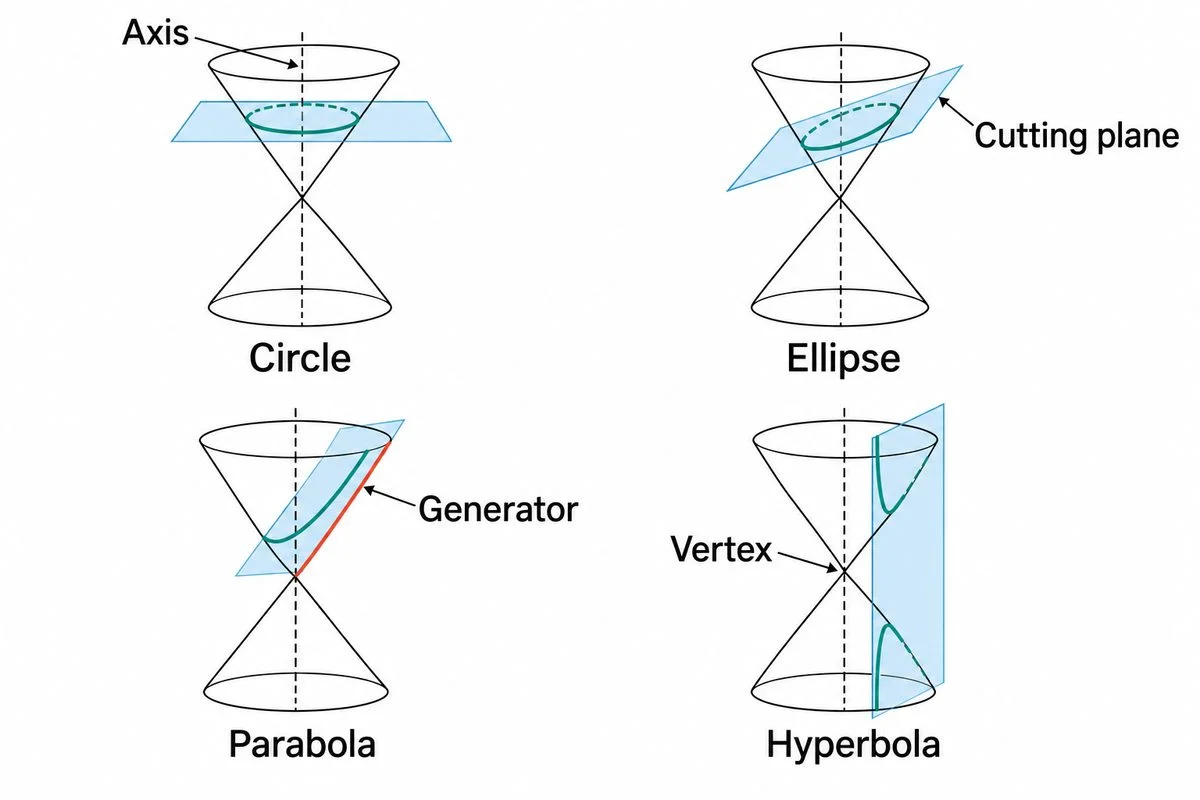
Four double cones showing the cutting planes that produce circle, ellipse, parabola and hyperbola.

1. Sections of a cone

Curves made where a flat surface cuts a cone.

Show
Look at the diagram’s four cuts. Find the axis and generator, then trace each curve.
Ask
What curve will a cut through both cone halves produce if it misses the tip?
Say
For these cuts, the angle determines the curve. A plane parallel to a generator gives a parabola. Cutting both halves gives a hyperbola.
Used in
An elliptical cone opening needs a matching cover.
If your child says…“Moving the cut higher changes the kind of curve.”
Ask
If the cutting surface slides without tilting, what happens to its angle?
What’s true
Parallel cuts missing the tip keep their curve type. Cuts through the tip give a point, a straight line, or two intersecting lines.
(x−1)2+(y−1)2=2\sqrt{(x-1)^2+(y-1)^2}=2

(x−1)2+(y−1)2=22(x-1)^2+(y-1)^2=2^2

2. Circle

Points equally far from a centre.

Show
Write this line. Say, “The centre is (1,1)(1,1), and the radius is two units. Here, x and y name a point’s coordinates. Subtract the centre’s coordinates, then use Pythagoras to find the distance. Square both sides.”
Ask
What replaces two squared?
Say
Four replaces two squared: square the radius.
Used in
Circle equations position round holes in drawing software.
If your child says…“The number on the right is the radius.”
Ask
What happens to the right side when we square both sides?
What’s true
The right side gives the radius multiplied by itself.

Parabolas and ellipses

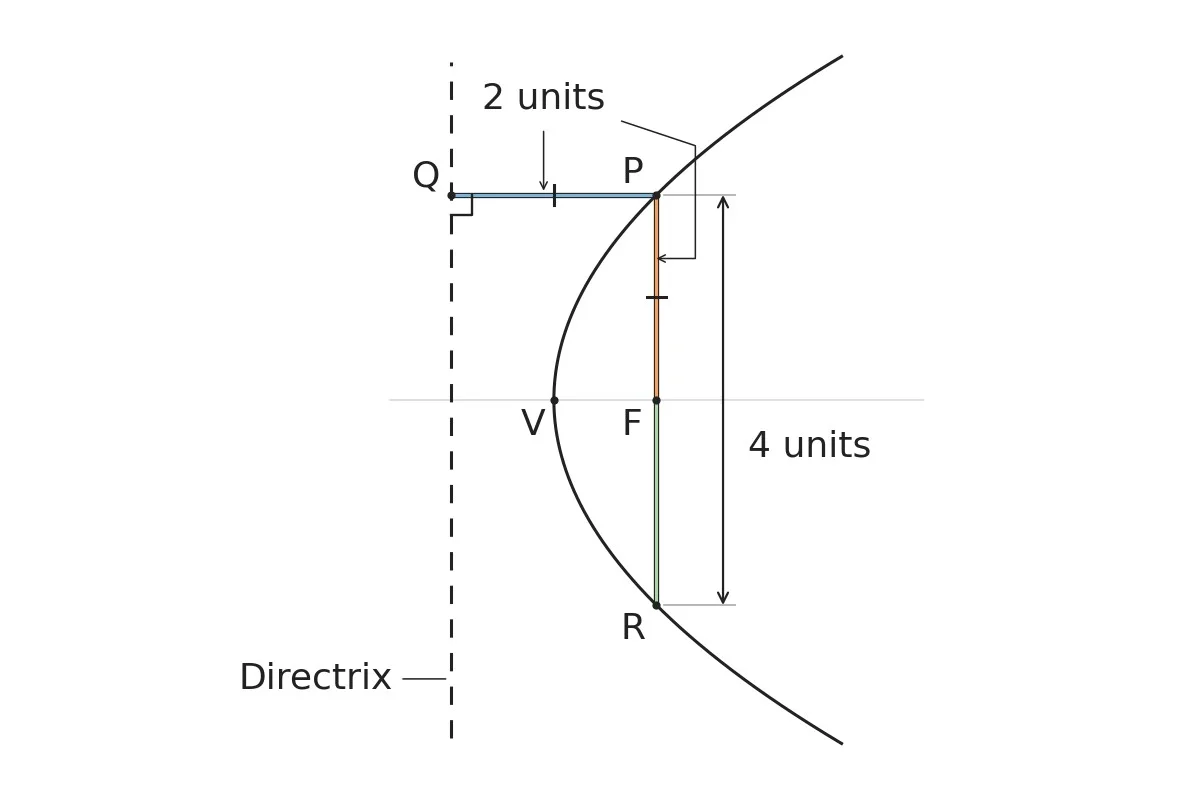
Parabola with equal focus and perpendicular directrix distances, plus the complete chord through its focus.

3. Parabola

Points equally far from a focus and directrix.

Show
Look at the diagram. Find focus F and the directrix. Compare PF with perpendicular PQ, then trace PR.
Ask
As P moves along this curve, how will its focus-distance and perpendicular directrix-distance compare?
Say
These distances stay equal along a parabola. The latus rectum PR includes both halves, totalling four units.
Used in
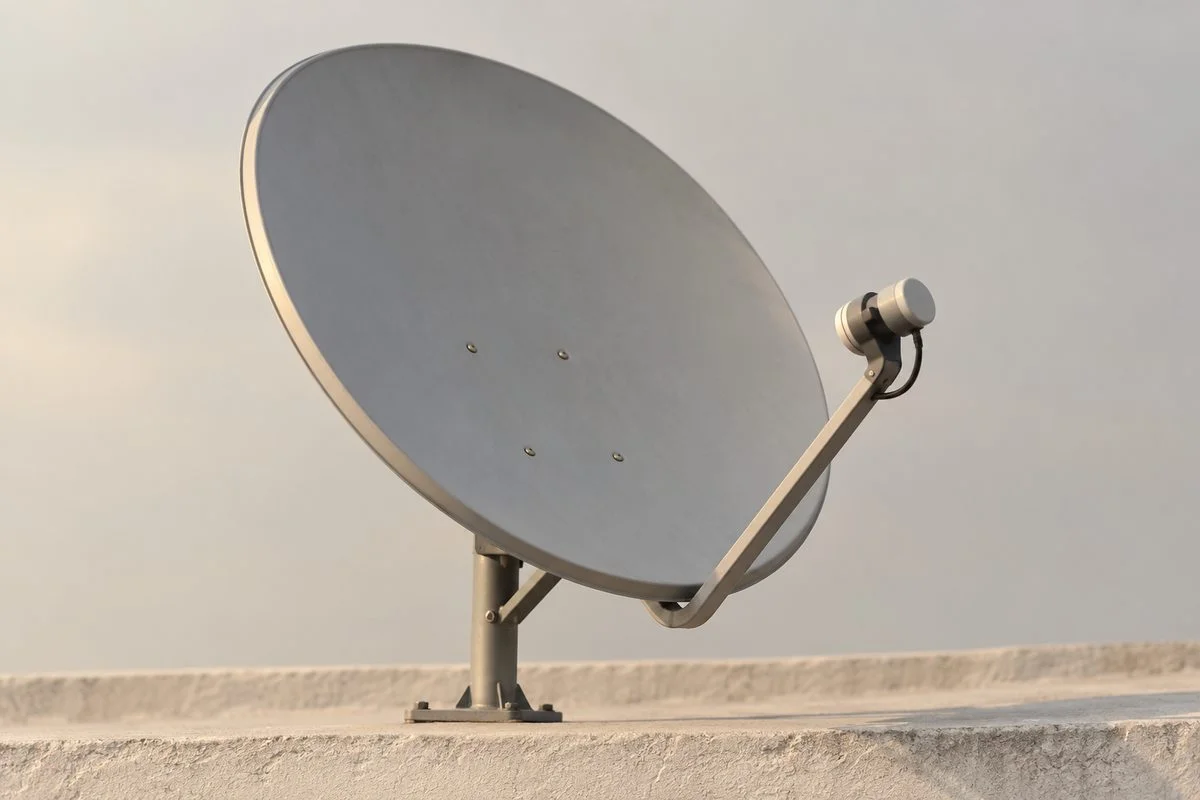
Parabolic reflectors gather signals towards receivers.
If your child says…“The chord ends at the focus, so its length is two.”
Ask
Where must both ends lie for this segment to be a chord?
What’s true
The latus rectum crosses the focus at right angles to the axis and reaches both sides.
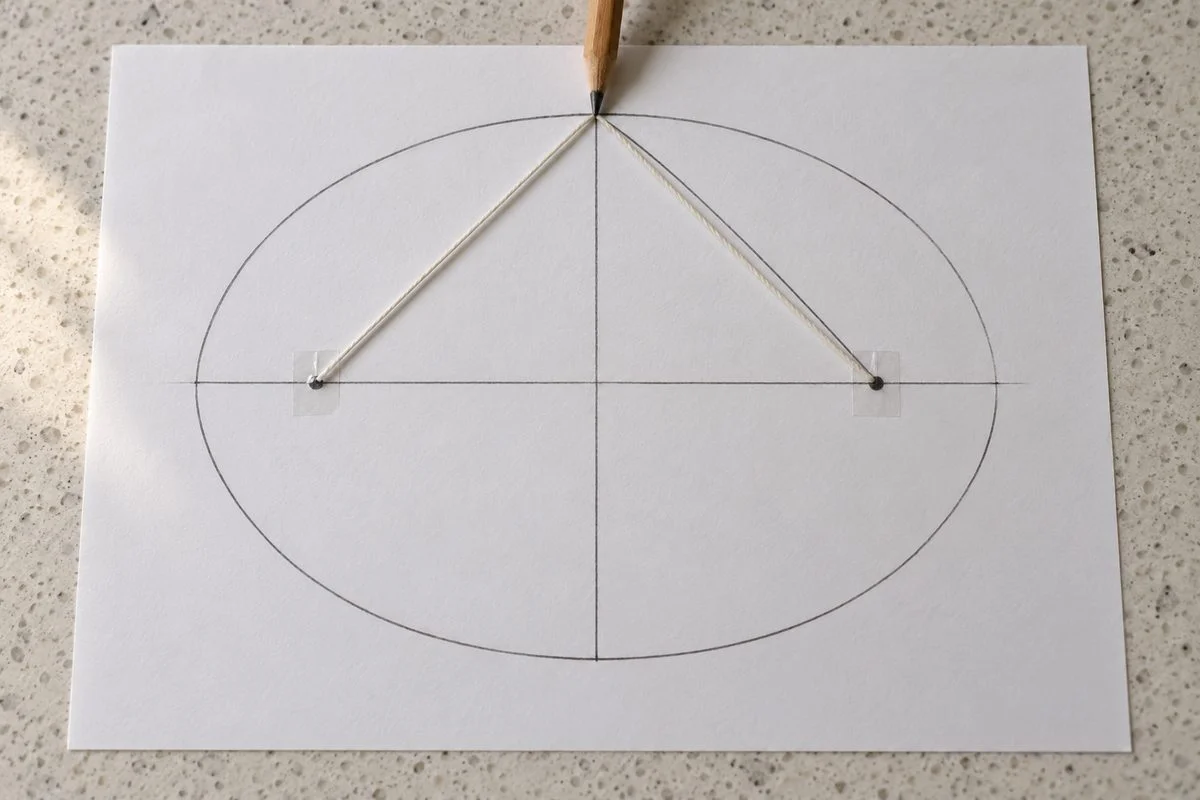
String ellipse with axes and a triangle joining its top, centre and focus.

4. Ellipse

Points with a fixed total distance to two foci.

Show
Tape string ends six centimetres apart horizontally. Leave ten centimetres of string between them. Trace with a pencil against taut string. Mark axes; join the top to either focus.
Ask
Before measuring, how long do you expect the top-to-focus segment to be?
Say
It is five centimetres: symmetry halves the total.
Used in
Elliptical paths provide closed walking routes.
If your child says…“The difference between the two distances stays fixed.”
Ask
Does the string fix the two lengths added together, or one subtracted from the other?
What’s true
The string fixes their total, which equals the longest diameter.

x2+4y2=4x^2+4y^2=4

x24+y2=1\frac{x^2}{4}+y^2=1

x24=1\frac{x^2}{4}=1

x2=4x^2=4

5. Standard equations of an ellipse

Denominators give squared semi-axes.

Show
Write this line. Say, “Divide every term by four, then set y to zero. This leaves x squared equal to four.”
Ask
Which x-values follow?
Say
Minus two and two both square to four.
Used in
Ellipse equations size oval tabletops.
If your child says…“The denominator four means the semi-axis is four.”
Ask
Which length squares to four?
What’s true
Take square roots for semi-axes; the latus rectum crosses a focus, perpendicular to the longer axis.

Hyperbolas and applications

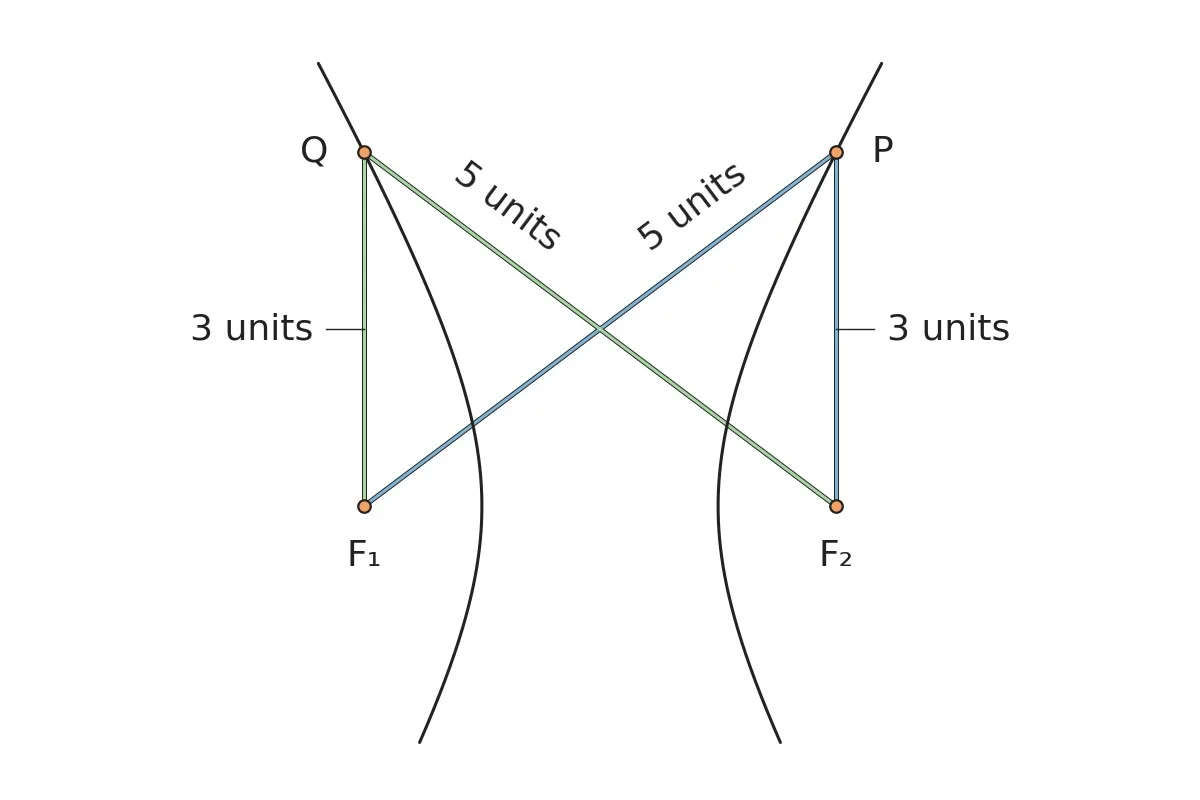
Two hyperbola branches with matching three-unit and five-unit distances from marked points to both foci.

6. Hyperbola

Points whose two focus-distances have a fixed absolute difference.

Show
Look at the diagram’s two branches and foci. Follow P’s segments to both foci, then Q’s. Read the lengths beside each pair.
Ask
What distance difference would another point on either branch need to keep?
Say
The longer distance exceeds the shorter by two units at both points. Keeping that difference fixed defines this hyperbola. The nearer focus switches between branches.
Used in
Differences in signal travel distances help locate a transmitter.
If your child says…“A hyperbola keeps the distance total fixed, like an ellipse.”
Ask
When both distances grow by the same amount, what happens to their difference?
What’s true
The fixed difference equals the gap between branch tips; the perpendicular bisector has zero difference.

4y2−x2=44y^2-x^2=4

y2−x24=1y^2-\frac{x^2}{4}=1

y2=1y^2=1

7. Standard equations of a hyperbola

The positive term sets the opening axis.

Show
Write this line. Say, “Divide every term by four, then set x to zero. This leaves y squared equal to one.”
Ask
Which y-values follow?
Say
The y-values are minus one and one.
Used in
Hyperbola equations position curves in drawing software.
If your child says…“The larger denominator tells me where the branches open.”
Ask
Could y be zero here without making a square negative?
What’s true
The positive term selects the opening axis. The latus rectum crosses a focus at right angles to that axis.

22=−4a(−1)2^2=-4a(-1)

4=4a4=4a

a=1a=1

x2=−4(1)yx^2=-4(1)y

8. Applications of conic sections

Measurements fix a conic’s equation.

Show
Write this line for a parabolic arch four metres wide and one metre high. Say, “The top is the origin; y points upwards. In metres, the right foot is (2,−1)(2,-1); a measures vertex-to-focus distance. Substituting the foot gives four equal to four times a. Dividing by four gives a equal to one. Replace a with one in the arch’s equation.”
Ask
What simplified equation follows?
Say
The foot fixes the coefficient: x2=−4yx^2=-4y.
Used in
Arch equations help builders calculate support heights.
If your child says…“The right foot’s sideways coordinate is the full width, four.”
Ask
Does the distance from the middle to one foot include both halves of the arch?
What’s true
The axis divides the width equally, so an edge’s sideways coordinate uses half.

A real problem

A parabolic reflector helped test ideas about the universe.

Astronomers found it difficult to pinpoint radio sources in the sky.

The Ooty Radio Telescope was ready in 1970.

Its reflector used stainless steel wires arranged in a parabolic shape.

Its observations supported the Big Bang model over the steady state theory.

TIFR Archives / Google Arts & CultureWikipedia

This dish illustrates a parabolic reflector; it is not the Ooty Radio Telescope.

Concept Lab · Common misconception

The tempting mistake in Conic Sections

Open standalone misconception page →

Does the denominator determine a parabola’s axis?

Wrong

In y² = 8x, the axis is vertical because y is squared.

Why it feels right. The squared letter draws my eye to its axis.

Right

In y² = 4ax, the parabola opens along the x-axis for a > 0.

Worked example

The two points with x = 2 are the same distance above and below the horizontal axis.
  1. At x = 2, y can be +4 or −4.
  2. The equal heights above and below the x-axis reveal the axis of symmetry.

Ask your child eight quick questions.

One per step. The answer and the reason are given.

  1. An elliptical cut slides parallel to itself, missing the cone’s tip. What curve remains?

    An ellipse. Sliding changes the size, while the cutting angle stays unchanged.

  2. A circle’s squared-distance equation has 4 on the right. What is its radius?

    2 units. The radius squared is four, so the radius is two.

  3. Each half of this focal chord measures two units. What is its complete length?

    Four units. The chord includes both equal halves, one on each side of the focus.

  4. An ellipse point is nine units from one focus and five from the other. Longest diameter?

    Fourteen units. The longest diameter equals the distance total, not the difference.

  5. For this ellipse, what is the full horizontal diameter?

    Four units. Its endpoints are two units either side of the centre.

  6. A hyperbola point has focus-distances nine and five. What is the gap between branch tips?

    Four units. The tip gap equals the larger focus-distance minus the smaller.

  7. In this equation, which axis carries the vertices?

    The y-axis. The positive y-squared term gives the vertical vertices despite its smaller denominator.

  8. With the origin at the top’s centre, what is the right foot’s x-coordinate?

    2 metres. The four-metre width extends equally on both sides of the axis.

15 more questions with answers, 5 with pictures