Skip to content

Teach Probability in eight steps.

For each idea: show it, ask before you tell, then say one line.

Gather two different coins, a die, paper, a pencil, an eraser and a bowl.

Common misconceptions & worked visual for this chapter · 15 practice questions with answers

How to teach it

Describe the possible results

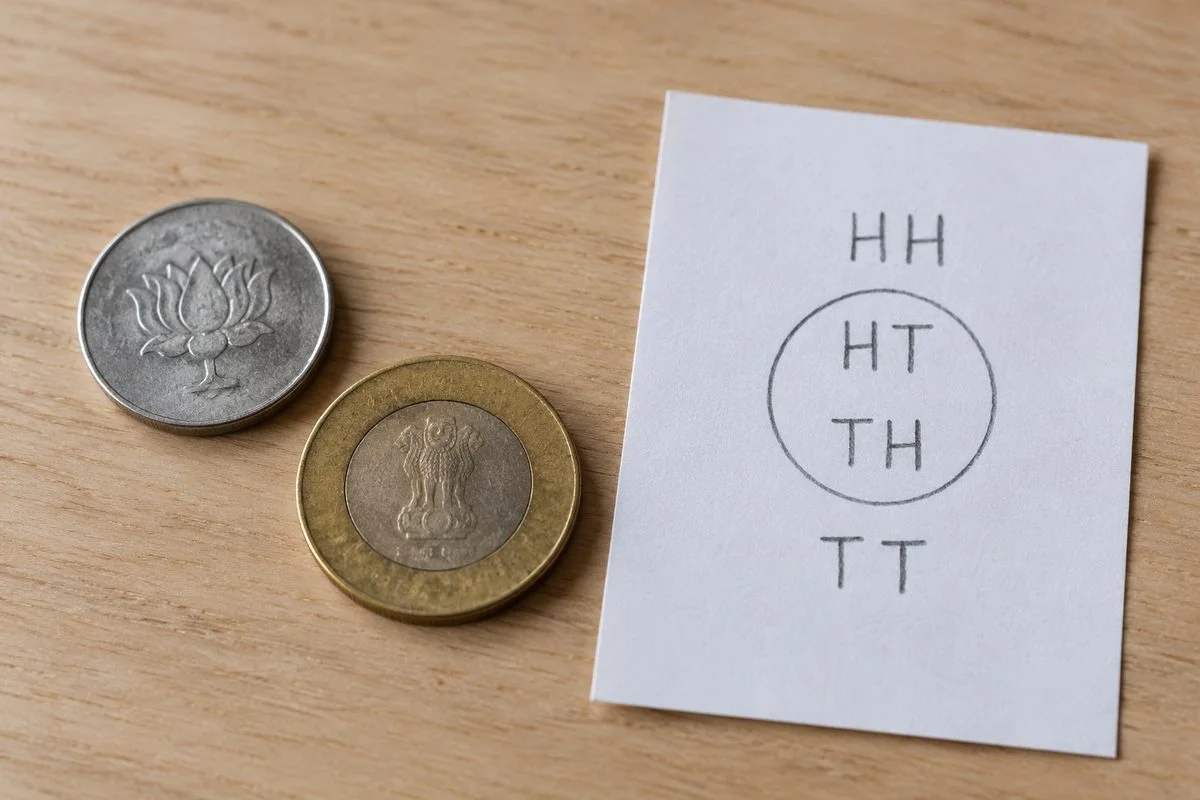
Two different coins beside recorded outcomes, with HT and TH circled together.

1. Event and types of events

An event is any subset of the possible outcomes.

Show
Use H for heads, T for tails. Arrange two different coins as HH, HT, TH, TT. Record these; circle HT and TH.
Ask
Which results make the circled event happen?
Say
Either does.
Used in
Delivery services group arrivals after the promised time to track delays.
If your child says…“Both circled results must happen.”
Ask
If HT appears, is it inside our circle?
What’s true
An event happens whenever the observed result matches any member.
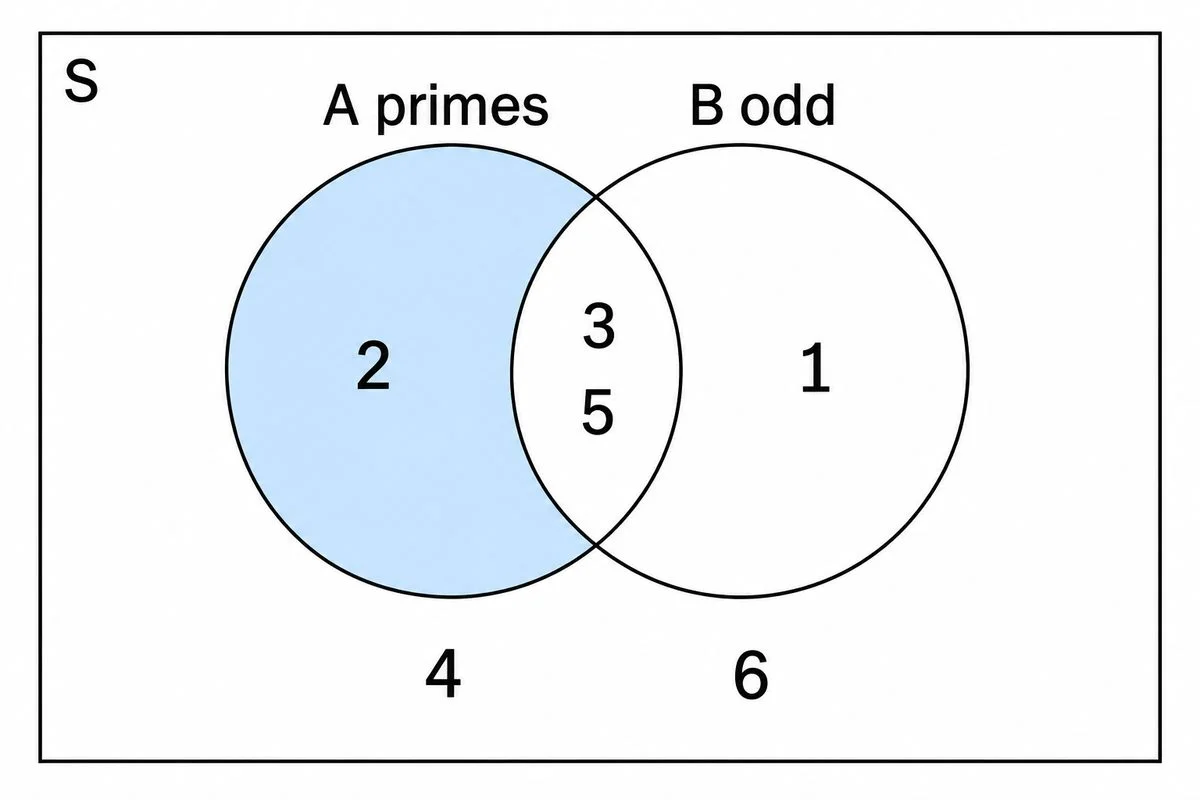
Overlapping prime and odd circles contain die outcomes, with 2 outside the overlap.

2. Algebra of events

Combine events using or, and, not, and but not.

Show
Look at the diagram for one die roll. S contains all six possible outcomes. Find A for primes, B for odd numbers, then their overlap.
Ask
Will 'prime and odd' include fewer outcomes than 'prime or odd'?
Say
Only the overlap qualifies for 'and', while either circle qualifies for 'or'.
Used in
Shopping filters combine conditions to narrow the items shown.
If your child says…“Prime but not odd means every number outside the odd circle.”
Ask
Would 4 pass the prime condition?
What’s true
The outcome must also belong to the prime circle.
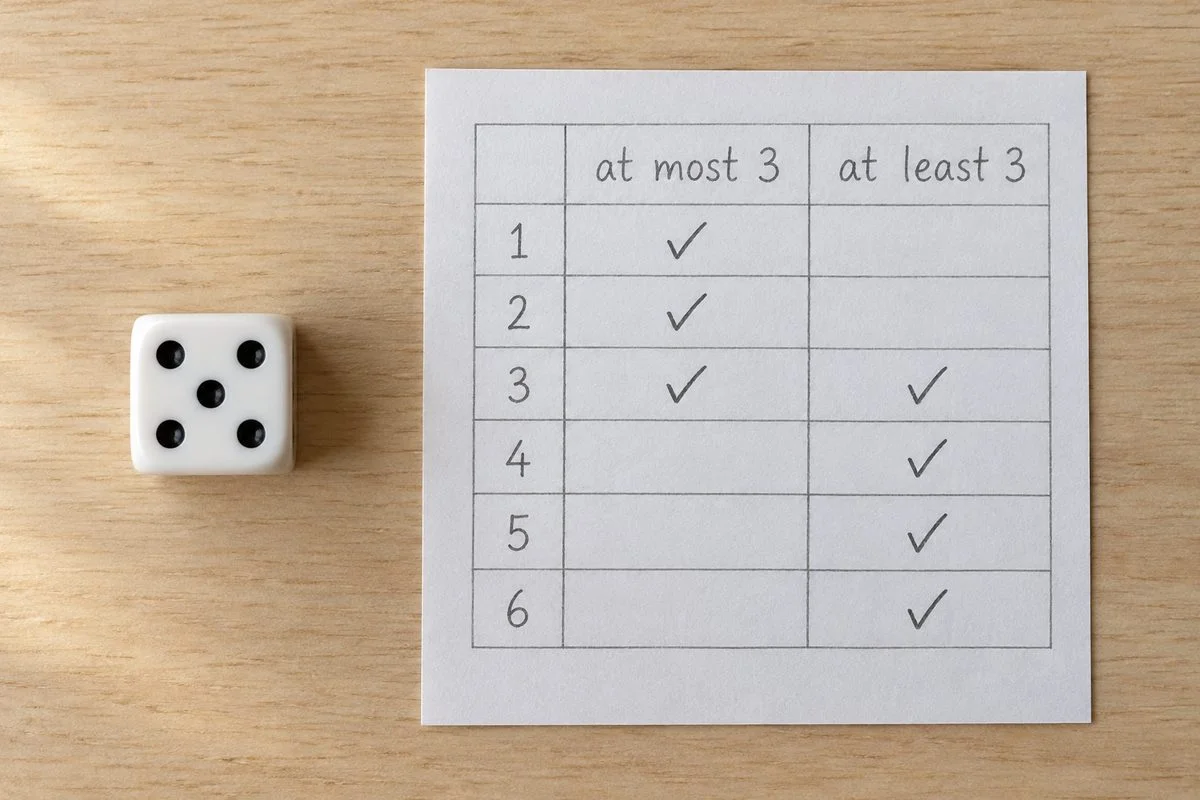
Die beside a checklist covering every face, with 3 ticked in both columns.

3. Mutually exclusive and exhaustive events

Exclusive events never overlap; exhaustive events leave no outcome uncovered.

Show
Inspect a die. List its faces under columns 'at most 3' and 'at least 3'. Tick every match. After the prediction, change the second heading to 'greater than 3' and erase its tick for 3.
Ask
Will that change remove the overlap without leaving any face uncovered?
Say
The original events were exhaustive despite sharing 3. After the change, they are also mutually exclusive.
Used in
Pass and fail categories classify completed inspections without counting a result twice.
If your child says…“Events that overlap cannot cover everything.”
Ask
Before changing the heading, which face had no tick?
What’s true
Coverage and overlap need separate checks.

Assign and count probabilities

14+q=1\frac{1}{4}+q=1

q=1−14q=1-\frac{1}{4}

4. Axiomatic approach to probability

Probabilities obey rules that keep all assigned chances consistent.

Show
Write these lines. Say: 'Assign heads one-quarter; q means tails' probability. These exclusive outcomes have probabilities totalling one.'
Ask
What must q equal?
Say
Three-quarters completes the total. Both probabilities are nonnegative. They add because heads and tails cannot happen together.
Used in
Checking forecast probabilities helps detect contradictory estimates.
If your child says…“Heads and tails must have equal probabilities.”
Ask
Which requirement would one-quarter and three-quarters break?
What’s true
Unequal assignments can satisfy both the range and total requirements.
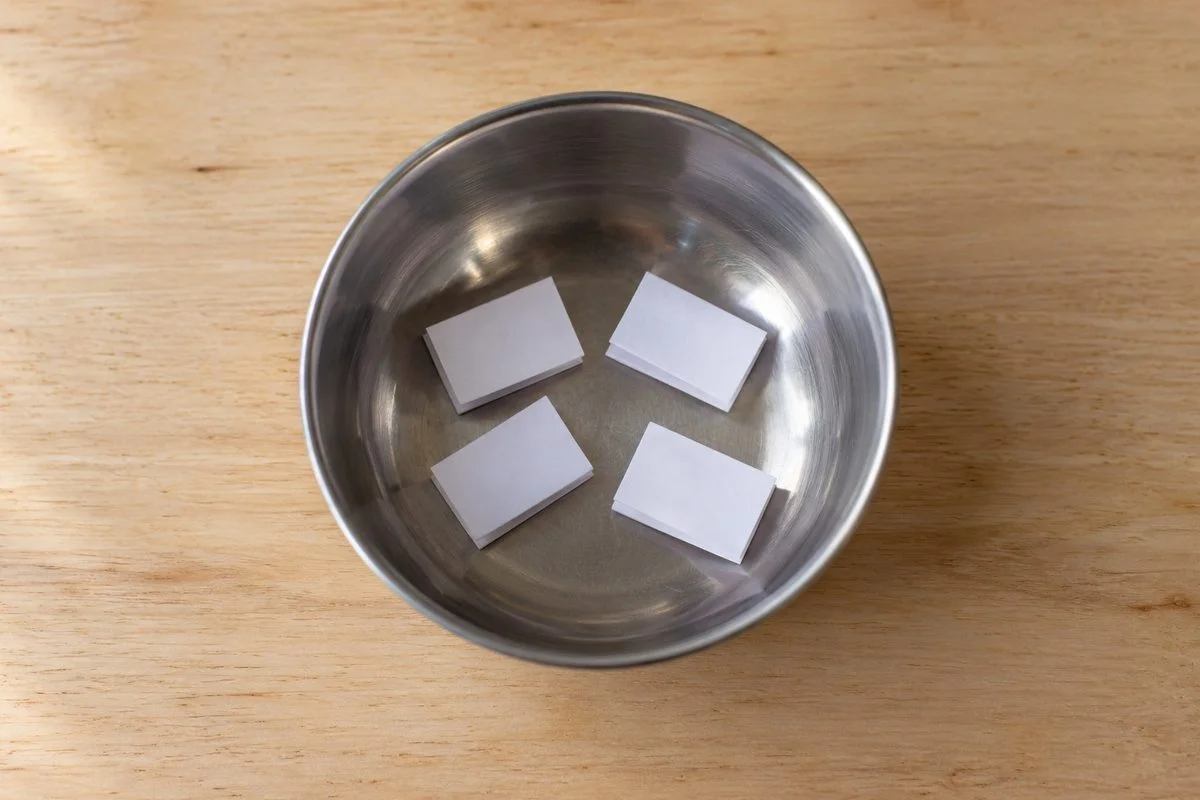
Four identical folded slips in a steel bowl before drawing.

5. Probabilities of equally likely outcomes

Add matching probabilities; use count ratios only with equally likely outcomes.

Show
Write Asha, Asha, Bala and Chitra on four equal slips. Fold alike and mix in a bowl. Treat each slip as equally likely. After the prediction, draw without looking, then open every slip.
Ask
What is the chance of drawing Asha or Bala?
Say
Asha's half and Bala's quarter add to 34\frac{3}{4}. Counting matching slips works because each slip has an equal chance.
Used in
Raffle organisers count tickets to compare entrants' chances of winning.
If your child says…“There are three names, so each has the same chance.”
Ask
Which name appears on more slips?
What’s true
The slips have equal chances, but the names do not.

n(S)=4×32n(S)=\frac{4\times3}{2}

n(S)=6n(S)=6

P(E)=1n(S)P(E)=\frac{1}{n(S)}

6. Probability using permutations and combinations

Count groups without order, and arrangements with order.

Show
Write these lines. Say: 'Choose two from two girls and two boys; all committees are equally likely. n(S) counts committees; E means both girls; P means probability.'
Ask
What probability follows?
Say
The probability is one-sixth: only one committee contains both girls.
Used in
Selection counts help organisers compare chances when choosing groups by lottery.
If your child says…“Choosing the same pair in reverse makes another committee.”
Ask
Who joins or leaves when you reverse those names?
What’s true
Reversing the selection order leaves the committee unchanged.

Combine probabilities

P(A∪B)=36+36−26P(A\cup B)=\frac{3}{6}+\frac{3}{6}-\frac{2}{6}

P(A∪B)=46P(A\cup B)=\frac{4}{6}

7. Probability of the event A or B

Add both chances, then remove one copy of their overlap.

Show
For a fair die, list A (even): 2, 4, 6; B (above 3): 4, 5, 6. Read union as 'or'. Write these lines.
Ask
What does this simplify to?
Say
It is two-thirds. Subtract the shared chance once: addition counted 4 and 6 twice.
Used in
Counting either of two defects once helps factories estimate the share needing repair.
If your child says…“Just add the chances of the two events.”
Ask
How many times did your addition include the face 4?
What’s true
Adding both probabilities counts their shared outcomes twice.

P(A)+P(A′)=1P(A)+P(A')=1

16+P(A′)=1\frac{1}{6}+P(A')=1

P(A′)=1−16P(A')=1-\frac{1}{6}

8. Probability of the event not A

Find an opposite event's chance by subtracting from one.

Show
Say: 'For a fair die, A means six; A-prime means every other face. Their probabilities total one, so subtract one-sixth from one.' After the prediction, write this equation.
Ask
What is the probability of not getting six?
Say
The remaining chance is five-sixths.
Used in
When success and failure cover every outcome without overlap, subtracting failure's chance gives success's chance.
If your child says…“Neither means one minus the chance of both.”
Ask
After removing only 'both', wouldn't cases where just one happens remain?
What’s true
Neither excludes every outcome where either event happens.

A real problem

A square helps breeders predict inherited traits.

Reginald Punnett devised this square in 1905.

It helps predict offspring traits when breeding plants or animals.

When inheritance outcomes are equally likely, counting possibilities gives expected proportions of genetic combinations.

WikipediaArizona State UniversityOpenStax, Rice University

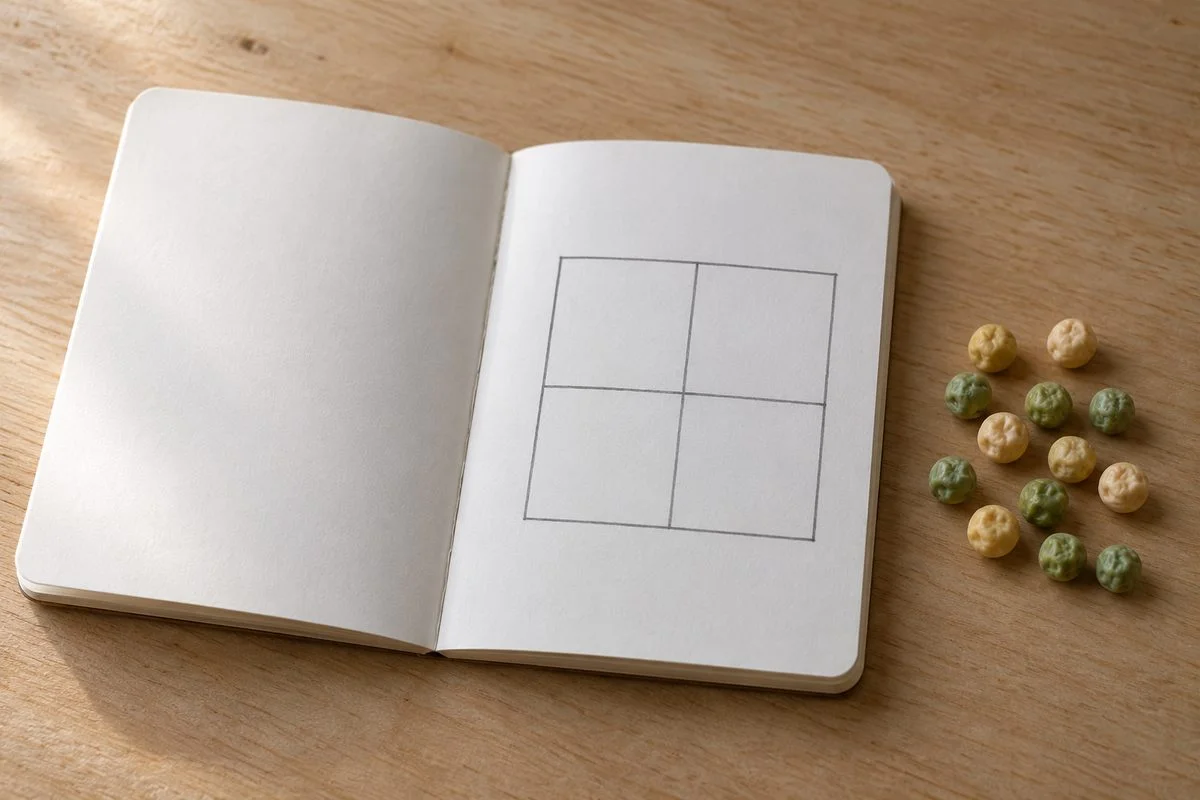
Yellow and green dried peas beside an unlabelled pencil square in a notebook.

Concept Lab · Common misconception

The tempting mistake in Probability

Open standalone misconception page →

Do mutually exclusive events count as independent?

Wrong

Two outcomes that cannot happen together must be independent.

Why it feels right. I treat separation as having no effect on the other event's probability.

Right

For independent events, the probability of both is the product of their individual probabilities.

Worked example

One roll
1
2
3
4
5
6
A ∩ B
No outcome
If independent
1/6×1/6
1/36
The faces 1 and 2 are separate outcomes on one die. No tile can belong to both events.
  1. On one fair die roll, 1 and 2 each have probability 1/6.
  2. The probability of both is 0, while their probability product is 1/36.
  3. The events are dependent.

Ask your child eight quick questions.

One per step. The answer and the reason are given.

  1. How many simple events are there for these two coins?

    Four. Each of HH, HT, TH and TT gives its own simple event.

  2. Which outcomes belong to prime or odd, including the overlap?

    1, 2, 3 and 5. Or includes either condition, including outcomes satisfying both.

  3. Which face prevents 'at most 3' and 'at least 3' from being mutually exclusive?

    3. Both conditions include 3, although together they cover every face.

  4. Why is assigning one-quarter to each coin outcome invalid?

    The total is only one-half. Together, heads and tails must account for the whole probability of one.

  5. What is Asha's chance, despite there being three names?

    12\frac{1}{2}. Two of the four equally likely slips carry Asha's name.

  6. How many committees contain both girls?

    One. Writing the girls in reverse order does not create another committee.

  7. How often should 4 contribute to the chance of even or greater than 3?

    Once. It belongs to both events but is still one outcome.

  8. To find the chance of neither event, what do you subtract from one?

    The chance of their union. Neither leaves out all outcomes where at least one event happens.

15 more questions with answers, 2 with pictures