Skip to content

Teach Sequences and Series in eight steps.

For each idea: show it, ask before you tell, then say one line.

Gather paper and a pencil.

Common misconceptions & worked visual for this chapter · 15 practice questions with answers

How to teach it

Positions, rules and totals

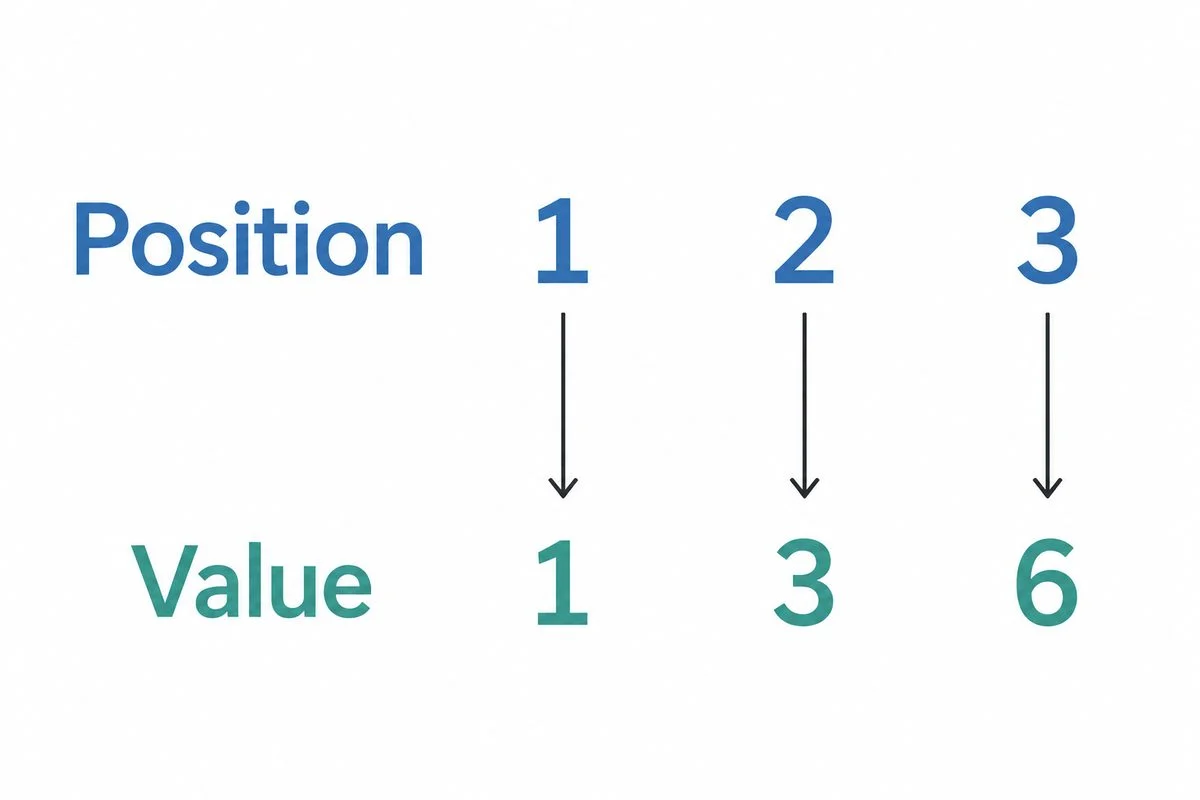
Arrows connect positions 1, 2, 3 to values 1, 3, 6.

1. Sequences

An ordered list gives one value at each allowed whole-number position.

Show
Look at the diagram’s Position row. Follow each arrow down to its Value entry.
Ask
If the first two values swap places, what will the second term become?
Say
It becomes 1, because the second term is whichever value occupies position 2.
Used in
Daily attendance counts form a sequence, preserving when each count occurred.
If your child says…“The second term must be 2.”
Ask
Where does the arrow from position 2 end?
What’s true
The second value is 3, written a2a_2 or a(2)a(2).

an=2n−1a_n=2n-1

a3=2(3)−1=5a_3=2(3)-1=5

a2=a1+2=3a_2=a_1+2=3

2. General term and recurrence relation

Find terms from positions, or build them from earlier values.

Show
Write these lines. Say n names position and ana_n its value. Start at 1; add 2.
Ask
What follows the second term using the repeat rule?
Say
Adding 2 gives 5. The general term uses position directly; recurrence needs a start and earlier values.
Used in
Knitting instructions use repeated rules to build each row from the previous row.
If your child says…“To find the third term, I set the rule equal to 3.”
Ask
Does the small 3 name a position or the answer?
What’s true
The requested position replaces n; it does not replace the term’s value.

S3=∑k=13(2k−1)S_3=\sum_{k=1}^{3}(2k-1)

S3=1+3+5S_3=1+3+5

3. Series and sigma notation

A series indicates addition; sigma writes that addition compactly.

Show
Write these lines, calling the sum of the first three terms S3S_3. Say sigma adds twice each position minus one, from position 1 through 3. Call the position k.
Ask
What total does this compact sigma expression give?
Say
The sum is 9. Sigma includes both end positions, so all three terms contribute.
Used in
A shopping bill adds individual costs to find the amount payable.
If your child says…“9 is the series.”
Ask
Which shows the individual contributions: the addition expression or 9?
What’s true
The addition expression is the series; evaluating it gives its sum.

Geometric progressions

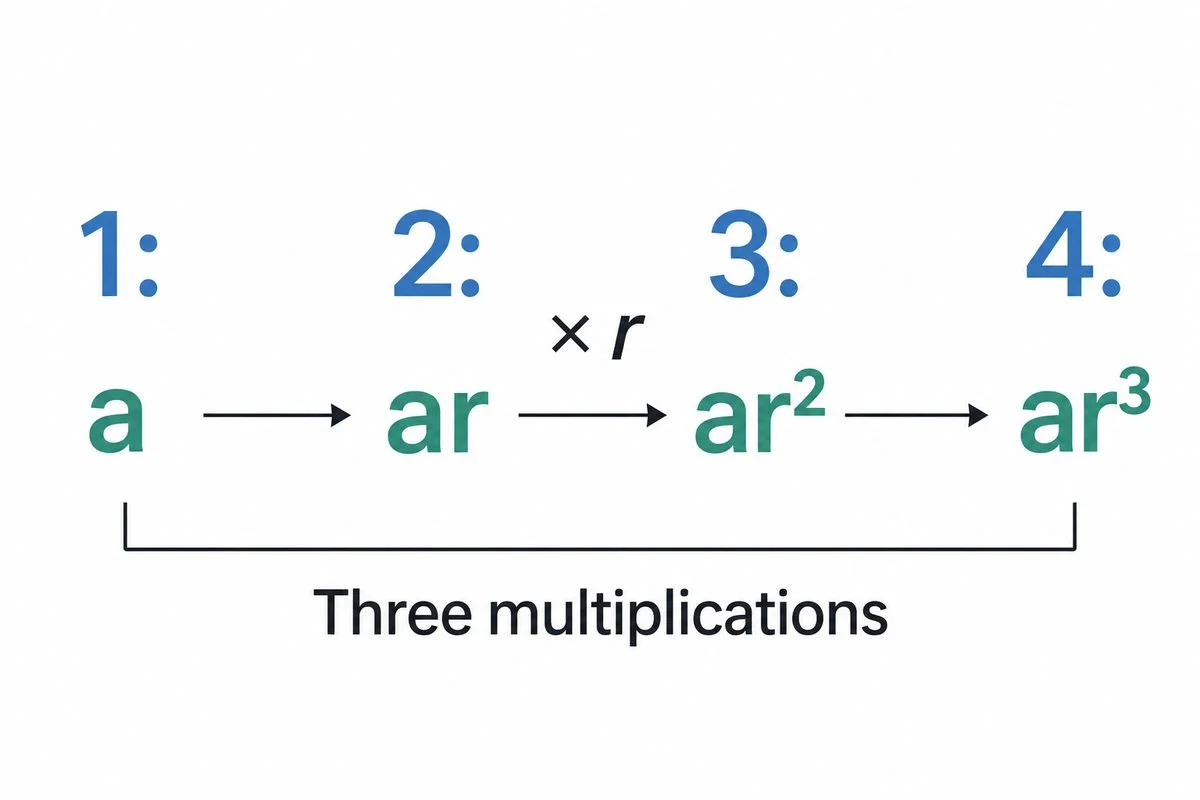
Four positions show three repeated multiplications from a to ar cubed.

4. Geometric progression and its general term

Nonzero terms follow by repeating the same nonzero multiplier.

Show
Follow the diagram’s arrows. Name the nonzero start a, multiplier r, position n and value ana_n.
Ask
What power of r reaches position 20?
Say
Nineteen multiplications reach position 20. Each position needs one fewer multiplication: an=arn−1a_n=ar^{n-1}.
Used in
Repeated discounts at the same percentage multiply the remaining price by the same factor. This helps calculate the final price.
If your child says…“The third term needs three multiplications.”
Ask
How many arrows connect the first position to the third?
What’s true
The starting term occupies position 1 before any multiplication happens.

8=2n−18=2^{n-1}

23=2n−12^3=2^{n-1}

n−1=3n-1=3

5. Applications of the general term of a G.P.

Work backwards to find positions, possible ratios and starting values.

Show
Write these lines for a progression starting at 1 and doubling. Let n name 8’s position.
Ask
Which position do you predict 8 will occupy?
Say
Position 4 follows three doublings.
Used in
Equal-percentage depreciation helps estimate when equipment will reach a chosen value.
If your child says…“Three doublings means the third term.”
Ask
Which position does the starting value occupy before any multiplication?
What’s true
The exponent counts multiplication steps after the starting position.

S=1+2+4S=1+2+4

2S=2+4+82S=2+4+8

2S−S=8−12S-S=8-1

6. Sum of the first n terms of a G.P.

Multiplying and subtracting reveals a geometric progression’s total.

Show
Write these lines, calling the total S. Align matching terms vertically before subtracting.
Ask
What is S after subtraction?
Say
S is 7 because matching terms cancel.
Used in
Geometric sums count stock across packs whose sizes increase by a fixed factor.
If your child says…“A given total must equal one term.”
Ask
Does S name the final contribution, or all contributions added together?
What’s true
For first term a and ratio r, n terms total a(rn−1)r−1\frac{a(r^n-1)}{r-1} when r differs from 1.

Geometric and arithmetic means

G2=8G\frac{G}{2}=\frac{8}{G}

G2=16G^2=16

7. Three terms of a G.P. and geometric mean

A middle term connects equal ratios and simplifies products.

Show
Write these lines. Call the positive middle term G.
Ask
What fits between 2 and 8 with equal ratios?
Say
4 fits because both ratios are 2.
Used in
Geometric means combine changing growth factors into a constant factor with the same overall effect.
If your child says…“The geometric mean is the usual average, so it is 5.”
Ask
Does multiplying 2 into 5 use the same factor as multiplying 5 into 8?
What’s true
The geometric mean uses matching ratios, giving the positive square root of the endpoints’ product.
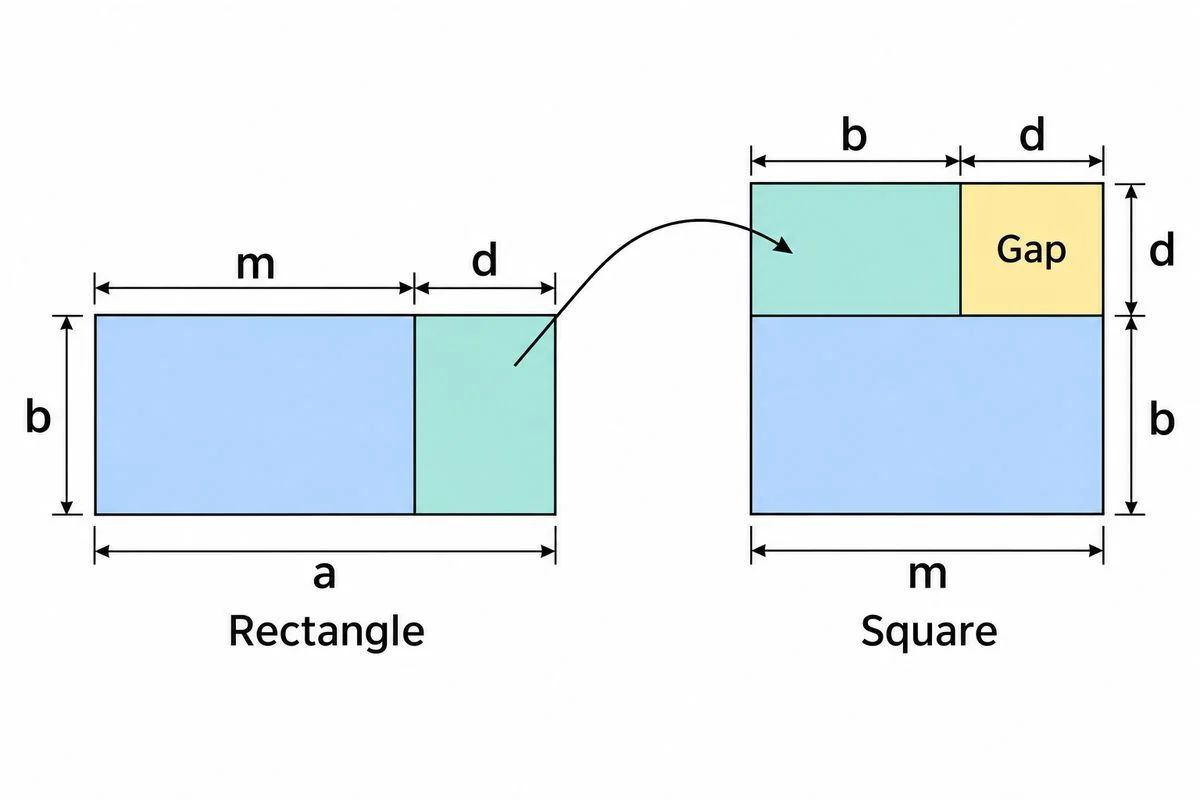
A rectangle rearranged inside a square leaves a smaller square gap.

8. Relationship between A.M. and G.M.

For positive numbers, the arithmetic mean cannot be smaller.

Show
In the diagram, a and b are sides, m their mean, d half their difference. Follow the rearrangement.
Ask
Which mean is larger?
Say
The outer square includes a gap, so its side, the arithmetic mean, exceeds the geometric mean.
Used in
For a fixed rectangular boundary, equal sides give the greatest enclosed area.
If your child says…“The geometric mean is always the larger mean.”
Ask
Which area is larger: the outer square or the pieces inside?
What’s true
For positive sides, this rearrangement leaves a square gap unless the sides are equal.

A real problem

PCR copies scarce DNA so there is enough to analyse.

PCR amplifies small DNA segments to provide material for analysis.

Repeated DNA duplication illustrates geometric growth under ideal copying conditions.

The automated process avoids growing bacteria to amplify DNA.

Researchers published a practical application in 1985.

Arizona State UniversityCold Spring Harbor LaboratoryNHGRI

An unbranded sample tube beside a cotton swab on a pale laboratory bench.

Concept Lab · Common misconception

The tempting mistake in Sequences and Series

Open standalone misconception page →

Is a term the same as the sum up to it?

Wrong

For 2, 4, 8, the third partial sum is 8.

Why it feels right. I use the third term wherever I see the index 3.

Right

A term is one value. A partial sum adds several values.

Worked example

a₃
8
S₃
2+4+8
14
The third term picks just the third tile. The third partial sum includes all three tiles.

Here a₃ = 8 and S₃ = 2 + 4 + 8 = 14.

Ask your child eight quick questions.

One per step. The answer and the reason are given.

  1. What does the small 2 in a2a_2 identify?

    The term’s position. Its position is second, but its value comes from the sequence.

  2. For the written rule, what replaces n when finding the third term?

    3. The input is the position; calculating gives the term’s value.

  3. What addition does the written sigma expression represent?

    1+3+51+3+5. A series shows the terms being added; 9 is their sum.

  4. How many multiplications take the first term to the third?

    Two. The first term already occupies a position before any multiplication.

  5. At which position is 8 in the written progression?

    Fourth. Three multiplication steps follow the first position.

  6. How many terms of 1, 2, 4, … add to 7?

    Three. The first three terms add to 7.

  7. What is the geometric mean of the two endpoints?

    4. Multiplying by 2 takes 2 to 4 and 4 to 8.

  8. For positive numbers, which mean can never be smaller than the other?

    The arithmetic mean. The square gap has nonnegative area, becoming zero only for equal numbers.

15 more questions with answers