Ordered pairs keep positions; a Cartesian product includes every combination.
Show
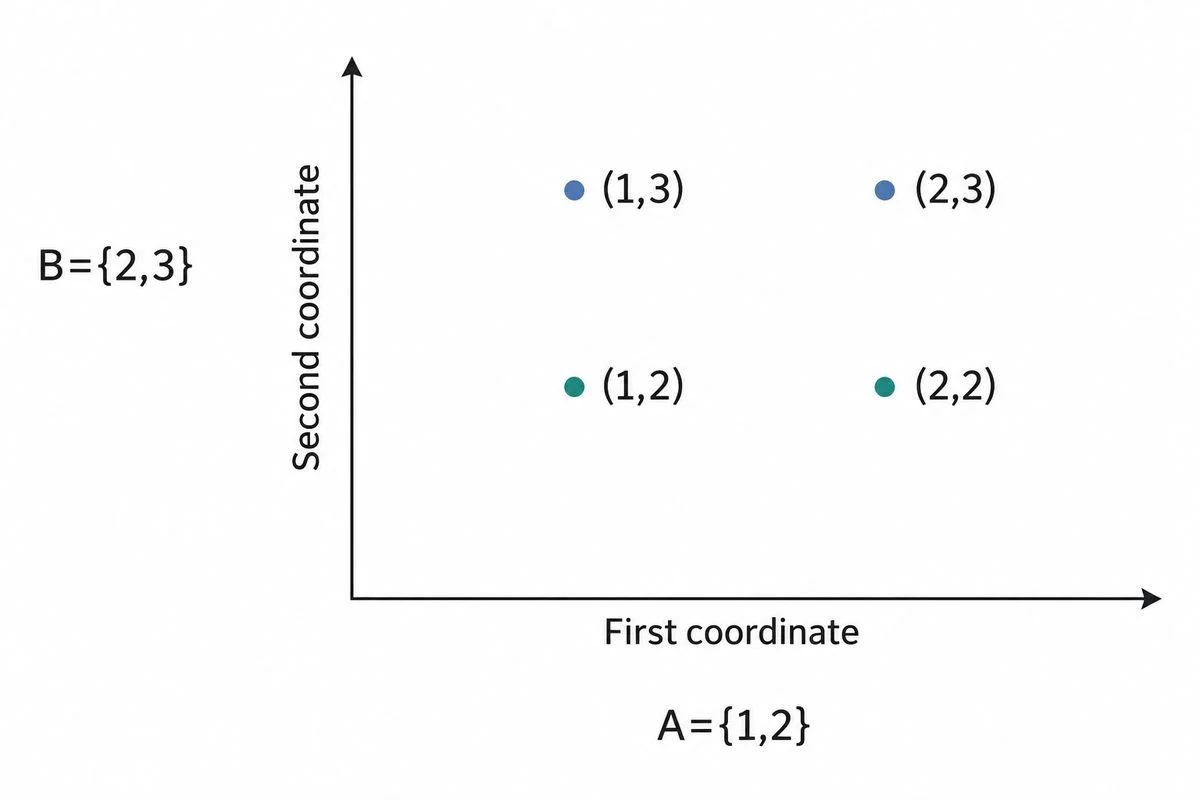
Look at the diagram. Read each point's horizontal coordinate first, then its vertical coordinate. Collect the different entries in each position.
Ask
If we rebuilt this product, which entries would supply A and which would supply B?
Say
Each first coordinate pairs with every second coordinate. For this nonempty product, first coordinates recover A, and second coordinates recover B.
Used in
Meal choices combine mains with accompaniments, helping kitchens list available combinations.
If your child says…“Changing the order makes no difference.”
Ask
Would swapping 1 and 3 keep their point in the same position?
What’s true
Switching different entries changes an ordered pair.
2. Number of elements in a Cartesian product and ordered triples
Multiply choices across positions.
Show
Say this first, then write the formula: A contains 0 and 1. B contains 2, 3 and 4. C contains 5 and 6.
Ask
How many triples can these six pairs make with C?
Say
There are twelve triples because each pair has two choices from C.
Used in
Map coordinates help locate destinations.
If your child says…“The counts match, so the products match.”
Ask
Can the reversed product start a pair with 0?
What’s true
Reversed products coincide only when their factors match or either factor is empty.
3. Cartesian product and set operations
The outside factor pairs with both inside sets.
Show
First say: A contains 0, B contains 1, and C contains 2. Union collects members from either set. Then write these lines.
Ask
Which products would give these two pairs separately?
Say
A times B gives (0,1), and A times C gives (0,2). Their union gives the same pairs as pairing A with B union C.
Used in
Combining activity lists preserves registrations without inventing new student–activity pairs.
If your child says…“Only the first inside set needs A.”
Ask
Where would the first entry of the second pair come from without A?
What’s true
Both resulting products need the outside factor.
Relations and functions
4. Relations; domain, codomain and range
Selected pairs determine participating inputs and outputs.
Show
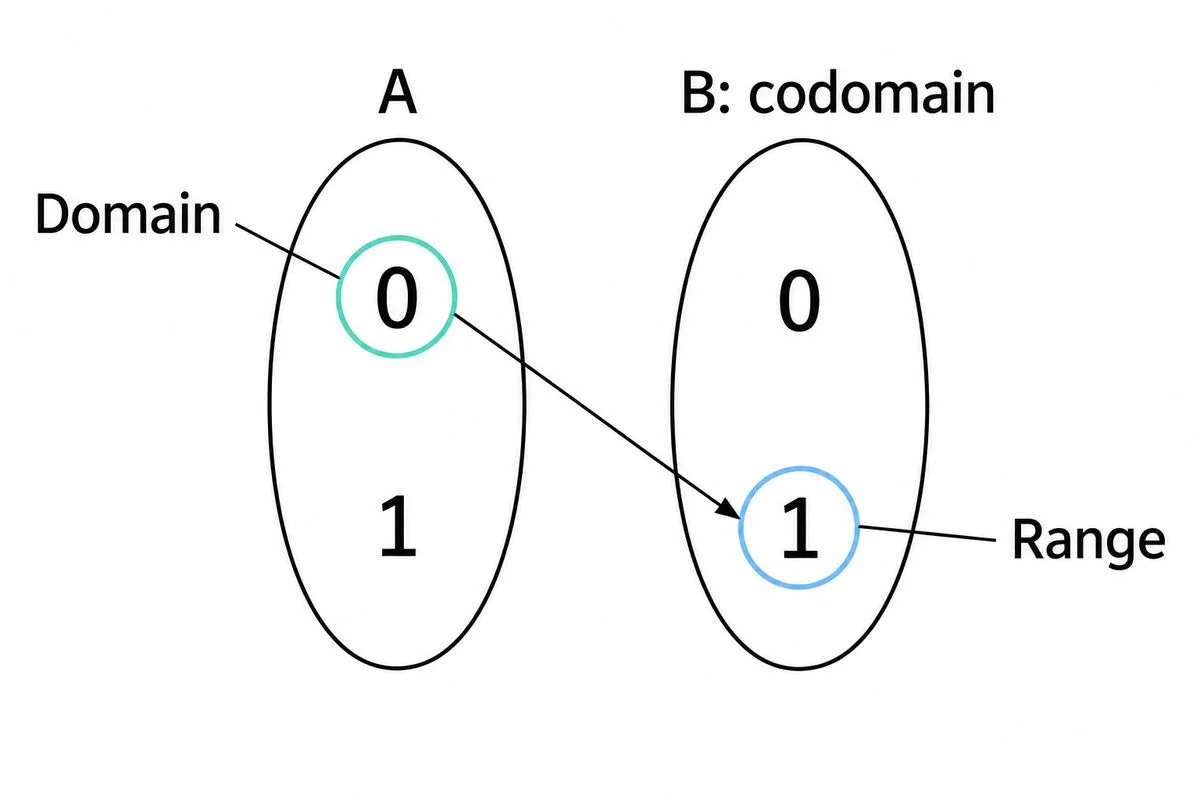
Look at the diagram for 'first entry smaller than second'. Follow the arrow, then inspect all of B.
Ask
Which entries take part under this rule?
Say
The domain contains 0, the range contains 1, and the codomain contains both.
Used in
Library borrowing records help track returns.
If your child says…“The range includes everything in B.”
Ask
Which arrow reaches 0?
What’s true
The range includes reached targets, while the codomain includes every allowed target.
5. Functions
Every allowed input receives exactly one output.
Show
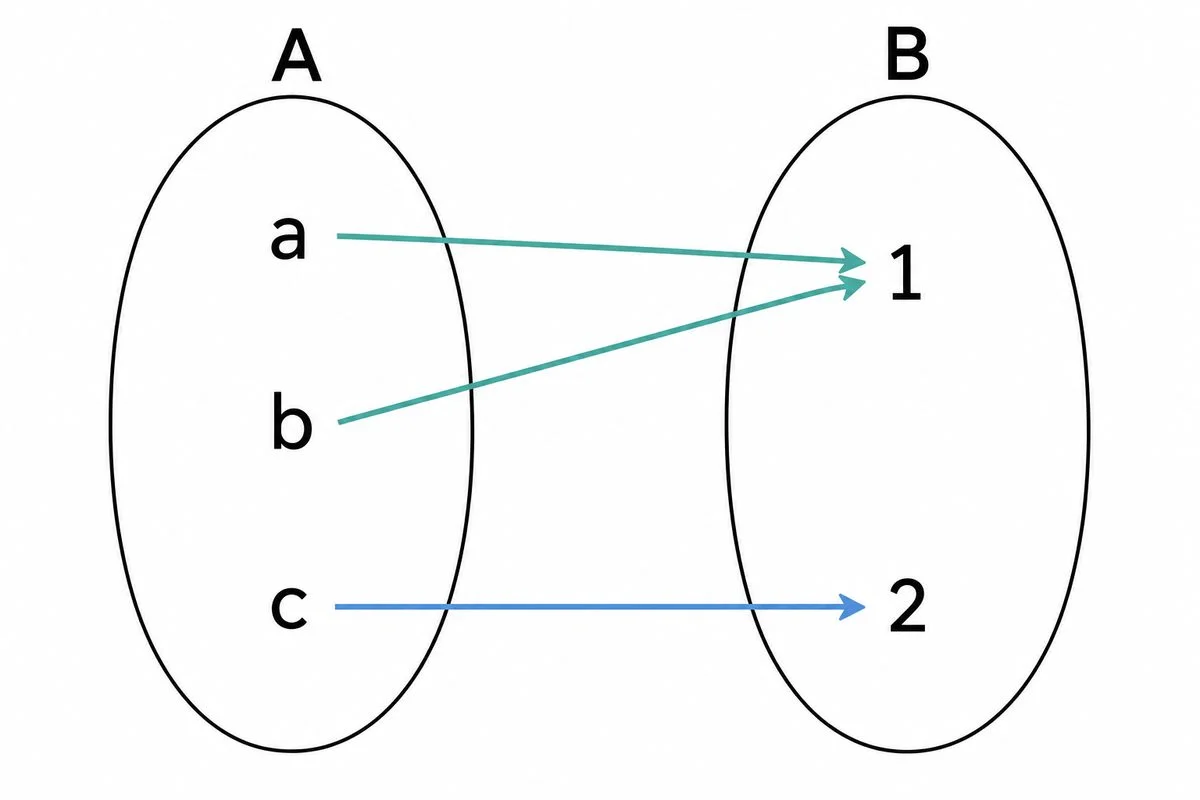
Look at the diagram. Count the arrows leaving each member of A. Follow the arrows from a and b to their shared output.
Ask
Does choosing any input here determine exactly one answer?
Say
Yes, every input has exactly one outgoing arrow, so this relation is a function. Different inputs may share an output.
Used in
A weighing scale assigns a weight reading to each parcel, helping calculate postage.
If your child says…“Different inputs need different outputs.”
Ask
Does a gain another output just because b reaches the same place?
What’s true
A function permits shared outputs but requires exactly one output for every input.
Working with function rules
6. Evaluation, domain and range of a real function
Check allowed inputs and attainable outputs.
Show
Say this first, then write the formula: f divides one by input x. Division by zero is undefined, so zero cannot be an input.
Ask
Which real numbers can come out of this rule?
Say
Every nonzero real number can come out, so the range also excludes zero. One divided by a nonzero number never gives zero. Any nonzero output is reached by using its reciprocal as the input.
Used in
Fare rules help travellers budget.
If your child says…“I can ignore the input’s negative sign.”
Ask
What number multiplied by negative one gives positive one?
What’s true
Substitution keeps the input’s sign.
7. Some functions and their graphs
Rules determine graph shapes.
Show
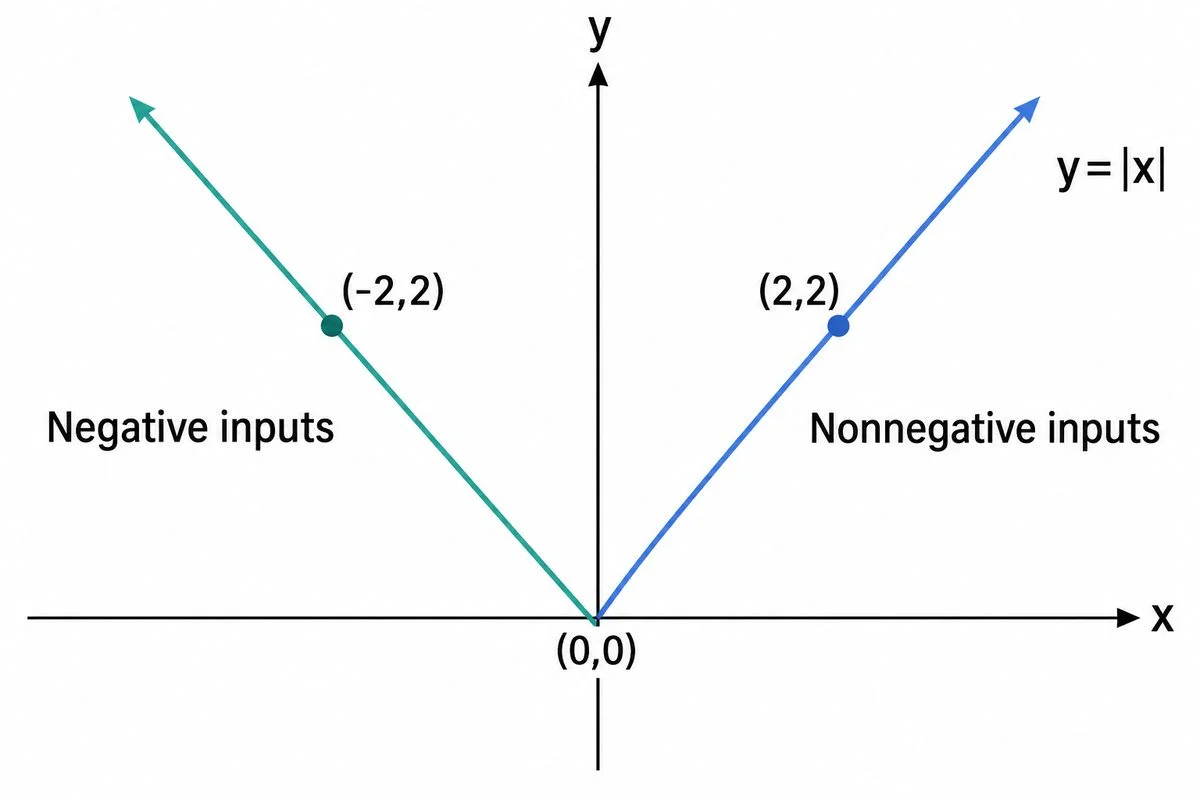
Look at the diagram: x marks inputs, and y marks outputs. Find the marked inputs, negative two and two. Follow their points to the same height.
Ask
From this graph, what output would negative three give?
Say
Negative three gives three because it lies three units from zero.
Used in
Size deviations help factories check accuracy.
If your child says…“A negative input stays negative inside the bars.”
Ask
Can a distance below zero describe how far apart two points are?
What’s true
Modulus measures distance from zero, so its output cannot be negative.
8. Algebra of real functions
Combine outputs at the same input.
Show
Say this first, then write the formula: f returns x; g returns x plus one. Subtract the whole output.
Ask
What remains after cancellation?
Say
Negative one remains.
Used in
Subtracting costs from income shows profit.
If your child says…“The minus changes only the first term.”
Ask
Have you subtracted the whole second output if you add its one?
What’s true
Subtracting a bracket subtracts every term inside.
A real problem
Mathematical relations made stored information easier to access.
Edgar Codd introduced the relational database model in 1970.
Earlier, retrieving information commonly required specialists to write programs.
His model organised records using mathematical relations involving several sets.
Relational databases made stored information easier for ordinary users to access.
We use cookies, including Meta’s and, if a ChatGPT advert brought
you, OpenAI’s, to see how visitors find us.
They are never used on your child’s screens in the app. You can turn them
off here, and change your mind any time.
Privacy policy