Skip to content

Teach Linear Inequalities in eight steps.

For each idea: show it, ask before you tell, then say one line.

Gather paper, a pencil and a ruler.

Common misconceptions & worked visual for this chapter · 15 practice questions with answers

How to teach it

Read comparisons

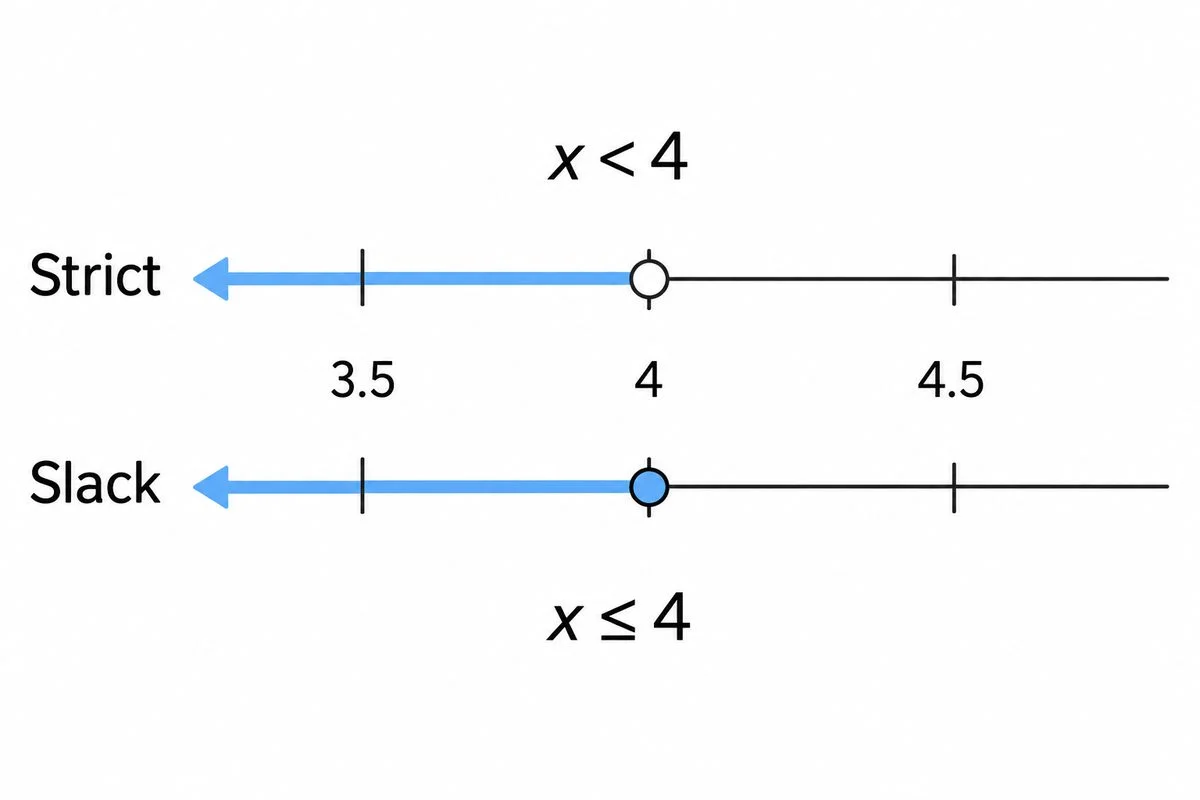
Two number lines compare an excluded boundary at four with an included boundary.

1. Inequalities; strict and slack inequalities

Comparisons give limits, with equality allowed only in slack inequalities.

Show
In the diagram, x names a number. Compare ‘less than four’ above with ‘at most four’ below.
Ask
Which comparison still holds when x reaches four?
Say
Only ‘at most four’ includes four.
Used in
Luggage weight limits allow lighter bags, helping prevent overloading.
If your child says…“At most four means less than four.”
Ask
Does exactly four exceed the limit?
What’s true
‘At most’ and ‘at least’ include equality; ‘less than’ and ‘greater than’ exclude it.
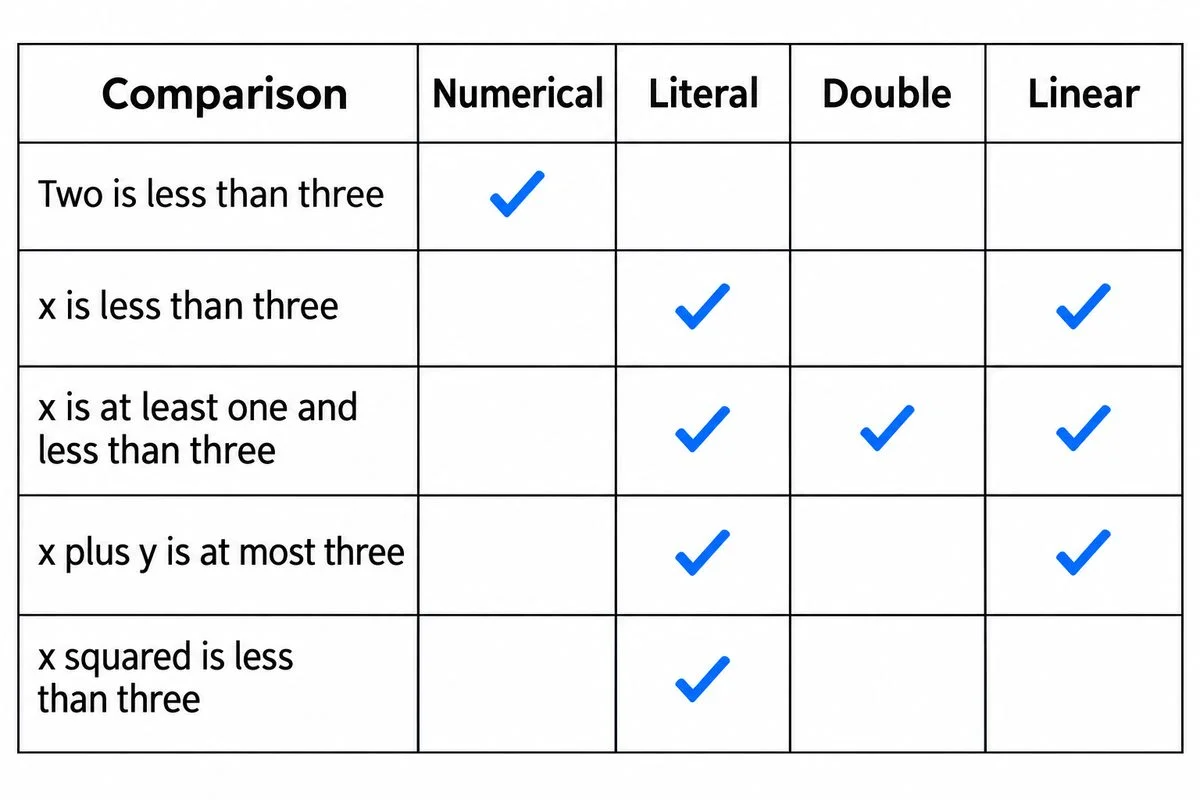
A comparison table shows overlapping numerical, literal, double and linear classifications.

2. Numerical, literal, double and linear inequalities

Numerical: numbers. Literal: variables. Double: two bounds. Linear: constant-plus-first-power terms.

Show
In the diagram, x and y name unknowns. Find the third row.
Ask
Which features place this row in several groups?
Say
An unknown between two bounds makes it literal and double. Its first-power variable makes it linear.
Used in
Shopping costs with fixed unit prices give linear comparisons, helping check affordable combinations.
If your child says…“The squared one is linear because it compares amounts.”
Ask
What power does x have in the last row?
What’s true
A nonzero squared term prevents an inequality from being linear.

Find and show solutions

2x+1<32x+1<3

2x<22x<2

2x2<22\frac{2x}{2}<\frac{2}{2}

3. Algebraic solutions of linear inequalities in one variable

Undo operations equally to find every allowed value that works.

Show
Write these lines. Say: ‘Subtracting equally preserves the gap. Dividing by positive two keeps the smaller side smaller.’
Ask
What does the final line simplify to?
Say
Every allowed number below one works.
Used in
A fixed charge plus a usage charge sets how much usage a budget allows.
If your child says…“Dividing by positive two reverses the sign.”
Ask
When both sides are halved, does the smaller side become larger?
What’s true
Positive division preserves order.

−2x>−5-2x>-5

x<52x<\frac{5}{2}

SR=(−∞,52)S_{\mathbb R}=(-\infty,\frac{5}{2})

4. Rule 2; solutions in different number sets

Negative scaling reverses order; the allowed number set restricts solutions.

Show
Write these lines. Say: ‘Negative division reflects positions across zero, reversing their left-to-right order.’
Ask
Which integers remain below this bound?
Say
Keep two and every smaller integer.
Used in
Whole-item orders require integer quantities, preventing answers that include part of an indivisible item.
If your child says…“The answer includes fractions even when x must be an integer.”
Ask
Is one and a half an integer, even though it lies below the bound?
What’s true
Keep only solutions belonging to the allowed number set.
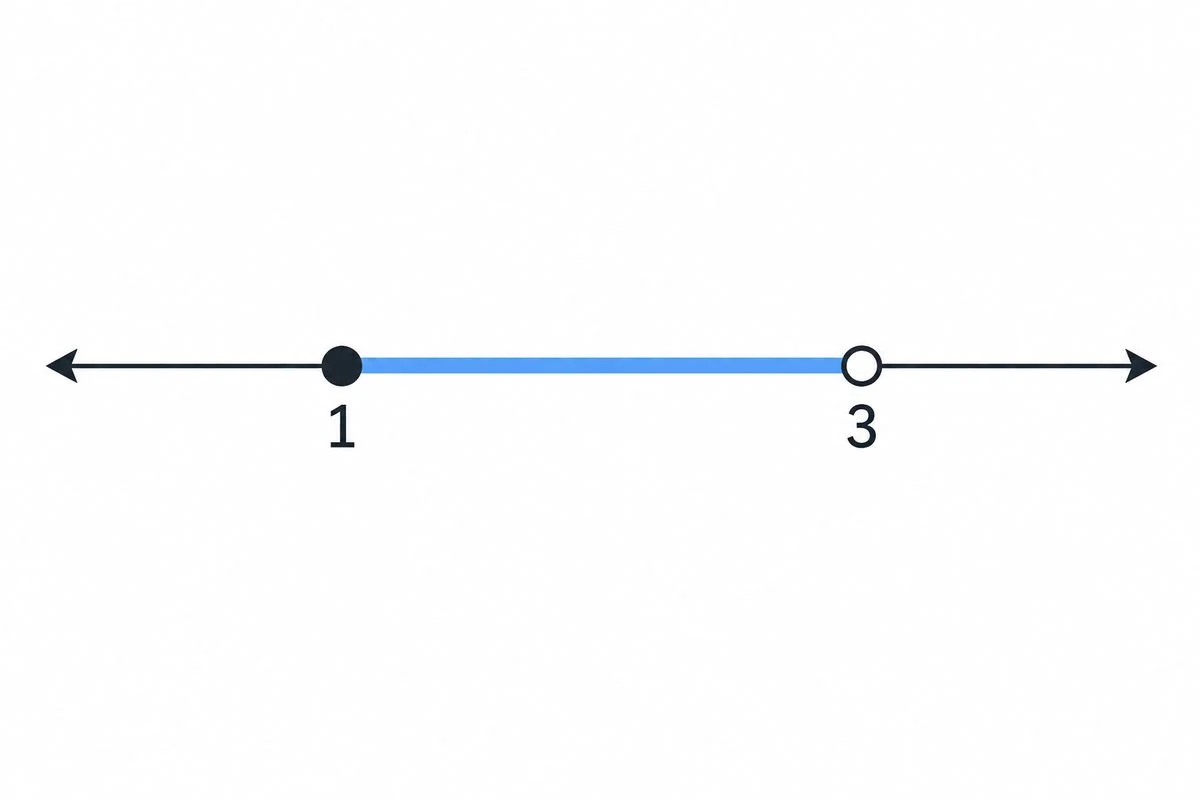
Number line shaded from a filled circle at 1 to an open circle at 3.

5. Graphical representation and interval notation

Lines and brackets show the allowed values and included endpoints.

Show
Look at the diagram. Say: ‘x is at least one and less than three.’ Find the filled endpoint, the open endpoint and the shaded segment between them.
Ask
Which interval brackets will match these circles?
Say
A square bracket includes one and a round bracket excludes three: [1,3)[1,3).
Used in
Measurement ranges show which sizes fit a part, helping avoid unsuitable replacements.
If your child says…“The endpoint is always left out.”
Ask
Does one meet ‘at least one’?
What’s true
An endpoint belongs when the comparison allows equality there.

Apply and combine limits

2+x2≥3\frac{2+x}{2}\geq3

2+x≥62+x\geq6

x≥6−2x\geq6-2

6. Applications of linear inequalities

Build the quantity described, then compare it with its limit.

Show
Use two equally weighted tests, each out of five. The first score is two; call the second x. Require an average of at least three. Write these lines, saying: ‘Divide the total by two to find the average.’
Ask
What does the final line become?
Say
The second score must be between four and five, including both. Four is the minimum because the limit applies to the average.
Used in
Average spending limits help balance expensive days with cheaper ones.
If your child says…“The total only needs to reach three.”
Ask
If the total were three, what would dividing it by two give?
What’s true
The required average applies after dividing the total by the number of tests.

1≤2x+1<51\leq2x+1<5

0≤2x<40\leq2x<4

02≤2x2<42\frac{0}{2}\leq\frac{2x}{2}<\frac{4}{2}

7. Double inequalities

Keep both bounds by changing all three parts equally.

Show
Write these lines. Say: ‘The middle must meet both limits. Subtract one throughout, then divide all three parts by two.’
Ask
What range remains after simplifying the final line?
Say
Changing all three parts equally leaves x at least zero and less than two.
Used in
Storage temperature ranges set lower and upper limits to help protect food.
If your child says…“I only need to change the two ends.”
Ask
If the middle stays unchanged, have you subtracted equally from both comparisons?
What’s true
The middle belongs to both comparisons, so it must receive the same operation.
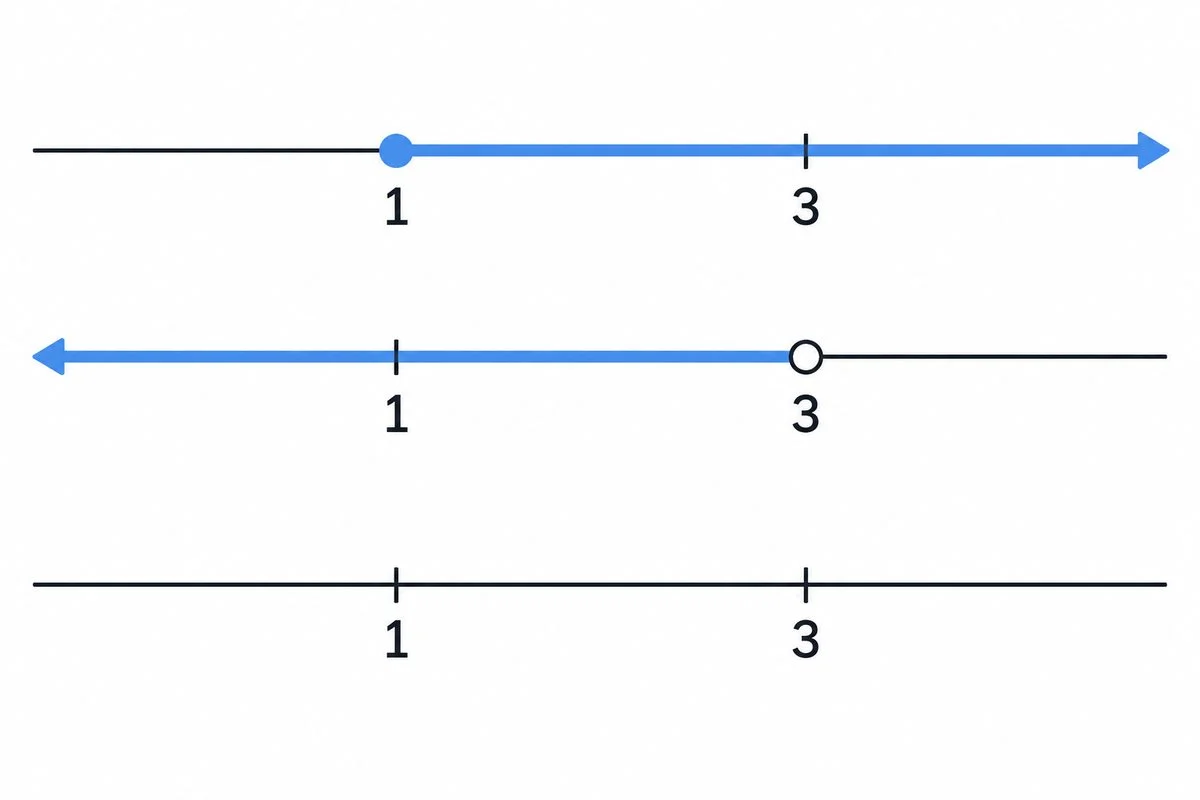
Three number lines show values at least 1, values below 3, and an unshaded bottom line.

8. System of inequalities

Keep only values that satisfy every required comparison.

Show
Read ‘x plus one is at least two’ and ‘twice x is less than six’. In the diagram, find the shaded range for each condition. Find where the top two shaded ranges overlap.
Ask
Which values would the third line show if it kept only the overlap?
Say
Keep only the overlap, from one included to three excluded: 1≤x<31\leq x<3.
Used in
Food combinations must meet every nutrient minimum, helping identify choices that satisfy all requirements.
If your child says…“Passing either condition is enough.”
Ask
Does three pass the condition ‘twice x is less than six’?
What’s true
Every solution must pass both conditions.

A real problem

Stigler’s diet problem combined nutritional limits with minimum cost.

The problem sought the cheapest food combination meeting recommended nutrient allowances.

Linear inequalities expressed the nutritional limits in the search for a low-cost diet.

Calculations established the model’s minimum diet cost in 1947.

INFORMS, hosted by University of PaviaWikipediaMIT BLOSSOMS

Loose groceries beside a closed notebook and calculator on a kitchen table.

Concept Lab · Common misconception

The tempting mistake in Linear Inequalities

Open standalone misconception page →

Can you multiply an inequality by a negative without reversing it?

Wrong

From −2x < 6, divide by −2 to get x < −3.

Why it feels right. I use the equation rule for both sides.

Right

Multiplying or dividing by a negative reverses order.

Worked example

The original inequality is true at x = 0. The solution extends to the right of −3 and includes 0.
  1. Check x = 0 in the original inequality.
  2. It works.
  3. Dividing correctly gives x > −3, which includes 0.

Ask your child eight quick questions.

One per step. The answer and the reason are given.

  1. Which comparison allows exactly four?

    At most four. A slack inequality includes equality at its boundary.

  2. Which feature makes the last comparison non-linear?

    The squared variable. Linear variable terms have power one.

  3. After dividing here, which values of x work?

    Every allowed value below one. Positive division keeps the comparison pointing the same way.

  4. Which natural numbers satisfy this inequality?

    One and two. Natural numbers start at one here, and the bound excludes three and larger numbers.

  5. Which endpoint belongs to this range: 1 or 3?

    One. The lower limit allows equality, but the upper limit excludes it.

  6. What total reaches an average of three across these two tests?

    Six. Dividing six by two gives the required average.

  7. After subtracting one throughout, what must the middle expression become?

    2x2x Subtracting one must change the middle as well as both ends.

  8. Why must three be excluded even though it passes the first condition?

    It fails the second condition. A solution must satisfy both conditions.

15 more questions with answers, 2 with pictures