Skip to content

Teach Sets in eight steps.

For each idea: show it, ask before you tell, then say one line.

Gather paper and a pencil.

Common misconceptions & worked visual for this chapter · 15 practice questions with answers

How to teach it

Members and collections

A={x∣x is a letter in MAMA}A=\{x\mid x\text{ is a letter in MAMA}\}

M, A, M, A.

1. Sets and their representations

A clear rule identifies members; a roster lists them.

Show
Write these lines. Say that x stands for a letter, and the vertical bar means “such that”.
Ask
What roster remains after removing repeats?
Say
The roster contains M and A once each. Both lines identify the same letters.
Used in
Clear sorting rules help libraries group books so readers can find them.
If your child says…“MAMA gives four elements because it has four letters.”
Ask
When M appears again, which new letter has arrived?
What’s true
Count different letters, rather than their appearances.
E contains natural numbers below 1.

F contains natural numbers below 4.

N={1,2,3,…}\mathbb N=\{1,2,3,\ldots\}

2. The empty set; finite and infinite sets

Finite sets have whole-number counts, even when those counts are unknown.

Show
Write these lines. Say: “We write the number of elements in E as n of E.”
Ask
Which collections would eventually stop producing new members if you kept listing them?
Say
E has zero members and F has three, so both are finite. E's number of elements is written n(E)=0n(E)=0. Natural numbers have no last member because adding one always gives another.
Used in
An empty search result tells us that nothing matches the chosen rule.
If your child says…“An empty set cannot be finite.”
Ask
How many natural numbers below 1 qualify, and is that count unfinished?
What’s true
Zero is a definite count, so an empty set is finite.
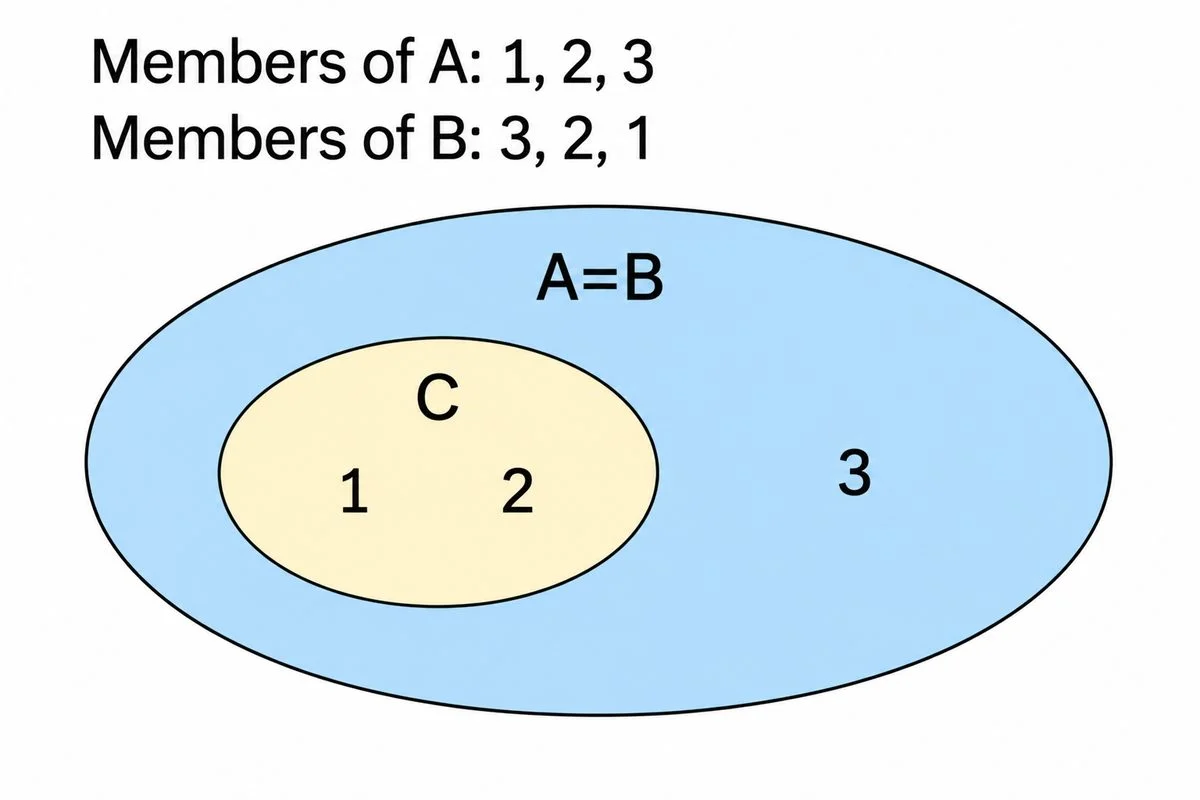
Matching rosters above nested ovals, with 3 outside the smaller set C.

3. Equal sets and subsets

Equal sets match members; subsets use only another set's members.

Show
Compare the diagram's rosters. Find C, then 3 outside C.
Ask
Which sets have identical members?
Say
A and B match, so they are equal. C is A's proper subset because it lacks 3. A is C's superset.
Used in
School club lists are subsets of pupil lists, helping check eligibility.
If your child says…“I can put the subset sign between 1 and A.”
Ask
Are you checking the number 1 itself, or every member of a collection?
What’s true
A is its own subset, but 1 is an element of A.
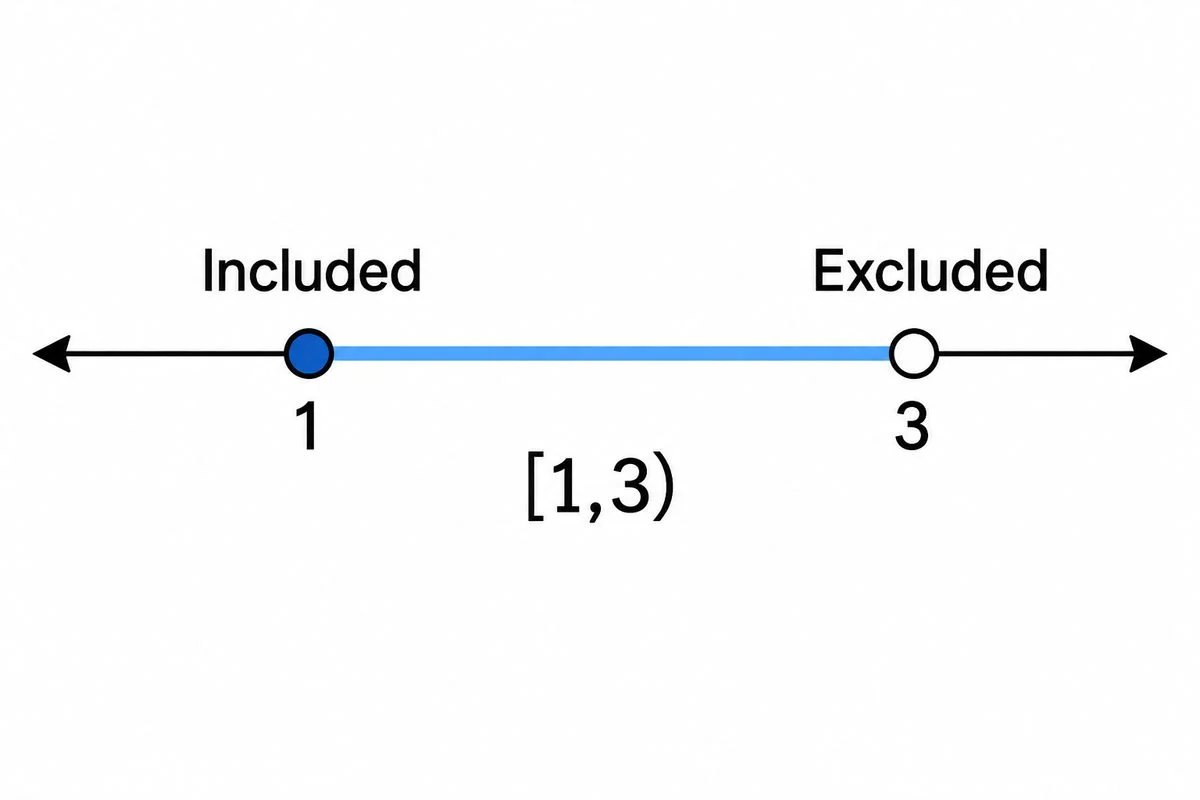
Highlighted number-line interval with 1 included and 3 excluded.

4. Intervals as subsets of the real numbers

Intervals include every real number between their stated boundaries.

Show
Look at the diagram. Follow the highlighted segment from the filled dot to the open circle. Point to the interval notation below.
Ask
Would numbers between 1 and 2 belong to this highlighted interval too?
Say
The interval contains every real number from 1 up to, but excluding, 3. The square bracket includes 1, and the round bracket excludes 3: [1,3)[1,3).
Used in
Allowed measurement ranges help carpenters check whether a piece will fit.
If your child says…“Only whole numbers belong to an interval.”
Ask
Where does 2.5 fall on the continuous segment?
What’s true
The interval includes fractional positions as well as whole-number positions.

Combining and comparing sets

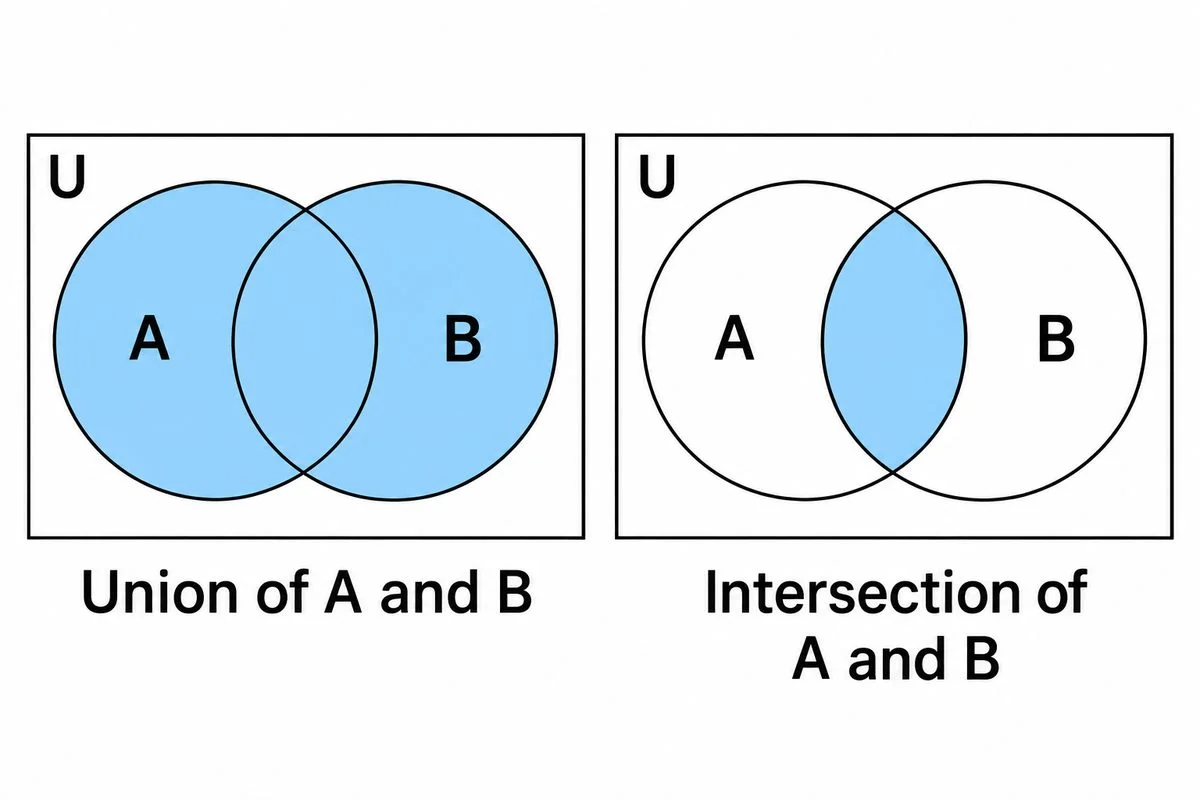
Union shades both circles; intersection shades only their overlap within the universal set.

5. Universal set, Venn diagrams, union and intersection

Union accepts either membership; intersection requires both.

Show
Compare the diagrams' shading. A and B are invitation lists.
Ask
Would combining these lists include someone listed only in A?
Say
Yes; union takes either circle. U contains everyone considered. Intersection takes their overlap.
Used in
Matching availability lists finds times when everyone can attend.
If your child says…“The union contains only the overlap.”
Ask
Would someone listed only in A still be invited?
What’s true
The union includes both entire circles, while the intersection includes only their overlap.

A contains 1, 2 and 3.

B contains 2 and 4.

A−B={1,3}A-B=\{1,3\}

6. Difference of sets

Keep members of the first set absent from the second.

Show
Write these lines. Say: “A minus B starts with A and removes members also in B.”
Ask
Starting with B instead, which members remain after removing those also in A?
Say
Only 4 remains when we start with B. Starting with A kept 1 and 3, so reversing the order changes the result.
Used in
Comparing registered names with arrivals identifies who has yet to arrive.
If your child says…“4 belongs in A minus B too.”
Ask
Was 4 ever a member of A?
What’s true
A minus B can contain only members of A.
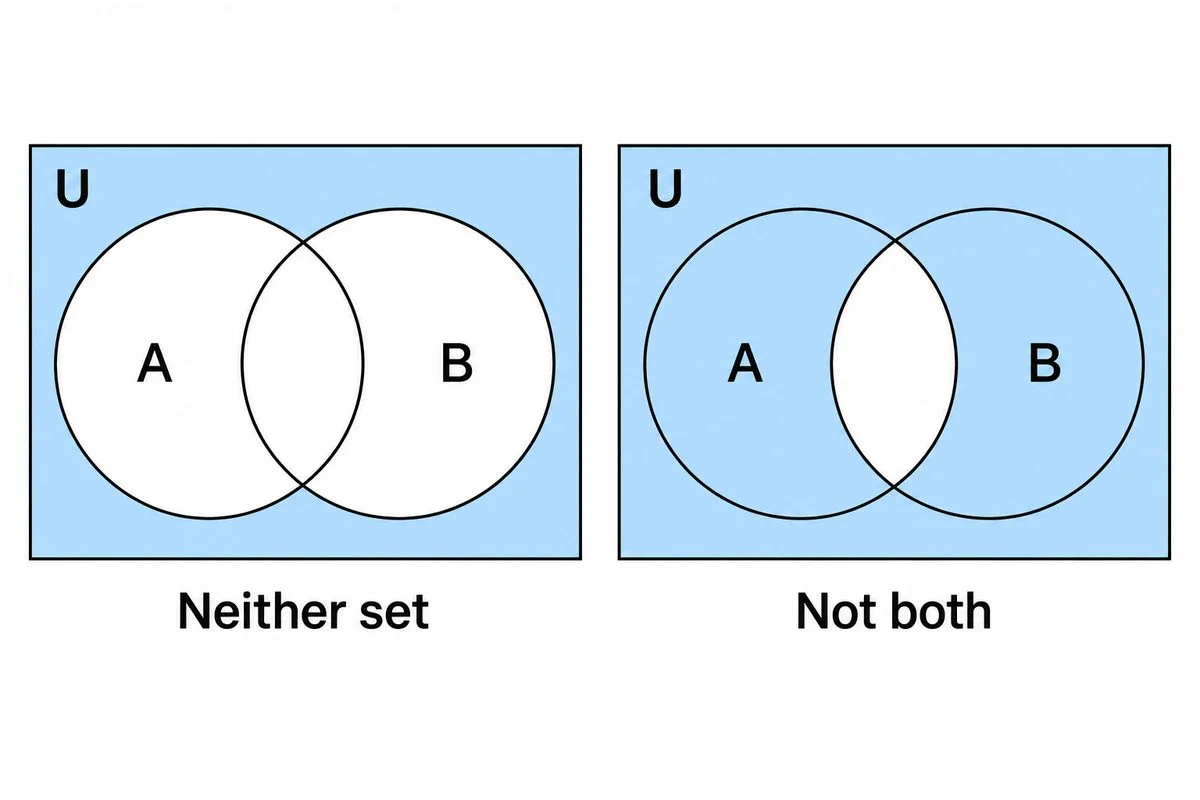
Left shading excludes both circles; right shading excludes only their overlap.

7. Complement of a set and De Morgan’s laws

A complement keeps everything outside a set, within its universe.

Show
Compare the diagrams' shaded regions within U.
Ask
Would a point inside A alone enter the union's complement?
Say
No, because it belongs to the union. Outside the union means outside both sets. Outside the intersection means outside at least one set.
Used in
Excluding books in either unwanted category leaves books outside both categories.
If your child says…“Being outside either circle is enough to be outside their union.”
Ask
Which panel shades a point inside A but outside B?
What’s true
The left shading excludes both circles; the right excludes only their shared part.

A∪B={x∣x∈A or x∈B}A\cup B=\{x\mid x\in A\text{ or }x\in B\}

A∪B={x∣x∈B or x∈A}A\cup B=\{x\mid x\in B\text{ or }x\in A\}

8. Equality of sets

Prove matching membership in both directions for arbitrary sets.

Show
Write these lines. Say: “Union means or; choose any sets A and B. The cup-shaped symbol means union.” Read the membership test forwards and backwards.
Ask
Will reversing these membership alternatives change which elements are included?
Say
Reversing the alternatives changes nothing: A∪B=B∪AA\cup B=B\cup A. Both directions work for arbitrary sets.
Used in
Equivalent database searches return the same records, allowing a simpler search to replace a complicated one.
If your child says…“It worked for my chosen sets, so it works for every set.”
Ask
What has your example checked about sets you never tried?
What’s true
A general proof covers arbitrary sets; one failing example disproves a universal claim.

A real problem

Set operations help retrieve stored information.

Edgar Codd introduced the relational database model in 1970.

Users could retrieve information without knowing how the database was physically organised.

Its algebra combines compatible collections of records using union, intersection and set difference.

WikipediaIBMJuniata College

Library computer displaying a book catalogue.

Concept Lab · Common misconception

The tempting mistake in Sets

Open standalone misconception page →

Can you switch an element and a subset?

Wrong

1 is a subset of {1, 2}.

Why it feels right. The number 1 appears inside the braces.

Right

An element belongs to a set. A subset is itself a set.

Worked example

Larger set
{12}
Member
1∈{1, 2}
One-element subset
{1}⊆{1, 2}
The element is the number 1. The subset is a set with that one number inside.
  1. Write 1 ∈ {1, 2}.
  2. Write {1} ⊆ {1, 2}.
  3. The braces change the object from a number to a set.

Ask your child eight quick questions.

One per step. The answer and the reason are given.

  1. How many elements belong to the set of letters in MAMA?

    Two. Only M and A occur; repeated appearances add no members.

  2. How would you classify E: finite or infinite?

    Finite. The selection has zero members, which is a definite count.

  3. Which symbol belongs between the number 1 and set A?

    ∈\in The number is an element; the subset sign compares sets.

  4. Does 2.5 belong to this interval?

    Yes. It lies between the boundaries; intervals include fractions and decimals.

  5. Which includes someone listed only in A: the union or the intersection?

    Union. Union requires membership in either list; intersection requires membership in both.

  6. Which numbers belong to A minus B?

    1 and 3. Both belong to A and neither belongs to B.

  7. A point lies inside A but outside B. Which panel shades its position?

    The right panel. It lies outside the overlap, but not outside both circles.

  8. What is still needed after an identity works for one choice of sets?

    A general proof. One successful case leaves other sets unchecked.

15 more questions with answers, 4 with pictures