Skip to content

Teach Biodiversity and Conservation in eight steps.

For each idea: show it, ask before you tell, then say one line.

Gather paper and a pencil.

Common misconceptions & worked visual for this chapter · 15 practice questions with answers

How to teach it

Recognise biodiversity

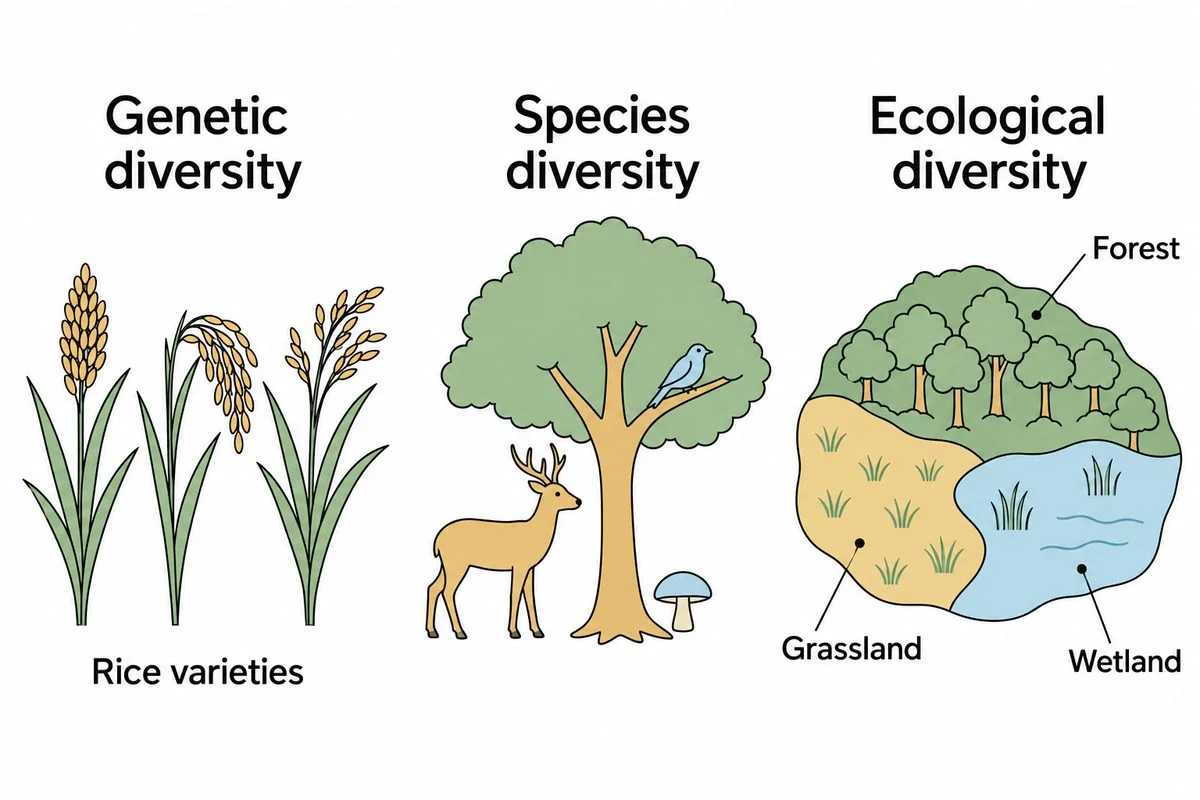
Three panels distinguish rice varieties, forest species and different ecosystems.

1. Genetic diversity, species diversity and ecological diversity

Variety within species, between species and among ecosystems.

Show
Read the diagram from left to right: rice varieties, forest species, then different ecosystems.
Ask
Would a species list capture all the variety shown here?
Say
No. It misses inherited differences within species and the variety of ecosystems.
Used in
Crop breeders use inherited variety to develop crops suited to different conditions.
If your child says…“Biodiversity means counting species.”
Ask
Would listing rice once record the inherited differences between its varieties?
What’s true
Species counts miss genetic and ecosystem variety, and appearance alone cannot establish genetic differences.
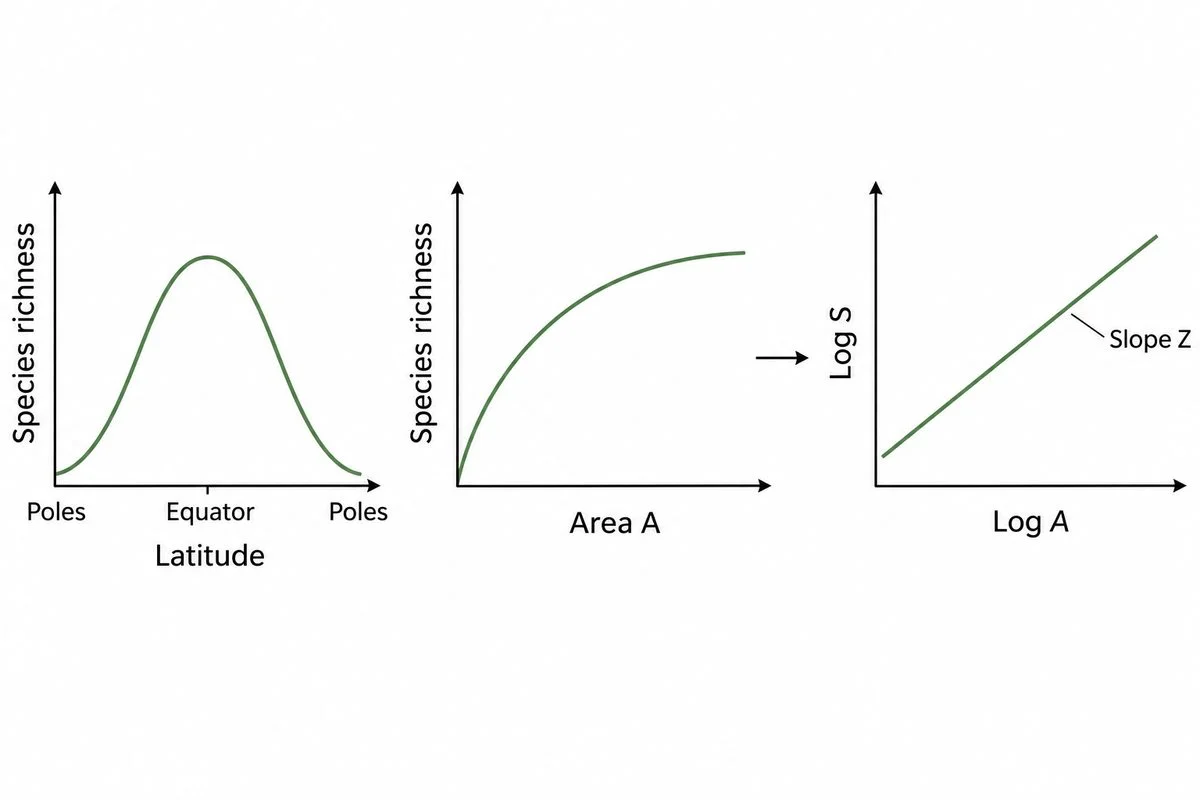
Latitude, species–area and logarithmic graphs show broad patterns in species richness.

2. Patterns of Biodiversity

Species richness generally increases towards the tropics and across larger areas.

Show
Trace the diagram's latitude peak, area curve and logarithmic line.
Ask
How should species richness change as surveyed area increases?
Say
Richness usually rises towards the tropics and with area.
Used in
Habitat surveys use area comparisons to assess how much variety a protected area includes.
If your child says…“A bigger area means fewer species.”
Ask
Which direction does the species–area curve go as area increases?
What’s true
The species–area model describes a broad trend, not a guarantee for every comparison between sites.
Overlapping aircraft panels joined by rows of rivets.

3. Importance of Species Diversity to the Ecosystem

Different species support production and steadier ecosystem functioning.

Show
Trace the row of rivets holding the overlapping aircraft panels together in the photo.
Ask
Would repeatedly removing these fasteners leave this joint equally dependable?
Say
Losing fasteners can weaken this joint, just as losing species can weaken ecosystems.
Used in
Protecting pollinators helps flowering crops produce seeds.
If your child says…“Every species does the same job.”
Ask
Could any other species automatically replace a lost pollinator?
What’s true
Species have different roles, although some can partly compensate for others.

Understand biodiversity loss

R=rpresentrbackgroundR=\frac{r_{\mathrm{present}}}{r_{\mathrm{background}}}

R=1001R=\frac{100}{1}

4. Loss of Biodiversity

Human activity accelerates extinction, and records miss some losses.

Show
Write these lines. Say: 'R is the present extinction rate divided by the background extinction rate. The numerator r means the present rate. The denominator r means the background rate. Both use extinctions per million species per year.' Use simplified rates: present 100, background 1.
Ask
At these rates, how many times faster would species disappear in the present?
Say
The multiplier is 100 in this simplified comparison.
Used in
Extinction records help conservation teams recognise losses and plan protection.
If your child says…“The recorded list includes every extinction.”
Ask
How would a list include a species nobody had discovered?
What’s true
Species can disappear before discovery or without anyone recording their loss.
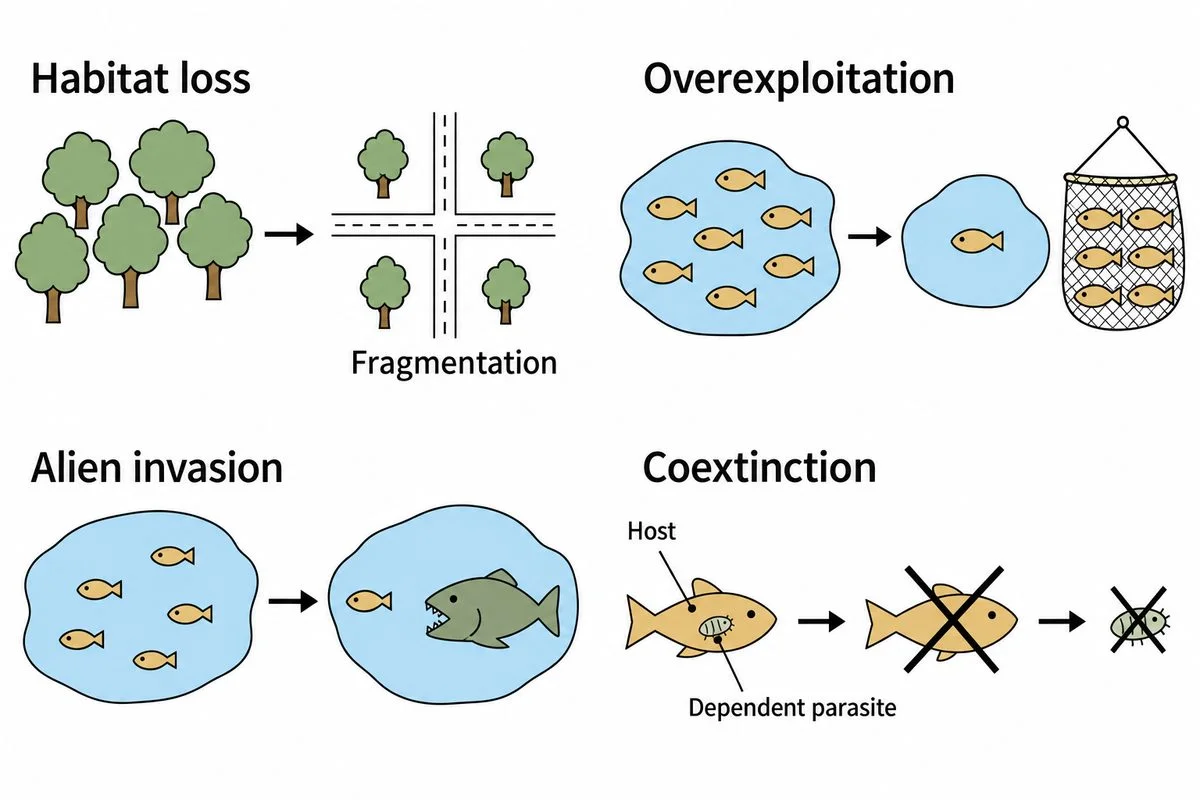
Four paired scenes show habitat damage, overharvesting, invasion and dependent species loss.

5. Causes of Biodiversity Losses: The Evil Quartet

Habitat damage, overharvesting, invasions and dependent species losses threaten biodiversity.

Show
Follow the diagram's arrows through forest clearance, fish harvesting, predator arrival and host loss.
Ask
Would preventing forest clearance prevent every loss shown here?
Say
No. Habitat damage removes or divides living space, while overharvesting takes organisms faster than populations recover. Some introduced species harm natives, and losing an irreplaceable partner can cause coextinction.
Used in
Forest corridors help separated populations move and exchange genes.
If your child says…“Species can suffer coextinction without depending on each other.”
Ask
What could the parasite survive on after its only host species vanished?
What’s true
Coextinction involves dependence on a species that disappears.

Protect biodiversity

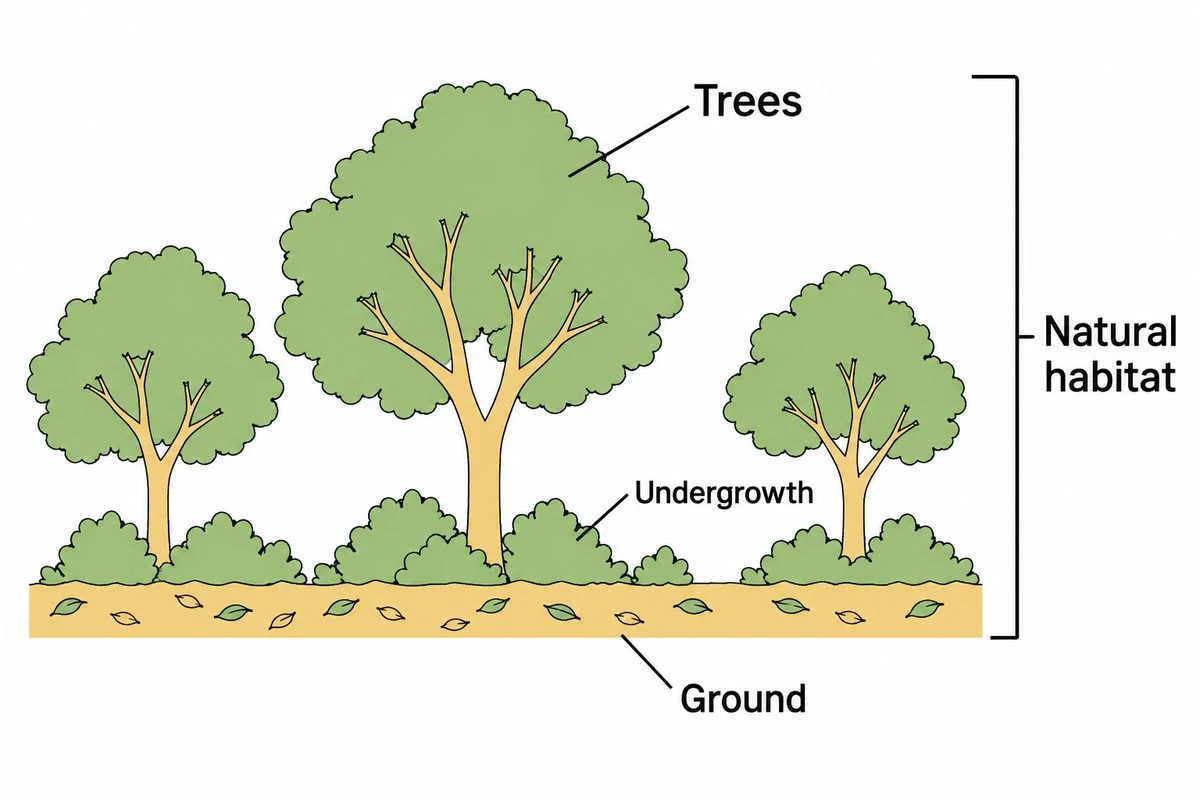
Diagram of trees, undergrowth and leaf-covered ground sharing one natural habitat.

6. In situ Conservation

Protect species together within their natural habitats.

Show
Find the largest tree, other trees, undergrowth and ground in the diagram. Notice their shared natural habitat.
Ask
What would protecting only the largest tree leave unprotected?
Say
Protecting only the largest tree would leave the other trees, undergrowth and ground unprotected.
Used in
National parks preserve shared habitats, keeping interacting species together.
If your child says…“Every species-rich forest is a hotspot.”
Ask
What must we also know about unique species and habitat loss?
What’s true
Many species alone do not establish hotspot status.
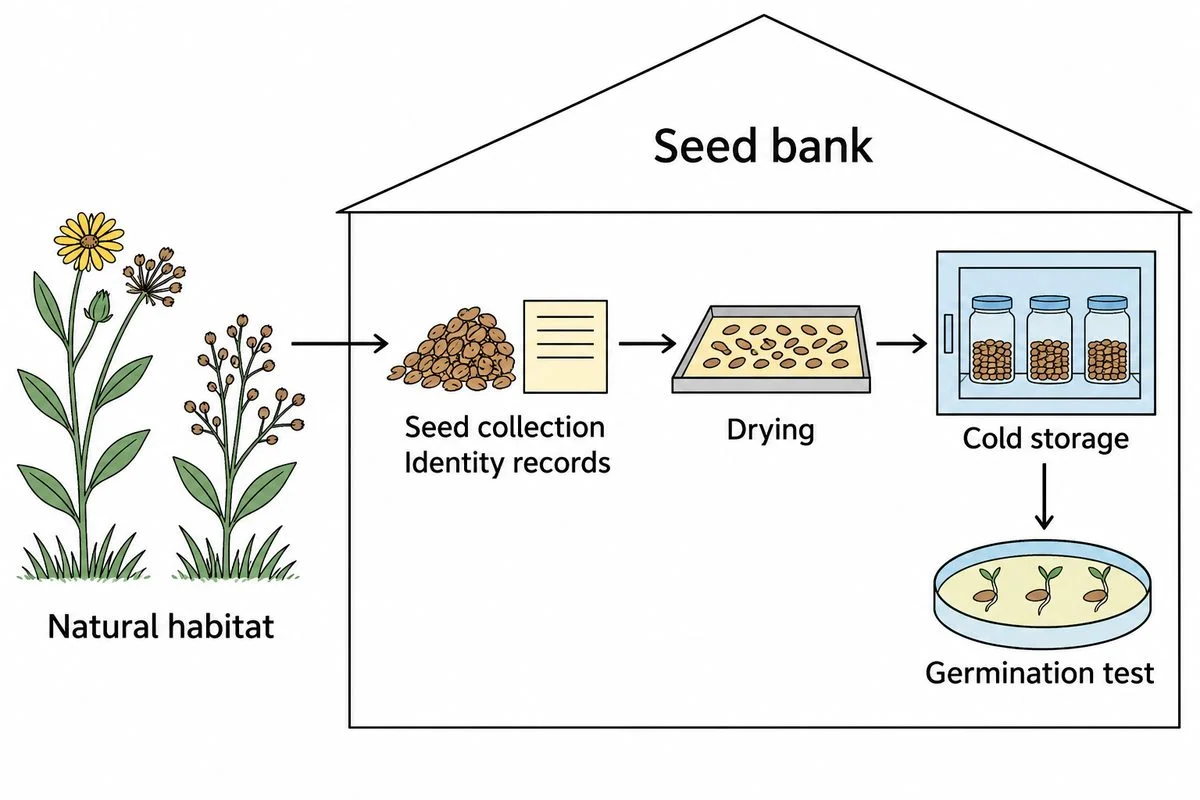
Seeds move from wild plants through bank storage to a germination test.

7. Ex situ Conservation

Keep organisms or reproductive material outside their natural habitats.

Show
Follow the diagram from wild plants through identification, drying and cold storage to germination testing.
Ask
What could this bank provide if the wild plant population disappeared?
Say
It could provide living seeds for growing plants outside their original habitat. Germination tests check whether stored seeds can still grow.
Used in
Seed banks retain plant varieties for future sowing alongside habitat protection.
If your child says…“Seed banks can save every species.”
Ask
What if a plant's seeds cannot survive drying and cold storage?
What’s true
Other species need living collections, frozen reproductive material or managed breeding.
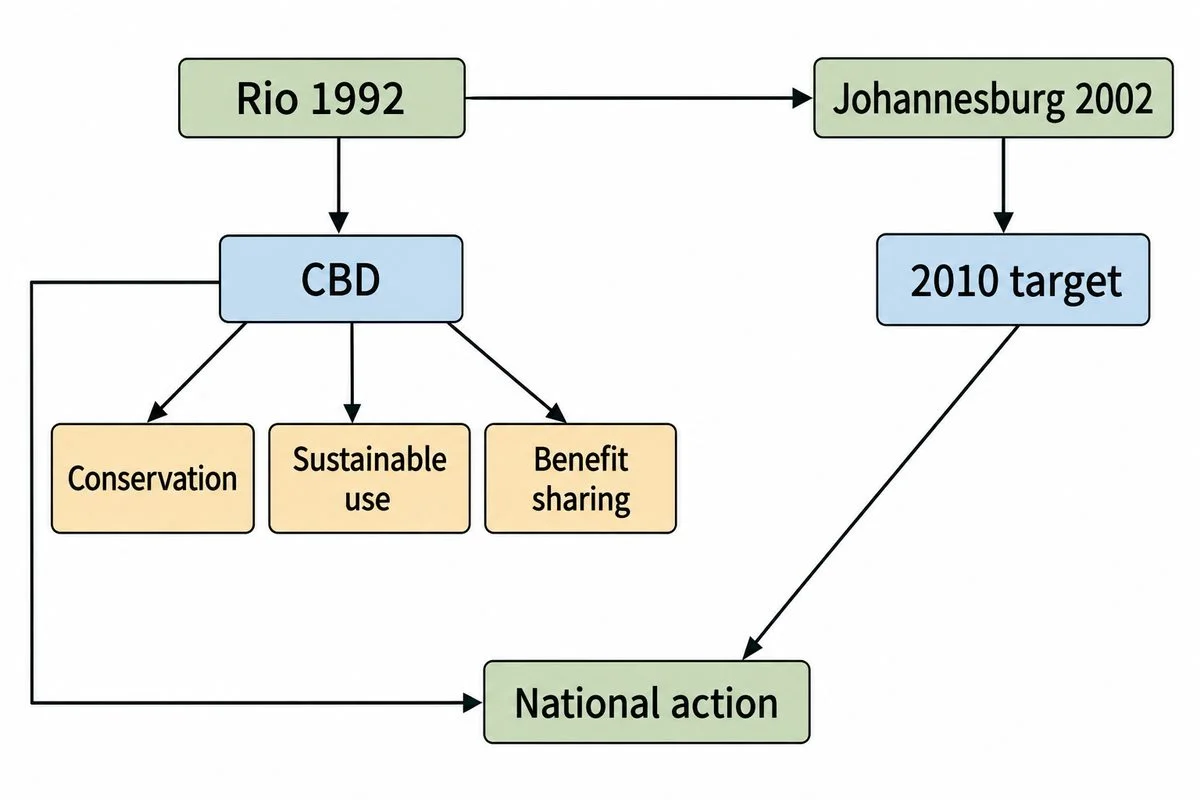
International milestones and shared conservation goals lead towards national action.

8. Biodiversity Conservation: Global Cooperation

Countries agree shared goals, then carry out conservation action.

Show
Follow CBD's goals, Johannesburg's target and national action in the diagram.
Ask
Would these agreements protect forests without action?
Say
CBD sets goals for conservation, sustainable use and fair sharing of benefits from genetic resources. Johannesburg's 2010 target was a commitment, not evidence of success. Countries must act.
Used in
International conservation agreements coordinate national efforts, helping countries address shared threats.
If your child says…“A Red List category saves the species.”
Ask
What changes in a forest just because its threatened species receives a category?
What’s true
A risk category alone cannot protect habitats or rebuild populations.

A real problem

A conservation campaign saved Silent Valley from a dam project.

The proposed dam threatened forest flooding and fragmentation of the lion-tailed macaque's habitat.

An expert committee warned that habitat size and species diversity would fall.

The campaign succeeded, and the hydropower project was scrapped.

Silent Valley became a national park in 1984.

The Indian ExpressDown To Earth

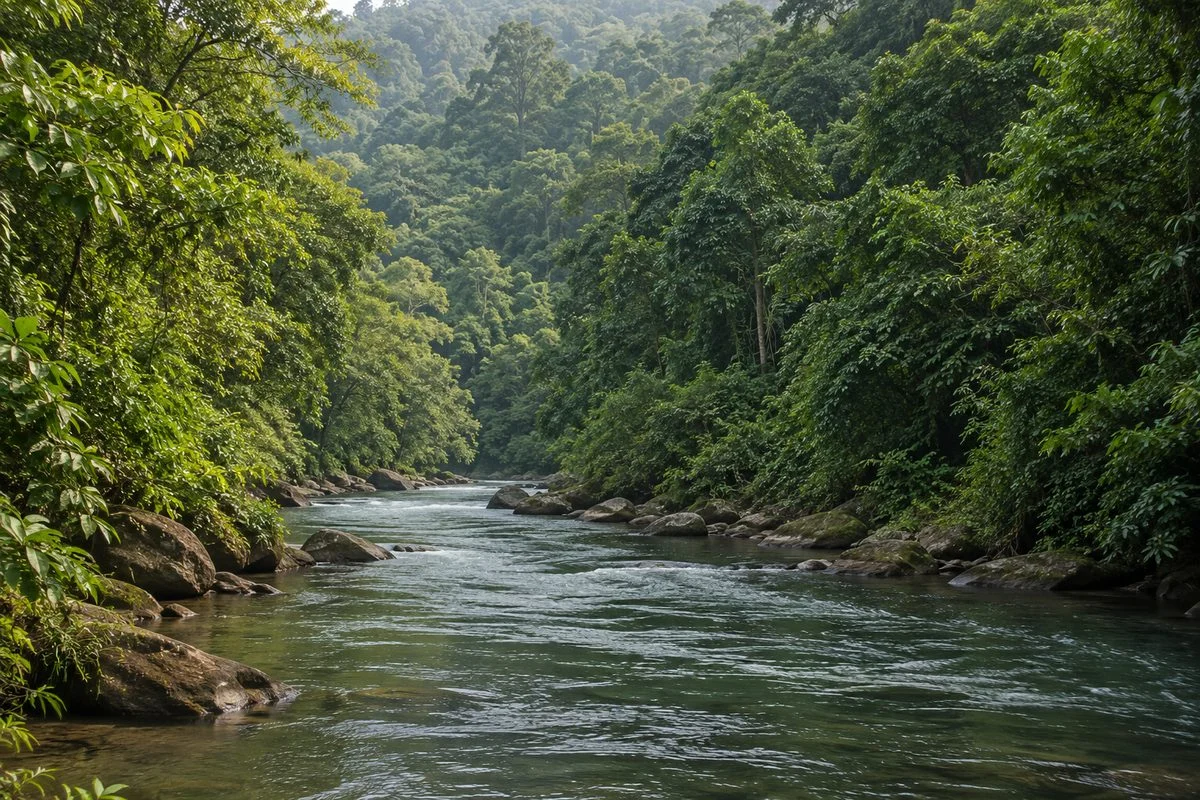
A river flowing through dense green forest in Silent Valley.

Concept Lab · Common misconception

The tempting mistake in Biodiversity and Conservation

Open standalone misconception page →

Can species count alone describe biodiversity?

Wrong

Two habitats with the same number of species have equal biodiversity in every respect.

Why it feels right. Species count is the easiest feature to compare.

Right

Species richness counts species. Evenness describes how similar their abundances are.

Worked example

Each bar represents 100 individuals. Both habitats have two species, but the top bar is much more evenly divided.
  1. Compare a habitat with 50 individuals of each of two species and another with 99 of one and 1 of the other.
  2. Both have richness 2.
  3. The 50:50 habitat has higher evenness.

Ask your child eight quick questions.

One per step. The answer and the reason are given.

  1. Which level declines when inherited differences between rice varieties disappear?

    Genetic diversity. Different varieties preserve inherited differences within the same species.

  2. What shape does the species–area power law take when both axes use logarithms?

    A straight line. Logarithms turn the power-law relationship into a line with slope Z.

  3. Why can losing different species have different effects?

    Their roles differ. Species contribute differently, so equal losses need not cause equal damage.

  4. Why can the true extinction total exceed the recorded total?

    Some losses go unrecorded. Undiscovered species and poorly monitored places leave gaps in the records.

  5. Which parasite risks coextinction when a host fish species disappears?

    One requiring that host alone. A parasite with no alternative host cannot survive the lost partnership.

  6. Does high species richness alone establish hotspot status?

    No. Hotspots also require exceptional endemism and severe habitat loss.

  7. What must seeds tolerate for conventional seed-bank storage to preserve them?

    Drying and cold storage. Seeds that die under these conditions need a different conservation method.

  8. After assessing extinction risk, what is needed to help a species recover?

    Practical protection and recovery work. Assessment guides action but does not itself remove threats.

15 more questions with answers