Skip to content

Teach Sexual Reproduction in Flowering Plants in eight steps.

For each idea: show it, ask before you tell, then say one line.

Gather a hibiscus, a plate, paper, a pencil, a pea pod, a soaked pea and a sprouted pea.

Common misconceptions & worked visual for this chapter · 15 practice questions with answers

How to teach it

Inside a flower

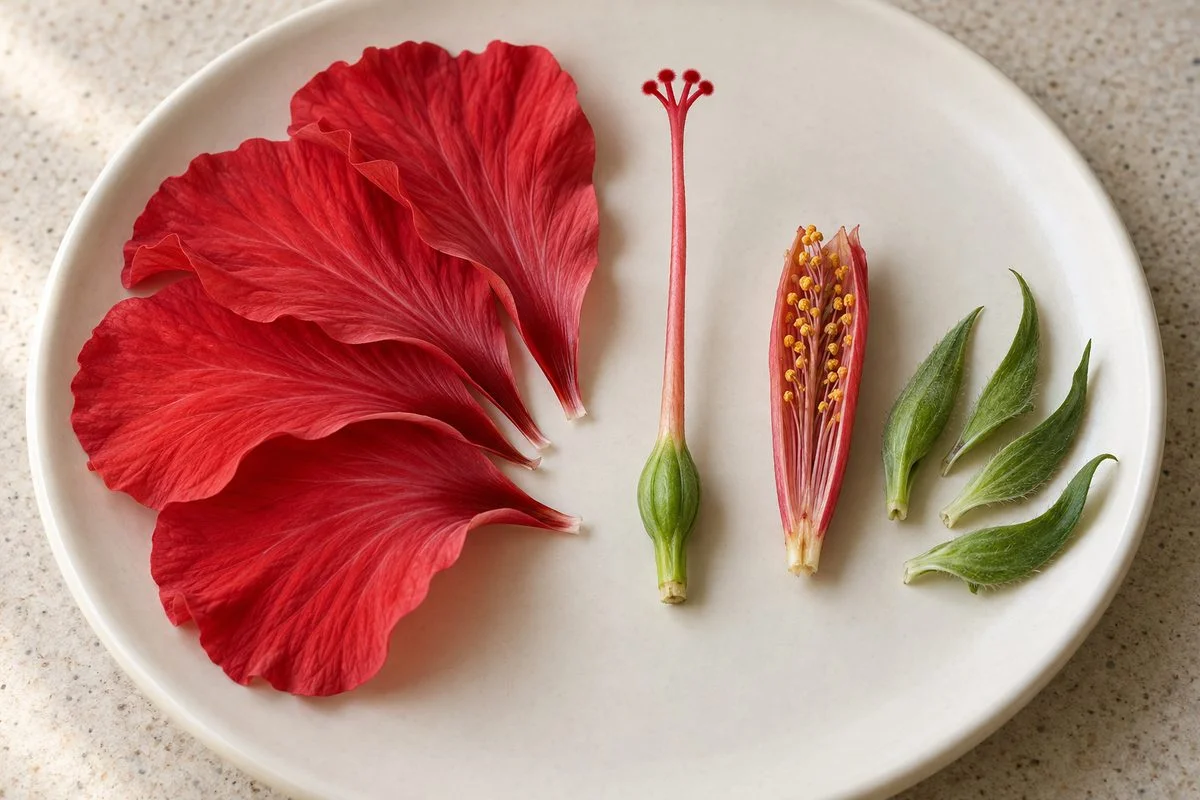
Hibiscus with removed petals beside its exposed reproductive parts on a plate.

1. Flower — A Fascinating Organ of Angiosperms

Flowers hold the parts needed for sexual reproduction.

Show
Place a hibiscus on a plate. Gently remove its petals. Follow a filament to its anther. Gently peel away the staminal tube and sepals to expose the style and ovary. Trace the pistil from stigma through style to its swollen ovary.
Ask
Which exposed part will receive pollen?
Say
Anthers produce pollen, while the stigma receives it. The ovary holds ovules.
Used in
Recognising these parts helps growers pollinate flowers by hand.
If your child says…“Flowers only attract insects.”
Ask
What jobs do the exposed parts have after the petals are gone?
What’s true
A flower's stamens and pistil carry out reproduction.
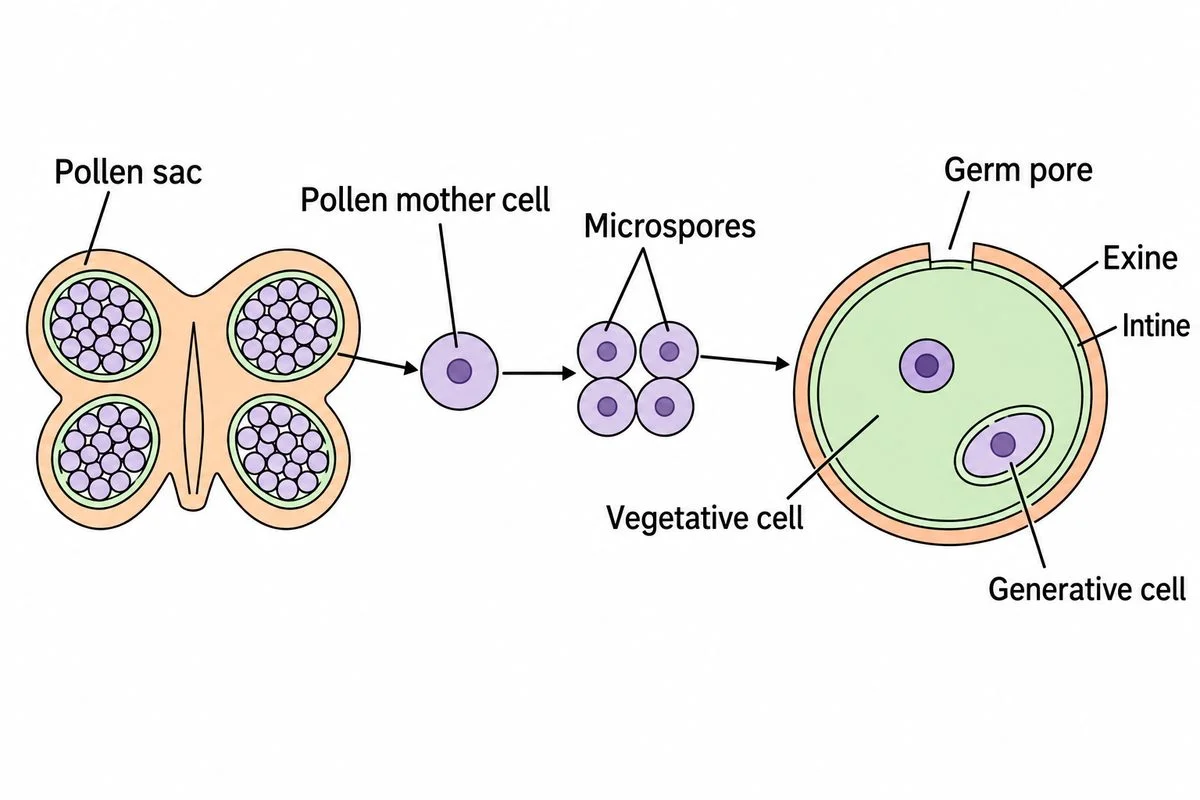
Pencil sequence showing anther sacs, a mother cell, four microspores and enlarged pollen.

2. Stamen, Microsporangium and Pollen Grain

Pollen develops from microspores and produces male gametes.

Show
Find the four pollen sacs on the diagram's left. Follow the mother cell to its four microspores. Find the cells inside the enlarged pollen grain on the right.
Ask
Will this whole pollen grain act as just one male gamete?
Say
Meiosis makes four microspores from one mother cell. Pollen is not one male gamete; its generative cell forms two male gametes.
Used in
Pollen's resistant outer wall protects it during transfer between flowers.
If your child says…“A pollen grain is one male gamete.”
Ask
Why does your pollen sketch contain a smaller cell inside the larger one?
What’s true
A pollen grain contains cells that perform different jobs.
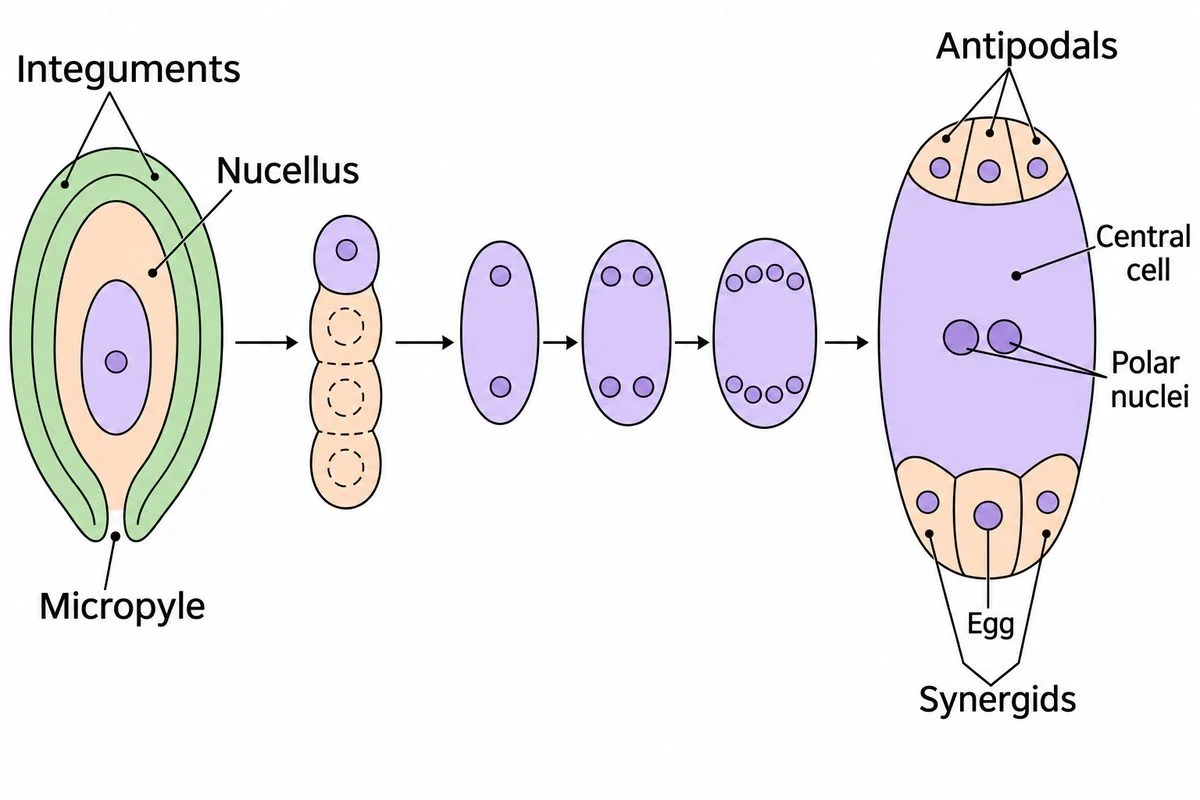
Pencil ovule sketch with an enlarged embryo sac and a megaspore development sequence.

3. The Megasporangium, Megasporogenesis and Embryo Sac

An ovule contains the embryo sac, which holds the egg.

Show
Follow the ovule diagram and megaspore sequence. Trace the opening, coverings and inner sac. Count cell boundaries separately from nuclei.
Ask
Will eight nuclei require eight separate cells here?
Say
Meiosis forms four megaspores, but usually three then degenerate. The resulting embryo sac has seven cells containing eight nuclei.
Used in
Ovule coverings become seed coats, protecting embryos inside seeds.
If your child says…“Eight nuclei must mean eight cells.”
Ask
Is there a cell boundary between the two central nuclei?
What’s true
Two polar nuclei share one central cell.

Pollen transfer and fertilisation

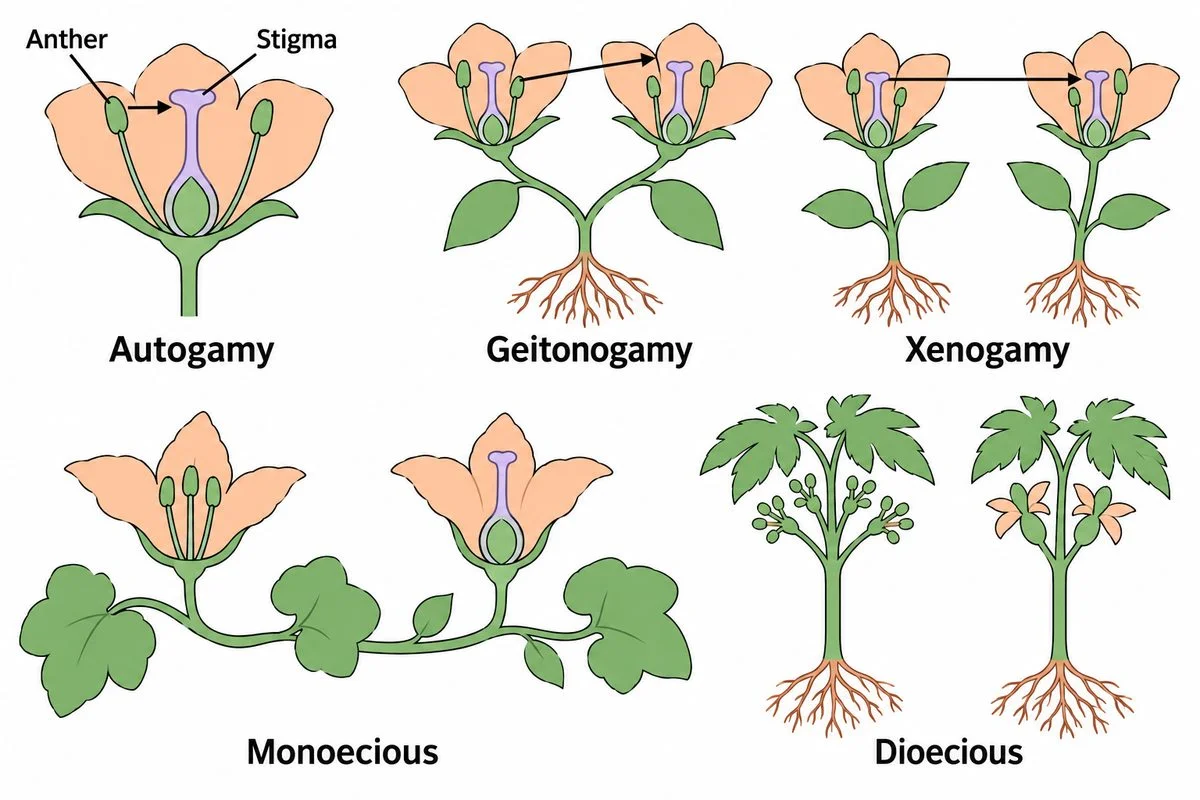
Pollen routes within flowers, within plants and between plants, with separate-sex arrangements below.

4. Pollination — Types, Agents and Outbreeding Devices

Pollen moves from anthers to stigmas.

Show
Trace the diagram's pollen routes. Compare the separate-sex arrangements below.
Ask
Does another flower always mean another parent plant?
Say
Autogamy stays within flowers, and geitonogamy stays within plants. Xenogamy connects different plants of one species. Separate male and female plants prevent both self-pollination routes.
Used in
Insect pollination helps crops produce fruits and seeds.
If your child says…“Different flowers mean different plant parents.”
Ask
Where do both flower stalks lead?
What’s true
Geitonogamy uses two flowers belonging to one plant.
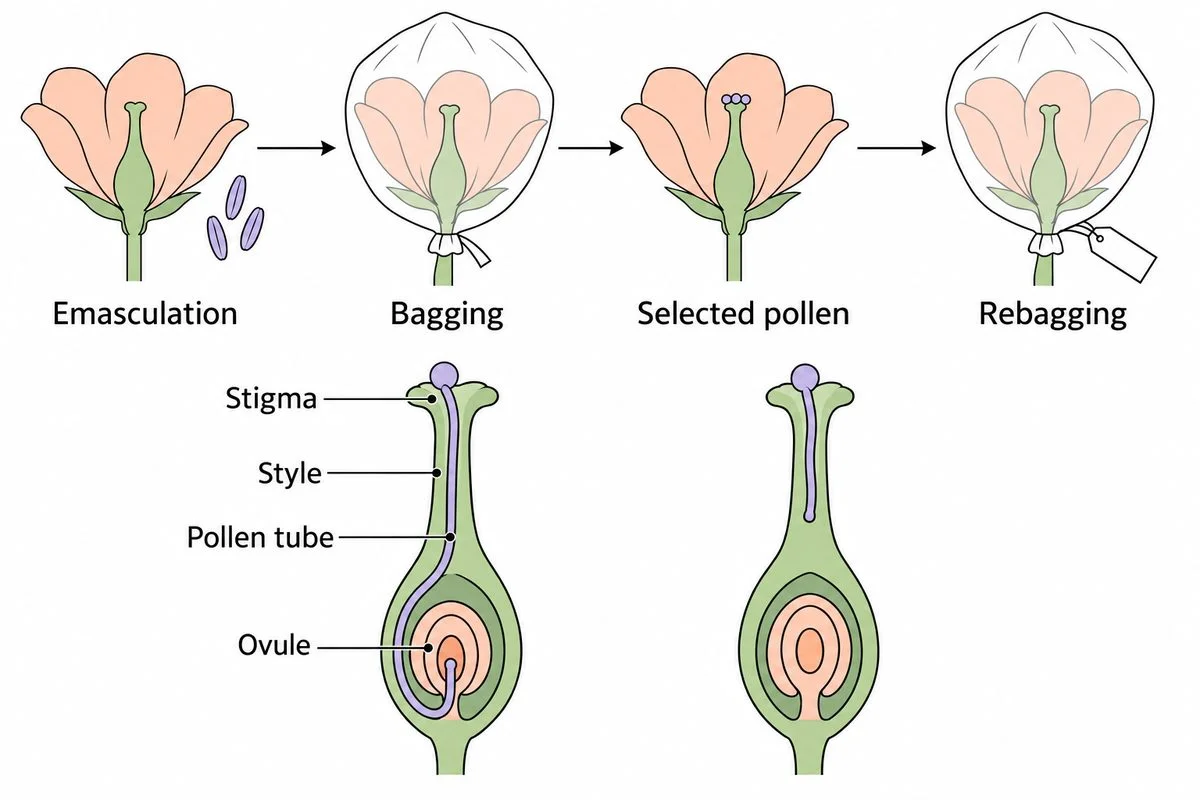
Controlled pollination sequence above two pistils showing successful and arrested pollen-tube growth.

5. Pollen–Pistil Interaction and Artificial Hybridisation

Chosen pollen still needs the pistil's acceptance.

Show
Follow the diagram's crossing sequence. Compare the pollen tubes below.
Ask
Why might selected pollen still fail?
Say
The pistil can reject incompatible pollen. Before pollen release, remove anthers, bag, pollinate the receptive stigma, then rebag.
Used in
Controlled crosses combine useful crop traits.
If your child says…“We only need the bag after adding pollen.”
Ask
What would keep visiting insects away before we apply our selected pollen?
What’s true
Bagging before and after the chosen pollination reduces contamination by unwanted pollen.
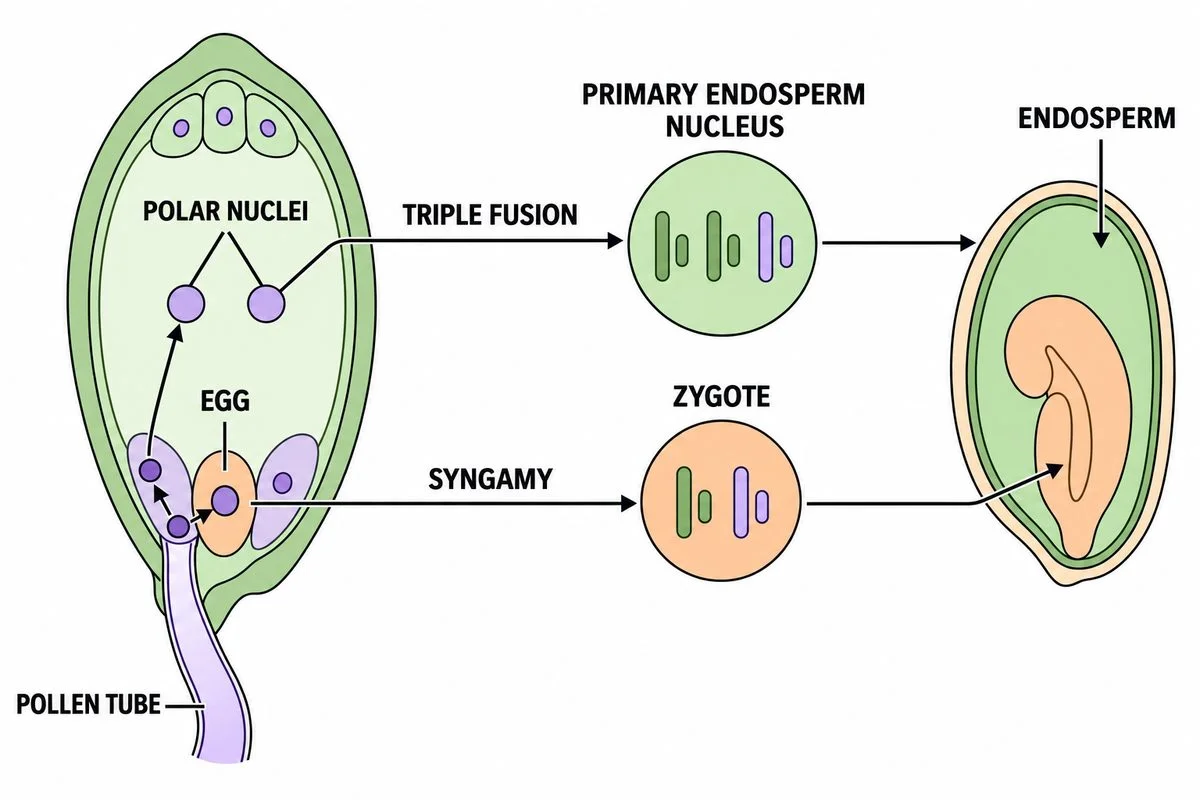
Two male gametes follow separate fusion routes, starting the embryo and its nourishing endosperm.

6. Double Fertilisation

Two fusions begin the embryo and its food tissue.

Show
Find the diagram's pollen tube entering a synergid through the ovule's opening. Locate its two male gametes, the egg and the polar nuclei.
Ask
This embryo sac has one egg. Will both male gametes fuse with it?
Say
One male gamete joins the egg, forming a diploid zygote. The other joins both polar nuclei, forming a triploid primary endosperm nucleus.
Used in
Endosperm nourishes embryos as seeds develop.
If your child says…“Both male gametes fertilise eggs.”
Ask
How many eggs can you find beside the two fusion routes?
What’s true
One male nucleus joins the egg nucleus, while the other joins both polar nuclei.

Seeds and new plants

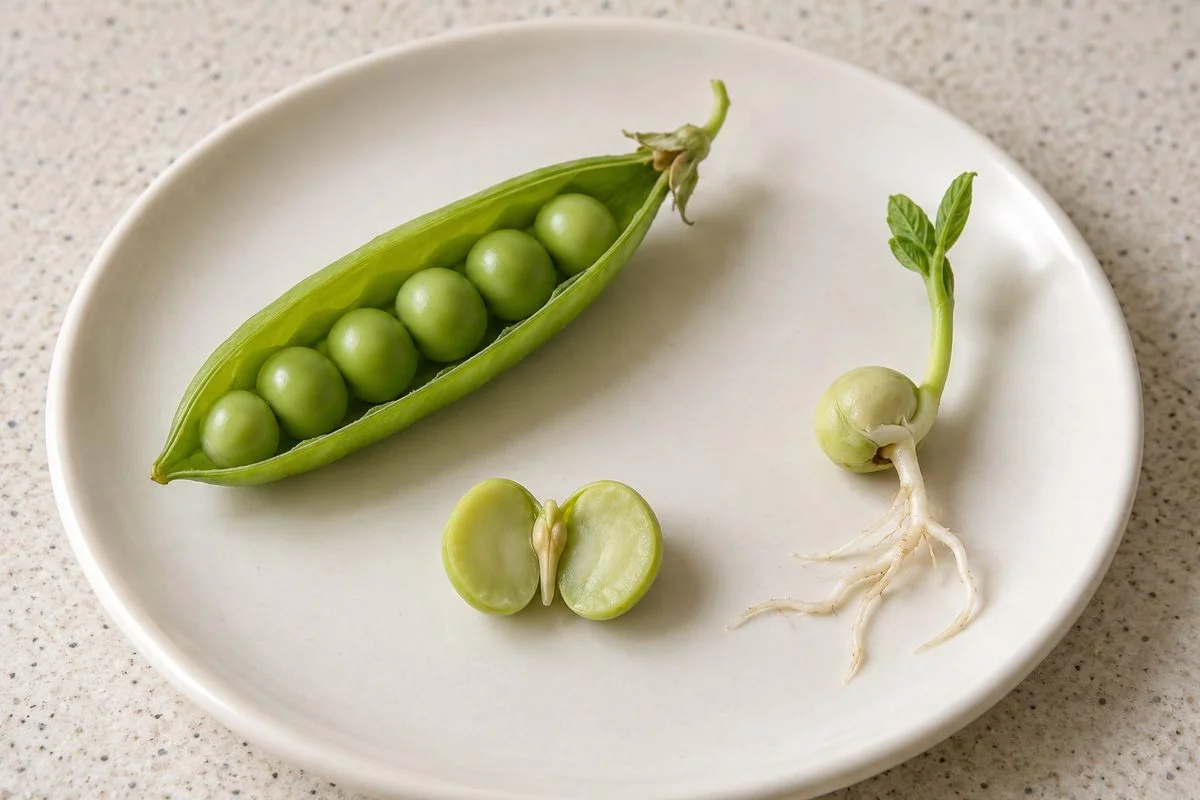
Opened pea pod beside a split soaked pea and a pea seedling.

7. Post-fertilisation: Endosperm, Embryo, Seed and Fruit

Seeds protect embryos and store food for their growth.

Show
Open a pea pod. Split a soaked pea with fingers, exposing cotyledons. Compare with a sprouted pea's root and shoot.
Ask
What will feed this seedling before its leaves make enough food?
Say
The pea pod develops from the ovary, and its seeds develop from ovules. The cotyledons store food that supports early growth. The sprout's root and shoot grow from the living embryo.
Used in
Dry seed storage preserves living embryos for later sowing.
If your child says…“A resting seed is dead.”
Ask
What did water, air and suitable warmth allow your pea's embryo to do?
What’s true
A viable resting seed stays alive and resumes growth when dormancy ends and conditions suit it.
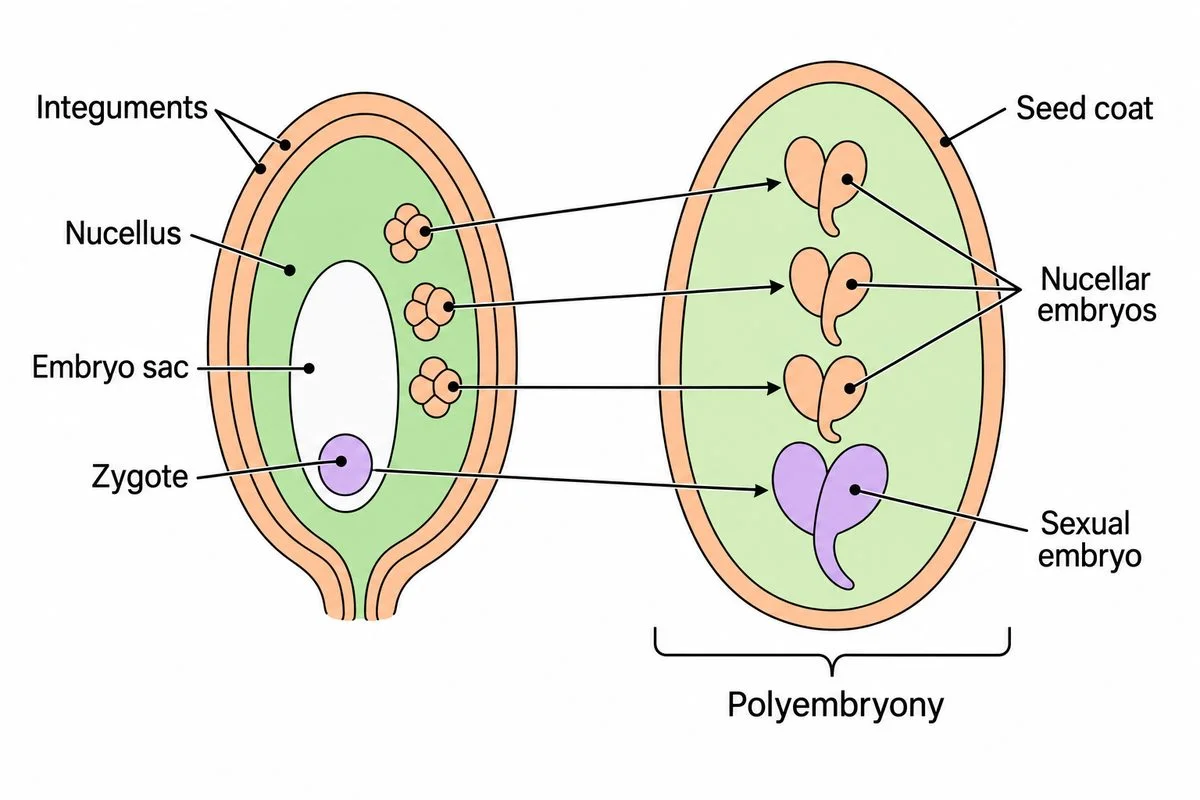
Citrus ovule showing sexual and nucellar embryo origins leading to several embryos within one seed.

8. Apomixis and Polyembryony

Seeds can form without fertilisation or contain several embryos.

Show
Find the zygote inside the embryo sac in the citrus ovule diagram. Locate developing embryos in the surrounding nucellus, then follow both routes into one seed.
Ask
Could this seed contain embryos that formed without an egg being fertilised?
Say
Yes, the nucellar embryos develop without fertilisation, showing apomixis. The zygote develops into a sexual embryo. Several embryos sharing this seed show polyembryony.
Used in
Apomictic hybrids could preserve useful traits, letting farmers save seed for sowing.
If your child says…“Polyembryony means many seeds inside a fruit.”
Ask
How many seed coats enclose all these embryos?
What’s true
Polyembryony concerns embryos sharing one seed, regardless of how they formed.

A real problem

Controlled flower reproduction helped produce high-yielding hybrid cotton.

Hybrid-4 cotton was released in India in 1970 and grown on a large scale.

Patel removed pollen-producing anthers from flowers on the female parent plants.

The resulting hybrid showed hybrid vigour through high cotton productivity.

Frontiers in Plant ScienceAzim Premji University — iThink Biology

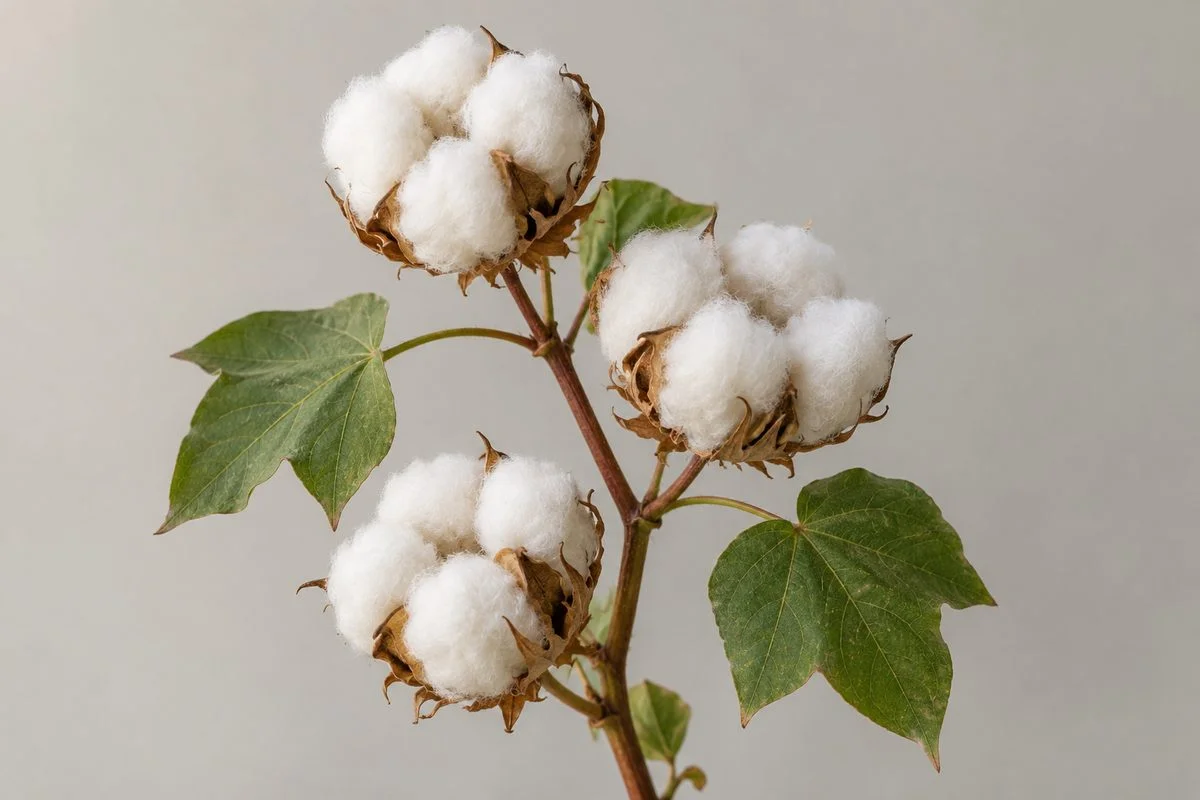
Cotton plant bearing open white cotton bolls.

Concept Lab · Common misconception

The tempting mistake in Sexual Reproduction in Flowering Plants

Open standalone misconception page →

Does pollination produce a seed immediately?

Wrong

Once pollen lands on the stigma, fertilisation is complete.

Why it feels right. Pollination and fertilisation are successive events that often get described together.

Right

Pollination transfers pollen. Fertilisation requires gametes to fuse.

Worked example

Path to fertilisation
Pollen lands on stigma→Tube grows toward ovule→Gametes delivered→One fuses with egg
Landing pollen on the stigma begins the path. Fertilisation occurs when a male gamete fuses with the egg.
  1. Follow a pollen grain on a compatible stigma.
  2. Its tube grows towards an ovule and delivers the male gametes.
  3. One fuses with the egg to form a zygote.

Ask your child eight quick questions.

One per step. The answer and the reason are given.

  1. Which pollen-making structures are lost if all stamens are removed?

    The anthers. Stamens carry anthers, which produce pollen.

  2. Which cell inside pollen produces the two male gametes?

    The generative cell. The pollen grain contains this cell rather than being one male gamete.

  3. How many cells contain the two polar nuclei before fertilisation?

    One central cell. Nuclei do not each need a separate cell.

  4. What connects different flowers on one plant?

    Geitonogamy. Both flowers share the same parent.

  5. When should bagging begin?

    Before unwanted pollen can arrive. Later bagging cannot remove pollen already delivered.

  6. What starts developing after a male nucleus joins the two polar nuclei?

    Endosperm. Triple fusion begins the embryo's food tissue, rather than another embryo.

  7. What living part resumes growth when a viable seed germinates?

    The embryo. Low activity during rest does not mean the embryo has died.

  8. A fruit has several seeds, each containing one embryo. Does this show polyembryony?

    No. Polyembryony means more than one embryo within a single seed.

15 more questions with answers