Skip to content

Teach Evolution in eight steps.

For each idea: show it, ask before you tell, then say one line.

Gather paper and a pencil.

Common misconceptions & worked visual for this chapter · 15 practice questions with answers

How to teach it

Origins and evidence

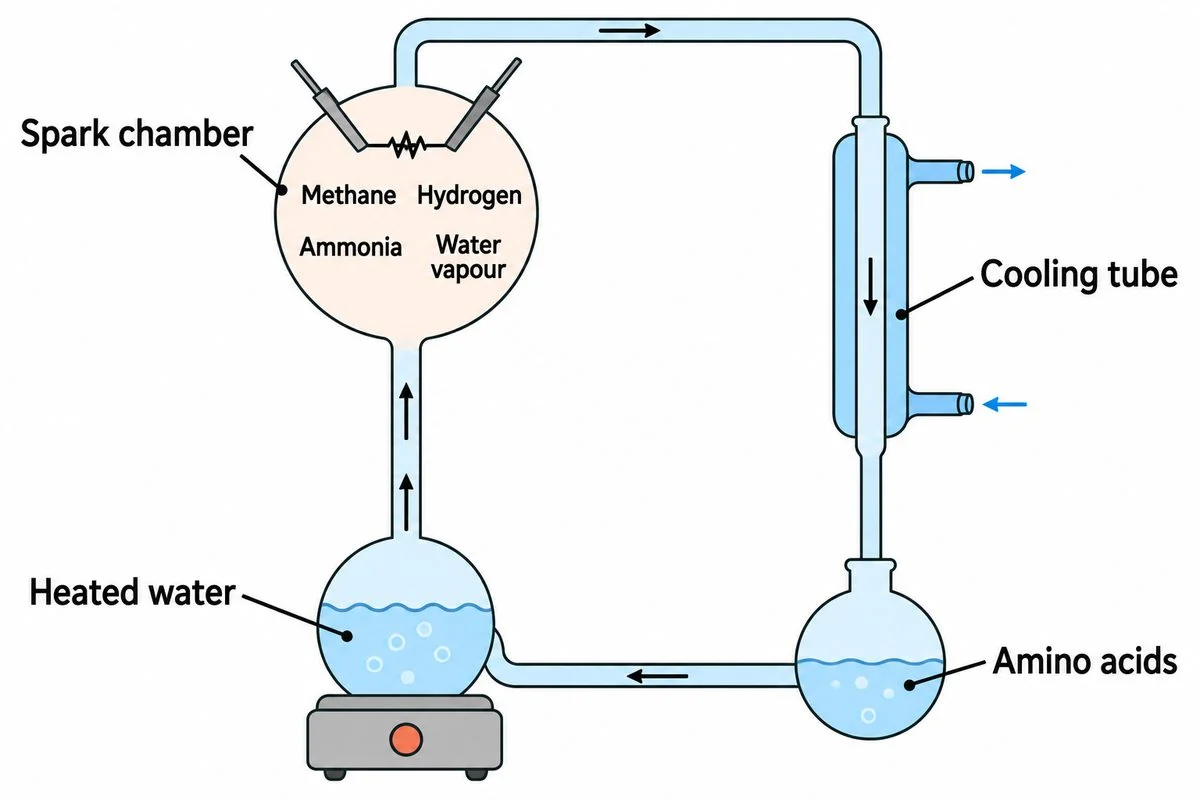
Connected water flask, labelled gases, spark chamber, cooling tube and amino acid collector.

1. Origin of Life

Chemistry could produce life's ingredients before cells existed.

Show
Find the heated water in the diagram. Follow the gases through the spark chamber and cooling tube. Find the collected amino acids.
Ask
Would finding amino acids here mean living cells had formed?
Say
Miller produced ingredients for life, without producing cells.
Used in
Origin-of-life experiments test possible chemical steps towards life.
If your child says…“Miller made living cells.”
Ask
Does the product label identify molecules or cells?
What’s true
Miller's experiment produced organic molecules under proposed early atmospheric conditions without added oxygen.
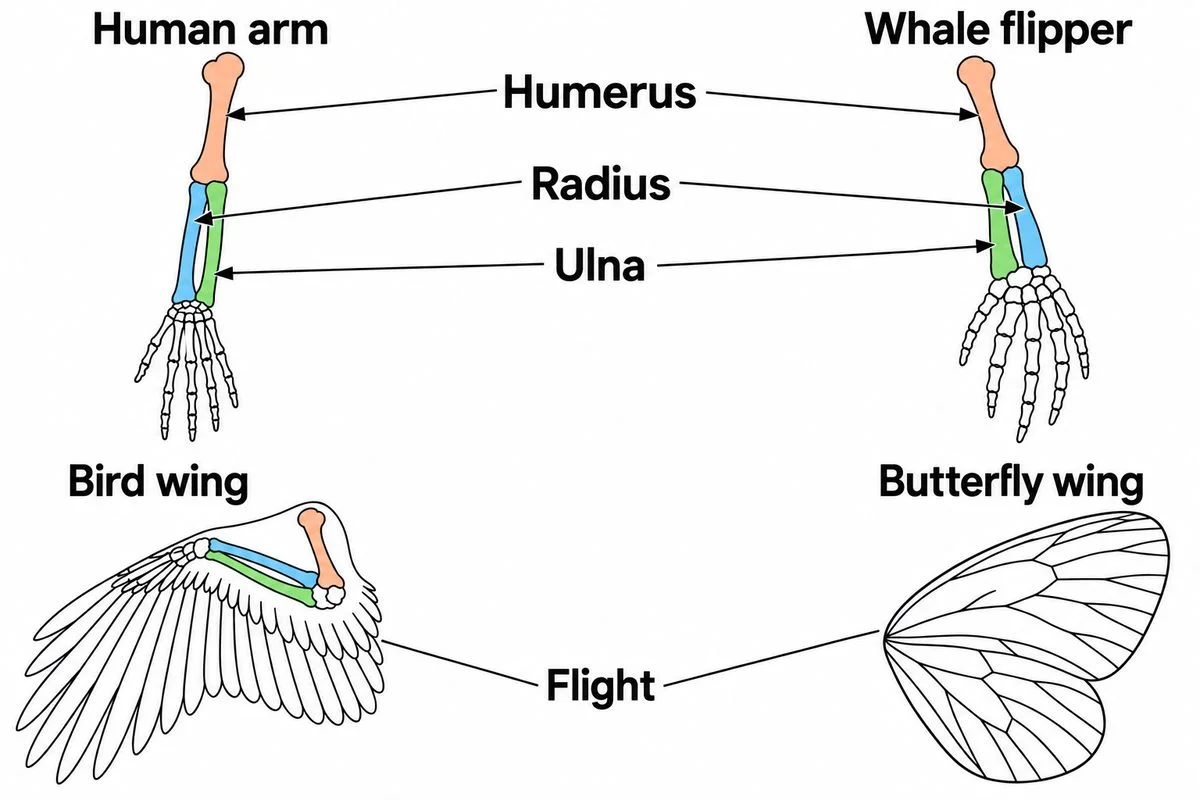
Matching forelimb bones above; bird and butterfly wings with different structures below.

2. Evidences for Evolution

Homologous structures share ancestry; analogous structures evolved independently for similar functions.

Show
Look at the diagram. Compare matching bones in the upper pair. Then compare the wings below.
Ask
Would sharing flight mean these wings have the same evolutionary origin?
Say
Matching forelimb bones support shared ancestry despite different uses. Bird and butterfly wings have different origins despite their shared flight function.
Used in
Comparing inherited structures helps establish relationships despite differences in how organisms live.
If your child says…“Doing the same job proves a shared origin.”
Ask
Does the butterfly wing have the bird wing's bones?
What’s true
Similar functions can evolve independently in structures with different origins.

How populations change

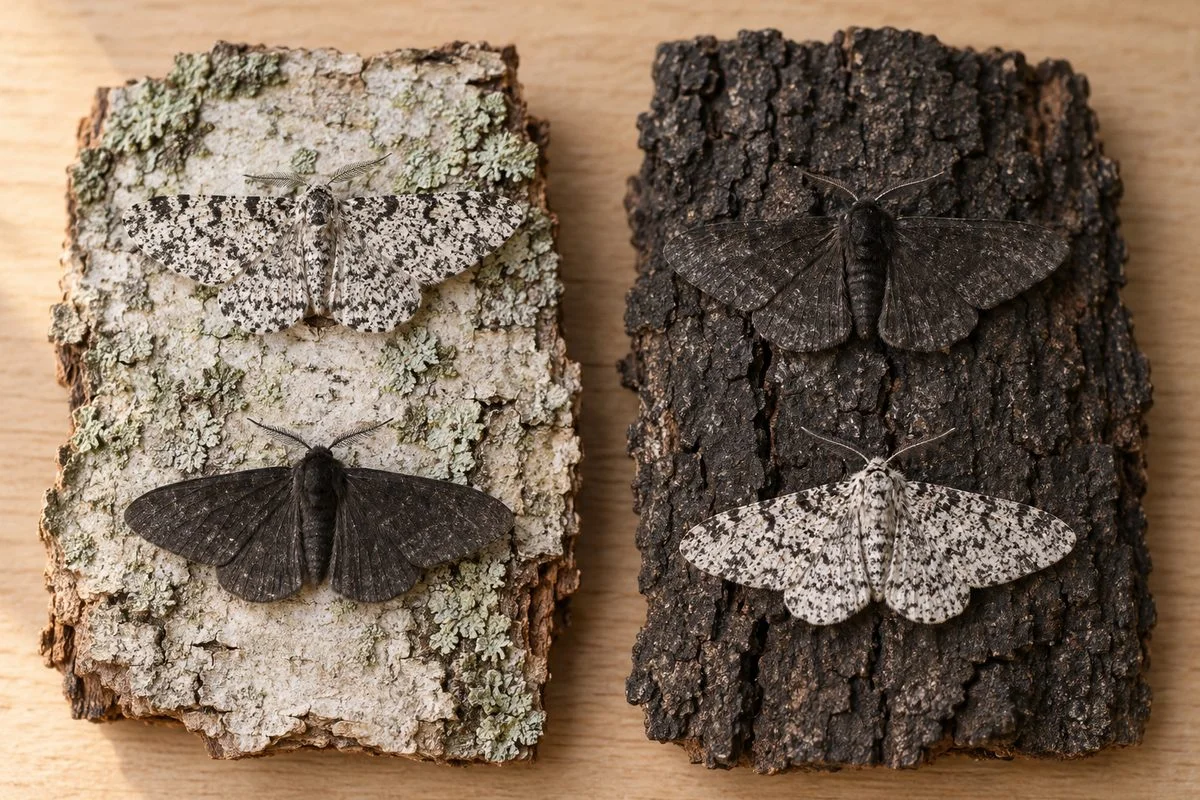
Pale and dark moth specimens arranged against pale and dark bark.

3. Industrial Melanism

Changed surroundings alter the success of existing inherited moth colours.

Show
In the photograph, compare each moth colour against both bark backgrounds.
Ask
Which existing colour would gain concealment if pale bark became dark?
Say
The darker colour would gain concealment.
Used in
Understanding resistance helps explain why an antibiotic can become less effective.
If your child says…“Soot makes moths and their offspring dark.”
Ask
Was a dark variant already present before the background changed?
What’s true
Selection favours existing inherited variants without necessarily eliminating every less successful variant.
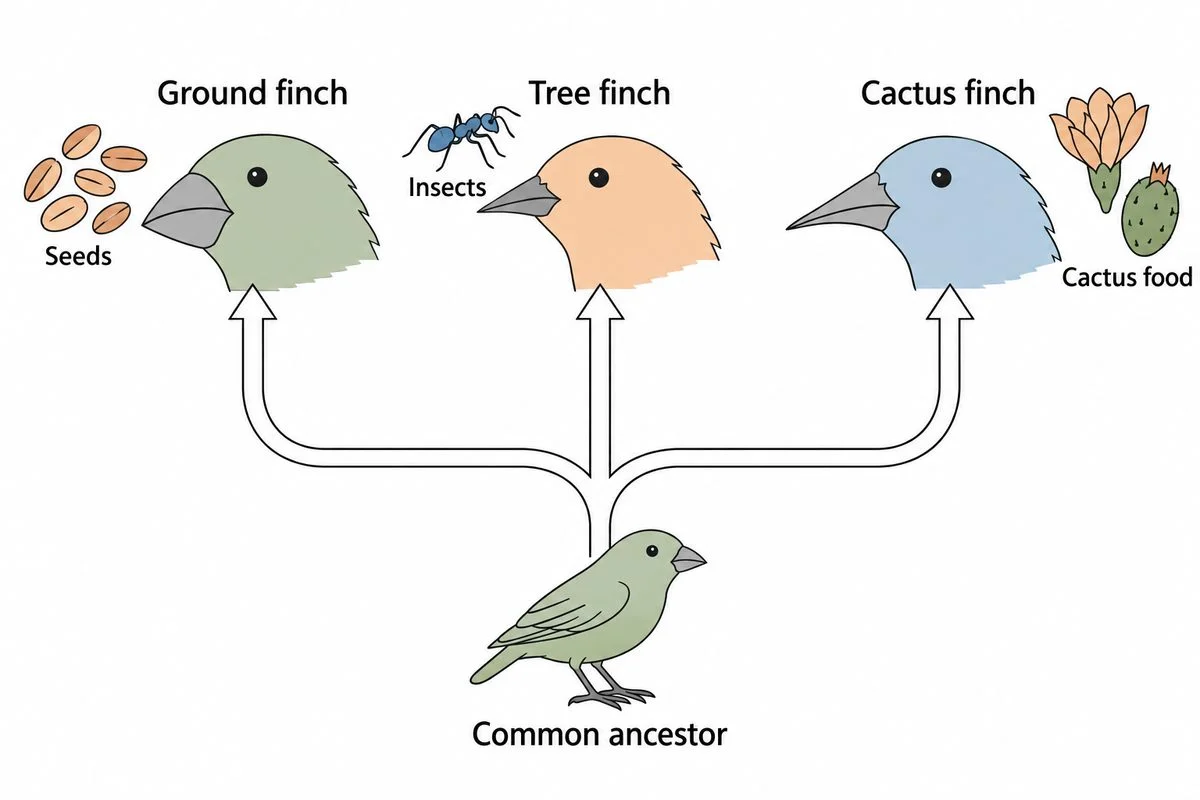
An ancestral finch branches into related finches with different beaks and foods.

4. Adaptive Radiation and Darwinian Natural Selection

Inherited differences spread through reproduction; related descendants diversify into different roles.

Show
Find the common ancestor at the diagram's bottom. Follow its branches to different beaks and foods.
Ask
How could related finches develop different beaks over many generations?
Say
Inherited beak differences can improve feeding and help birds leave more offspring. Related populations can gradually become species using different foods.
Used in
Selective breeding favours inherited traits that make crops more useful.
If your child says…“The strongest individual is always the fittest.”
Ask
How would a strong individual with no offspring pass on its traits?
What’s true
Fitness depends on reproductive success, not strength alone.
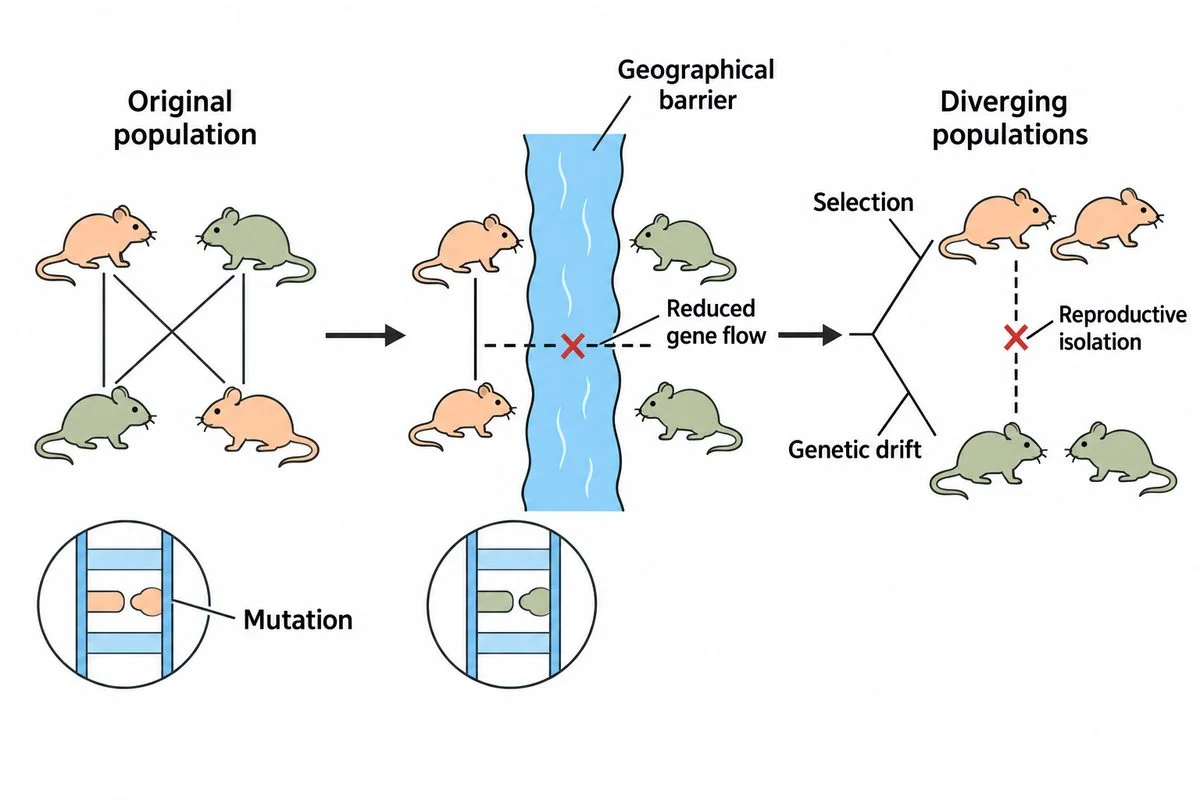
A rodent population separates, diverges over generations and develops reproductive isolation.

5. Mechanism of Evolution

Mutation adds variation; reduced interbreeding helps populations diverge into species.

Show
Follow the diagram from one population to two separated by a river. Trace their later divergence.
Ask
How could these separated populations become different species?
Say
They could become separate species if reproductive barriers persist when they meet again.
Used in
Enzyme engineering uses mutation and screening to find variants that work better.
If your child says…“Organisms make mutations because they need them.”
Ask
Does a DNA change know which conditions the population will face?
What’s true
Mutations produce new gene versions without anticipating whether they will help.

q=14=12q=\sqrt{\frac14}=\frac12

p=1−q=12p=1-q=\frac12

6. Hardy–Weinberg Principle

Equilibrium supplies a baseline for detecting changes in inherited variation.

Show
Write these lines. Say: 'A and a are two versions of one gene. Their frequencies are p and q, respectively. Here, one quarter of individuals are aa, with two copies of a.'
Ask
What fraction should carry both versions, Aa?
Say
Half carry both versions, since either parent can supply either: 2pq=122pq=\frac12.
Used in
Conservationists consider founder effects because small starting populations can lose inherited variation by chance.
If your child says…“Stabilising selection favours both extremes.”
Ask
If stabilising selection favours middle forms, which selection favours both extremes?
What’s true
Disruptive selection favours both extremes, breaking our calculation's assumption of no selection.

The history of life

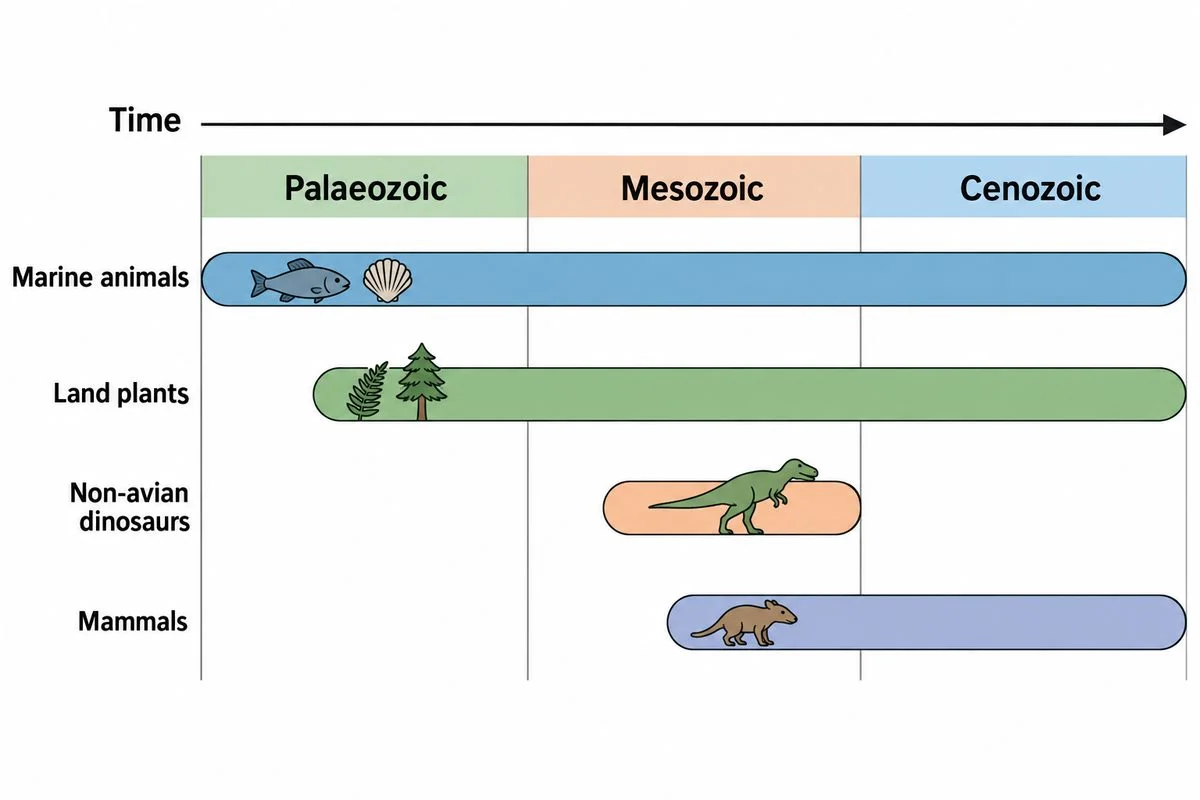
Four fossil-history tracks show earlier land plants and overlapping dinosaur and mammal ranges.

7. A Brief Account of Evolution

Fossils reveal when groups appeared, overlapped and disappeared.

Show
Read the diagram's time arrow from left to right. Compare where the four tracks begin and end.
Ask
Could one Mesozoic rock layer contain both mammal and dinosaur fossils, given these overlapping tracks?
Say
Yes. Mammals and these dinosaurs overlapped in time. Land plants appeared earlier than either group.
Used in
Fossil sequences help reconstruct earlier life and environments.
If your child says…“Land animals appeared before land plants.”
Ask
Do these dinosaur and mammal tracks show when the first land animals appeared?
What’s true
In this broad sequence, plants colonised land before animals.
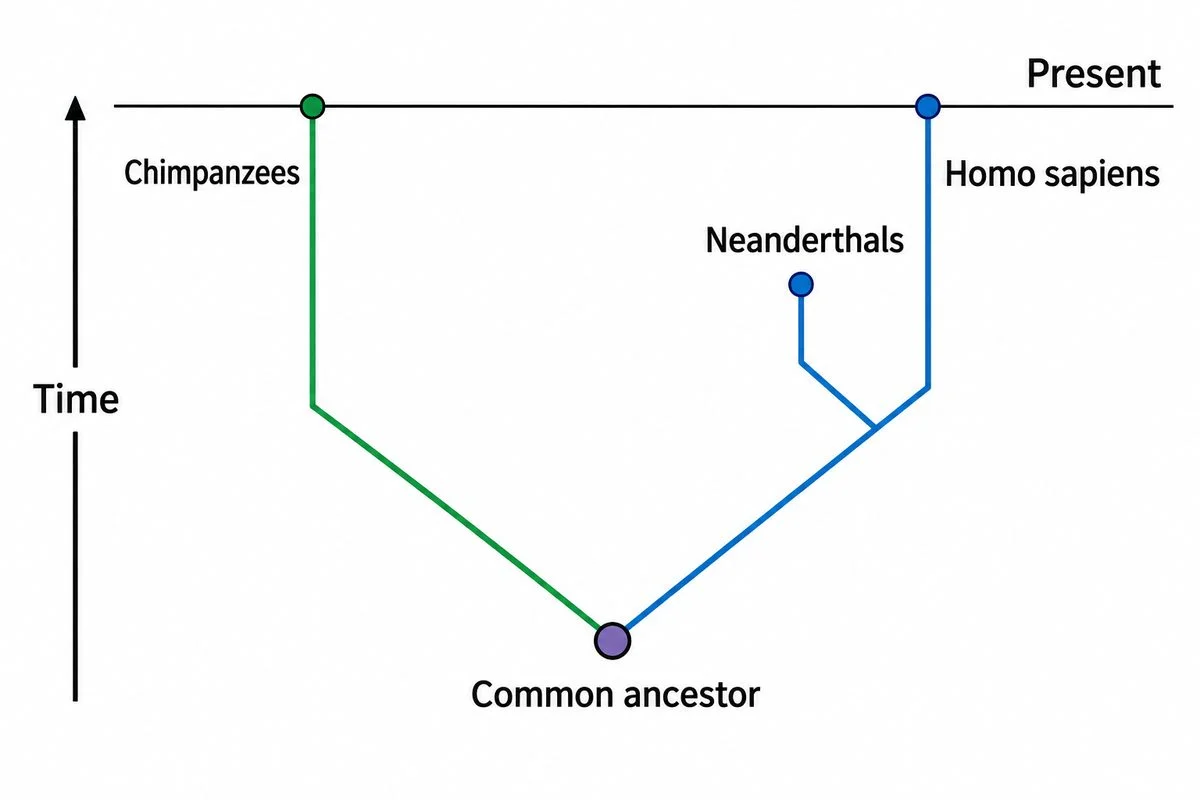
Chimpanzees and human lineages branch separately; the Neanderthal branch ends before the present.

8. Origin and Evolution of Man

Humans and other apes share ancestors along separate evolutionary branches.

Show
Trace the diagram upward from the common ancestor. Follow chimpanzees separately, then the two human branches.
Ask
From these separate branches, would humans evolving require chimpanzees to disappear?
Say
Chimpanzees can persist because their branch is separate from ours. Neanderthals share a more recent ancestor with us.
Used in
Branching family trees help compare fossil relatives without assuming each was our direct ancestor.
If your child says…“Chimpanzees are the step just before humans.”
Ask
Does the chimpanzee branch lead into Homo sapiens or continue separately?
What’s true
Chimpanzees and humans descended along separate branches from shared ancestors.

A real problem

Mutation and screening improved an enzyme's performance in organic solvents.

Organic solvents often greatly reduce enzyme activity.

Arnold published her landmark enzyme directed-evolution paper in 1993.

Repeated mutation and screening produced an improved enzyme variant.

The evolved enzymes could help make chemicals in organic solvents.

CaltechUC BerkeleyCaltech

A rack of test tubes on a laboratory bench.

Concept Lab · Common misconception

The tempting mistake in Evolution

Open standalone misconception page →

Does a bacterium evolve because it needs to survive?

Wrong

An antibiotic makes each bacterium develop the resistance it needs.

Why it feels right. The resistant population appears after antibiotic exposure.

Right

Selection changes how common heritable traits are across generations.

Worked example

Susceptible
99 before exposure→Killed in this example
Resistant
1 before exposure→Survives→Resistant descendants multiply
The resistant variant exists before exposure. Removing susceptible cells changes which variant is left to reproduce.
  1. Imagine 99 susceptible bacteria and 1 already resistant bacterium.
  2. If exposure kills the susceptible ones, the resistant survivor can multiply and make resistance common.

Ask your child eight quick questions.

One per step. The answer and the reason are given.

  1. What did Miller collect that supplied ingredients for life?

    Amino acids. Producing these molecules did not demonstrate the formation of living cells.

  2. Do bird and butterfly wings alone establish close ancestry?

    No. Their shared flight function evolved in structures with different origins.

  3. When dark moths reproduce more successfully than pale moths, what happens to the dark-colour frequency?

    It increases. Unequal reproduction changes inherited colour frequencies rather than recolouring individual moths.

  4. Which has greater fitness: a sterile individual or one leaving viable offspring?

    The one leaving viable offspring. Inherited traits reach later generations through reproduction, not strength alone.

  5. What does unrestricted interbreeding do to differences between diverging populations?

    It mixes their inherited variants. Reduced exchange helps differences persist as populations diverge.

  6. Which selection pattern favours very small and very large seeds over middle-sized seeds?

    Disruptive selection. Both extremes succeed more than intermediate forms.

  7. Which appeared earlier on this timeline: land plants or non-avian dinosaurs?

    Land plants. Their fossil record begins earlier than the dinosaur record.

  8. What connects chimpanzees and Homo sapiens on this tree?

    Shared ancestors. Separate descendant branches share ancestry without forming successive steps.

15 more questions with answers