Skip to content

Teach Principles of Inheritance and Variation in eight steps.

For each idea: show it, ask before you tell, then say one line.

Gather paper and a pencil.

Common misconceptions & worked visual for this chapter · 15 practice questions with answers

How to teach it

How alleles pass between generations

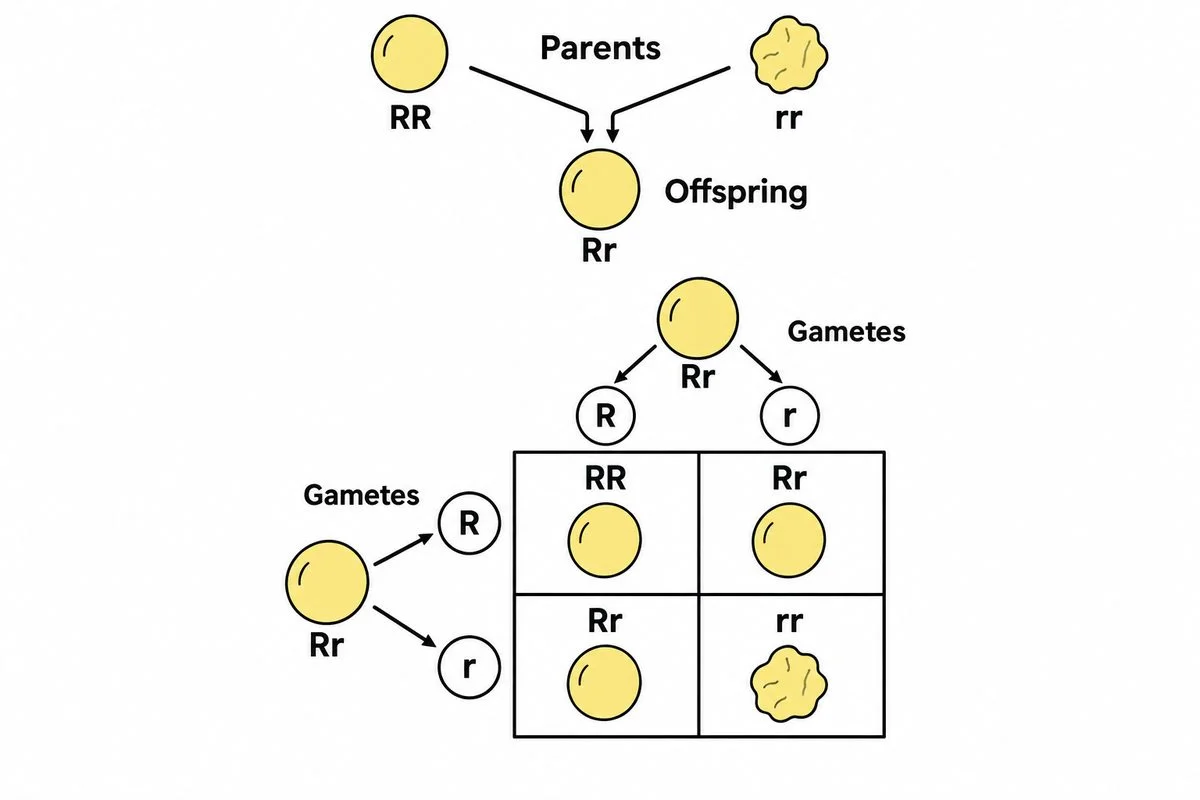
Pea generations and a Punnett square show how wrinkled offspring reappear.

1. Mendel’s experiments, dominance and segregation

A dominant appearance can hide a recessive allele.

Show
In the diagram, follow the parents to their offspring, then gametes. Cover the square.
Ask
How could these round offspring produce wrinkled seeds?
Say
The round offspring retain r; their alleles separate into gametes. Two r gametes produce wrinkled seeds.
Used in
Breeders use test crosses to reveal hidden recessive alleles.
If your child says…“The dominant allele destroys the recessive allele.”
Ask
How could this offspring be wrinkled if the round parent had lost r?
What’s true
Each gamete receives one allele per gene; dominance describes expression rather than usefulness or frequency.
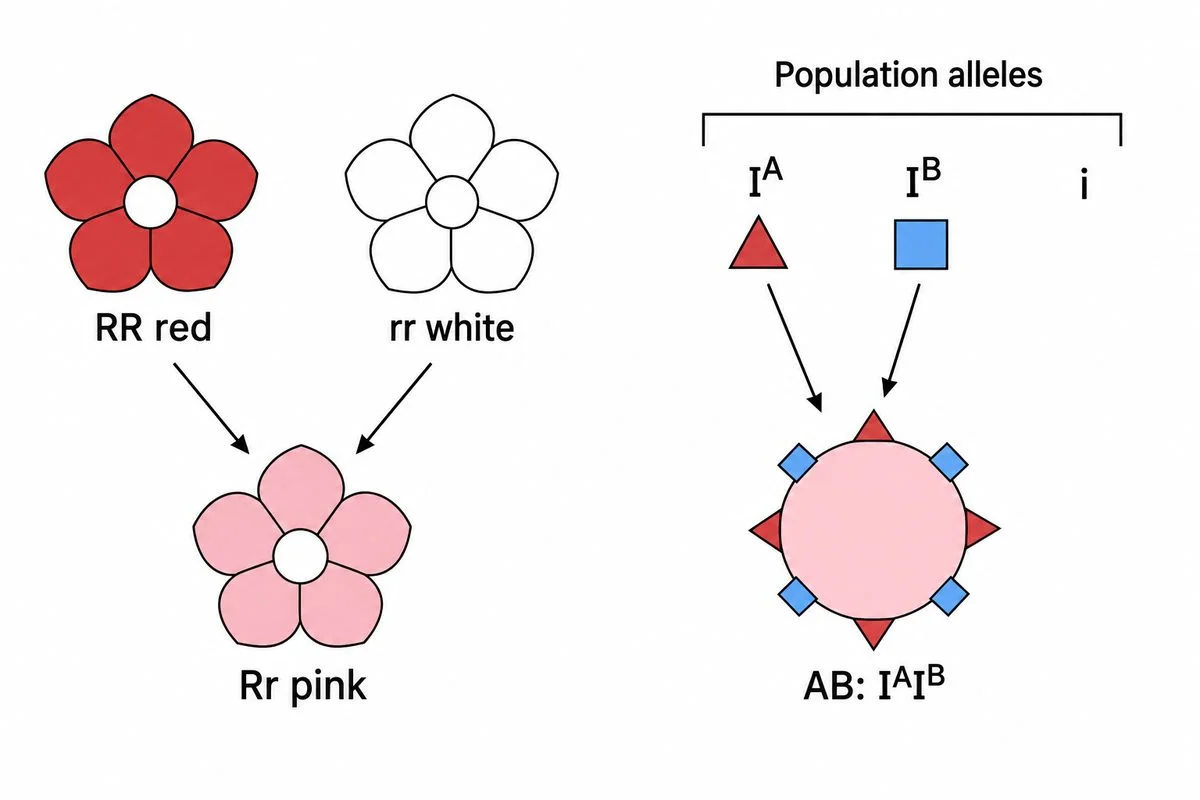
Flower inheritance beside population alleles and an AB cell with two marker types.

2. Incomplete dominance, co-dominance and multiple alleles

Alleles can give an intermediate appearance or both show.

Show
In the diagram, find the red and white flowers and the three population alleles. Cover the pink flower and blood cell before following their arrows.
Ask
Must the flower offspring and AB blood cell each show only one allele's effect?
Say
The flower is pink, but its alleles stay separate. The AB cell carries both A and B markers. Three ABO alleles exist across people.
Used in
Blood-group inheritance explains possible blood groups within families.
If your child says…“An AB individual carries all three ABO alleles.”
Ask
Where would i fit when each parent contributes just one copy?
What’s true
The population has three ABO alleles, but an AB individual carries only the A and B alleles.

P(round)=34P(\text{round})=\frac{3}{4}

P(yellow)=34P(\text{yellow})=\frac{3}{4}

P(round and yellow)=34×34P(\text{round and yellow})=\frac{3}{4}\times\frac{3}{4}

3. Dihybrid cross and law of independent assortment

Different allele pairs can separate independently.

Show
Write this line for RrYy crossed with RrYy. Say: R and r represent round and wrinkled seeds; Y and y represent yellow and green. P means probability; assume independent inheritance and complete dominance. Each trait has a three-in-four chance.
Ask
What fraction should be both round and yellow?
Say
Nine sixteenths: multiply the independent chances.
Used in
Breeders predict trait combinations to plan crosses.
If your child says…“RrYy can make only RY and ry gametes.”
Ask
If R separates independently of Y and y, which can accompany R?
What’s true
RrYy makes RY, Ry, rY and ry gametes equally often when these genes assort independently.

How inheritance patterns differ

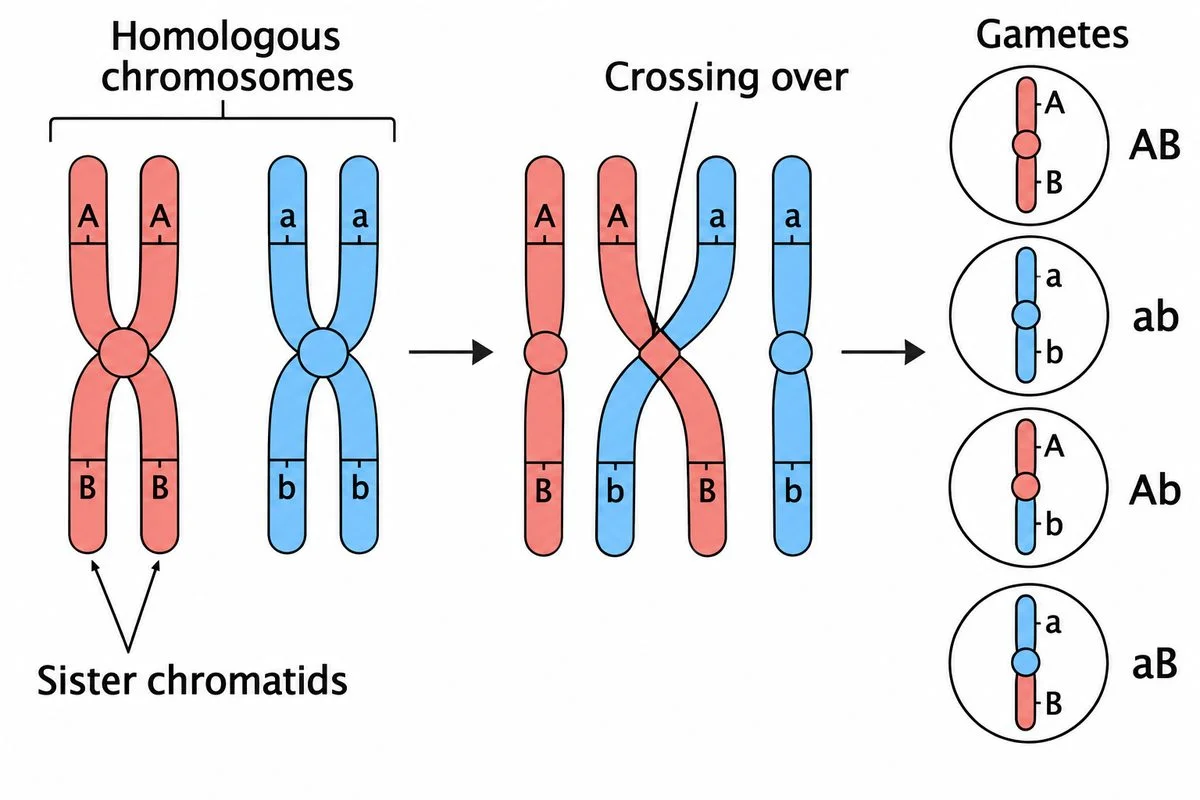
Crossing over between homologous chromosomes produces parental and recombinant gametes.

4. Chromosomal theory of inheritance, linkage and recombination

Crossing over can separate genes sharing a chromosome.

Show
In the diagram, find the paired chromosomes and their matching gene positions. Trace the exchange between two non-sister chromatids. Cover the gamete labels.
Ask
Could these linked genes produce combinations besides AB and ab?
Say
Chromosomes carry genes, so nearby genes tend to travel together. Crossing over between non-sister chromatids can produce Ab and aB alongside AB and ab.
Used in
Recombination helps geneticists map genes to investigate inheritance.
If your child says…“Genes on the same chromosome can never separate.”
Ask
What happens to the original pairings when matching chromosome sections exchange?
What’s true
Greater gene separation generally increases recombination, but observed two-gene recombination never exceeds 50 percent.
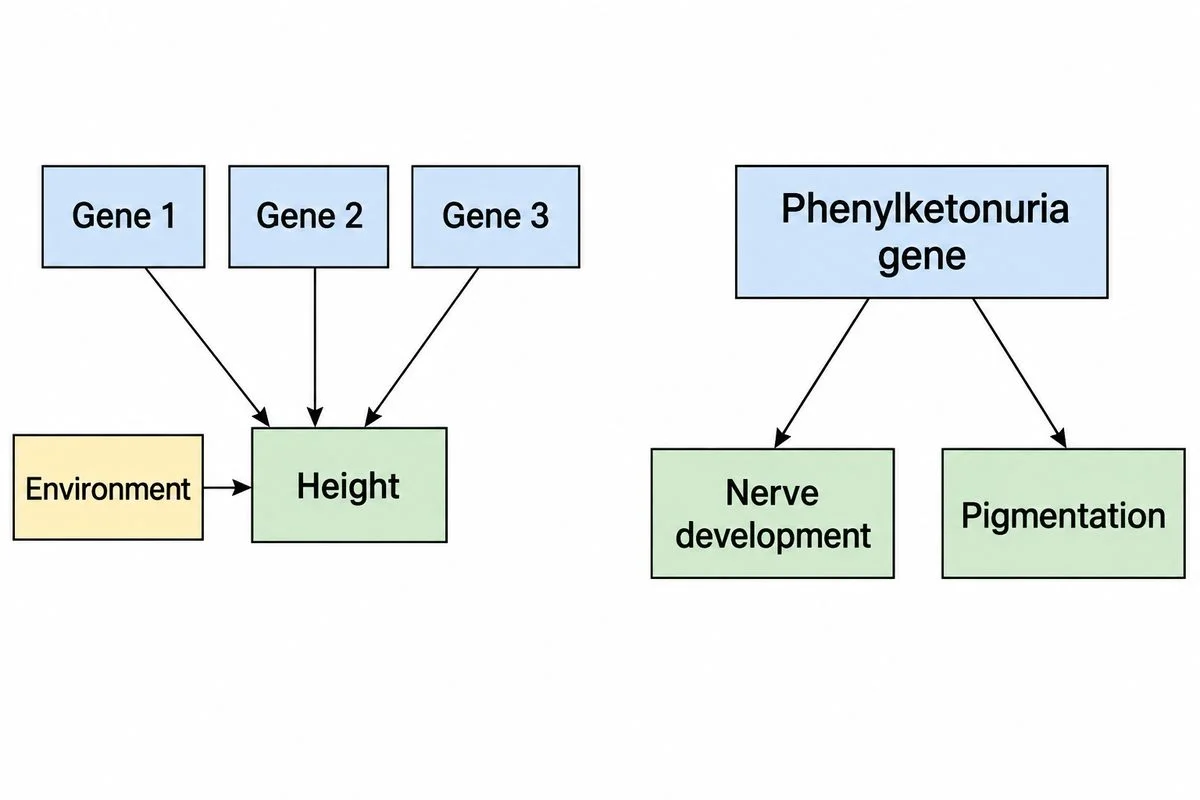
Several genes influence height; one changed gene influences nerve development and pigmentation.

5. Polygenic inheritance and pleiotropy

Many genes affect one trait; one gene can affect several.

Show
In the diagram, follow the genes and environment towards height. Find the phenylketonuria gene, then cover its outgoing arrows.
Ask
Could this one gene affect more than one trait?
Say
Several genes and nutrition influence height. In phenylketonuria, one changed gene affects nerve development and pigmentation.
Used in
Growth records track development without expecting everyone to reach the same height.
If your child says…“A trait controlled by genes cannot respond to its surroundings.”
Ask
Could different nutrition affect growth even when inherited alleles stay the same?
What’s true
Environmental conditions can change a polygenic trait's appearance without changing its inherited alleles.
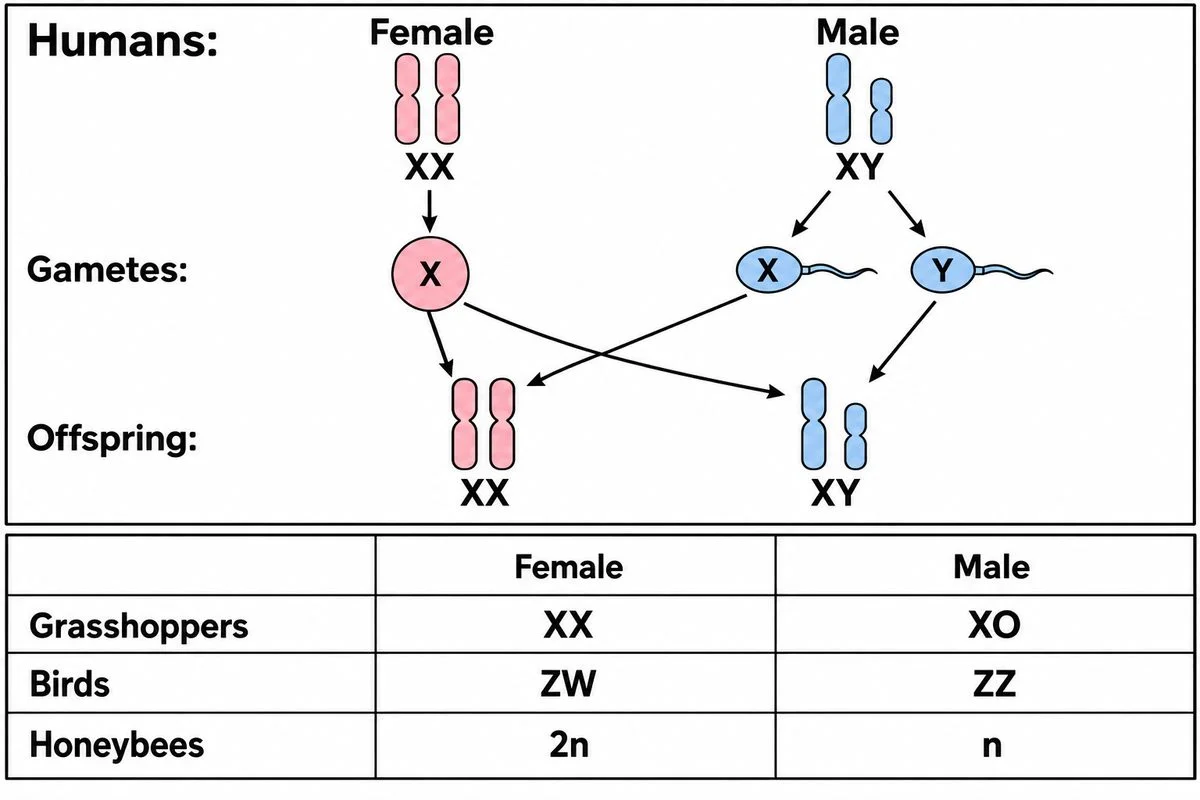
Human chromosome contributions above comparisons of grasshopper, bird and honeybee sex determination.

6. Sex determination

Different species use different routes to determine sex.

Show
In the diagram, trace human gametes. Compare the species below.
Ask
What pair forms when this egg meets an X-bearing sperm?
Say
XX forms because both gametes supply X. Bird eggs carry Z or W; grasshopper sperm carry X or no sex chromosome. Honeybee males develop from unfertilised eggs; females develop from fertilised eggs.
Used in
Understanding chromosome inheritance counters blame directed at mothers over a baby's sex.
If your child says…“Every animal uses the human XX–XY system.”
Ask
Which bird parent has two different sex chromosomes?
What’s true
Honey-bee males develop from unfertilised haploid eggs, while females develop from fertilised diploid eggs.

Changes in genes and chromosomes

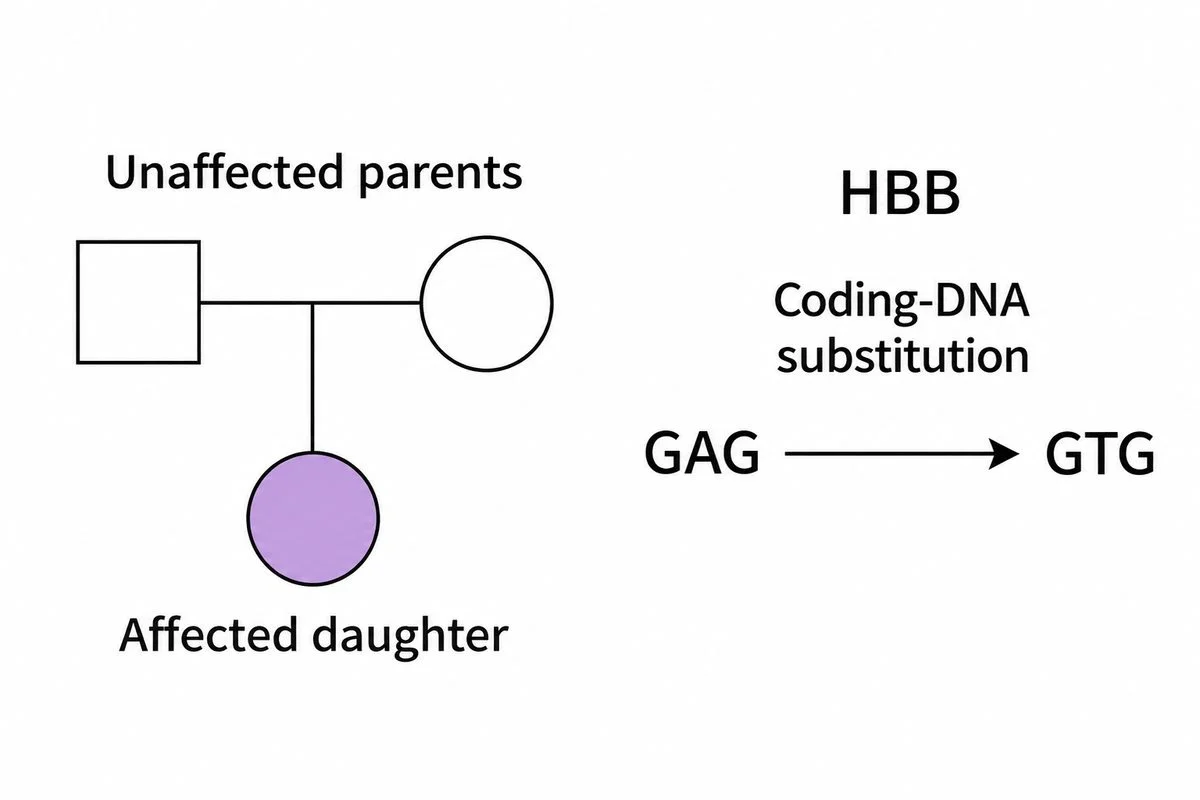
Pedigree of unaffected parents and an affected daughter beside an HBB coding-DNA substitution.

7. Mutation, pedigree analysis and Mendelian disorders

Mutations change genetic information; pedigrees trace inheritance.

Show
In the diagram, find the unshaded parents and shaded daughter. Shading indicates sickle-cell anaemia. Find the HBB coding-DNA substitution beside them.
Ask
Must another child also be affected?
Say
No: carriers can pass either allele. This DNA substitution changes beta-globin. Inheriting this allele from both parents causes sickle-cell anaemia.
Used in
Pedigrees reveal inherited risks hidden by appearances.
If your child says…“Unaffected parents cannot have an affected child.”
Ask
Could each unaffected parent carry an allele whose effect appears when the daughter receives both?
What’s true
Mutations can arise spontaneously or become more frequent with mutagens, and many have no visible effect.
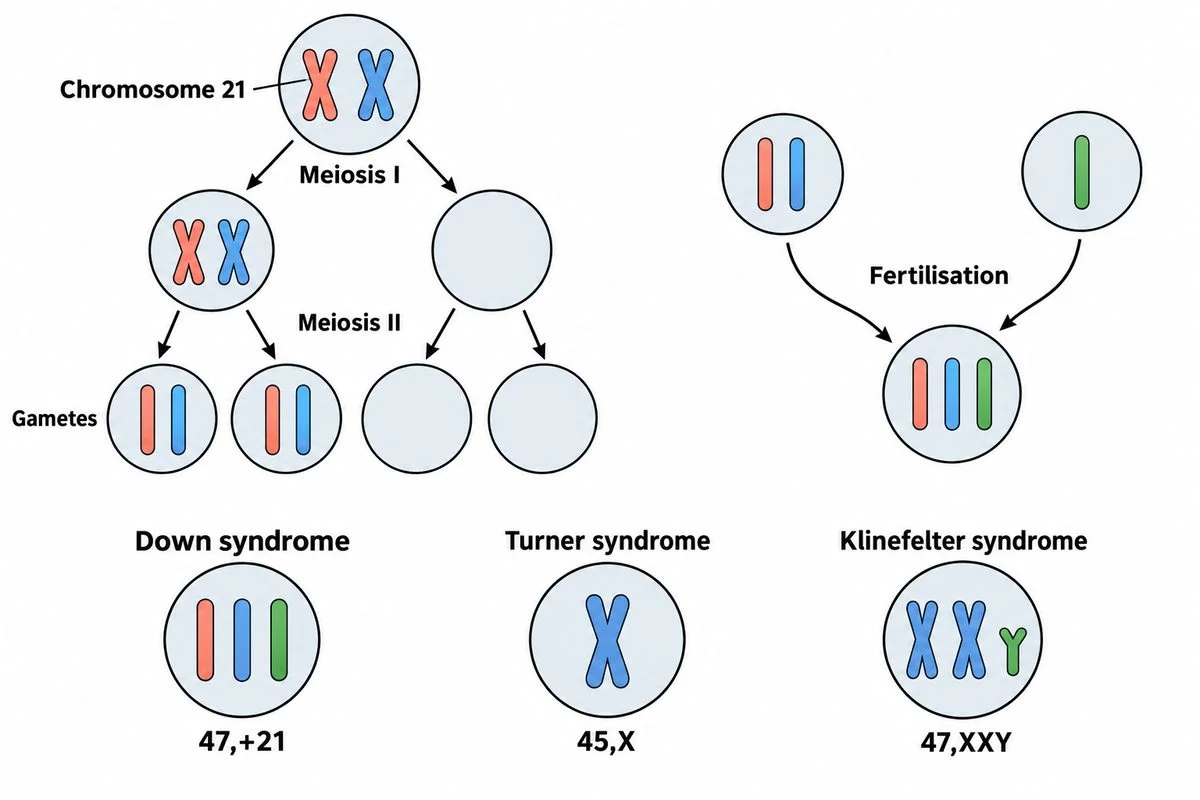
Failed chromosome separation produces abnormal gametes; fertilisation can produce three chromosome-21 copies.

8. Chromosomal disorders

Failed chromosome separation can change chromosome numbers.

Show
In the diagram, follow chromosome 21 through both divisions into gametes. Find the separate normal gamete; cover the fertilisation result. Compare the chromosome patterns below after predicting.
Ask
How many chromosome 21 copies will these two gametes contribute together?
Say
Failed separation gives one gamete two copies; fertilisation adds another, producing the usual Down syndrome pattern. Turner syndrome has one X; Klinefelter syndrome typically has XXY.
Used in
Chromosome analysis helps explain developmental conditions.
If your child says…“Down syndrome means one chromosome 21 is missing.”
Ask
When this gamete contributes two copies and the other contributes one, is a copy missing?
What’s true
Nondisjunction changes whole-chromosome numbers, unlike a change within one gene.

A real problem

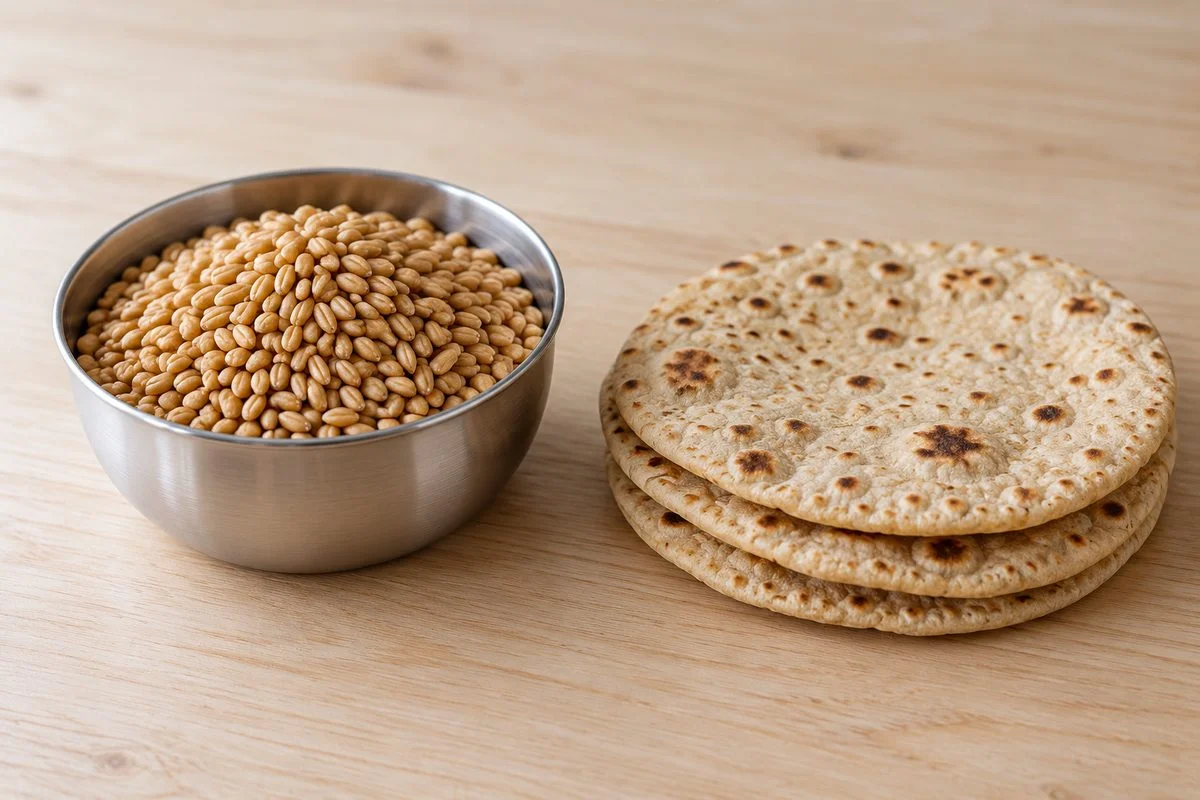
A wheat mutation produced amber grain.

The original red grain had low consumer preference in India.

Swaminathan and colleagues developed Sharbati Sonora in 1967.

This amber-grained mutant came from red-grained Mexican wheat.

Crossing experiments showed that red grain-colour alleles dominated white alleles.

Ramon Magsaysay Award FoundationM. S. Swaminathan Research FoundationNational Institute of Genetics, Japan

A bowl of amber wheat grains beside freshly made chapatis.

Concept Lab · Common misconception

The tempting mistake in Principles of Inheritance and Variation

Open standalone misconception page →

Can dominance tell you the frequency of an allele?

Wrong

A dominant allele must be carried by most members of the population.

Why it feels right. I hear dominant as meaning numerically most prevalent.

Right

Dominance describes the phenotype of a heterozygote. Allele frequency counts copies in a population.

Worked example

A copies5
a copies195
Five heterozygous plants express the dominant trait. They carry only five A copies out of 200 alleles.
  1. In a model population, 5 plants are Aa and 95 are aa.
  2. All 5 Aa plants express the dominant A trait, yet A accounts for only 5 of 200 allele copies, or 2.5%.

Ask your child eight quick questions.

One per step. The answer and the reason are given.

  1. Which allele must each round parent supply to make a wrinkled offspring?

    r. A wrinkled offspring needs r from both parents.

  2. Which ABO allele is absent from an AB individual's genotype?

    i. The two copies carry the A and B alleles.

  3. What gamete types can RrYy make when these genes assort independently?

    RY, Ry, rY, ry. Each gamete receives one allele from each independently separating pair.

  4. What new combinations can crossing over produce from these AB and ab chromosomes?

    Ab and aB. Exchanging matching sections can separate alleles previously carried together.

  5. Besides inherited genes, what growing condition discussed here can affect height?

    Nutrition. Several genes contribute to height, but growing conditions also influence it.

  6. Which sex-chromosome types can a bird's eggs carry?

    Z or W. Female birds carry ZW, so their eggs can receive either chromosome.

  7. Where did this daughter's two sickle-cell alleles come from?

    One from each parent. Each unaffected carrier can pass the changed allele to an offspring.

  8. What chromosome-number change does this diagram produce in the offspring?

    An extra chromosome 21. Failed separation gives one gamete two copies before fertilisation adds another.

15 more questions with answers