Skip to content

Teach Biotechnology Principles and Processes in eight steps.

For each idea: show it, ask before you tell, then say one line.

Gather paper and a pencil.

Common misconceptions & worked visual for this chapter · 15 practice questions with answers

How to teach it

Principles and tools

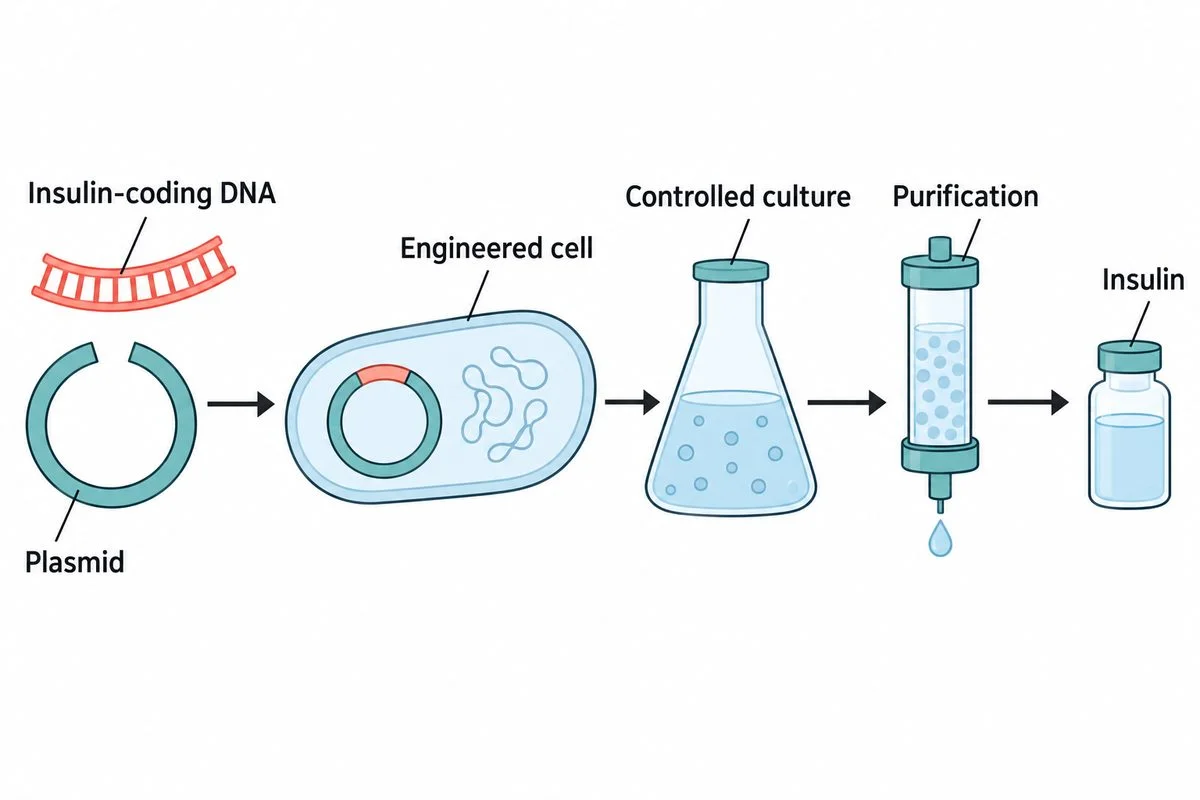
DNA insertion, controlled cell growth and purification lead to insulin.

1. Principles of biotechnology

Change DNA, grow cells under control, and recover useful products.

Show
Look at the diagram. Follow the insulin-coding DNA into the cell, then towards the culture and purification.
Ask
What must happen after this cell receives the gene before it can supply usable insulin?
Say
The gene gives the cell instructions for making insulin. Controlled, contamination-free growth and purification turn production into a useful product.
Used in
Engineered cells supply insulin for treating diabetes.
If your child says…“Once the gene goes in, the medicine is ready.”
Ask
How would you separate insulin from the cells that made it?
What’s true
Making a usable medicine also requires controlled production and purification.
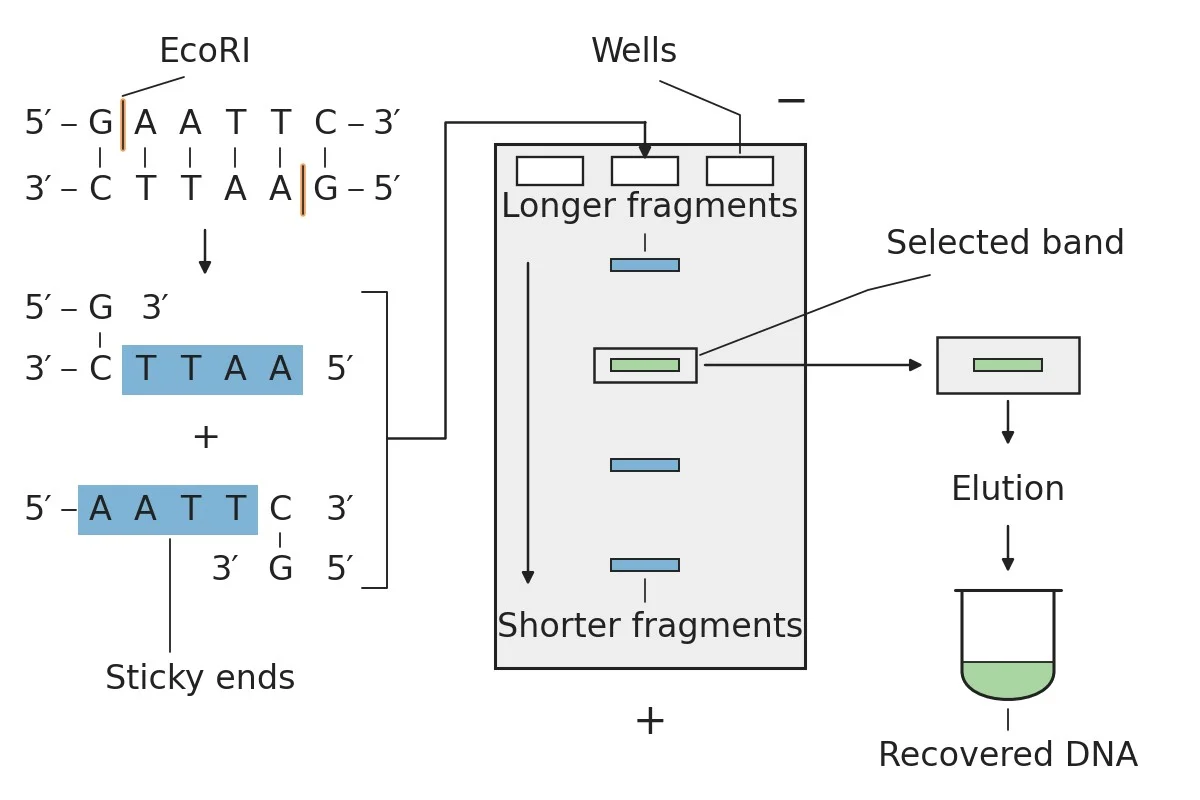
Specific DNA cuts lead to gel separation and recovery of a selected fragment.

2. Restriction enzymes and separation and isolation of DNA fragments

Cut, separate and recover DNA.

Show
Look at the diagram. Follow the marked cuts into the gel, then the selected band towards recovery.
Ask
Which fragments should travel farther towards the positive end after this mixture enters the gel?
Say
Restriction enzymes cut at recognised sequences. DNA carries a negative charge, so it moves towards the positive electrode. Smaller fragments usually travel farther. Elution recovers DNA from a selected band.
Used in
Recovered fragments supply selected DNA for insertion into vectors.
If your child says…“The bigger DNA piece travels farther.”
Ask
Which piece would pass through small pores more easily?
What’s true
Smaller DNA fragments pass through the gel’s pores more easily.
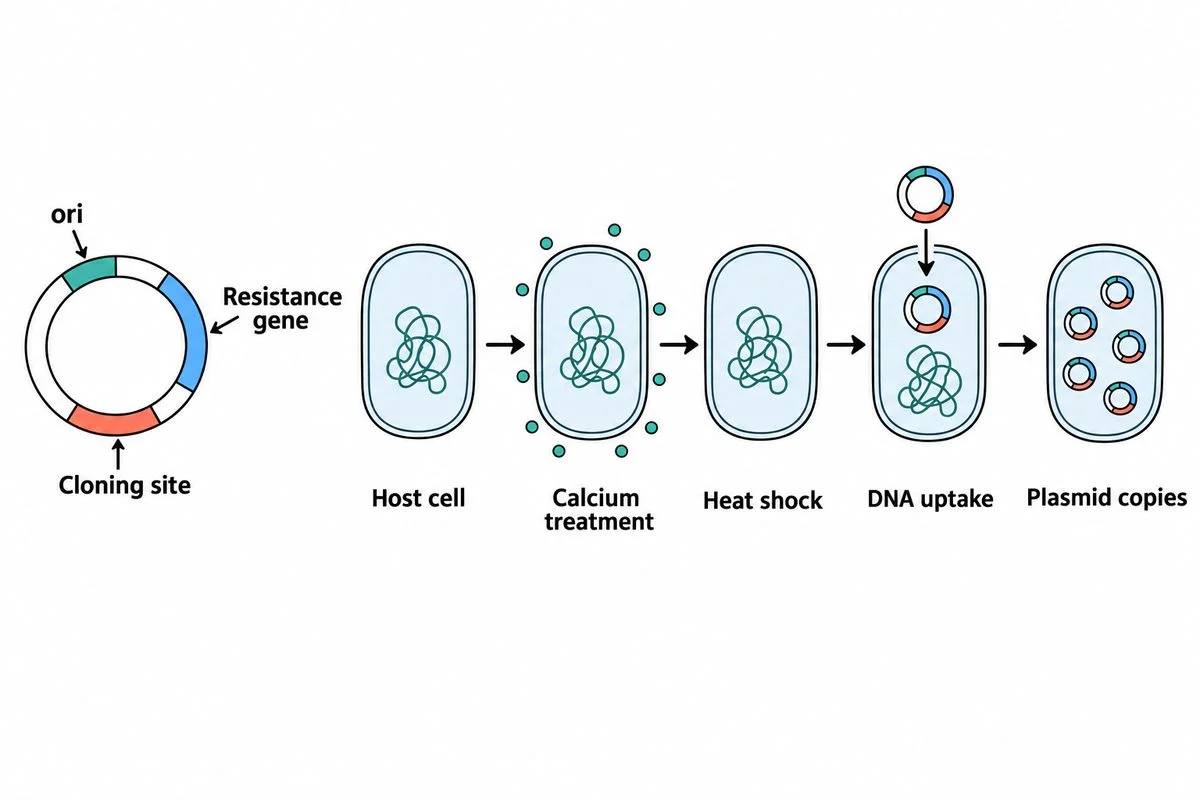
A plasmid map beside bacterial treatment, DNA uptake and plasmid copying.

3. Cloning vectors and competent host

A DNA carrier needs copying features and a suitable host.

Show
Look at the diagram. Find the plasmid’s three marked regions, then follow treatment and uptake.
Ask
What would happen to this plasmid’s copying if its ori were removed?
Say
The cloning site accepts DNA, ori starts copying, and the resistance gene allows selection. Calcium treatment and heat shock help some bacteria take up plasmids.
Used in
Plasmid vectors let laboratories maintain copies of inserted genes in bacteria.
If your child says…“Getting inside is enough for a plasmid to copy.”
Ask
Where would copying start if ori were missing?
What’s true
A plasmid needs an origin of replication to copy independently in its host.

Making and introducing recombinant DNA

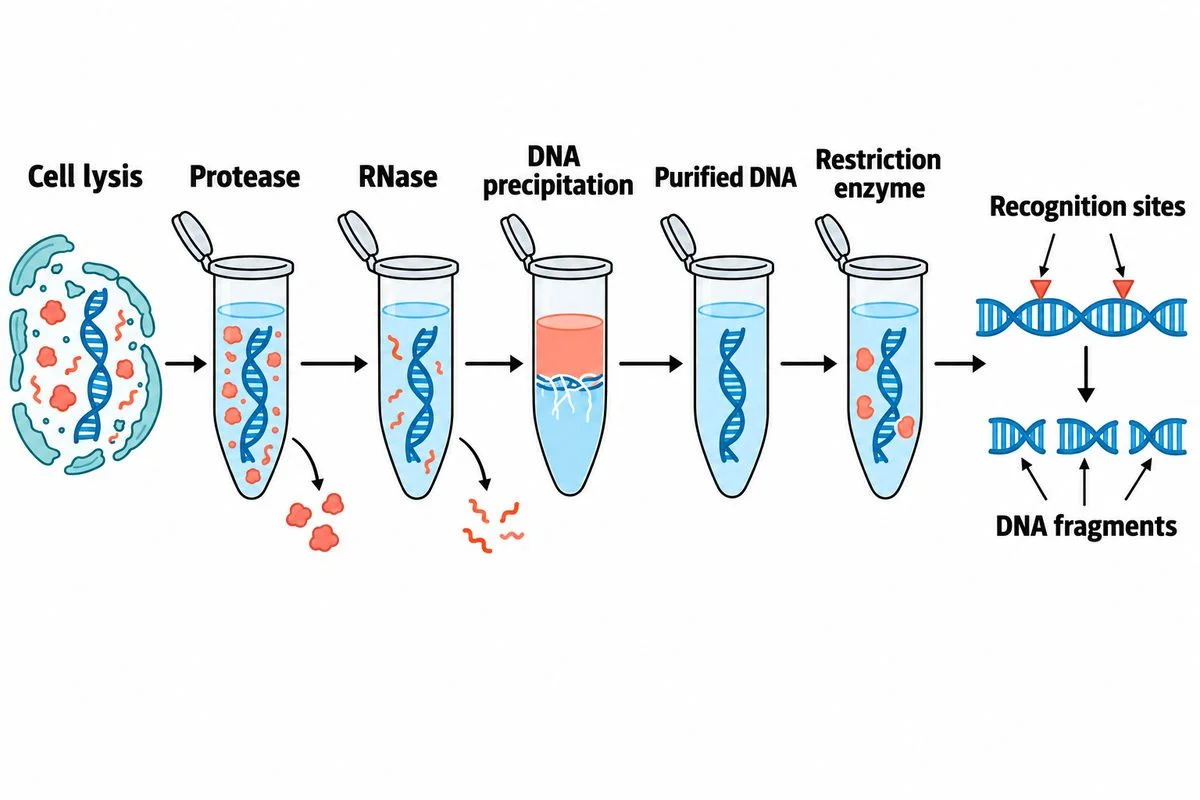
DNA remains intact during cleaning and precipitation before deliberate restriction cutting.

4. Isolation of the genetic material and cutting of DNA at specific locations

Clean DNA before controlled cutting.

Show
Look at the diagram. Follow DNA from the opened cell through cleaning, precipitation, redissolving and controlled cutting.
Ask
What would happen to this DNA if DNA-digesting enzymes stayed active during cleaning?
Say
Protect DNA while protease removes proteins and RNase removes RNA. Chilled ethanol brings DNA out of solution. Redissolve it before restriction cutting in the right buffer and temperature.
Used in
Purified DNA reduces interference in genetic tests.
If your child says…“DNA-digesting enzymes can keep working during extraction.”
Ask
What target would remain if its DNA were chopped up?
What’s true
Uncontrolled DNA digestion can destroy the target before it is isolated.
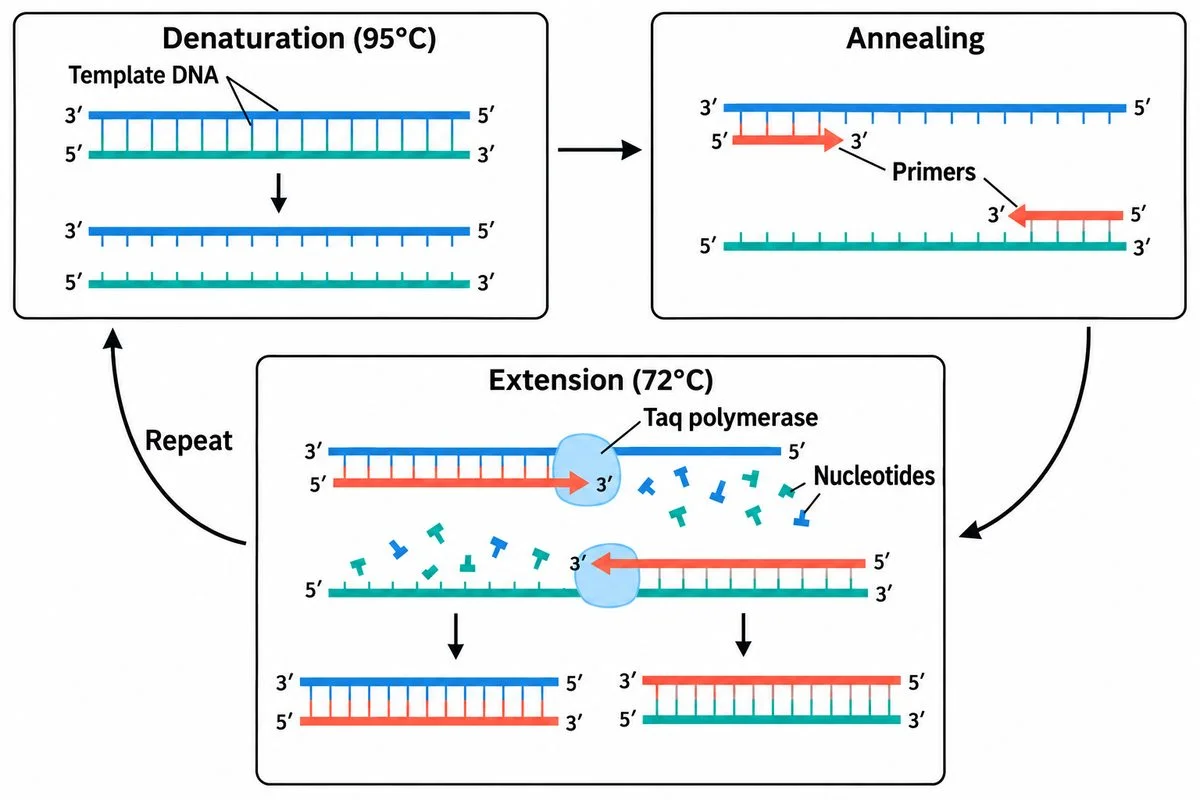
PCR cycles through strand separation, primer binding and extension to multiply selected DNA.

5. Amplification of gene of interest using PCR

Primers select DNA for repeated copying.

Show
Look at the diagram. Follow strand separation, primer binding and extension, then the arrow returning to separation.
Ask
How could repeating this cycle produce enough copies of the chosen region to study?
Say
Heating separates the strands. Primers bind after cooling, and heat-stable Taq polymerase extends them using free nucleotides. New strands become templates, so repeated cycles multiply the region between the primers.
Used in
PCR supplies enough DNA for testing.
If your child says…“PCR copies DNA without primers.”
Ask
Which starting ends would polymerase extend if both primers were absent?
What’s true
Polymerase needs primers to begin copying the selected region.
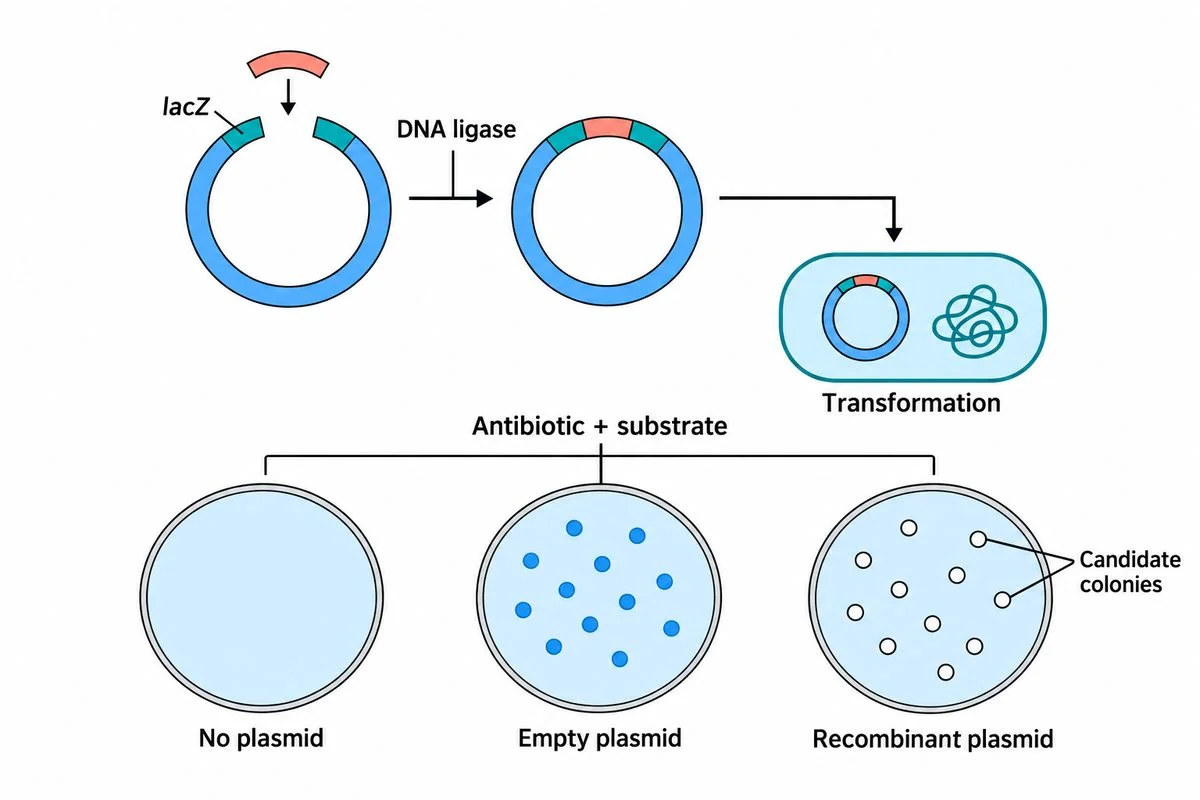
Antibiotic survival and colony colour distinguish plasmid uptake from candidate recombinant colonies.

6. Insertion of recombinant DNA into the host cell

Join DNA, introduce it, then screen.

Show
Look at the diagram. Follow the joined DNA into bacteria, then compare growth and colony colour.
Ask
Would antibiotic survival alone distinguish bacteria carrying these empty and recombinant plasmids?
Say
DNA ligase joins the insert into the plasmid’s lacZ gene. Both plasmids allow survival, but disrupting lacZ makes colonies white on this medium.
Used in
Screening identifies cultures with inserted DNA.
If your child says…“Surviving the antibiotic proves the new gene is inside.”
Ask
What allows bacteria with an empty plasmid to survive here?
What’s true
An empty vector can provide the same antibiotic resistance.

Producing and preparing the product

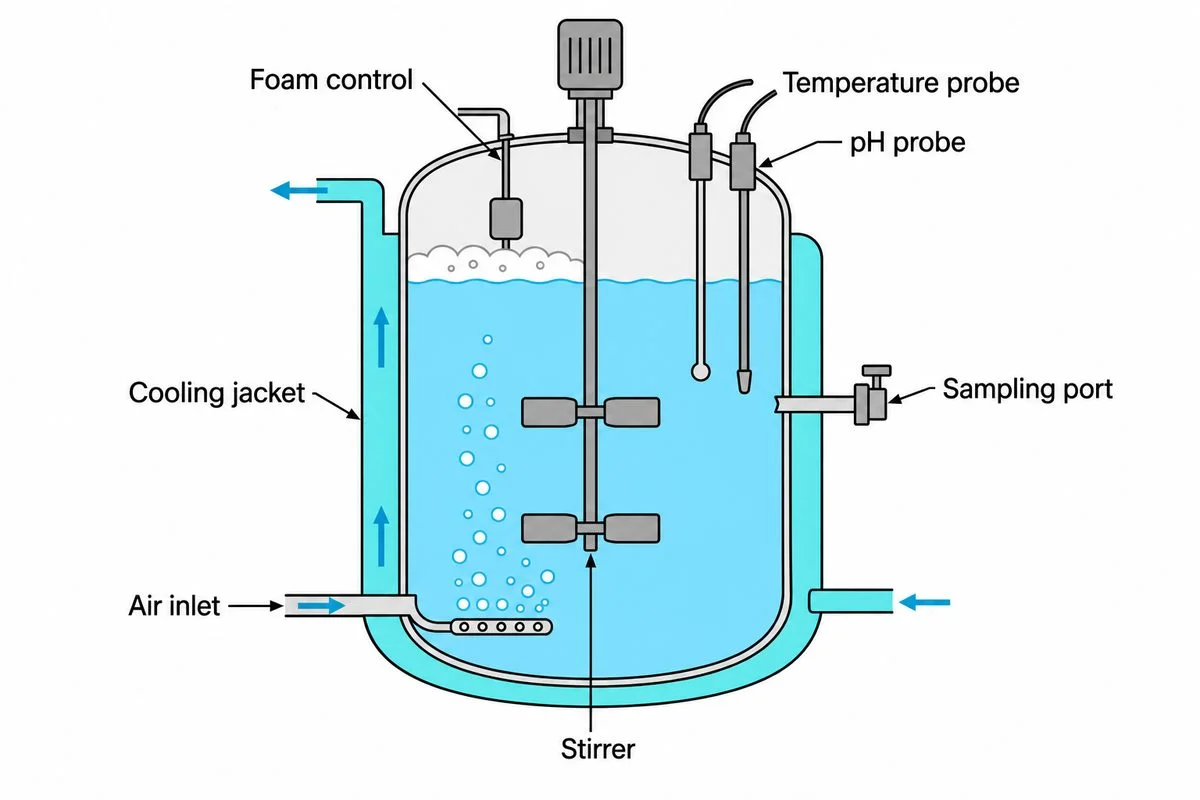
Diagram of a stirred tank with a cooling jacket and control fittings.

7. Bioreactors

Vessels that control conditions for growing cells.

Show
Look at the diagram. Find the stirrer, air inlet and cooling jacket. Then find the probes, sampling port and foam control.
Ask
What would happen to this culture’s temperature if the cooling jacket stopped working?
Say
The jacket cools the culture. Other systems regulate mixing, oxygen, pH and foam.
Used in
Bioreactors support reliable production in large cultures.
If your child says…“A bioreactor is just a bigger flask.”
Ask
Which parts of this tank would an ordinary flask lack?
What’s true
Large cultures need monitoring and control throughout production.
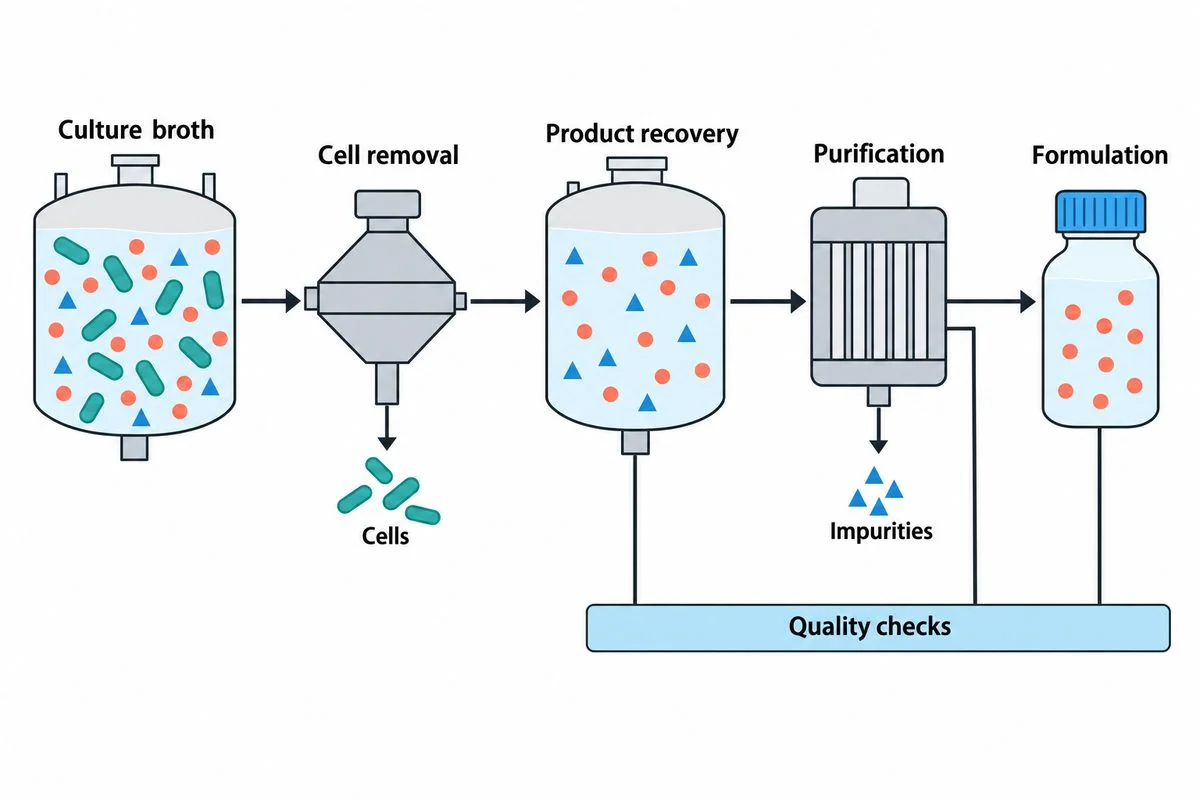
Cell removal leaves dissolved impurities, followed by product recovery, purification, formulation and quality checks.

8. Downstream processing

Recover, purify, prepare and check the product after production.

Show
Look at the diagram. Follow the product through cell removal, recovery, purification, formulation and quality checks.
Ask
Would removing these cells leave a medicine ready to use?
Say
Here, cells release the product into impure broth. Recover and purify it, prepare its usable form, and check quality during processing and before use.
Used in
Medicine manufacture removes culture impurities and checks product strength before use.
If your child says…“The liquid from the culture is already medicine.”
Ask
What remains mixed with the product after these cells are removed?
What’s true
Culture liquid also contains cells, unused nutrients and waste.

A real problem

An Indian vaccine project helped make hepatitis B vaccination more affordable.

Rangarajan transferred IISc’s vaccine technology in 2002.

Engineered yeast produced the hepatitis B surface antigen used in vaccine manufacture.

The project helped lower costs and bring vaccination into the Universal Immunisation Programme.

The vaccine protects by stimulating antibodies against this surface antigen.

IISc ConnectIISc BiochemistryWHO

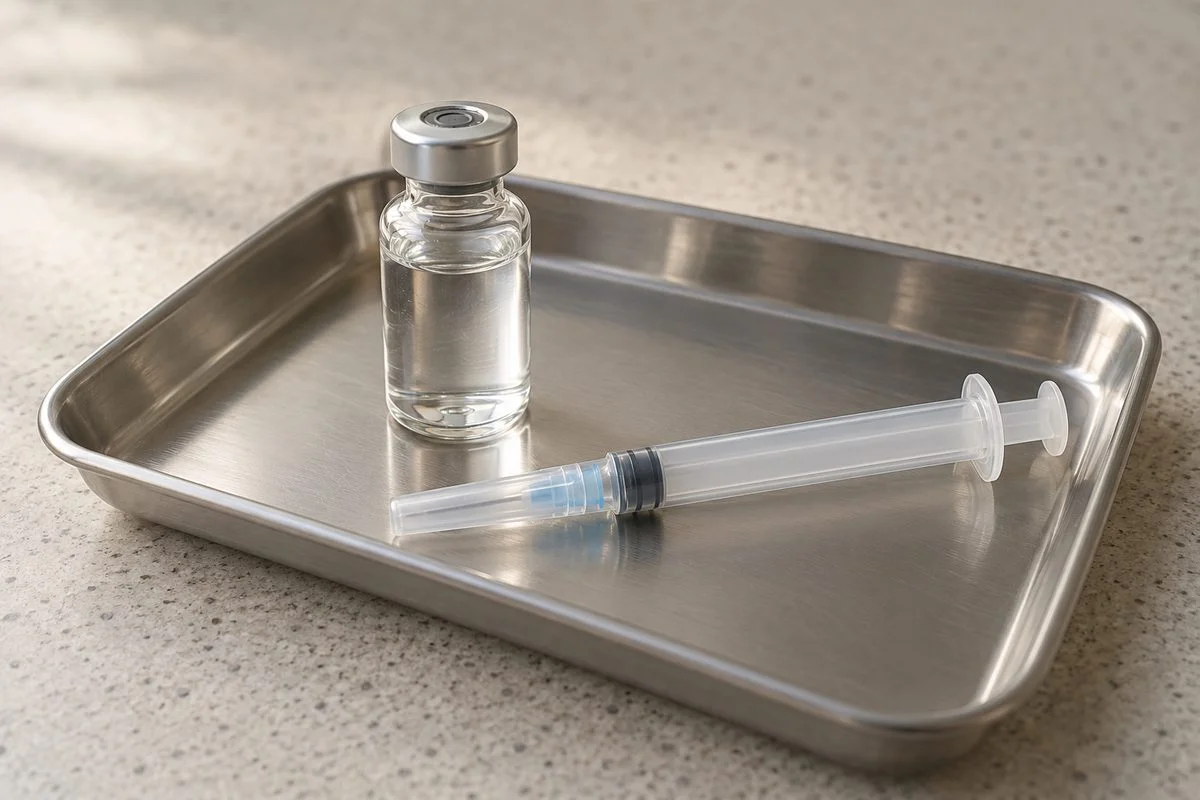
Unbranded vaccine vial and capped syringe on a steel clinic tray.

Concept Lab · Common misconception

The tempting mistake in Biotechnology Principles and Processes

Open standalone misconception page →

Does antibiotic survival prove the target gene is present?

Wrong

Every colony that grows on the antibiotic must contain the desired DNA insert.

Why it feels right. I assume the selection step tests the entire cloning result.

Right

A resistance marker selects for the marker. A separate check can confirm the insert.

Worked example

Empty plasmid
Marker retained→Colony grows→Shorter PCR product
Plasmid with insert
Marker retained→Colony grows→Longer PCR product
The resistance marker allows both plasmids to pass selection. PCR can then distinguish different insert sizes.
  1. If a plasmid retains its resistance marker whether or not it has an insert, cells with either plasmid can grow.
  2. A PCR test spanning the insertion site can distinguish the two by product size.

Ask your child eight quick questions.

One per step. The answer and the reason are given.

  1. Why is inserting the insulin gene alone insufficient?

    Production and purification are needed. A gene supplies instructions; cells must make the product, which then needs purification.

  2. Which fragments stay nearer the wells?

    Larger fragments. The gel slows larger fragments more.

  3. Which missing vector feature prevents independent copying after entry?

    The origin of replication. Entry into a cell does not provide the vector’s copying start point.

  4. How should DNA-digesting enzymes be controlled during isolation?

    Keep them inactive. This preserves the target DNA.

  5. What supplies polymerase’s starting points?

    The primers. Separating strands alone does not provide primers.

  6. Which colony colour identifies candidate recombinants on this medium?

    White. Disrupting lacZ prevents blue colour on this medium.

  7. Which part shown removes excess heat from the culture?

    The cooling jacket. Vessel size alone cannot regulate temperature.

  8. Which three stages follow product recovery in this diagram?

    Purification, formulation and quality checks. Visible separation does not establish purity, strength or required sterility.

15 more questions with answers