Skip to content

Teach Biotechnology and Its Applications in eight steps.

For each idea: show it, ask before you tell, then say one line.

Gather paper and a pencil.

Common misconceptions & worked visual for this chapter · 15 practice questions with answers

How to teach it

Protecting crops

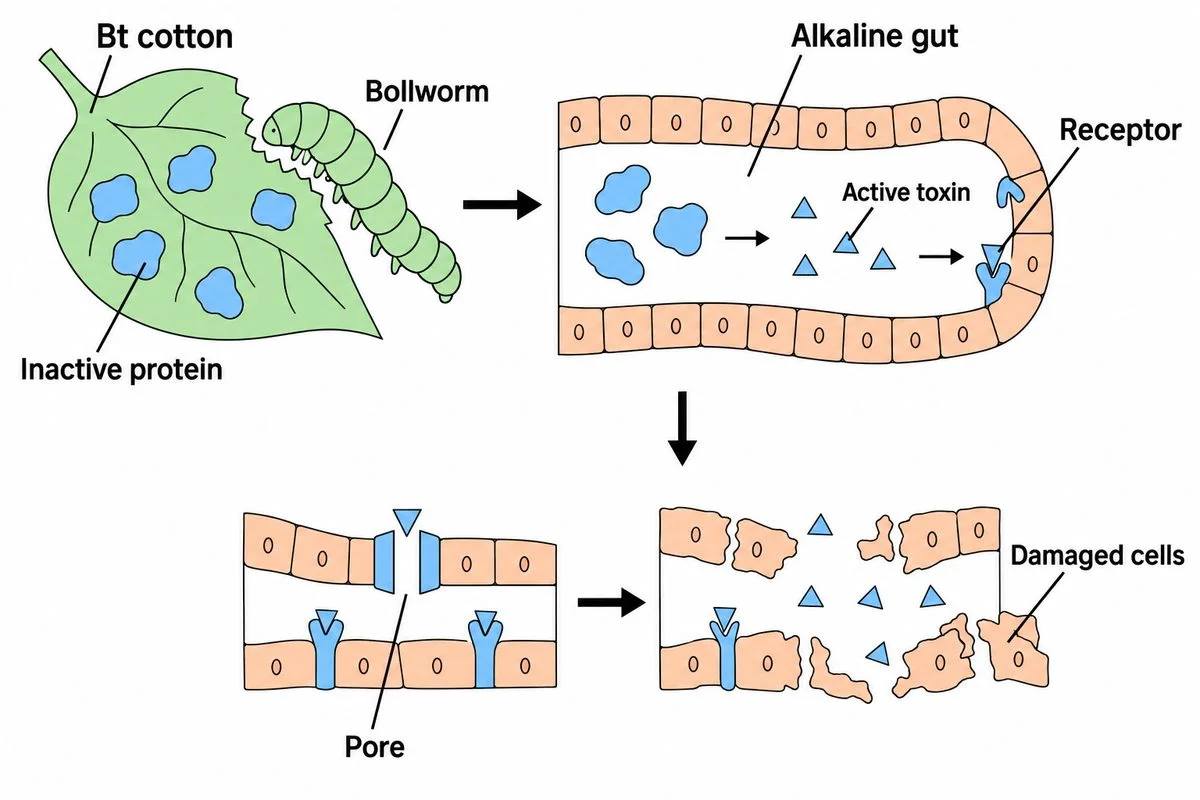
Bt protein enters a bollworm's gut, becomes active and damages cells through pores.

1. Biotechnology in Agriculture: Bt cotton

An introduced gene helps crops resist particular insect pests.

Show
Look at the diagram. Follow the protein from the cotton leaf into the bollworm's gut. Find the receptors and pores.
Ask
What do you predict happens when a susceptible bollworm eats this cotton leaf?
Say
This cotton makes a protein activated in susceptible insects' alkaline guts. It binds matching receptors and opens pores, damaging gut cells.
Used in
Bt cotton reduces bollworm damage, helping protect harvests.
If your child says…“One added gene solves every farming problem forever.”
Ask
Would this protein protect cotton from insects without matching gut receptors?
What’s true
Susceptible insects activate Bt protein in alkaline guts, but pest resistance can develop.
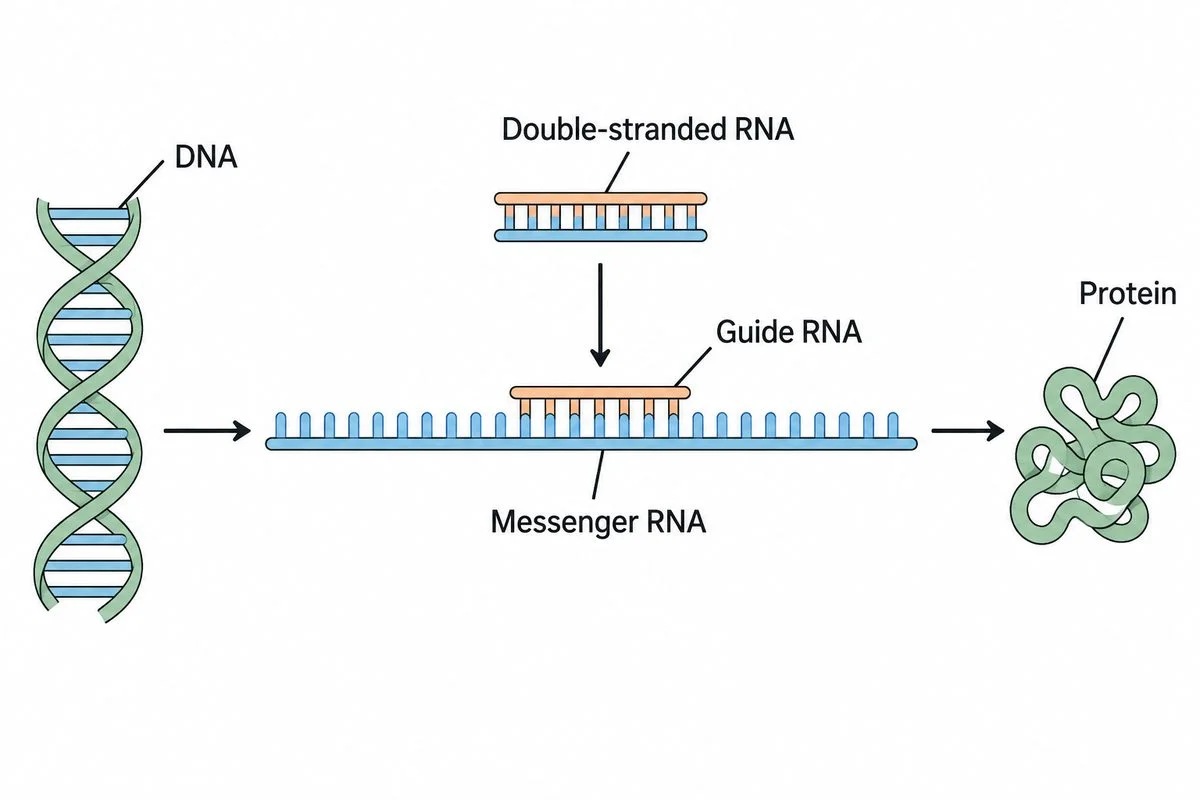
Diagram of DNA, messenger RNA, protein and a matching RNA guide.

2. RNA interference

Matching RNA silences a message.

Show
Find DNA, messenger RNA, protein and double-stranded RNA in the diagram. Find the guide RNA beside its matching message.
Ask
What happens to protein production?
Say
The matching guide targets this message for destruction, reducing its protein production. DNA remains intact.
Used in
RNA interference protects tobacco by silencing an essential nematode message.
If your child says…“RNA interference makes every gene more active.”
Ask
How could destroying these instructions increase the protein made from them?
What’s true
RNA interference reduces activity of a matching message rather than activating every gene.

Making medicines and studying disease

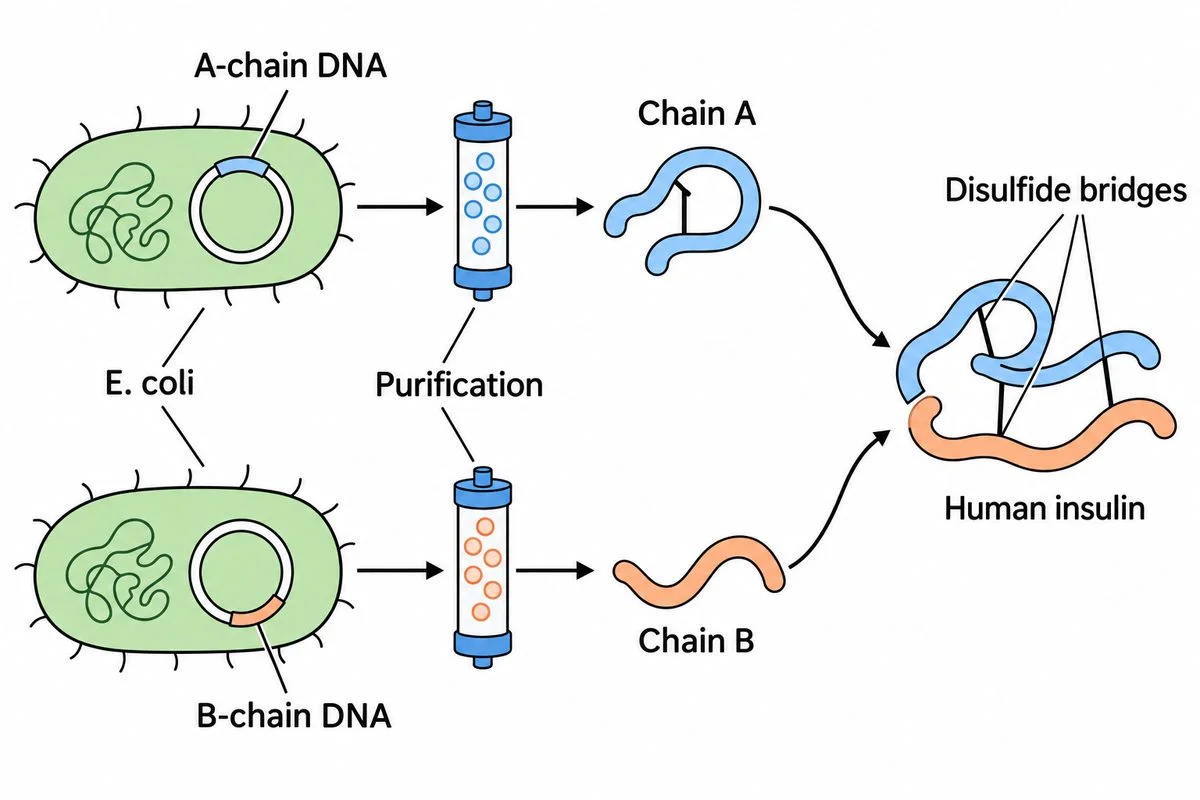
Engineered bacteria produce separate insulin chains, which are purified and joined by disulfide bridges.

3. Biotechnological Applications in Medicine: Genetically Engineered Insulin

Engineered microbes supply insulin chains for assembly.

Show
Look at the diagram. Follow each bacterium's route to its purified insulin chain. Find where the chains join through disulfide bridges.
Ask
Would these separate chains work as insulin before they are correctly joined?
Say
Engineered bacteria make the A and B chains, which are then purified. Joining them with the correct disulfide bridges makes working insulin.
Used in
Recombinant vaccine antigens help immunity recognise pathogens.
If your child says…“A lab-made medicine needs no cleaning.”
Ask
Does making insulin also remove the cells and liquid surrounding it?
What’s true
Useful proteins must be separated from their producing cells and growth medium, then checked.
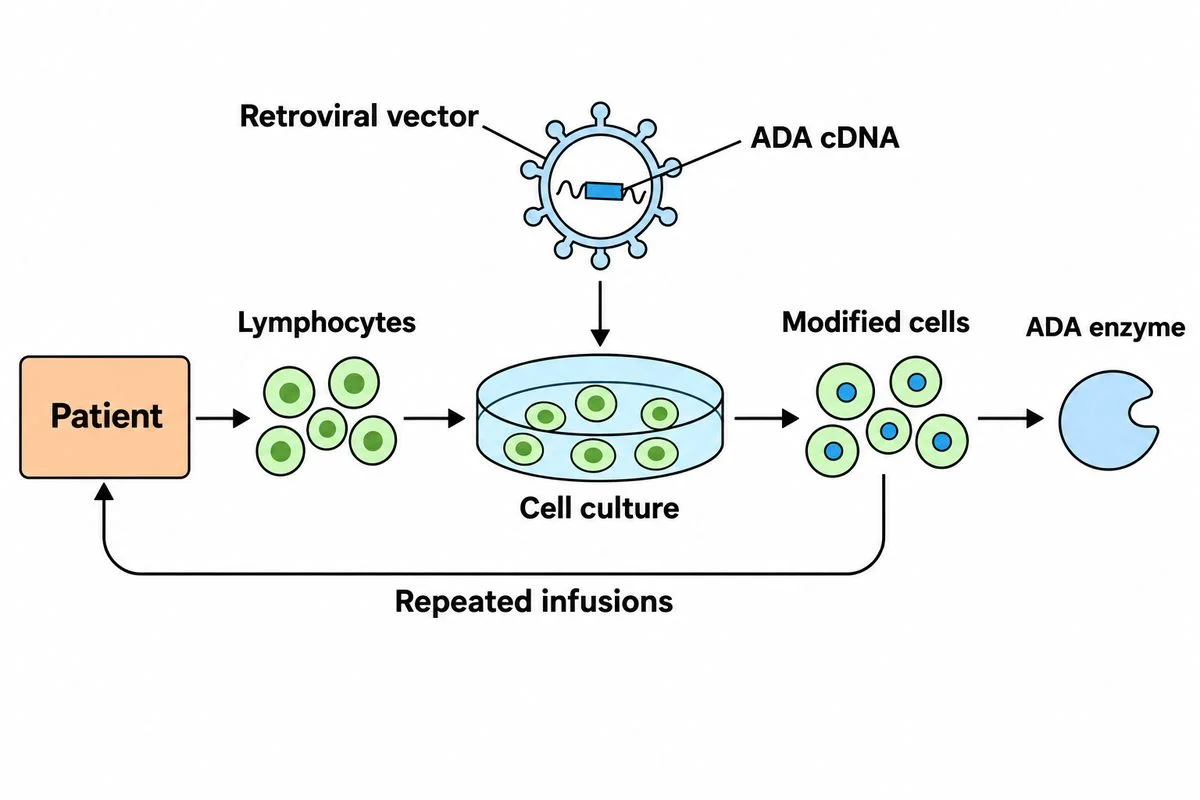
Lymphocytes receive working ADA DNA in culture and return to the patient.

4. Gene Therapy

Selected cells receive working gene instructions to help treat disease.

Show
Look at the diagram. Follow the lymphocytes into culture, where a retroviral vector delivers working ADA DNA. Trace their return to the patient.
Ask
Could these lymphocytes make the missing enzyme after receiving working ADA DNA?
Say
The added DNA lets these lymphocytes make ADA enzyme.
Used in
Working ADA instructions help treated immune cells make the missing enzyme.
If your child says…“One gene-therapy dose cures ADA deficiency forever.”
Ask
What happens to the benefit when the corrected lymphocytes die?
What’s true
Corrected lymphocytes die, while corrected blood-forming stem cells can provide continuing replacement cells.
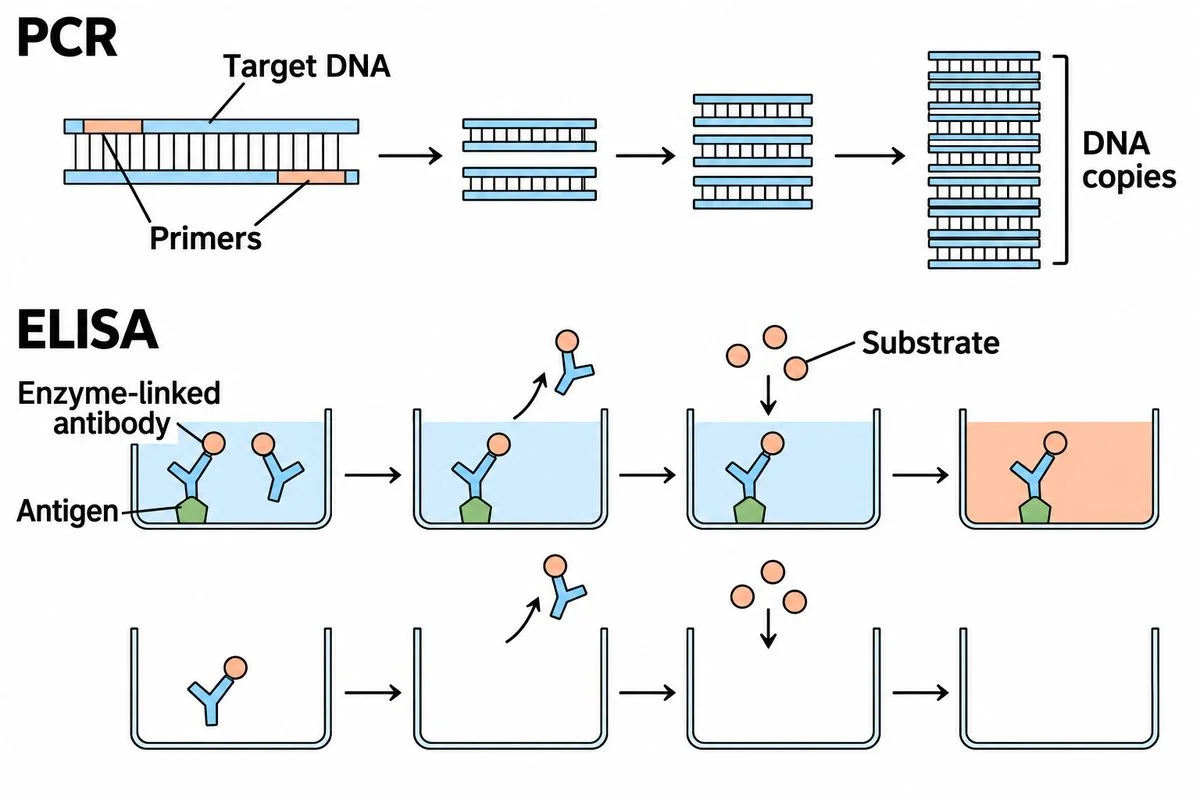
PCR copies target DNA, while ELISA produces colour after specific antigen–antibody binding.

5. Molecular Diagnosis

PCR copies DNA; ELISA uses antigen–antibody binding to detect disease indicators.

Show
Look at the diagram's upper route from primers to DNA copies. Below, follow antibody binding, washing and substrate addition in the ELISA wells.
Ask
Looking at these two routes, could the tests reveal infection before symptoms appear?
Say
PCR copies DNA selected by primers, making tiny amounts detectable. In this ELISA, antibodies bind the antigen, and washing removes unbound antibodies. The attached enzyme turns added substrate into a coloured product.
Used in
PCR helps detect infection when pathogen DNA is scarce, sometimes before symptoms appear.
If your child says…“PCR finds proteins using antibodies.”
Ask
Which route copies DNA, and which uses antibodies?
What’s true
PCR copies DNA using primers, enzymes and temperature cycles.
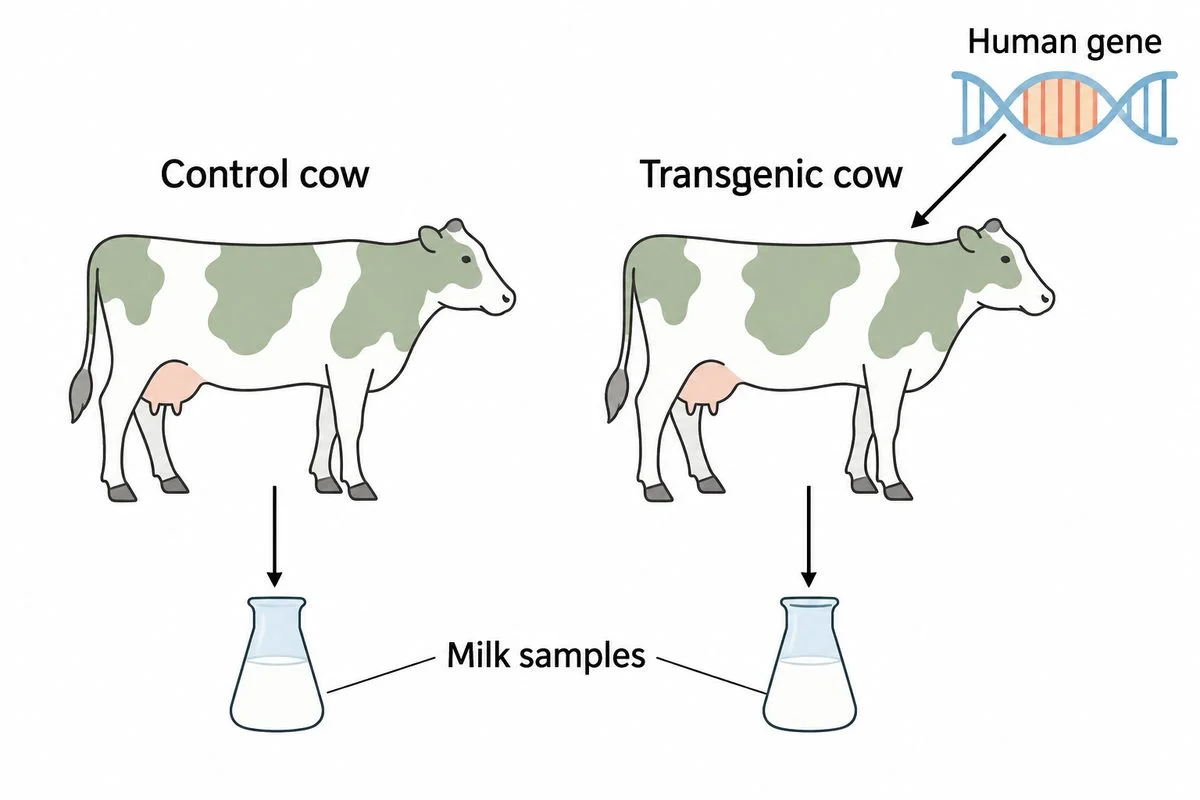
Diagram of control and transgenic cows, each connected to its milk sample.

6. Transgenic Animals

Animals with introduced genes help produce proteins and investigate biology.

Show
Look at the diagram. Find the control cow and the cow with an introduced human gene. Follow each cow's connection to its milk sample.
Ask
Would testing only the altered cow show whether its added gene caused a milk difference?
Say
No; the control helps check whether the added gene accounts for a protein difference.
Used in
Transgenic animals can produce medicinal proteins for use in treatments.
If your child says…“A modified animal works exactly like a human.”
Ask
Does adding one human gene give this cow every human feature?
What’s true
Animal models reproduce selected features, so human checks and animal welfare safeguards remain necessary.

Checking safety and fair use

A blank sheet lies open on a tabletop, divided into equal halves by a central crease.

7. Ethical Issues: Biosafety

Each proposed GM use needs evidence about benefits, risks and safeguards.

Show
Fold paper into two columns. Read aloud: 'A contained Bt trial shows target-insect deaths, with no other results.' Pause for prediction. Record the benefit left and missing evidence right.
Ask
Would reviewers approve release using only these target-insect results?
Say
No; pest control alone leaves questions about other organisms, escaped genes, food safety and affected farmers.
Used in
Biosafety assessment helps identify risks before a GM organism is released.
If your child says…“Every GM organism is completely safe.”
Ask
Which result here tells us what happens to other organisms?
What’s true
Safety depends on the organism, its introduced trait and its intended use.
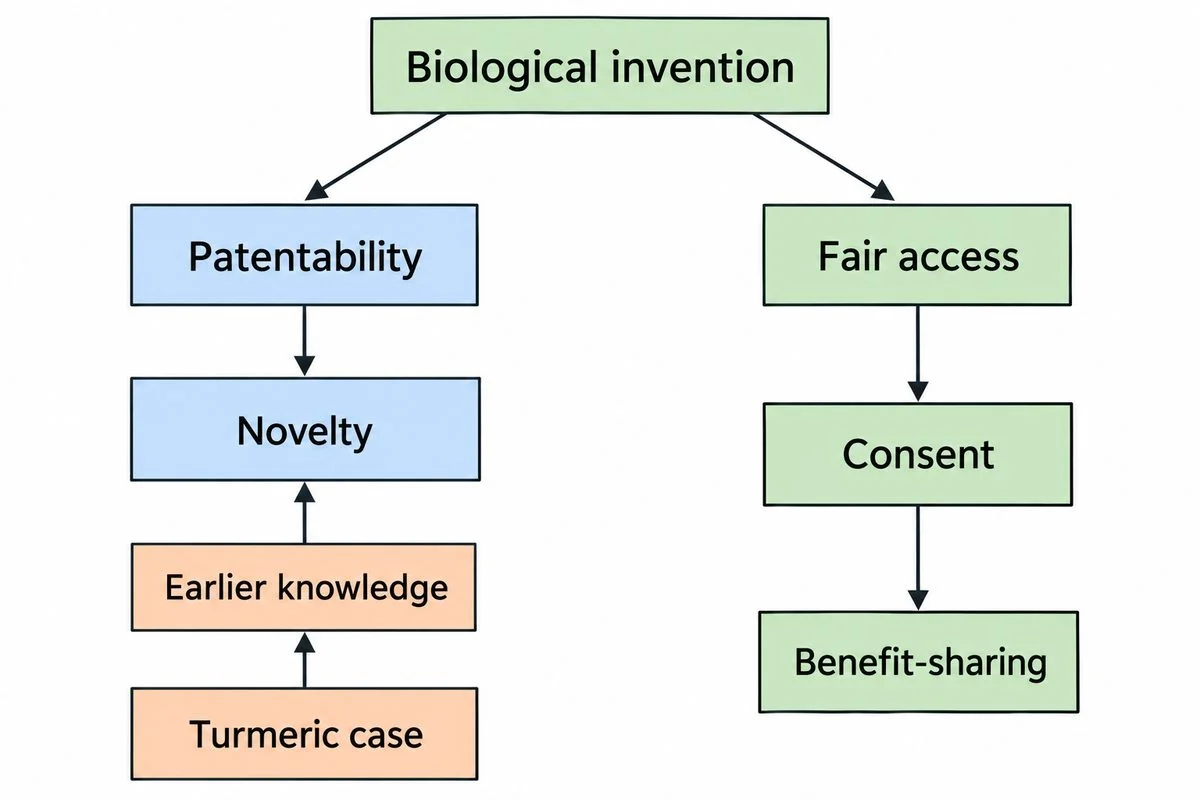
Separate branches examine patent novelty and fair access through consent and benefit-sharing.

8. Biopatents and Biopiracy

Patent rights and fair use of biological knowledge are separate questions.

Show
Look at the diagram's two branches. Follow earlier turmeric knowledge to the novelty check on the left. Find consent and benefit-sharing on the right.
Ask
Would obtaining a patent also show that this knowledge was used fairly?
Say
Earlier records described turmeric being used to treat wounds, so that use was already known. A patent does not show that communities gave permission or received a fair share.
Used in
Records of traditional knowledge help challenge patent claims for uses already known.
If your child says…“Traditional knowledge can never count against a patent.”
Ask
Can this use be new if an earlier record already describes it?
What’s true
Documented traditional use can establish that a claimed invention was already known.

A real problem

Recorded traditional knowledge helped challenge patent claims.

India began building its Traditional Knowledge Digital Library in 2001.

The library helped patent examiners access traditional knowledge across language barriers.

Its evidence helped halt European patent grants and prompted applicants to withdraw applications.

Harvard Business SchoolWIPOWIPO

Small steel bowl of turmeric powder on a kitchen counter.

Concept Lab · Common misconception

The tempting mistake in Biotechnology and Its Applications

Open standalone misconception page →

Does Bt maize protect against every insect?

Wrong

A crop carrying a Bt gene resists all insect pests.

Why it feels right. The phrase insect-resistant sounds like a universal property.

Right

Different Bt proteins affect particular susceptible groups of insects.

Worked example

Susceptible caterpillar
Eats tissue→Bt protein acts in gut
Aphid outside target range
Feeds on crop→Outside this protein's target range
The protein targets susceptible insects. Exposure through the crop does not imply that every species is affected.
  1. A Bt protein selected against a caterpillar pest acts in the gut of susceptible larvae.
  2. An aphid can still feed on the same plant because it is outside that protein's target range.

Ask your child eight quick questions.

One per step. The answer and the reason are given.

  1. Why might Bt cotton lose protection against its target pest over time?

    Pests can develop resistance. Resistance can weaken the protection provided by the introduced gene.

  2. What happens to protein production from a message targeted by RNA interference?

    It decreases. Silencing the matching message reduces production of its protein.

  3. What removes producing cells and growth medium from a recombinant medicine?

    Separation and purification. Producing the protein does not make the surrounding mixture ready for treatment.

  4. Why might corrected lymphocytes need replacing after ADA gene therapy?

    They die. Adding working ADA instructions does not make lymphocytes immortal.

  5. Which test multiplies tiny amounts of target DNA?

    PCR. PCR amplifies DNA, while ELISA relies on antigen–antibody binding.

  6. Where must findings from an animal disease model still be checked before claiming human benefit?

    In humans. An animal model reproduces selected features, not every aspect of human biology.

  7. Why can't target-pest deaths alone establish safety for other insects?

    Other insects were not tested. Target-pest deaths alone reveal nothing about effects on other insects.

  8. What evidence challenged the turmeric patent's claim that the wound-treatment use was new?

    Documented earlier traditional use. Evidence of an earlier use challenges a claim that the use is new.

15 more questions with answers