Skip to content

Teach Molecular Basis of Inheritance in eight steps.

For each idea: show it, ask before you tell, then say one line.

Gather paper and a pencil.

Common misconceptions & worked visual for this chapter · 15 practice questions with answers

How to teach it

DNA and its copying

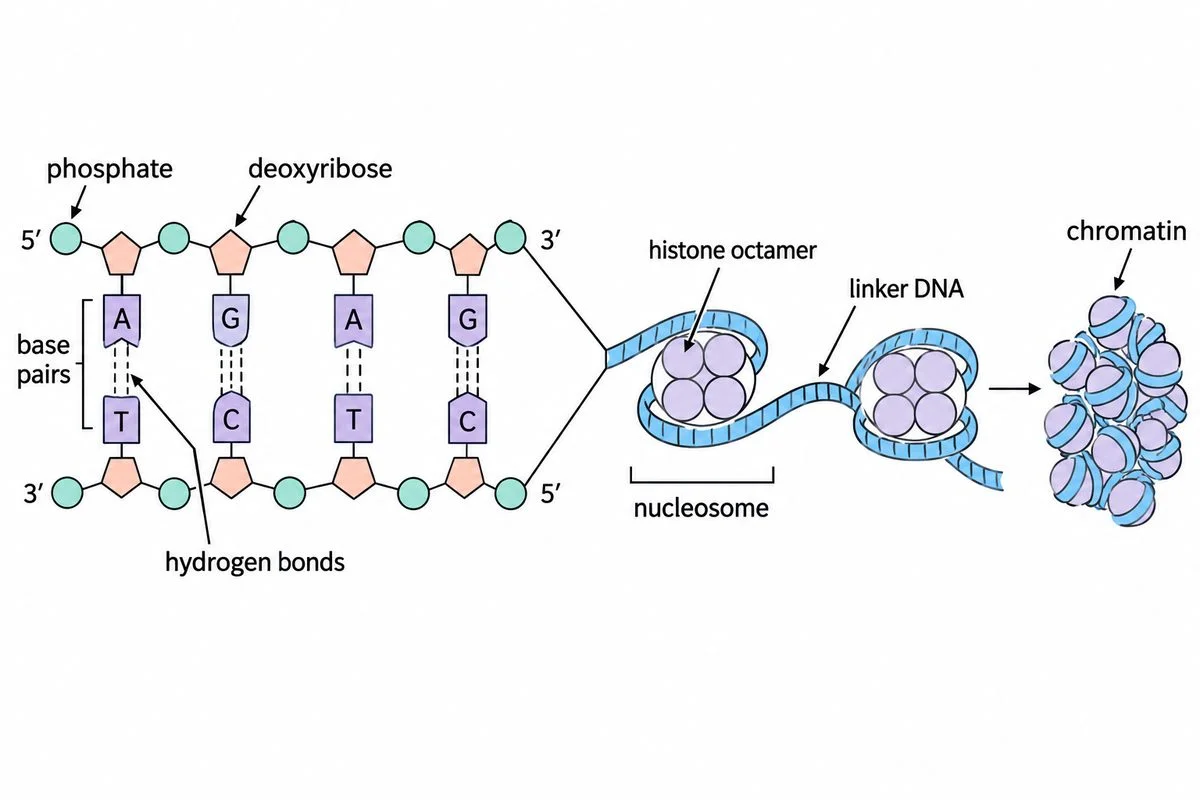
Oppositely directed DNA strands connect to nucleosomes and compact chromatin.

1. The DNA: polynucleotide chains and packaging

DNA strands pair oppositely; packaging saves space.

Show
Find the backbones, base pairs and opposite strand directions in the diagram. Follow DNA around histones into compact chromatin.
Ask
How will wrapping help this long DNA fit inside a tiny nucleus?
Say
DNA’s paired strands run in opposite directions, with A facing T and G facing C. Wrapping around histones compacts this long molecule.
Used in
Studying DNA packaging helps explain gene inactivity.
If your child says…“The most tightly packed genes work hardest.”
Ask
Which DNA looks easier to reach: the exposed stretch or the tightly packed region?
What’s true
Looser packing usually makes genes easier to reach and transcribe.
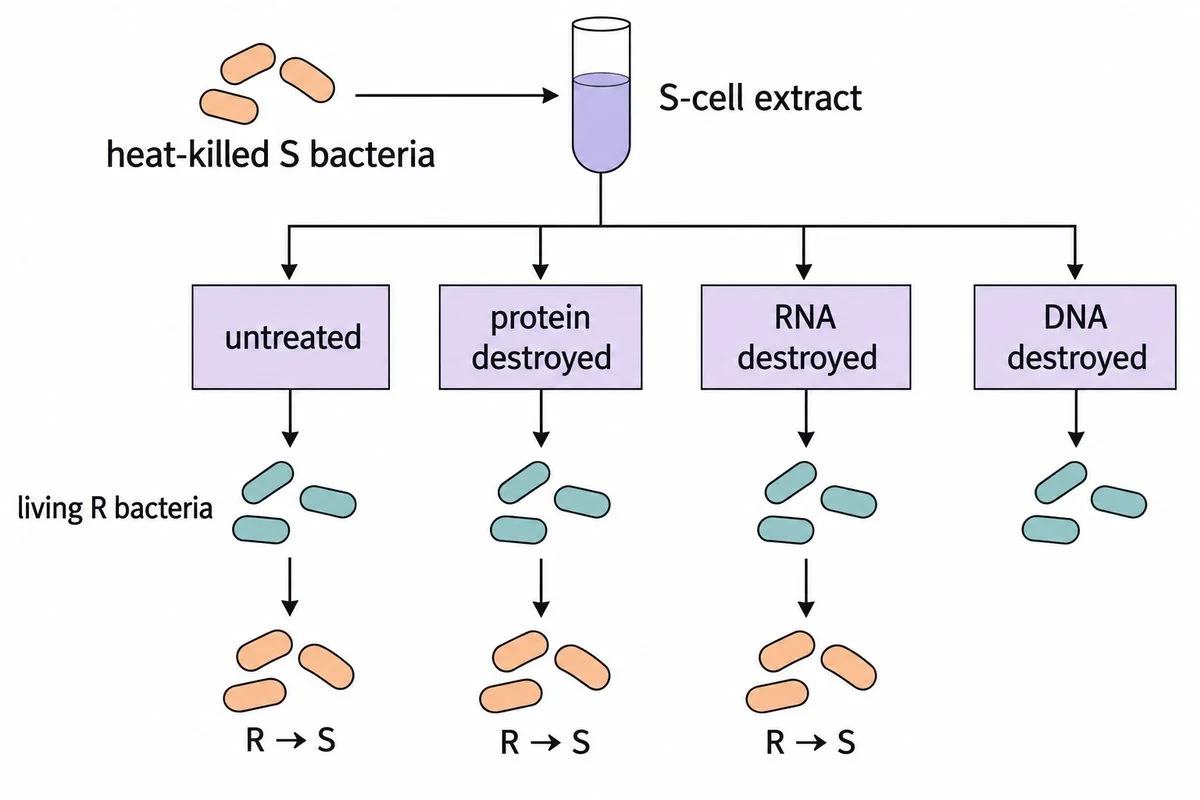
Four extract treatments show R bacteria becoming S bacteria, with the DNA-destruction outcome unfinished.

2. The search for genetic material and RNA world

Treatments reveal DNA’s hereditary role; RNA’s abilities suggest an earlier role.

Show
Find the four extract treatments in the diagram. Compare the three marked outcomes with the unfinished DNA-destruction branch.
Ask
Will transformation happen after DNA destruction?
Say
The extract changed living R bacteria into S bacteria unless its DNA was destroyed.
Used in
DNA analysis helps researchers investigate inherited changes linked to disease.
If your child says…“Protein carried the inherited change.”
Ask
Why did the inherited change survive when proteins were destroyed?
What’s true
Transformation required DNA, and phage experiments also traced DNA into bacteria while protein coats remained outside.
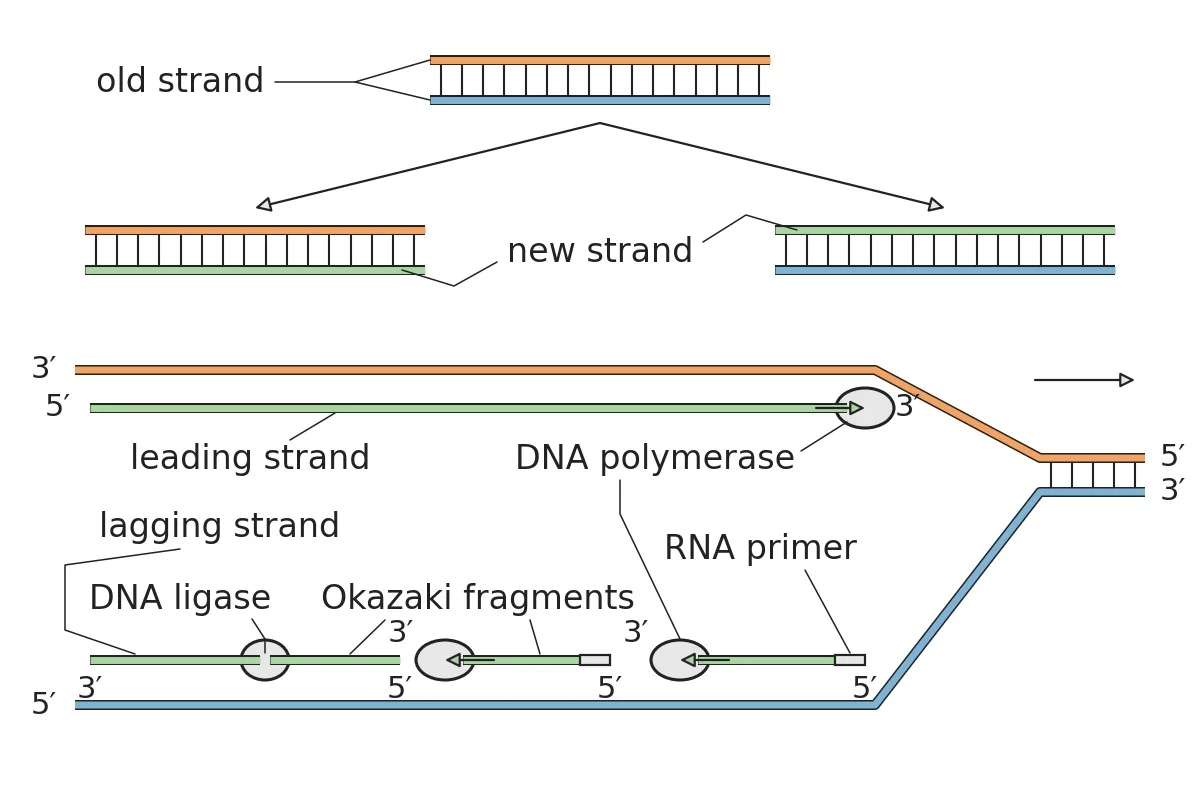
Old strands enter daughter DNA molecules above a fork with continuous and fragmented synthesis.

3. Replication

Each DNA copy retains an original strand.

Show
Trace each old strand into a daughter molecule in the diagram. Follow the growth arrows at the fork below.
Ask
How will each daughter molecule receive the original DNA information?
Say
Each copy keeps one old strand beside a new complementary strand. New DNA grows 5′ to 3′, continuously on one side and in fragments on the other.
Used in
Before cells divide, DNA copying provides genetic information for both new cells.
If your child says…“Both new strands grow in one continuous piece.”
Ask
Can both strands grow towards the opening while adding only at their 3′ ends?
What’s true
The templates run in opposite directions, but new DNA grows only from five-prime to three-prime. At each fork, this means one new strand must be made in short pieces.

Using and controlling genes

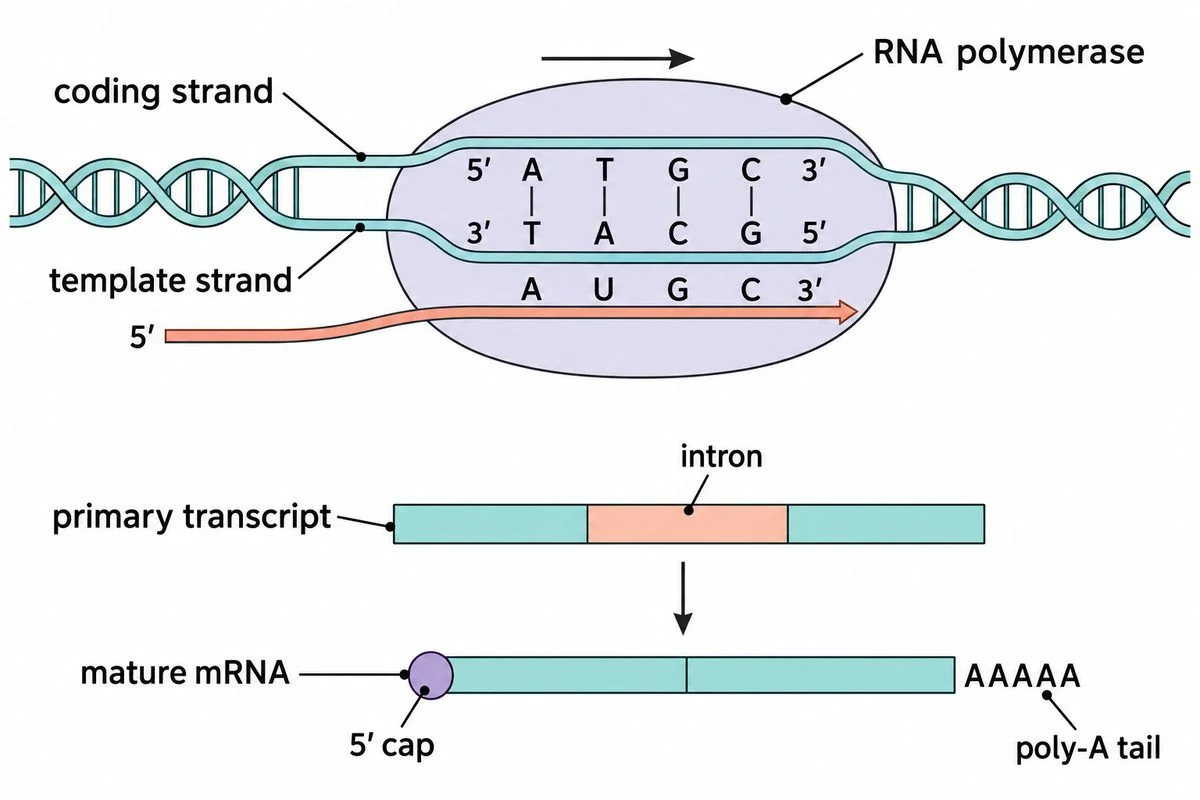
Aligned DNA and RNA sequences above an RNA processing diagram.

4. Transcription

A DNA template guides RNA production; processing prepares eukaryotic mRNA.

Show
Find the template and coding strands in the diagram. Follow RNA growth, then the processing arrow to mature mRNA.
Ask
How will this first RNA copy become a message ribosomes can use?
Say
The template guides RNA production, so RNA matches the coding strand except U replaces T. Processing removes introns, joins exons, and adds a cap and tail to eukaryotic mRNA.
Used in
RNA copies let cells use stored DNA instructions to make proteins.
If your child says…“The coding strand is the strand being copied.”
Ask
Which DNA strand has bases complementary to the growing RNA?
What’s true
Polymerase reads the template, although the resulting RNA resembles the coding strand.
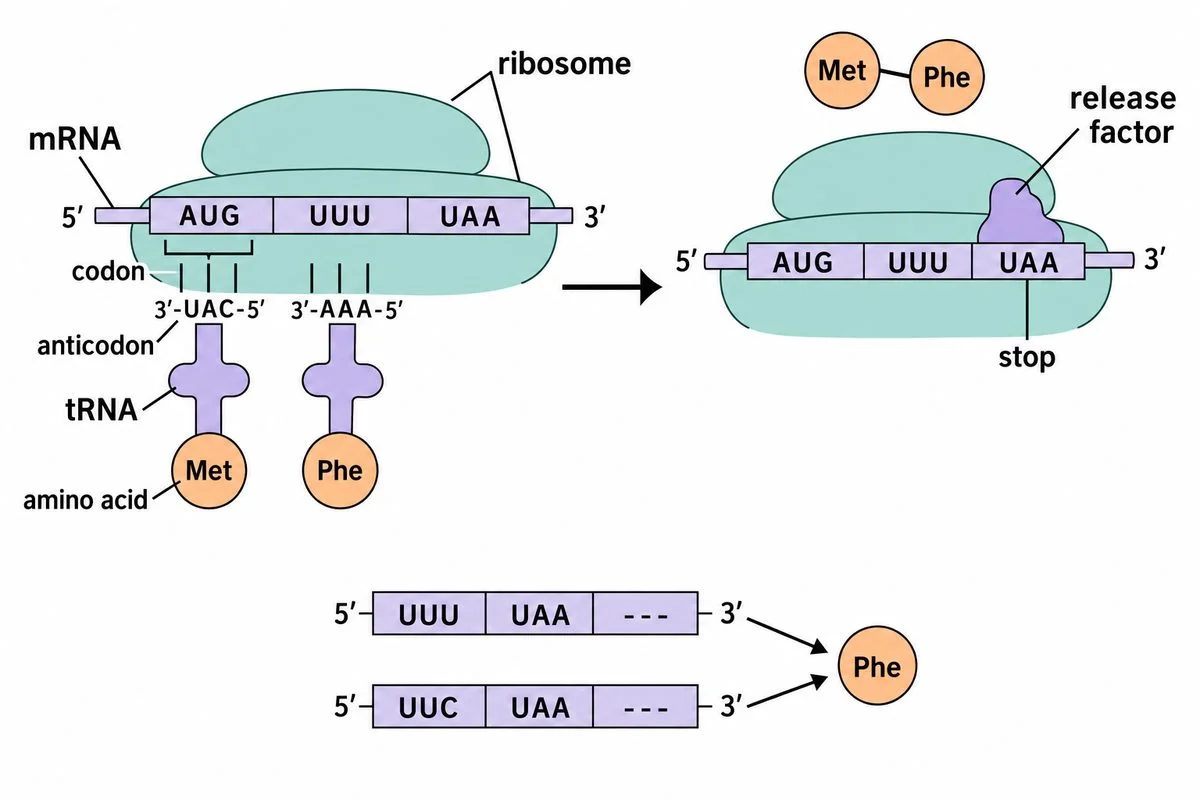
A ribosome decodes triplets, releases a chain, and compares UUU with UUC.

5. Genetic code and translation

Ribosomes read RNA triplets; tRNAs bring amino acids.

Show
Find matching codons and anticodons in the diagram. Follow termination, then compare UUU and UUC.
Ask
How will these triplets determine the amino acid sequence?
Say
tRNAs match codons and deliver amino acids. A release factor ends translation at UAA. UUU and UUC specify phenylalanine, so this substitution preserves both protein and reading frame.
Used in
Cells translate RNA instructions to build proteins needed for growth.
If your child says…“Every base swap shifts all the later triplets.”
Ask
Did replacing UUU with UUC add or remove a position in the message?
What’s true
Replacing a base preserves the grouping; adding or deleting bases can shift it.
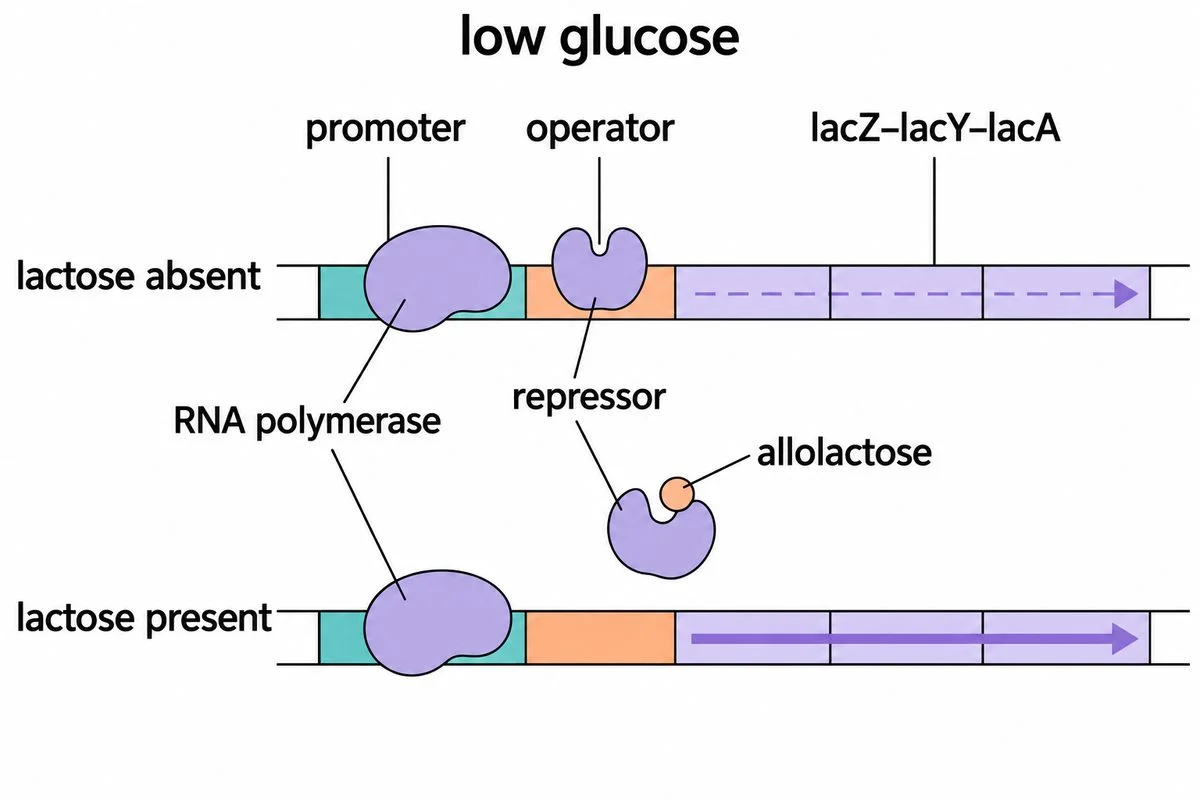
Matched lac operons show repression without lactose and transcription after allolactose binds the repressor.

6. Regulation of gene expression: the lac operon

An inducer loosens the repressor’s grip, allowing lactose-use genes to be read.

Show
Compare the diagram’s two rows with glucose low in both. Find the operator, repressor and allolactose, then follow transcription.
Ask
Will making lactose-use enzymes help this bacterium when lactose is absent?
Say
Without lactose, the repressor keeps these genes almost off, reducing unnecessary enzyme production. Allolactose, made from lactose, weakens the repressor’s binding. With glucose low, RNA polymerase can then transcribe the genes.
Used in
Bacteria regulate lactose-use enzymes, reducing unnecessary enzyme production.
If your child says…“Lactose makes the repressor block the genes more strongly.”
Ask
Can a repressor that loses its grip keep blocking this DNA site?
What’s true
The inducer weakens the repressor’s grip on the operator.

Reading and comparing genomes

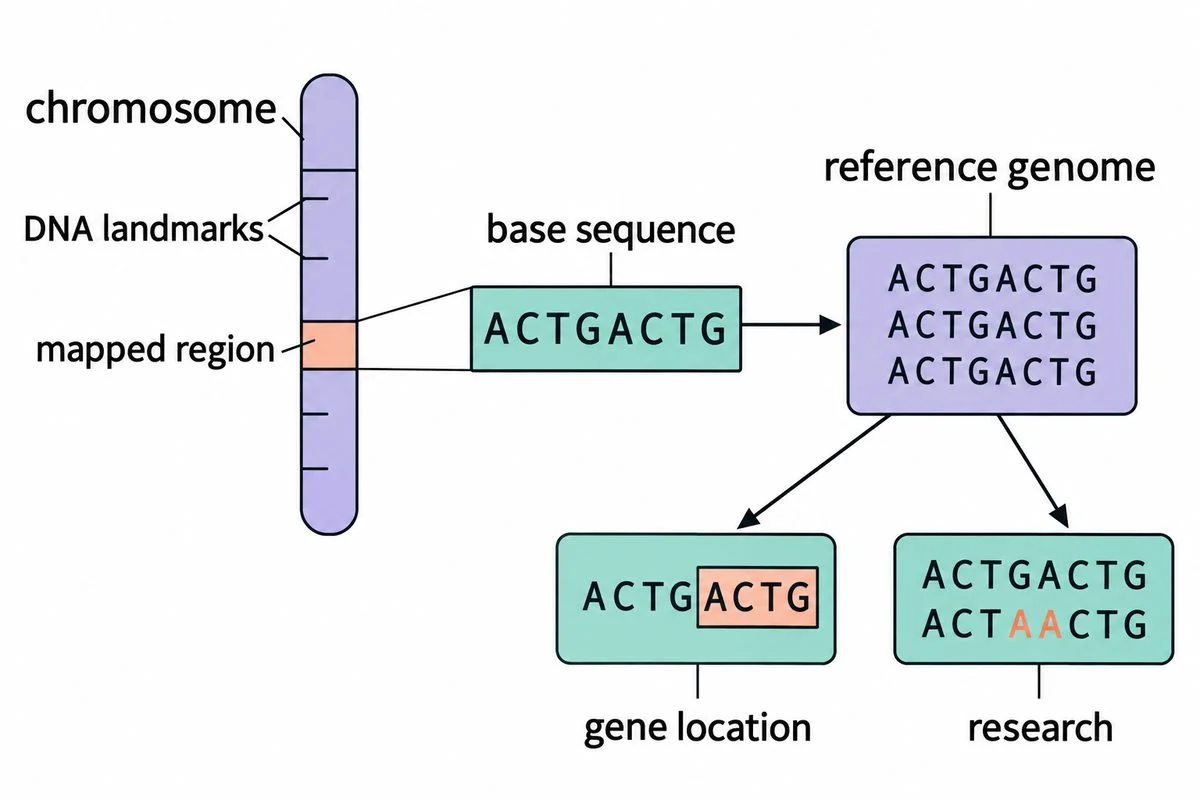
A chromosome region expands into a base sequence linked to a shared research reference.

7. Human Genome Project

A shared genome reference supports research; personal genetic information needs privacy.

Show
Find the marked chromosome region in the diagram. Follow its enlarged base sequence into the shared reference and research panels.
Ask
How could this shared DNA reference help researchers find and study a gene?
Say
The diagram shows a shared reference for locating genes and studying their base sequences.
Used in
Genome comparisons help researchers study human ancestry.
If your child says…“Useful genome information should be open to everyone.”
Ask
Would you want an insurer reading your health risks without your permission?
What’s true
Sharing identifiable genome data without consent can expose people to discrimination.
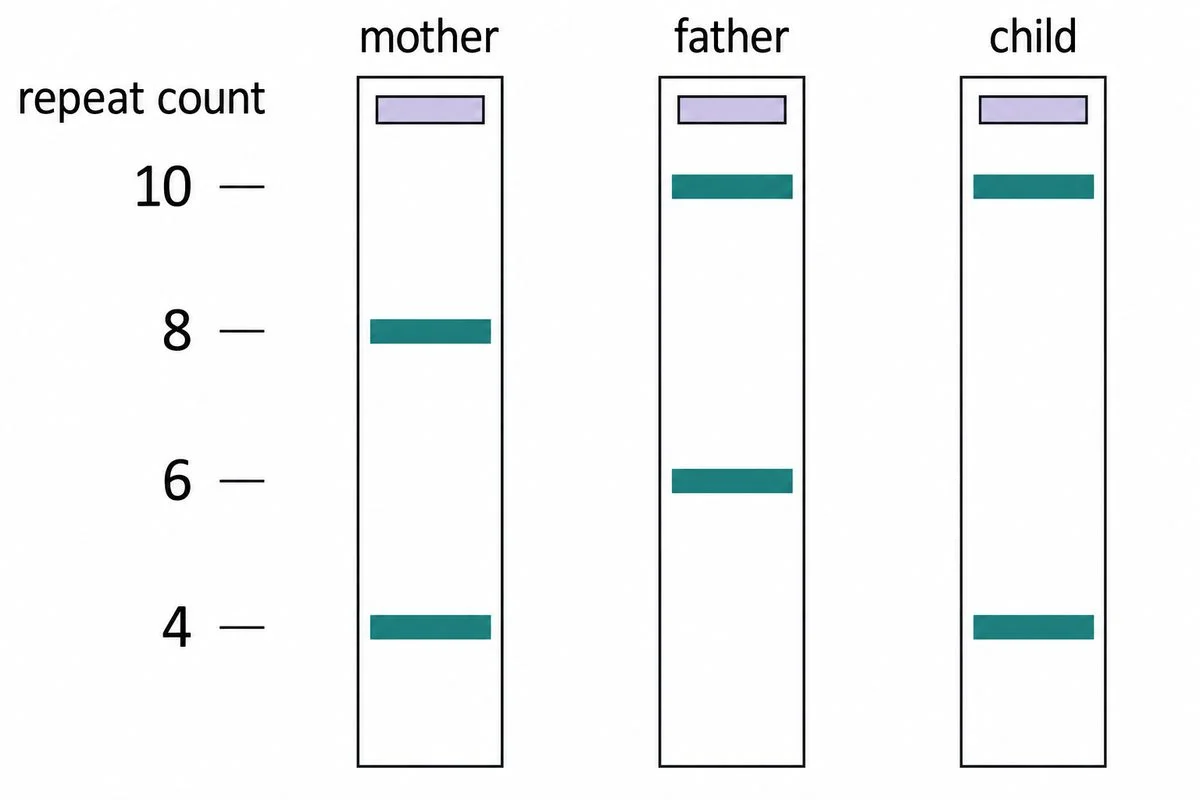
Three labelled DNA banding lanes showing repeat counts for mother, father and child.

8. DNA fingerprinting

Inherited DNA repeats help compare identity and parentage.

Show
Find the mother, father and child lanes in the diagram. Match each child band to a parent’s band at the same height.
Ask
Which parent could supply each child band?
Say
The 4-repeat variant matches the mother; the 10-repeat variant matches the father.
Used in
DNA profiles provide evidence for identifying people and checking biological relationships.
If your child says…“All the child’s DNA bands come from the mother.”
Ask
Which maternal band could explain the child’s 10-repeat variant?
What’s true
At this chromosome region, the child inherits a variant from each biological parent.

A real problem

Indian DNA probes helped resolve identity and parentage questions.

In 1988, CSIR-CCMB developed indigenous probes for DNA fingerprinting.

These probes revealed patterns that distinguish most people; identical twins share the same pattern.

The probes supported forensic investigations and parentage determination.

Lalji Singh developed DNA fingerprinting for crime investigations at CCMB in Hyderabad.

CSIRThe Times of IndiaThe Indian Express

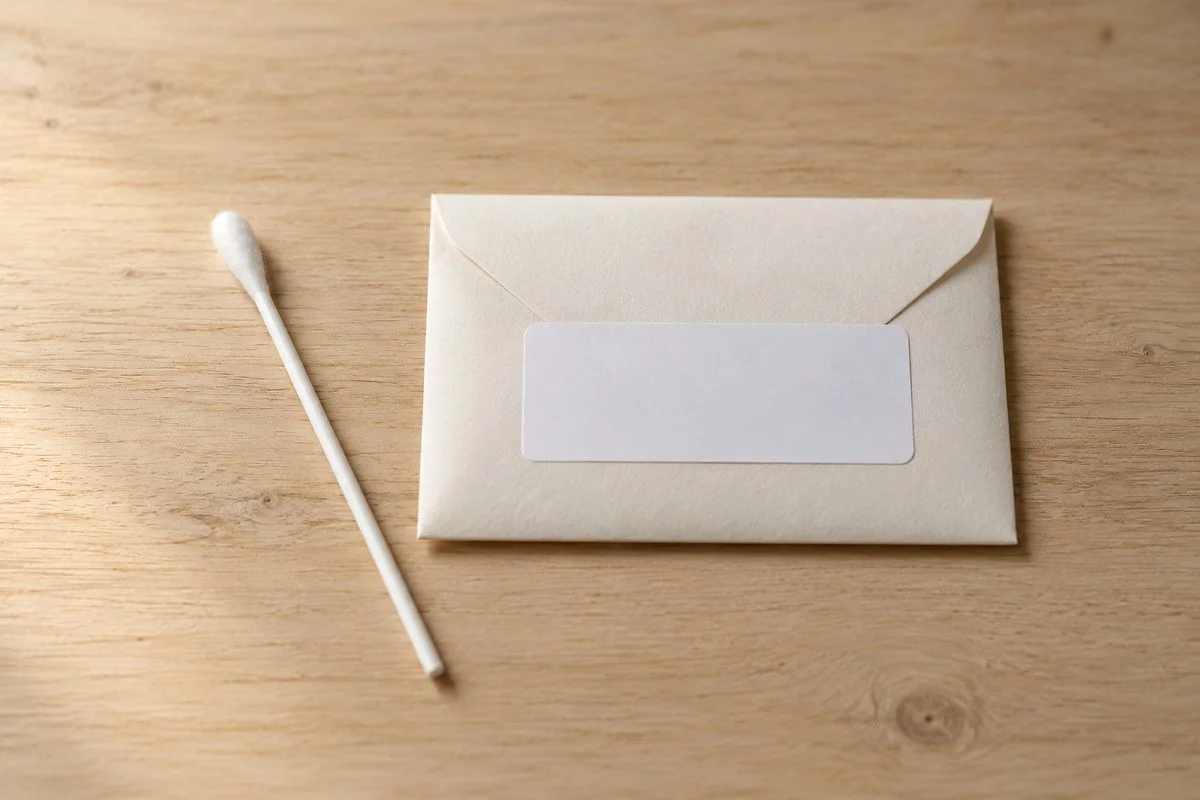
A cotton cheek swab beside a closed sample envelope with a blank label.

Concept Lab · Common misconception

The tempting mistake in Molecular Basis of Inheritance

Open standalone misconception page →

Does a cell transcribe all its DNA at once?

Wrong

A cell must copy its whole genome into RNA whenever it needs a protein.

Why it feels right. Transcription sounds like the genome copying that occurs before cell division.

Right

Transcription makes RNA from selected regions of DNA. DNA replication copies the genome.

Worked example

Transcription
Gene X→RNA for X→Protein X can be made
Replication
DNA across chromosomes→Copies of the DNA
Transcription can copy one selected gene into RNA. Replication copies DNA across the chromosomes.
  1. A cell making more of protein X can transcribe the gene for X.
  2. During DNA replication, it instead copies the DNA across its chromosomes.

Ask your child eight quick questions.

One per step. The answer and the reason are given.

  1. Which packing makes a gene harder to reach: loose or tight?

    Tight packing. Dense packing reduces access to the DNA.

  2. Destroying which substance prevented the inherited change?

    DNA. Destroying protein or RNA did not prevent transformation.

  3. Which new strand needs its short stretches joined?

    The lagging strand. Its fragments grow away from the advancing fork before ligase joins them.

  4. Which DNA strand does polymerase read for this gene?

    The template strand. RNA pairs with the template and therefore resembles the other strand.

  5. After UUU becomes UUC, what happens to the following codon’s position?

    It stays in place. A substitution replaces a base without adding or removing one.

  6. What happens to the repressor’s binding when the inducer attaches?

    Its binding weakens. The inducer changes the repressor’s shape, allowing transcription.

  7. Who should agree before someone’s identifiable genome data is shared?

    The person it belongs to. Genetic information can reveal private health risks and family relationships.

  8. Which parent supplies the child’s 10-repeat variant in this diagram?

    The father. The paternal lane contains that variant; the maternal lane does not.

15 more questions with answers