Skip to content

Teach A Square and a Cube in eight steps.

For each idea: show it, ask before you tell, then say one line.

Gather paper, pencil, ruler, nine equal paper squares with 5 cm sides and sixteen chickpeas.

Common misconceptions & worked visual for this chapter · 15 practice questions with answers

How to teach it

Making square numbers

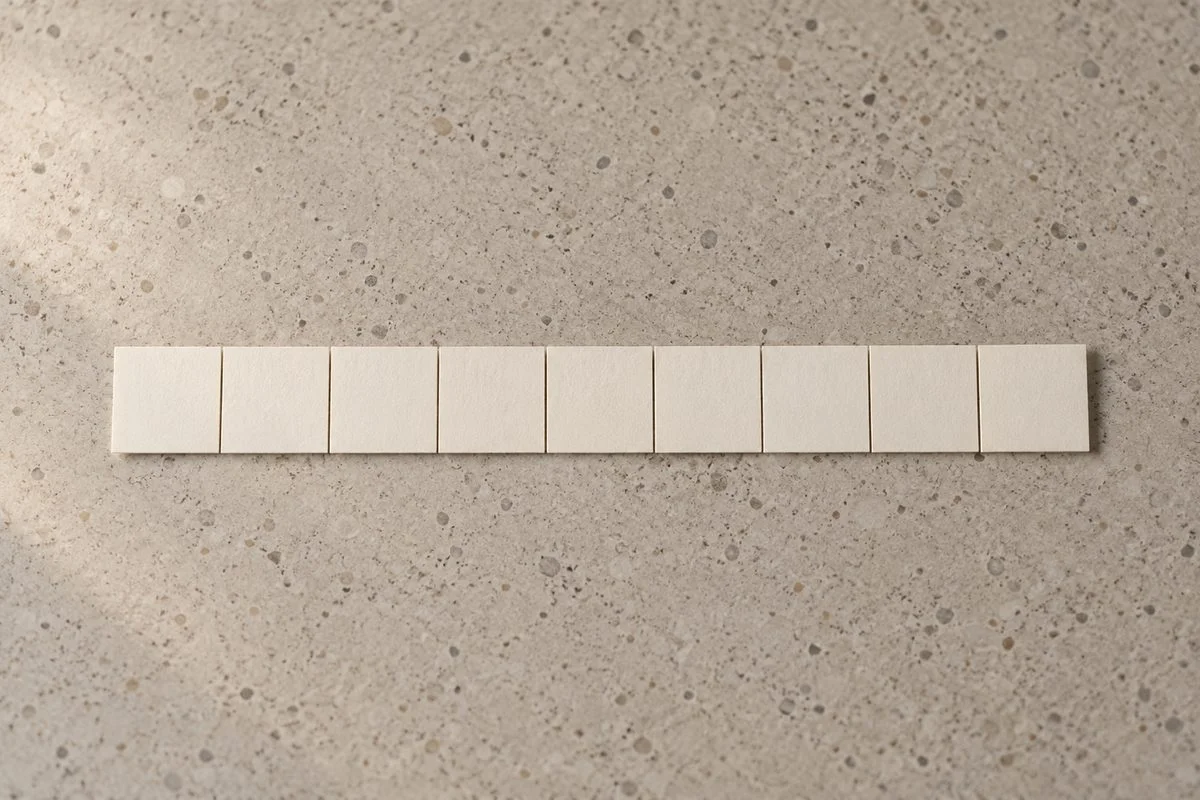
Nine equal paper squares arranged edge-to-edge in one row.

1. Square Numbers

Squaring multiplies a number by itself. Factor lists count each value once.

Show
Arrange nine paper squares in one row. Record how many tiles run along each side. After prediction, make three equal rows and list the distinct factors.
Ask
Will the square’s equal sides give one new factor or two?
Say
Three squared means three multiplied by itself: 32=93^2=9. Different partners give two distinct factors. Equal partners give just one.
Used in
Squaring a square tile’s side gives its area, helping calculate floor coverage.
If your child says…“The two 3s count as two different factors.”
Ask
Do the two equal sides give different numbers?
What’s true
A factor list includes each value only once.
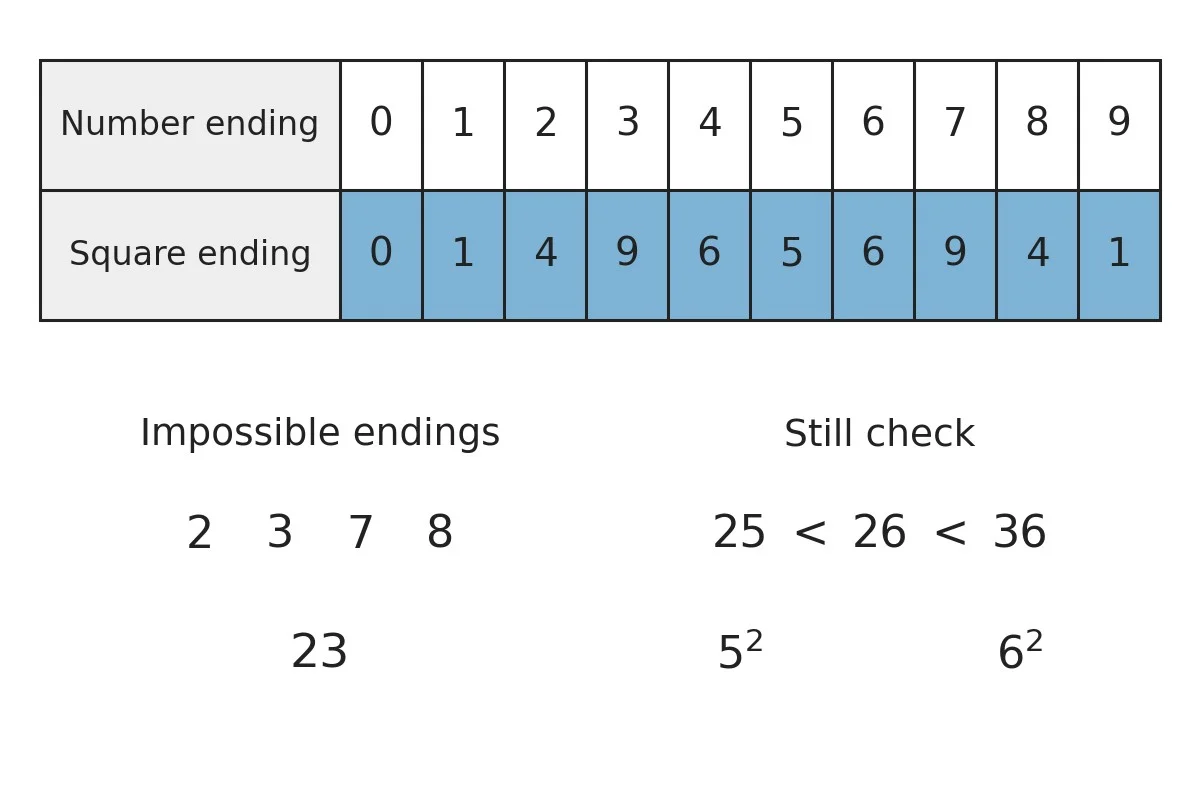
Square-ending table with 23 rejected and 26 between neighbouring squares.

2. Properties of Square Numbers

Last digits can rule squares out, but cannot prove them.

Show
Read the diagram’s ending table. Find 23, then 26 between 25 and 36.
Ask
Can either 23 or 26 be a square?
Say
Neither is a square. The table rules out 23. But 26 falls between neighbouring squares.
Used in
Last-digit checks catch impossible area calculations before someone orders materials.
If your child says…“26 ends in 6, so it must be a square.”
Ask
Which whole-number side could give 26, between square areas 25 and 36?
What’s true
An allowed ending does not guarantee a square.
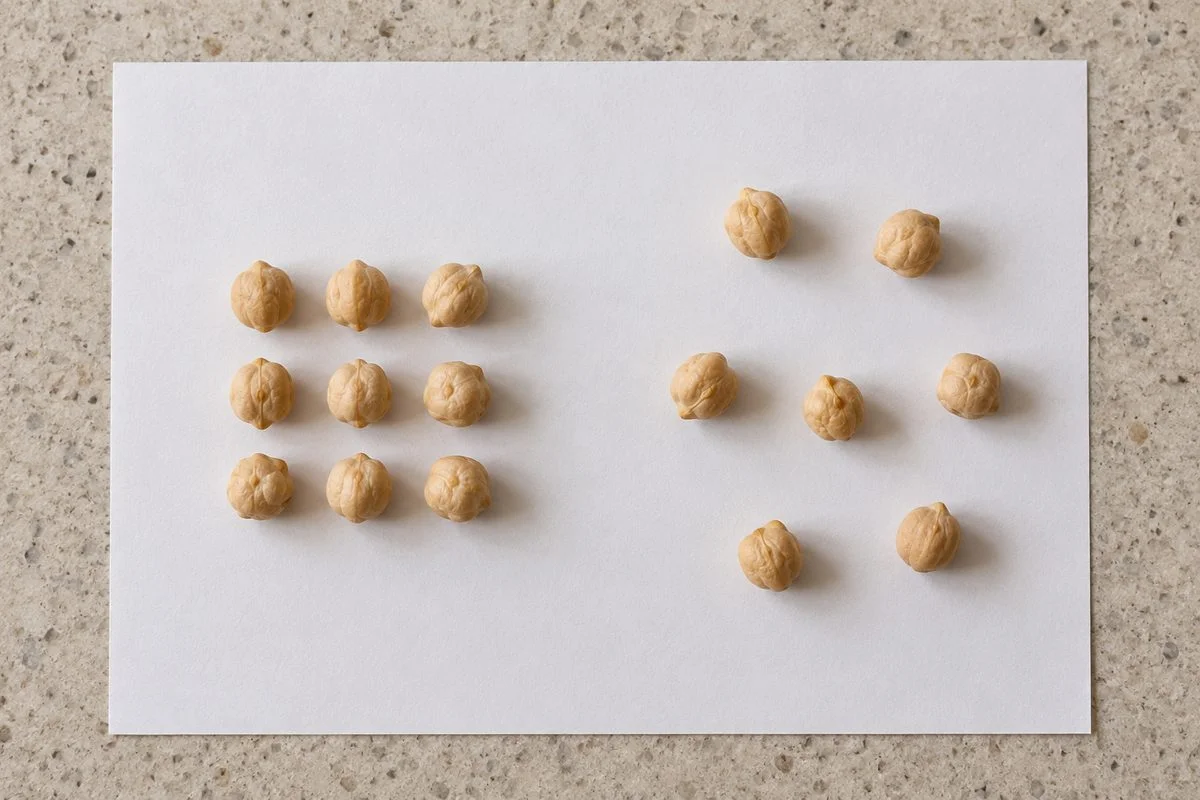
A square of nine chickpeas with seven loose chickpeas beside it.

3. Perfect Squares and Odd Numbers

Successive odd borders build bigger squares.

Show
Start with one chickpea. Add borders of three, then five, making a square each time. After prediction, add seven. Separate the square along a diagonal into triangles with four rows and three rows.
Ask
How many more chickpeas will complete the next square?
Say
Adding seven chickpeas to nine completes a square of sixteen. The triangles contain ten and six chickpeas. Together they make that same square.
Used in
Counting borders gives the paving needed to enlarge square courtyards.
If your child says…“The difference is seven, so seven whole numbers lie between.”
Ask
Which numbers remain when you leave out both 9 and 16?
What’s true
Counting strictly between two whole numbers excludes both endpoints.

Finding square roots

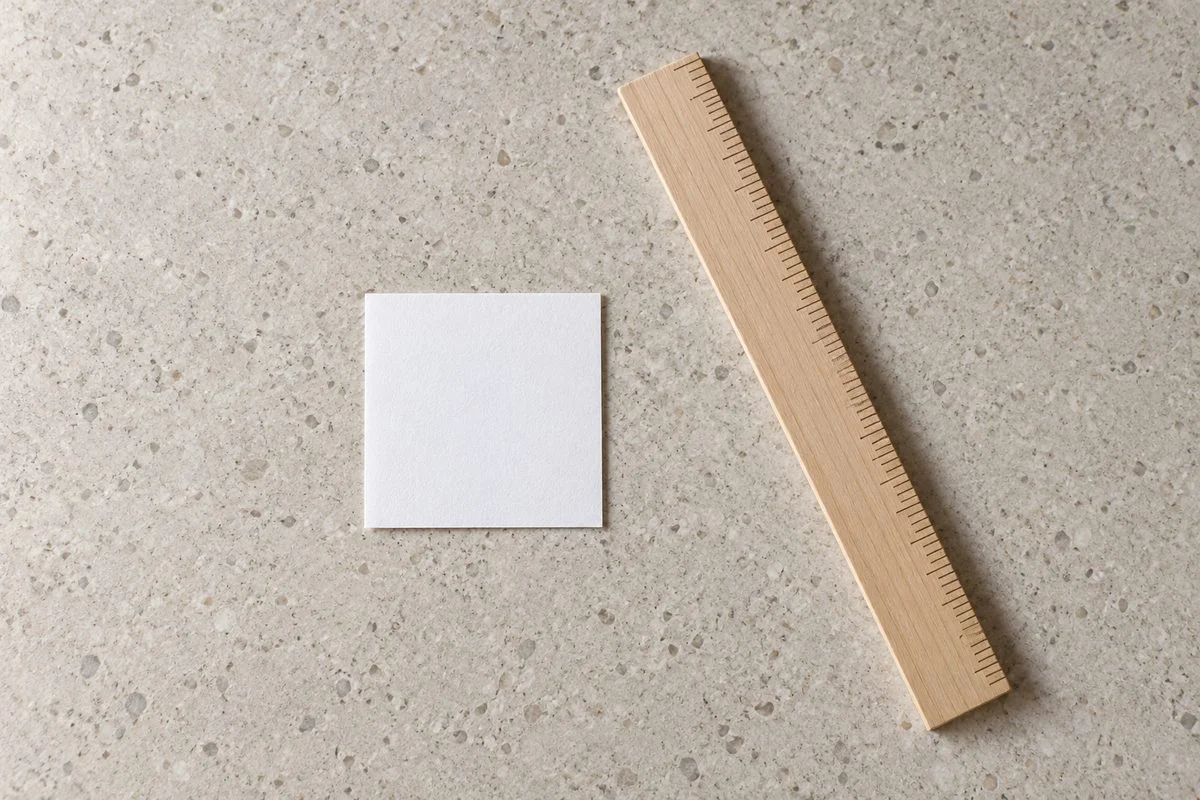
A blank paper square with a ruler resting separately beside it.

4. Square Roots

A square root multiplied by itself gives the starting number.

Show
Set out a prepared paper square with sides of 5 cm. Say, “Its area is 25 square centimetres.” After prediction, measure a side and multiply its length by itself.
Ask
What side length will give this area?
Say
The side length is 25=5\sqrt{25}=5.
Used in
Square roots give the side length needed for a square repair patch of known area.
If your child says…“Only 5 gives 25 when squared.”
Ask
What does −5 multiplied by −5 give?
What’s true
A positive number has two square roots, but a physical side length must be positive.

16=2×2×2×216=2\times2\times2\times2

16=(2×2)(2×2)16=(2\times2)(2\times2)

5. Square Roots Using Prime Factorisation

Split prime factors equally into two identical products to find roots.

Show
Write this line. Say, “Pair every prime factor.” Underline the identical products.
Ask
From these two identical groups, what do you predict the positive square root will be?
Say
Each group gives four, so the positive square root is four.
Used in
Prime factorisation checks whether a fixed number of chairs can fill a square seating arrangement.
If your child says…“I take each different prime once, so the root is 2.”
Ask
Does multiplying 2 by itself rebuild all four factors shown?
What’s true
Take one factor from every pair, including repeated pairs of the same prime.

32<10<423^2<10<4^2

32<10<42\sqrt{3^2}<\sqrt{10}<\sqrt{4^2}

6. Estimating Square Roots

Nearby square numbers put bounds on a square root.

Show
Write this line for square cloth of area 10 square centimetres. Say, “Three squared is nine, and four squared is sixteen. A longer square side needs more area. The sign << means ‘is less than’.”
Ask
Between which neighbouring whole numbers does the square root of 10 lie?
Say
The square root of ten lies between three and four.
Used in
Rounding down helps cloth cutters choose whole-centimetre square pieces that fit the available square cloth.
If your child says…“I round up when the larger square is nearer.”
Ask
Can a piece needing more cloth fit inside the cloth available?
What’s true
A square that needs more area cannot fit, however close its area is.

Making cubes and finding cube roots

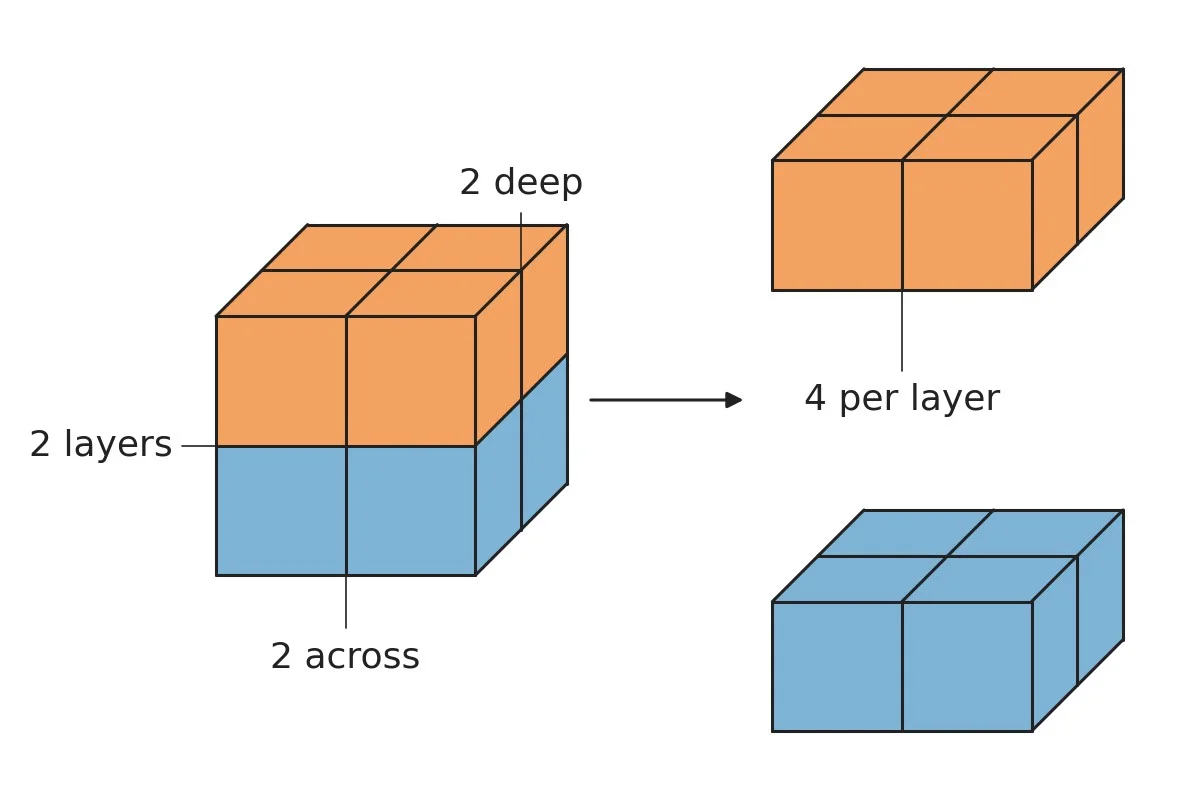
A divided cube beside its two separated square layers.

7. Cubes

Cubing multiplies three equal factors.

Show
Look at the diagram’s cube on the left. Find its two units across, two deep and two layers. Follow the arrow to the separated layers on the right.
Ask
How many unit cubes fill this cube with two units along every edge?
Say
Each layer has four cubes, and there are two layers. Two cubed means multiplying two by itself and then by two: 23=2×2×2=82^3=2\times2\times2=8.
Used in
Counting rows, columns and layers gives the number of equal boxes in a cubical stack.
If your child says…“There are four cubes because the layer has four.”
Ask
Where have you counted the cubes in the upper layer?
What’s true
The whole solid includes every layer, not just the bottom layer.

64=2×2×2×2×2×264=2\times2\times2\times2\times2\times2

64=(2×2)(2×2)(2×2)64=(2\times2)(2\times2)(2\times2)

8. Cube Roots

Three identical factor products reveal the cube root.

Show
Write this line. Say, “Which number was cubed?”
Ask
Looking at these three identical groups, what number do you predict was cubed?
Say
Each group gives four, so the cube root is four.
Used in
Cube roots give a cubical container’s inside edge length from its volume, helping plan storage.
If your child says…“Matching pairs prove that a number is a cube.”
Ask
Does a pair supply enough copies for all three identical products?
What’s true
Every prime factor must belong to a matching group of three, with none left over.

A real problem

Square roots connected model tests to full-sized ships.

Froude’s Admiralty Experimental Works opened in May 1872.

He related model speeds to the square roots of their lengths.

His experiments let engineers predict a full-sized ship’s water resistance from a model.

Science Museum GroupMITU.S. Naval Institute

A model boat pulled through water, leaving a visible wake.

Concept Lab · Common misconception

The tempting mistake in A Square and a Cube

Open standalone misconception page →

Do factors always come in different pairs?

Wrong

Every number has an even number of factors.

Why it feels right. I count two factors in every multiplication pair.

Right

A square has one pair whose entries are equal.

Worked example

Pairs of 36
136
218
312
49
6
Each factor pair contributes two different values except 6 × 6. Count 6 once.
  1. For 36, the pairs are 1×36, 2×18, 3×12, 4×9 and 6×6.
  2. Count 6 once, giving nine distinct factors.

Ask your child eight quick questions.

One per step. The answer and the reason are given.

  1. How many distinct factors does 9 have?

    Three. Its factors are 1, 3 and 9, with 3 counted once.

  2. Why is 26 not a perfect square, despite its ending?

    It lies between consecutive squares. Five squared is 25, and six squared is 36.

  3. How many whole numbers lie strictly between 9 and 16?

    Six. Count 10 through 15, leaving out both square numbers.

  4. Which two numbers give 64 when multiplied by themselves?

    8 and −8. Two negative factors give a positive product, just as two positive factors do.

  5. What is the positive square root of 16?

    4. Both pairs contribute a 2, giving a root of 4.

  6. Square cloth has area 140 square centimetres. What is the largest whole-centimetre square side that fits?

    11 cm. A side of 12 cm needs 144 square centimetres, exceeding the available area.

  7. A solid cube has four layers, each containing sixteen unit cubes. How many are there altogether?

    64. All four layers count, so multiply sixteen by four.

  8. The prime factorisation of 32 contains five copies of 2. Is 32 a perfect cube?

    No. Five copies cannot be shared equally among three identical products.

15 more questions with answers, 1 with pictures