Skip to content

Teach Algebra Play in eight steps.

For each idea: show it, ask before you tell, then say one line.

Gather paper, a pencil, fourteen coins and a small plate.

Common misconceptions & worked visual for this chapter · 15 practice questions with answers

How to teach it

Explain the tricks

R=2x+22−xR=\frac{2x+2}{2}-x

R=x+1−xR=x+1-x

1. Think of a Number

Letters explain a trick’s fixed result.

Show
Name the start x and result R. Write this line, saying, “Halve the whole numerator.”
Ask
What remains after subtracting the starting number?
Say
One remains.
Used in
Removing added charges from a bill recovers the original price.
If your child says…“I can subtract my starting number before halving.”
Ask
If you subtract first, will the starting number also get halved?
What’s true
Halving first and subtracting first act on different amounts.
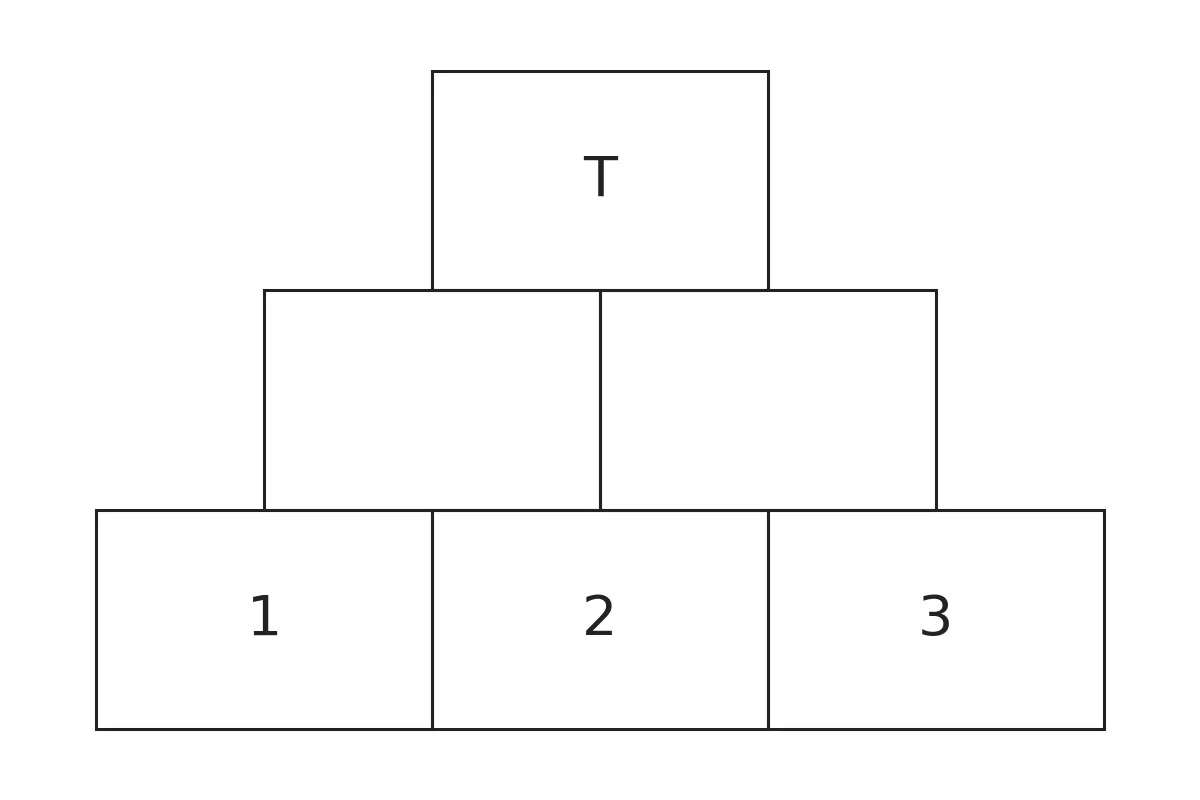
Pyramid with bottom numbers 1, 2, 3, blank middle boxes and top T.

2. Number Pyramids

Each upper box combines its two lower neighbours.

Show
Look at the pyramid diagram. Call the top number T. Follow the bottom 2 into both middle boxes.
Ask
What goes in the top box?
Say
Eight; the middle number is counted twice.
Used in
Subtracting known expenses from a bill’s total reveals a missing expense.
If your child says…“I just add every bottom number once.”
Ask
Where does the middle 2 appear in the first line?
What’s true
The middle bottom number enters both neighbouring sums, so it reaches the top twice.
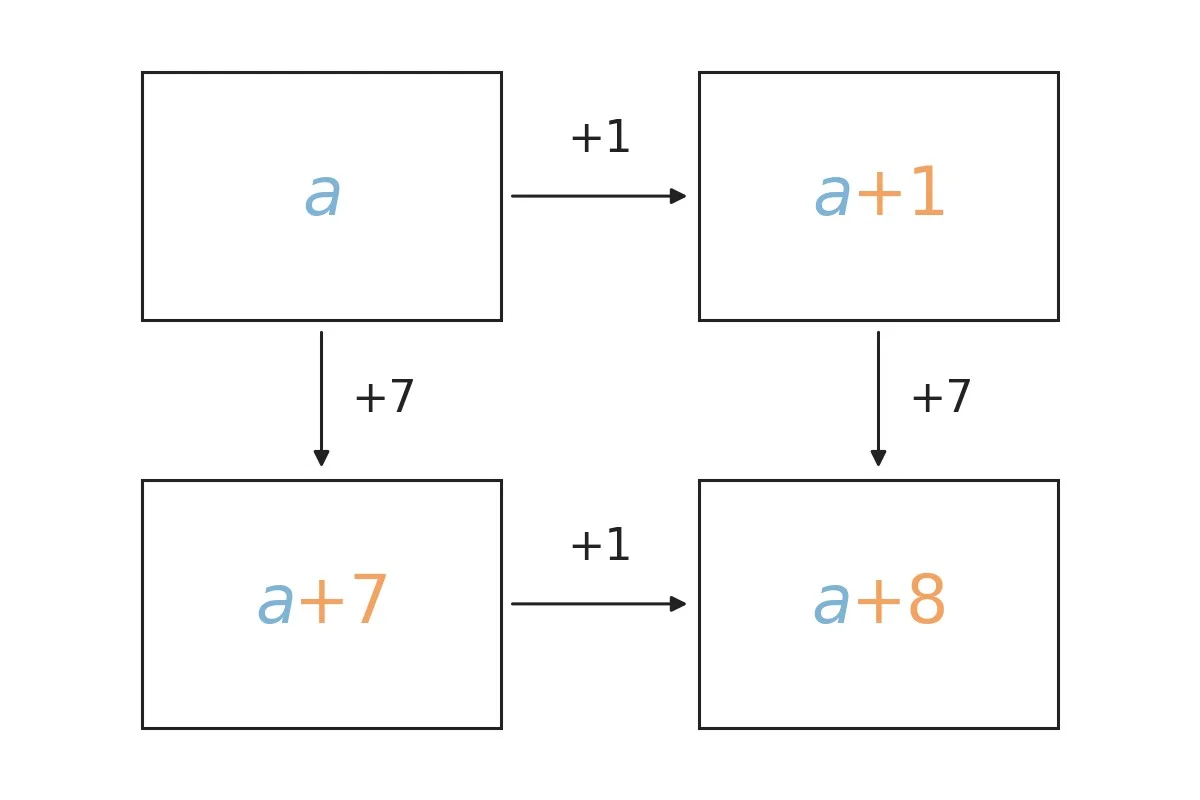
Calendar block showing how rightward and downward steps determine four neighbouring dates.

3. Fun with Grids

Spacing connects grid entries and totals.

Show
Look at the calendar diagram and call the top-left date a. Follow the rightward arrows, then the downward arrows. Point to the four copies of a and the added numbers.
Ask
What total do you predict for these four cells, using a?
Say
Multiply the top-left date by four, then add sixteen. Each date contains a; the extra one, seven and eight together make sixteen.
Used in
Calendar spacing helps families find dates for weekly plans.
If your child says…“I divide the total by four, then subtract sixteen.”
Ask
Does the sixteen belong to each date, or to the whole total?
What’s true
Remove the extra sixteen before sharing the remaining total between four equal copies.

D=(20+1)×3−(30+1)×2D=(20+1)\times3-(30+1)\times2

D=(60+3)−(60+2)D=(60+3)-(60+2)

D=3−2D=3-2

4. The Largest Product

Compare whole products when placing digits.

Show
Call the difference D. Write this line, saying, “Multiply both tens and ones.”
Ask
Which product do you predict is larger: 21 times 3 or 31 times 2?
Say
The difference is one: 21 times 3 wins.
Used in
Comparing length times width identifies which rectangular layout provides more floor space.
If your child says…“The biggest two-digit number must give the biggest product.”
Ask
Does the largest two-digit candidate give the largest result here?
What’s true
The multiplier acts on both places, so both factors affect the product.

D=(10b+a)−(10a+b)D=(10b+a)-(10a+b)

D=(10b−b)+(a−10a)D=(10b-b)+(a-10a)

D=9b−9aD=9b-9a

5. Decoding Divisibility Tricks

Place value explains digit tricks.

Show
Name nonzero digits a, b, with b larger, and difference D. Write this line, saying, “Exchange tens and ones.”
Ask
For these reversed numbers, what will their difference divided by nine give?
Say
It gives the digit difference. Nine multiplies the digit difference.
Used in
Place-value checks help catch arithmetic errors when adding bills.
If your child says…“Subtracting and dividing by nine gives the digit sum.”
Ask
After collecting matching letters, are the digit terms added or subtracted?
What’s true
Larger minus smaller gives nine times the positive difference between their digits.

Track quantities and changes

0+82=4\frac{0+8}{2}=4

4+82=6\frac{4+8}{2}=6

s=6+82s=\frac{6+8}{2}

6. Backwards doubling and removal

Undo changes in reverse order.

Show
Say, “Flowers double, then lose eight, three times, leaving none.” Name the start s. Read the steps and write the equation, saying, “Restore, then halve.”
Ask
What starting count does the last line give?
Say
Seven flowers; each reversal restores an earlier count.
Used in
A food seller subtracts all costs from sales to find profit.
If your child says…“Adding back what was removed gives the starting amount.”
Ask
After restoring the removed flowers, are you before or after the doubling?
What’s true
Adding back restores the doubled amount, so halving is still needed.
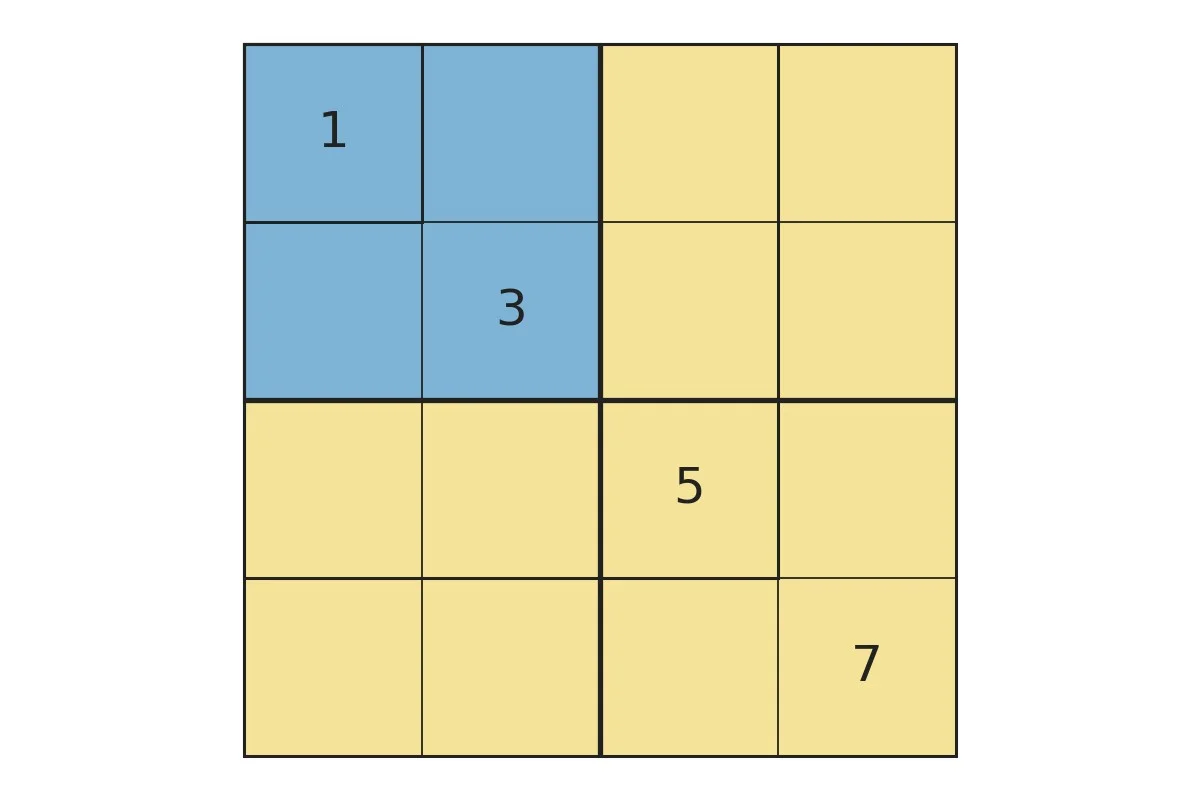
Square grid with one blue quarter, three yellow quarters and labelled odd-number layers.

7. Successive blocks of positive odd numbers

Adding consecutive odd numbers from one builds larger squares.

Show
Look at the diagram. Find the blue square, then the three equally sized yellow squares.
Ask
What is the blue count divided by the yellow count?
Say
Yellow fills three matching squares, so the fraction is 13\frac{1}{3}.
Used in
Counting tiles in a square extension helps buy only the additional tiles.
If your child says…“The next block includes all the coloured cells.”
Ask
Which coloured cells were already there before the yellow block was added?
What’s true
The next block contains only the newly added cells.
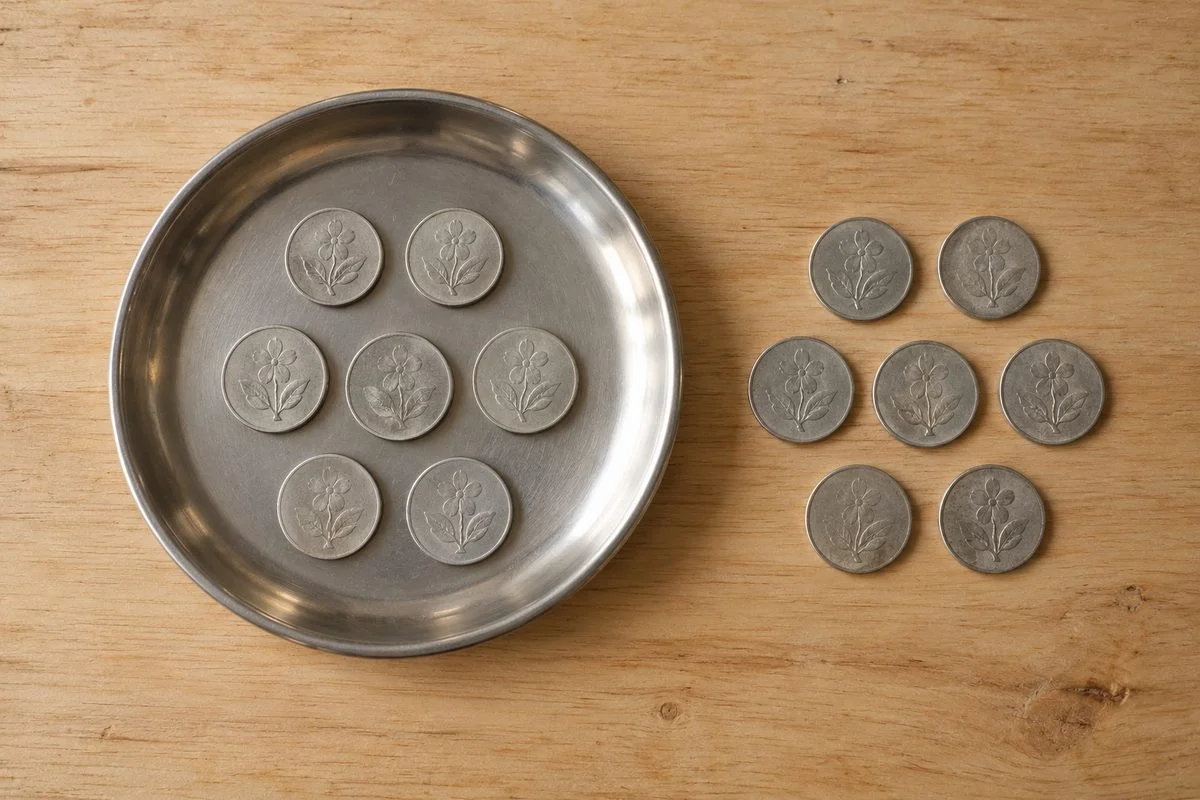
Seven coins on a steel plate, with seven reserve coins beside it.

8. Karim and the Genie

Repeated fees can exhaust a pile even when it doubles.

Show
Put seven coins on a plate and seven beside it. Count coins, ignoring their rupee values. After the prediction, add matching coins, then return eight to the reserve. Repeat for three rounds altogether, counting after each payment.
Ask
How many coins will remain after three rounds?
Say
Six, four, then zero coins remain. Each addition is smaller than the fee.
Used in
Repeated fees can use up savings even when money is added.
If your child says…“I can pay first and double afterwards.”
Ask
Starting with seven coins, could you pay eight before doubling?
What’s true
Payment follows doubling, and the doubled pile must contain enough coins for the fee.

A real problem

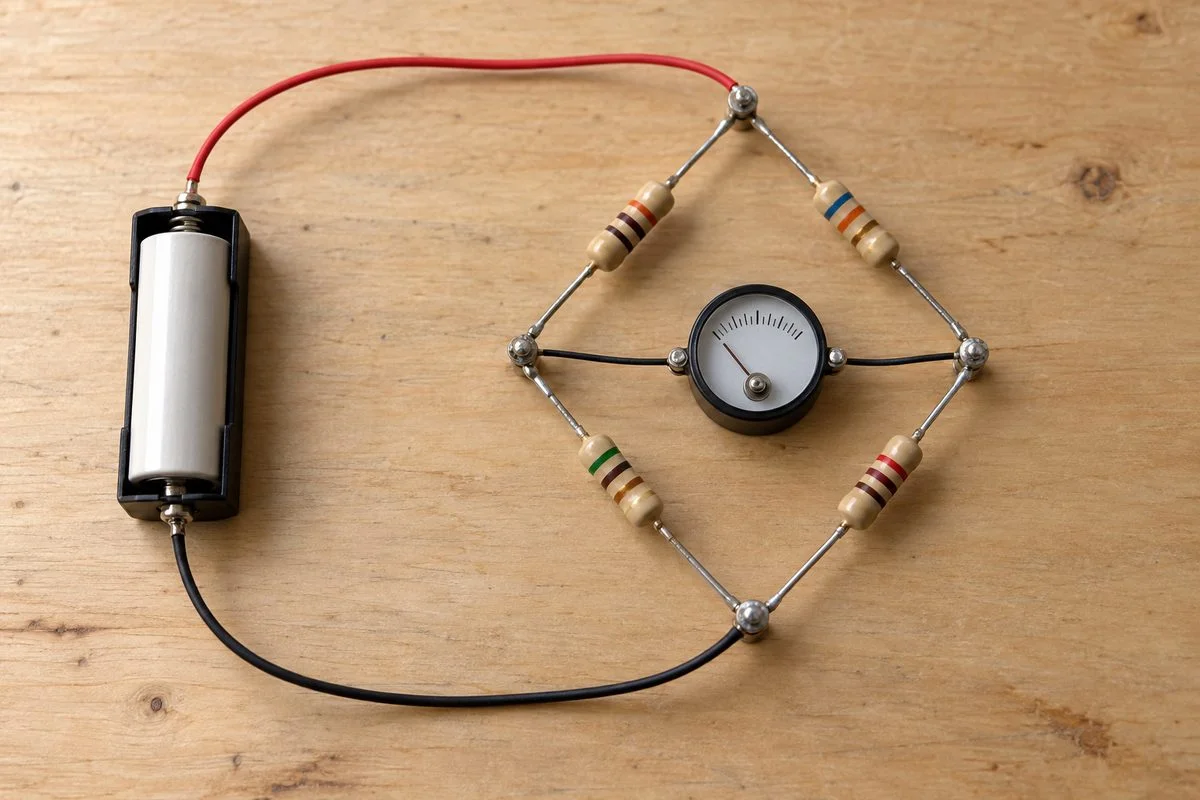
A bridge circuit measures an unknown resistance.

Wheatstone presented Christie’s invention in 1843.

The bridge later served in telegraphy.

It measured resistance accurately without needing current or voltage readings.

When the detector shows no current, an equation gives the unknown resistance.

National MagLabOpen UniversityOpenStax

Battery-powered bridge with four connected resistors and an analogue current detector on a wooden workbench.

Concept Lab · Common misconception

The tempting mistake in Algebra Play

Open standalone misconception page →

Can you square a sum term by term?

Wrong

(x + 3)² = x² + 9

Why it feels right. I square each term I can see.

Right

Squaring a sum means multiplying both complete brackets.

Worked example

The two 3x rectangles are part of the square. Squaring only the terms leaves them out.
  1. Split a square of side x + 3 into x², two rectangles of area 3x, and a square of area 9.
  2. The total is x² + 6x + 9.

Ask your child eight quick questions.

One per step. The answer and the reason are given.

  1. Start with 6, double, add 10, halve, then subtract 6. What remains?

    5. Halve the whole amount before subtracting the starting number.

  2. With 2, 3, 4 along the bottom, what reaches the top?

    12. The middle 3 contributes twice through the two boxes above it.

  3. A calendar block totals 64. What is its top-left date?

    12. Subtract sixteen first, then divide the remaining forty-eight by four.

  4. Using 2, 5, 8 once, which arrangement gives the largest product?

    52×852\times8. The largest digit multiplies both places of the best remaining two-digit number.

  5. For 72 minus 27, what does dividing by nine give?

    5, the digit difference. Subtraction leaves nine times the digit difference, rather than the digit sum.

  6. A count doubles, then loses 3, leaving 11. What was the starting count?

    7. Adding three restores fourteen, which must then be halved.

  7. After the block 1, 3, 5, what is the next three-number block’s sum?

    27. Only seven, nine and eleven belong to the next block.

  8. Start with 10 coins, double, then pay 6. How many remain?

    14 coins. Double ten before subtracting six.

15 more questions with answers, 6 with pictures