Skip to content

Teach The Baudhāyana-pythagoras Theorem in eight steps.

For each idea: show it, ask before you tell, then say one line.

Gather plain and squared paper, coloured paper, a pencil, ruler, scissors and three small opaque boxes.

An adult handles the scissors.

Common misconceptions & worked visual for this chapter · 15 practice questions with answers

How to teach it

From squares to right triangles

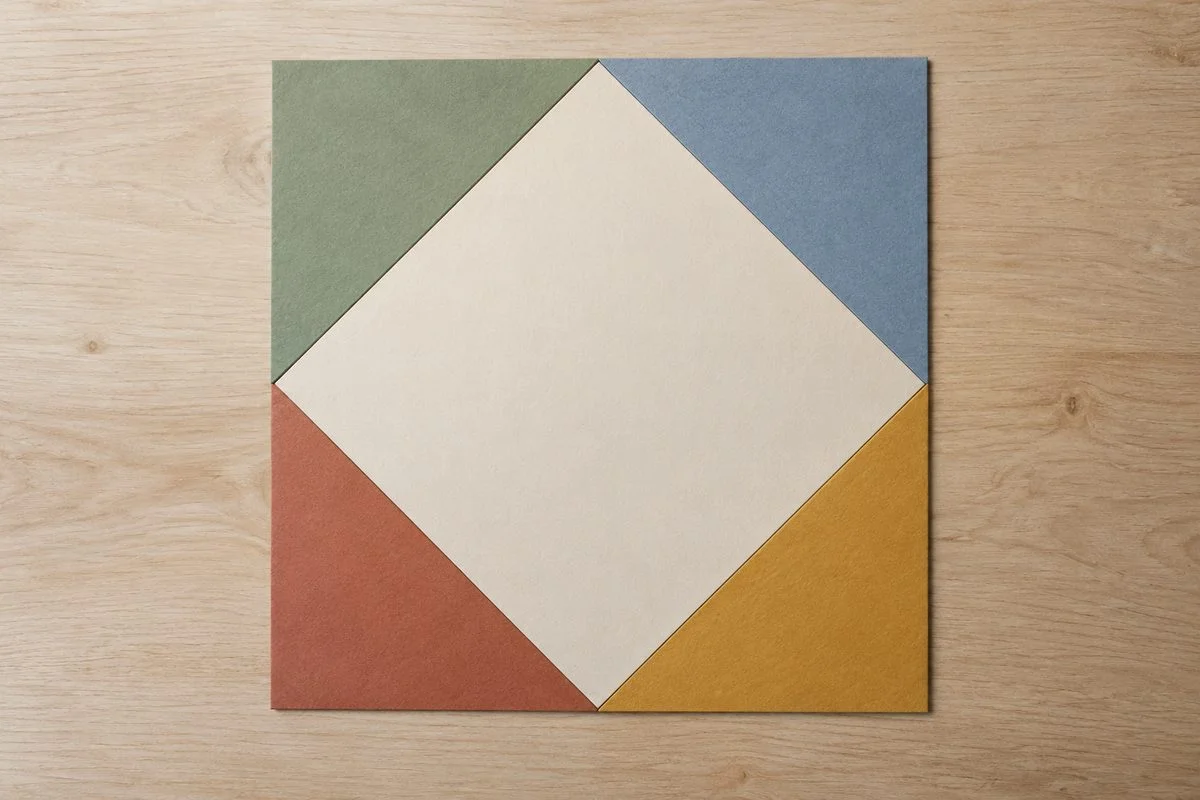
Four paper triangles fitted around a central square form a larger square.

1. Doubling a Square

A square’s diagonal supplies the side for twice its area.

Show
An adult cuts one of two identical squares along both diagonals. Fit each triangle’s longest edge against the uncut square. After predicting, trace around everything; remove triangles.
Ask
How many original squares fill this outline?
Say
The pieces still contain two original squares’ worth of paper. The larger square’s side equals the original square’s diagonal.
Used in
Patchwork cutters calculate square areas to avoid wasting fabric.
If your child says…“Half the side means half the area.”
Ask
When both dimensions halve, how many smaller squares would cover the original?
What’s true
Halving both dimensions leaves a quarter of the area.
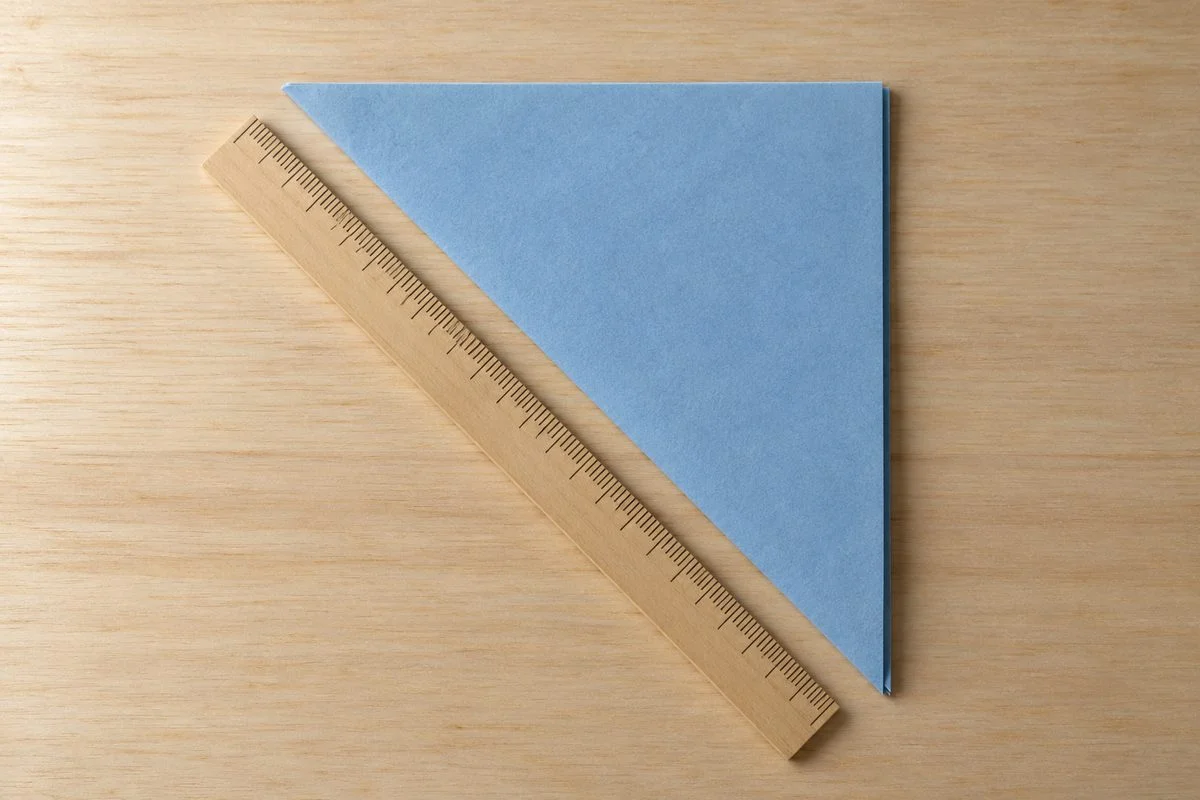
A diagonally folded paper square with a ruler beside its longest edge.

2. Hypotenuse of an Isosceles Right Triangle

The hypotenuse faces the right angle.

Show
Fold a 10 cm square diagonally; call 10 cm one unit. Square 1.4 and 1.5: 1.96 and 2.25. After predicting, measure the fold.
Ask
Between which lengths does it lie?
Say
Its square is two, so its length is between 1.4 and 1.5 units.
Used in
Tile diagonals determine corner-to-corner cut lengths.
If your child says…“Square root of two is exactly 1.4.”
Ask
Does squaring 1.4 give the required area of 2?
What’s true
The diagonal’s square is exactly 2, but 1.4 squared is only 1.96.
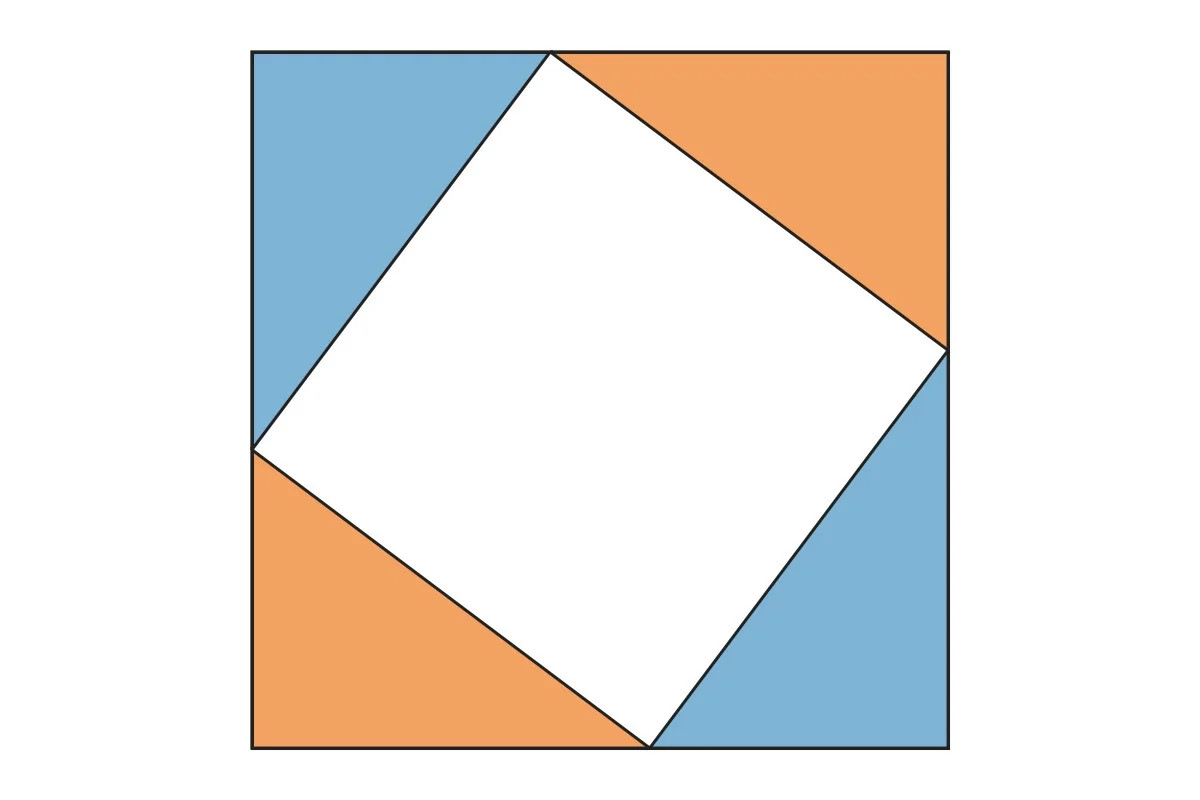
Four identical right triangles in the corners of a square leave a tilted square opening.

3. The Baudhāyana–Pythagoras Theorem

In right triangles, the smaller squares’ areas total the largest square’s area.

Show
An adult cuts four 3 cm–4 cm right triangles. Arrange them as shown. After predicting, pair them into rectangles: bottom-left horizontal, top-right vertical.
Ask
Will uncovered area change?
Say
The uncovered area stays unchanged. Its twenty-five square centimetres give a hypotenuse of five centimetres.
Used in
Tabletop diagonals show whether rods fit across.
If your child says…“The 4 cm side is the hypotenuse.”
Ask
Which side does not touch the right-angle corner?
What’s true
The hypotenuse faces the right angle.
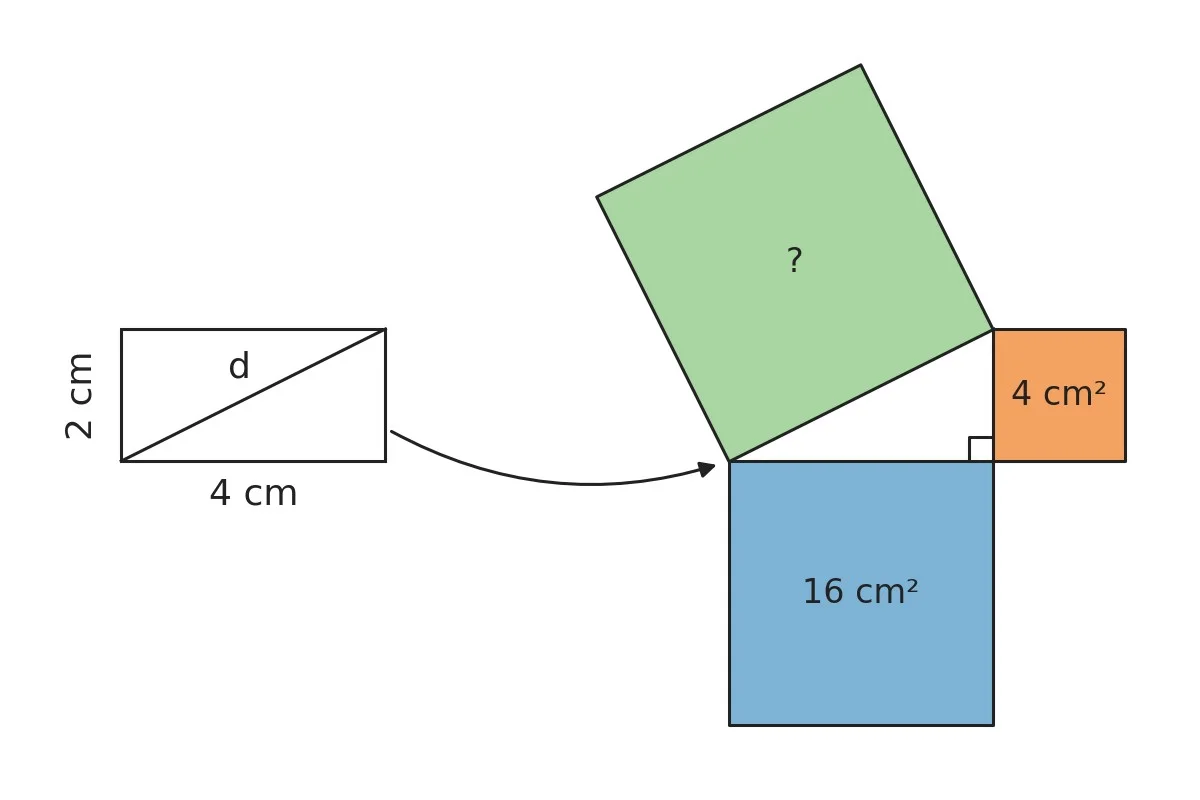
A rectangle’s diagonal becomes the hypotenuse of a triangle with squares on its sides.

4. Combining Two Different Squares

The diagonal’s square combines areas of squares on the length and width.

Show
Find the rectangle’s diagonal, labelled d, in the diagram. Follow the arrow to its triangle and three squares.
Ask
What area will combine the two smaller squares into one square?
Say
The hypotenuse square combines four and sixteen square centimetres, giving twenty.
Used in
Combining areas helps size a square fabric patch.
If your child says…“The new square’s side is 2 plus 4.”
Ask
Does the diagonal follow both rectangle edges, or cut straight across?
What’s true
The square areas add, rather than their side lengths.

Using the theorem

52−42=25−165^2-4^2=25-16

52−42=95^2-4^2=9

52−42=325^2-4^2=3^2

5. Right-Triangles Having Integer Sidelengths

Whole-number sides can satisfy the theorem.

Show
Say, “Five squared minus four squared equals three squared.” Write this line.
Ask
What follows after adding four squared?
Say
Three squared plus four squared equals five squared.
Used in
Builders use triples to set right angles.
If your child says…“Doubling a primitive triple keeps it primitive.”
Ask
What common factor would all three doubled lengths have?
What’s true
Scaling preserves the right angle. Multiplying every length by a whole number above one gives them a common factor.
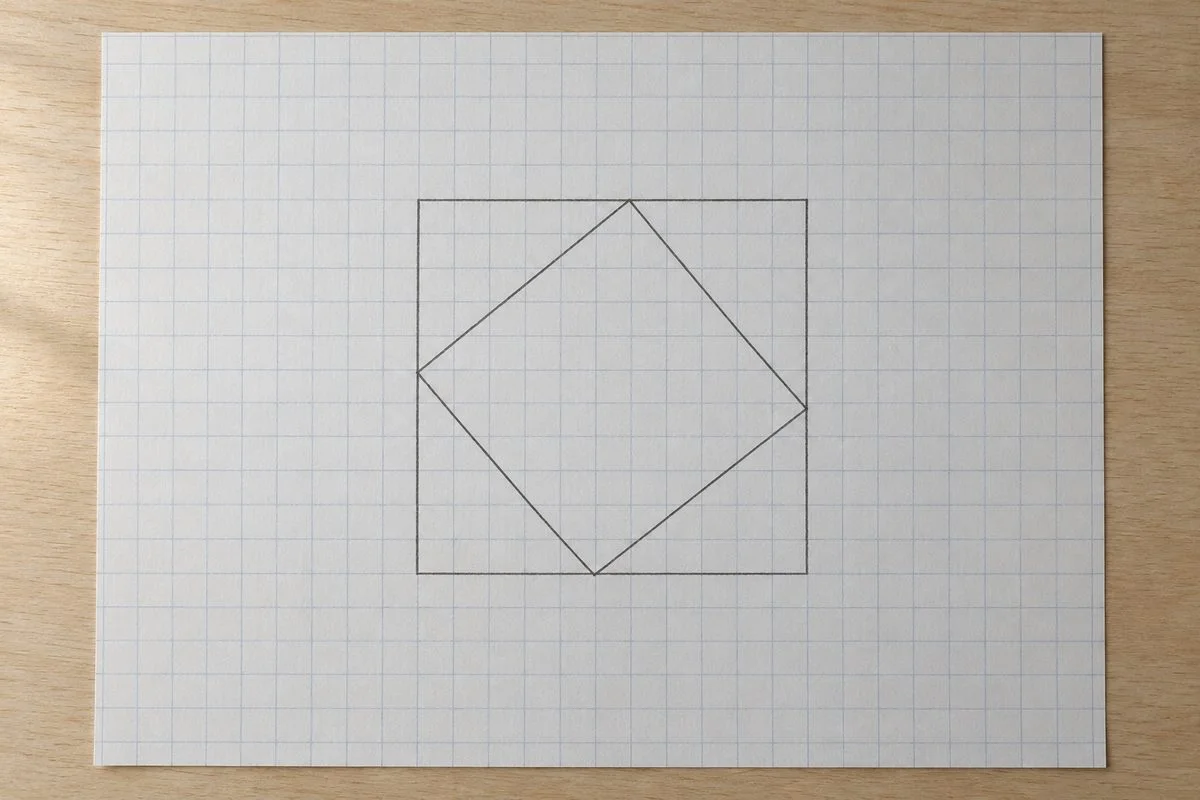
A tilted square inside a larger grid square, before its corner triangles are removed.

6. Squares with Corners on a Dot Grid

Tilted squares need not have whole-number sides.

Show
On squared paper, move three right, two up; then two left, three up. Move three left, two down; join back to the start. Enclose it in a 5-by-5 square. After predicting, an adult removes corner triangles.
Ask
What area remains?
Say
Each removed triangle covers three square units, leaving thirteen.
Used in
Tilted squares guide tile patterns with predictable coverage.
If your child says…“A square must follow the grid lines.”
Ask
Does turning a square change its equal sides or right angles?
What’s true
A square can have corners on grid dots while its sides cross grid lines.

x2+32=52x^2+3^2=5^2

x2=52−32x^2=5^2-3^2

x2=16x^2=16

7. Further Applications of the Baudhāyana–Pythagoras Theorem

Subtract square areas to find a shorter side.

Show
Say, “The hypotenuse is five units; one leg is three units. Call the missing length x.” Write this line. Say, “Twenty-five minus nine gives sixteen.”
Ask
What positive length has square sixteen?
Say
The missing length is four units.
Used in
A ramp’s length and rise determine its floor space.
If your child says…“I add the squares whenever a side is missing.”
Ask
Does 25 include both smaller squares, or only the known one?
What’s true
The hypotenuse’s square includes both smaller squares, so subtract the known one.

Reasoning with labels

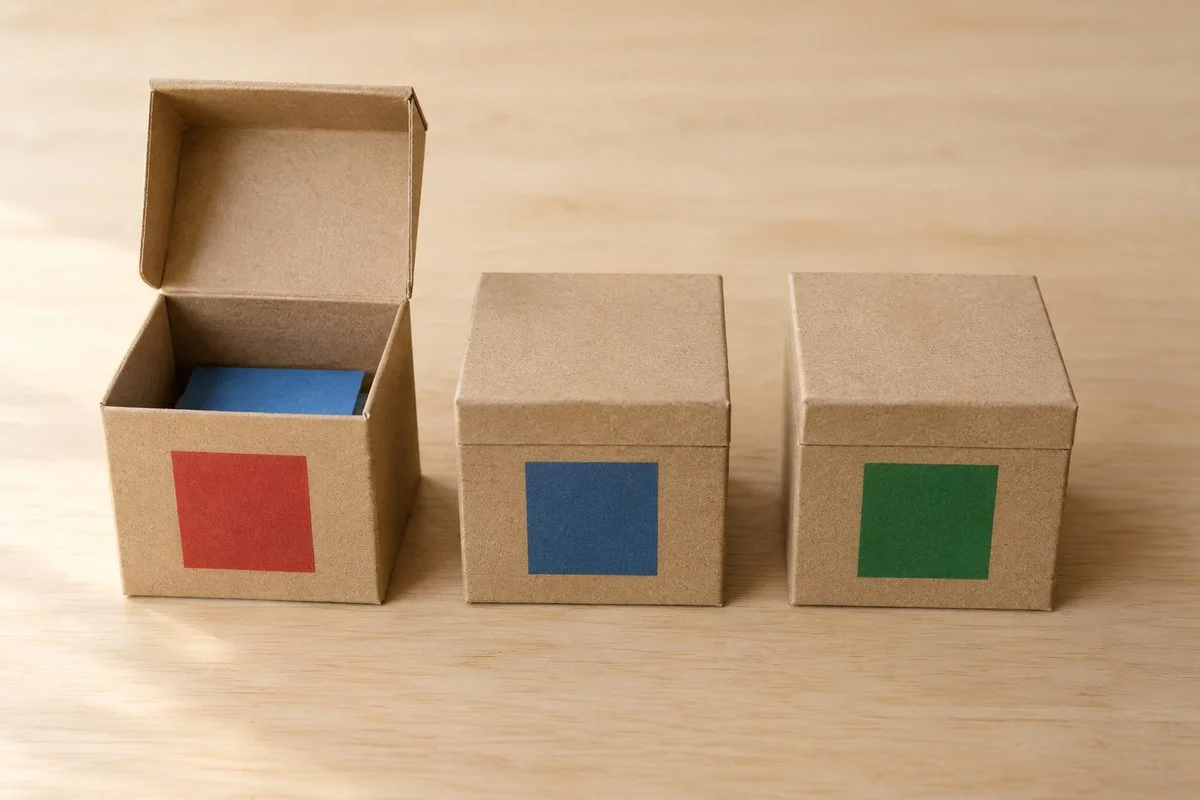
Three colour-labelled boxes; only the red-labelled box is open, revealing blue paper.

8. Puzzle Time

Incorrect labels rule out choices.

Show
Label boxes with red, blue and green patches; hide blue, green and red paper respectively. Say, “Each colour appears inside once. Every label is incorrect.” Open the red-labelled box. After predicting, check the others.
Ask
What colours are inside the unopened boxes?
Say
The green-labelled box contains red, leaving green for the blue-labelled box.
Used in
Elimination identifies mixed-up storage boxes with fewer checks.
If your child says…“We still need to open another box.”
Ask
Can the green-labelled box hold green when every label is incorrect?
What’s true
Every label is incorrect, so each remaining colour has only one possible box.

A real problem

A-series paper keeps its proportions when resized.

The paper standard appeared in August 1922.

Halving an A-series sheet across its longer sides gives approximately the next smaller size.

Its width and height match a square’s side and diagonal.

Documents resize between these sheets without distortion.

German Institute for StandardizationUniversity of CambridgeWikipedia

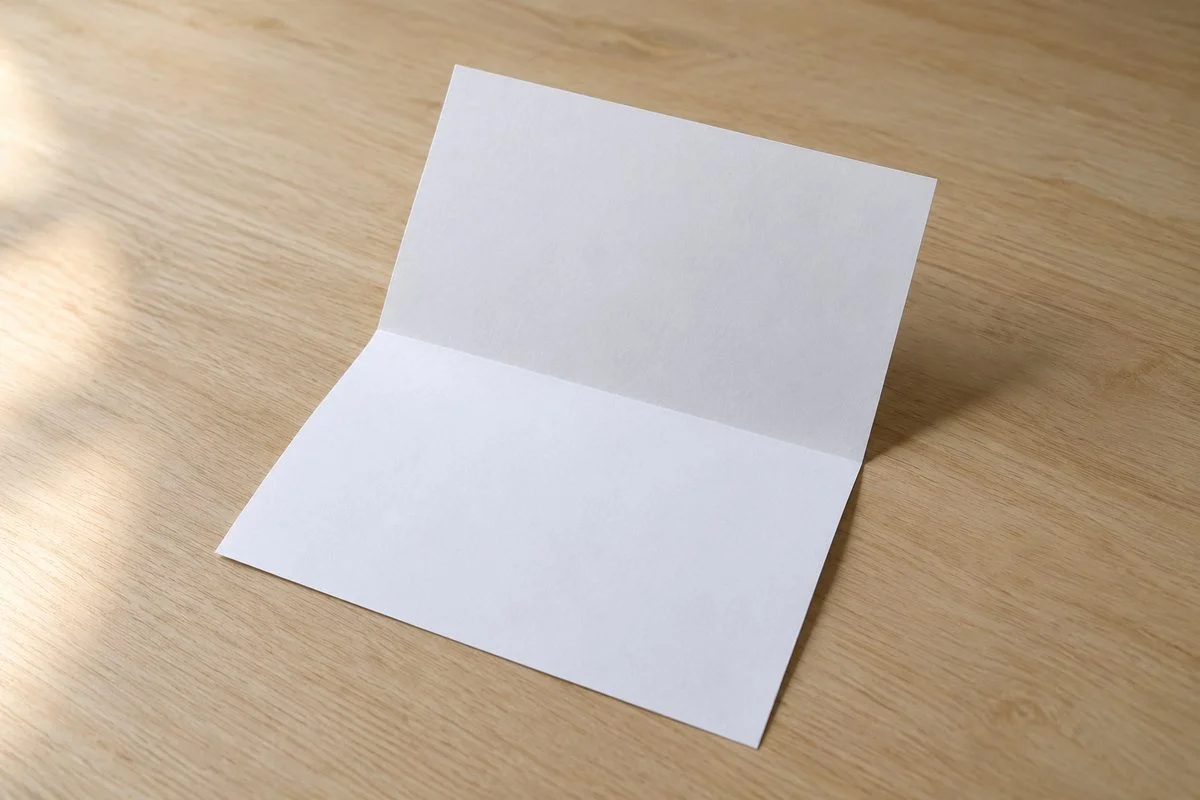
A blank A4 sheet folded with its short edges together on a wooden desk.

Concept Lab · Common misconception

The tempting mistake in The Baudhāyana-pythagoras Theorem

Open standalone misconception page →

Can the theorem be used on any triangle?

Wrong

For two sides 3 cm and 4 cm, the third side must be 5 cm.

Why it feels right. I recognise the 3–4–5 pattern without looking at the angle.

Right

The square relation holds for the sides of a right triangle.

Worked example

The 3 and 4 sticks can open at different angles. Their far endpoints move apart as the angle opens.
  1. Hinge sticks of lengths 3 and 4.
  2. At 90° their far ends are 5 apart.
  3. Open the angle wider and the gap increases.

Ask your child eight quick questions.

One per step. The answer and the reason are given.

  1. A square’s side is halved. What fraction of its original area remains?

    One quarter. Both length and width halve.

  2. Is 1.4 exactly equal to 2\sqrt{2}?

    No. Squaring 1.4 gives 1.96, which is below 2.

  3. The 3 cm and 4 cm sides meet at a right angle. How long is the opposite side?

    5 cm. Its square is 9 plus 16, and the square root of 25 is 5.

  4. What is the new square’s area?

    20 square centimetres. Add the squares of the rectangle’s dimensions, rather than the dimensions themselves.

  5. What common factor greater than one do 6, 8 and 10 share?

    2. Scaling keeps the square relationship but introduces a common factor.

  6. What is the area of the tilted square?

    13 square units. The enclosing area is 25; the four corner triangles total 12.

  7. What must you do to 25 to find the missing shorter side’s square?

    Subtract 9. The hypotenuse’s square already includes both shorter-side squares.

  8. Which unopened box contains red?

    The green-labelled box. Blue is already found, and the green label must be incorrect.

15 more questions with answers, 12 with pictures