Skip to content

Teach We Distribute, Yet Things Multiply in eight steps.

For each idea: show it, ask before you tell, then say one line.

Gather 12 dry chana, eight coins, scrap paper, a ruler and a pencil.

Common misconceptions & worked visual for this chapter · 15 practice questions with answers

How to teach it

Split products into parts

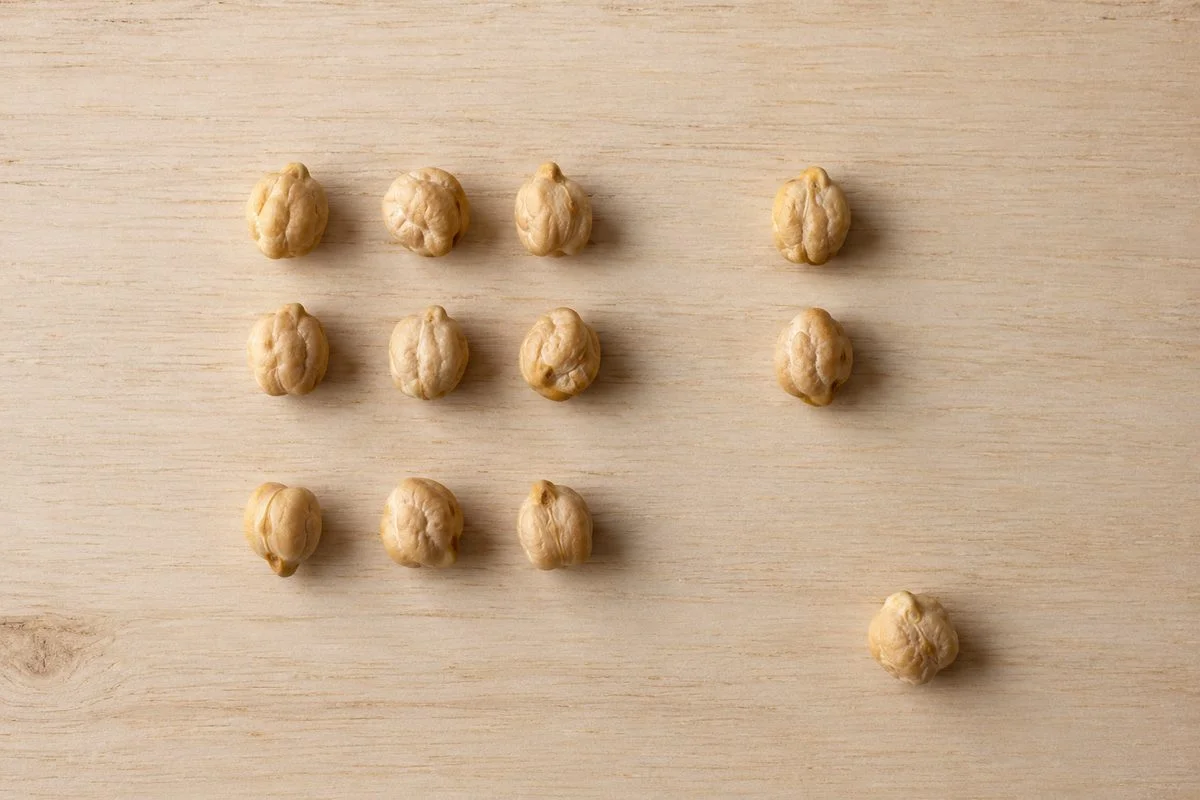
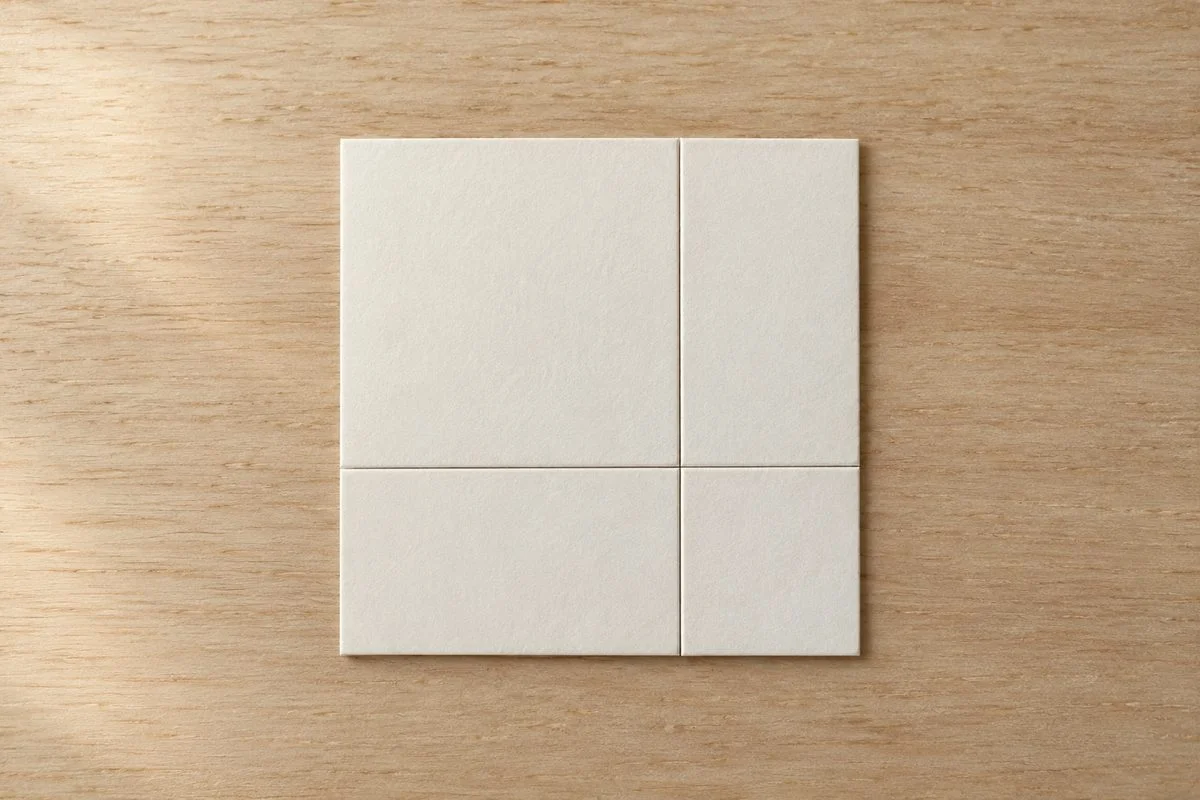
Chana rectangle with two added strips, an empty corner and one loose chana.

1. Some Properties of Multiplication; Identity 1

Multiply every pair of parts, including the new corner.

Show
Make two rows of three chana. Add a column and row, leaving the corner empty.
Ask
What completes the rectangle, and which four groups give its total?
Say
Count the original block, both added strips and the corner.
Used in
Seating plans count added rows and columns to find how many seats fit.
If your child says…“Adding both strips finishes the rectangle.”
Ask
Which place remains empty after both strips are added?
What’s true
The strips leave a corner that also needs counting.
−2(x2+x+1)+x=−2x2−2x−2+x-2(x^2+x+1)+x=-2x^2-2x-2+x

−2x2−2x−2+x=−2x2+(−2+1)x−2-2x^2-2x-2+x=-2x^2+(-2+1)x-2

2. Expanding Products and Collecting Like Terms

Multiply through, then combine terms with matching letters and powers.

Show
Write these lines. Say, “The letter x is a number.” Say, “Its square means x times itself.” Point to each bracket term as negative two multiplies it.
Ask
What simplified expression comes next?
Say
Negative two copies of x plus one copy leave negative x. The answer is negative two x squared, minus x, minus two.
Used in
Combining charges for matching items makes bills shorter and easier to check.
If your child says…“Terms with x can all join together.”
Ask
When x is two, are x and x squared equal?
What’s true
Combine terms only when their letters and powers match.

19×11=19(10+1)19\times11=19(10+1)

19(10+1)=190+1919(10+1)=190+19

3. Fast Multiplications Using the Distributive Property

Use a round multiplier, then add or subtract one copy.

Show
Write these lines for eleven items costing 19 rupees each. Say, “Count ten copies, then one more.” Align the addition by place value.
Ask
What total comes next?
Say
Carrying gives 209 rupees.
Used in
Round multipliers make bulk stock totals easier to calculate mentally.
If your child says…“I can write every digit sum beside the next.”
Ask
Where does the extra hundred go when the tens add up?
What’s true
A place holds one digit, so larger sums need carrying.

Build and connect square identities

Two paper squares and two rectangles fitted together into a larger square.

4. Identity 1A

Squaring a sum includes two matching rectangles between the squares.

Show
Fold and tear paper into pieces measuring 4×4, 4×2, 2×4 and 2×2 cm. Assemble them into a square. Call the longer side-part a and the shorter one b.
Ask
Which pieces disappear from our count if we count only the two squares?
Say
Include both rectangles as well as both squares: (a+b)2=a2+2ab+b2(a+b)^2=a^2+2ab+b^2.
Used in
Flooring estimates include both border strips, preventing too few tiles being ordered.
If your child says…“I just square each part and add.”
Ask
Which pieces sit between the two squares?
What’s true
That count leaves out both rectangles.
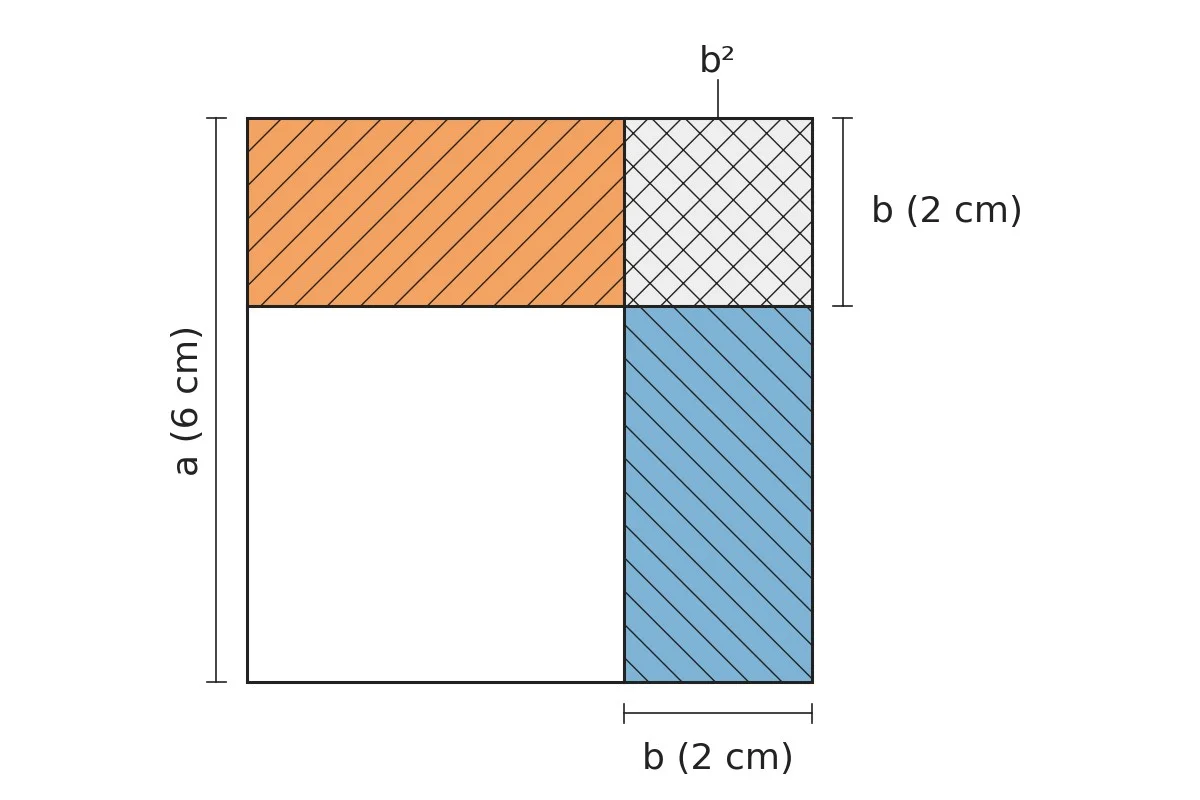
Diagram of a square with overlapping top and right bands and labelled lengths.

5. Identity 1B

Subtract both strips, then restore their overlap once.

Show
Look at the diagram. Find the top and right bands, then their overlap. The square's side is a, and each band's width is b.
Ask
Which area would subtracting both bands remove twice?
Say
Restore the corner once to find the remaining square's area: (a−b)2=a2−2ab+b2(a-b)^2=a^2-2ab+b^2.
Used in
Removing top and right borders leaves the usable area of a square noticeboard.
If your child says…“The little square must be subtracted too.”
Ask
How many sets of shading cover that corner?
What’s true
The corner already belongs to both subtracted bands.

(a+b)2+(a−b)2=a2+2ab+b2+a2−2ab+b2(a+b)^2+(a-b)^2=a^2+2ab+b^2+a^2-2ab+b^2

a2+2ab+b2+a2−2ab+b2=2a2+2b2a^2+2ab+b^2+a^2-2ab+b^2=2a^2+2b^2

6. Investigating Patterns: Pattern 1

Adding the squared sum and squared difference doubles the original squares' total.

Show
Write these lines. Say, “Here a and b can be any numbers.” Cross out the equal positive and negative middle terms.
Ask
What expression comes next when you take the common factor outside?
Say
The middle terms cancel. Two copies of each square give twice the sum of the original squares.
Used in
Equivalent area formulas help compare square designs with fewer calculations.
If your child says…“I can put the two inside each square.”
Ask
When both factors double, how many copies of the original product result?
What’s true
Doubling before squaring makes four copies of the original square.
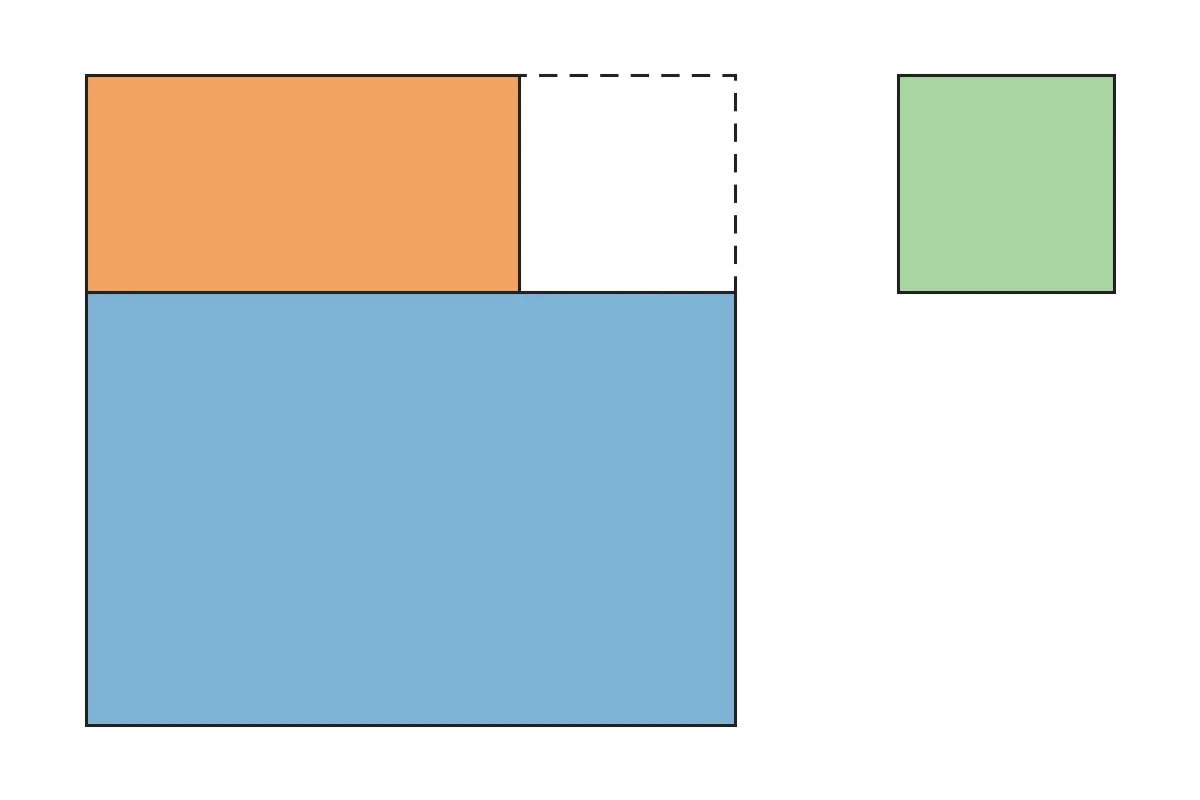
Two rectangles form a square missing one corner; the removed small square lies beside them.

7. Identity 1C

Subtracting squares gives the product of their sides' sum and difference.

Show
Fit 6×4, 4×2 and 2×2 cm paper pieces into a square. Call its side a and the small square's side b. Remove the small square, leaving the rectangles ready to rearrange.
Ask
Before rearranging these rectangles, what product do you think will describe their combined area?
Say
Rearrange the pieces into a rectangle measuring a plus b by a minus b. Multiplying these lengths gives the remaining area.
Used in
Subtracting a square opening's area gives the tabletop surface needing paint.
If your child says…“Subtracting squares means squaring the difference.”
Ask
Are the length and width of our remaining rectangle equal?
What’s true
The rectangle's sides are a plus b and a minus b.

Check different expressions

k(k+1)+k=k2+k+kk(k+1)+k=k^2+k+k

k2+k+k=k2+(1+1)kk^2+k+k=k^2+(1+1)k

8. Mind the Mistake, Mend the Mistake; This Way or That Way, All Ways Lead to the Bay

Check whether different expressions count the same coins.

Show
Arrange eight coins in a three-by-three square with its top-right corner empty. Say, “k is two.” Write these lines.
Ask
What simplified expression comes next?
Say
The equality is already valid. The two k terms combine into two k; the k squared term stays unchanged.
Used in
Equivalent spreadsheet formulas shorten calculations.
If your child says…“An unfinished line must be incorrect.”
Ask
Did expanding change how many coins the expression counts?
What’s true
An equality can hold before its terms are fully combined.

A real problem

Rearranging algebra made large-number multiplication faster.

Karatsuba’s multiplication algorithm was published in 1962.

For sufficiently large numbers, it outperformed the usual school multiplication method.

Its key step rewrites the algebra used to calculate part of the product.

WikipediaUniversity of Illinois

Unbranded laptop beside paper with handwritten multiplication calculations.

Concept Lab · Common misconception

The tempting mistake in We Distribute, Yet Things Multiply

Open standalone misconception page →

Does the outside factor reach both terms?

Wrong

3(x + 2) = 3x + 2

Why it feels right. I multiply the first term and carry the other term along.

Right

Distribute the factor to every term in the bracket.

Worked example

Three bags
x🍊🍊
x🍊🍊
x🍊🍊
Total
3x apples
6 oranges
Each of the three bags contains both x apples and two oranges.
  1. Three bags each hold x apples and 2 oranges.
  2. Together they hold 3x apples and 6 oranges.

Ask your child eight quick questions.

One per step. The answer and the reason are given.

  1. When both 12 and 15 increase by one, how much does their product increase?

    28. The increase includes both strips and the extra corner: twelve plus fifteen plus one.

  2. Which terms in the first expanded line can combine?

    −2x-2x and +x+x. Their letter parts match, including the power.

  3. What is 94 multiplied by 11?

    1034. Add 940 and 94, carrying into the hundreds and thousands.

  4. What term is missing from a2+b2a^2+b^2 when squaring a plus b?

    2ab2ab. Each of the two rectangles has area a times b.

  5. After subtracting both bands, what must happen to the corner's area?

    Add it back once. Subtracting each band counted the shared corner twice.

  6. Which two positive whole numbers have squares totalling twice the sum of 525^2 and 626^2?

    11 and 1. Use their sum and difference, rather than doubling each number.

  7. What factors give x2−9x^2-9 using the sum and difference of x and a positive number?

    (x+3)(x−3)(x+3)(x-3). A difference of squares uses a sum multiplied by a difference.

  8. Before the two k terms combine, is the first equality valid?

    Yes. Both expressions count the same groups; combining terms only shortens the expression.

15 more questions with answers, 2 with pictures