Skip to content

Teach Number Play in eight steps.

For each idea: show it, ask before you tell, then say one line.

Gather paper, a pencil and 8 dried chickpeas.

Common misconceptions & worked visual for this chapter · 15 practice questions with answers

How to teach it

Odd, even and complete groups

(1+2+3+4)−(1+2+3−4)=4+4(1+2+3+4)-(1+2+3-4)=4+4

(1+2+3+4)−(1+2+3−4)=2×4(1+2+3+4)-(1+2+3-4)=2\times4

1. Sum of Consecutive Numbers; Breaking Even

Odd or even can stay unchanged when a calculation changes.

Show
Say, “Parity means odd or even. Only the final sign changes. Subtracting the expressions cancels the matching terms, leaving two fours.” Then write the equation.
Ask
How much will the answer change if we switch the final plus to minus?
Say
The change is 8, keeping parity unchanged.
Used in
Odd-or-even checks can reject impossible totals before a full calculation.
If your child says…“Changing plus to minus makes an even answer odd.”
Ask
Can adding or removing complete pairs leave a new unpaired unit?
What’s true
Switching a sign changes the total by an even amount, including when answers become negative.
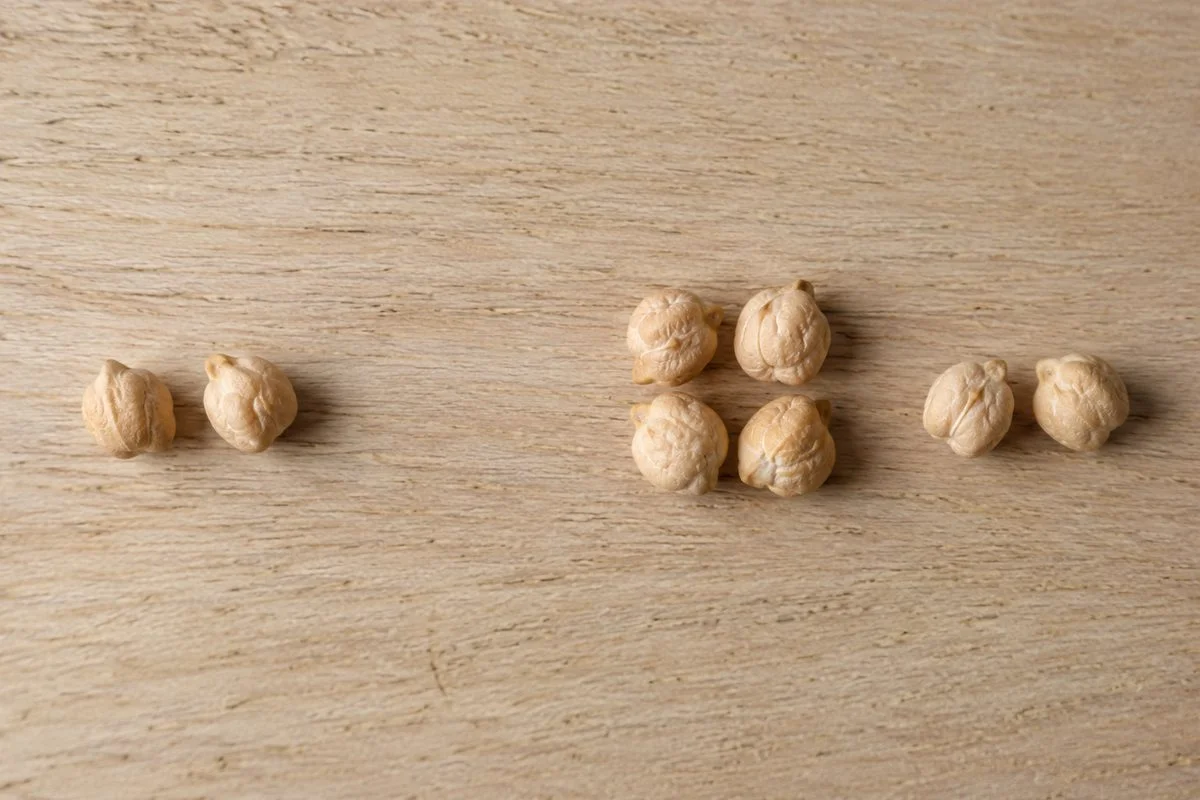
Eight chickpeas arranged as a group of four and two separate pairs.

2. Pairs to Make Fours

Even counts make complete fours when remainders after dividing by four match.

Show
Make piles of 2 and 6 chickpeas. Arrange complete fours, keeping leftover pairs apart. After the prediction, join the leftovers.
Ask
Will the leftovers fill another group of four?
Say
The two leftover pairs fill another four.
Used in
Matching leftovers lets packing batches combine without leaving an incomplete pack.
If your child says…“Any two even numbers make a multiple of four.”
Ask
If only one pile leaves a pair, what completes that pair’s group of four?
What’s true
Both counts must have matching remainders when grouped into fours.
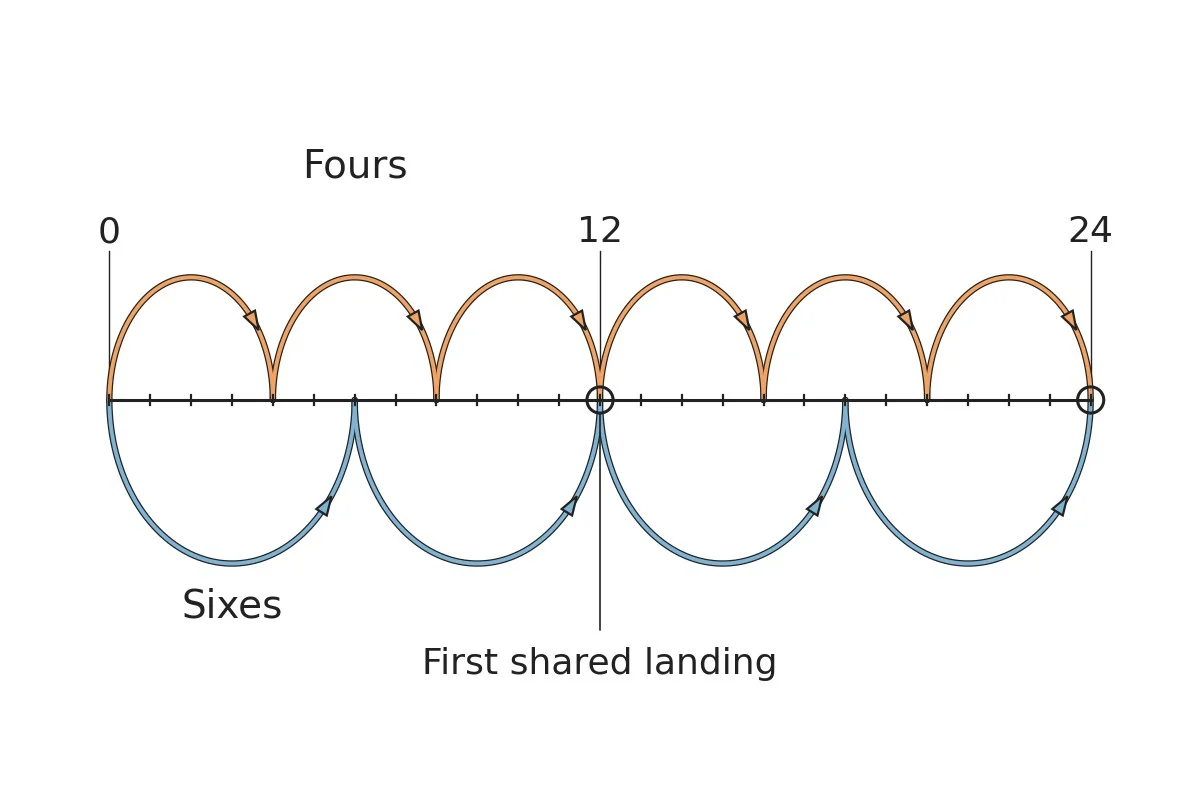
Jumps of four and six share landings at twelve and twenty-four.

3. Always, Sometimes, or Never

Passing two divisibility tests need not guarantee their product.

Show
Look at the diagram. Follow jumps of four above the line, then six below. Find their shared landings.
Ask
If both jump routes reach a number, must it be divisible by 24?
Say
Both routes reach 12 and 24, but only 24 is divisible by 24.
Used in
Common multiples help match quantities sold in different pack sizes.
If your child says…“Passing the 4 and 6 tests means passing the 24 test.”
Ask
Does 12 pass both tests while being too small to contain a complete 24?
What’s true
Passing both tests guarantees divisibility by their LCM, which can be smaller than their product.

8+8=(5+3)+(5+3)8+8=(5+3)+(5+3)

16=5×2+616=5\times2+6

16=5×2+(5+1)16=5\times2+(5+1)

4. What Remains?

Combine leftovers, then remove any further complete groups.

Show
Say, “Each eight contains a complete five and three leftovers. Together, they make sixteen: two fives and six leftovers. Split those six into five and one.” Then write the equation.
Ask
What remainder will their sum leave after we regroup the six leftovers?
Say
The remainder is 1. Six leftovers make another complete five, with one left.
Used in
Remainders locate positions in repeating border patterns without drawing every repetition.
If your child says…“The remainder is just the leftovers added together.”
Ask
Can six still be the remainder when another group of five fits?
What’s true
A remainder cannot contain another complete group or be negative.

What digits reveal

18=1×10+818=1\times10+8

18=1×(9+1)+818=1\times(9+1)+8

18=9+(1+8)18=9+(1+8)

5. Checking Divisibility Quickly

Place value explains shortcuts for checking exact division.

Show
Say, “Eighteen has one ten and eight units. Split the ten into nine and one. Put the remaining one and eight together in brackets.” Then write the equation.
Ask
What will the final bracket give?
Say
The bracket gives 9. Removing this nine leaves one plus eight, the digit sum.
Used in
Digit tests check whether a total can be shared equally without long division.
If your child says…“Ending in 4 means a number divides by 4.”
Ask
After removing the hundred from 114, does the remaining 14 divide exactly by 4?
What’s true
For division by 4, the final two digits matter because complete hundreds already divide exactly.

110=100+10+0110=100+10+0

110=(99+1)+(11−1)+0110=(99+1)+(11-1)+0

110=11×10+(1−1+0)110=11\times10+(1-1+0)

6. Divisibility by 11

Alternating digit signs remove complete elevens from place values.

Show
Say, “Split 110 into a hundred, a ten and zero units. A hundred is one more than 99. Ten is one less than eleven. Both 99 and eleven are multiples of eleven. Together, they make ten elevens, leaving one extra unit and one missing unit.” Then write the equation.
Ask
What will remain after removing the complete elevens?
Say
Zero remains, so 110 divides exactly by 11.
Used in
Alternating digit checks can catch some errors when numbers are copied.
If your child says…“Adding all the digits tests 11 too.”
Ask
In the tens bracket, is the extra unit added or taken away?
What’s true
The tens contribution is subtracted because ten falls one short of eleven.

99=9×10+999=9\times10+9

9+9=189+9=18

7. Digital Roots

Repeated digit addition ends at a single digit.

Show
Say, “Ninety-nine is a multiple of nine, but its digits total eighteen.” Then write the equation.
Ask
What single digit will adding eighteen’s digits give?
Say
It gives 9.
Used in
Repeated digit sums help catch some arithmetic errors in handwritten bills.
If your child says…“I stop after adding the digits once.”
Ask
Does 18 have only one digit?
What’s true
Keep adding the resulting digits until just one digit remains.

A+A+A=10B+AA+A+A=10B+A

2A=10B2A=10B

2A=102A=10

8. Digits in Disguise

Find hidden digits using place value and consistent rules.

Show
Say, “Adding A three times gives BA, with nonzero tens digit B and units digit A. Remove one A from each side, leaving twice A equal to ten times B. Twice A cannot exceed 18, so B must be 1. That makes twice A equal to ten.” Then write the equation.
Ask
Which digit do you predict A will be?
Say
A is 5, since doubling it gives 10.
Used in
Reconstructing a smudged calculation uses known digits to narrow down missing ones.
If your child says…“Different letters can use the same digit.”
Ask
If two different letters both mean 1, have they followed the different-digits rule?
What’s true
Each letter keeps its digit, different letters differ, and the first digit cannot be zero.

A real problem

Book numbers helped catch copying errors.

The International Standard Book Number became an international standard in 1970.

It identifies a book’s specific title, edition and format.

The original checking method used remainders with a prime divisor.

Its check could detect incorrectly copied digits and swapped digits.

U.S. ISBN AgencyInternational ISBN AgencyUniversity of New Brunswick

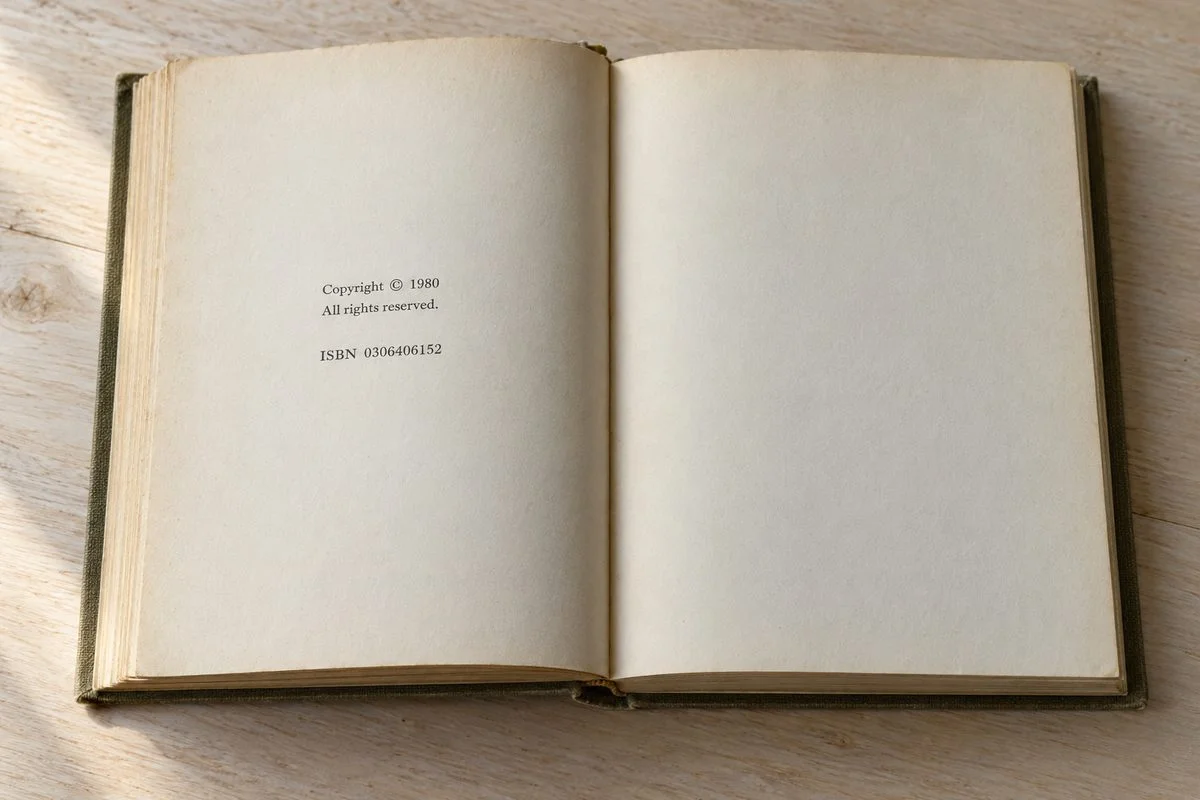
Older library book open to its copyright page with its ISBN visible.

Concept Lab · Common misconception

The tempting mistake in Number Play

Open standalone misconception page →

Can a pattern of examples establish a number rule?

Wrong

If n² + n + 41 is prime for the first several whole numbers, it must always be prime.

Why it feels right. A long run of matches feels like proof.

Right

A rule that claims to work for every number fails if even one example breaks it.

Worked example

Small inputs
n = 0: 41→n = 1: 43→n = 2: 47
Counterexample
n = 40→1,681→41 × 41
Several successes do not rule out a counterexample. At n = 40 the output is 41 squared.
  1. At n = 0, 1 and 2 the outputs are 41, 43 and 47.
  2. At n = 40, the output is 40² + 40 + 41 = 41², a composite number.

Ask your child eight quick questions.

One per step. The answer and the reason are given.

  1. Is 3 minus 4 minus 5 minus 6 odd or even?

    Even. Each sign change adds or removes an even amount.

  2. What remains when 8 chickpeas and 6 chickpeas are grouped together into fours?

    2 chickpeas. The starting remainders differ, so a pair remains.

  3. Which shared landing disproves the claim that passing both tests guarantees divisibility by 24?

    12. Twelve is divisible by four and six, but not by twenty-four.

  4. Two numbers leave 5 and 3 when divided by 7. What remainder does their sum leave?

    1. The eight leftovers contain another seven, leaving one.

  5. Which final digits must you test to check 114 for divisibility by 4?

    14. The hundred divides exactly, but the remaining fourteen does not.

  6. What alternating digit total does 462 give, starting with plus at units?

    0. Two minus six plus four cancels, rather than adding every digit.

  7. What is the digital root of 489710?

    2. The sums 29 and 11 still have two digits, so continue to 2.

  8. If P means 1, which digit is forbidden for a different letter Q?

    1. Different letters need different digits, even when the arithmetic works.

15 more questions with answers