Skip to content

Teach Area in eight steps.

For each idea: show it, ask before you tell, then say one line.

Gather scrap paper, a ruler, pencils, a colouring pencil and scissors.

An adult does all cutting and keeps scissors away from fingers.

Common misconceptions & worked visual for this chapter · 15 practice questions with answers

How to teach it

Count and compare areas

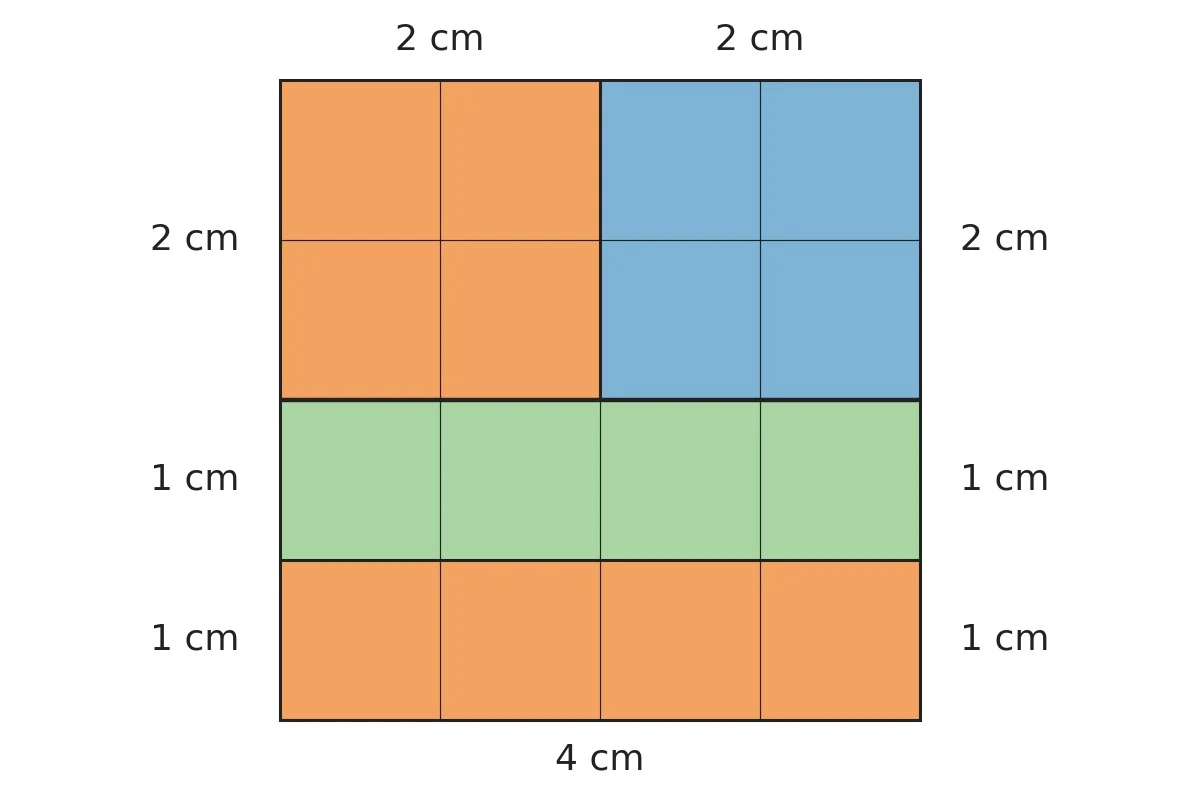
Gridded square with labelled lengths, divided into two squares above two strips.

1. Rectangles and Squares

Area counts inside unit squares; perimeter measures only the outside boundary.

Show
Look at the diagram. Find the four shares. After predicting, count their squares and compare outside boundaries using the labelled lengths.
Ask
Will these four pieces give equal shares for colouring?
Say
Each covers four squares, counted as rows times columns. Their perimeters differ: 8 cm around a square, 10 cm around a strip.
Used in
Area tells how much carpet covers a floor; perimeter tells how much edging surrounds it.
If your child says…“Different shapes cannot have equal areas.”
Ask
How many centimetre squares belong to each share?
What’s true
Different outlines can enclose the same number of unit squares.
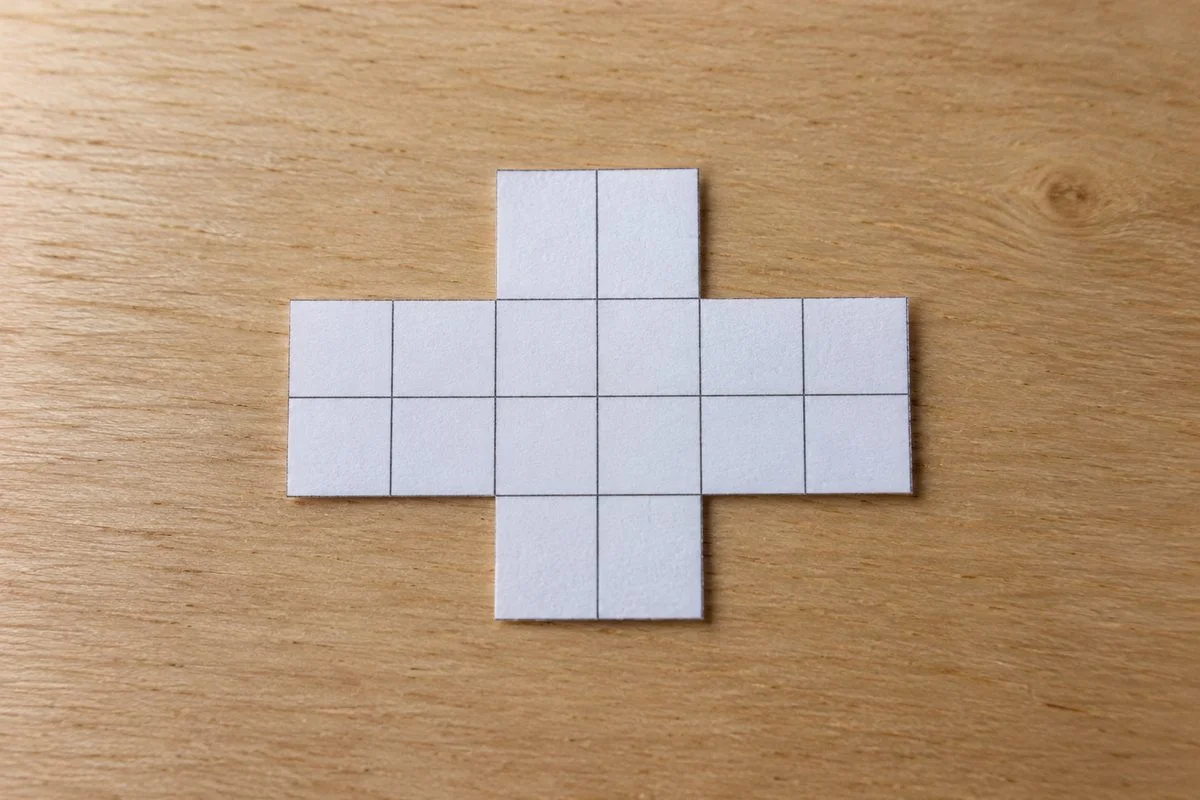
Two gridded paper strips crossing over a shared square.

2. Crosspath and Tube

Count shared patches once.

Show
An adult cuts gridded strips: 6 by 2 cm and 4 by 2 cm. Cross them at right angles with a full 2-by-2 cm overlap. After predicting, overlap their end squares fully to form an L.
Ask
Will the covered area change?
Say
Both cover 16 square centimetres after subtracting the overlap.
Used in
Subtracting overlaps avoids buying extra paving.
If your child says…“I just add both strip areas.”
Ask
Which patch belongs to both strips?
What’s true
Adding both areas counts their shared square twice.
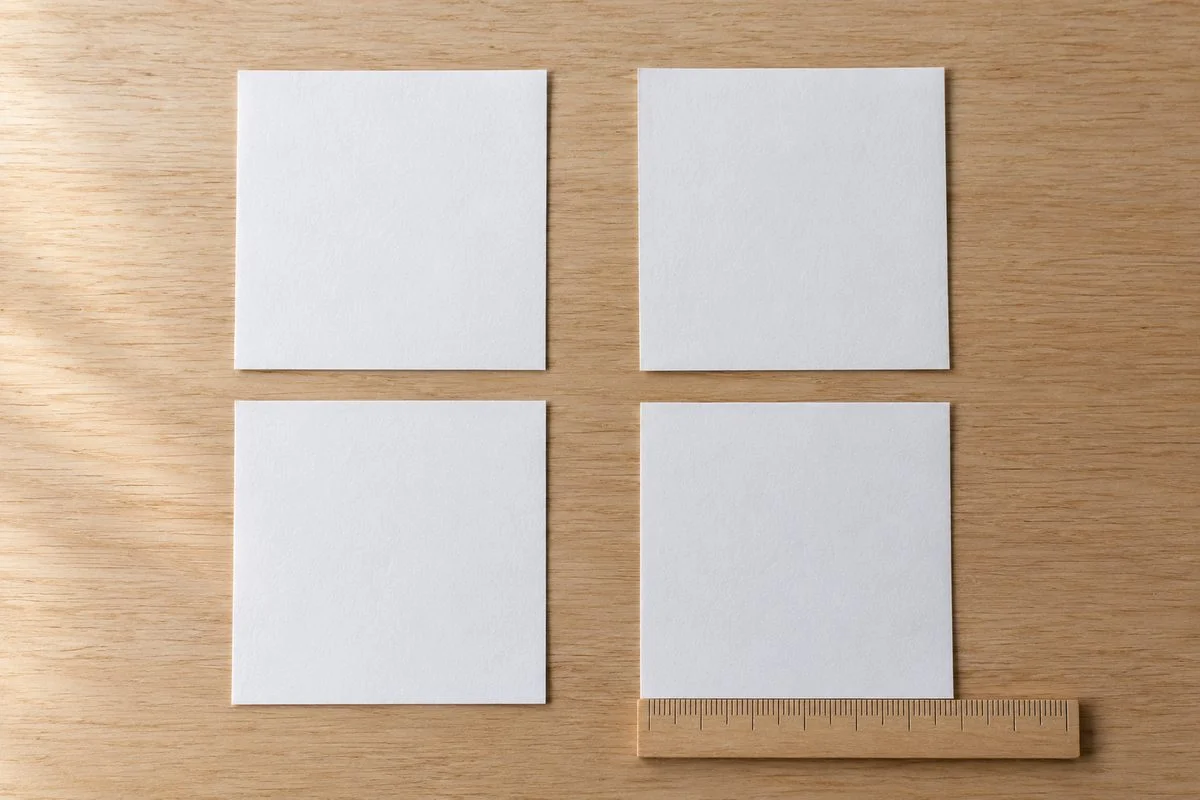
Four equal paper squares waiting to form a larger square.

3. Area of a Square

Area changes with both dimensions, including when converting units.

Show
An adult cuts four 10 cm paper squares. After predicting, fit them into a 20 cm square. Express a small side as 10 cm and 0.1 m. Multiply each measurement by itself.
Ask
How many small squares will cover a square with twice their side length?
Say
Four fit because both directions double. The small square covers 100 square centimetres, or 0.01 square metres.
Used in
Enlarging a square cloth pattern requires extra fabric in both directions.
If your child says…“Doubling the side only doubles the area.”
Ask
How many small squares fit across, and how many rows fit?
What’s true
Doubling both dimensions makes the area four times as large.

Use triangles to find areas

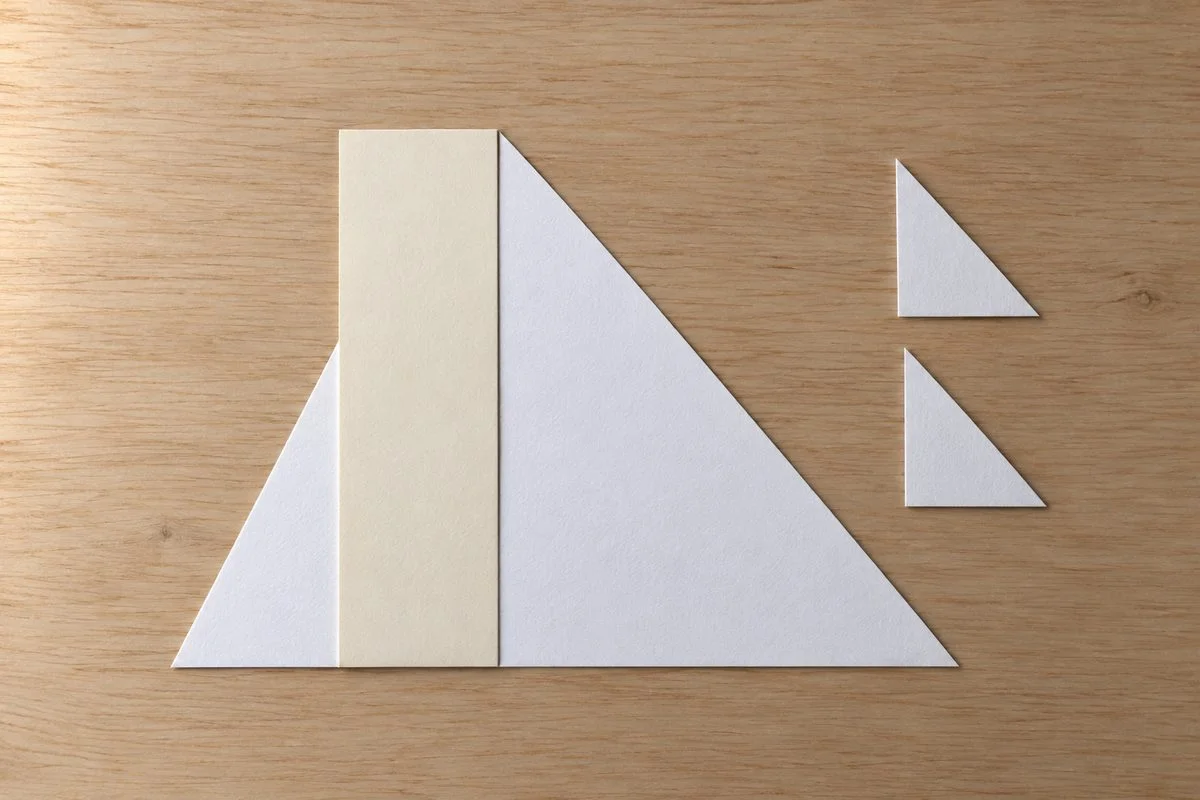
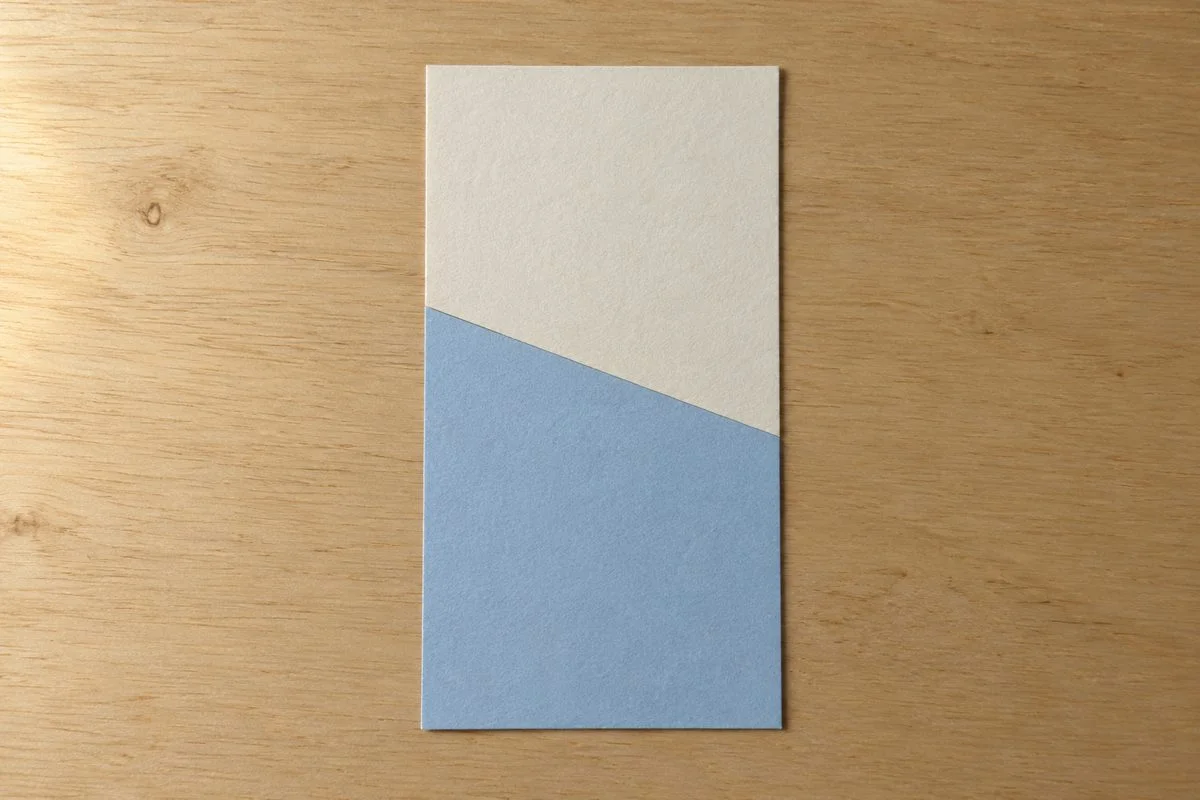
Paper triangle turned onto a sloping side, beside a square-cornered scrap and offcuts.

4. Triangles

A triangle covers half a rectangle with matching base and height.

Show
Join a 6-by-4 cm paper rectangle’s bottom corners to its top midpoint. An adult cuts off the corners; fit them over the triangle. Turn its 5 cm side down. Locate its height with a paper corner.
Ask
Will the height remain 4 cm?
Say
The corners cover half: 12 square centimetres. Double that area and divide by 5: height is 4.8 cm.
Used in
Area measures a triangular shelf’s usable surface.
If your child says…“The old height works with any side.”
Ask
Does the old height meet your new base at a right angle?
What’s true
Each chosen base needs its own perpendicular height.
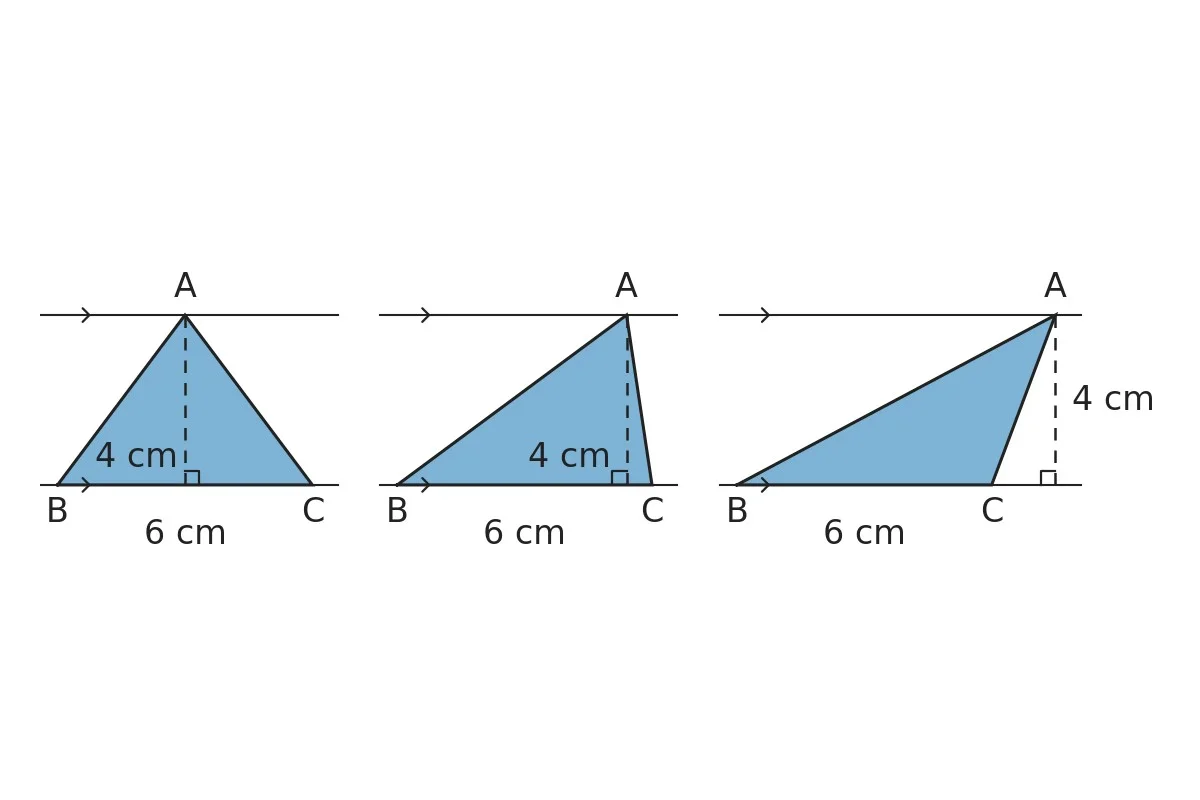
Three differently slanted triangles with matching bases and perpendicular heights between parallel lines.

5. Triangles between Parallel Lines with a Common Base

Matching bases and perpendicular heights give triangles equal areas.

Show
Look at the diagram. Follow each 6 cm base, then its dashed 4 cm perpendicular height.
Ask
Will moving the top corner sideways change the triangle’s area?
Say
Each triangle covers 12 square centimetres: half of 6 times 4. Their bases and perpendicular heights match, even when their outlines differ.
Used in
Matching bases and heights let painters plan equal paint quantities for triangular panels.
If your child says…“The more slanted triangle covers more space.”
Ask
Do the base and perpendicular height change as the top corner moves along the upper line?
What’s true
Moving the top corner along this parallel line leaves the perpendicular height unchanged.
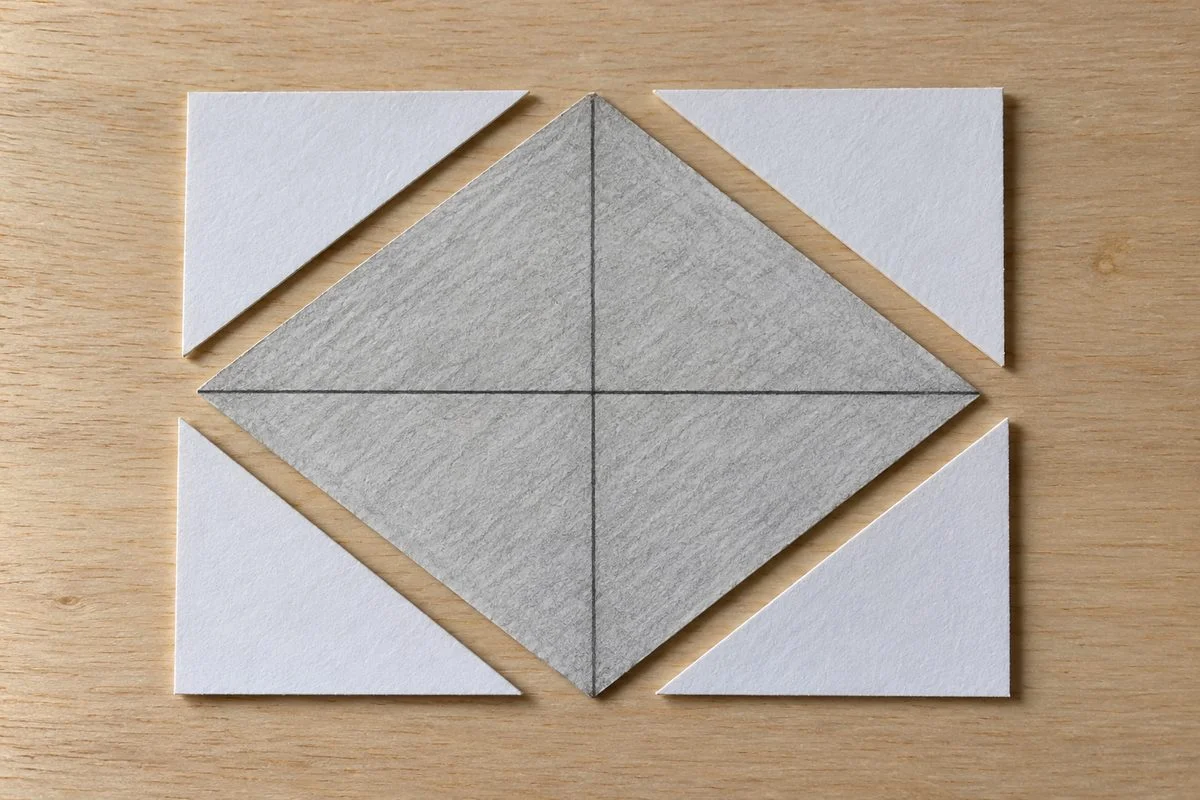
Shaded paper rhombus divided by diagonals, with four corner offcuts beside it.

6. Area of any Polygon: Rhombus

Add inside triangle areas, or subtract outside areas from the rectangle’s area.

Show
Join a 6-by-8 cm paper rectangle’s side midpoints. Shade the rhombus; draw its diagonals. An adult cuts off the corners. After predicting, fit them over the rhombus.
Ask
Will the four corner pieces exactly cover the shaded rhombus?
Say
The four corners together cover half the rectangle. The rhombus covers the other half. Its four triangles total 24 square centimetres, half the diagonals’ product.
Used in
Triangle partitions help tailors calculate cloth for many-sided panels.
If your child says…“I can leave one triangle out of the total.”
Ask
Which part of the shaded paper would your total leave uncounted?
What’s true
Add every inside triangle, or subtract all outside corners from the rectangle.

Rearrange pieces into rectangles

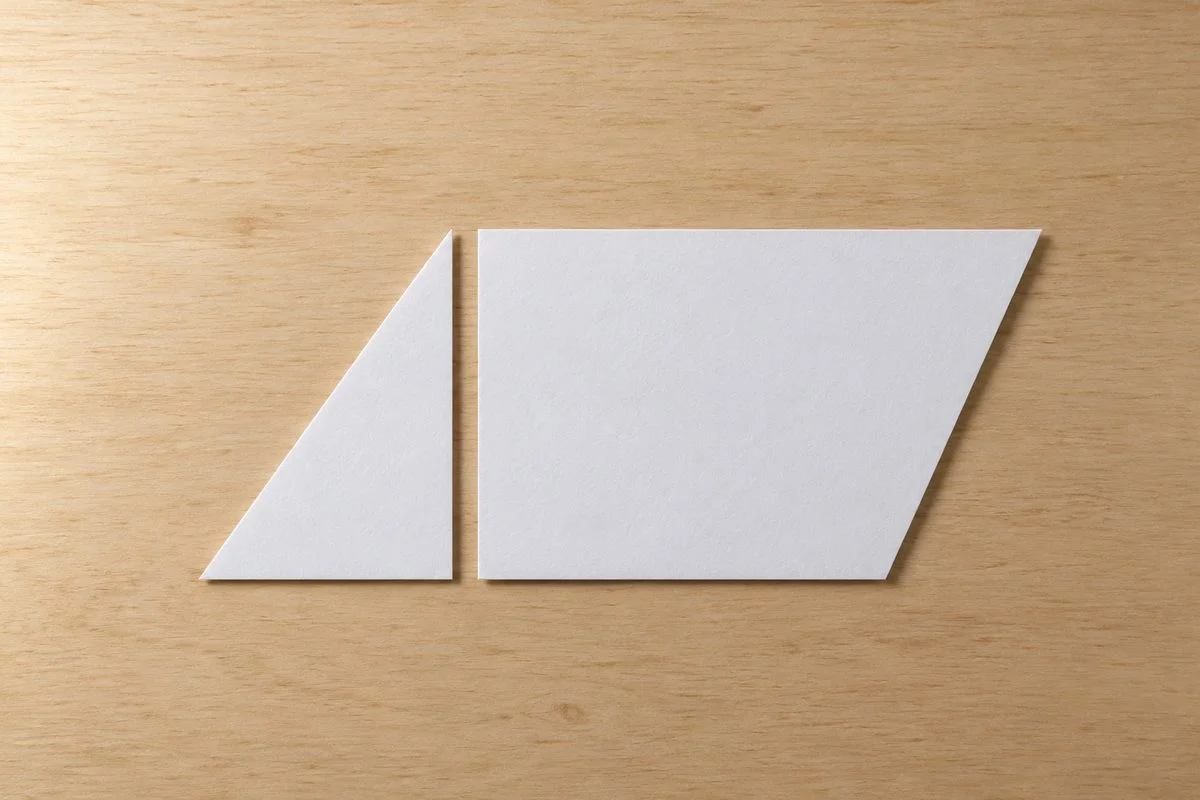
Paper parallelogram with its left triangular end cut free.

7. Parallelogram and Dissection

Rearrangement reveals base times perpendicular height.

Show
An adult cuts a parallelogram: base 6 cm, height 3 cm, top shifted 2 cm right. Cut vertically from its top-left corner. After predicting, move the triangle right into a rectangle; measure around it.
Ask
Will its area change?
Say
Without gaps or overlaps, it retains 18 square centimetres despite its changed perimeter.
Used in
Rearranging fabric pieces makes patches without wasting cloth.
If your child says…“Overlapping the pieces keeps the same covered area.”
Ask
Would every piece still cover a separate patch if you overlapped them?
What’s true
Overlapping pieces cover less surface because some paper covers paper.
Two paper trapeziums joined along sloping edges to form a tall rectangle.

8. Trapezium

Matching copies reveal the area.

Show
An adult cuts matching right trapeziums: parallel sides 2 and 4 cm, height 2 cm. Turn one halfway round; join sloping edges. Turn the rectangle sideways; locate the parallel sides and their separation.
Ask
Will joining these matching trapeziums make a rectangle with twice one piece’s area?
Say
Yes: add parallel sides, multiply by perpendicular separation, halve: 6 square centimetres.
Used in
Trapezium area determines glass needed for window panes.
If your child says…“One trapezium has the whole rectangle’s area.”
Ask
How many matching pieces share the rectangle’s area?
What’s true
The rectangle contains two matching trapeziums, so each occupies half.

Concept Lab · Common misconception

The tempting mistake in Area

Open standalone misconception page →

Which side is the height of a slanted parallelogram?

Wrong

Multiply the base by the slanted side to find area.

Why it feels right. The slanted side looks like the second dimension.

Right

Height is the perpendicular distance to the base.

Worked example

Both shapes have base 6 and perpendicular height 4. The dashed cut shows the triangular piece that can slide to the other end.
  1. A parallelogram has base 6 cm, slanted side 5 cm and height 4 cm.
  2. Slide a triangular end to make a 6 × 4 rectangle of area 24 cm².

Ask your child eight quick questions.

One per step. The answer and the reason are given.

  1. How do the areas of a top square and a bottom strip compare?

    They are equal. Each contains four unit squares despite having a different outline.

  2. What area must you subtract after adding these strip areas?

    4 square centimetres. The shared square was counted twice.

  3. What fraction of the larger square does one small square cover?

    One quarter. The larger square contains two rows of two small squares.

  4. What height belongs with this triangle’s 5 cm base?

    4.8 cm. The area stays unchanged, but the new base needs its matching perpendicular height.

  5. Which triangle has the largest area?

    All have equal area. Each has the same base and perpendicular height.

  6. Each inside triangle covers 6 square centimetres. What is the whole rhombus’s area?

    24 square centimetres. All four triangles contribute to the shaded region.

  7. What happens to the covered area if the moved triangle overlaps the other piece?

    It decreases. The overlapping paper no longer covers a separate patch.

  8. What is the area of either trapezium in this rectangle?

    6 square centimetres. The rectangle’s 12 square centimetres are shared equally between two matching pieces.

15 more questions with answers, 15 with pictures