Skip to content

Teach Proportional Reasoning-2 in eight steps.

For each idea: show it, ask before you tell, then say one line.

Gather paper, paper strips, pencils, pen, eraser, ruler, protractor, three ₹2 coins, equal cups, water, jug, bowls, tape, clock and roasted chana.

Common misconceptions & worked visual for this chapter · 15 practice questions with answers

How to teach it

Compare and share

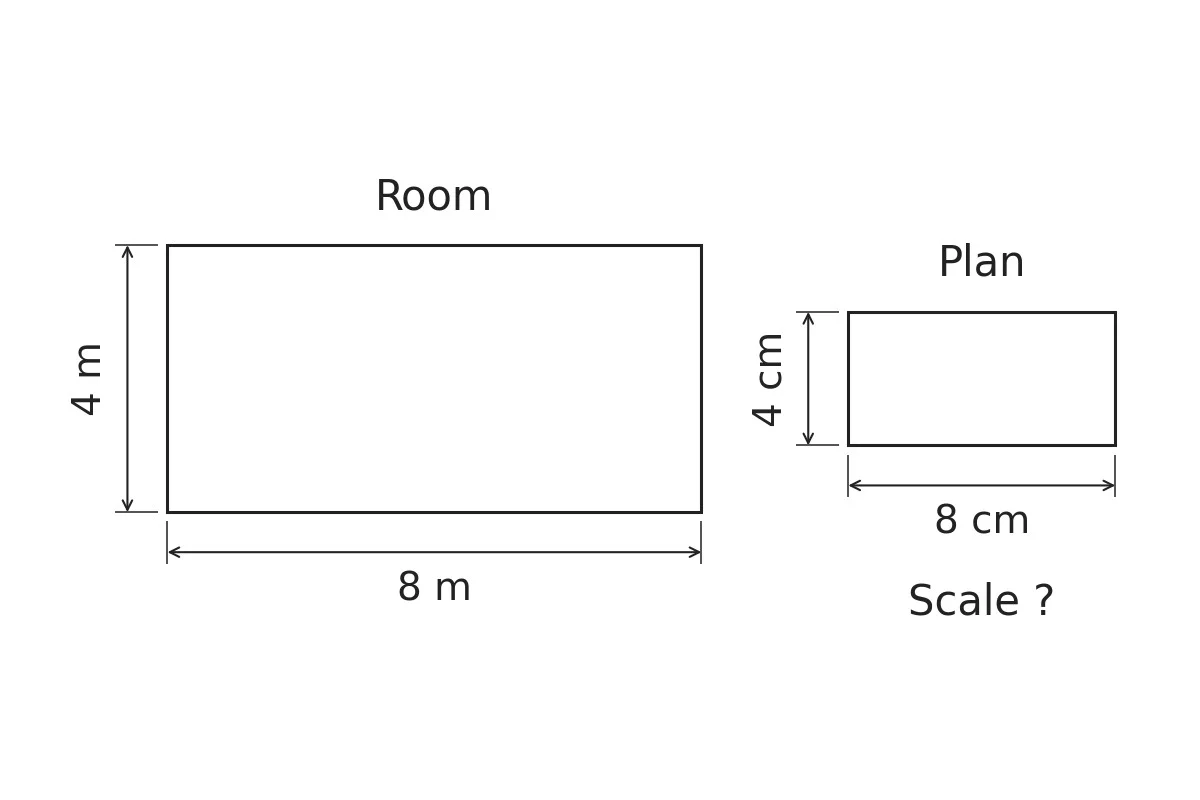
Room and plan rectangles with corresponding lengths labelled in metres and centimetres.

1. Proportion and Representative Fraction

Compare paper and actual lengths using matching units.

Show
Look at the diagram’s room, then its plan. Say, “The room measures 800 cm by 400 cm.” Compare each plan length with its matching room length.
Ask
What scale lets this small plan show both room dimensions correctly?
Say
Each plan centimetre represents 100 room centimetres, giving a scale of 1:100. Both comparisons agree: 8800=4400=1100\frac{8}{800}=\frac{4}{400}=\frac{1}{100}.
Used in
Building plans help builders position walls accurately.
If your child says…“The ratios match whenever their differences match.”
Ask
For 6:3 and 5:2, do 6 times 2 and 3 times 5 match?
What’s true
Equal cross-products show equal ratios, even when the differences differ.
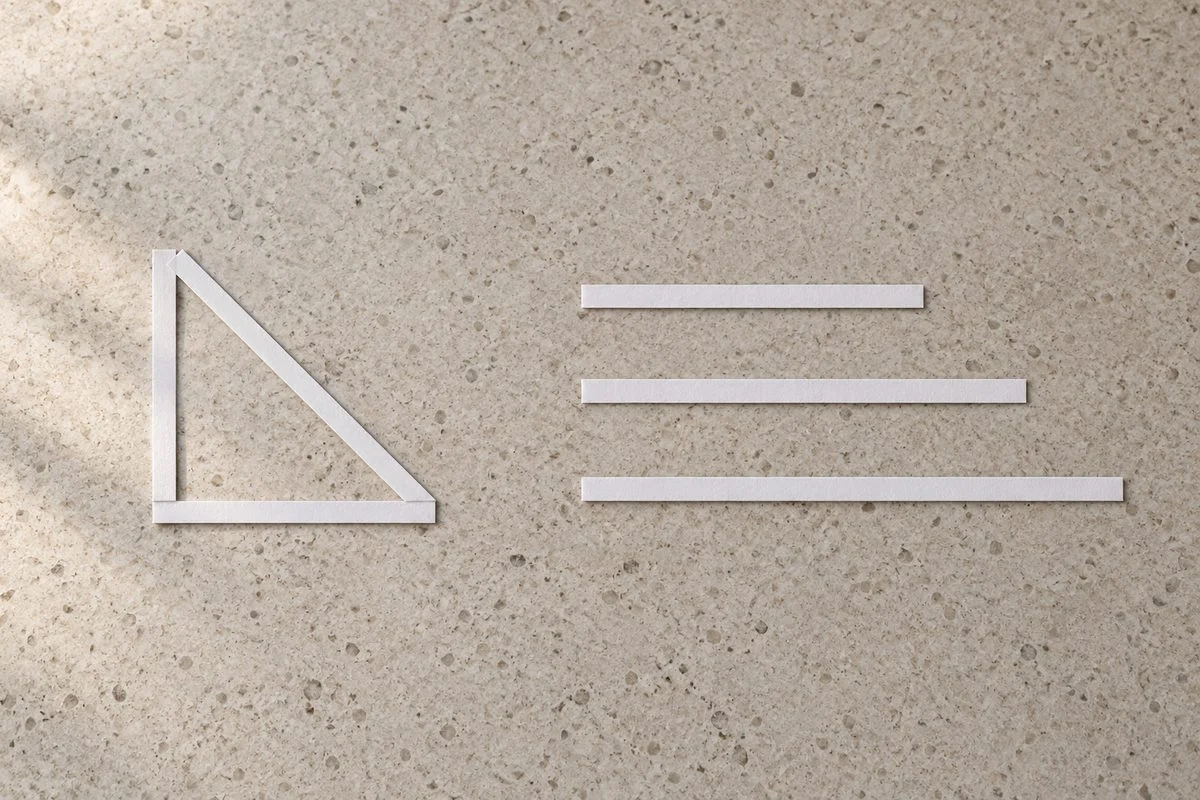
A small paper-strip triangle beside three separate strips twice as long.

2. Ratios with More Than Two Terms

Every length changes by the same factor, preserving shape.

Show
Arrange paper strips of 3, 4 and 5 cm into a triangle. Set out strips of 6, 8 and 10 cm. After predicting, join their ends into a triangle.
Ask
Will doubling every side change the triangle’s shape?
Say
Doubling every side enlarges the triangle while keeping its shape.
Used in
Enlarging a sewing pattern equally in every direction preserves its proportions.
If your child says…“The same side ratio means the triangles have the same size.”
Ask
How can the sizes match when the longest sides measure 5 cm and 10 cm?
What’s true
A valid side ratio fixes shape, while the chosen lengths determine size. Any two sides together must be longer than the third.

1+1+2=41+1+2=4

Each equal part measures 180∘÷4=45∘180^\circ\div4=45^\circ.

1×45∘=45∘1\times45^\circ=45^\circ — each smaller angle

3. Dividing in a Given Ratio

Ratio numbers count equal parts.

Show
Write these lines. Say, “The triangle’s angles share 180° in the ratio 1:1:2.” The last written line gives each smaller angle.
Ask
How large must the angle receiving two parts be?
Say
The remaining angle is 90° because it receives two 45° parts.
Used in
Ingredient ratios keep mixtures consistent.
If your child says…“There are three angles, so I divide the whole by three.”
Ask
Does the largest angle contain the same number of equal parts as a smaller angle?
What’s true
Add the ratio numbers because they count equal parts, not groups.
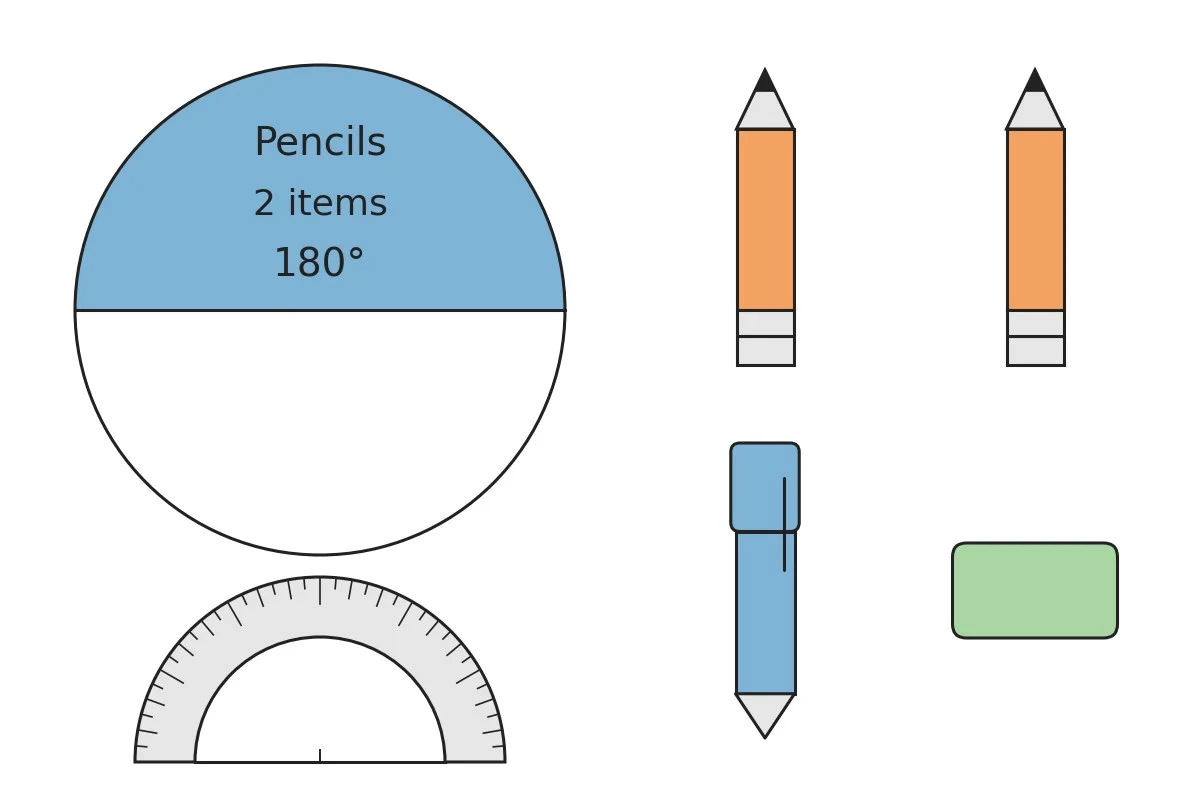
Stationery beside a circle with a labelled pencil semicircle, undivided lower half and protractor.

4. Pie Charts

Slices divide a complete circle according to each group’s share.

Show
Find the two pencils, pen and eraser in the diagram. Compare the pencils’ share with the semicircle labelled ‘Pencils’, ‘2 items’ and ‘180°’.
Ask
How large should the pen and eraser slices each be?
Say
Each remaining item gets 90°, or 25%, because four items share 360°.
Used in
Household spending charts show which expenses take the largest shares of a budget.
If your child says…“I measure every slice from the first line.”
Ask
Where would the next slice fit if you measured over the pencils’ slice again?
What’s true
Each new slice begins at the boundary where the previous slice ends.

Compare rates and time

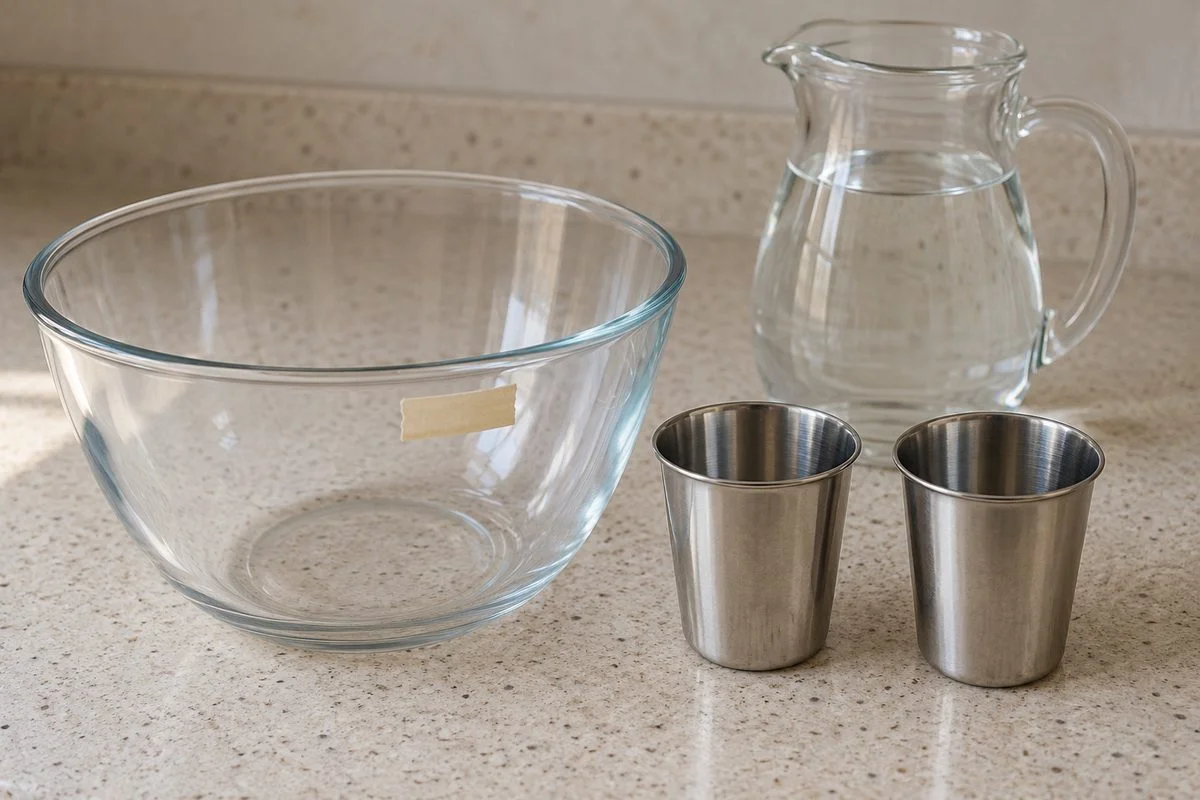
An empty marked bowl beside two equal cups and a water jug.

5. Time Taken Together

Combined filling rates add, reducing time for the same job.

Show
Mark a bowl’s six-cupful level, then empty it. Plan each ten-second interval: your child pours one cupful, you pour two. After predicting, fill together. Record rates 1, 2, 3 beside required intervals 6, 3, 2.
Ask
How many ten-second intervals will filling together take?
Say
Together you add three cupfuls per interval, so filling takes two intervals. Each rate multiplied by its filling time gives the same six cupfuls.
Used in
Adding steady tap flow rates helps estimate how quickly a shared tank fills.
If your child says…“Working together takes six plus three intervals.”
Ask
If three cupfuls arrive each interval, how could six cupfuls need nine intervals?
What’s true
The amounts added during each interval combine, so the separate filling times do not add.
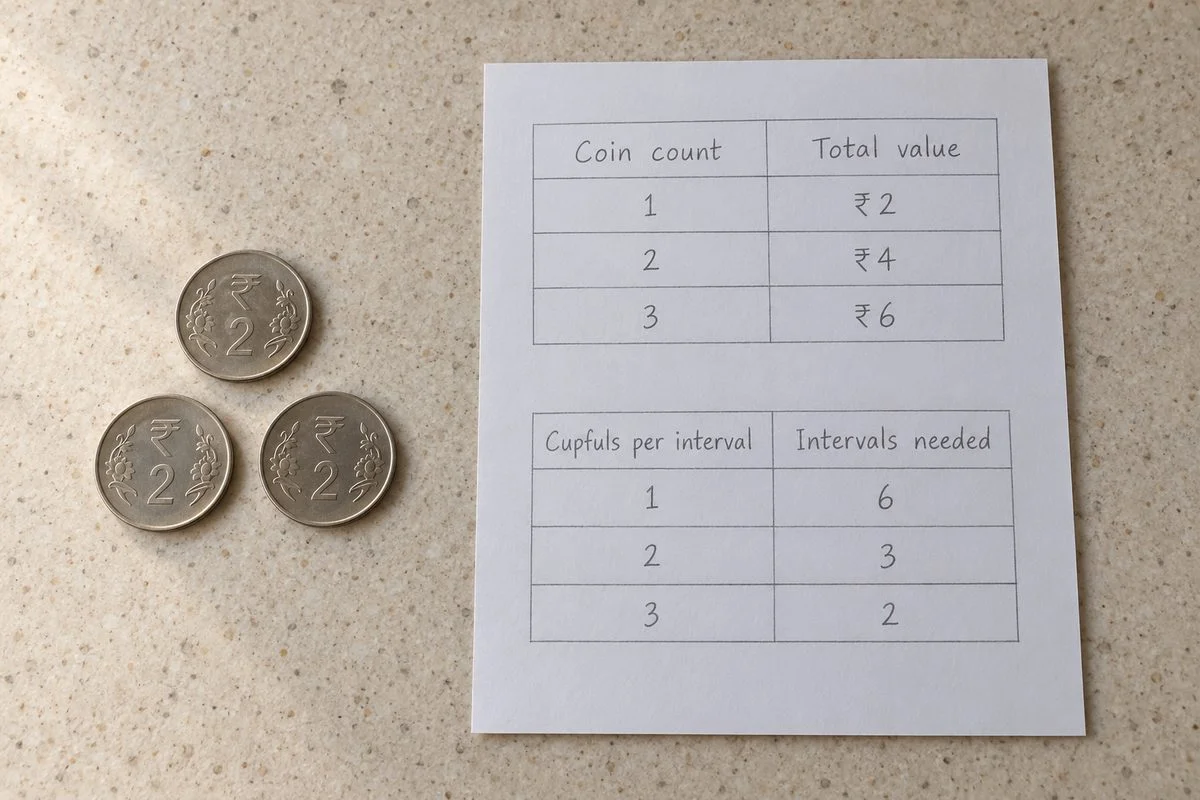
Three ₹2 coins beside count-and-value and filling-rate-and-time tables.

6. Direct and Inverse Proportion

Direct proportion preserves a quotient; inverse proportion preserves a product.

Show
Add three ₹2 coins one at a time. Record counts 1, 2, 3 beside values ₹2, ₹4, ₹6. Place this beside the filling table.
Ask
Which table will keep division unchanged, and which will keep multiplication unchanged?
Say
The coin table keeps value divided by count constant. The filling table keeps rate multiplied by time constant.
Used in
At a fixed price per item, direct proportion helps calculate the total cost.
If your child says…“Whenever one quantity increases, the other must decrease.”
Ask
Does adding another identical coin reduce the pile’s value?
What’s true
At a fixed value per coin, increasing the count increases the total value.

Use a fixed whole

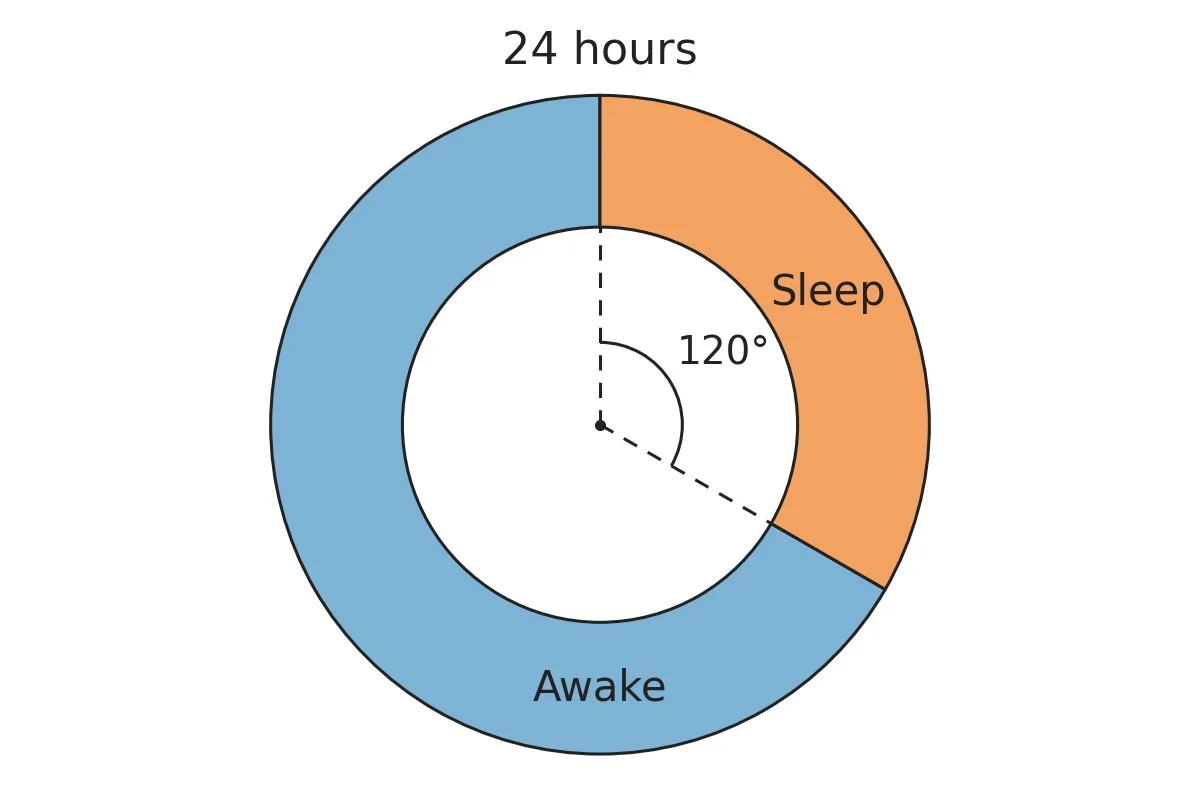
Ring chart showing a 120° Sleep band within a complete 24-hour day.

7. Ring Chart

A band’s angle gives its share of the day.

Show
Look at the diagram. Find the Sleep band and trace its boundaries to the centre. Read its 120° angle and the whole ring’s 24-hour label.
Ask
How many hours does this band represent?
Say
One-third of the full turn represents eight hours. The empty centre leaves this share unchanged.
Used in
Daily activity charts help compare time spent sleeping and awake.
If your child says…“I compare the sleeping angle with the largest band.”
Ask
Does the largest band contain the whole day, or only part of it?
What’s true
The complete turn represents the whole day, including every band.
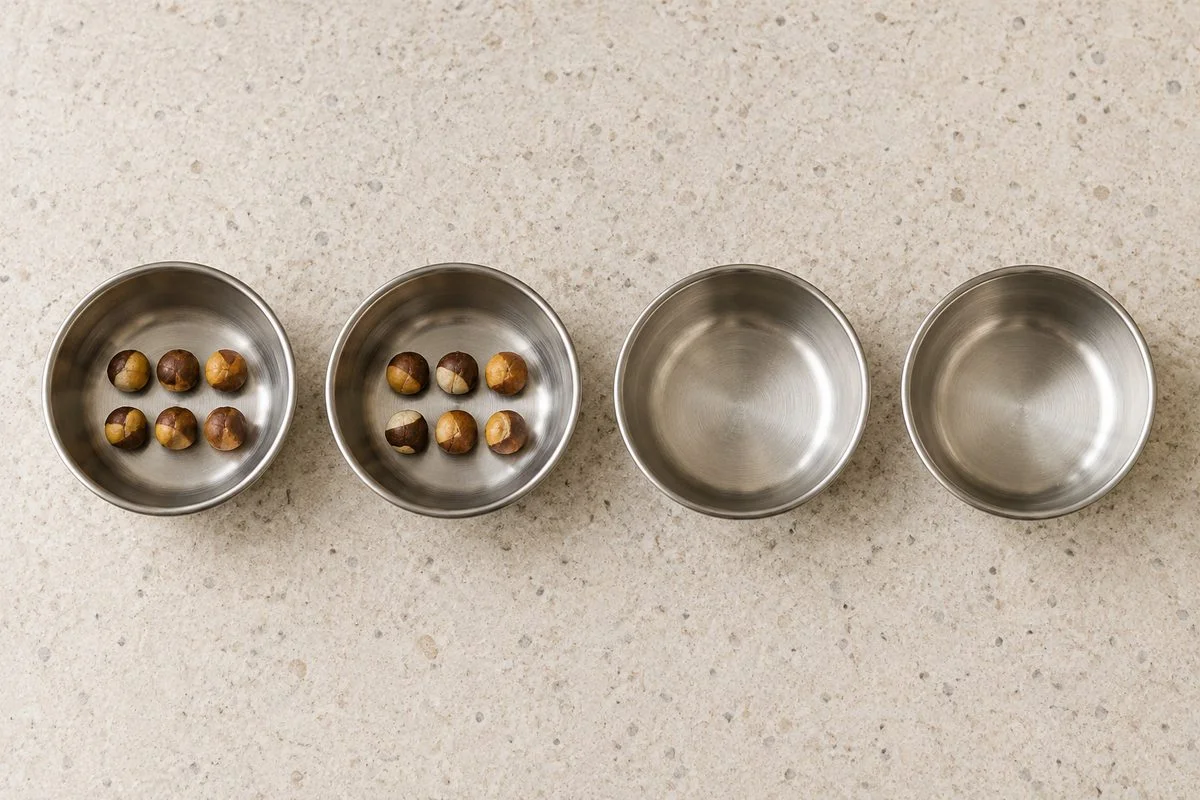
Two bowls containing six chana each beside two empty bowls.

8. Inverse Proportion

More equal portions mean smaller portions when the total stays fixed.

Show
Share 12 roasted chana equally between two bowls. Place two empty bowls beside them. After predicting, redistribute the same chana equally across all four bowls.
Ask
With twice as many bowls, how many chana will each receive?
Say
Each bowl gets three because the unchanged total now fills twice as many equal portions. Bowl count multiplied by chana per bowl stays twelve.
Used in
Sharing a fixed food supply equally helps plan portions for a larger group.
If your child says…“Twice as many bowls means twice as many chana in each.”
Ask
Where would the extra chana come from if both the bowls and their portions doubled?
What’s true
Doubling the number of equal portions halves each portion when the total stays fixed.

A real problem

A pie chart showed an empire’s geographical shares.

The earliest known pie chart is generally credited to William Playfair in 1801.

His chart showed the Turkish Empire’s geographical shares across Asia, Europe and Africa.

Pie charts make each part’s share of a fixed whole visible.

Gresham CollegeWikipedia

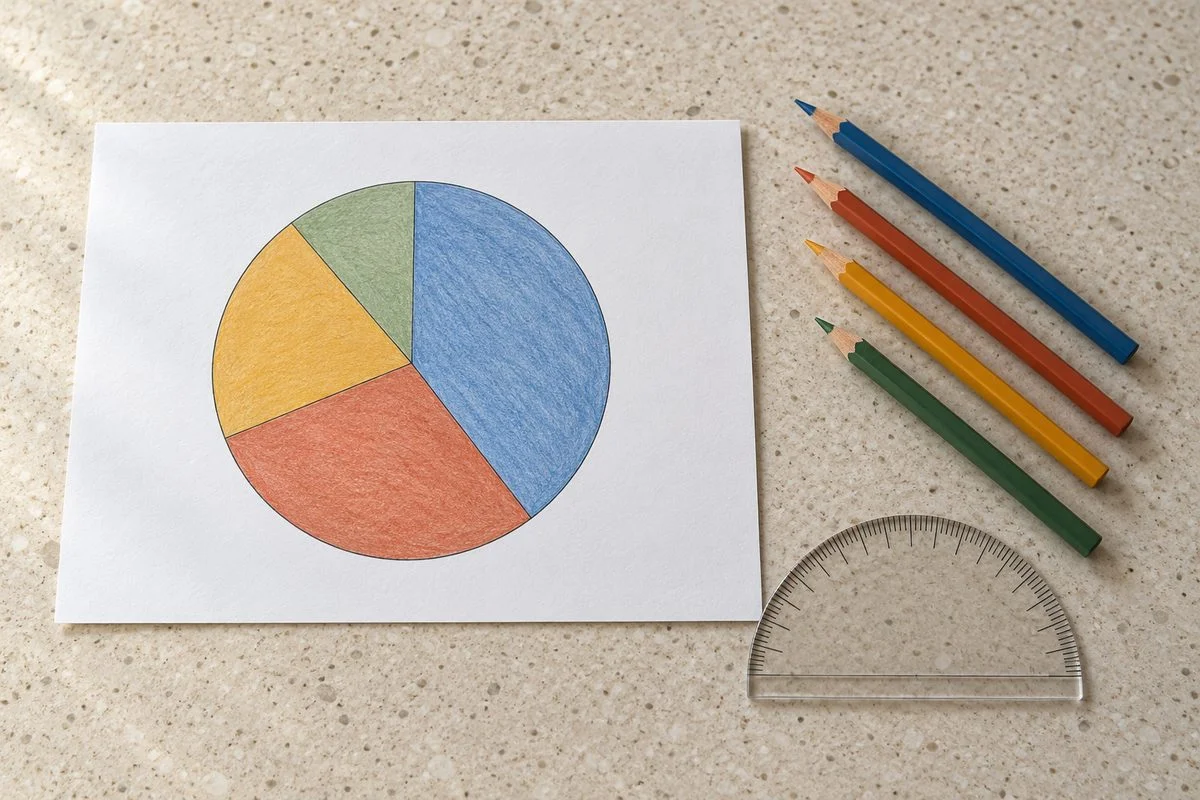
A coloured paper pie chart beside a protractor and coloured pencils.

Concept Lab · Common misconception

The tempting mistake in Proportional Reasoning-2

Open standalone misconception page →

Do more workers always take more time?

Wrong

If workers double, the time for a fixed task doubles.

Why it feels right. I expect both amounts to rise together.

Right

At the same rate per worker, more workers can finish a fixed task sooner.

Worked example

2 workers2 h
4 workers1 h
For the same 12-unit job, doubling the crew halves the time when workers can work in parallel.
  1. Two workers each finish three equal units per hour.
  2. A 12-unit job takes 2 hours.
  3. Four equally fast workers take 1 hour if they can work in parallel.

Ask your child eight quick questions.

One per step. The answer and the reason are given.

  1. Are 6:3 and 5:2 equal ratios?

    No. Their cross-products are 12 and 15, despite matching differences.

  2. When every side doubles, how do the triangle’s size and shape compare with the original?

    Size changes; shape stays. Every corresponding length changes by the same factor.

  3. The ratio is 1:1:2. What number divides the whole to find one ratio part?

    4. The ratio counts four equal parts across three groups.

  4. After the pen slice, which boundary marks zero when measuring the eraser’s angle?

    At the pen’s ending boundary. Consecutive slices sit beside each other without overlapping.

  5. Which stays unchanged across the filling table: rate plus time, or rate multiplied by time?

    Rate multiplied by time. Every pair describes filling the same six-cupful bowl.

  6. At the same filling rate, do more identical tanks take longer or less time?

    Longer. Each additional tank needs the same filling time.

  7. What angle represents the whole day when calculating a sleeping band’s share?

    360°. All the bands together complete a full turn.

  8. What happens to each portion when the bowl count doubles but the total stays fixed?

    Each portion halves. The same total must be shared among twice as many equal portions.

15 more questions with answers, 9 with pictures