Skip to content

Teach A Story of Numbers in eight steps.

For each idea: show it, ask before you tell, then say one line.

Gather six beans, plain and squared paper, a pencil, ₹10 note and ₹1 coin.

Common misconceptions & worked visual for this chapter · 15 practice questions with answers

How to teach it

Counting and landmark symbols

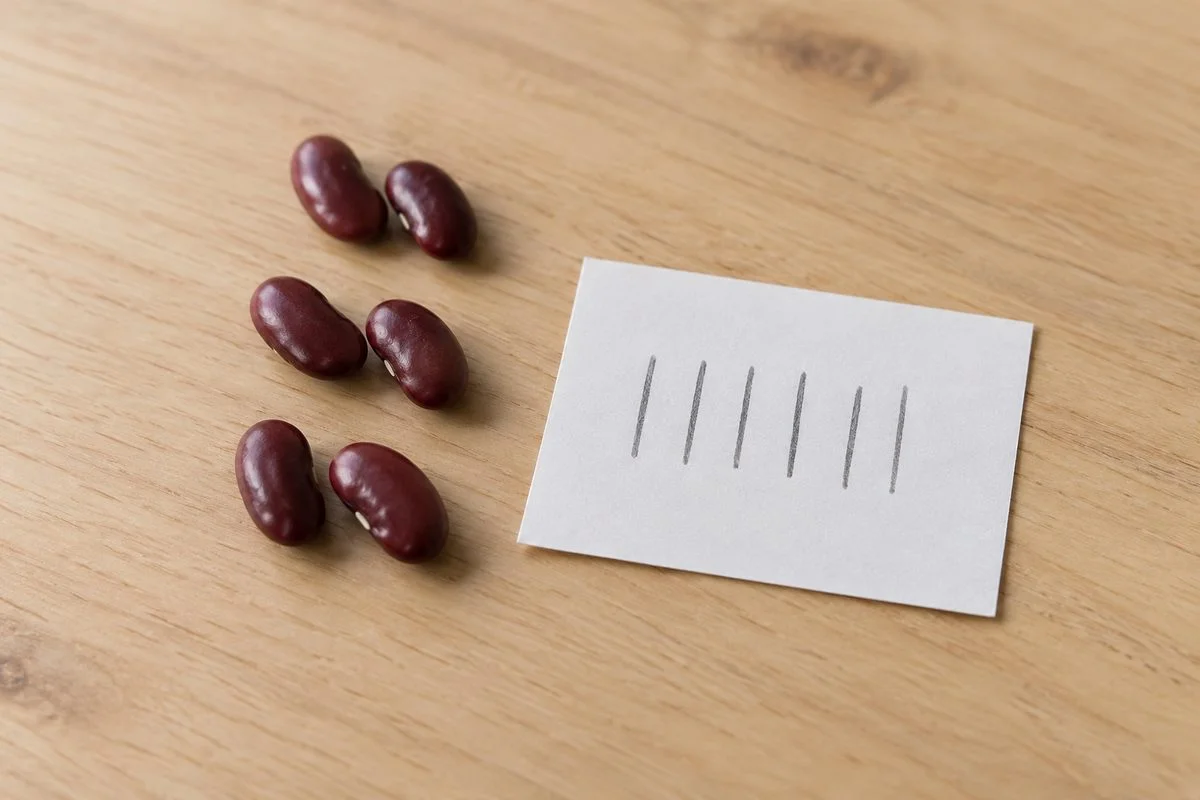
Three pairs of beans beside six pencil tally strokes.

1. Number Names Obtained by Counting in Twos

Repeated group names add their values.

Show
Count six beans into a row, making one tally each. Arrange them in pairs. Say, “Ukasar means two.”
Ask
What total will ukasar-ukasar-ukasar give?
Say
Three ukasars give six because we add each pair.
Used in
Counting socks in pairs makes checking a collection quicker.
If your child says…“Three ukasars mean two times two times two.”
Ask
How many beans do the three pairs contain altogether?
What’s true
Each repeated word adds another pair.
IX=X−I\mathrm{IX}=\mathrm{X}-\mathrm{I}

IX=10−1\mathrm{IX}=10-1

2. The Roman Numerals

Symbols carry fixed values; their order can signal subtraction.

Show
Write I 1, V 5, X 10 and L 50. Add C 100, D 500 and M 1000. Say, “In IX, take one away from ten.” Write these lines.
Ask
What number should the next line give?
Say
IX means nine.
Used in
Roman chapter numbers help readers find sections in books.
If your child says…“I always add every Roman symbol.”
Ask
Does IX place the one before the ten or after it?
What’s true
In IX, I before X signals subtraction.

VII+III=V+(II+III)\mathrm{VII}+\mathrm{III}=\mathrm{V}+(\mathrm{II}+\mathrm{III})

VII+III=V+V\mathrm{VII}+\mathrm{III}=\mathrm{V}+\mathrm{V}

3. Arithmetic Operations with Roman Numerals

Roman symbols need different numbers of copies to reach larger symbols.

Show
Say, “Collect the five ones and exchange them for V, leaving two Vs.” Write these lines.
Ask
Which single symbol will replace these two Vs?
Say
Write X: five ones made V, but only two Vs make X.
Used in
Decimal arithmetic uses regular exchanges, making bill totals easier to calculate.
If your child says…“Every Roman exchange needs ten copies.”
Ask
Did both exchanges in these lines need the same number of copies?
What’s true
The exchange size changes between Roman landmarks.

∩ ∣ ∣=10+1+1\cap\,|\,|=10+1+1

∩ ∣ ∣=10+2\cap\,|\,|=10+2

4. The Egyptian Number System

Symbol shapes carry powers of ten; positions do not.

Show
Draw a stroke for one, an arch for ten, and a coil for one hundred. Say, “Each shape keeps its value wherever it stands.” Write these lines.
Ask
What total should we write next?
Say
The marks total twelve because we add their fixed values.
Used in
Currency denominations can be totalled in any order without changing the amount.
If your child says…“Moving an Egyptian symbol changes its value.”
Ask
Would moving the arch change what its shape means?
What’s true
Its shape determines its value, regardless of position.

Bases and place value

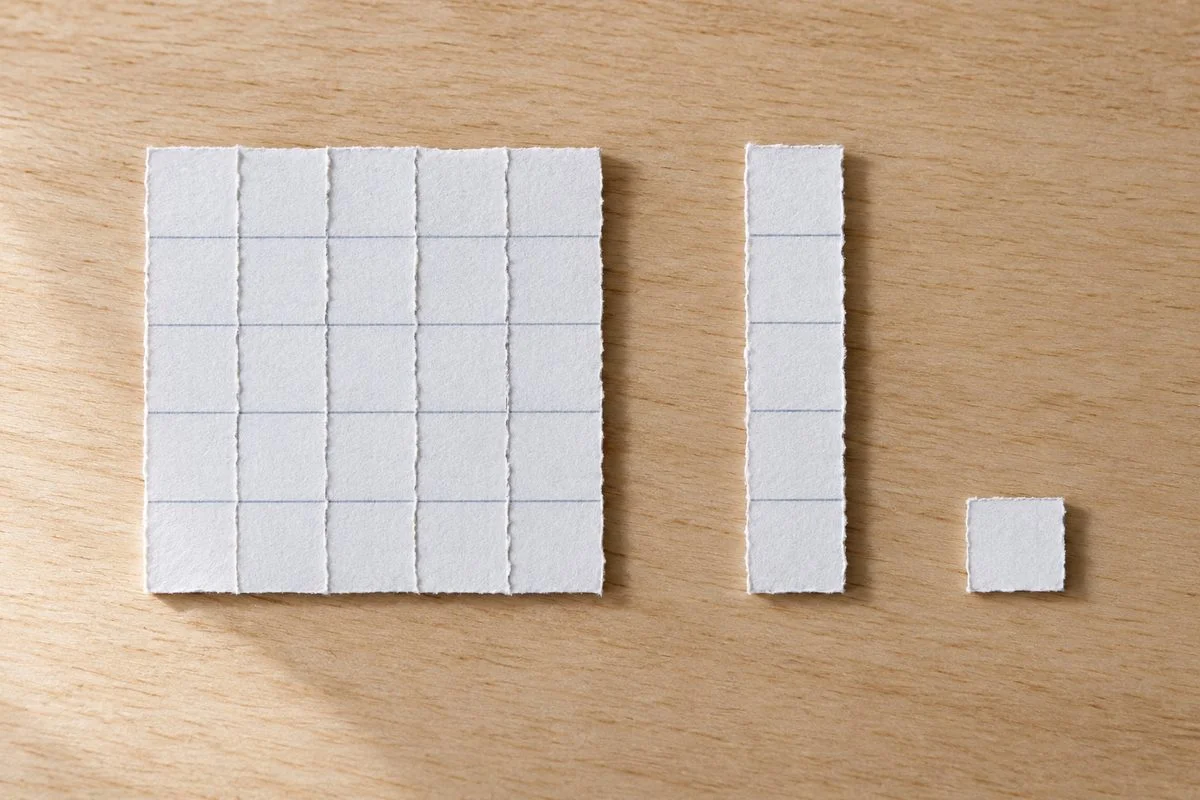
Paper square made from five strips, beside one strip and one square.

5. The Idea of a Base

Base landmarks start at one and grow by the same multiplier.

Show
Fold and tear six five-square strips and one single square from squared paper. Join five strips into a square. Keep the remaining strip and square separate.
Ask
What digits will record the twenty-fives, fives and ones, starting with the largest group?
Say
One group of each size gives 111 in base five.
Used in
Bundling stock into successively larger groups makes large inventories easier to count.
If your child says…“Base five lets me write the digit 5.”
Ask
What larger group do five five-square strips make?
What’s true
Five groups must exchange for the next size, leaving each digit below five.

N=1×60+(10+1)×1N=1\times60+(10+1)\times1

N=60+11N=60+11

6. The Mesopotamian Number System

From right to left, places are worth 1, 60 and 3600.

Show
Label places 60s and 1s. Draw a wedge left, then a chevron and wedge together right. Say, “N is the total; chevrons mean ten and wedges one within each group.” Write these lines.
Ask
What total comes next?
Say
The total is seventy-one.
Used in
Clocks group seconds into minutes, keeping time displays compact.
If your child says…“I just add the two groups.”
Ask
What does the 60s heading make the left wedge worth?
What’s true
The left group counts sixties when the right group counts ones.
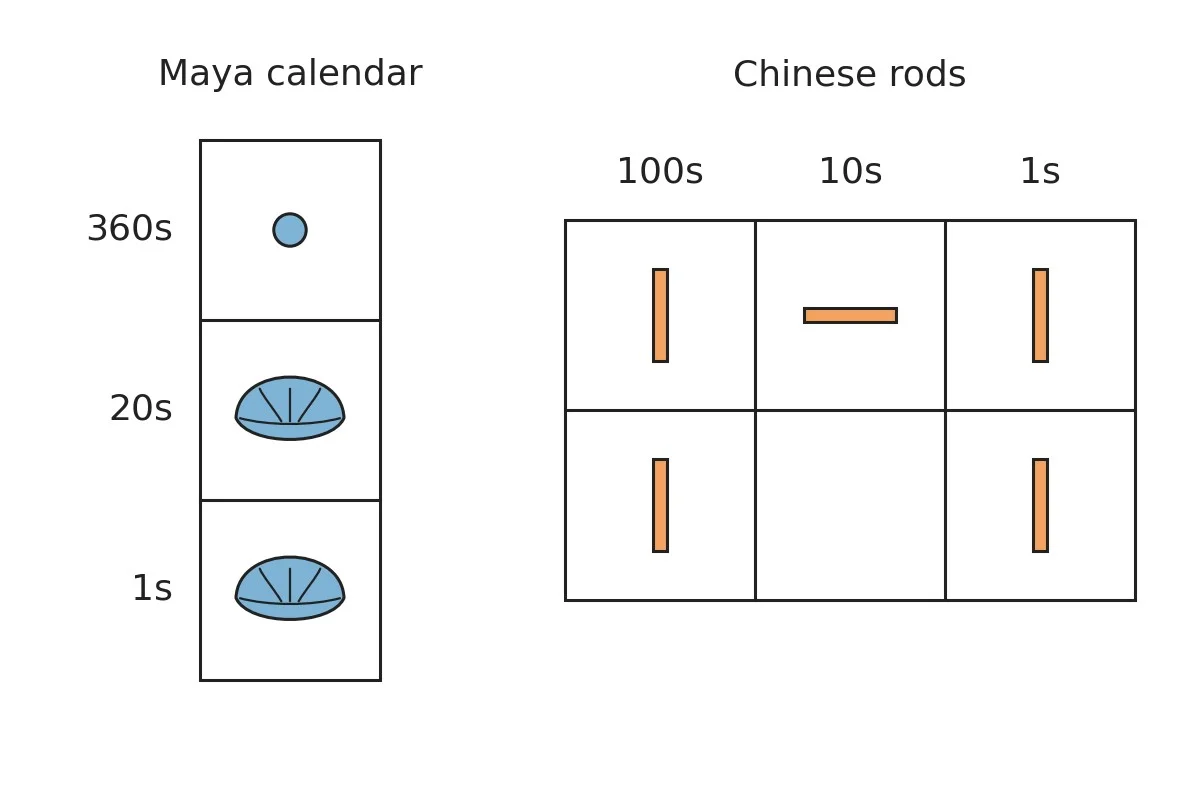
Labelled Maya calendar stack beside Chinese rod rows showing an empty tens place.

7. The Mayan Number System and the Chinese Number System

Maya place multipliers change. Chinese rods leave empty places blank.

Show
Read Maya places upwards and Chinese places leftwards in the diagram.
Ask
What does the lower Chinese row mean with no tens?
Say
It means 101: the blank holds the tens place.
Used in
Chinese rod directions separate places, making records easier to read.
If your child says…“The third Maya place must be four hundred.”
Ask
Does multiplying twenty by twenty reach the top row's value?
What’s true
These Maya calendar places reach 360 by multiplying twenty by eighteen.

What zero does

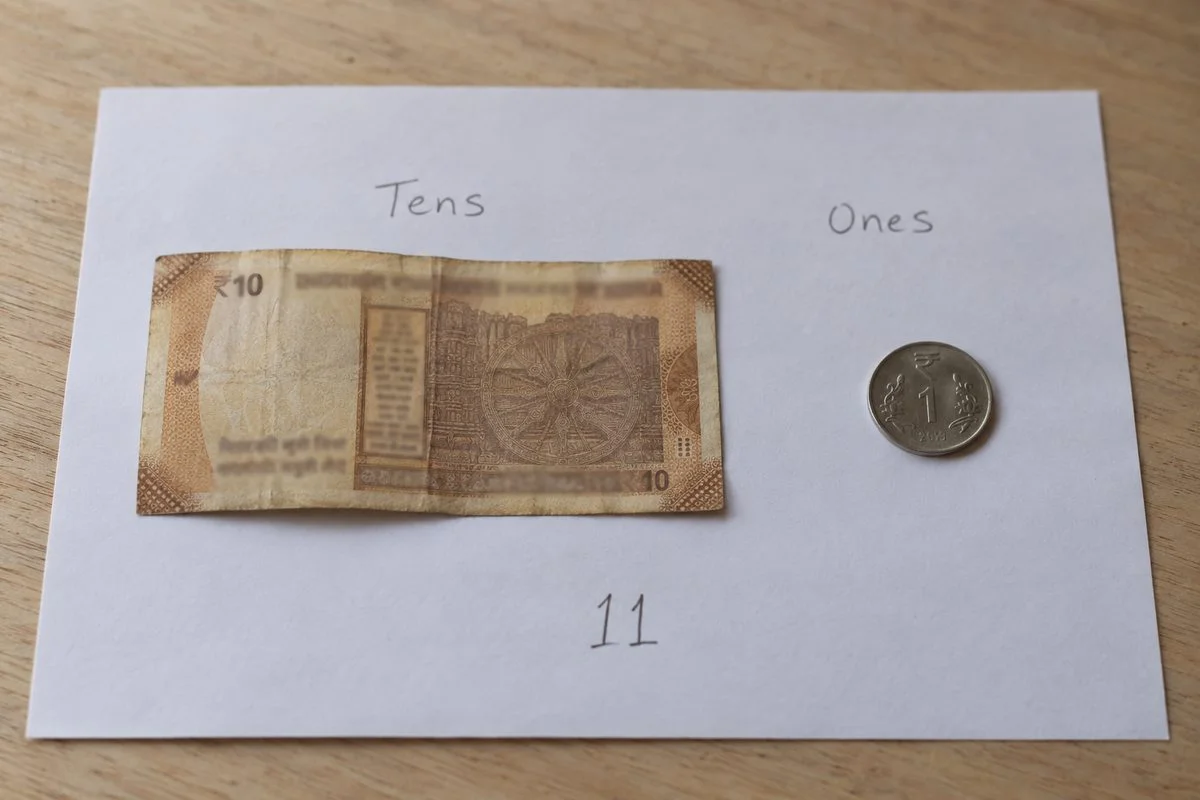
₹10 note left of a ₹1 coin on plain paper.

8. Zero

Zero holds an empty place and names an empty amount.

Show
Place a ₹10 note and ₹1 coin on paper. Label their places Tens and Ones; record 11. After the prediction, remove the coin, then the note, recording each amount.
Ask
What will we write after each removal?
Say
Write 10, then 0: zero marks no ones first, then no money remaining.
Used in
Zero in an account balance records that no money remains.
If your child says…“I can leave an empty place out.”
Ask
After removing the coin, would writing just 1 show the note's value?
What’s true
Leaving out an empty place moves digits to its left into lower places.

A real problem

Binary arithmetic helped a machine solve equations.

The Atanasoff–Berry Computer was completed at Iowa State University in 1942.

It was built to solve equations but was not programmable.

Its innovations included electronic computation and binary arithmetic.

Iowa State University LibraryComputer History MuseumWikipedia

Unbranded desktop computer beside a closed notebook.

Concept Lab · Common misconception

The tempting mistake in A Story of Numbers

Open standalone misconception page →

Does an extra digit always make a number larger?

Wrong

IX is larger than X because IX has two symbols.

Why it feels right. In our usual whole-number notation, more digits mean a larger number when there are no leading zeros.

Right

Roman numerals use a different rule. I before X subtracts one.

Worked example

On the number line, IX is before X and XI is after X.
  1. X is ten.
  2. IX is ten minus one, which is nine.
  3. XI is ten plus one, which is eleven.
  4. The position of I changes its effect.

Ask your child eight quick questions.

One per step. The answer and the reason are given.

  1. Does repeating ukasar add another two or multiply the running total by two?

    Add another two. Each word contributes another pair to the collection.

  2. What does XL mean when X before L signals subtraction?

    40. Take ten away from fifty.

  3. How many Vs combine to make X?

    Two. Each V contributes five, so two make ten.

  4. What total would the same arch and strokes give in reverse order?

    Twelve. Reordering these fixed values leaves their sum unchanged.

  5. What replaces five groups in the fives place?

    One twenty-five. Five fives fill the next place, leaving none in the fives place.

  6. What are groups 10 and 40 worth in the 60s and 1s places?

    640. Ten sixties contribute six hundred, then forty ones complete the total.

  7. What value does the dot in the top Maya row carry?

    360. This calendar system's third place is eighteen twenties, rather than twenty twenties.

  8. What amount remains after removing only the ₹1 coin?

    10 rupees. The zero preserves the empty ones place while the note supplies one ten.

15 more questions with answers