Skip to content

Teach Proportional Reasoning in eight steps.

For each idea: show it, ask before you tell, then say one line.

Gather rectangular paper, a pencil, ruler, chickpeas, rajma, cool milk, water, spoon, cups, raisins and a plate.

Common misconceptions & worked visual for this chapter · 15 practice questions with answers

How to teach it

Recognising equal ratios

Flat and folded rectangular sheets with matching lower-left corners, beside a ruler.

1. Observing Similarity in Change

Multiplying width and height by the same factor preserves shape.

Show
Take identical rectangular sheets. Fold one to halve its width, then its height. Align their lower-left corners. After prediction, measure both.
Ask
Will both measurements have changed by the same factor?
Say
Both measurements halve, so the folded rectangle keeps the original shape.
Used in
Enlarging photographs proportionally keeps familiar objects from looking stretched.
If your child says…“A bigger rectangle must have a different shape.”
Ask
What happened to each measurement when you folded the sheet?
What’s true
Rectangles can differ in size while their width-to-height ratios match.
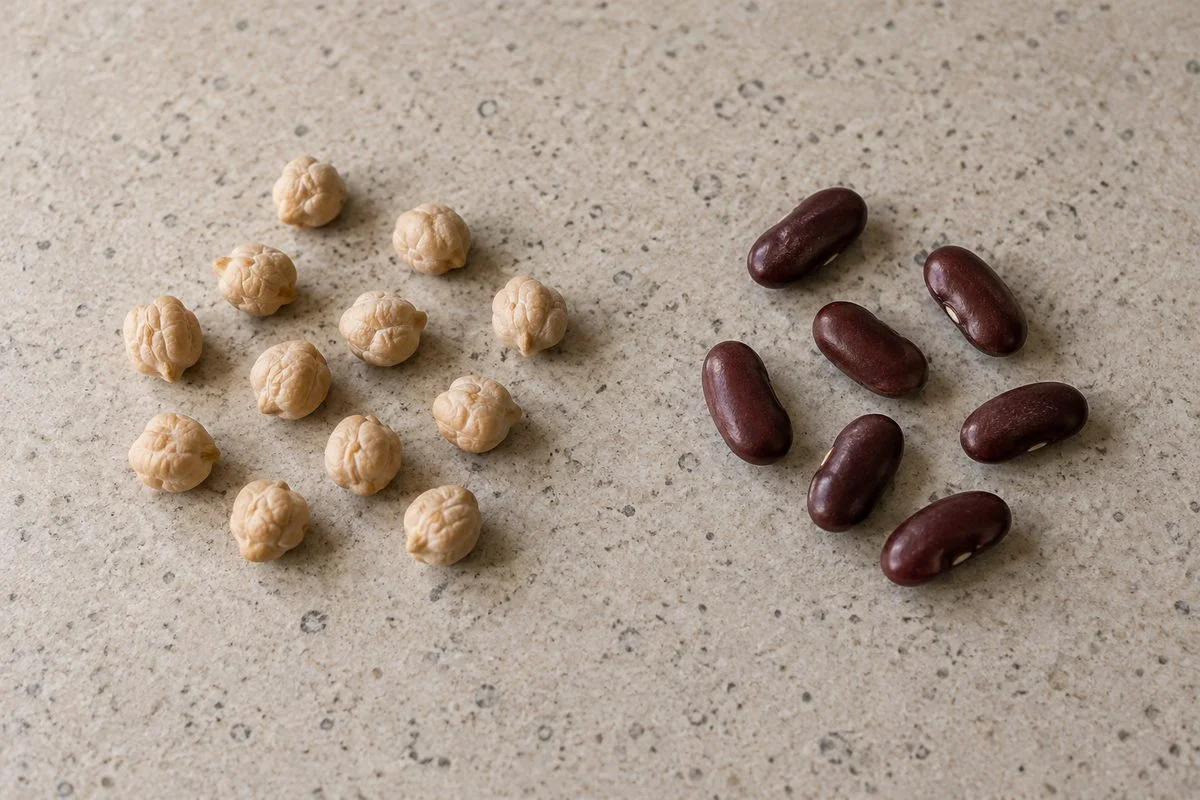
Separate clusters of chickpeas and rajma beans before grouping.

2. Ratios and Ratios in their Simplest Form

Keep quantities in order; simplify both using their greatest shared factor.

Show
Count 12 chickpeas and 8 rajma beans. Record chickpeas to rajma as 12 to 8. After prediction, arrange identical groups using every bean.
Ask
What is the greatest number of identical groups we can make?
Say
We can make 4 identical groups. Divide both counts by 4 to get 3 to 2.
Used in
Ingredient ratios help cooks keep batches consistent.
If your child says…“Swapping the numbers means the same thing.”
Ask
Which bean belongs first when we say rajma to chickpeas?
What’s true
The first number belongs to the quantity named first.

Two thirds becomes twelve eighteenths.

Four sixths also becomes twelve eighteenths.

23=46\frac{2}{3}=\frac{4}{6}

3. Proportional Ratios

Equal ratios have matching simplest forms and equal cross-products.

Show
Write these lines. Say, “Compare two thirds with four sixths by making both denominators eighteen.”
Ask
Will these ratios match when you finish multiplying?
Say
Both become twelve eighteenths, so the ratios match.
Used in
Comparing proportions helps match a replacement tile’s shape to an existing tile.
If your child says…“Both numbers grew, so the ratios must match.”
Ask
What multiplier changed each term from 2 to 3 into 4 to 6?
What’s true
Both terms must grow by one shared multiplier.
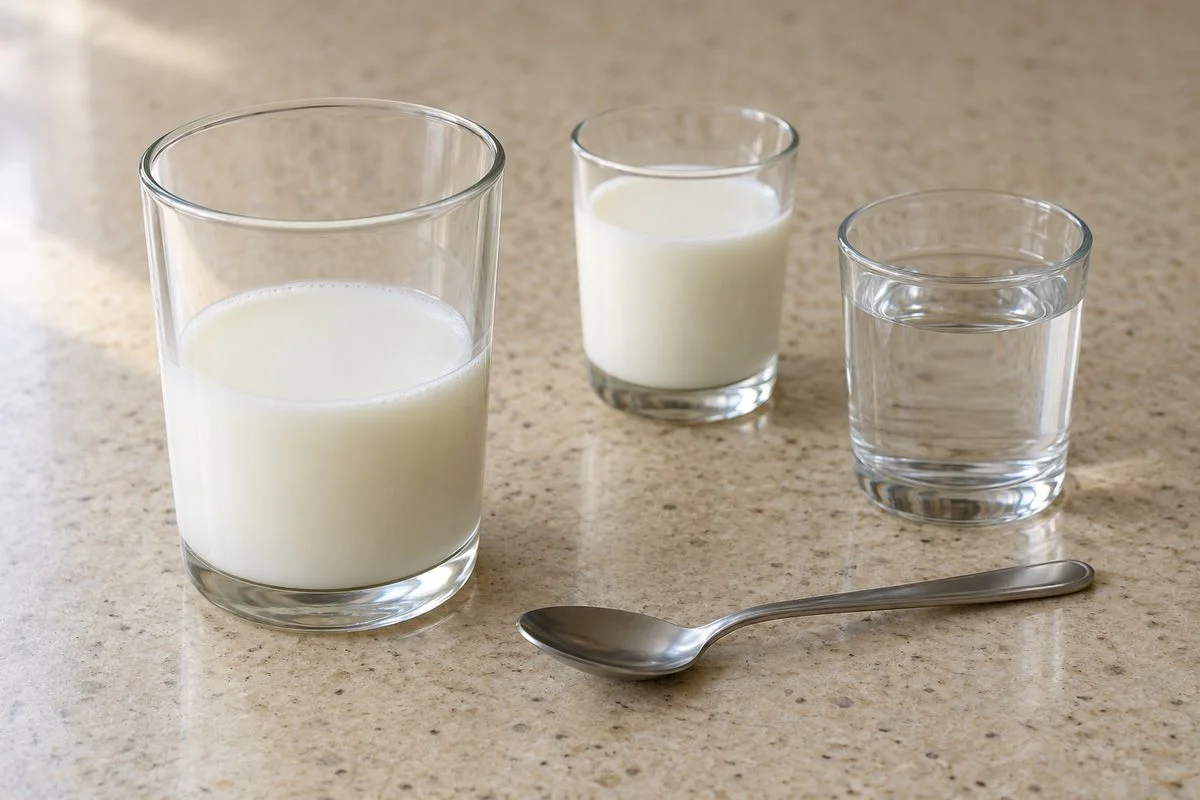
Diluted milk beside a spoon and separate cups of milk and water.

4. Problem Solving with Proportional Reasoning

Equal additions change a ratio between unequal amounts.

Show
Mix one spoonful of cool milk with two spoonfuls of water. Record the amounts. After prediction, add one spoonful of each and update the record.
Ask
Will adding one spoonful of each keep the milk-to-water ratio unchanged?
Say
The amounts become 2 spoonfuls of milk and 3 of water. Equal additions changed this ratio.
Used in
Paint mixtures keep their colour when added colours follow the original ratio.
If your child says…“Adding the same amount keeps the ratio.”
Ask
Milk doubled, but did water double?
What’s true
Equal additions affect unequal starting amounts by different factors.

Using proportions

2:3=4:x2:3=4:x

x=3×(4÷2)x=3\times(4\div2)

5. Finding Missing Terms in Proportional Ratios

Use the matching terms’ multiplier to find the missing amount.

Show
Write these lines. Say, “The missing number is x. Four is twice two.”
Ask
If two becomes four, what do you predict three must become?
Say
Double three too, giving six.
Used in
Fabric sellers use a fixed price per metre to calculate different lengths’ costs.
If your child says…“I can double the first number and leave the other alone.”
Ask
Two doubles to four. What must happen to three to keep the ratio unchanged?
What’s true
Changing only one term changes the ratio.

One kilogram is 1,000 grams.

x=20×1000÷500x=20\times1000\div500

6. Comparing Prices Using Proportional Reasoning

Match units, then compare costs for equal quantities.

Show
Write these lines for rice offers: 500 g for ₹20 and 1 kg for ₹45. Say, “Here, x means the first offer’s price in rupees for one kilogram.”
Ask
What do you predict one kilogram of rice costs using the smaller packets?
Say
The first offer costs ₹40 per kilogram. That is cheaper than ₹45 for the same amount.
Used in
Comparing detergent prices for equal weights helps shoppers spend less.
If your child says…“The bigger packet must be better value.”
Ask
What would one kilogram cost using the smaller packets?
What’s true
Packet size alone cannot tell us the cost of an equal amount.
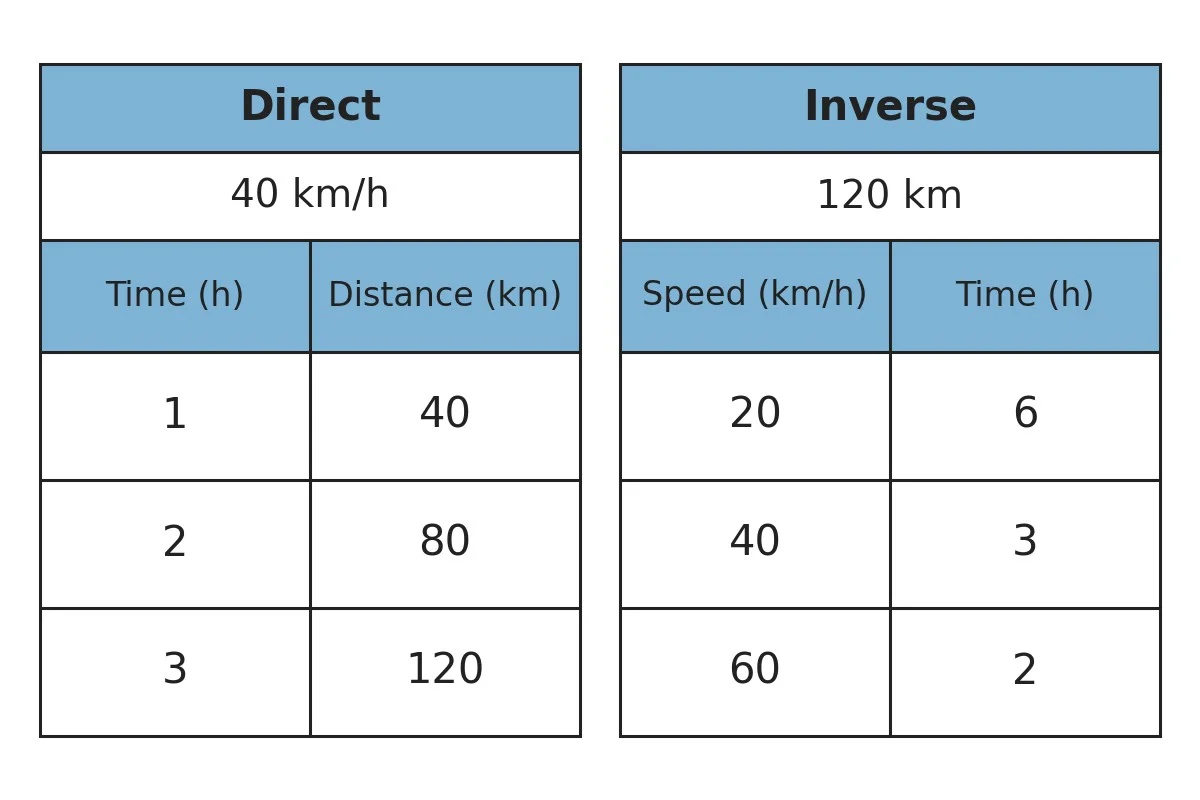
Journey tables compare distance at fixed speed and travel time for fixed distance.

7. Direct and Inverse Proportion

Direct proportion keeps the quotient fixed; inverse proportion keeps the product fixed.

Show
Look at the diagram. Compare fixed speed and fixed distance. Cover both middle rows.
Ask
What happens to each second quantity when the first doubles?
Say
At fixed speed, doubling time doubles distance. For fixed distance, doubling speed halves time.
Used in
For a fixed trip, constant speed determines travel time, helping plan arrival.
If your child says…“If the speed doubles, the travel time doubles too.”
Ask
Would travelling faster make the same trip take longer?
What’s true
For a fixed distance, doubling speed halves travel time.
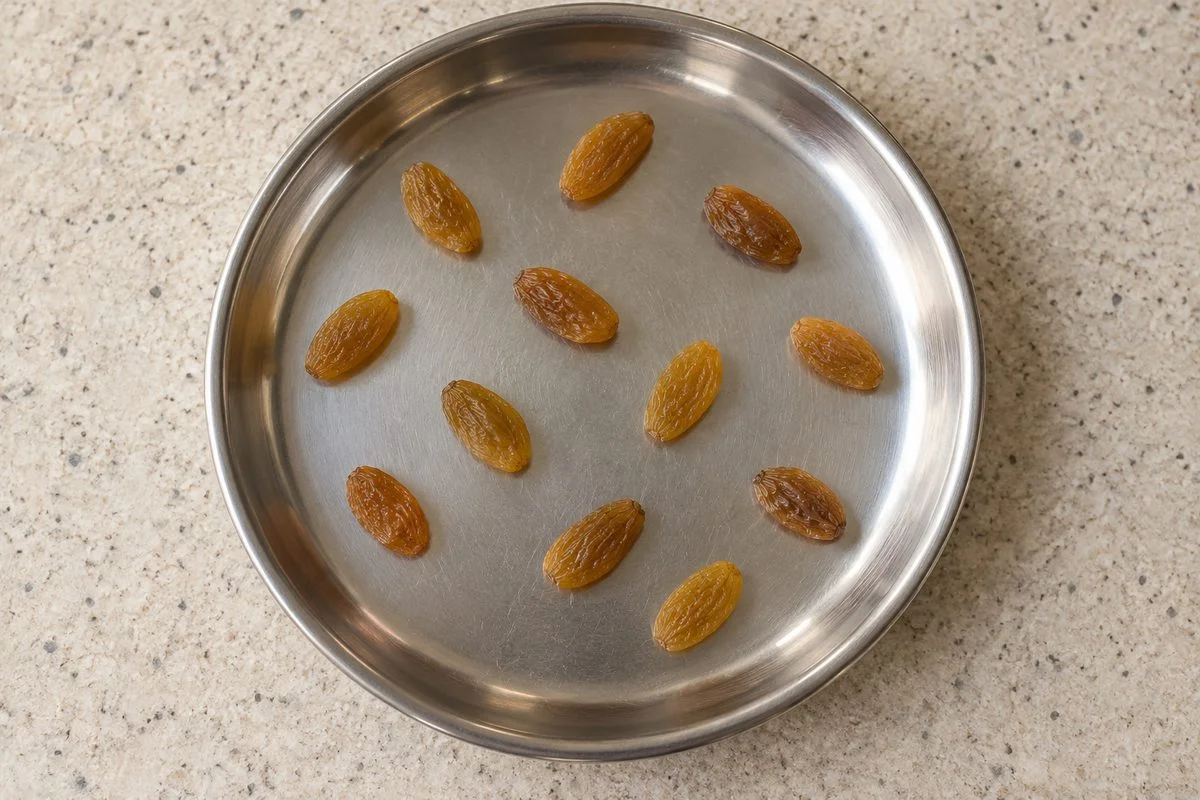
Twelve loose raisins on a steel plate before sharing.

8. Sharing, but Not Equally!

Ratio numbers count equal parts, not individual objects.

Show
Set out 12 raisins on a plate. After prediction, make four equal piles. Give your child three piles and keep one.
Ask
How many raisins will you get with three parts for you and one for me?
Say
Each part holds 3 raisins, giving you 9 and me 3.
Used in
Partners use agreed ratios to divide a business’s profit.
If your child says…“Three to one means three raisins for me and one for you.”
Ask
How many raisins would your plan leave on the plate?
What’s true
The ratio counts parts, and all the raisins must be shared.

A real problem

A pantograph copies drawings at different sizes.

Christoph Scheiner invented his pantograph in 1603.

It copied diagrams at larger or smaller sizes.

Adjusting its hinge positions changed the copying scale.

It helped reproduce artwork, architectural drawings and maps.

Ingolstadt City MuseumUniversity of St AndrewsMuseo Galileo

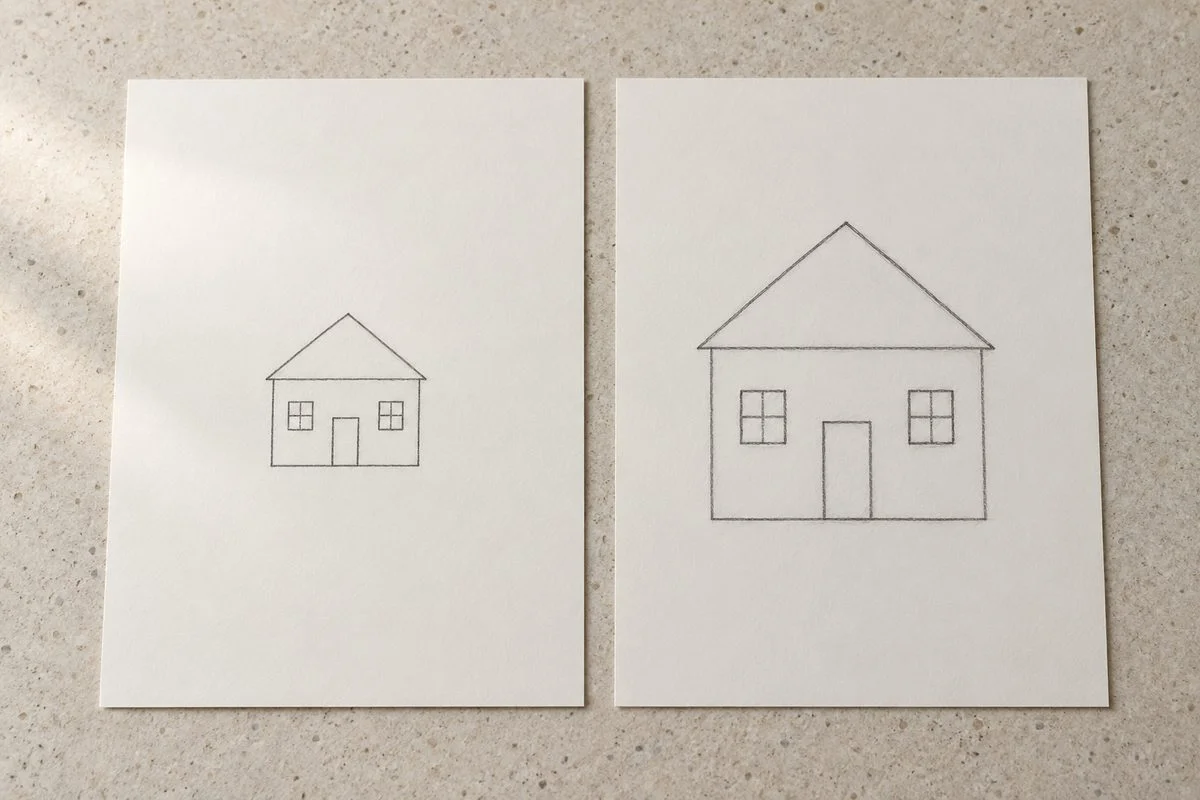
A pencil sketch beside a proportionally enlarged copy on a drawing desk.

Concept Lab · Common misconception

The tempting mistake in Proportional Reasoning

Open standalone misconception page →

Does adding the same amount preserve a recipe?

Wrong

A 2:3 syrup-to-water ratio stays the same at 3:4.

Why it feels right. Both quantities increased by 1.

Right

Scale both quantities by the same factor to keep the ratio.

Worked example

Original · 2:3
SS
WWW
Two batches · 4:6
SSSS
WWWWWW
Changed · 3:4
SSS
WWWW
Repeating the whole recipe gives four syrup and six water. Adding one to each does not repeat the recipe.
  1. Two batches of 2 cups syrup and 3 cups water make 4:6.
  2. The mixture 3:4 has a greater share of syrup.

Ask your child eight quick questions.

One per step. The answer and the reason are given.

  1. A picture’s width halves but its height stays unchanged. What happens to its shape?

    It becomes narrower. Only the width changed, so the width-to-height ratio changed.

  2. What is the simplest ratio of rajma to chickpeas in this collection?

    2 to 3. Rajma comes first, and both counts divide by four.

  3. Are 8 to 3 and 24 to 6 proportional?

    No. One term triples while the other doubles.

  4. With 2 spoonfuls of milk, how many spoonfuls of water altogether keep the original ratio?

    4 spoonfuls. Doubling the milk requires doubling the water too.

  5. Six is to ten as eighteen is to what number?

    30. Both terms must triple to keep their ratio.

  6. Which rice offer gives more rice for the same money?

    The 500 g offer. Its price per kilogram is lower.

  7. For the fixed trip, how does travel time change when speed doubles?

    It halves. Speed multiplied by time must still equal the same distance.

  8. When sharing all 12 raisins in the ratio 3 to 1, what does 3 count?

    Equal parts. Each part contains three raisins, so three parts contain nine.

15 more questions with answers, 2 with pictures