Skip to content

Teach Exploring Some Geometric Themes in eight steps.

For each idea: show it, ask before you tell, then say one line.

Gather paper, pencil, scissors, ruler, container, carton, five equal cubes, prepared nets, triangular prism, triangular pyramid, and releasable-seam cylinder sleeve and cone.

An adult handles scissors and prepares all cut paper pieces.

Common misconceptions & worked visual for this chapter · 15 practice questions with answers

How to teach it

Patterns and solids

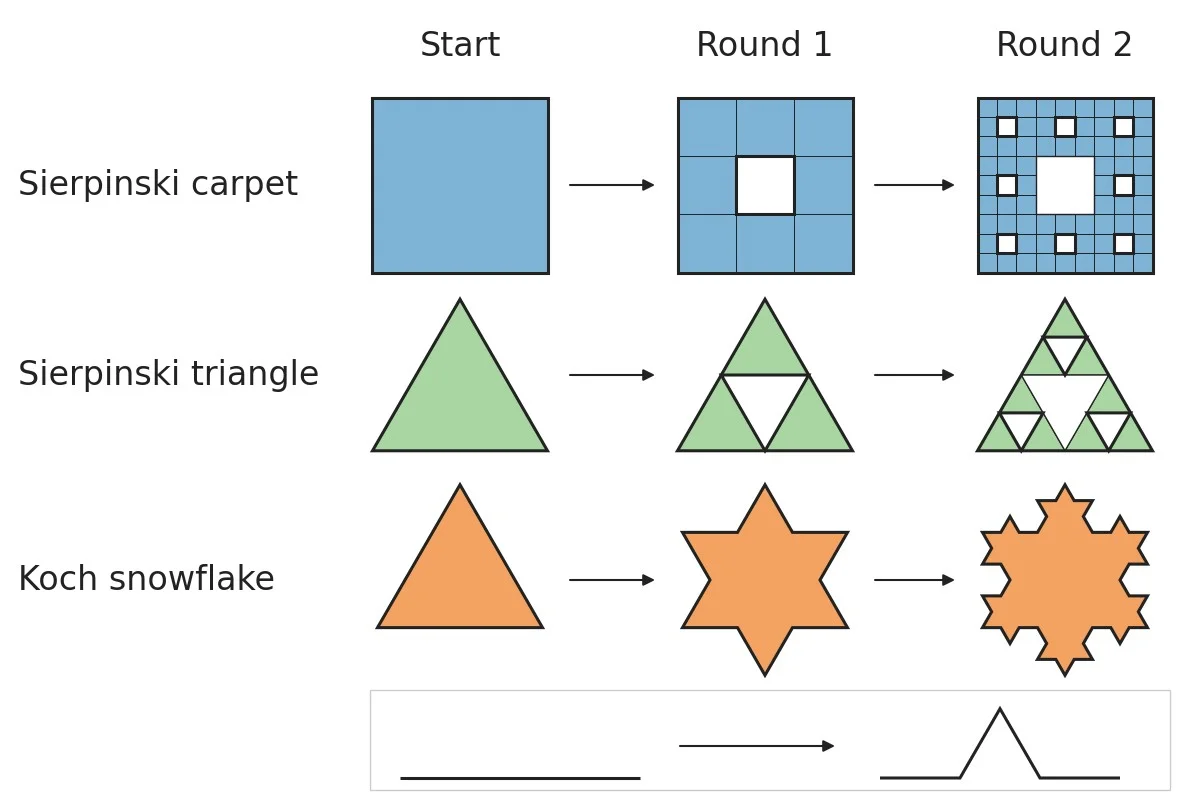
Successive carpet, triangle and snowflake stages show smaller repeated patterns and persistent holes.

1. Fractals

Similar shapes repeat at smaller sizes.

Show
Follow the diagram’s rows, then the snowflake inset.
Ask
How will repeating these rules add detail?
Say
Smaller copies keep earlier holes.
Used in
Some fabric designs repeat similar shapes at smaller sizes for finer detail.
If your child says…“Only the holes from the latest cutting count.”
Ask
Where did the first central hole go?
What’s true
Earlier holes remain when smaller holes are added.
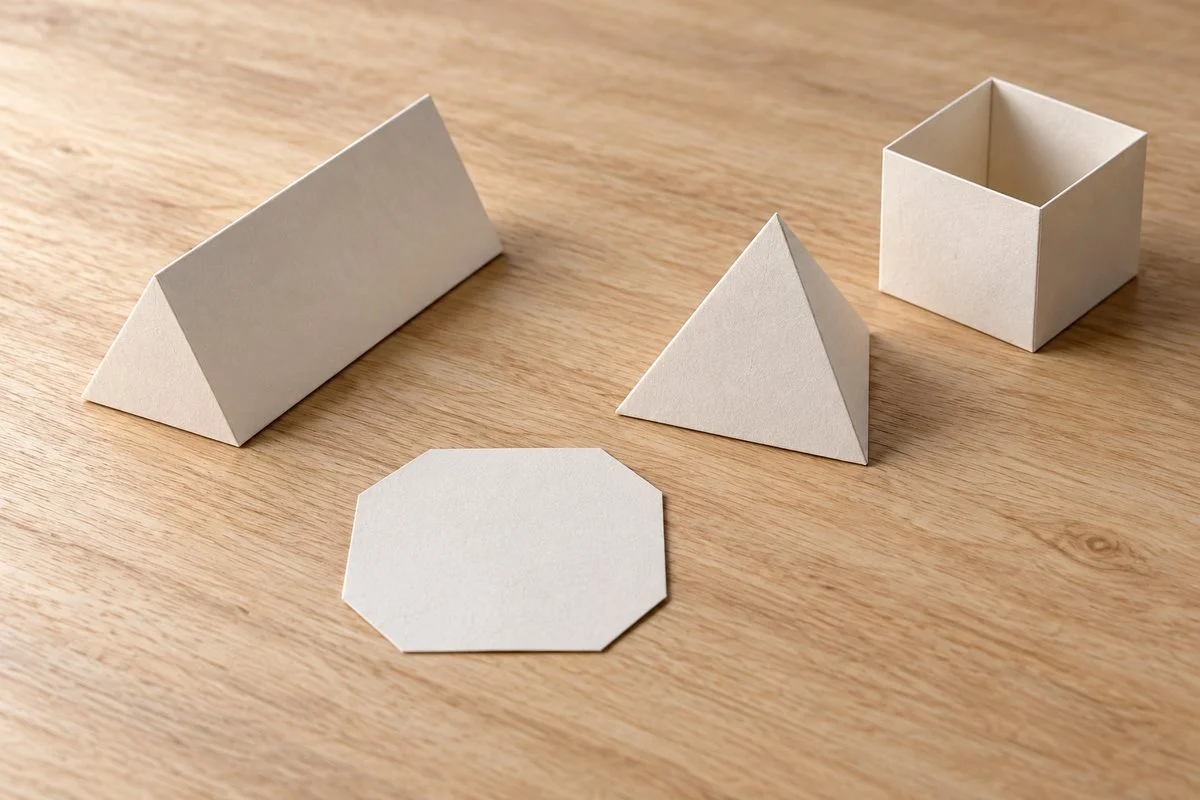
Paper prism and pyramid beside a trimmed square and container.

2. Visualising Solids

Surfaces, edges and corners help us recognise solids.

Show
An adult trims a paper square’s corners. Trace its boundary. View a container from above and beside it. Handle the prepared solids. After predicting, count the triangular prism’s edges.
Ask
Will counting around both ends include every edge?
Say
Cutting corners changes the boundary, and a container can have different outlines from different viewpoints. A triangular prism has three joining edges besides the six edges around its ends.
Used in
A rolling pin’s curved side lets it roll smoothly.
If your child says…“The prism has six edges, all around its ends.”
Ask
Which edges connect one triangular end to the other?
What’s true
The edges joining the prism’s matching ends also belong in the count.
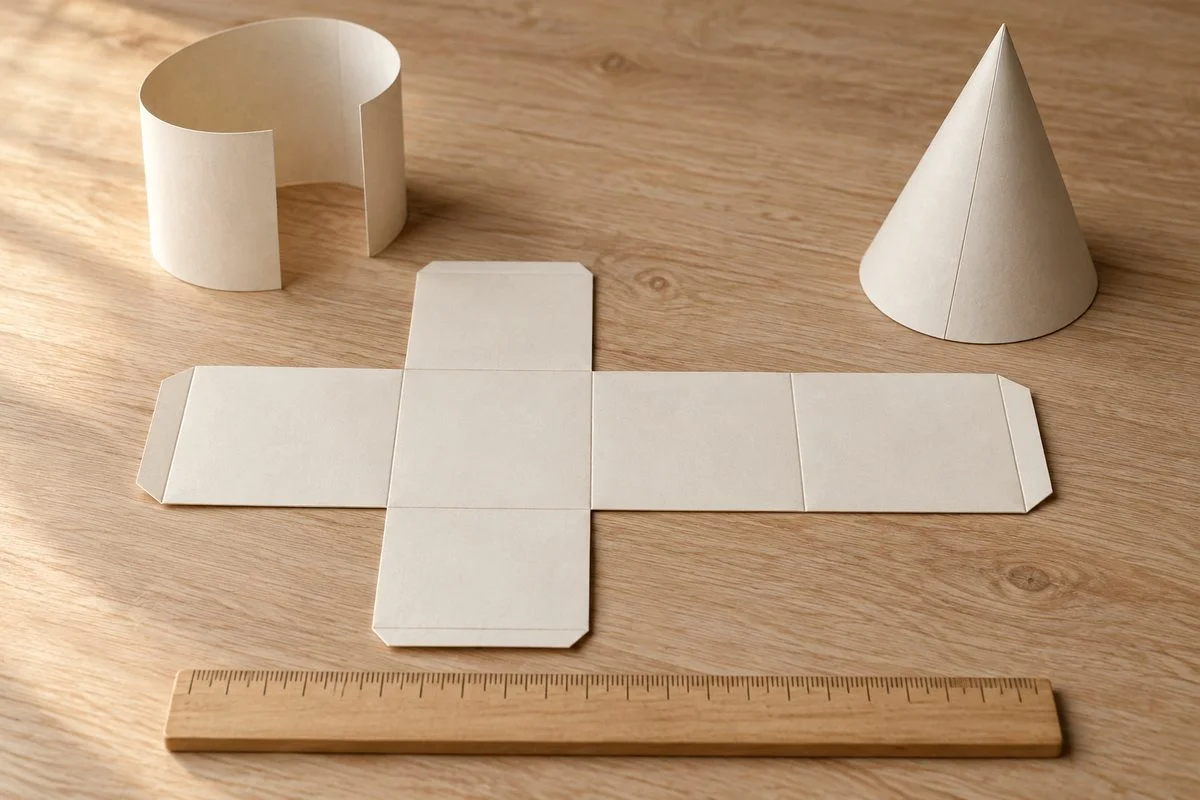
Opened carton and cylinder sleeve beside a ruler and closed paper cone.

3. Making Solids

Flat pieces fold into solids when their faces fit.

Show
Fold the prepared nets. Open a carton and measure matching faces. Unfasten the paper cylinder sleeve. Keep the cone’s seam closed until predicting. After predicting, open the cone’s curved surface and compare its radius with the sloping side.
Ask
Will the cone’s opened radius match its base radius or sloping side?
Say
Nets close without gaps or overlaps. The sleeve spans the height and base circumference; the sector’s radius matches the sloping side.
Used in
Flat packaging nets save storage space.
If your child says…“The cone opens into its base circle.”
Ask
When you flatten the cone, does its tip-to-rim distance change?
What’s true
Only the cone’s curved surface opens into a sector, with its circular base separate.

Paths and views

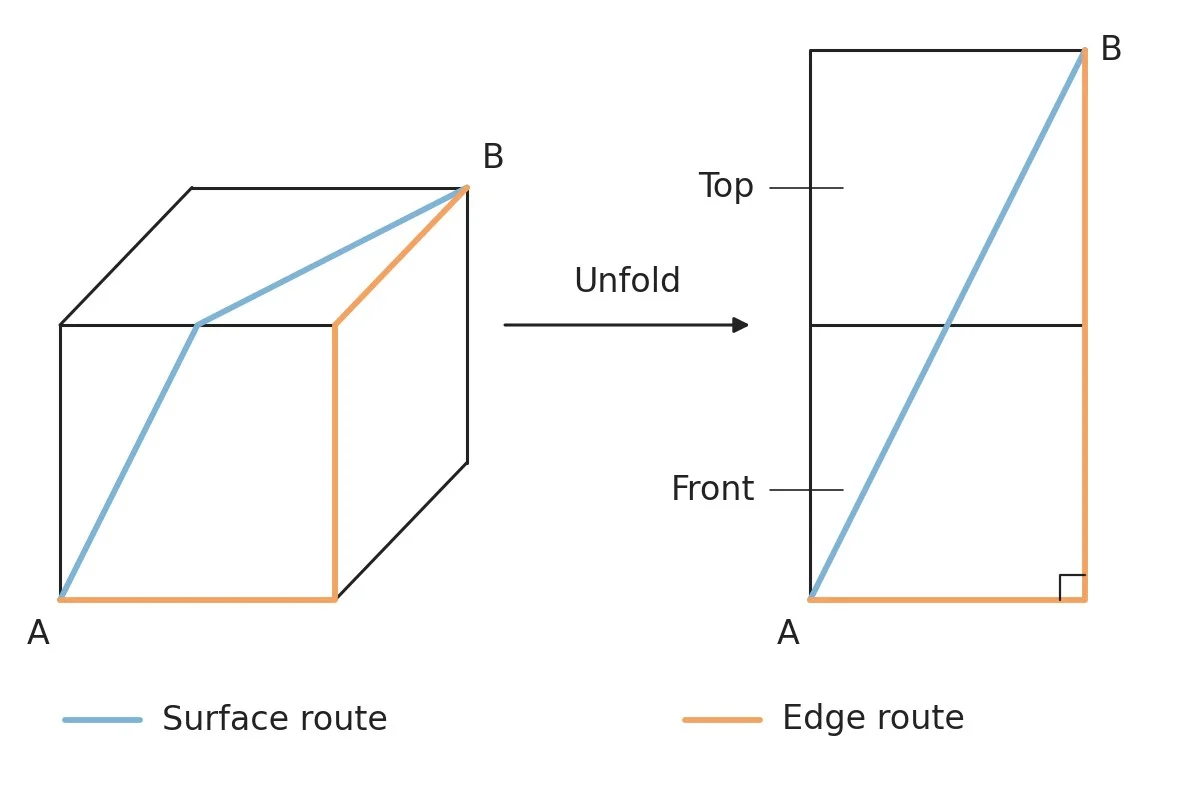
Cube and unfolded faces compare a straight surface route with an edge route.

4. Shortest Paths on a Cube

Unfold faces to measure surface routes.

Show
Trace both diagram routes from cube to unfolding.
Ask
Which surface route is shorter?
Say
Blue is shorter: unfolding preserves lengths and straightens this route.
Used in
Unfolding helps measure ribbon across box faces.
If your child says…“I add the rectangle’s sides to get the diagonal.”
Ask
Does the blue line follow the rectangle’s sides or cross between its corners?
What’s true
The diagonal’s square equals the sum of the squares of the perpendicular sides.
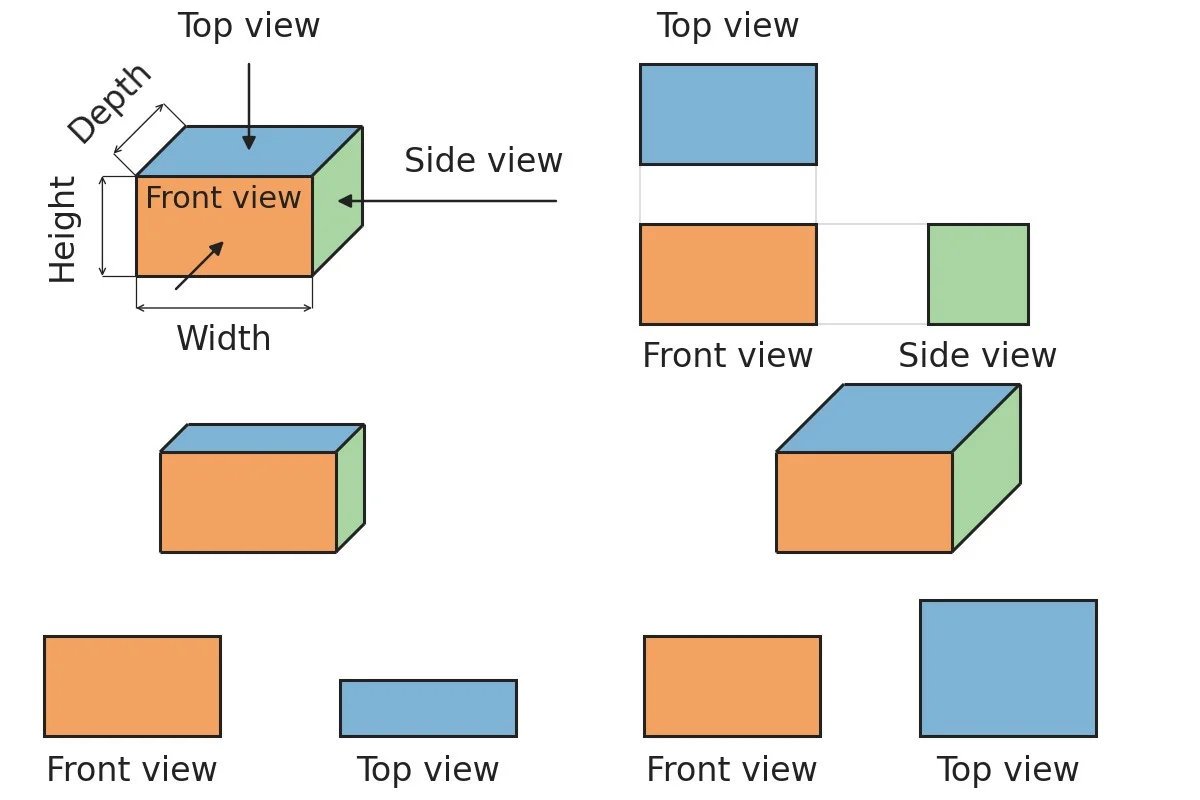
A cuboid’s three views and two boxes with matching fronts but different depths.

5. Projections

A flat view hides depth.

Show
Follow the diagram’s viewing arrows to each flat view. Compare the boxes below.
Ask
Will these boxes look identical from above?
Say
Their top views differ because their depths differ. Front views hide depth, top views hide height, and side views hide width.
Used in
Furniture drawings show several views so makers can check measurements.
If your child says…“Matching front views mean the boxes have the same shape.”
Ask
Where can you see the extra depth that the front view hides?
What’s true
Boxes with different depths can have identical front views.
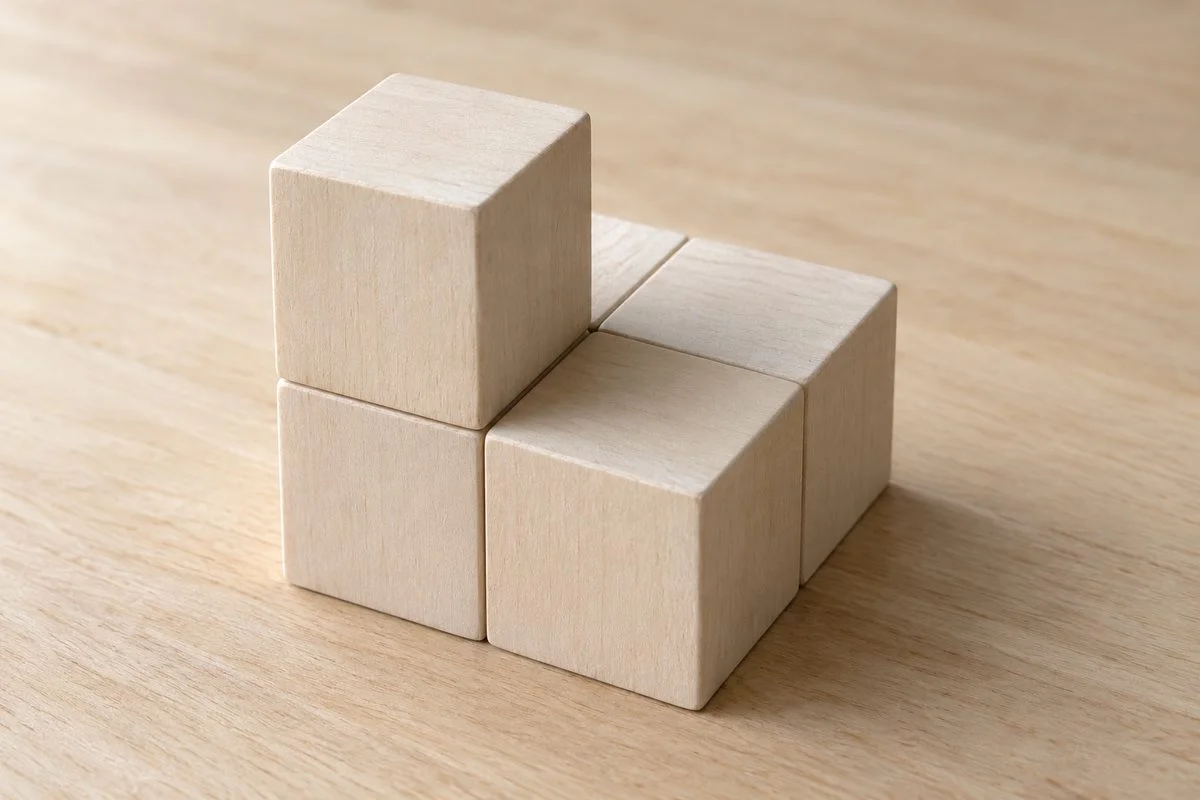
Five cubes arranged as a square base with one cube above its front-left corner.

6. Representation of Solids on a Plane Surface

Several views reveal arrangements.

Show
Make a two-by-two cube base with another cube above its front-left corner. Record front, top and side views. Rebuild from these records.
Ask
How many cubes will we find in the base after lifting the upper cube?
Say
The complete base contains four cubes, including the covered cube. All three recorded views must match the rebuilt stack, including visible dividing lines.
Used in
Stacking plans include covered packages for accurate stock totals.
If your child says…“A covered cube does not count.”
Ask
When we lift the top cube, was the cube underneath already there?
What’s true
Covering a cube hides it without removing it from the stack.

Drawing solids

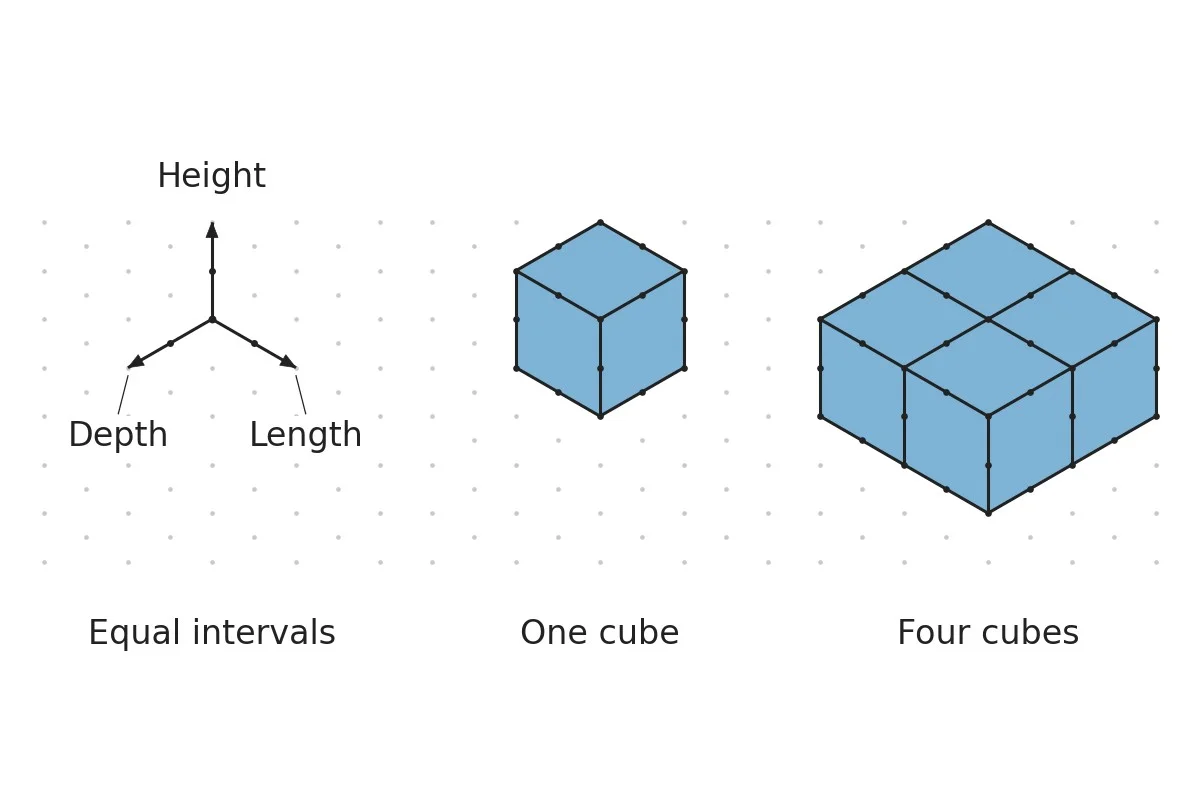
Isometric grids show equal edge intervals, a completed cube and a four-cube layer.

7. Drawing on Isometric Grids

Equal units along three directions show solids.

Show
Compare upright and sloping grid intervals in the diagram. Find the four cubes’ shared faces.
Ask
Do sloping cube edges need fewer intervals?
Say
Equal edges need equal intervals. Here, height runs vertically, depth down-left and length down-right.
Used in
Assembly drawings show several faces together to clarify where parts fit.
If your child says…“Sloping cube edges need shorter lines than upright edges.”
Ask
Do equal steps along the grid’s different directions measure differently?
What’s true
Equal cube edges have equal drawn lengths in an isometric drawing.
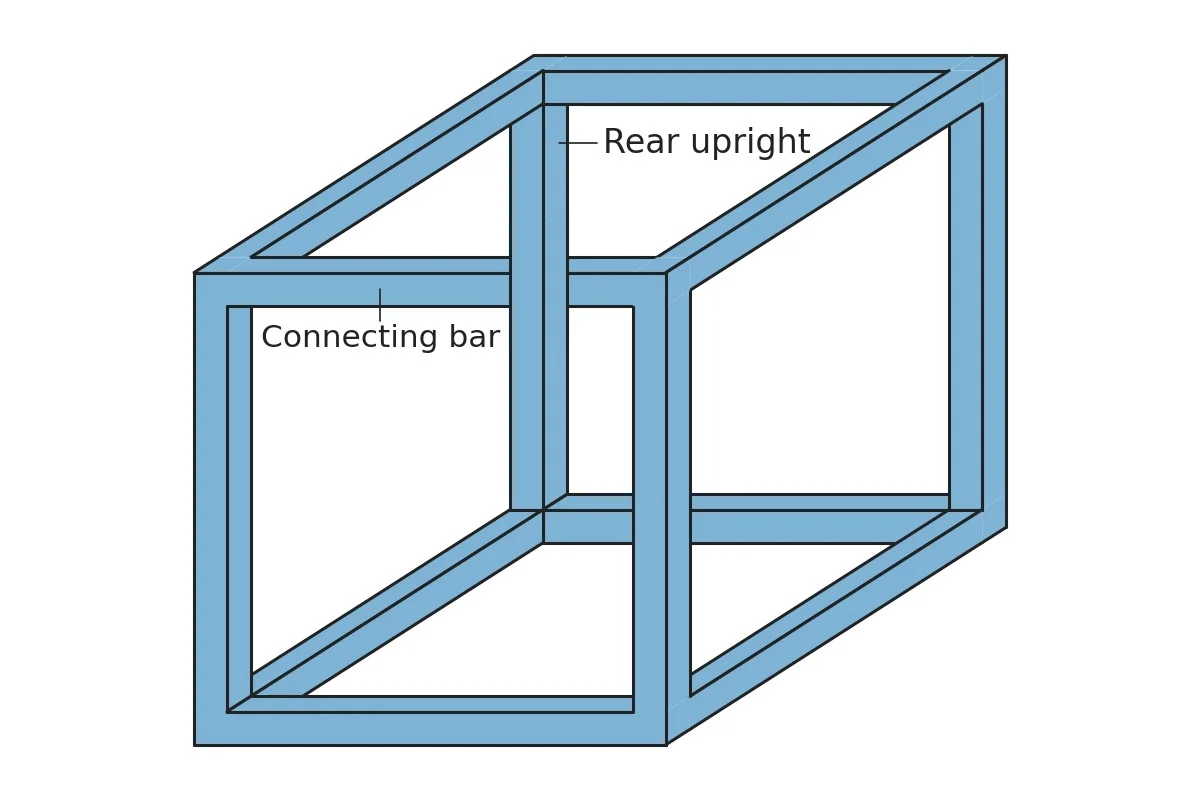
Impossible cube frame with a rear upright crossing in front of a connecting bar.

8. Impossible Figures

Convincing separate joins can contradict each other in one drawing.

Show
Find the joins in the cube-frame diagram and inspect them one at a time. Use scrap paper to cover the other joins. Uncover the whole frame. After predicting, trace each bar and check which bars pass in front.
Ask
Could all these joins fit together in one solid cube frame?
Say
Each join can look convincing while the complete frame demands conflicting connections.
Used in
Checking every join in a construction drawing helps prevent parts that cannot fit together.
If your child says…“Every corner looks possible, so the whole frame must be possible.”
Ask
Can this straight bar keep these connections and also pass in front at that crossing?
What’s true
A buildable frame needs all its joins and spatial directions to agree.

A real problem

One sphere made complex roof shapes practical to manufacture.

The early roof designs prevented mould reuse and would have made construction more expensive.

The final major roofs used sections of the same sphere.

Adopting the spherical design in 1961 allowed repeated manufacture of roof parts.

Sydney Opera HouseInstitution of Structural EngineersPowerhouse Museum

Orange with curved peel sections arranged beside it.

Concept Lab · Common misconception

The tempting mistake in Exploring Some Geometric Themes

Open standalone misconception page →

Can a boundary grow when its individual segments get shorter?

Wrong

A Koch-curve step shortens the boundary because every replacement segment is shorter.

Why it feels right. I track the length of each piece and overlook the larger count.

Right

Total length depends on the length and the number of segments.

Worked example

The first line spans three units. The replacement path contains four segments of one unit each.
  1. Replace one 3-unit segment with four 1-unit segments.
  2. Their combined length is 4 units.
  3. The shorter pieces make a longer boundary.

Ask your child eight quick questions.

One per step. The answer and the reason are given.

  1. The carpet had one hole, then gained eight smaller holes. How many holes are there?

    Nine holes. The original hole remains alongside the eight new holes.

  2. How many edges join the matching ends of a triangular prism?

    Three. Each corner of one triangular end connects to the matching corner at the other.

  3. A cone’s sloping side measures 5 cm. What radius does its opened sector have?

    5 cm. Flattening preserves the distance from the tip to the curved rim.

  4. Which route does adding the rectangle’s width and height measure?

    The orange edge route. The blue diagonal crosses the rectangle instead of following its sides.

  5. How do the two boxes’ top views differ?

    They show different depths. The top view reveals depth, which the matching front views hide.

  6. How many cubes are in this complete square base and its single upper cube?

    Five. The base contains four cubes, including the covered cube.

  7. A cube edge spans two vertical intervals. How many intervals should its sloping edges span?

    Two. Equal cube edges use equal units along all three isometric directions.

  8. What must agree before convincing separate corners can form a buildable frame?

    All the joins. A possible whole requires consistent connections, even when individual corners look convincing.

15 more questions with answers, 15 with pictures