Skip to content

Teach Fractions in Disguise in eight steps.

For each idea: show it, ask before you tell, then say one line.

Gather paper, scrap paper, a pencil, ruler, five coins, two equally sized rotis and a plate.

Common misconceptions & worked visual for this chapter · 15 practice questions with answers

How to teach it

Shares and wholes

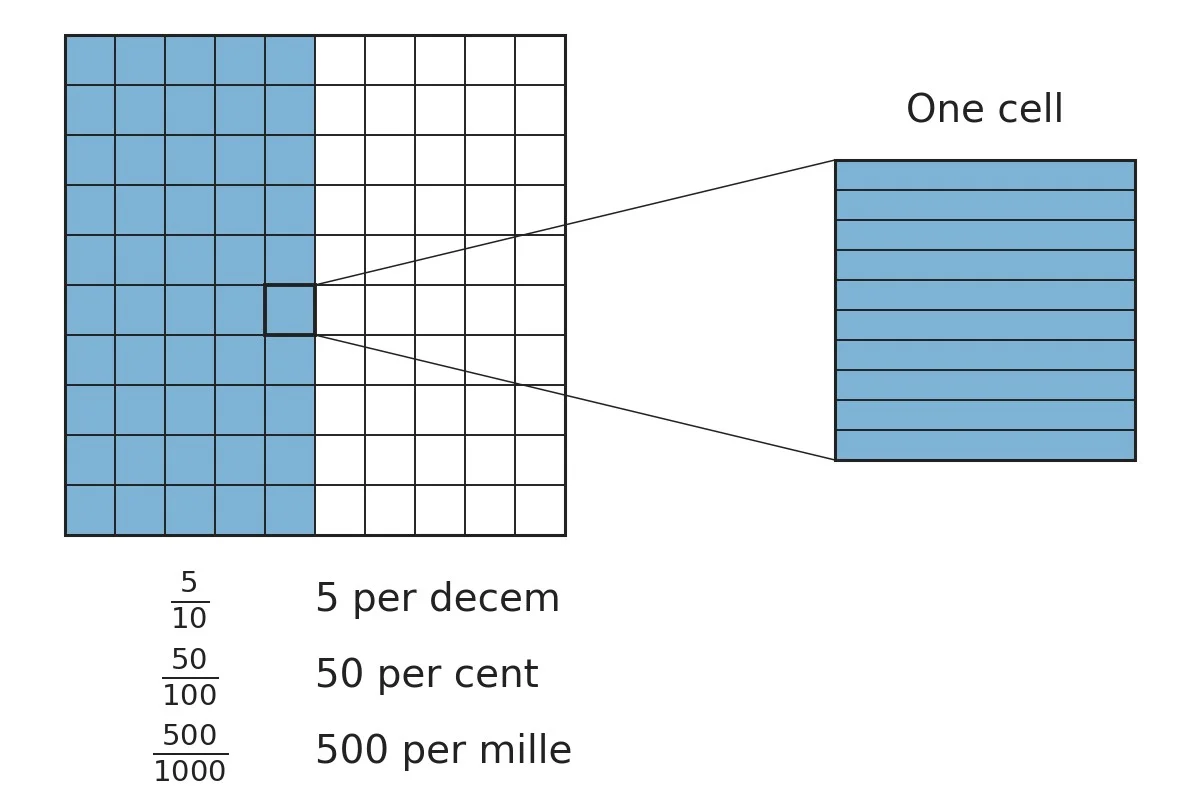
Half-shaded hundred-square with an enlarged cell divided into ten strips and equivalent share labels.

1. Per Cent, Per Decem and Per Mille

Count the same share in tenths, hundredths or thousandths.

Show
Find the shaded columns, cells and enlarged cell in the diagram.
Ask
How many shaded strips result when every cell becomes ten equal strips?
Say
This half is 5 per decem, 50 per cent, or 500 per mille. Each cell becomes ten smaller parts.
Used in
Battery percentages show the remaining share of a full charge.
If your child says…“Five shaded columns means 5%.”
Ask
When you count cells instead of columns, how many shaded parts are there?
What’s true
Count shaded parts and total parts using the same-sized pieces.
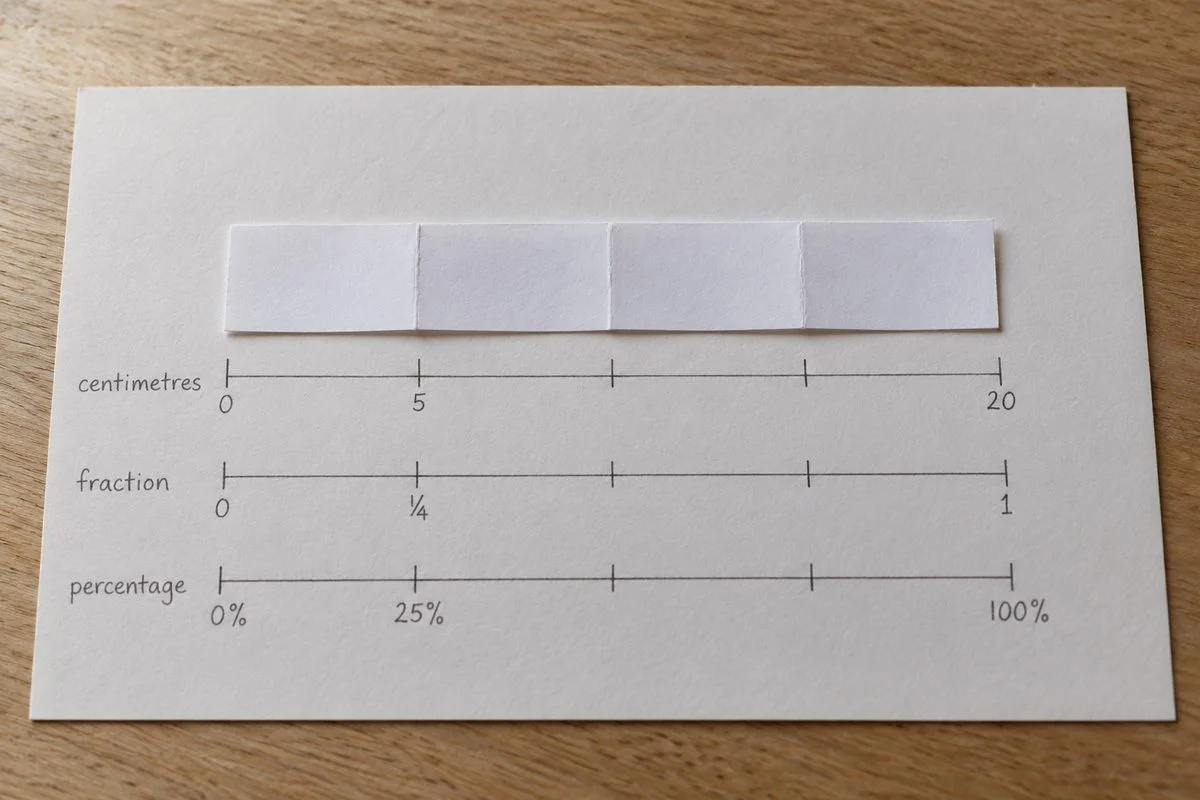
Unfolded paper strip above three partly labelled length, fraction and percentage scales.

2. Bar Models

Equal sections connect lengths, fractions and percentages.

Show
Fold a 20 cm paper strip into four equal lengths. Unfold it. Below it, start separate centimetre, fraction and percentage scales. Mark endpoints and the first crease: 5 cm, one-quarter, 25%.
Ask
What three labels belong at the third crease?
Say
The third crease marks 15 cm, three-quarters and 75%.
Used in
Measured strips help divide shelf space into equal sections.
If your child says…“A percentage cannot go beyond 100%.”
Ask
If this whole strip is 100%, what happens when the length extends beyond it?
What’s true
A length greater than the reference strip has a percentage greater than 100%.
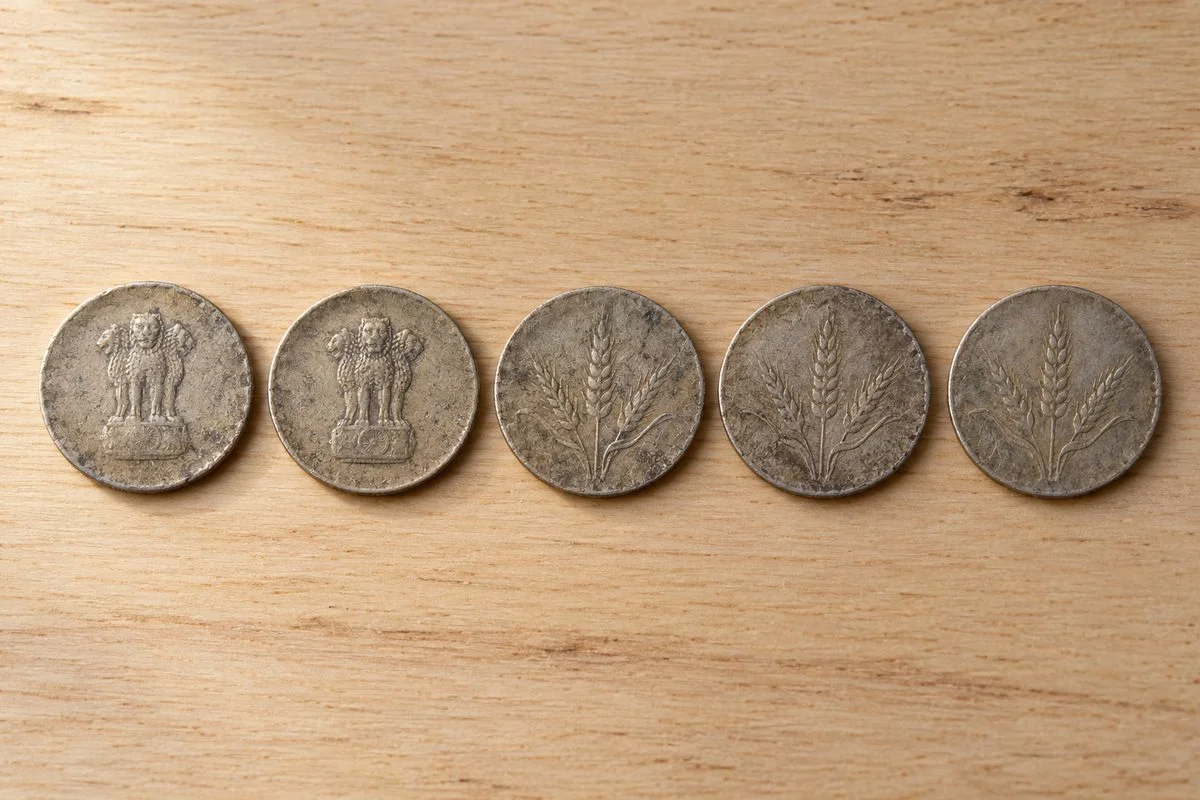
Five coins in a row, two heads-up and three tails-up.

3. Ratios and Percentages

Add all ratio parts before finding each percentage share.

Show
Arrange five coins: two heads-up, three tails-up. Count them all.
Ask
If one tail becomes a head, will the percentage showing heads rise or fall?
Say
It rises. Currently, heads make 40% and tails 60%, together 100%.
Used in
A completed share of a savings target shows how much remains to save.
If your child says…“Two heads and three tails means heads are two-thirds of the coins.”
Ask
Are there three coins altogether, or five?
What’s true
The whole includes both heads and tails.
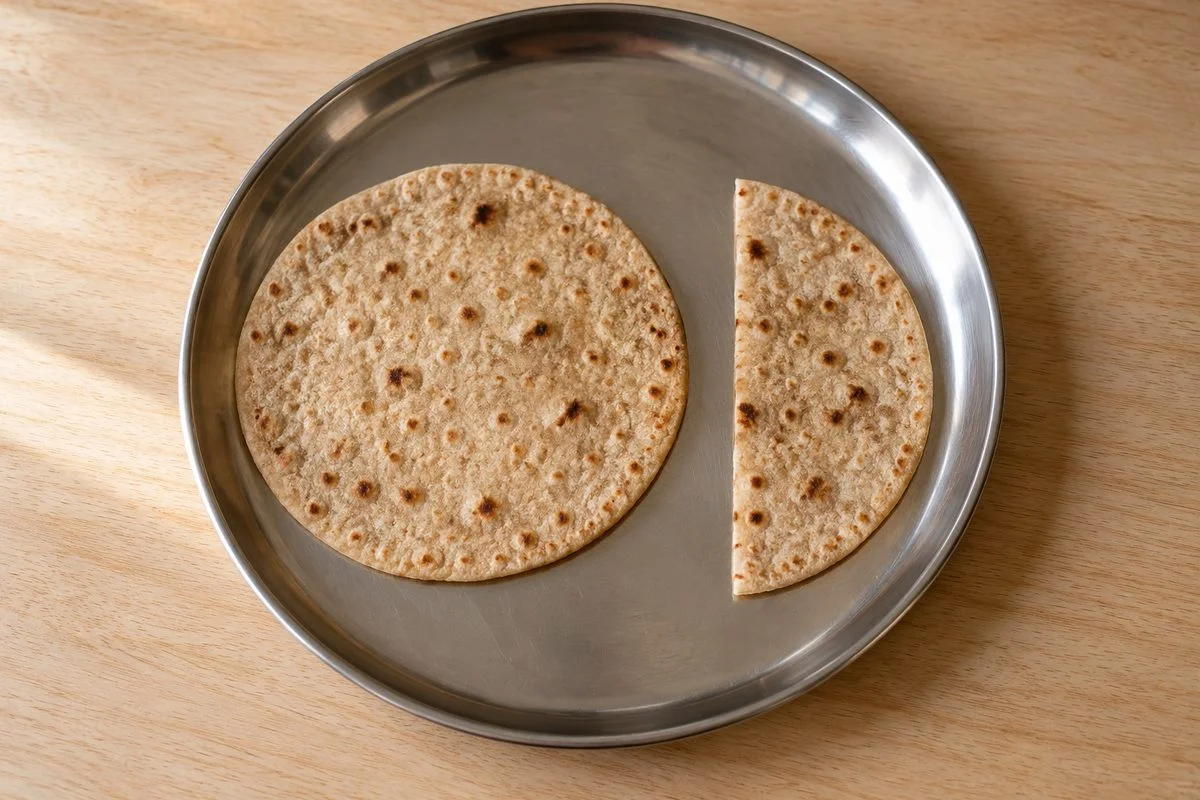
A whole roti beside half an equally sized roti on a steel plate.

4. Proportions and Absolute Amounts

The amount depends on the percentage and its starting whole.

Show
Plate a whole roti beside half an equally sized roti. After predicting, halve each portion.
Ask
Will half of each portion give equally large pieces?
Say
The larger portion gives more.
Used in
Shopkeepers compare profit with their costs to judge what they earned.
If your child says…“Both are 50%, so both pieces must be the same size.”
Ask
Did the two starting portions contain the same amount of roti?
What’s true
Equal percentages can give unequal amounts when the wholes differ.

Changes, areas and bills

A1=4+50100×4A_1=4+\frac{50}{100}\times4

A1=6A_1=6

A2=6−50100×6A_2=6-\frac{50}{100}\times6

A2=6−3A_2=6-3

5. Successive Percentage Changes

Each change uses the amount reached after the previous change.

Show
Write these lines. Say, 'A-one names the raised price; A-two names the final price, in rupees.'
Ask
What is the final price?
Say
It is 3 rupees: the fall halves the raised price.
Used in
Successive shop discounts determine what a buyer finally pays.
If your child says…“A 50% rise and a 50% fall cancel.”
Ask
Does the fall remove half of 4 rupees or half of 6 rupees?
What’s true
The fall takes half of a larger amount than the rise used.
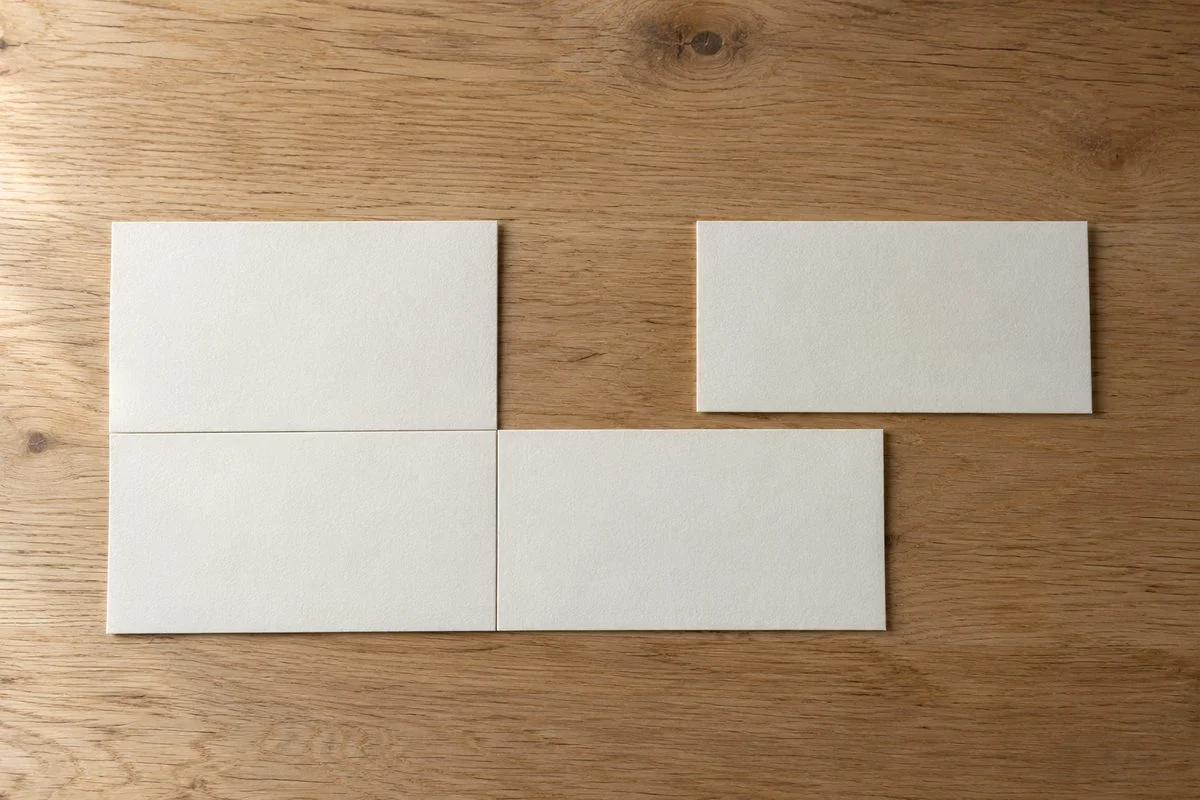
Three equal paper rectangles form an L, with the fourth beside the gap.

6. Percentage Area

Compare a region's area with the entire area.

Show
Fold a rectangular sheet into four equal rectangles. Tear along the creases. Reassemble the sheet. Move one piece aside.
Ask
If we put the fourth piece back, what percentage of the original area will they cover?
Say
Together, all four pieces cover 100% of the original sheet. These pieces show shares through area.
Used in
Area percentages help plan how much garden space each crop receives.
If your child says…“Three pieces always mean 75%.”
Ask
What makes each piece here the same share of the sheet?
What’s true
Counting pieces gives area shares only when those pieces have equal areas.

Tax=10100×20\text{Tax}=\frac{10}{100}\times20

Tax=2\text{Tax}=2

Bill=20+2\text{Bill}=20+2

7. Tax Added to a Bill

Calculate tax from the subtotal, then add it.

Show
Write these lines. Say, 'Ten per cent means one-tenth; amounts are rupees.'
Ask
What total must be paid?
Say
Pay 22 rupees, including tax.
Used in
Checking tax helps explain the bill's total.
If your child says…“The tax calculation gives the whole bill.”
Ask
Where does the original 20 rupees appear in the amount paid?
What’s true
The percentage calculation gives tax alone; the bill also includes the subtotal.

Chessboard movement

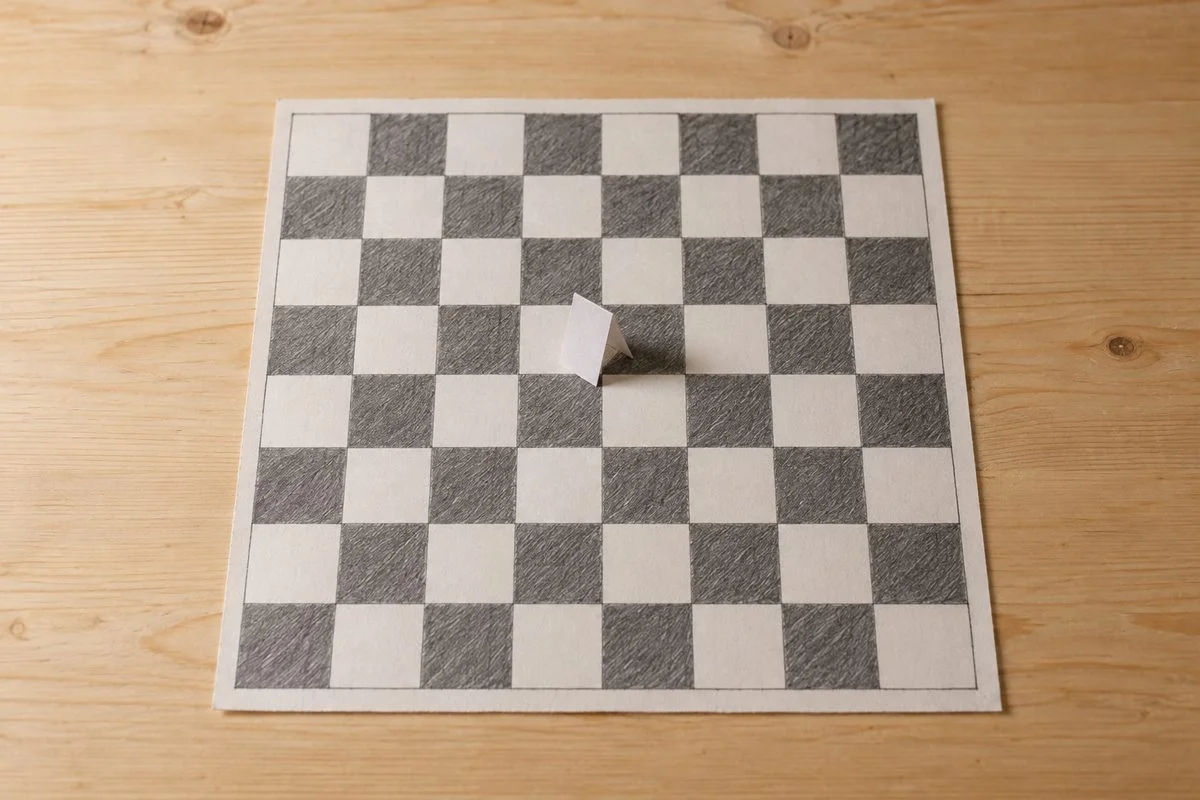
Homemade chessboard with a folded paper playing piece near its centre.

8. Peaceful Knights

A knight moves two squares, then one at right angles.

Show
Draw an eight-by-eight chessboard and fold a scrap into a playing piece. Place it near the centre. Demonstrate two squares across and one perpendicular, landing only at the destination. Return it to its start.
Ask
Which other squares can this knight reach in one move?
Say
The knight's landing square is two squares across, then one square at right angles.
Used in
Knowing a knight's possible destinations helps a chess player protect pieces.
If your child says…“Where can it land?”
Ask
Which destination completes both the two-square part and the one-square part?
What’s true
The destination must complete both parts of the move.

A real problem

A trial showed that a polio vaccine worked.

The nationwide Salk vaccine trial was approved in 1954.

Some participants received the vaccine and others received a placebo.

The evaluators did not know which participants received which.

The trial established that Salk's vaccine was effective.

SmithsonianUniversity of Toronto

An unbranded capped syringe on a plain clinic tray.

Concept Lab · Common misconception

The tempting mistake in Fractions in Disguise

Open standalone misconception page →

Does a percent already give a count?

Wrong

A 25% discount always means 25 rupees off.

Why it feels right. I read 25% as a fixed amount.

Right

A percentage is a share of a specified whole.

Worked example

25% of ₹20050 rupees
25% of ₹400100 rupees
One quarter is the same fraction of both prices. The higher price has the bigger rupee discount.
  1. One quarter of ₹200 is ₹50.
  2. One quarter of ₹400 is ₹100.
  3. Both discounts are 25%.

Ask your child eight quick questions.

One per step. The answer and the reason are given.

  1. What percentage of this square is shaded?

    50%. Fifty of its hundred equal cells are shaded.

  2. A length exceeds this whole strip. Is its percentage above or below 100%?

    Above 100%. The reference strip already accounts for 100%.

  3. Which count belongs below the two heads when writing their fraction?

    Five. The denominator counts every coin, including both heads and tails.

  4. Which gives more roti: half the whole roti or half the half-roti?

    Half the whole roti. The same fractional share of a larger starting portion gives more.

  5. How many rupees does the 50% fall remove here?

    3 rupees. The fall uses the raised price of 6 rupees.

  6. What must match before counting pieces tells us their area shares?

    Their areas. Unequal pieces contribute unequal areas, even though each counts as one piece.

  7. What does the 2 rupees represent?

    The tax alone. The subtotal must still be added to find the bill.

  8. Can the knight land two squares across and two squares sideways from its start?

    No. One direction needs two squares, but the perpendicular direction needs only one.

15 more questions with answers, 15 with pictures