Skip to content

Teach Light: Mirrors and Lenses in eight steps.

For each idea: show it, ask before you tell, then say one line.

Gather a shiny steel ladle, shiny steel spoon, pen cap and standing flat mirror.

Common misconceptions & worked visual for this chapter · 15 practice questions with answers

How to teach it

Mirrors and their images

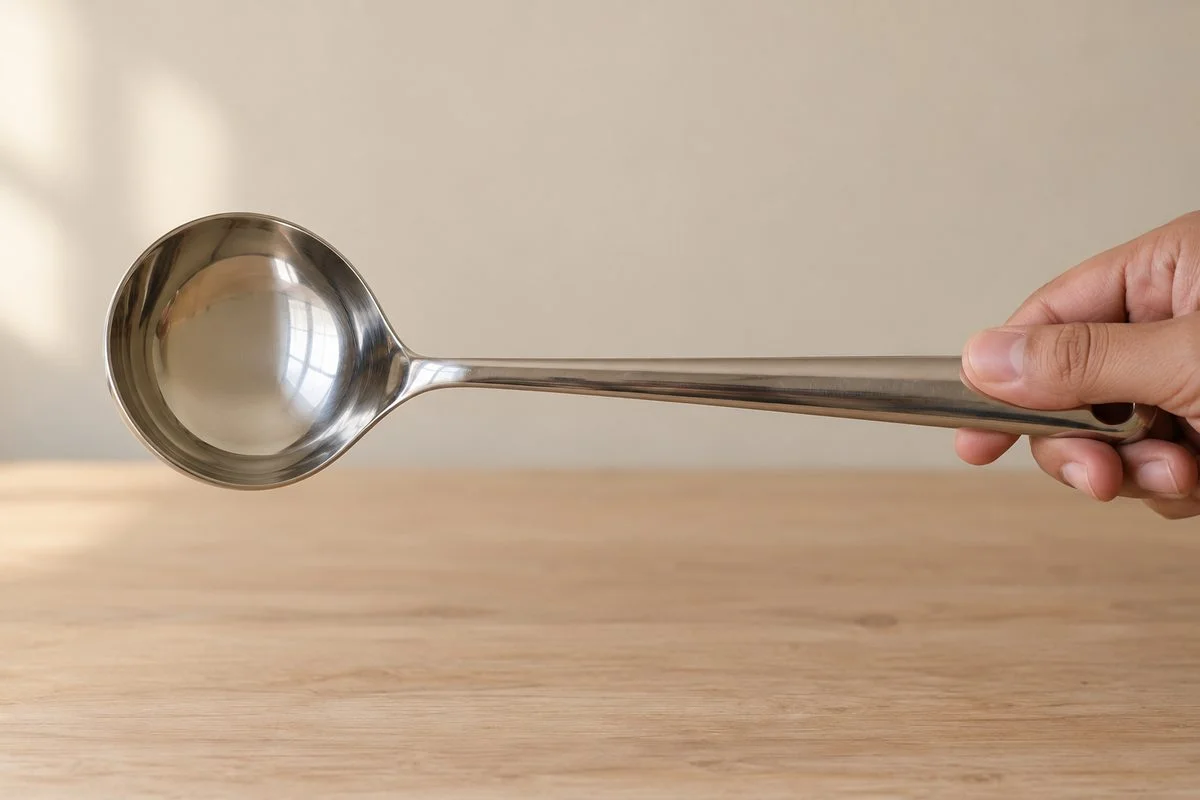
A hand holds a steel ladle sideways, revealing its curved bowl.

1. Spherical mirrors

Their reflecting surfaces curve like parts of a hollow sphere.

Show
Hold a shiny steel ladle sideways at eye level. After the prediction, turn it to inspect both surfaces. The ladle illustrates curves; its bowl need not be perfectly spherical.
Ask
When you turn the ladle over, will the other reflecting surface curve inward or outward?
Say
Concave curves inward; convex bulges outward. Look sideways at the reflecting surface to tell them apart.
Used in
A dentist’s concave mirror enlarges a nearby tooth, making details easier to see.
If your child says…“The rim tells me the mirror type.”
Ask
Did the rim change when you turned the ladle?
What’s true
The reflecting surface’s curve decides the type.
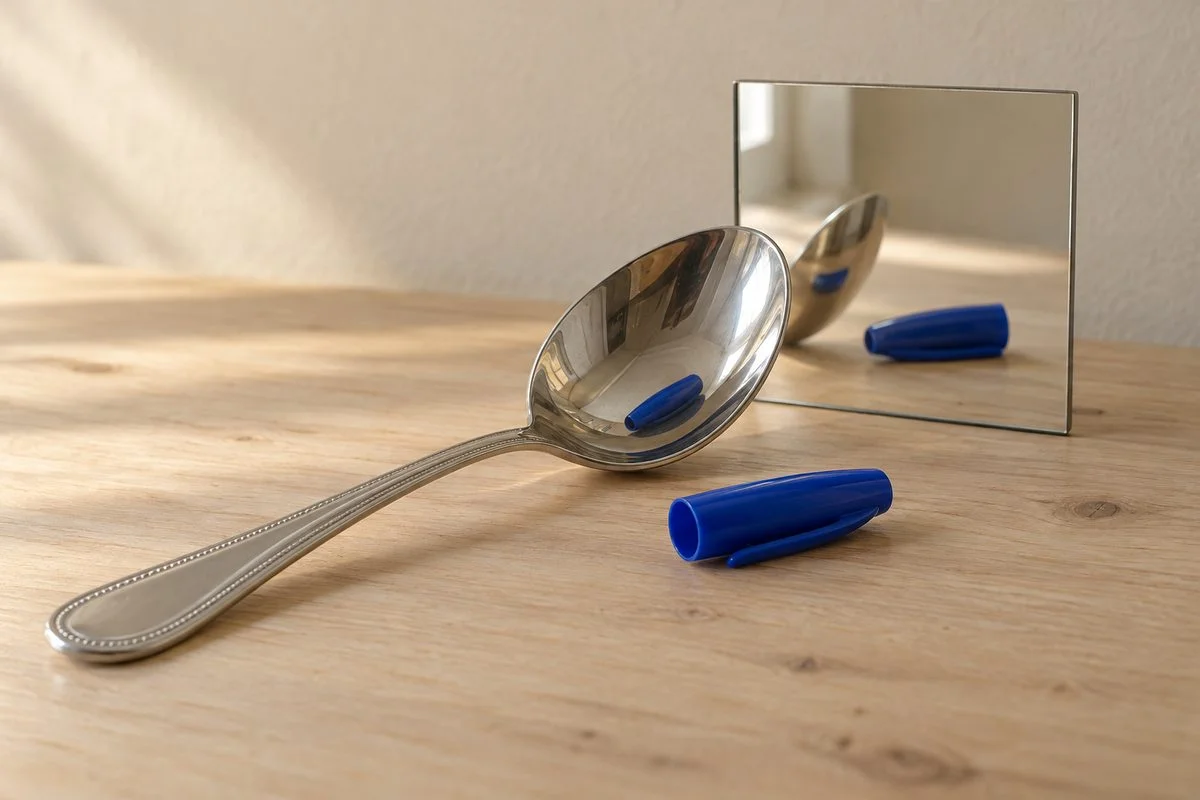
Pen cap beside a steel spoon and a flat mirror.

2. Images in plane, concave and convex mirrors

Mirror shape and object distance determine image size and orientation.

Show
Hold a cap near both spoon sides and the flat mirror. Predict, then move it away.
Ask
Which reflection might turn upside down farther away?
Say
Close concave images are upright and enlarged; distant ones invert. Convex images stay upright and smaller. Plane images stay upright and equal-sized.
Used in
Convex vehicle mirrors show upright images across a wider traffic view.
If your child says…“An upright image means a flat mirror.”
Ask
Does the spoon’s outward side give an upright image?
What’s true
Curved mirrors can also give upright images.

How mirrors reflect light

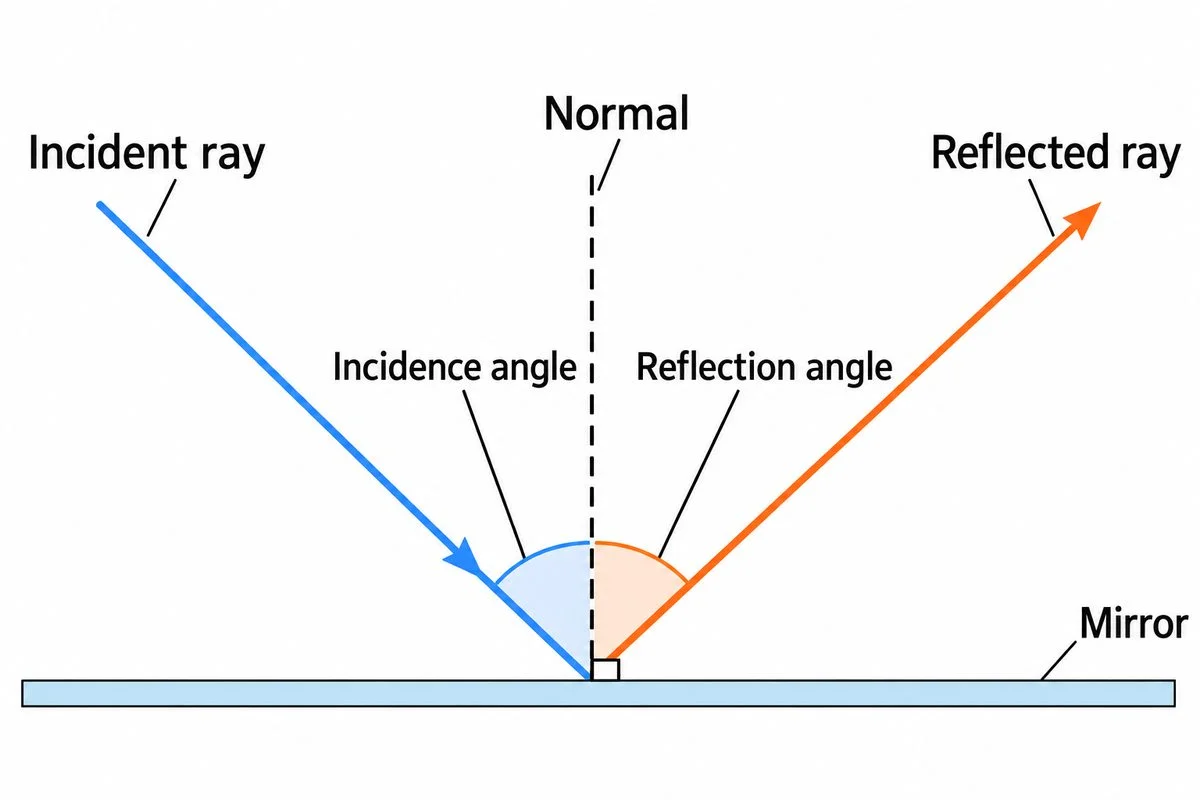
Incoming and reflected rays make equal angles with a normal perpendicular to the mirror.

3. Normal, incidence and reflection

Light arrives and leaves at equal angles from the normal.

Show
Find the incoming ray and dashed normal in the diagram. After predicting, follow the outgoing arrow and compare the marked angles.
Ask
What angle from the normal will the outgoing ray make?
Say
The outgoing angle matches the incoming angle because reflection keeps these angles equal. Measure both from the normal, which meets the mirror at a right angle.
Used in
Road-corner mirrors reflect light from hidden traffic into view.
If your child says…“We measure both angles from the mirror.”
Ask
Would straight-on light make a zero angle with the surface or the normal?
What’s true
Both angles are measured from the normal.
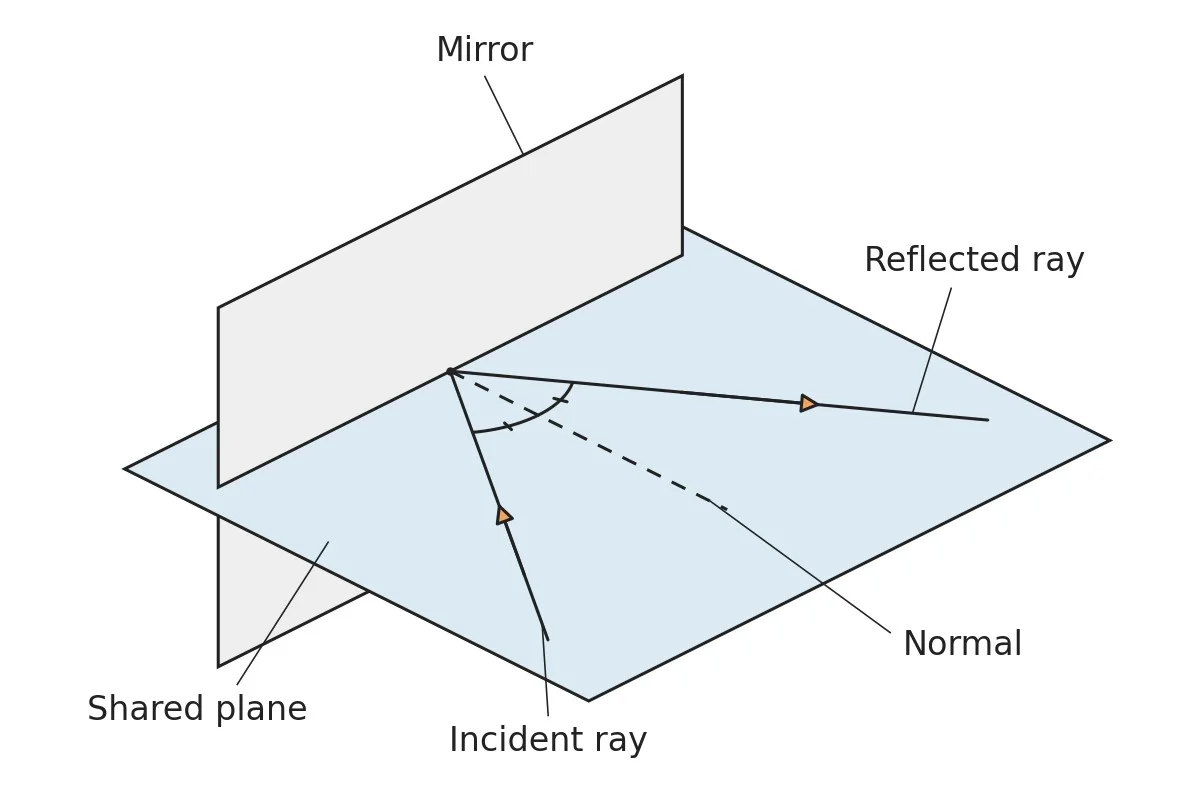
Both rays and the normal lie within a shaded plane meeting an upright mirror.

4. Laws of reflection

Both rays and the normal share one flat plane.

Show
Find the shaded plane in the diagram. Follow the incoming ray to the mirror. After predicting, trace the normal and outgoing ray within that plane.
Ask
If only equal angles mattered, could the outgoing ray point outside this shaded plane?
Say
Equal angles alone allow other directions, but reflection also keeps all three lines in one plane.
Used in
A torch’s concave reflector can direct its bulb’s light into nearly parallel rays.
If your child says…“Equal angles tell us everything about reflection.”
Ask
Which rule keeps the outgoing ray inside the shaded plane?
What’s true
The shared-plane rule also fixes which way the reflected ray travels.
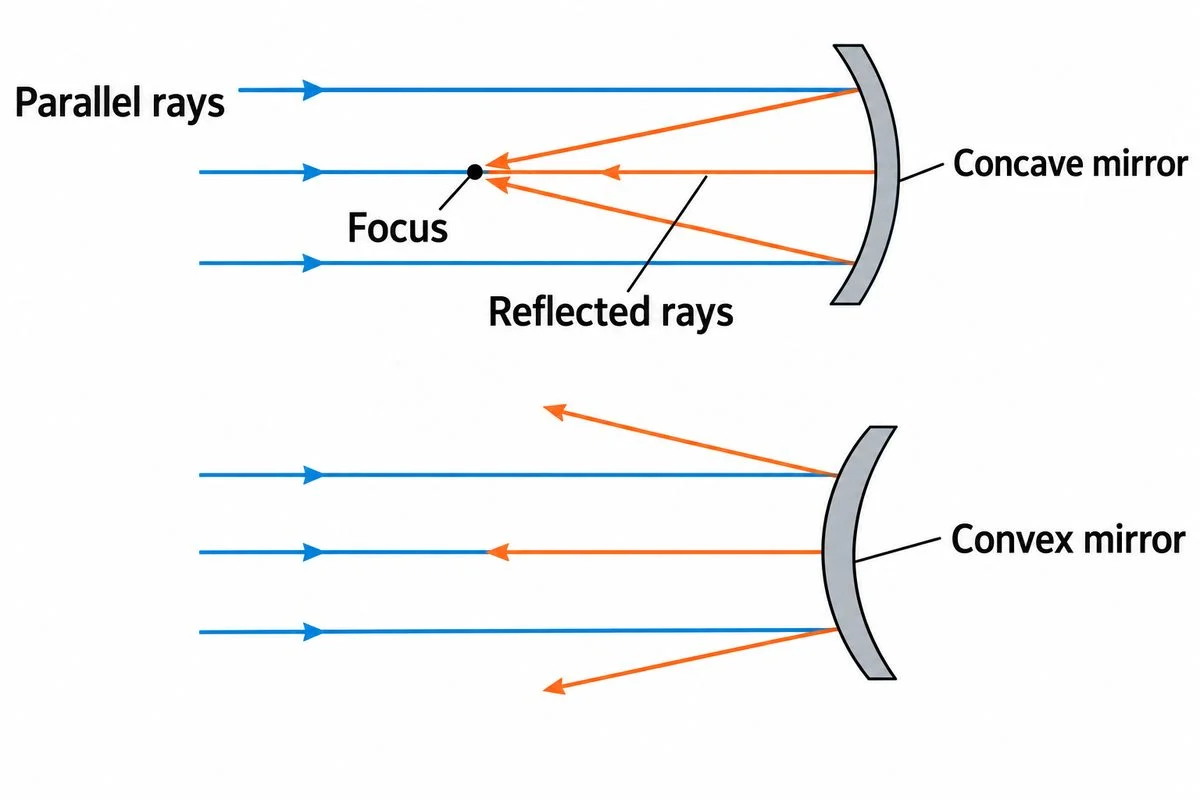
Parallel rays gather after concave reflection and spread after convex reflection.

5. Converging and diverging mirrors

Concave mirrors gather parallel light; convex mirrors spread it apart.

Show
Find the parallel incoming rays in both diagram panels. After predicting, follow their reflected paths away from each mirror.
Ask
Which mirror could gather sunlight into a small hot spot?
Say
Near its central line, a concave mirror gathers parallel rays; a convex mirror spreads them. The concave mirror concentrates sunlight’s energy into a small area, making that spot hotter.
Used in
Concave solar cookers concentrate sunlight onto a vessel, helping food heat up.
If your child says…“The hollow side always spreads light apart.”
Ask
Do the reflected arrows from the concave mirror approach each other or separate?
What’s true
A concave mirror brings parallel light near its central line together.

Lenses

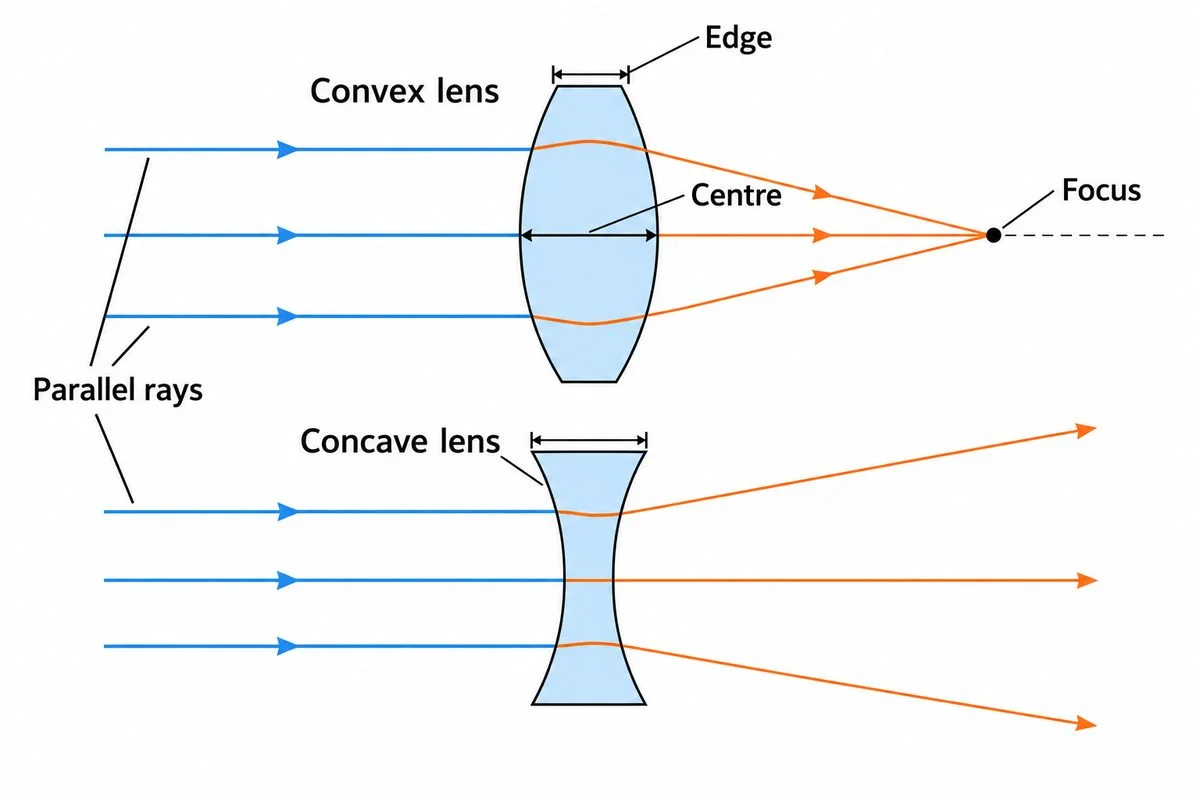
A thick-centred lens gathers passing rays; a thin-centred lens spreads them.

6. Convex and concave lenses

Curved transparent surfaces bring passing light together or spread it apart.

Show
Compare each lens’s centre and edges in the diagram. After predicting, follow the parallel rays through both lenses.
Ask
Which lens will bring these passing rays together?
Say
In air, the thick-centred convex glass lens brings parallel rays together. The thin-centred concave glass lens spreads them because its surfaces curve differently.
Used in
Camera lenses bend passing light to form images.
If your child says…“Convex lenses spread parallel light apart.”
Ask
Do the outgoing arrows behind the thick-centred lens approach each other?
What’s true
Ordinary convex lenses in air bring parallel rays near their central line together.
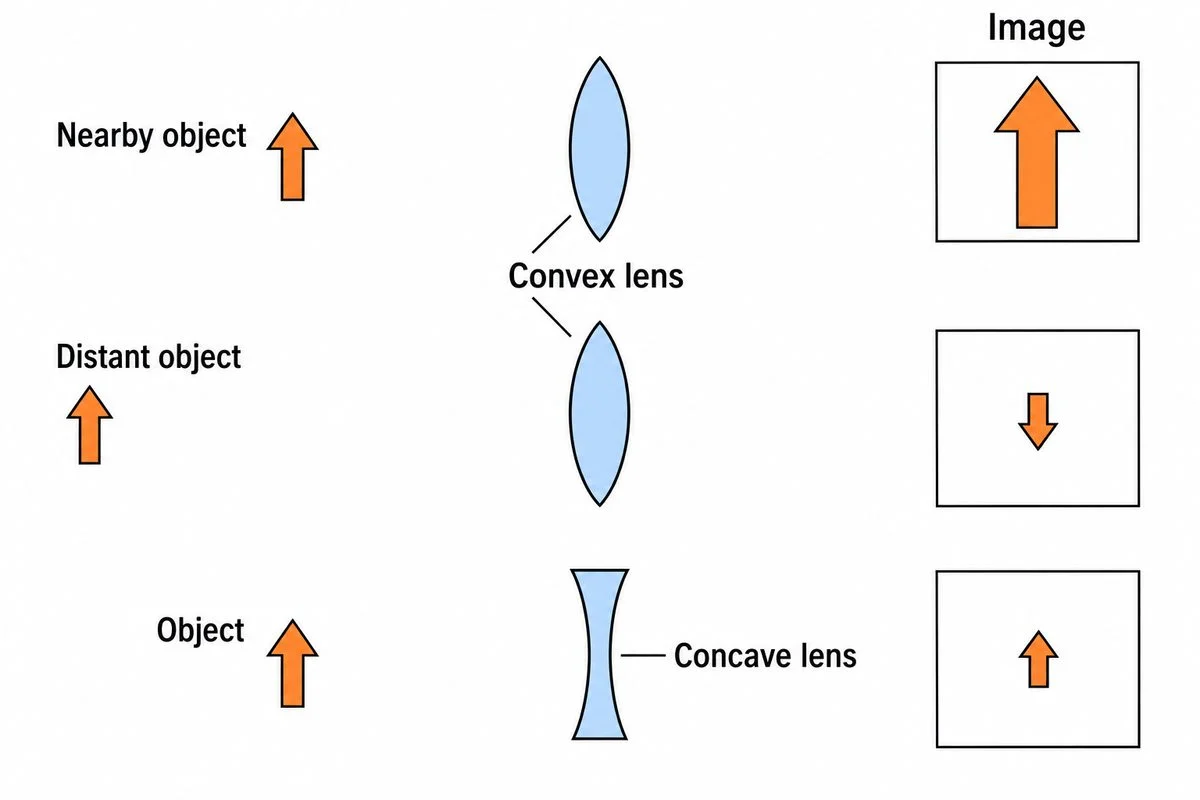
Three lens comparisons show enlarged upright, smaller inverted and smaller upright images.

7. Images through lenses

Convex images change with distance; concave images remain upright and smaller.

Show
Compare the diagram’s image boxes for both lenses and distances.
Ask
Will the distant object still look upright and enlarged?
Say
Convex lenses enlarge sufficiently close objects upright; distant images appear smaller and inverted. Concave-lens images stay upright and smaller.
Used in
A magnifying glass enlarges nearby print, making small letters easier to see.
If your child says…“Convex lenses always enlarge.”
Ask
What changes between the nearby and distant objects’ image boxes?
What’s true
A convex lens’s image depends on object distance.
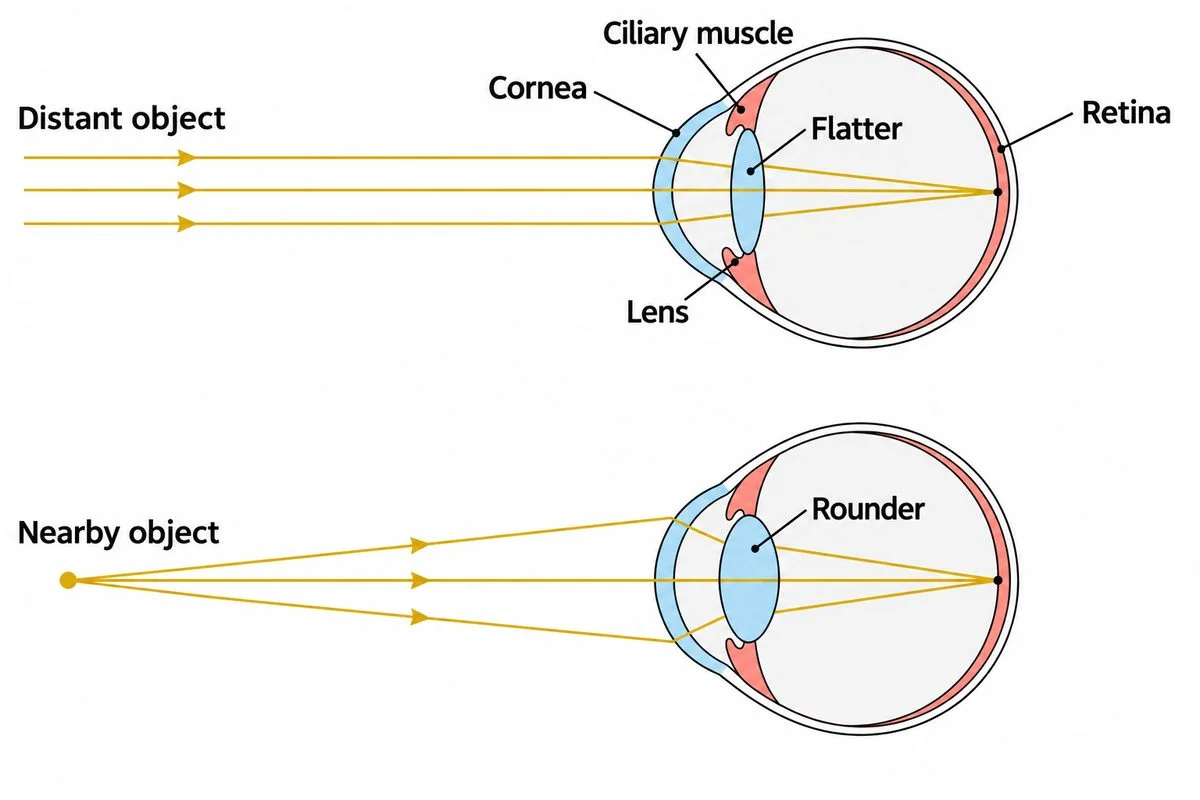
Rounder and flatter eye lenses focus light onto matching positions on the retina.

8. Lenses in the eye

The eye’s flexible convex lens helps focus near and distant objects.

Show
Compare lens shapes in both eye diagrams. Follow light to each retina.
Ask
How does focusing nearby change the lens?
Say
The cornea and lens focus light onto the light-sensitive retina. Muscles usually make healthy young eyes’ lenses rounder nearby and flatter for distant objects.
Used in
The eye’s lens helps focus light onto its light-sensitive back surface, forming a sharp image.
If your child says…“My eye’s lens stays the same shape.”
Ask
Which lens is rounder when light reaches the same back surface?
What’s true
Muscles change the lens’s shape as focusing distance changes.

A real problem

A liquid mirror helps survey the sky.

The International Liquid Mirror Telescope addresses the need for an inexpensive telescope dedicated to sky surveys.

It was inaugurated on 21 March 2023.

Its rotating liquid forms a concave, parabolic reflecting surface that focuses light.

At Devasthal in India, it helps identify celestial objects that change.

University of Liège — research repositoryDepartment of Science & TechnologyUniversity of Liège

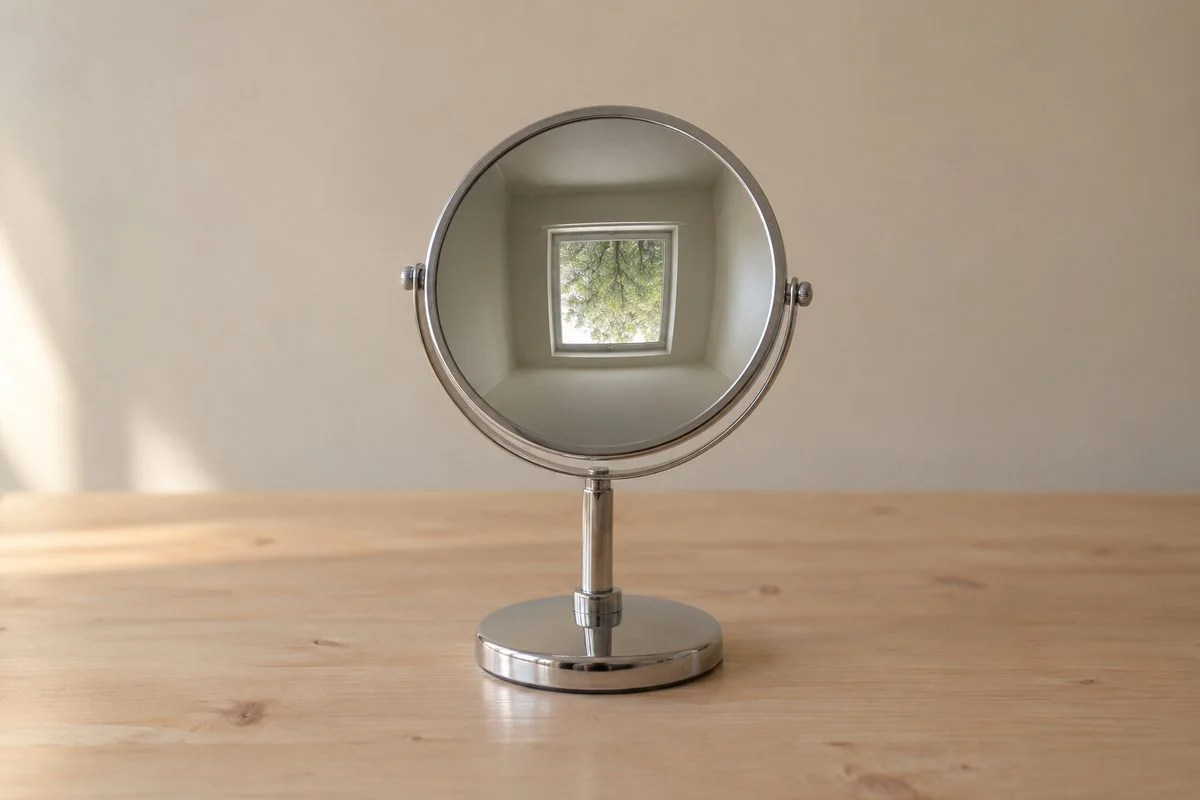
A concave shaving mirror reflects a distant window.

Concept Lab · Common misconception

The tempting mistake in Light: Mirrors and Lenses

Open standalone misconception page →

Why do mirror images look reversed?

Wrong

A plane mirror swaps left and right in space.

Why it feels right. My reflection looks like someone facing me with a different raised hand.

Right

A plane mirror reverses depth relative to its surface.

Worked example

The mirror flips the direction toward or away from its surface. An upward arrow along the surface still points up.
  1. Hold an arrow pointing toward the mirror.
  2. Its image points back toward you.
  3. An arrow along the mirror keeps its sideways direction.

Ask your child eight quick questions.

One per step. The answer and the reason are given.

  1. From the side, how do concave and convex reflecting surfaces curve?

    Concave inward; convex outward. The reflecting surface’s curve identifies the mirror type.

  2. An image stays upright and smaller at every object distance. Which mirror produces it?

    A convex mirror. Upright alone is insufficient; staying smaller distinguishes it from a plane mirror.

  3. Light strikes along the normal. What is its angle of incidence?

    0°. Incidence is measured from the normal, not the mirror surface.

  4. If the incoming ray changes direction, can the shared plane turn too?

    Yes. The plane follows the incoming ray and the normal.

  5. Where does the energy concentrated by a concave solar mirror come from?

    Sunlight. The mirror gathers incoming sunlight; it does not produce the heating energy.

  6. What happens to parallel rays passing through a convex lens with a thicker centre?

    They come together. A convex lens brings parallel rays near its central line together.

  7. Which way up is the distant object’s image in the convex-lens example?

    It turns upside down. A convex lens does not keep every object’s image upright and enlarged.

  8. How does a healthy young eye’s lens change when focusing farther away?

    It becomes flatter. Different viewing distances need different focusing strength.

15 more questions with answers, 2 with pictures