Skip to content

Teach Atomic Foundations of Matter in eight steps.

For each idea: show it, ask before you tell, then say one line.

Gather paper and a pencil.

Common misconceptions & worked visual for this chapter · 8 practice questions with answers

How to teach it

Atoms and chemical changes

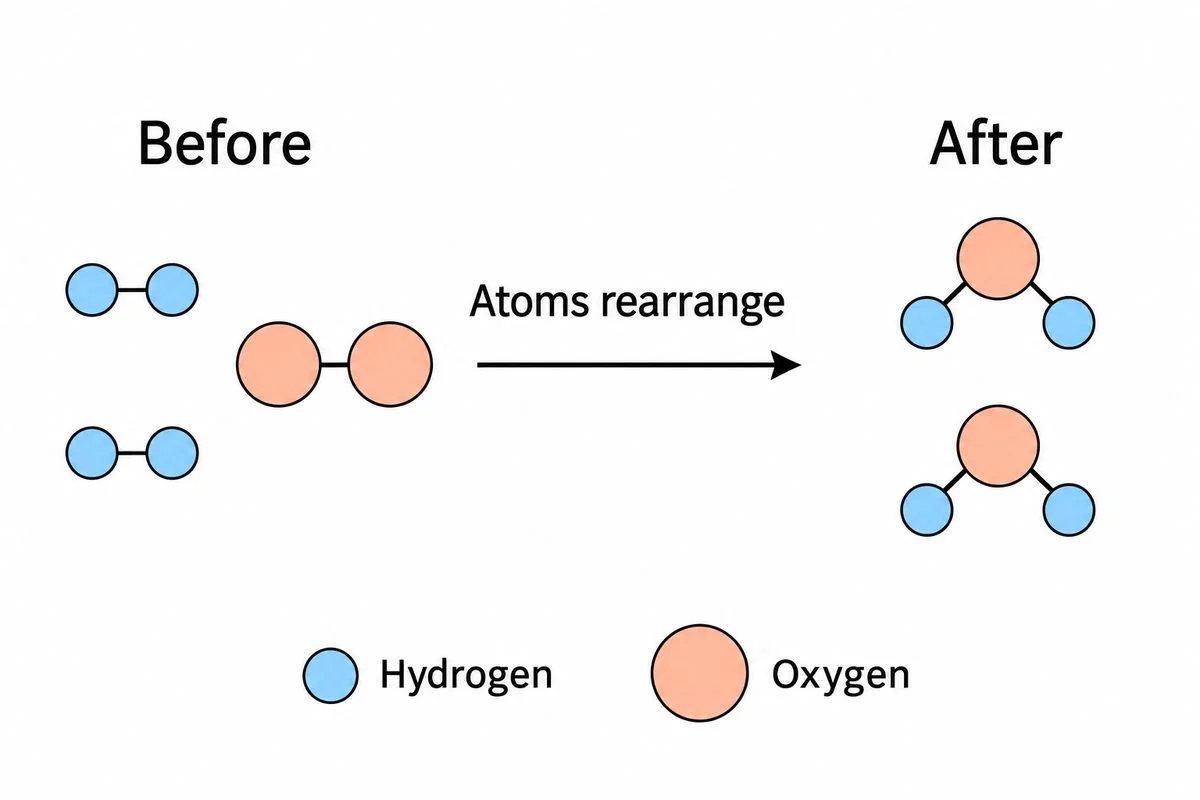
Hydrogen and oxygen atoms regroup into water molecules without changing either atom count.

1. Conservation of mass and Dalton’s atomic theory

Chemical reactions regroup atoms without changing their total mass.

Show
Look at the diagram. Count hydrogen atoms before and after, then oxygen atoms.
Ask
When these atoms form water, what will happen to their total mass?
Say
Their total mass is conserved. The atoms change partners, but none disappear or appear.
Used in
Ammonia production combines nitrogen and hydrogen to make fertiliser, helping farmers grow more food.
If your child says…“Some mass disappears during a reaction.”
Ask
Which atoms have disappeared when you count each kind again?
What’s true
A sealed reaction preserves total mass because no atoms enter, leave or disappear.
9 g water: mH:mO=1:8\text{9 g water: }m_{\mathrm H}:m_{\mathrm O}=1:8

18 g water: mH:mO=2:16\text{18 g water: }m_{\mathrm H}:m_{\mathrm O}=2:16

2. Law of constant proportions

A pure compound keeps its elements in fixed proportions by mass.

Show
Say, “We will compare the masses of hydrogen and oxygen in two water samples.” Then write these lines.
Ask
What will the larger sample’s mass ratio become when simplified?
Say
Both element masses double, so their mass ratio stays one to eight.
Used in
Medicine manufacturers check compounds’ element proportions to help detect impurities.
If your child says…“Pure water can have any ratio of hydrogen to oxygen.”
Ask
Do both elements’ masses increase by the same factor?
What’s true
Changing the sample size does not change a pure compound’s element proportions.

How atoms join

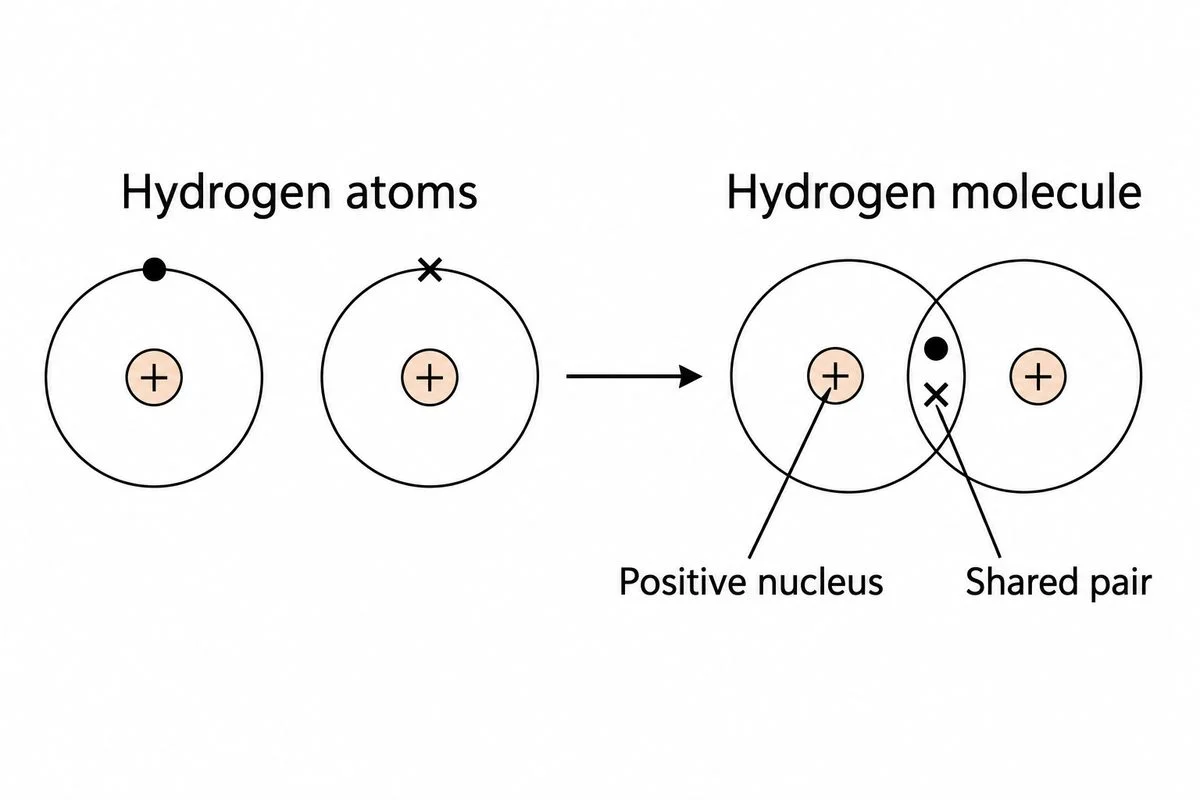
Two hydrogen atoms share an electron pair attracted by both positive nuclei.

3. Covalent bonding

Atoms join by sharing pairs of electrons.

Show
Look at the diagram’s separate hydrogen atoms. Follow the arrow to the shared pair between their nuclei.
Ask
What will hold these hydrogen atoms together when they share the electron pair?
Say
Both positive nuclei attract the shared electron pair, holding the atoms together.
Used in
Covalent bonds hold long molecular chains together in plastic, helping make useful containers.
If your child says…“One atom gives its electron away.”
Ask
Does the shared pair interact with one nucleus or both?
What’s true
Both atoms share the electron pair in this covalent bond.
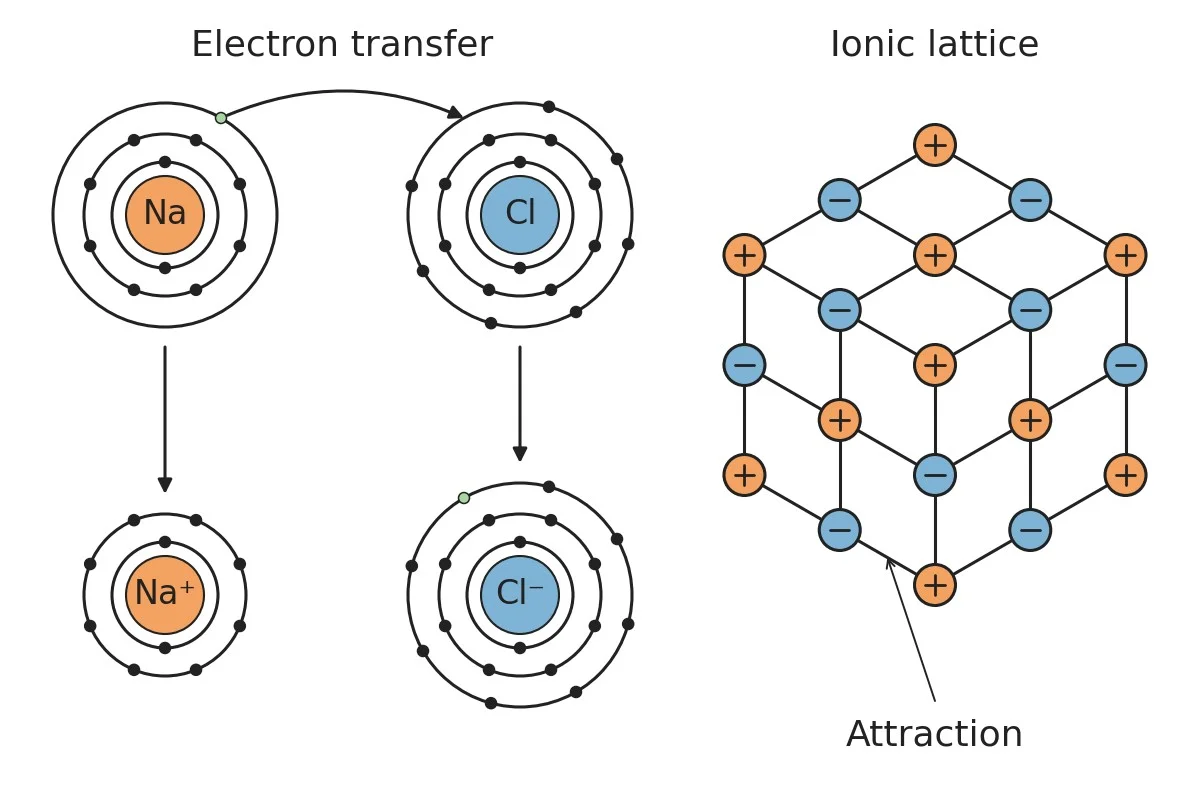
Electron transfer forms sodium and chloride ions that attract throughout a repeating crystal.

4. Ionic bonding

Oppositely charged ions attract and hold an ionic solid together.

Show
Follow the diagram’s electron from sodium to chlorine. Find the resulting ions, then the repeating crystal.
Ask
How will transferring this electron help sodium and chlorine form a crystal?
Say
Electron transfer forms oppositely charged ions. Their attraction holds the crystal together. Its positive and negative charges balance.
Used in
Ionic attraction holds table salt’s crystals together, allowing storage as solid grains.
If your child says…“Salt must have an overall charge because its ions are charged.”
Ask
What charge remains after each positive charge cancels a negative charge?
What’s true
The ions’ positive and negative charges balance across the compound.

One magnesium ion has charge +2.

2(−1)=−22(-1)=-2 — two chloride ions

Together, their charges balance.

5. Writing chemical formulae

An ionic formula shows the smallest ion ratio that balances charges.

Show
Say, “Each magnesium ion has two positive charges. Each chloride ion has one negative charge.” Then write these lines.
Ask
What formula will show this smallest balanced ratio?
Say
One magnesium ion needs two chloride ions to balance its charge. The formula is MgCl₂.
Used in
Chemical formulae identify compounds in cleaning products, helping manufacturers select the intended ingredients.
If your child says…“One ion of each is enough.”
Ask
What charge remains with one magnesium ion and only one chloride ion?
What’s true
Equal ion counts do not necessarily balance their charges.

Properties and masses

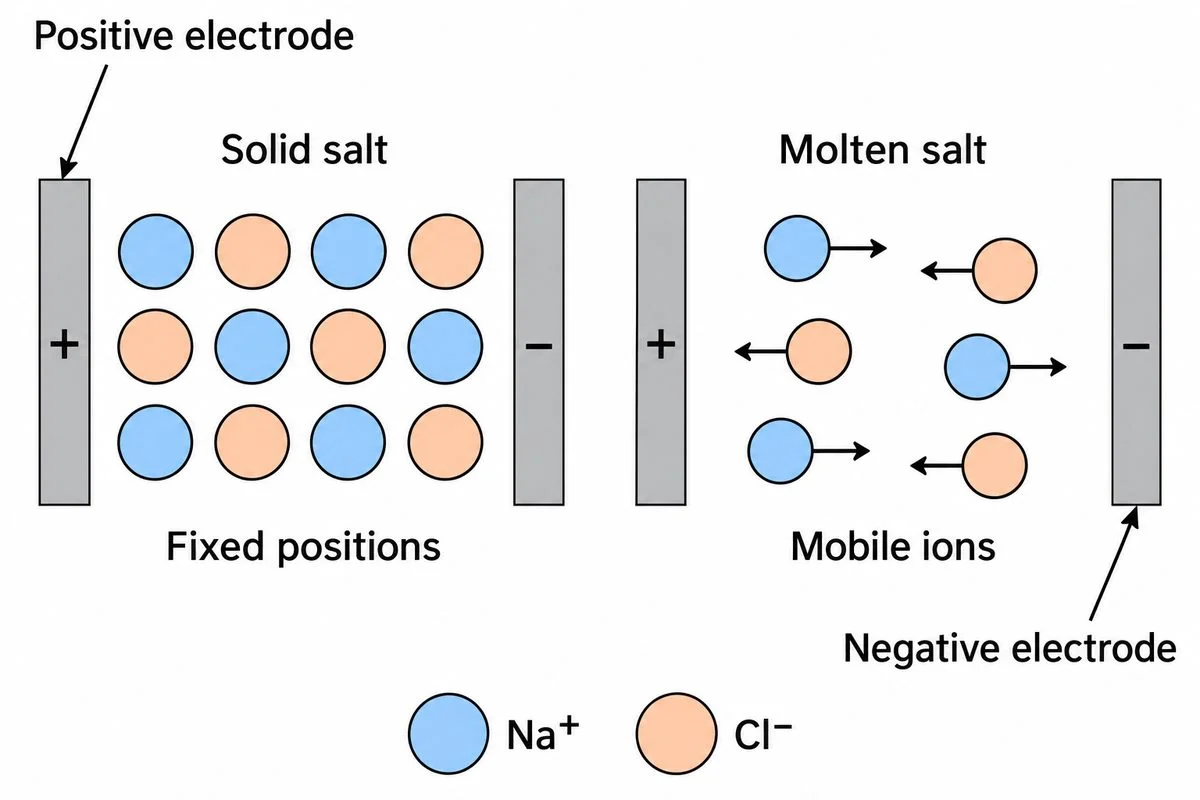
Solid salt has positioned ions; molten salt has ions moving towards opposite electrodes.

6. Electrical conductivity

Ionic substances carry electricity when their ions can travel.

Show
Look at the diagram’s solid salt, then molten salt. Follow the arrows towards opposite electrodes.
Ask
What will melting change that lets salt carry electricity?
Say
Melting lets ions travel and carry charge. Solid salt’s ions only vibrate around their positions.
Used in
Moving ions carry charge inside batteries, helping them supply electricity to household devices.
If your child says…“The ions already flow through solid salt.”
Ask
Can an ion travel across the solid while remaining around its position?
What’s true
Solid salt’s ions vibrate around their positions but cannot travel through the solid.
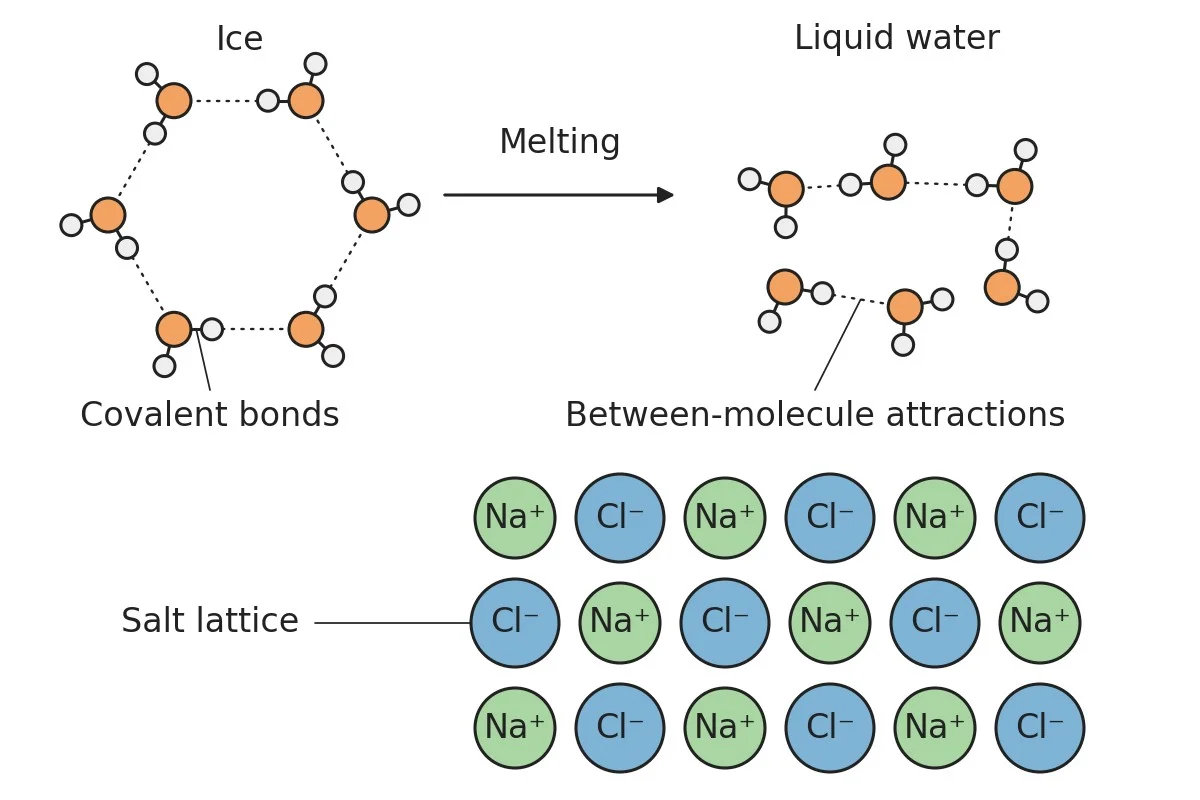
Water molecules remain intact during melting, above a comparison salt lattice.

7. Melting points

Small molecular substances usually melt more easily than ionic solids.

Show
Look at the diagram’s water molecules before and after melting. Compare their attractions with the salt lattice.
Ask
Which will melt more easily here, ice or salt?
Say
Ice melts when attractions between its molecules are overcome. Each molecule stays intact. Salt’s stronger attractions between ions mean it melts at a higher temperature than ice.
Used in
Candle wax melts readily, allowing liquid wax to feed the wick and sustain the flame.
If your child says…“Sharing electrons always makes a substance hard to melt.”
Ask
Does melting separate whole water molecules or split each molecule’s atoms apart?
What’s true
Small molecular substances often melt easily because attractions between their molecules are weak.

The two hydrogen atoms contribute 2×1 u=2 u2\times1\,\mathrm{u}=2\,\mathrm{u}.

The oxygen atom contributes 16 u.

8. Molecular mass and formula-unit mass

Add atomic masses for every atom shown in the formula.

Show
Say, “Each water molecule has two hydrogen atoms and one oxygen atom. Atomic masses use the unit u.” Then write these lines.
Ask
What molecular mass will adding both contributions give?
Say
Water’s molecular mass is 18 u because both hydrogen atoms count.
Used in
Fertiliser manufacturers use formula masses to calculate nutrient quantities, helping supply the intended nutrients.
If your child says…“I count each element only once.”
Ask
Which hydrogen atom would disappear from your calculation if you counted hydrogen only once?
What’s true
Both calculations include every atom indicated by the formula.

A real problem

Ammonia production made fertiliser widely available.

Carl Bosch brought ammonia production to industrial scale by 1913.

The process combines nitrogen and hydrogen under high pressure with a catalyst.

Widely available ammonia fertiliser helped farmers increase crop yields.

WWF Netherlands (TNO archive)Science History InstituteScience News

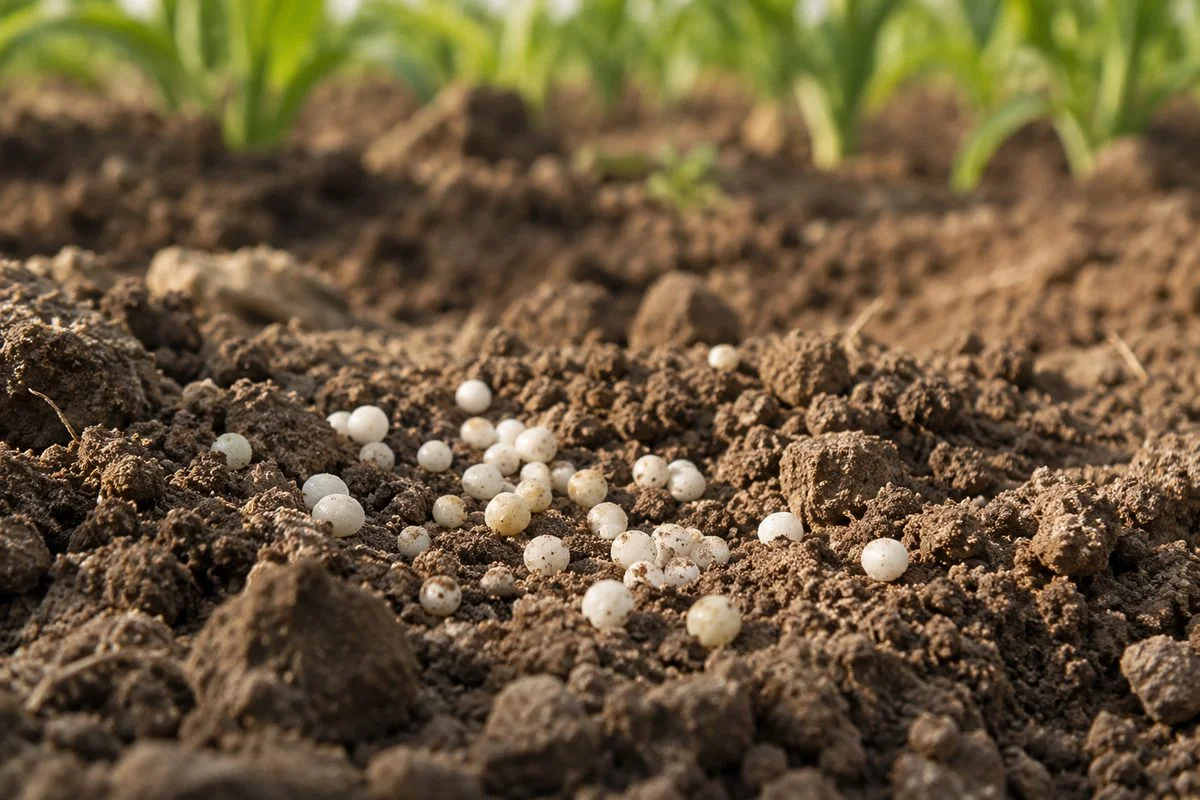
Fertiliser granules on soil beside growing crops.

Concept Lab · Common misconception

The tempting mistake in Atomic Foundations of Matter

Open standalone misconception page →

Can you change subscripts to balance an equation?

Wrong

Change H₂O to H₂O₂ to balance the oxygen atoms.

Why it feels right. Both symbols refer to hydrogen and oxygen, so the extra oxygen looks harmless.

Right

Coefficients change amounts. Subscripts specify substances.

Worked example

Reactants
HH
HH
OO
Products
HOH
HOH
Both sides contain four H atoms and two O atoms. The product stays water.

2H₂ + O₂ → 2H₂O gives four H atoms and two O atoms on each side, with water as the product.

Ask your child eight quick questions.

One per step. The answer and the reason are given.

  1. What happens to total mass during a chemical reaction when nothing enters or leaves?

    It stays the same. The atoms regroup without being created or destroyed.

  2. Could pure water have a hydrogen-to-oxygen mass ratio of 1:4?

    No. Pure water always has a hydrogen-to-oxygen mass ratio of 1:8.

  3. What happens to the electron pair joining the atoms in a hydrogen molecule?

    Both atoms share it. A covalent bond involves sharing the pair, rather than giving it away.

  4. What overall charge does sodium chloride have?

    Zero. Its positive and negative charges cancel.

  5. What formula correctly combines Mg²⁺ and Cl⁻?

    MgCl₂. Two chloride ions balance the charge of one magnesium ion.

  6. What prevents solid salt’s ions from carrying electricity through it?

    They cannot travel through it. Charge carriers must move through the substance to carry electricity.

  7. Which attractions are overcome when ice melts?

    Attractions between water molecules. Melting leaves the covalent bonds inside each water molecule intact.

  8. Using hydrogen’s mass of 1 u and oxygen’s 16 u, what is water’s molecular mass?

    18 u. Both hydrogen atoms contribute: 2 × 1 + 16 = 18 u.

8 more questions with answers