Skip to content

Teach Journey Inside the Atom in eight steps.

For each idea: show it, ask before you tell, then say one line.

Gather paper and a pencil.

Common misconceptions & worked visual for this chapter · 8 practice questions with answers

How to teach it

Models of the atom

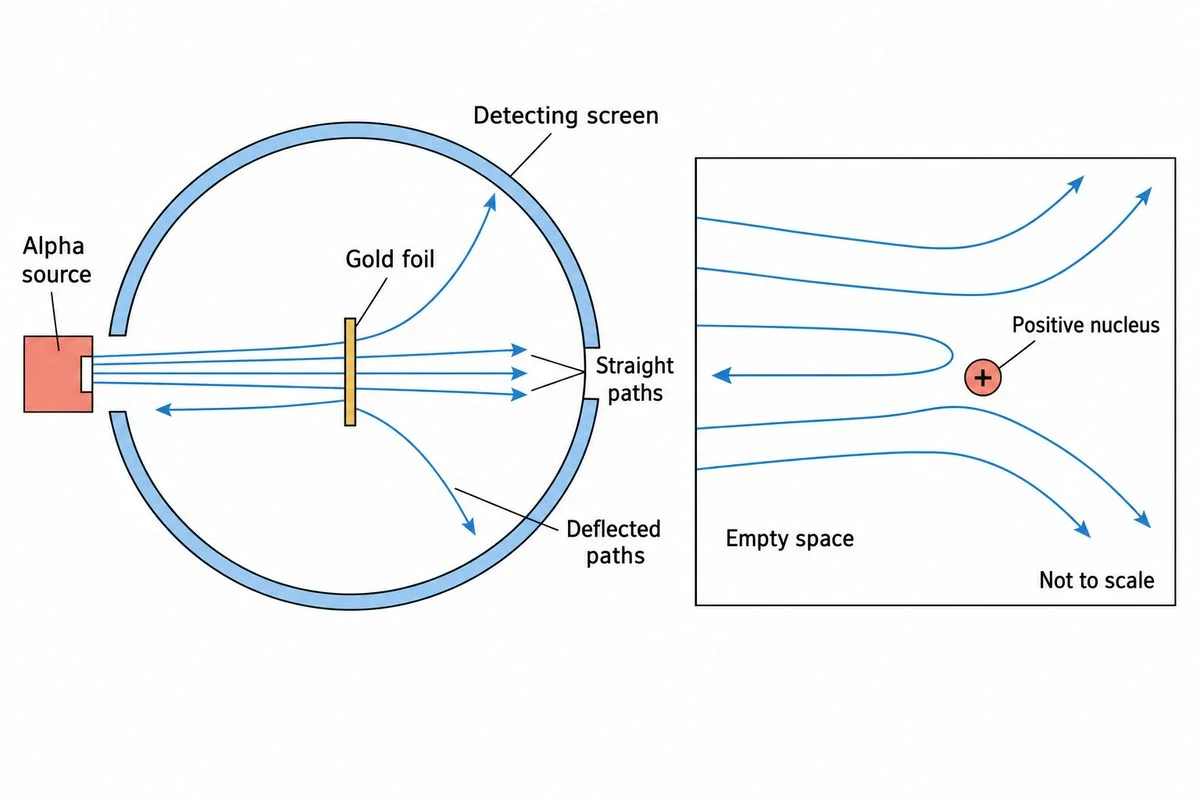
Gold-foil experiment beside enlarged particle paths bending away from a tiny positive nucleus.

1. Atomic models and experimental evidence

Atoms have a tiny positive nucleus and mostly empty space.

Show
Look at the diagram’s gold foil and particle paths. Find the returning path. Follow the enlarged paths near the positive nucleus.
Ask
For these paths, would evenly spreading the positive charge still produce such sharp turns?
Say
Most paths pass through empty space. A tiny positive nucleus repels positive alpha particles, turning a few sharply. This rules out evenly spread positive charge.
Used in
Atomic models explain electrical conduction, helping us choose metals for wires.
If your child says…“The positive charge is spread everywhere.”
Ask
Could widely spread charge turn a few particles back so sharply?
What’s true
The rare sharp deflections showed that positive charge was concentrated in a tiny nucleus.
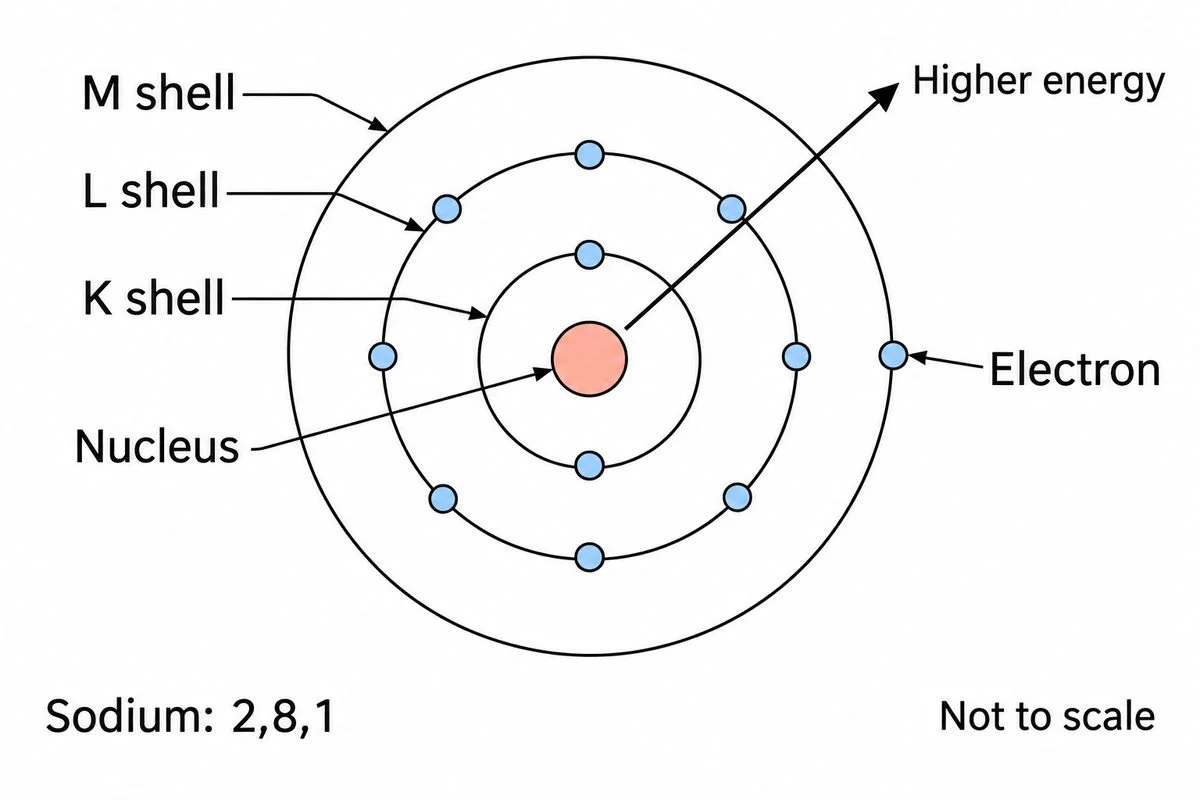
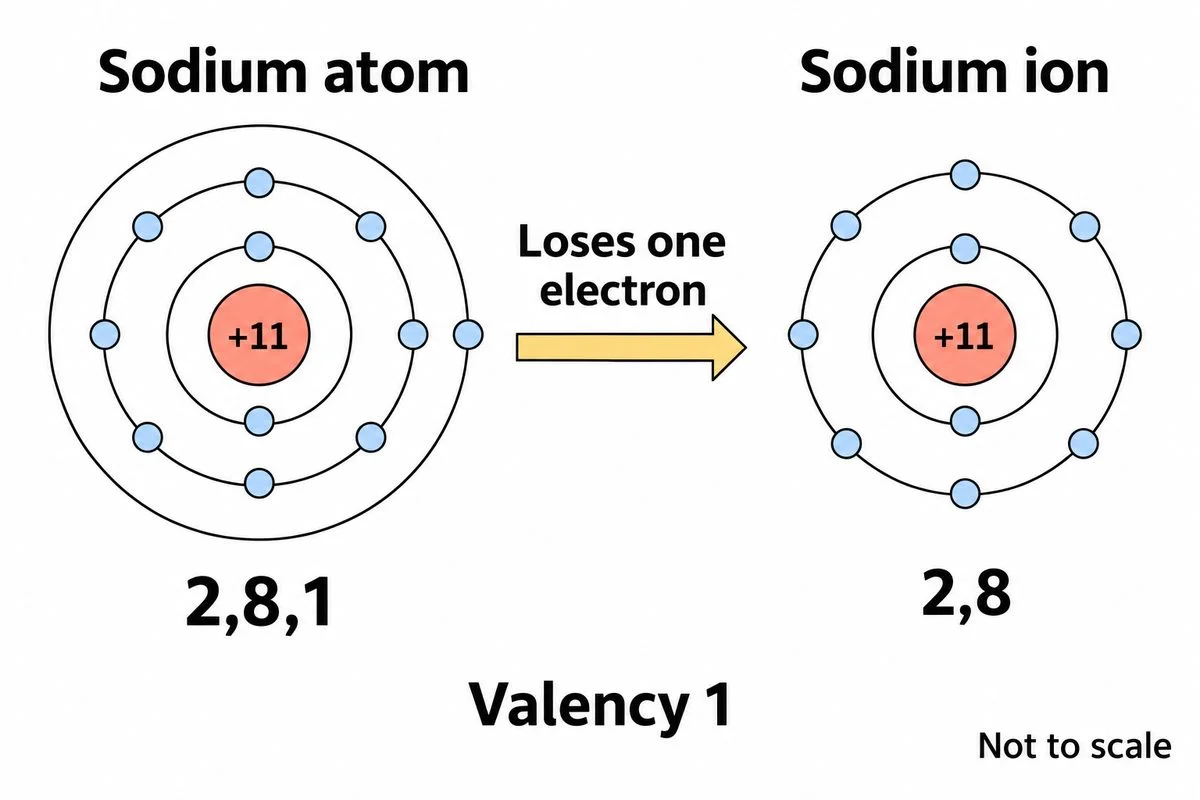
Sodium’s three shells contain two, eight and one electrons, with energy increasing outwards.

2. Bohr’s model and electron distribution

Electrons occupy shells with different energies outside the nucleus.

Show
Look at the sodium diagram. Count electrons from K outwards through L to M. Follow the outward energy arrow.
Ask
Where must sodium’s eleventh electron go after K holds two and L holds eight?
Say
It goes into M. The circles represent shells with different allowed energies.
Used in
In gas-filled signs, electrons release light when they fall to lower energy levels.
If your child says…“Electrons belong inside the nucleus.”
Ask
Are the electron dots inside the nucleus or on the surrounding shells?
What’s true
Electrons occupy shells around the nucleus, outside it.

Particles, counts and valency

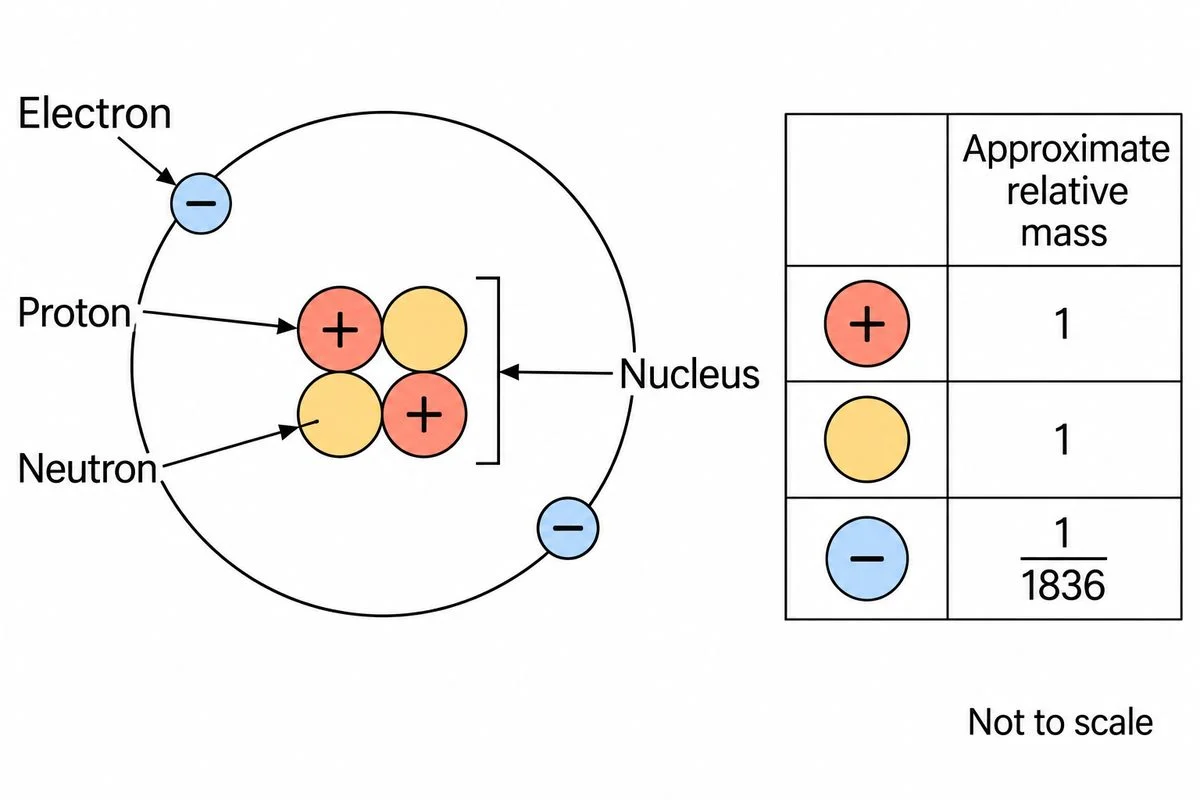
Helium’s nuclear particles and surrounding electrons beside their approximate relative masses.

3. Protons, neutrons, and atomic mass

Protons and neutrons account for nearly all an atom’s mass.

Show
Look at the helium diagram. Find its nuclear particles, then its electrons. Compare their masses in the table.
Ask
Using this table, would adding one neutron or one electron increase the atom’s mass more?
Say
Adding one neutron increases the atom’s mass more. The nucleus holds nearly all the mass because its particles are much heavier than electrons.
Used in
Atomic masses help fertiliser makers weigh ingredients in the required proportions.
If your child says…“Electrons provide most of the mass.”
Ask
Which particles have the larger relative masses in the table?
What’s true
Each proton or neutron is much heavier than an electron.

Atom charge=11(+1)+11(−1)=0\text{Atom charge}=11(+1)+11(-1)=0

Ion charge=11(+1)+10(−1)\text{Ion charge}=11(+1)+10(-1)

4. Neutral atoms

Matching proton and electron counts balance an atom’s charge.

Show
Say: “Count each proton’s charge as plus one and each electron’s as minus one.” Write this line.
Ask
What charge will remain if this balanced sodium atom loses one electron?
Say
The ion’s charge becomes plus one because one proton’s charge is left unbalanced. The neutral atom had charged particles whose charges cancelled.
Used in
Antistatic treatments reduce excess charge on clothes, reducing static cling.
If your child says…“A neutral atom has no charged particles.”
Ask
Does a zero total remove the eleven protons or eleven electrons?
What’s true
Each proton’s positive charge balances one electron’s negative charge.

Atomic number=11\text{Atomic number}=11

Mass number=11+12=23\text{Mass number}=11+12=23

5. Atomic number and mass number

Protons identify elements, while protons plus neutrons give mass number.

Show
Say: “Sodium’s atomic number is eleven: it has eleven protons. Mass number counts protons and neutrons.” Write this line.
Ask
For sodium, what particles would remain after subtracting the protons from the total nuclear particles?
Say
Subtract eleven protons from twenty-three nuclear particles to get twelve neutrons. The proton count identifies sodium, while the mass number counts protons and neutrons.
Used in
Atomic numbers organise the periodic table, helping people identify and compare elements.
If your child says…“Mass number counts electrons too.”
Ask
If mass number counts only nuclear particles, why subtract electrons?
What’s true
Subtract the proton count from mass number to find the neutron count.
Sodium loses its lone outer electron, leaving two occupied shells containing two and eight.

6. Valency

Combining capacity depends on electrons lost, gained or shared.

Show
Look at the sodium atom on the diagram’s left. Follow the electron-loss arrow to the ion. Compare their outermost occupied shells.
Ask
Looking at sodium’s shells, what would happen to its outermost occupied shell after losing one electron?
Say
Losing the lone outer electron leaves the full shell underneath as the outermost occupied shell.
Used in
Valency helps chemists work out formulas for household cleaning ingredients.
If your child says…“Eleven electrons means valency eleven.”
Ask
How many electrons leave when the arrangement changes from 2,8,1 to 2,8?
What’s true
Valency here counts the electron lost.

Comparing atoms

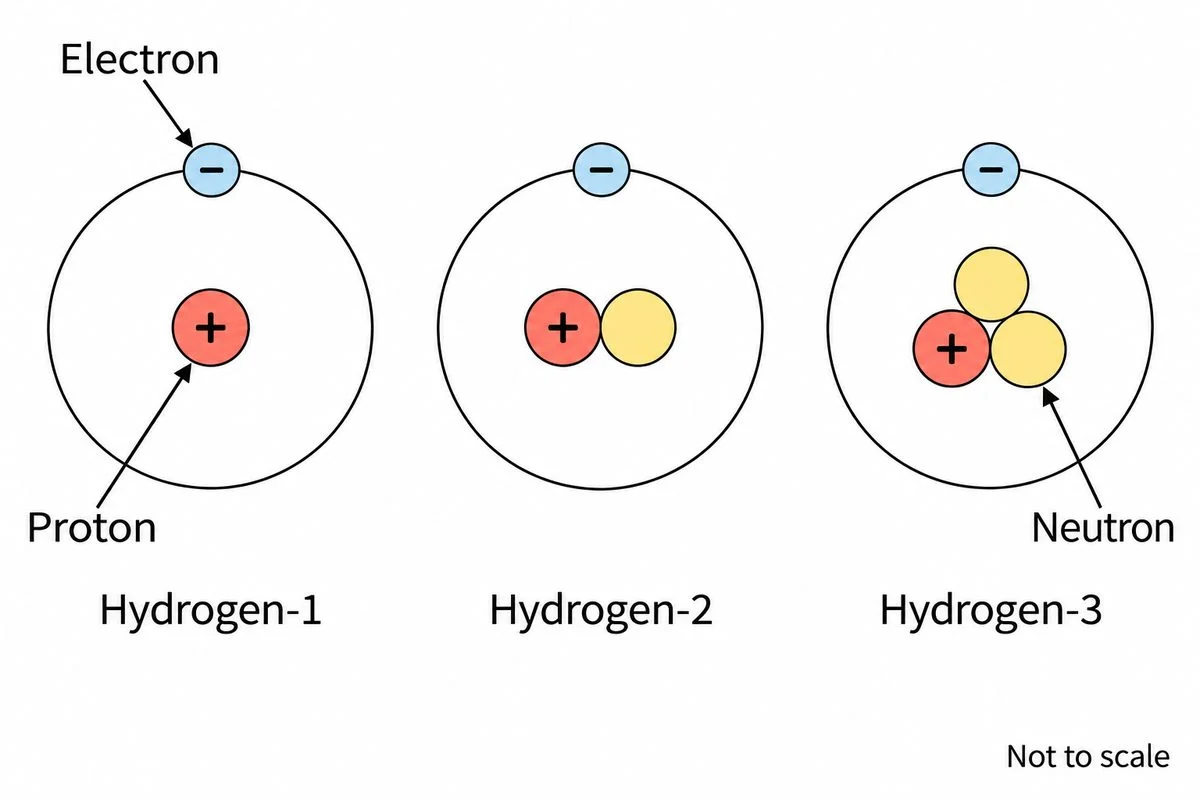
Three hydrogen isotopes share one proton each but contain different numbers of neutrons.

7. Isotopes

The same element can have atoms with different neutron counts.

Show
Look across the three hydrogen diagrams. Count each nucleus’s protons, then its neutrons.
Ask
Would these different neutron counts make the atoms different elements?
Say
They remain hydrogen because each nucleus has one proton. Their different neutron counts give different mass numbers, making them isotopes.
Used in
Radioactive cobalt has helped doctors reach deep tumours while reducing skin damage.
If your child says…“Isotopes have different proton counts.”
Ask
Which count changes across these nuclei: protons or neutrons?
What’s true
Proton count decides the element.
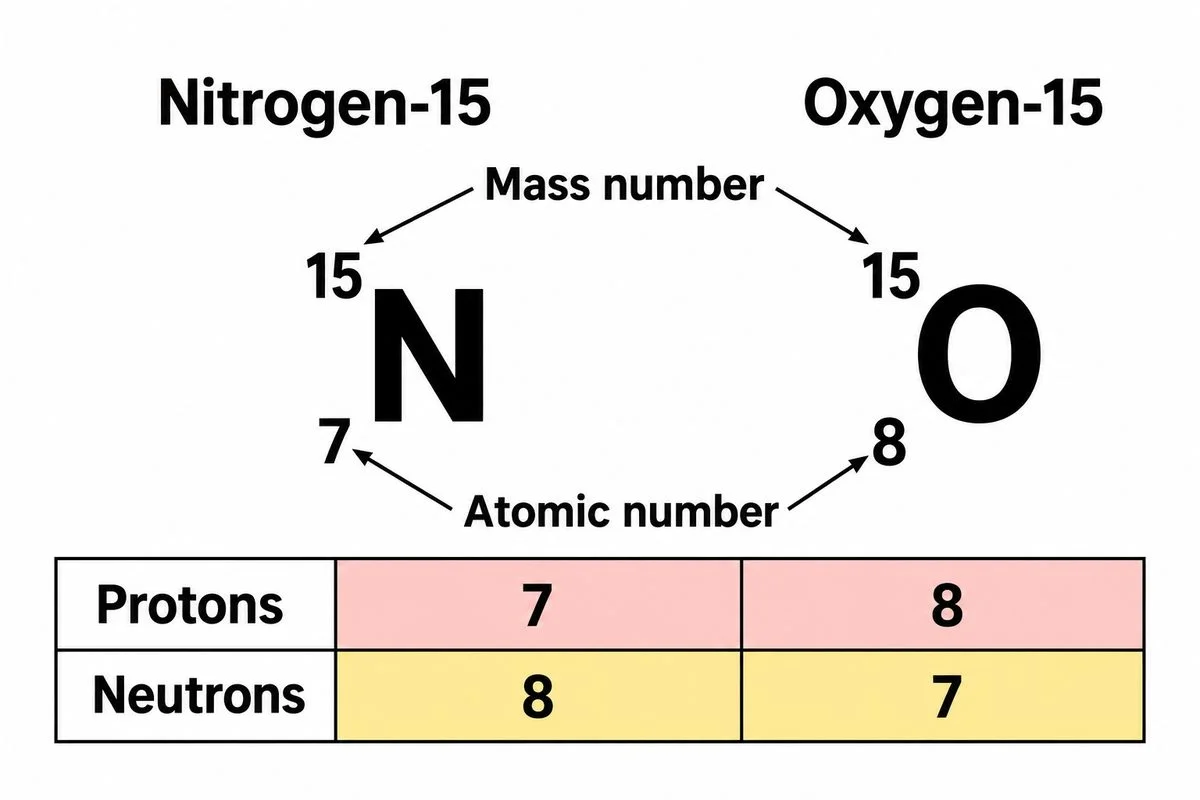
Nitrogen-15 and oxygen-15 have matching mass numbers but different proton counts.

8. Isobars

Different elements can have matching mass numbers.

Show
Look at nitrogen and oxygen in the diagram. Compare their upper mass numbers, then their lower atomic numbers.
Ask
Would matching mass numbers make these atoms the same element?
Say
No, their different proton counts make them different elements. Both nuclei contain fifteen particles altogether, so these atoms are isobars.
Used in
Chemical tests distinguish elements with matching mass numbers, helping laboratories identify substances.
If your child says…“Isobars are atoms of the same element.”
Ask
Do equal totals guarantee equal proton counts?
What’s true
Their proton counts differ.

A real problem

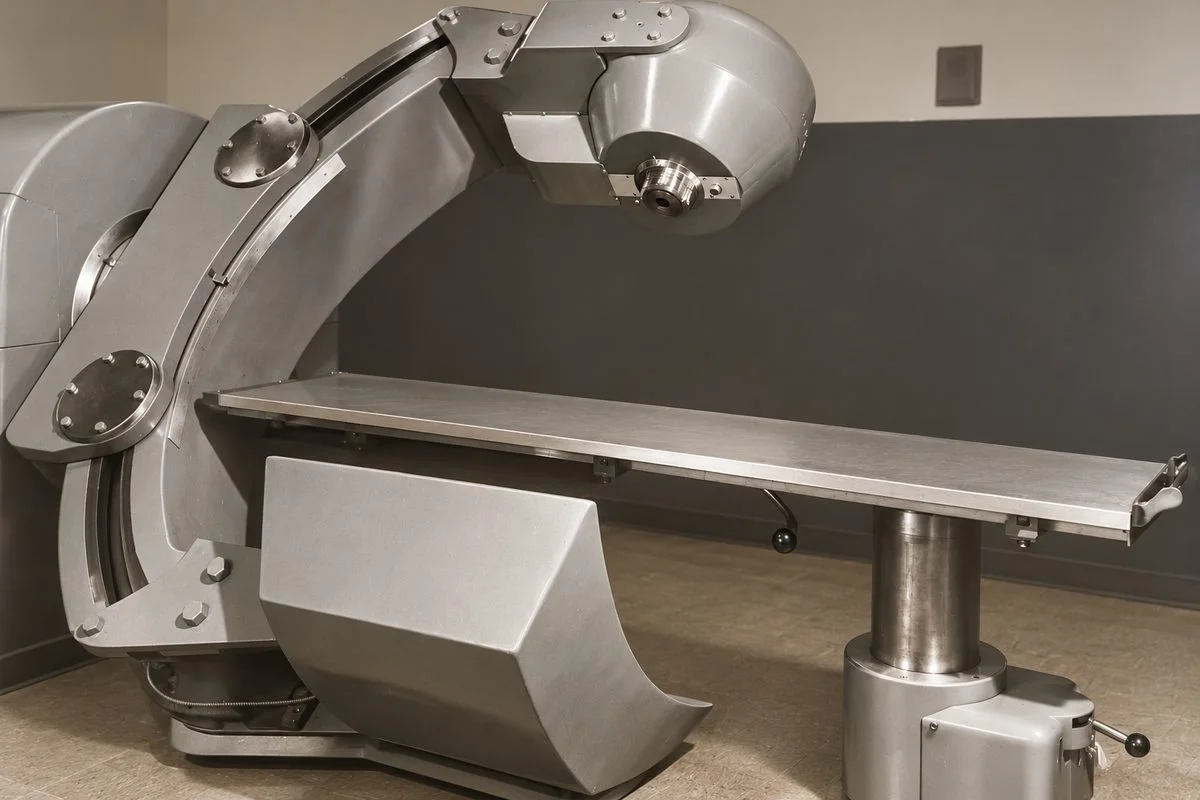
A cobalt treatment machine reached deep tumours.

Earlier radiation treatments struggled to reach tumours deep inside the body.

Ivan Smith’s team developed a pioneering cobalt cancer treatment machine in 1951.

Cobalt treatment could reach deep tumours with less skin damage than earlier treatments.

National Research Council CanadaWestern UniversityLondon Health Sciences Centre

A cobalt cancer treatment machine in an empty treatment room.

Concept Lab · Common misconception

The tempting mistake in Journey Inside the Atom

Open standalone misconception page →

Does losing an electron change the element?

Wrong

A sodium atom becomes a different element when it loses an electron.

Why it feels right. The charge and behaviour change.

Right

The proton count determines the element.

Worked example

ParticleProtonsElectrons
Na1111
Na⁺1110
Only the electron count changes. Both have 11 protons and are sodium.
  1. Neutral sodium has 11 protons and 11 electrons.
  2. Na⁺ has 11 protons and 10 electrons.
  3. Both have the sodium nucleus.

Ask your child eight quick questions.

One per step. The answer and the reason are given.

  1. What did the rare sharp deflections reveal about positive charge?

    Concentrated in a tiny nucleus. Widely spread charge could not explain those sharp turns.

  2. Where does Bohr’s model place electrons relative to the nucleus?

    Outside it, in shells. The shells surround the nucleus.

  3. Which particles provide nearly all an atom’s mass?

    Protons and neutrons. Electrons are much lighter than either nuclear particle.

  4. A neutral atom has eight protons. How many electrons does it have?

    Eight. Eight negative electrons balance eight positive protons.

  5. An atom has atomic number 11 and mass number 23. How many neutrons?

    Twelve. Subtract eleven protons from twenty-three nuclear particles.

  6. What is the valency for an electron arrangement of 2,8,1?

    One. Losing the lone outer electron leaves a full outer shell.

  7. Which particle count differs between chlorine-35 and chlorine-37?

    The neutron count. Both are chlorine, so their proton counts match.

  8. Argon-40 and calcium-40 have matching mass numbers. What name describes this pair?

    Isobars. They are different elements with the same mass number.

8 more questions with answers