Skip to content

Teach Cell: The Building Block of Life in eight steps.

For each idea: show it, ask before you tell, then say one line.

Gather a potato, sugar, water, two glasses, a teaspoon, a tablespoon, a knife, paper and a pencil.

An adult cuts the potato and keeps the knife away from your child.

Common misconceptions & worked visual for this chapter · 15 practice questions with answers

How to teach it

Cells and living things

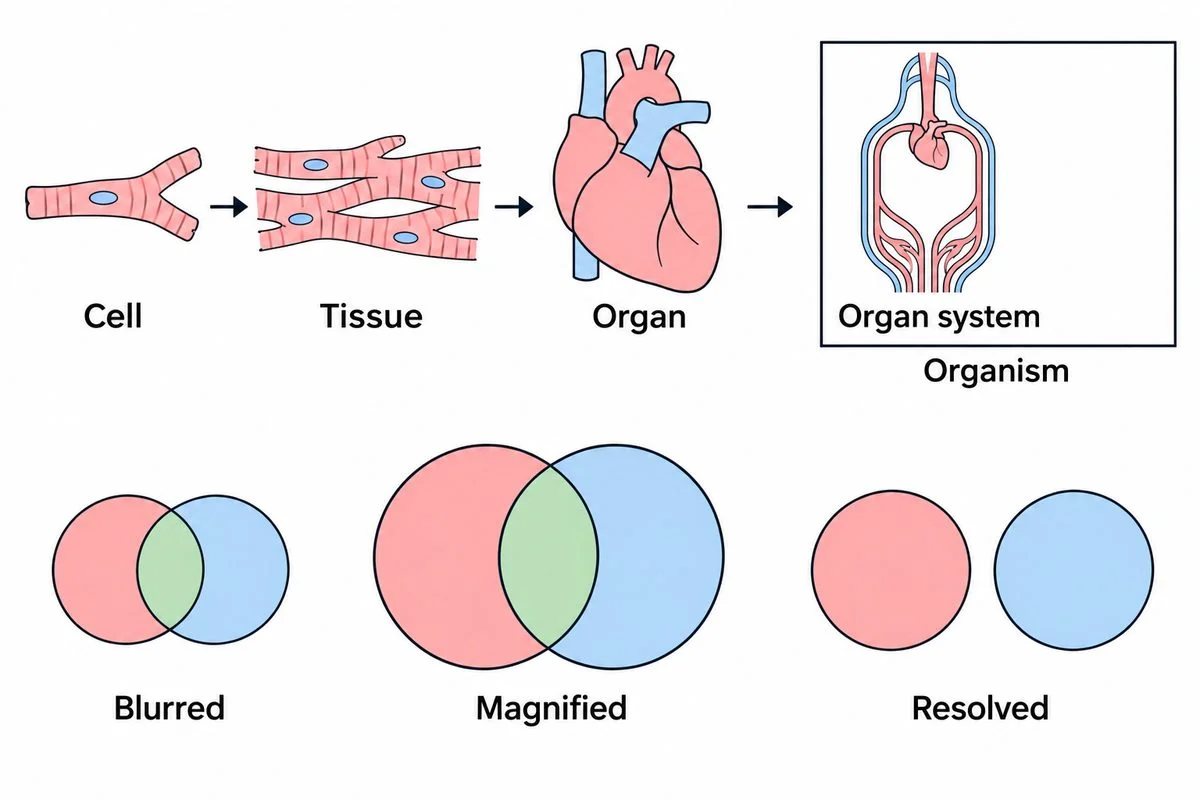
Cell organisation above blurred, enlarged and separately resolved details.

1. Cells and microscopy

Cells perform life functions within tissues, organs and organ systems.

Show
Follow the diagram from heart muscle cell to organism. Cover the magnified and resolved panels until after predicting.
Ask
Would enlarging this blurred view let you distinguish its two nearby details?
Say
Working cells form tissues, organs and organ systems. Magnification enlarges images, while resolution lets us distinguish nearby details.
Used in
Microscope resolution lets nearby cell parts appear separate, making them easier to distinguish.
If your child says…“A bigger image always shows more detail.”
Ask
Did enlargement separate details that were blurred together?
What’s true
Enlargement cannot separate details that were not resolved.
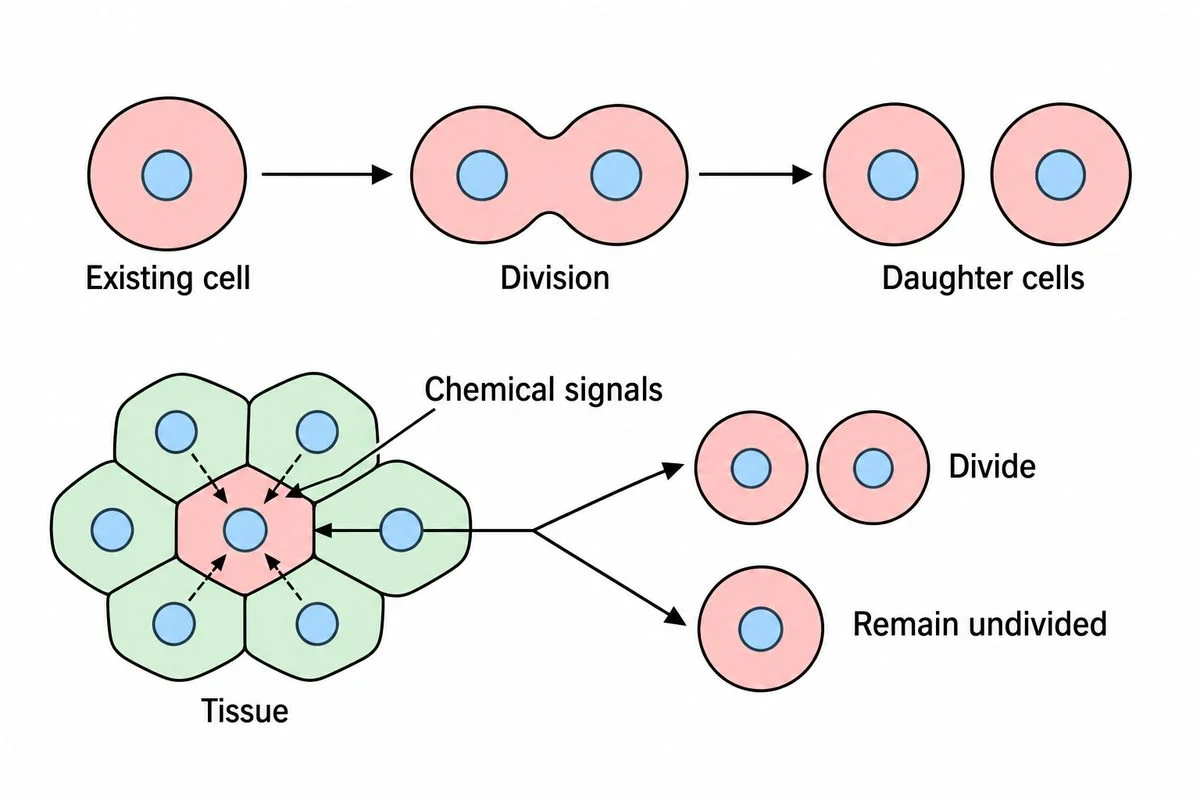
Existing cells divide, while signals help regulate division within tissue.

2. Cell theory and growth control

Existing cells produce new cells, with division controlled by tissue needs.

Show
Find the existing cell in the diagram. Trace its division, then find signals from nearby tissue cells.
Ask
Where would extra cells come from when this tissue needs repair?
Say
Existing cells divide to supply new cells. Chemical signals help control when division happens.
Used in
Regulated cell division replaces cells lost from skin, maintaining its surface.
If your child says…“Cells dividing again and again must mean cancer.”
Ask
If signals control this new growth, must repeated division mean cancer?
What’s true
Repeated division can be healthy when signals regulate it.

Cell boundaries and contents

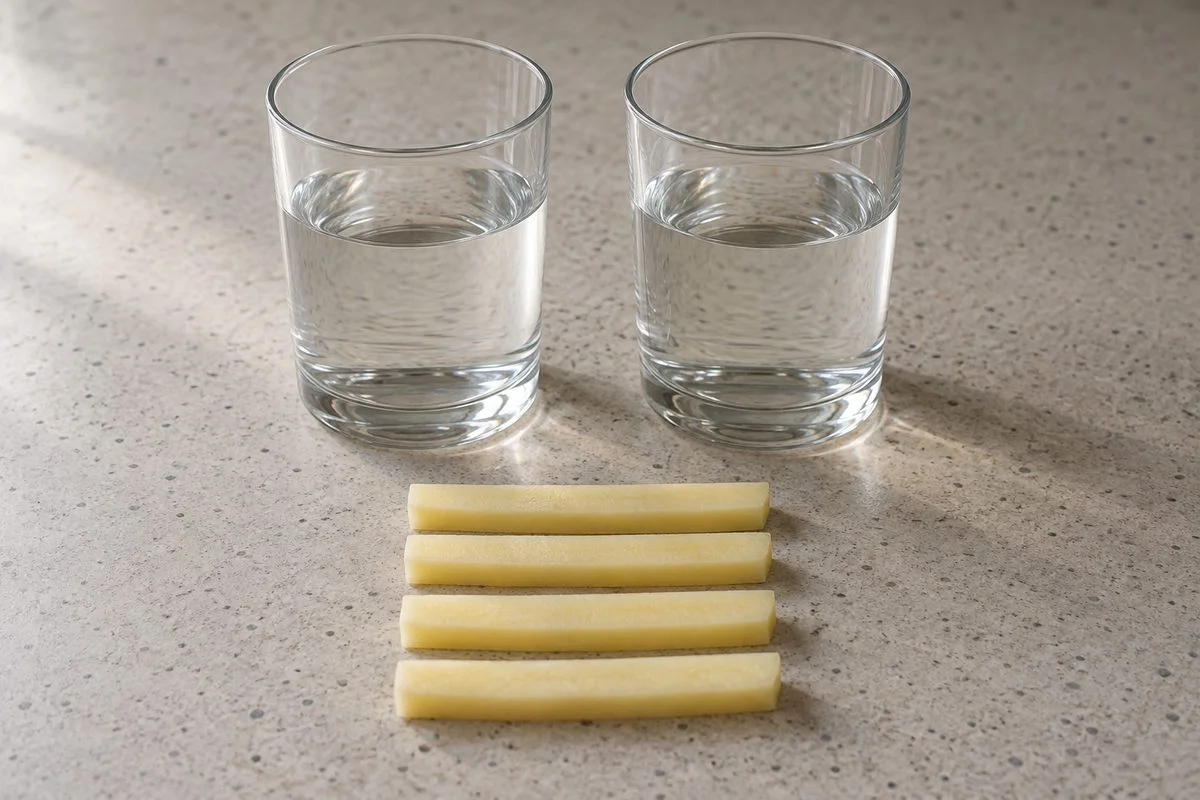
Potato strips beside two glasses of clear liquid before soaking.

3. Cell membrane, diffusion and osmosis

Water crosses cell membranes during osmosis.

Show
An adult cuts potato strips and removes the knife. Mix four teaspoons of sugar with four tablespoons of water. After predicting, soak separately in this solution and water for 45–60 minutes, then compare bending.
Ask
Which strip will lose water?
Say
The sugar-soaked strip loses water by osmosis.
Used in
Pressure reverses osmosis to provide drinking water from seawater.
If your child says…“Sugar solution makes water enter the strip.”
Ask
Which side has less water relative to sugar?
What’s true
Across these membranes, water moves overall towards the solution containing more dissolved sugar.
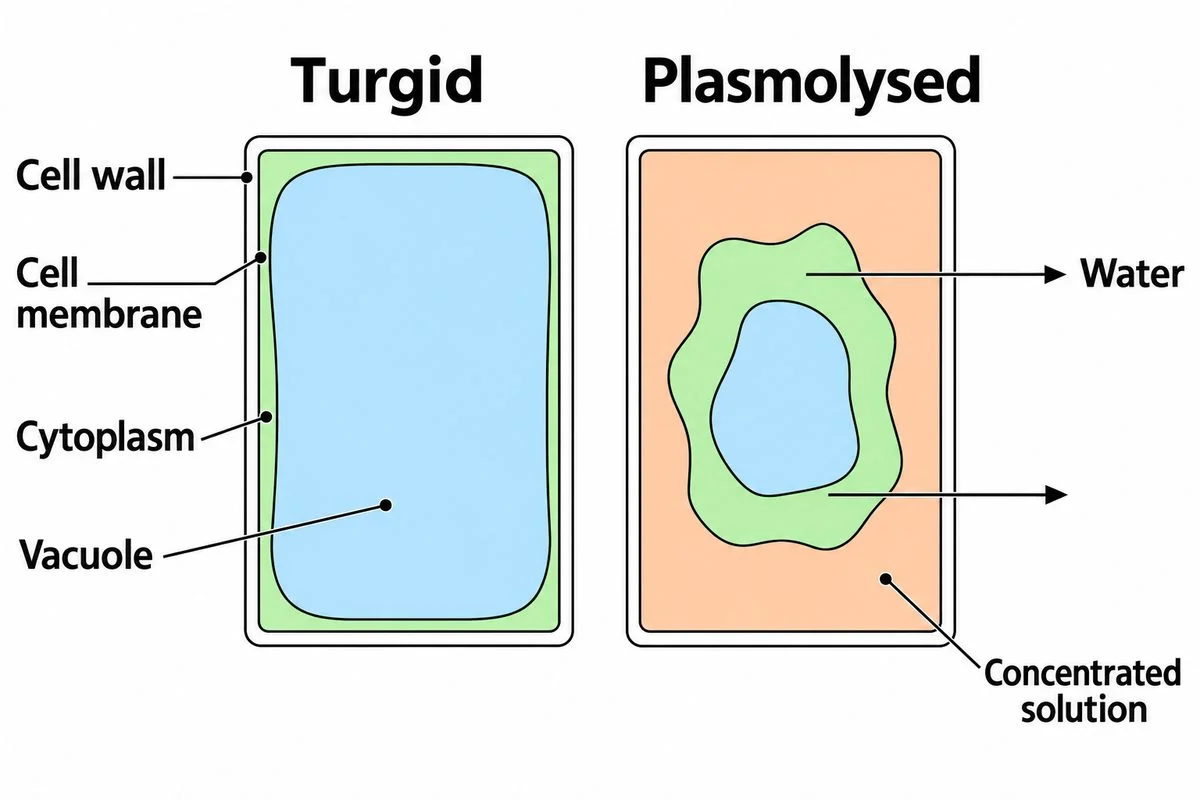
Plant cell before and after water loss, with its wall unchanged.

4. Cell wall and plasmolysis

Water loss pulls the membrane inward while the wall retains shape.

Show
Cover the diagram's right cell. Find the left cell's wall, membrane and vacuole. After predicting, uncover the right cell.
Ask
Which boundary would keep its outline when this cell loses water?
Say
Water leaves the cell, shrinking its vacuole and pulling its membrane away from the wall. This is plasmolysis; the rigid wall keeps its outline.
Used in
Cellulose walls support plant cells even when their contents lose water.
If your child says…“The cell wall shrinks when water leaves.”
Ask
Which boundary has moved inward in the right cell?
What’s true
The membrane retreats with the shrinking contents, while the rigid wall retains its outline.
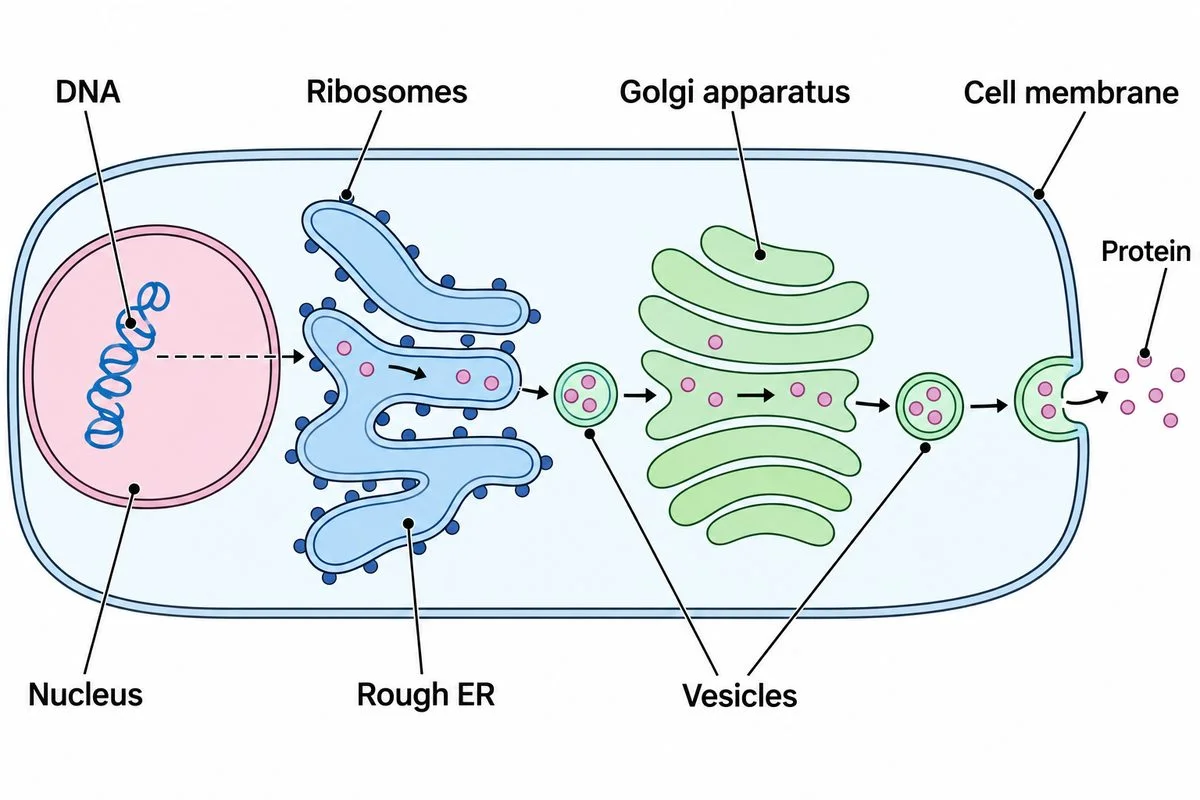
DNA instructions reach ribosomes; proteins travel through rough ER and Golgi for release.

5. Nucleus and cell manufacturing

DNA supplies instructions, while ribosomes and other organelles handle protein production.

Show
Find nuclear DNA in the diagram. Follow dashed instruction arrows to ribosomes. Trace solid protein arrows through rough ER, vesicles and Golgi towards the cell surface.
Ask
Where would this cell make a protein before sending it outside?
Say
DNA provides instructions, and ribosomes on rough ER make the protein. Vesicles carry it through the Golgi apparatus, which modifies, sorts and packages it for release.
Used in
The Golgi apparatus modifies, sorts and packages proteins, preparing them for delivery.
If your child says…“The Golgi apparatus makes proteins.”
Ask
Where does the protein first appear along this route?
What’s true
Ribosomes make proteins before the Golgi apparatus receives them.
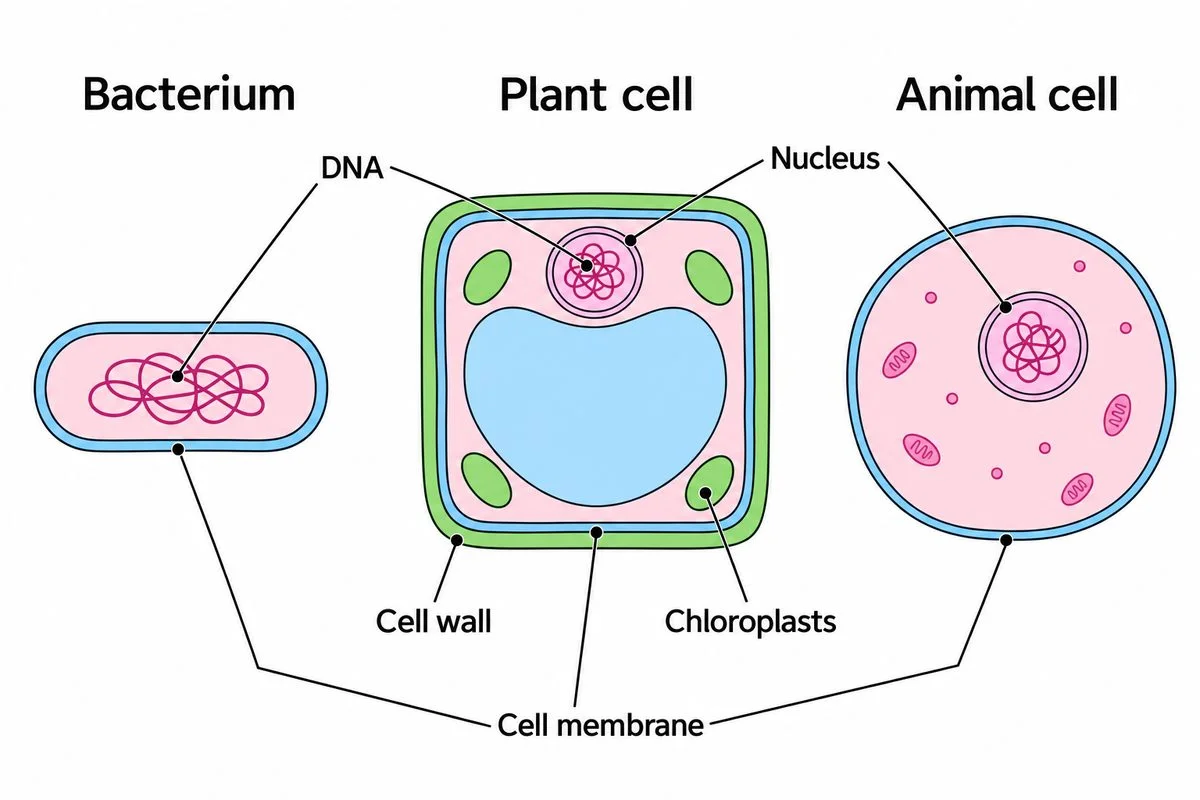
Bacterial, leaf and animal cells compared by DNA location and visible structures.

6. Prokaryotic, eukaryotic, plant and animal cells

Prokaryotes lack enclosed nuclei, while eukaryotes have them.

Show
Locate DNA in each cell in the diagram. Compare nuclei, then the leaf cell's wall, chloroplasts and large vacuole.
Ask
Where would this bacterium keep its DNA without a nucleus?
Say
Bacterial DNA lies inside the cell without an enclosed nucleus. Plant and animal cells usually enclose their main DNA in a nucleus. This leaf cell has a wall, a large vacuole and chloroplasts.
Used in
Bacteria have ribosomes to make the proteins their cells need.
If your child says…“Without a nucleus, bacteria cannot have DNA.”
Ask
Which boundary still surrounds the bacterium's DNA?
What’s true
Bacterial DNA occupies a region called the nucleoid, without a surrounding nuclear membrane.
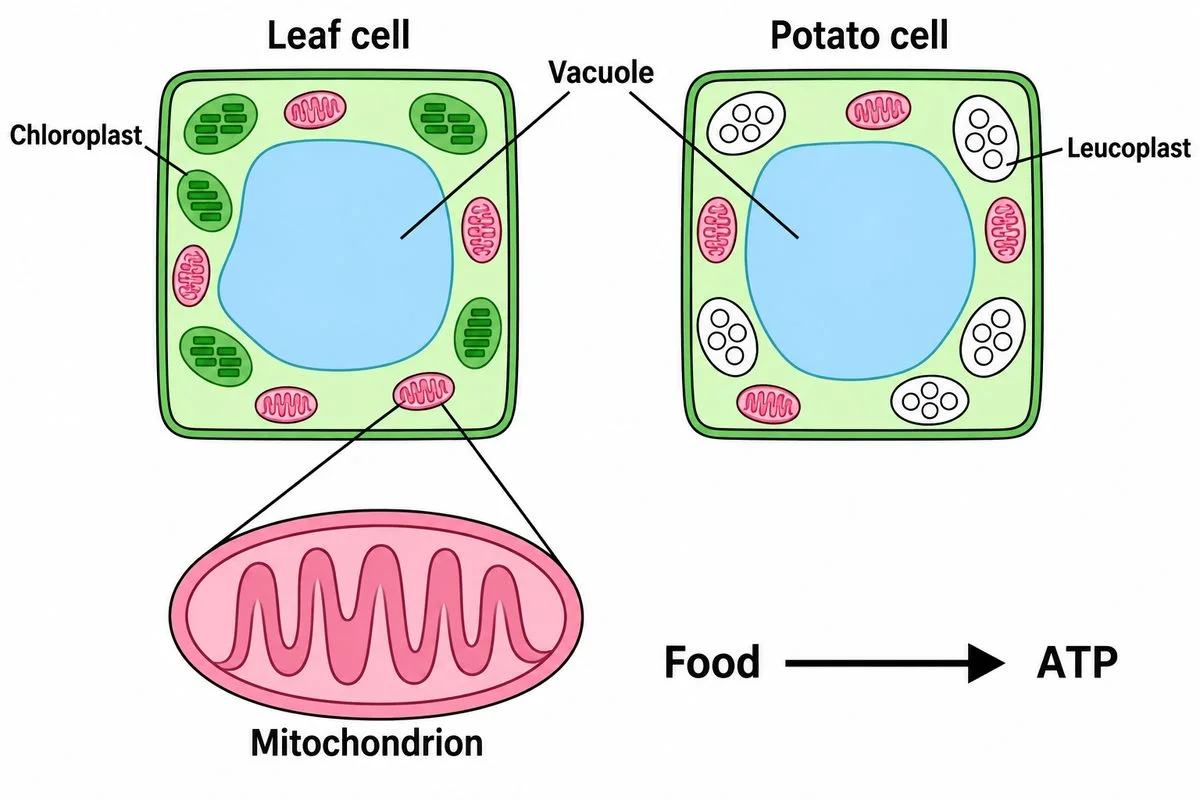
Leaf and potato cells contain different plastids, alongside mitochondria and fluid-filled vacuoles.

7. Mitochondria, plastids and vacuoles

Organelles make food, release its energy, store substances and support cells.

Show
Compare plastids in the diagram's leaf and potato cells. Find mitochondria and vacuoles in both.
Ask
Without light, could this leaf cell's mitochondria still release energy from food?
Say
Chloroplasts make food using light, while colourless leucoplasts store food. Mitochondria transfer food energy into ATP for cell work. Vacuoles hold cell sap and help keep cells firm.
Used in
Water-filled vacuoles press against cell walls, helping plants stay firm.
If your child says…“Every plastid is green.”
Ask
Would a colourless food store need green pigment to do its job?
What’s true
Some plastids store food or contain other colours instead of chlorophyll.

Cell division

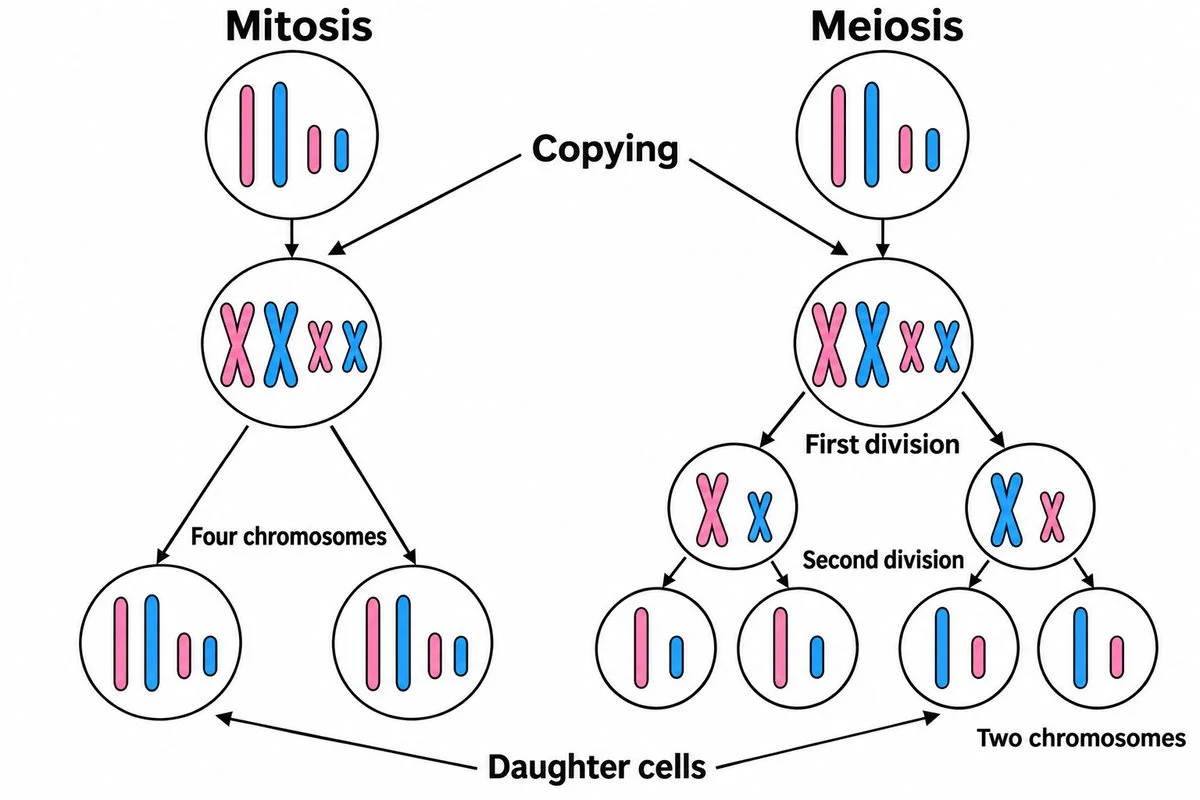
Mitosis preserves four chromosomes per cell; meiosis produces cells with two each.

8. Mitosis and meiosis

Mitosis preserves chromosome number, while meiosis halves it.

Show
Cover the diagram's final cells. Find each starting cell's four chromosomes and follow the copying arrows. Uncover the outcomes after predicting.
Ask
Which division would supply replacement cells with the original chromosome number?
Say
Chromosomes are copied first. Mitosis makes two cells with four chromosomes each here, preserving the number for growth and repair. Meiosis makes four cells with two each.
Used in
Mitosis adds root cells, helping roots grow towards water.
If your child says…“Each new skin cell gets half the chromosomes.”
Ask
How does each final mitosis cell's chromosome count compare with the starting cell's?
What’s true
Chromosomes are copied before mitosis, so each new cell receives a full set.

A real problem

Minjur turns seawater into drinking water.

Chennai’s drinking-water sources depend on monsoons, so shortages occur frequently.

Minjur’s plant began commercial operation on 25 July 2010.

Its membranes hold back salts while water passes through.

Reverse osmosis applies pressure greater than osmotic pressure to push drinking water through membranes.

Press Information BureauWikipediaCSIR

Kitchen tap filling a stainless-steel drinking-water vessel.

Concept Lab · Common misconception

The tempting mistake in Cell: The Building Block of Life

Open standalone misconception page →

Do plant cells have cell membranes?

Wrong

Plant cells have walls in place of membranes.

Why it feels right. A rigid wall looks like the only boundary.

Right

A plant cell has a membrane inside its wall.

Worked example

The outer wall stays fixed. In concentrated salt solution the inner membrane and contents pull inward.
  1. In a suitable microscope demonstration, a plant cell in concentrated salt solution loses water.
  2. Its cell contents and membrane pull inward, and the wall remains in place.

Ask your child eight quick questions.

One per step. The answer and the reason are given.

  1. Does enlarging a microscope image always make two nearby cell parts appear separate?

    No. Enlargement alone cannot separate unresolved details.

  2. What makes cancerous growth different from normal skin replacement?

    Loss of normal growth control. Healthy replacement responds to signals that regulate division.

  3. Which way does water move overall when potato cells enter concentrated sugar solution?

    Out of the cells. The surrounding solution has less water relative to dissolved substances.

  4. Which plant-cell boundary keeps its outline when water loss pulls the contents inward?

    The cell wall. The rigid wall retains its outline while the contents shrink.

  5. Which particles on rough ER assemble proteins before the Golgi apparatus receives them?

    Ribosomes. The Golgi receives proteins already made by ribosomes.

  6. What is the region containing a bacterium's main DNA called?

    In its nucleoid. The DNA remains inside the cell without a surrounding nuclear membrane.

  7. Which plastids can store food in an underground potato?

    Leucoplasts. These colourless plastids store food without photosynthesis.

  8. Compared with their parent, how many chromosomes do new skin cells receive?

    The same number. Copying before mitosis supplies each new cell with a full set.

15 more questions with answers