Skip to content

Teach Sound Waves: Characteristics and Applications in eight steps.

For each idea: show it, ask before you tell, then say one line.

Gather a steel bowl, spoon, rubber band, tiffin box, flexible ruler, paper and pencil. Use a table, tiled bathroom and furnished room.

Common misconceptions & worked visual for this chapter · 8 practice questions with answers

How to teach it

How sound travels

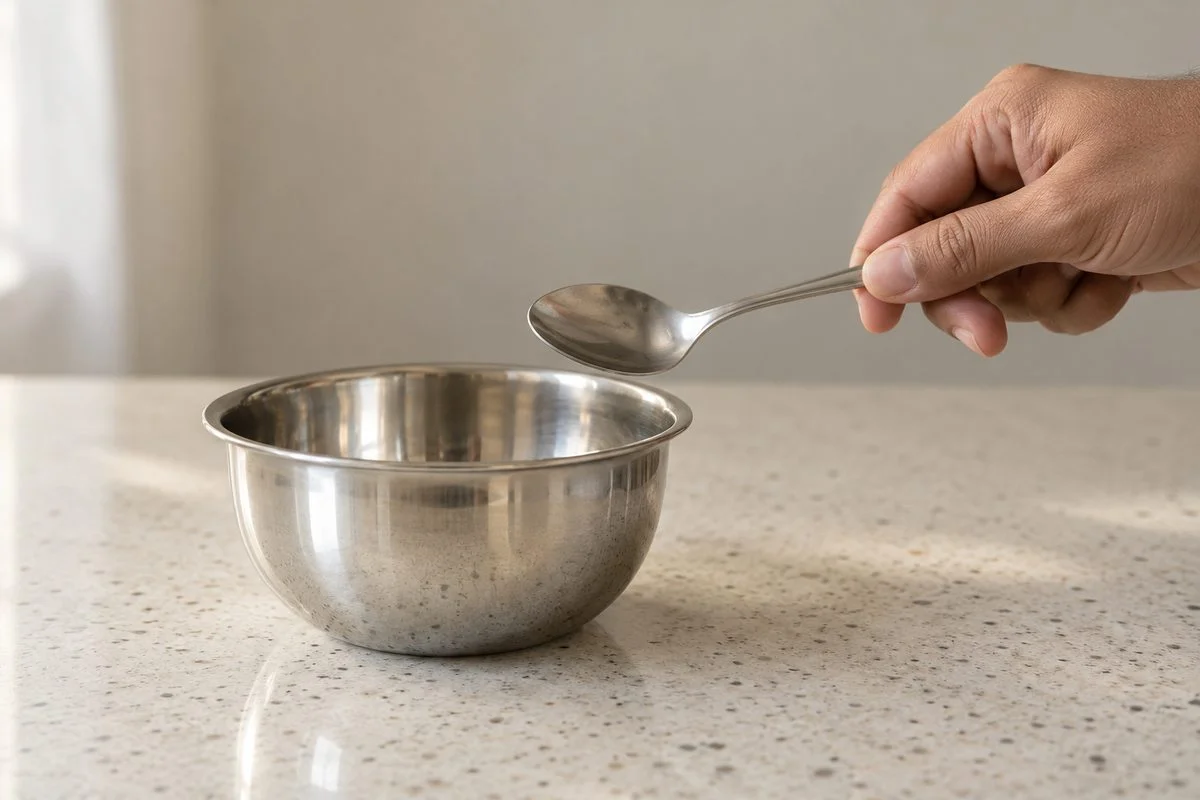
A spoon held above a steel bowl, ready to tap.

1. Production and propagation of sound

Vibrating objects send energy through matter.

Show
Hold a spoon ready. After the prediction, tap the bowl gently, listen, then hold its rim.
Ask
What will happen to the ringing when you steady the bowl?
Say
Holding the rim reduces the bowl’s vibrations, so its ringing fades.
Used in
An ultrasound probe sends sound into the body for examination.
If your child says…“The bowl’s air travels to my ear.”
Ask
Do you need a breeze from the bowl to hear it?
What’s true
Particles vibrate around their places; without matter, sound cannot travel.

Describing sound

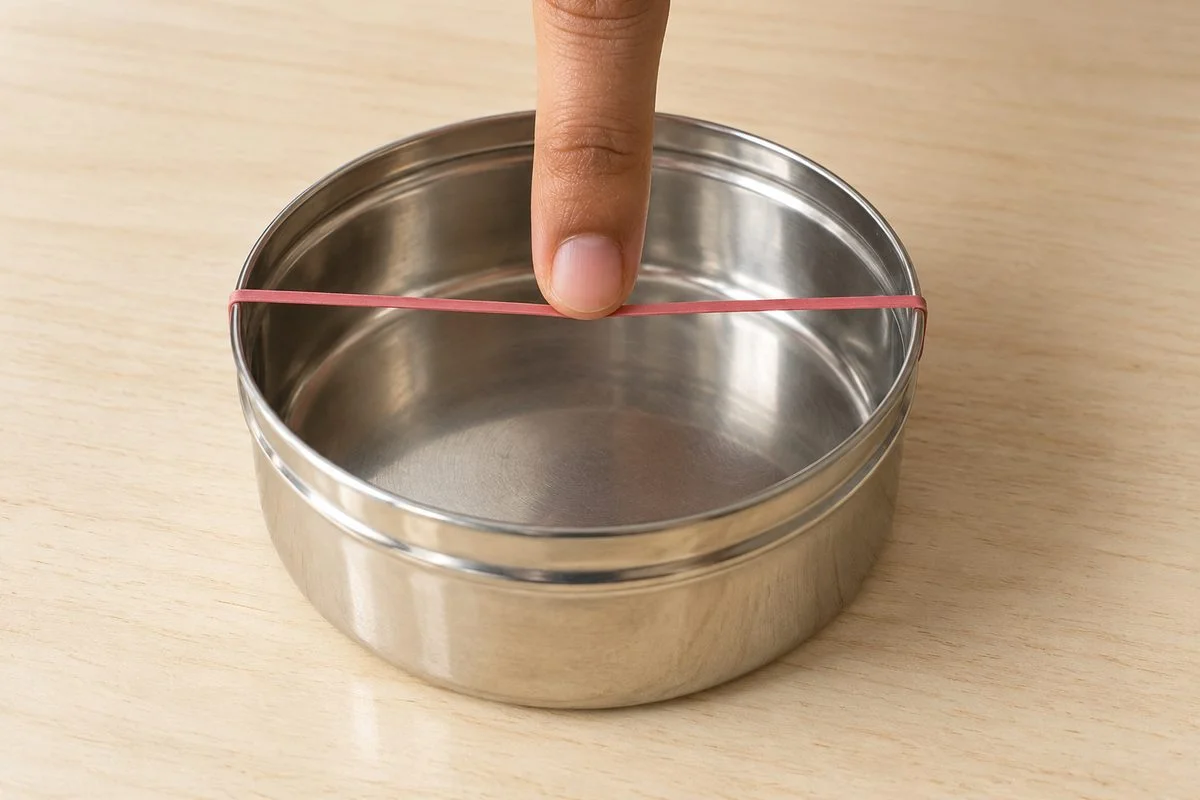
A fingertip beside a rubber band stretched across an open steel tiffin box.

2. Amplitude and loudness

Amplitude is a particle’s greatest distance from its resting position during vibration.

Show
Stretch a rubber band around an open, empty tiffin box so it crosses the opening. After predicting, pluck it gently, then a little harder.
Ask
Which pluck will make the louder sound?
Say
The harder pluck makes a larger vibration, which makes the sound louder.
Used in
Reducing excessive sound intensity helps protect hearing.
If your child says…“More vibrations each second means louder sound.”
Ask
Did the stronger pluck mainly change loudness or make a different note?
What’s true
Loudness depends on amplitude; frequency determines pitch.
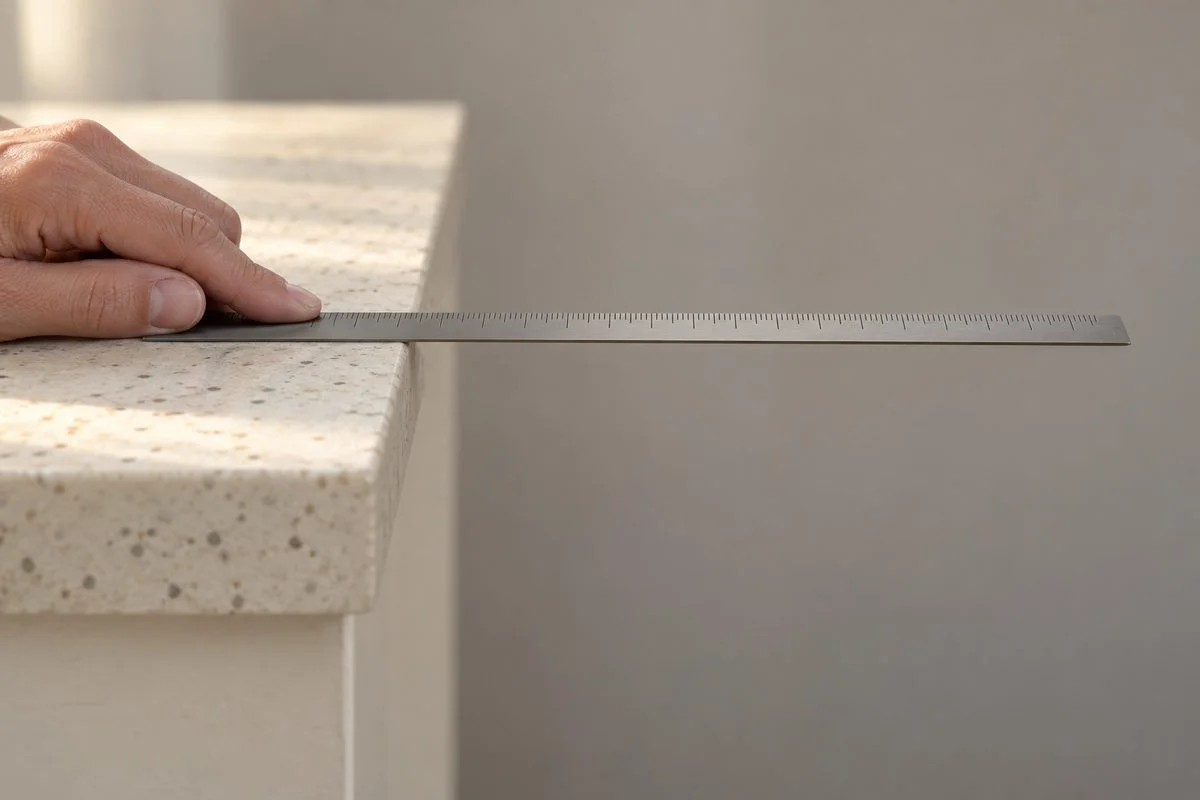
One hand holds a ruler with its free end beyond a table edge.

3. Frequency, pitch and time period

Frequency counts vibrations each second; period measures one vibration’s duration.

Show
Hold a flexible ruler firmly against a table, with half sticking beyond the edge. After predicting, pluck it gently. Shorten the part sticking out and pluck again.
Ask
Which length sticking out will vibrate faster and sound higher?
Say
The shorter length vibrates faster, giving a higher pitch.
Used in
Pitch lets listeners distinguish high notes from low notes.
If your child says…“A bigger vibration makes a higher note.”
Ask
Would making the same note louder necessarily make it higher?
What’s true
Pitch follows frequency, not the size of each vibration.
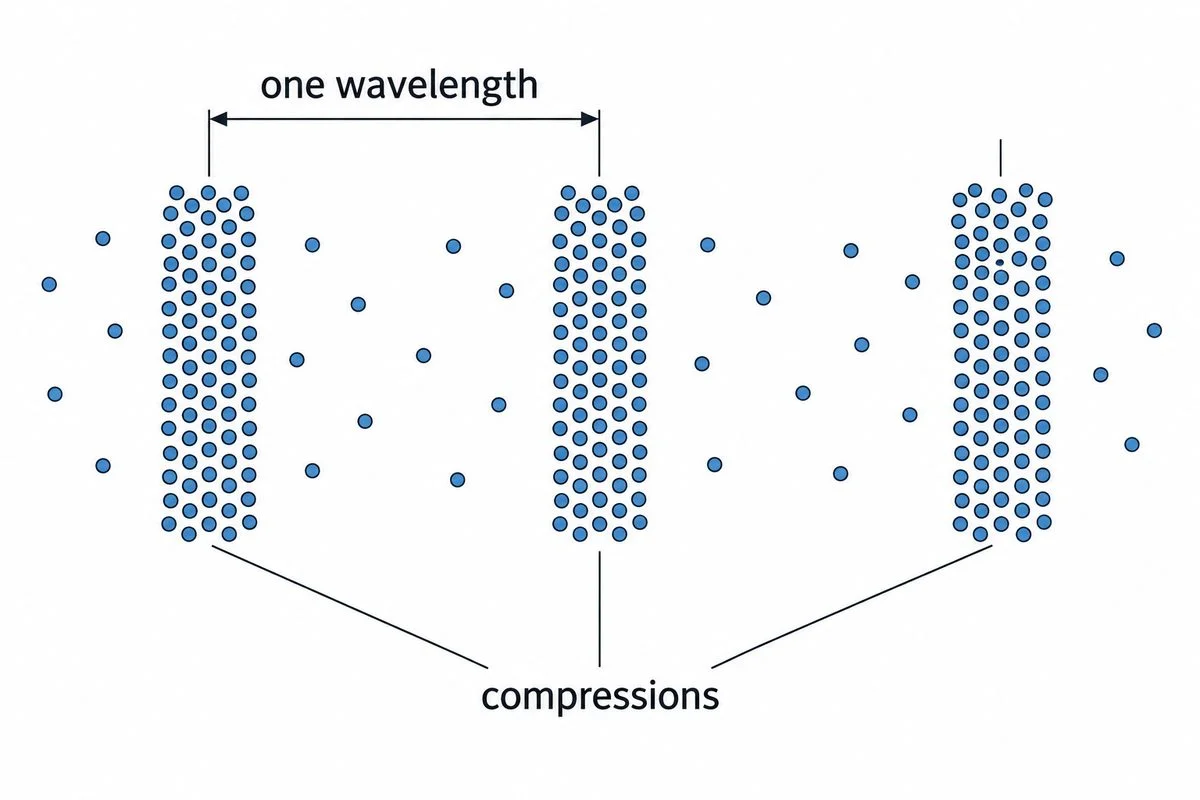
Pencil sketch of crowded particle bands, with an arrow between neighbouring band centres.

4. Wavelength and wave speed

Wavelength measures the spacing between neighbouring compressions.

Show
Look at the diagram. Find two neighbouring compressions and trace the arrow between their centres.
Ask
If these bands spread farther apart, what happens to the wavelength?
Say
The wavelength increases when the bands spread farther apart. The arrow spans one wavelength.
Used in
Instrument makers use sound wavelengths to choose pipe lengths for different notes.
If your child says…“Speed is frequency times time period.”
Ask
Which gives speed: frequency × time period, or frequency × wavelength?
What’s true
Time period measures one vibration’s duration. Wavelength gives the distance sound travels during that vibration.
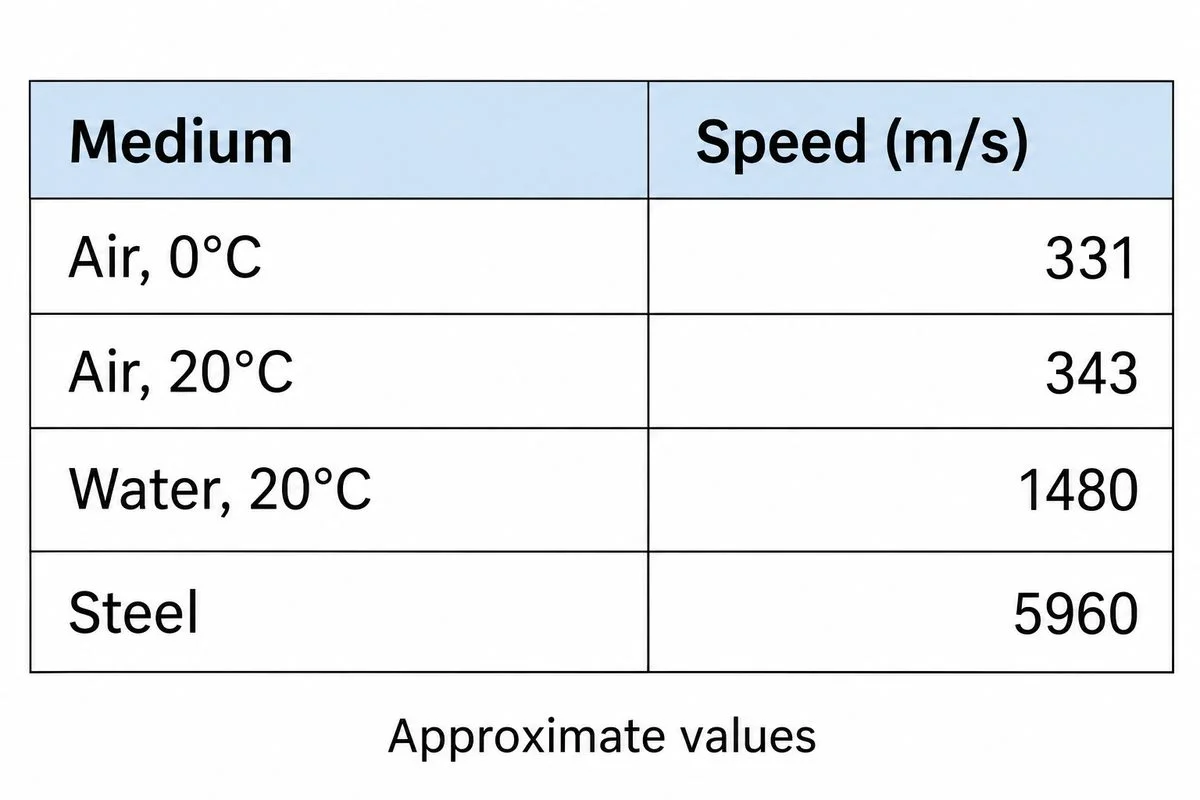
Table compares sound speeds in cold air, warmer air, water and steel.

5. Speed of sound

Sound speed changes with material and temperature.

Show
Look at the diagram. Compare the two air speeds first, then the water and steel speeds.
Ask
Will sound travel equally fast in all four cases shown here?
Say
Sound speed changes with material and temperature. Here, warmer air carries sound faster, and steel carries it fastest.
Used in
Echo calculations use the medium’s sound speed to estimate distance.
If your child says…“Sound travels fastest through air.”
Ask
Which chart entry has the highest speed?
What’s true
Sound usually travels fastest through solids, then liquids, then gases.

Reflected and unheard sound

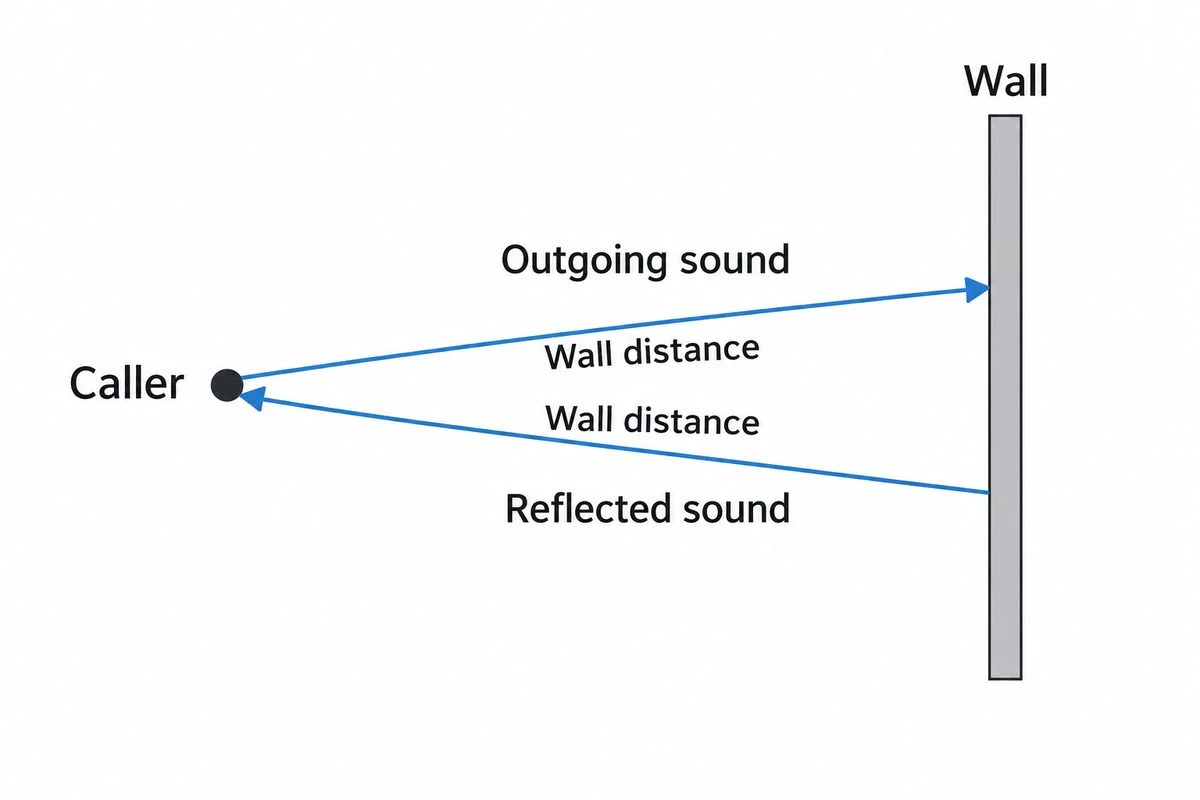
Sound travels from a marked caller position to a wall and returns.

6. Reflection and echoes

A sufficiently delayed reflected sound is heard as a separate echo.

Show
Look at the diagram. Trace sound from the caller's position to the wall and back.
Ask
If this wall were farther away, would its echo take longer to return?
Say
Yes, the echo would take longer to return. Sound reflects back, so its return time covers both journeys.
Used in
Sonar uses returning sound to estimate distance.
If your child says…“The echo time measures only the trip to the wall.”
Ask
Where must the reflected sound finish for you to hear it?
What’s true
The echo's delay includes travel to the wall and back.
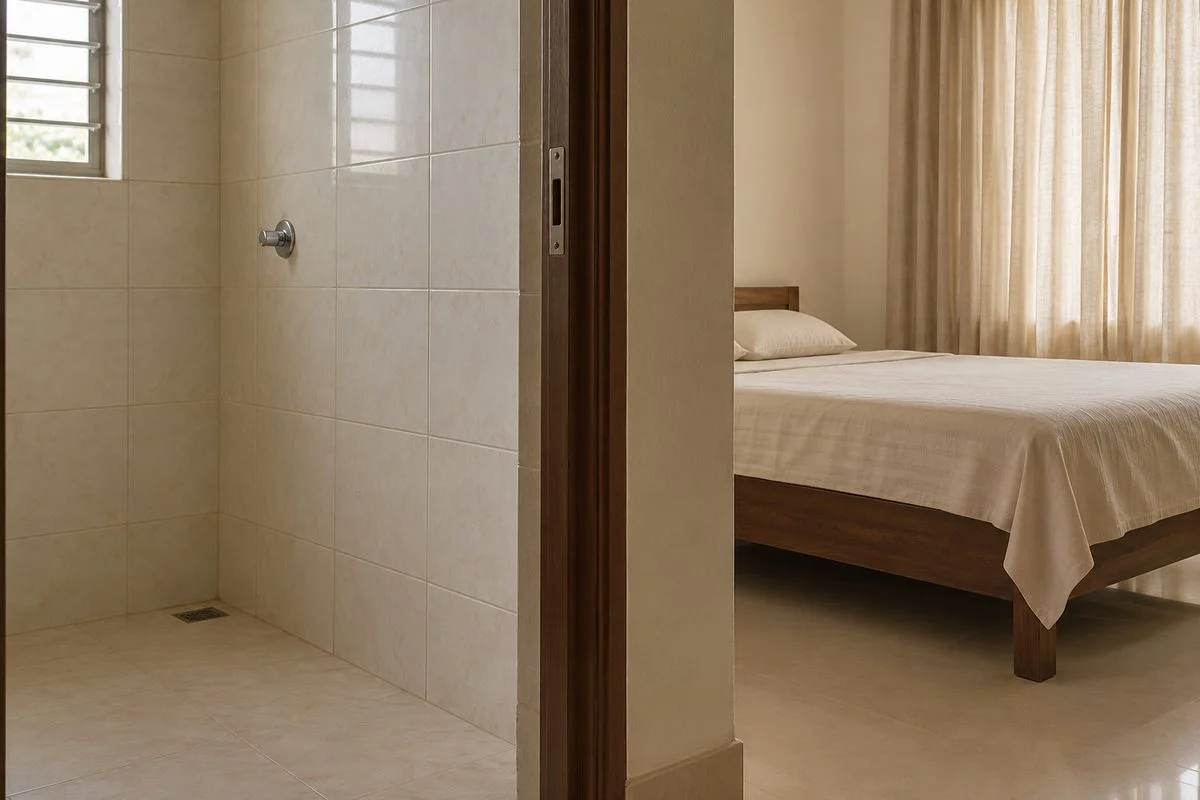
A doorway joins a bare tiled bathroom and a bedroom with curtains and bedding.

7. Reverberation and absorption

Repeated reflections make sound linger; soft materials reduce this.

Show
Stand in a bare, tiled bathroom. After predicting, say ‘ha’ and listen as you stop. Repeat at a similar volume in a room with curtains and bedding.
Ask
In which room will the sound linger longer?
Say
The sound will linger longer in the bare bathroom. Soft furnishings absorb some sound, reducing reverberation.
Used in
Curtains and cushioned seats reduce excessive reverberation in auditoriums.
If your child says…“Soft surfaces make more echoes.”
Ask
Which room made your voice linger less?
What’s true
Soft materials absorb sound rather than reflecting all of it.
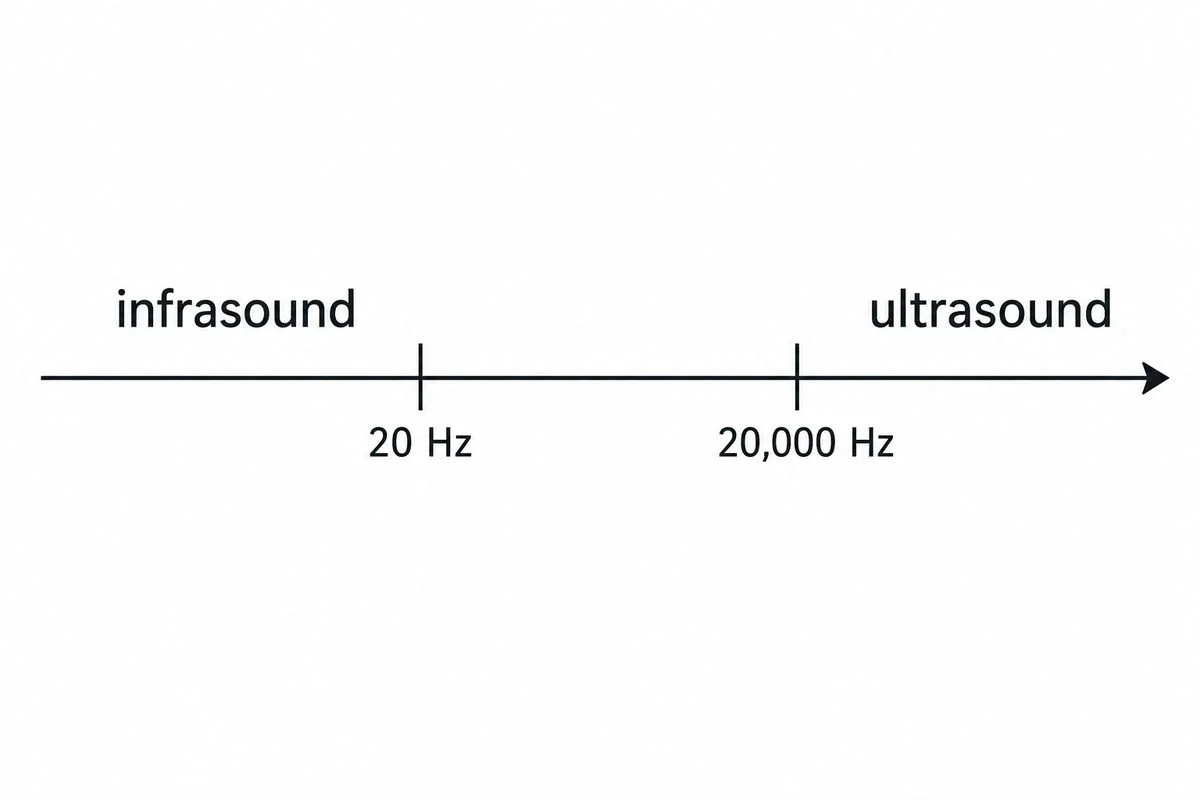
A pencil frequency arrow marks hearing boundaries, with infrasound left and ultrasound right.

8. Hearing range, infrasound and ultrasound

Human hearing covers a limited range of sound frequencies.

Show
Look at the diagram’s frequency arrow. Find 20 Hz and 20,000 Hz, then locate infrasound and ultrasound.
Ask
Will people usually hear the sound sent by an ultrasound probe?
Say
The middle region is the usual human hearing range, roughly 20–20,000 Hz. Infrasound lies below this range, and ultrasound lies above it.
Used in
Ultrasound cleaning removes dirt from places that brushes cannot easily reach.
If your child says…“People can hear every frequency.”
Ask
Could your ear miss a vibration even though the vibration exists?
What’s true
Sound can exist beyond the frequencies human ears detect.

A real problem

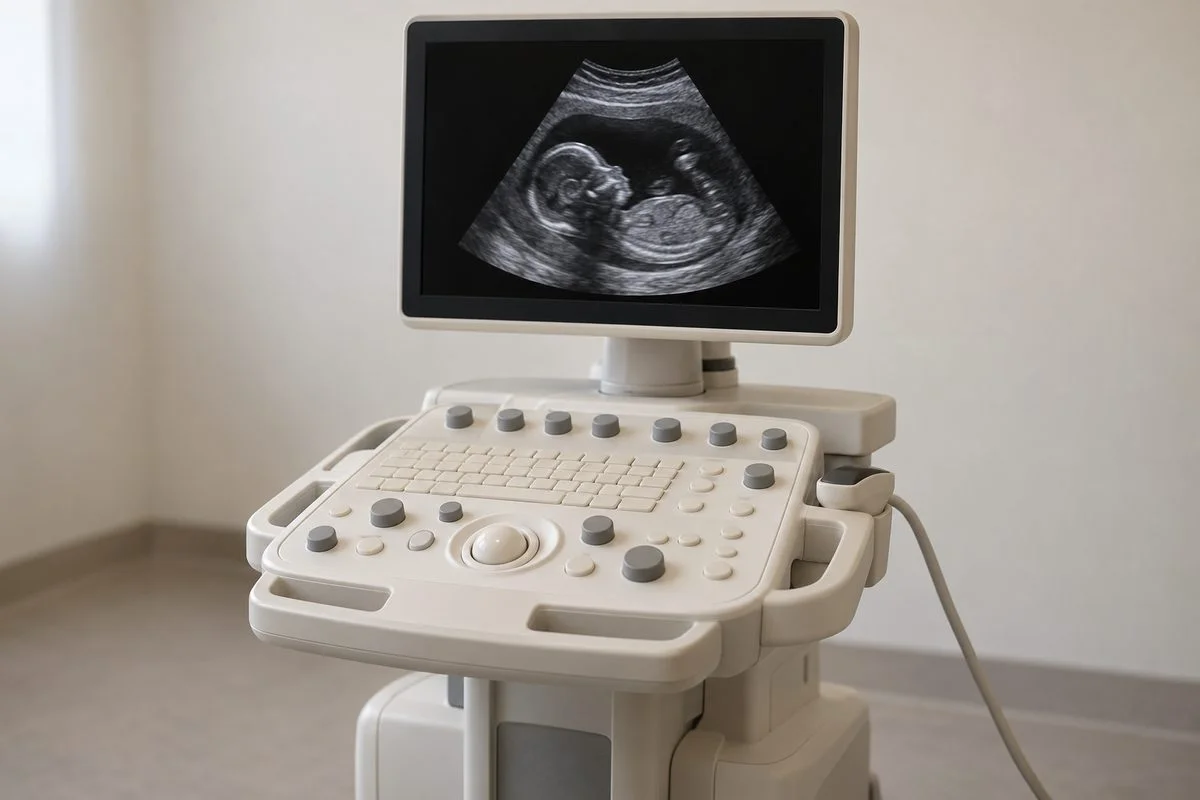
A pioneering scanner opened the womb to examination with sound.

Donald, MacVicar and Brown published their pioneering ultrasound research in 1958.

Their work opened the way to examining a growing baby inside the womb.

An ultrasound probe sends sound into the body and detects echoes returning from within.

British Medical Ultrasound SocietyUniversity of GlasgowNIH

An ultrasound scanner displays a baby's image on its monitor.

Concept Lab · Common misconception

The tempting mistake in Sound Waves: Characteristics and Applications

Open standalone misconception page →

Do air particles travel all the way from speaker to listener?

Wrong

The speaker sends its air particles across the room.

Why it feels right. Sound arrives at my ear, so I imagine the particles arriving too.

Right

A sound wave passes along a disturbance through local particle motion.

Worked example

The close-spaced coils form a moving compression. The marked coil oscillates locally.
  1. In a spring model, push the first coils briefly.
  2. The compression travels along the spring as each coil oscillates near its original position.

Ask your child eight quick questions.

One per step. The answer and the reason are given.

  1. What reaches your ear from the bowl: energy or the bowl’s nearby air particles?

    Energy. Neighbouring particles pass the disturbance onward while vibrating around their own places.

  2. Two sounds have equal frequency but different amplitudes. Which is louder?

    The one with greater amplitude. Larger vibrations increase loudness without requiring a higher frequency.

  3. Two vibrations differ in size but repeat equally often. How do their pitches compare?

    They have the same pitch. Equal frequencies give equal pitches, even when amplitudes differ.

  4. How do you calculate sound speed from 200 Hz and a wavelength of 1.5 m?

    Frequency × wavelength: 300 m/s. Multiply frequency by wavelength, not by time period.

  5. Which usually carries sound faster: steel or air?

    Steel. Closely linked particles in solids pass vibrations onward quickly.

  6. An echo returns after 0.4 s. Sound travels at 340 m/s. How far away is the wall?

    68 m. The delay includes both journeys, so divide speed times time by two.

  7. What happens to lingering sound when a bare hall gains curtains?

    It decreases. Curtains absorb some sound, reducing repeated reflections.

  8. Why can we not usually hear a sound at 40,000 Hz?

    Above our usual hearing range. Our usual upper hearing limit is about 20,000 Hz.

8 more questions with answers