Skip to content

Teach How Forces Affect Motion in eight steps.

For each idea: show it, ask before you tell, then say one line.

Gather a spoon, thick book, coin, stiff card, steel tumbler, soft ball, paper and pencil near a clear table.

Common misconceptions & worked visual for this chapter · 12 practice questions with answers

How to teach it

Forces and motion

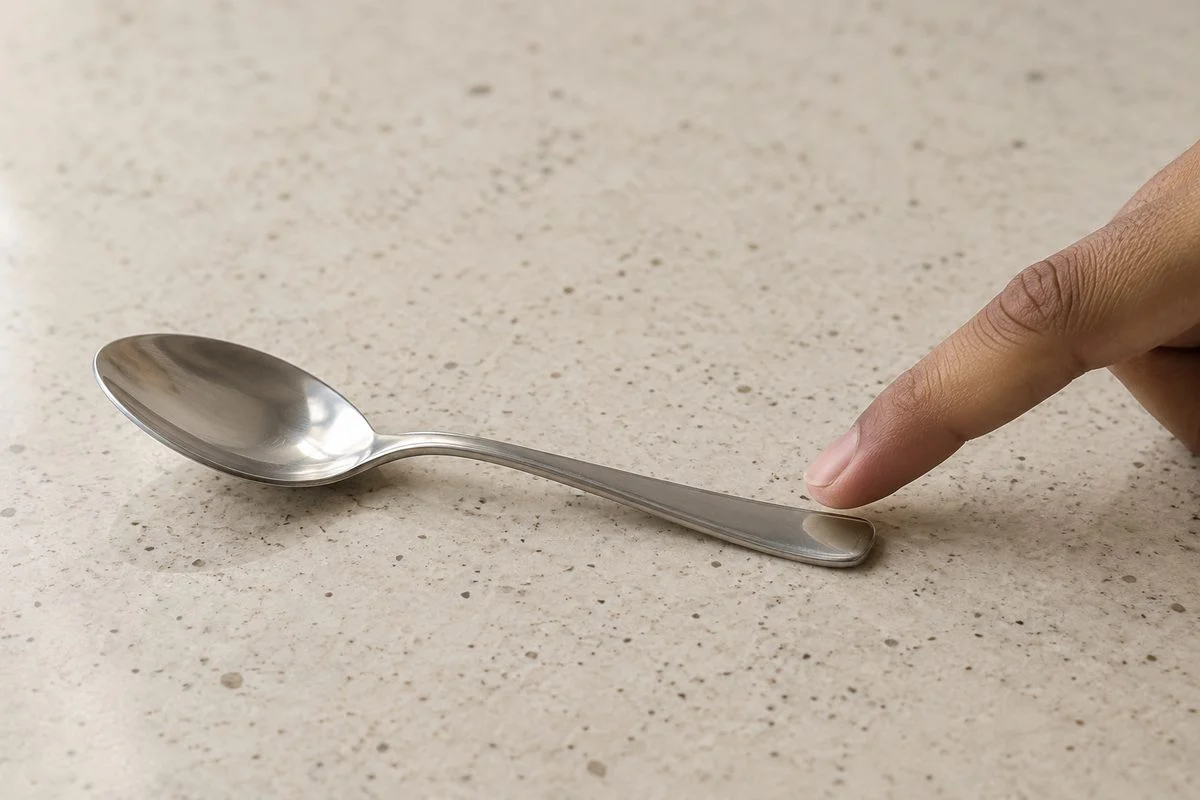
A finger poised beside a spoon on a table.

1. Force

A push or pull has size and direction.

Show
Rest a spoon on the table. Point in the direction you will push. After the prediction, push it that way.
Ask
Which way will the spoon start moving?
Say
The spoon will start moving in the direction you push it.
Used in
Pulling a cart provides a force that can get it moving.
If your child says…“Just add all the force numbers.”
Ask
Does a leftward pull help a rightward pull?
What’s true
Opposing forces subtract when finding the overall force.
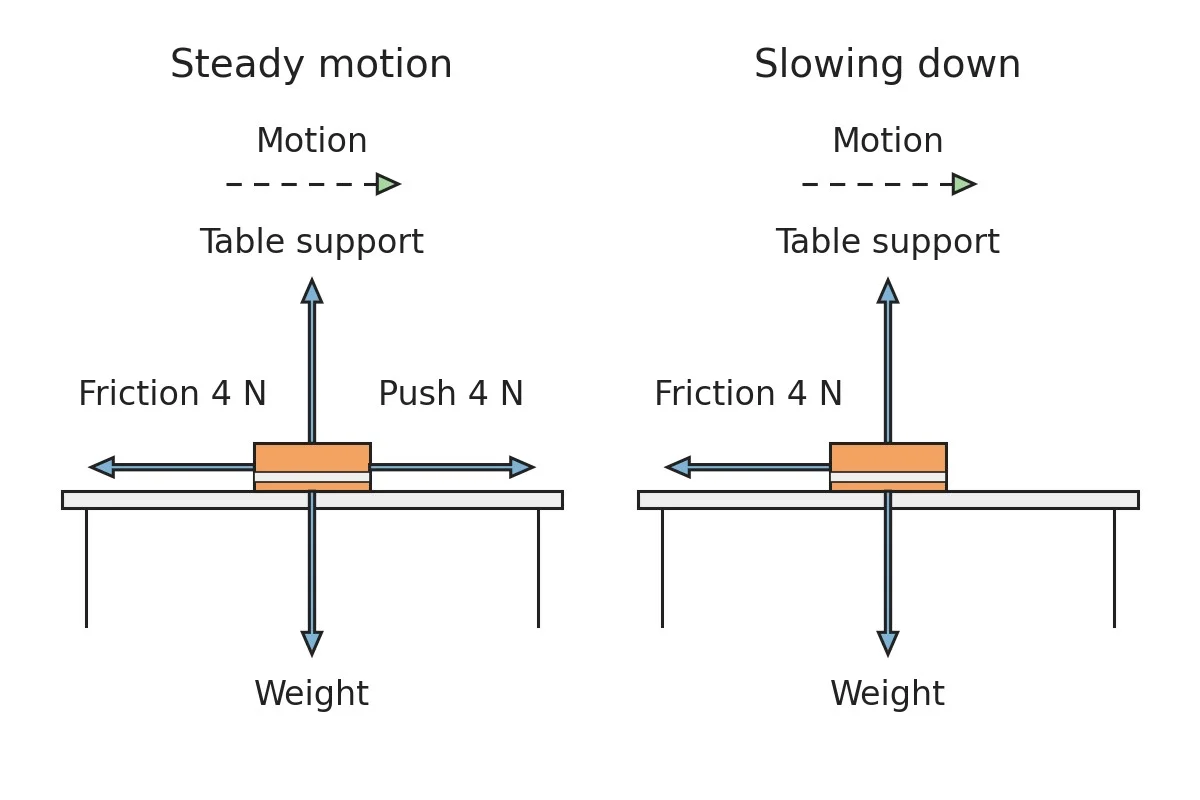
Book diagrams compare balanced forces during steady motion with friction acting after release.

2. Balanced and unbalanced forces

Balanced forces preserve velocity; unbalanced forces change it.

Show
Look at the diagram and compare the left book's opposing arrows. Find the right book, where the push has ended. Check that the vertical arrows balance in both panels.
Ask
Will the left book need a larger forward force to keep moving steadily?
Say
The left book keeps moving steadily because its forces balance. After the push ends, friction slows the right book.
Used in
Balanced forces let a trolley travel steadily despite resistance.
If your child says…“Moving needs a bigger forward push.”
Ask
Would a bigger forward force keep the speed unchanged?
What’s true
Steady straight motion needs no leftover forward force.
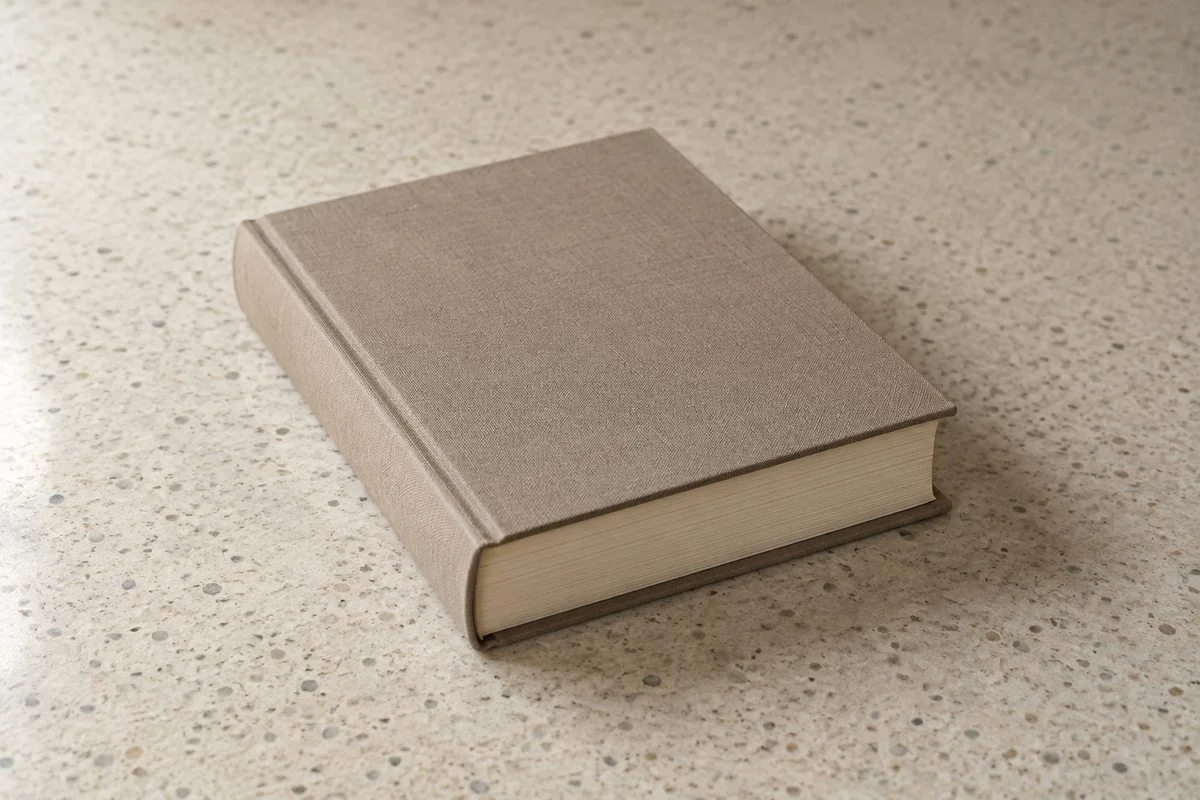
A thick book resting on a clear tabletop before pushing.

3. Friction

Friction resists slipping where surfaces touch.

Show
Rest a thick book on the table. After predicting, push gently without moving it. Push harder, then release it as it slides.
Ask
Will a gentle sideways push move this book?
Say
Friction balances the gentle push while the book stays still. After release, friction slows the sliding book.
Used in
Friction gives shoes grip, helping us walk without slipping.
If your child says…“Friction never helps.”
Ask
Would walking be easier if shoes slid freely?
What’s true
Friction can provide grip as well as slow sliding.

Inertia, momentum and changing motion

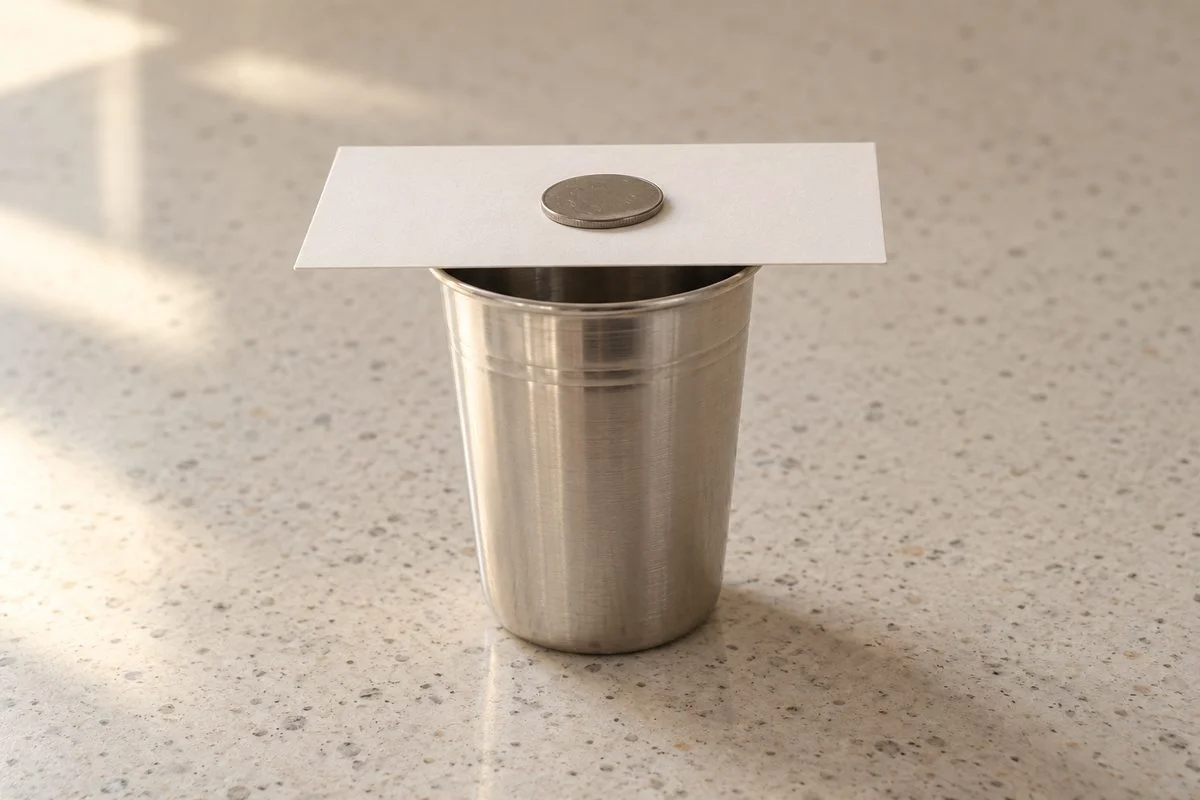
A coin on a card covering a steel tumbler.

4. Newton's first law and inertia

Without net force, rest or steady straight motion continues.

Show
Place the card across the tumbler, with the coin above the opening. After the prediction, flick the card quickly sideways.
Ask
Will the coin follow the card sideways?
Say
The coin hardly moves sideways because of inertia, but gravity pulls it into the tumbler.
Used in
A loaded truck resists changes in motion more than an empty trolley.
If your child says…“Inertia pushes passengers forwards.”
Ask
Does continuing forwards need a new forward push?
What’s true
A passenger's body was moving before the bus stopped.

p=mvp=mv

p=(40 kg)(1 m/s)=40 kg m/sp=(40\,\mathrm{kg})(1\,\mathrm{m/s})=40\,\mathrm{kg\,m/s} east.

5. Momentum

Momentum is mass times velocity, with the same direction.

Show
Write these lines for a 40 kg child moving east at 1 m/s. Say: momentum equals mass times velocity. Use p for momentum, m for mass, and v for velocity.
Ask
What momentum will the same child have at 2 m/s east?
Say
The momentum becomes 80 kg m/s east because doubling velocity doubles momentum.
Used in
Braking changes a vehicle's momentum to bring it to rest.
If your child says…“My force equals my speed.”
Ask
Does multiplying mass by velocity give momentum or force?
What’s true
A net force changes momentum and does not measure speed.

a=Fnetma=\frac{F_{\mathrm{net}}}{m}

a=4 N2 kga=\frac{4\,\mathrm{N}}{2\,\mathrm{kg}}

6. Newton's second law

For unchanged mass, stronger net forces produce greater acceleration.

Show
Write these lines for a 2 kg trolley pushed right with 6 N against 2 N. Say: acceleration, a, equals net force, F net, divided by mass, m.
Ask
What is the trolley's acceleration, including direction?
Say
Its acceleration is 2 m/s² rightwards.
Used in
A gun's greater mass limits its recoil acceleration.
If your child says…“Four kilograms means four newtons.”
Ask
Does pushing harder change the trolley's mass?
What’s true
Kilograms measure mass, while newtons measure force.
One hand holding a soft ball, ready for a gentle toss.

7. Impulse

A net force acting over time changes an object's momentum.

Show
After predicting, toss a soft ball gently for your child to catch with little hand movement. Repeat a similar toss from the same distance, with your child moving their hands backwards.
Ask
Will catching with your hands moving backwards feel gentler or harder?
Say
If the ball arrives at the same speed, both catches remove the same momentum. Taking longer to stop it means a smaller average stopping force.
Used in
An airbag reduces injury by giving a person longer to stop.
If your child says…“A longer stop means a bigger force.”
Ask
Which catch took longer, and which felt gentler?
What’s true
Compare catches with the same ball arriving at the same speed.

Forces between objects

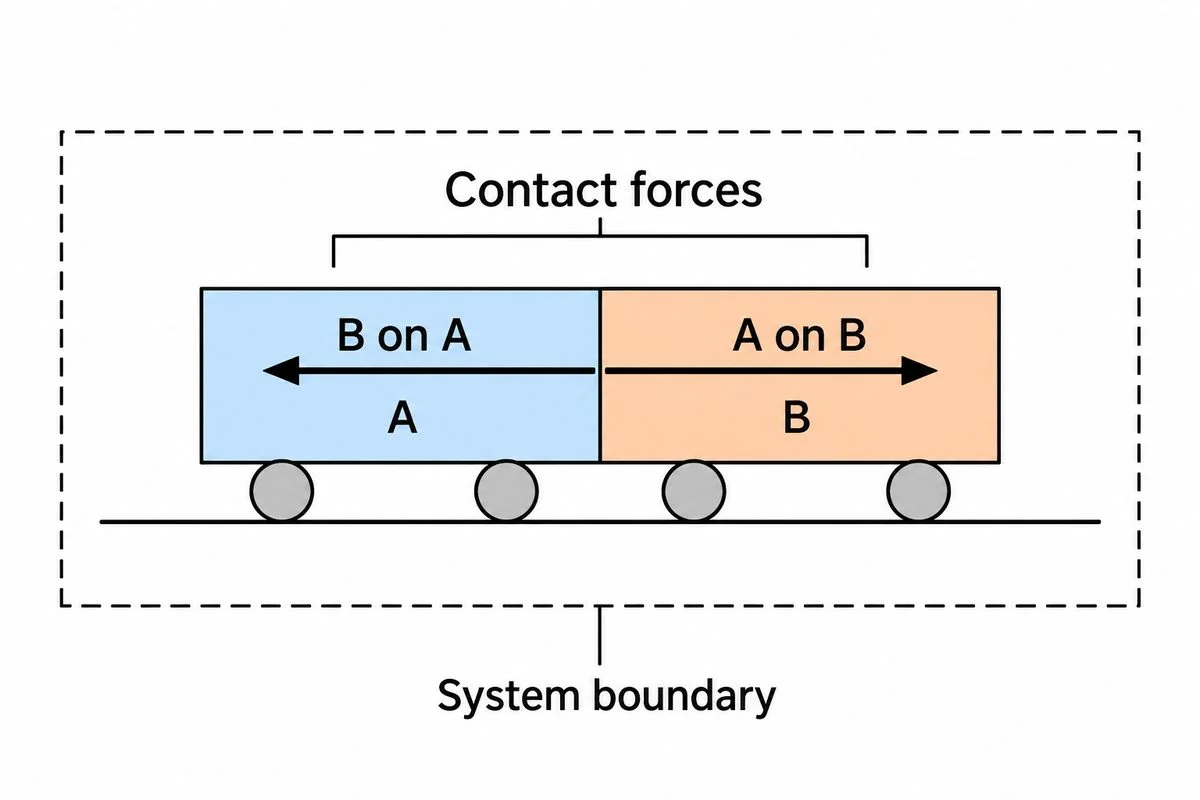
Equal opposite forces act on separate trolleys inside a shared system boundary.

8. Newton's third law and systems of objects

Paired forces act on different objects. Net external force changes total momentum.

Show
Look at the diagram. Find each contact force on its trolley. Trace the boundary enclosing both trolleys.
Ask
Will these opposite forces cancel on either trolley during the collision?
Say
These forces do not cancel on either trolley because the equal, opposite forces act simultaneously on different trolleys.
Used in
When a walking foot pushes backwards, the ground pushes it forwards, helping the person move ahead.
If your child says…“The paired forces cancel on each trolley.”
Ask
Which trolley receives each force?
What’s true
Each force acts on a different object.

A real problem

A brake parachute helped stop an experimental landing vehicle.

The experiment took place on 22 March 2024.

It tested a fast landing like that of a vehicle returning from space.

The vehicle stopped on the runway using a brake parachute and other mechanisms.

Air resistance, called drag, opposes an aircraft's motion through the air.

ISROAkashvaniNASA

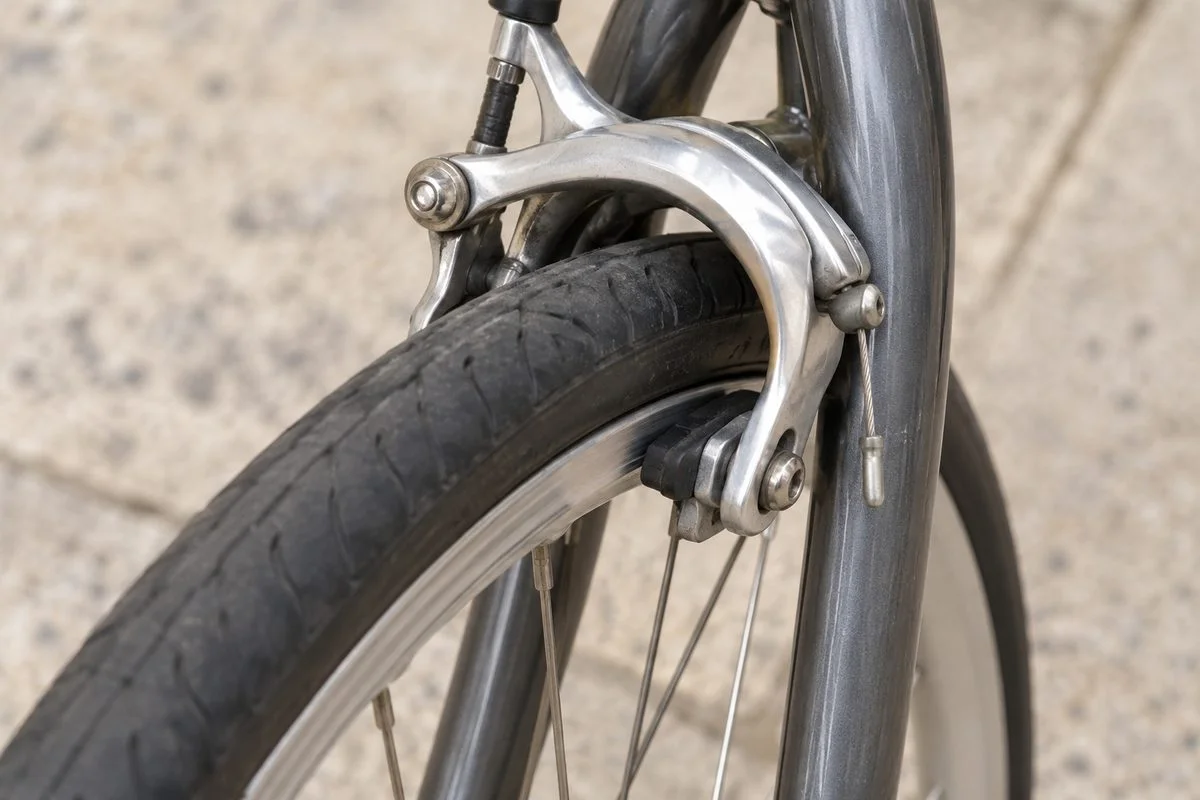
Bicycle wheel with brake pads pressing against its rim.

Concept Lab · Common misconception

The tempting mistake in How Forces Affect Motion

Open standalone misconception page →

Does constant motion require a net force?

Wrong

A trolley moving steadily must have a forward net force.

Why it feels right. I associate pushing with keeping it moving.

Right

A net force changes velocity.

Worked example

A steady velocity can coexist with balanced horizontal forces. The trolley's net force is zero.
  1. A trolley moving at constant speed on a straight level track has zero net force.
  2. A push may balance friction without changing its speed.

Ask your child eight quick questions.

One per step. The answer and the reason are given.

  1. A cart has pulls of 12 N rightwards and 7 N leftwards. What remains overall?

    5 N rightwards. The pulls oppose each other, so their sizes subtract.

  2. Why can a trolley keep moving steadily when its forward push balances resistance?

    The net force is zero. A net force changes velocity, rather than keeping an object moving steadily.

  3. Which contact force prevents a shoe from slipping as it pushes against the ground?

    Friction. Friction resists slipping between the shoe and ground.

  4. A bus stops suddenly. Why does a passenger's upper body continue forwards?

    It was already moving. The body tends to continue moving when the feet stop.

  5. What quantity have you calculated by multiplying mass by velocity?

    Momentum. Momentum combines mass and velocity, while net force changes momentum.

  6. What net force gives a 4 kg object an acceleration of 3 m/s²?

    12 N. Multiply mass by acceleration to find the net force.

  7. For the same momentum loss, how does an airbag reduce the average stopping force?

    By lengthening the stopping time. The same momentum change is spread over more time.

  8. Why don't the paired forces cancel on trolley A?

    They act on different trolleys. Each trolley receives only one force from this pair.

12 more questions with answers