Skip to content

Teach Gravitation in eight steps.

For each idea: show it, ask before you tell, then say one line.

Gather paper, a pencil, a book and a low table.

Common misconceptions & worked visual for this chapter · 15 practice questions with answers

How to teach it

Orbits and gravitational attraction

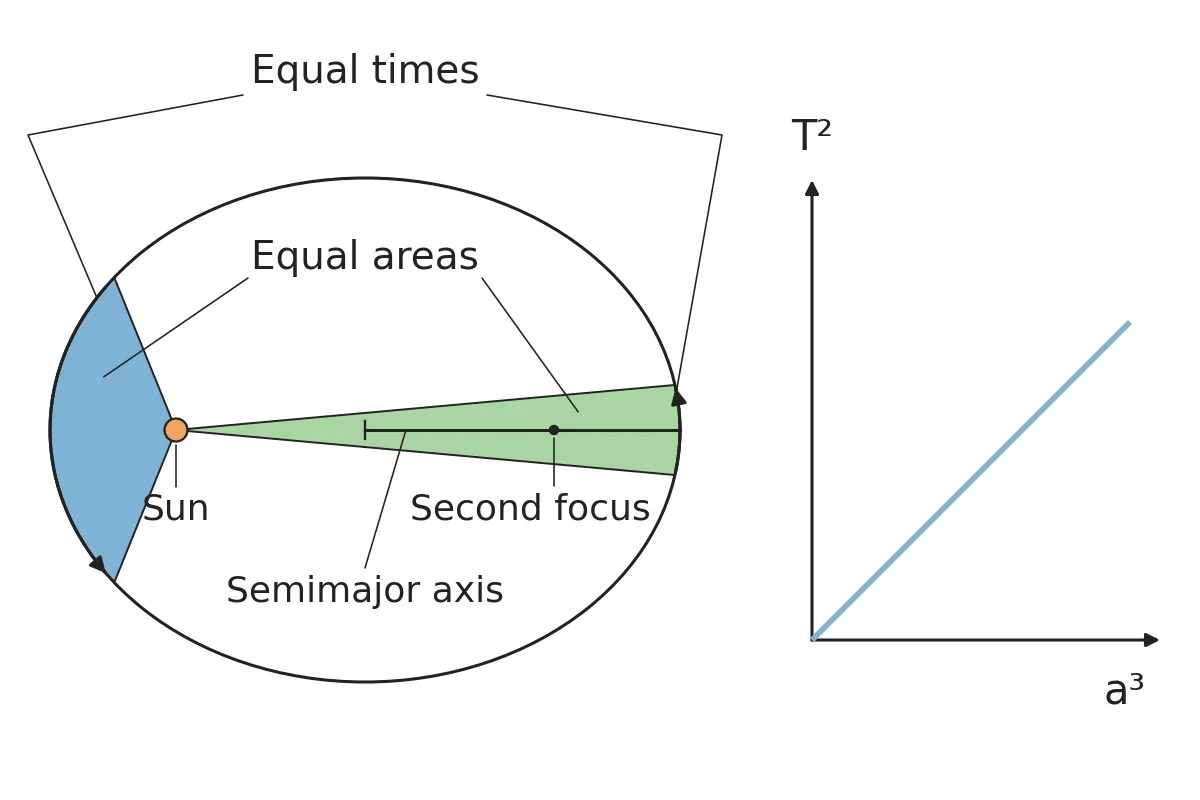
Elliptical orbit with equal swept areas beside a period–size graph.

1. Kepler’s laws

Planets follow ellipses, with changing speed and predictable periods.

Show
Look at the diagram’s Sun and shaded areas. Then find the graph. T means orbit time, and a means semimajor axis.
Ask
Which shaded section requires more travel during the same time?
Say
The Sun sits at one focus. Planets move faster nearby, sweeping equal areas in equal times. Around that Sun, the ratio T2/a3T^2/a^3 stays constant.
Used in
An orbit’s size and period let astronomers estimate the central mass.
If your child says…“Equal areas mean equal speeds.”
Ask
With a shorter Sun–planet distance, would equal travel sweep the same area?
What’s true
In a noncircular planetary orbit, equal swept areas require faster motion nearer the Sun.
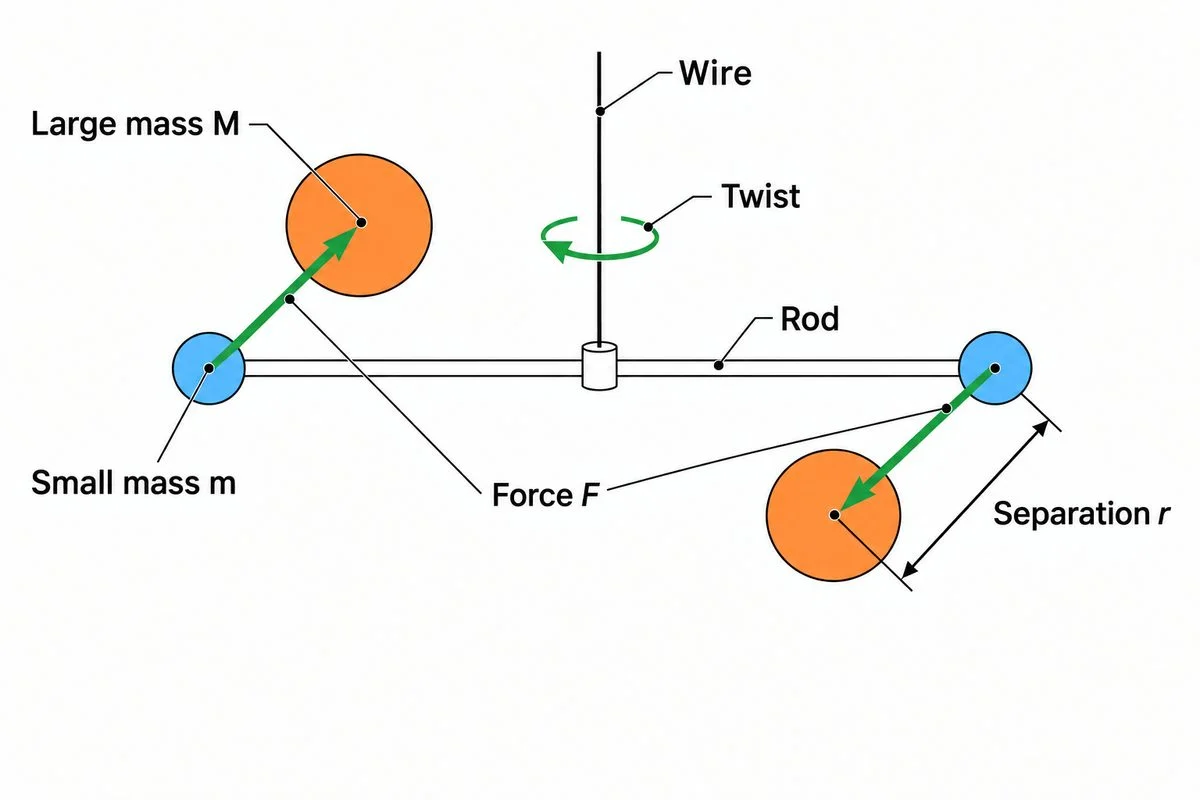
Torsion balance with gravitational force arrows, sphere separation and wire twist.

2. Universal gravitation and measurement of G

Masses attract; G sets their attraction’s strength.

Show
Find masses M and m, centre separation r, and force arrows F in the diagram. Follow the wire’s twist.
Ask
Will the forces shown turn the rod even though they are equal and opposite?
Say
The wire twists until its opposing torque balances gravity’s turning effect.
Used in
G lets scientists calculate gravitational forces.
If your child says…“Opposite pulls cannot turn anything.”
Ask
Do these arrows turn the rod in opposite directions or the same direction?
What’s true
Opposite forces along different lines can turn objects.
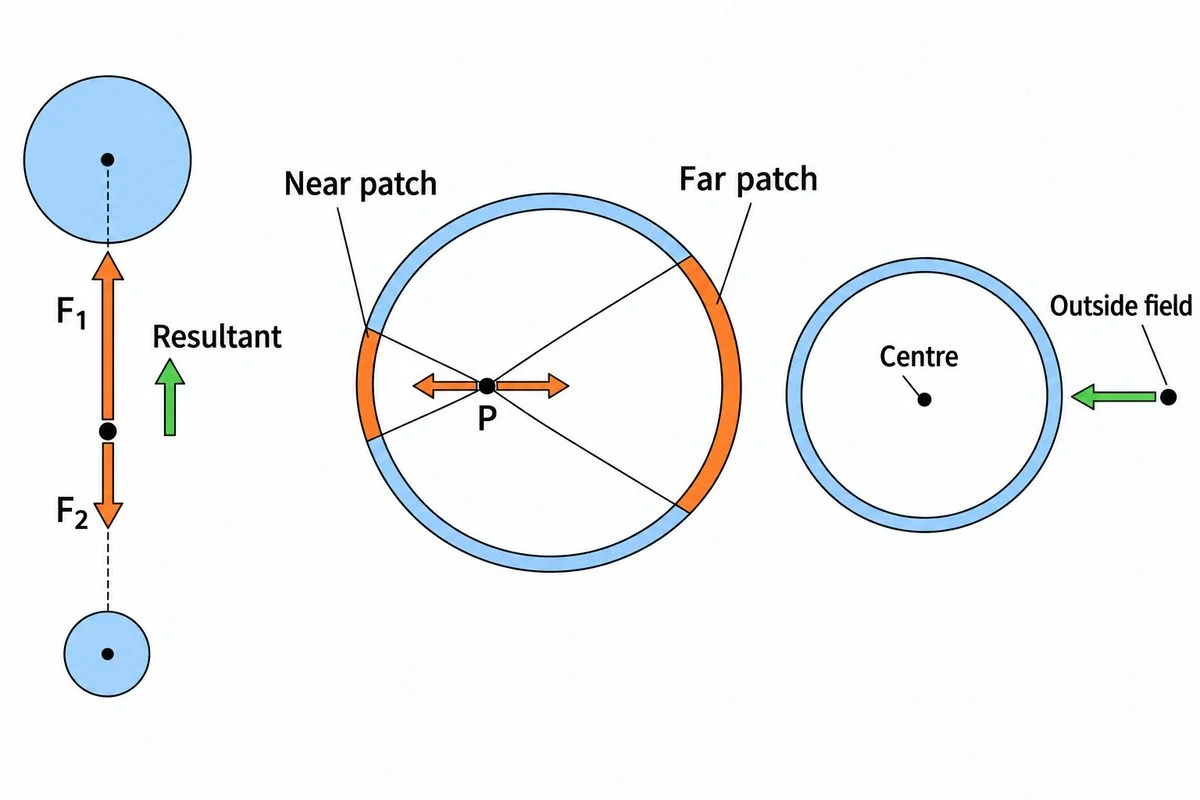
Force addition, cancelling shell patches and the field outside a spherical shell.

3. Superposition and the shell theorem

Gravitational pulls combine by direction and can cancel.

Show
Find the resultant in the diagram. Compare shell patches, then find the outside arrow.
Ask
Will the nearer shell wall pull more strongly at P?
Say
The larger far patch balances the nearer patch. Shell pulls cancel inside. Outside, treat its mass as central.
Used in
The shell theorem simplifies calculating gravity outside spherical planets by treating their mass as central.
If your child says…“I add both pulls, even when they point opposite ways.”
Ask
What remains when the two arrows at P are equal and opposite?
What’s true
Equal gravitational pulls in opposite directions cancel, including paired contributions inside a uniform spherical shell.

Gravity and energy

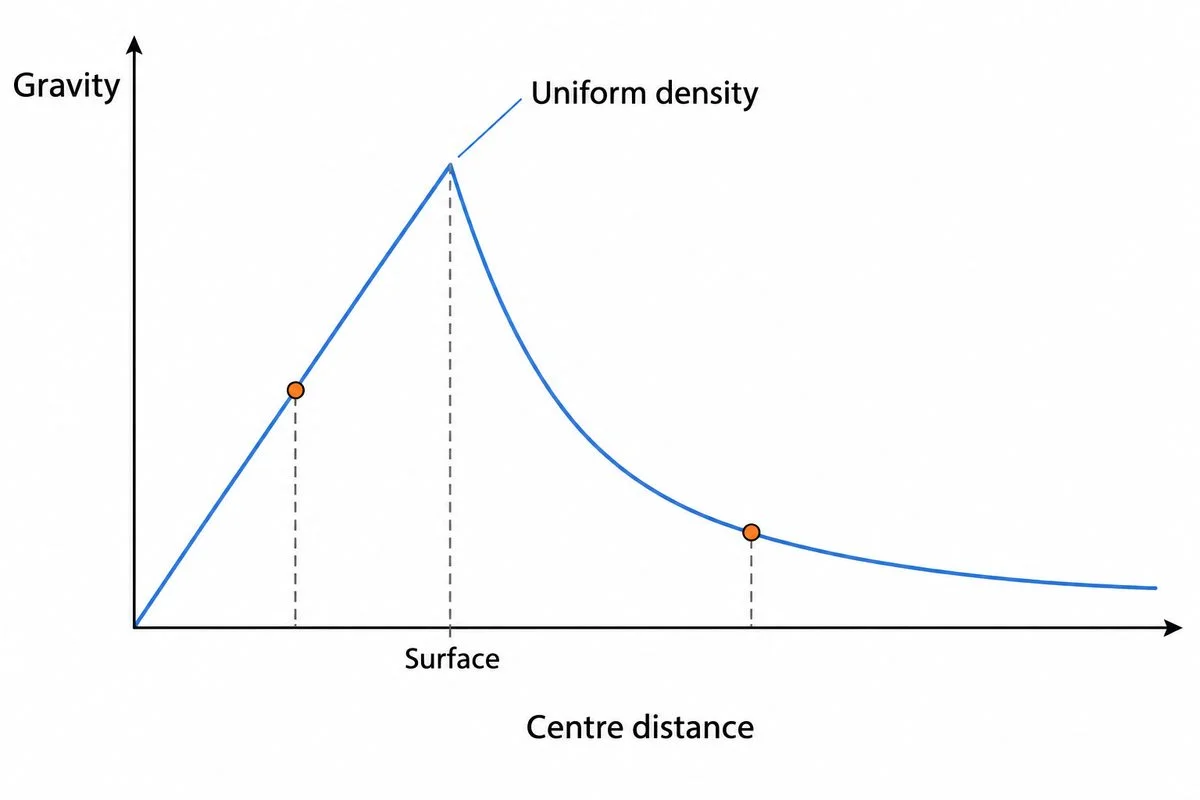
Graph showing gravity rising inside a uniform sphere and falling outside.

4. Variation of acceleration due to gravity

Gravity varies with position.

Show
Find ‘Surface’ in the diagram. Follow the line inward towards the centre.
Ask
Will gravity strengthen towards the centre?
Say
For uniform density, gravity weakens inward from the surface.
Used in
Surface gravity, radius and G give a planet’s mass.
If your child says…“Deeper means stronger gravity.”
Ask
Does the graph rise towards the centre?
What’s true
Inside a uniform sphere, outer layers cancel and enclosed mass decreases inward.
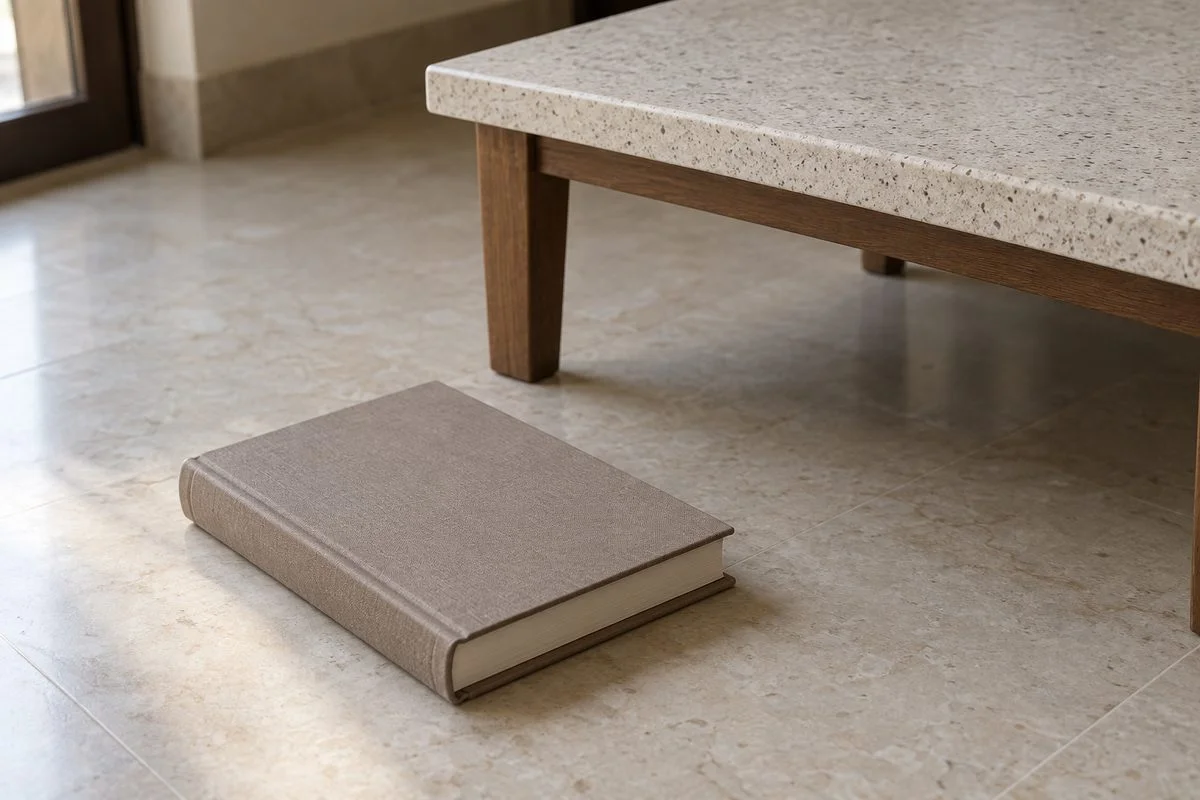
Book on the floor beside a low table, ready to be lifted.

5. Gravitational potential, potential energy and work

Potential measures gravitational energy per mass relative to a chosen zero.

Show
Put a book on the floor beside a low table. Call the floor zero potential energy. After the prediction, slowly lift the book onto the table. Repeat, calling the tabletop zero instead.
Ask
Will changing which level we call zero change the effort of the same lift?
Say
Lifting stores gravitational energy, whichever level we call zero.
Used in
Gravitational energy calculations determine the work needed to lift objects far above a planet.
If your child says…“Gravitational potential must be positive.”
Ask
If the tabletop is zero, is potential energy below it positive or negative?
What’s true
With zero at infinity, gravitational potential near an isolated mass is negative.

12mve2=GMmR\frac12 m v_e^2=\frac{GMm}{R}

ve=2GM/R=2gRv_e=\sqrt{2GM/R}=\sqrt{2gR}

ve=2(9.8)(6.4×10⁶) m s−1v_e=\sqrt{2(9.8)(6.4\times10^6)}\,\mathrm{m\,s^{-1}}

6. Escape speed and conservation of energy

Starting energy determines escape.

Show
Write these lines. Name object mass m, Earth mass M, radius R and gravitational constant G. Name surface gravity g and escape speed vₑ. Set potential energy zero at infinity. Ignore air, rotation, other bodies and further propulsion.
Ask
What minimum launch speed follows from the last line?
Say
The minimum is about 11.2 km/s, with speed approaching zero infinitely far away. Both energies scale with mass, so mass cancels.
Used in
Escape calculations set launch speeds for leaving planets.
If your child says…“Heavier objects need a faster escape launch.”
Ask
After cancelling the object’s mass, where could its heaviness change the answer?
What’s true
At the same launch point, object mass changes both energies equally, leaving escape speed unchanged.

Satellites and free fall

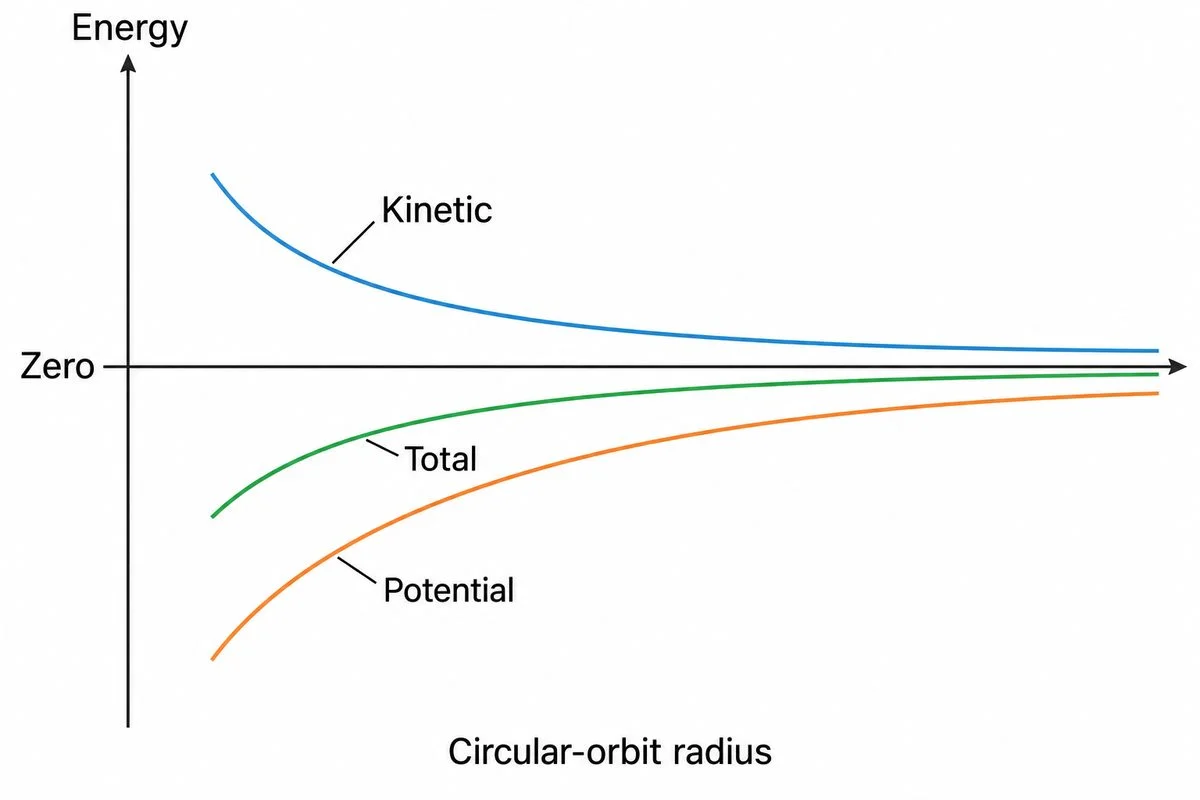
Graph of kinetic, potential and total energy against circular-orbit radius.

7. Circular orbital speed and binding energy

Higher circular orbits are less tightly bound.

Show
Find the kinetic and total energy curves in the diagram. Follow both towards larger circular-orbit radii.
Ask
Will kinetic energy rise?
Say
Higher circular orbits have less kinetic energy but greater total energy.
Used in
Lunar orbit adjustments enable surface mapping.
If your child says…“Adding energy always increases speed.”
Ask
Does less kinetic energy mean faster motion?
What’s true
Between circular orbits, potential energy rises while kinetic energy falls.
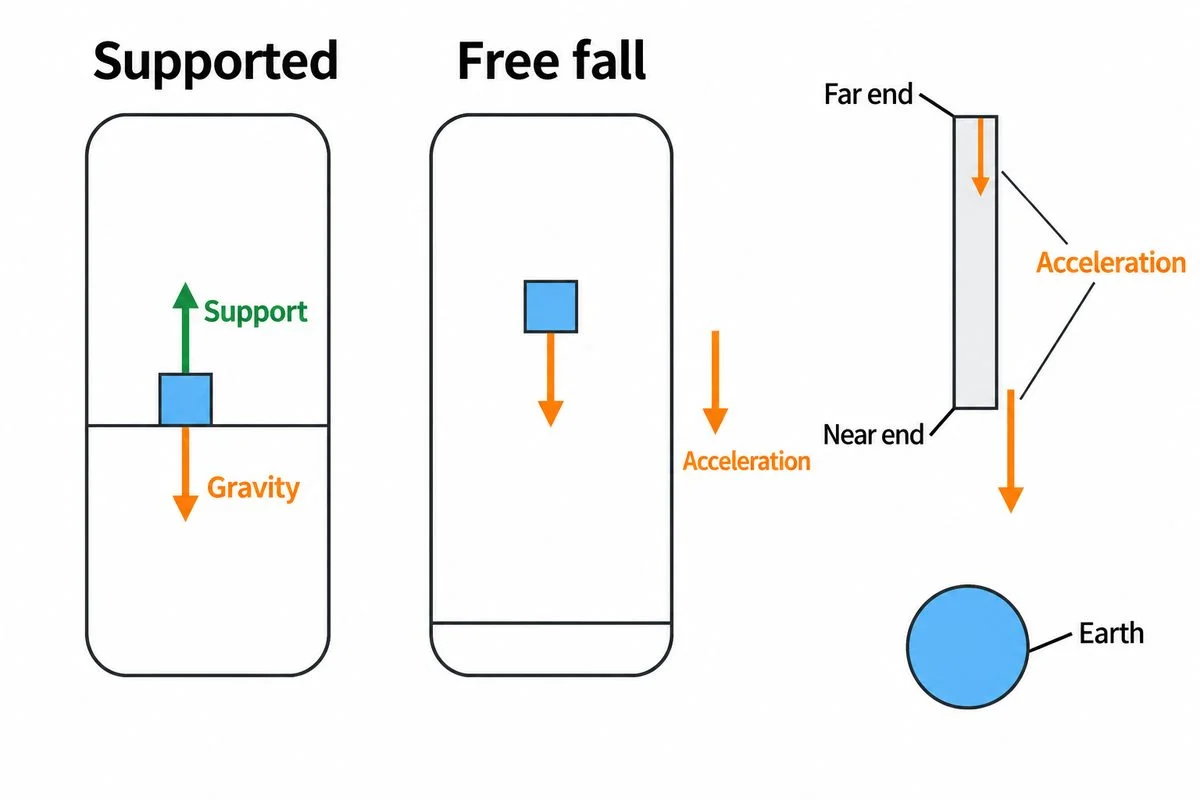
Support and free fall beside unequal Earthward accelerations across a spacecraft.

8. Weightlessness and tidal effects

Objects feel weightless without support. Unequal gravitational pulls cause tidal effects.

Show
Compare the supported object and freely falling cabin in the diagram. Then compare Earthward acceleration arrows at the spacecraft’s ends.
Ask
Will the object need support from the floor while it falls together with the cabin?
Say
They fall together, so the floor supplies no supporting push while gravity remains. The nearer end accelerates more strongly towards Earth, producing tidal stretching.
Used in
Shared free fall lets astronauts float inside orbiting spacecraft.
If your child says…“Astronauts float because gravity has gone.”
Ask
If gravity vanished, what would keep the spacecraft’s path curving?
What’s true
A hollow spacecraft does not block external gravity, and floating does not show gravity is absent.

A real problem

Slowing a spacecraft enabled lunar capture.

Slowing Chandrayaan-1 allowed the Moon’s gravity to capture it into orbit.

It reached its final operational lunar orbit on 12 November 2008.

It mapped the Moon’s chemistry, minerals and surface geology.

ESAESAISRO

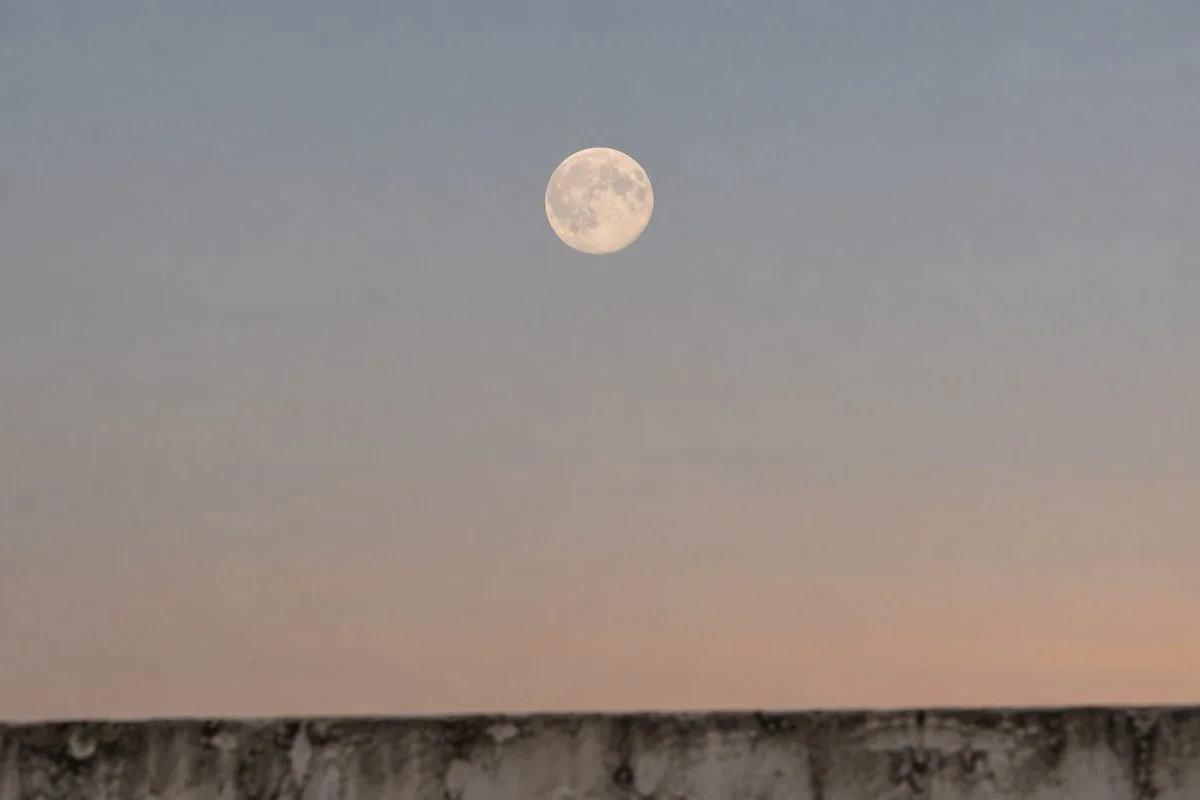
Moon above a neighbourhood rooftop at dusk.

Concept Lab · Common misconception

The tempting mistake in Gravitation

Open standalone misconception page →

Is an astronaut weightless because gravity is absent?

Wrong

Astronauts float because gravity has stopped acting.

Why it feels right. I associate floating with the absence of a downward pull.

Right

Orbiting objects are in continuous free fall under gravity.

Worked example

Gravity pulls the cabin and the loose object in nearly the same direction and with nearly the same acceleration.
  1. A cabin and a loose object inside it share nearly the same gravitational acceleration towards Earth.
  2. The object floats relative to the cabin as both fall together.

Ask your child eight quick questions.

One per step. The answer and the reason are given.

  1. Where does a planet move fastest in an elliptical orbit around the Sun?

    Nearest the Sun. A shorter radius requires faster sideways motion to maintain equal swept areas.

  2. What can equal, opposite forces do when applied perpendicularly at opposite rod ends?

    Turn the rod. Their turning effects add because the forces act along different lines.

  3. Two equal gravitational pulls act in opposite directions. What is their total force?

    Zero. Equal pulls in opposite directions cancel instead of adding their sizes.

  4. Halfway from a uniform planet’s centre to its surface, what fraction of surface gravity remains?

    One-half. Inside a uniform sphere, gravity decreases in proportion to distance from its centre.

  5. With the tabletop as zero, what sign has the book’s potential energy on the floor?

    Negative. Lifting to the zero level requires positive work.

  6. Under these assumptions, how does doubling the object’s mass change its required escape speed?

    It stays the same. Both motion energy and gravitational energy double, so mass cancels.

  7. After a satellite reaches a higher circular orbit, how has its kinetic energy changed?

    It has decreased. The higher circular orbit requires a lower speed.

  8. Why does an astronaut’s scale read zero during an unpowered orbit?

    Astronaut and spacecraft fall together. The scale supplies no supporting push during their shared free fall.

15 more questions with answers, 3 with pictures