Skip to content

Teach Thermal Properties of Matter in eight steps.

For each idea: show it, ask before you tell, then say one line.

Gather a non-mercury school thermometer, paper and a pencil.

Common misconceptions & worked visual for this chapter · 15 practice questions with answers

How to teach it

Temperature and expansion

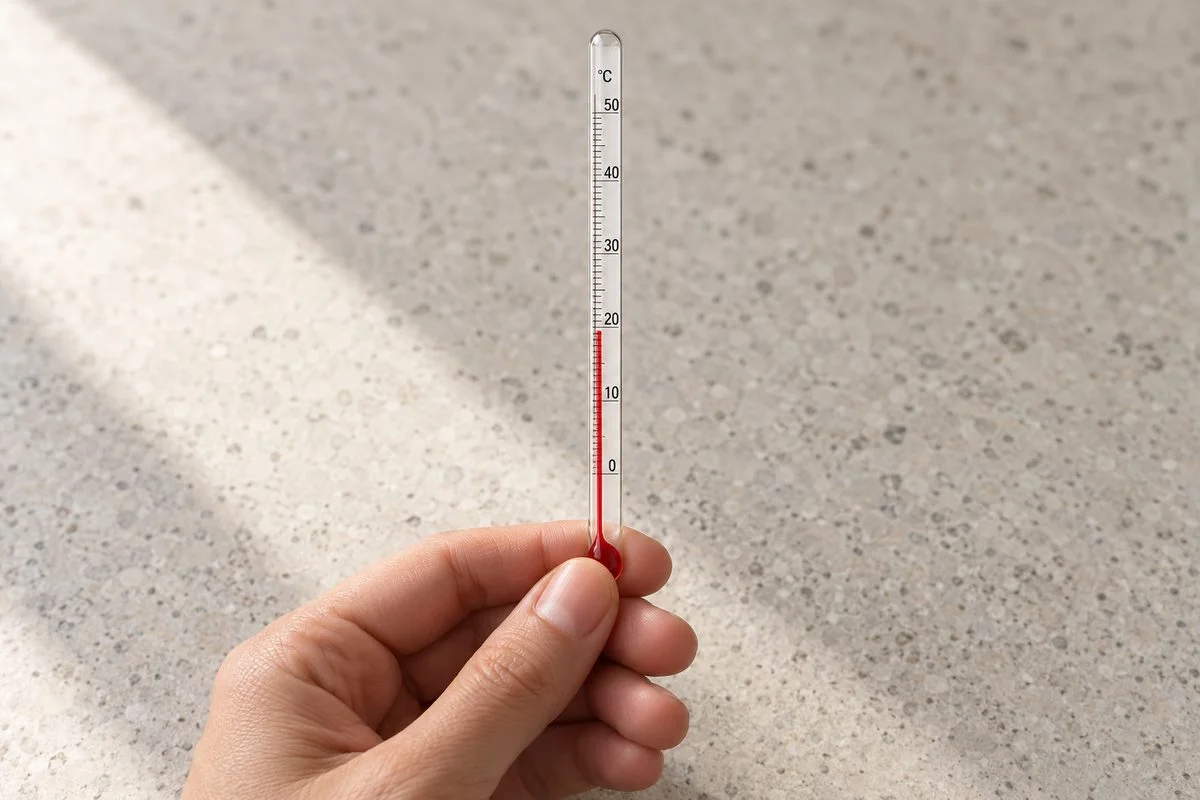
One hand gently holds a thermometer bulb, with its stem and Celsius scale visible.

1. Temperature and thermometric scales

Temperature sets heat's direction; scales assign temperature readings.

Show
Read a non-mercury school thermometer at room temperature. After predicting, gently enclose its sensing bulb in your palm. Watch the reading settle.
Ask
Will your warmer hand make the reading rise or fall?
Say
The reading rises as your warmer hand transfers heat to the thermometer.
Used in
Fixed-volume gas thermometers use pressure changes to measure temperature.
If your child says…“I add 273.15 to the temperature rise.”
Ask
Does adding the same amount to both readings change their difference?
What’s true
Celsius and kelvin have equal-sized steps, so their temperature changes have equal numerical values.
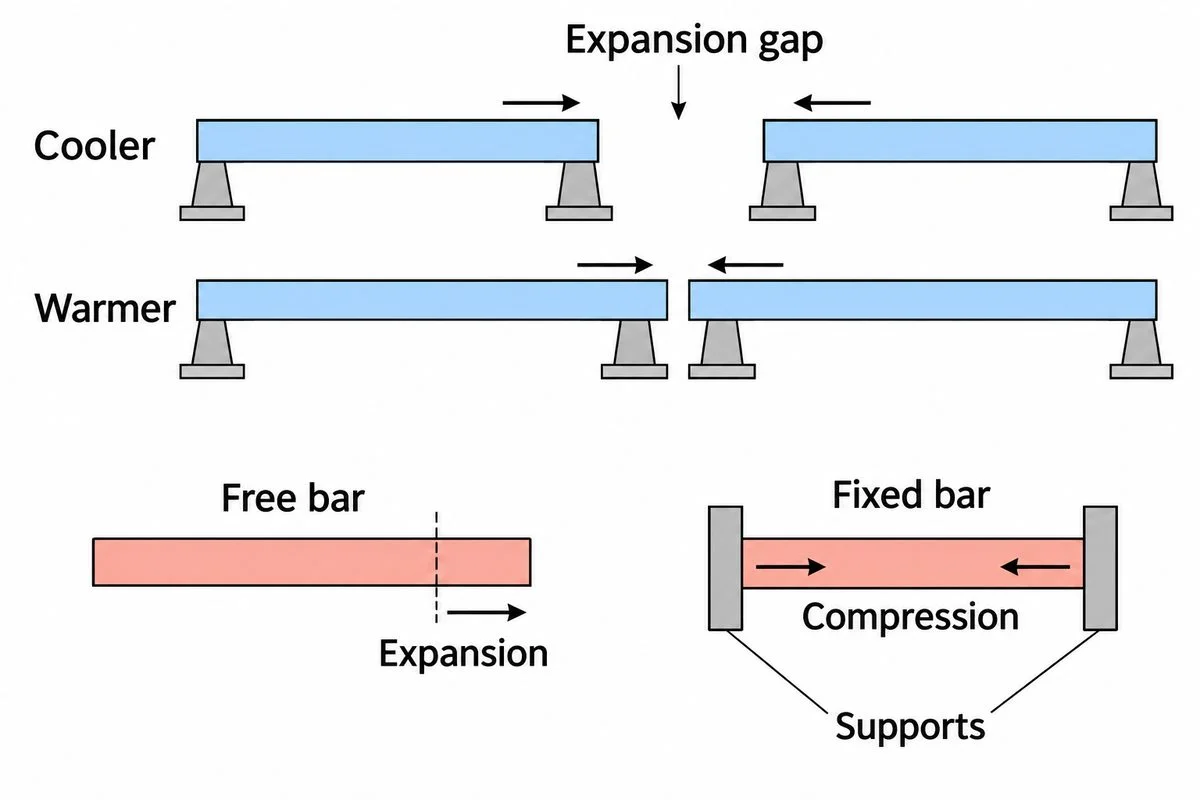
Bridge gaps accommodate expansion; fixed supports compress a heated bar.

2. Thermal expansion and thermal stress

Expansion changes lengths, areas and volumes, while restraints can create stress.

Show
Compare the cooler and warmer bridge gaps in the diagram. Below, find the free bar and the bar between supports.
Ask
How will this gap protect the bridge when its sections warm?
Say
Heating usually enlarges a solid's length. The gap accommodates the sections' expansion. Fixed supports prevent lengthening and compress the heated bar.
Used in
Heating enlarges a ring's hole so it fits a wider rim.
If your child says…“No length change means no stress.”
Ask
What must the clamps exert to prevent expansion?
What’s true
Restraints oppose expansion even when length stays unchanged.
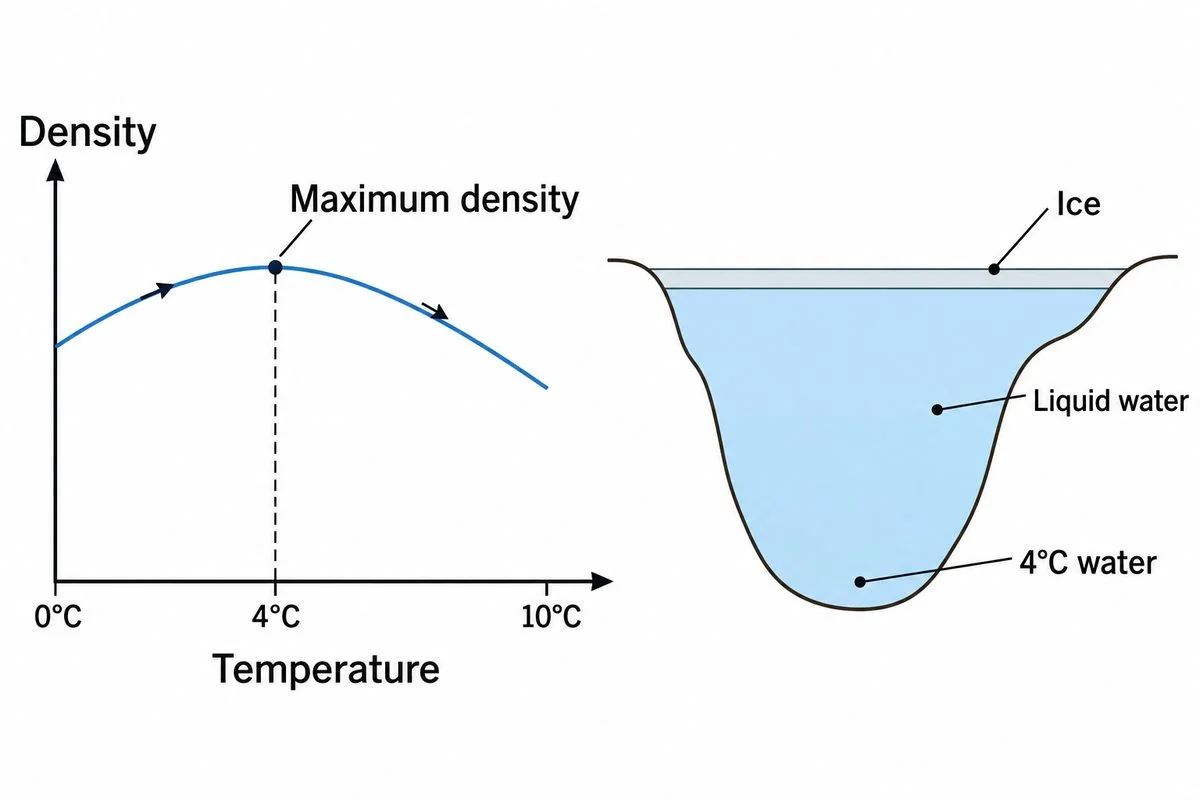
Water density peaks at 4°C; pond ice lies above deeper liquid water.

3. Density and anomalous expansion of water

Expansion lowers density at fixed mass; water behaves unusually near freezing.

Show
Follow the diagram's density curve from 0°C through 4°C to 10°C. Then find the pond's ice and deeper water.
Ask
As this pond cools below 4°C, where will the colder water remain?
Say
Water contracts when warmed from 0°C to 4°C, where its density is greatest. Below 4°C, cooling makes water less dense, so it stays above denser water. The surface freezes first.
Used in
Floating ice slows heat loss from the water below.
If your child says…“Expanding liquid becomes denser.”
Ask
If unchanged mass fills more space, what happens to mass per unit volume?
What’s true
Expansion spreads unchanged mass through more volume, lowering density.

Energy for warming and changing state

0.100c(60−Tf)=0.200c(Tf−30)0.100c(60-T_f)=0.200c(T_f-30)

60−Tf=2(Tf−30)60-T_f=2(T_f-30)

4. Heat capacity and calorimetry

Heat capacity measures energy needed per kelvin of temperature rise.

Show
Write these lines for mixing water: 0.100 kg at 60°C, 0.200 kg at 30°C. Say: specific heat is c; final temperature is T_f. Ignore container heating and heat escape.
Ask
What final temperature follows?
Say
The mixture reaches 40°C. Heat lost equals heat gained.
Used in
Calorimetry includes the vessel's warming to measure a material's specific heat.
If your child says…“More water means higher specific heat.”
Ask
Have we changed the material or its amount?
What’s true
Adding mass increases heat capacity without changing specific heat.
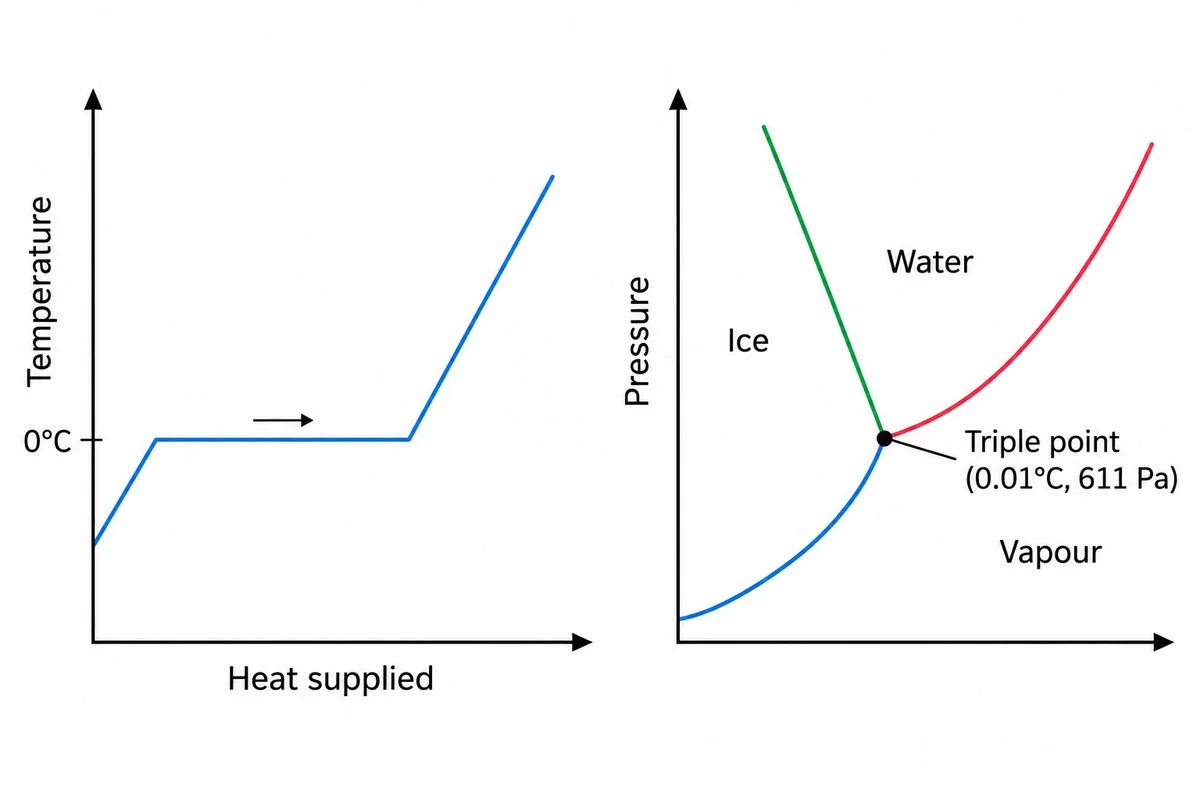
Melting plateau beside water's phase boundaries meeting at the triple point.

5. Latent heat and phase equilibrium

State changes transfer energy at temperatures affected by pressure.

Show
Follow the diagram's heating curve through its flat melting section. Beside it, follow the phase boundaries to their meeting point.
Ask
Where will added energy go while the melting section stays flat?
Say
Energy melts ice without raising its temperature. Each phase boundary allows two phases to coexist. At 0.01°C and about 611 Pa, ice, water and vapour coexist.
Used in
Pressure cookers raise water's boiling temperature, allowing hotter cooking water.
If your child says…“Melting ice takes in no heat.”
Ask
What supplies the energy that turns this ice into water?
What’s true
Melting needs energy even while temperature holds steady.

Heat transfer and cooling

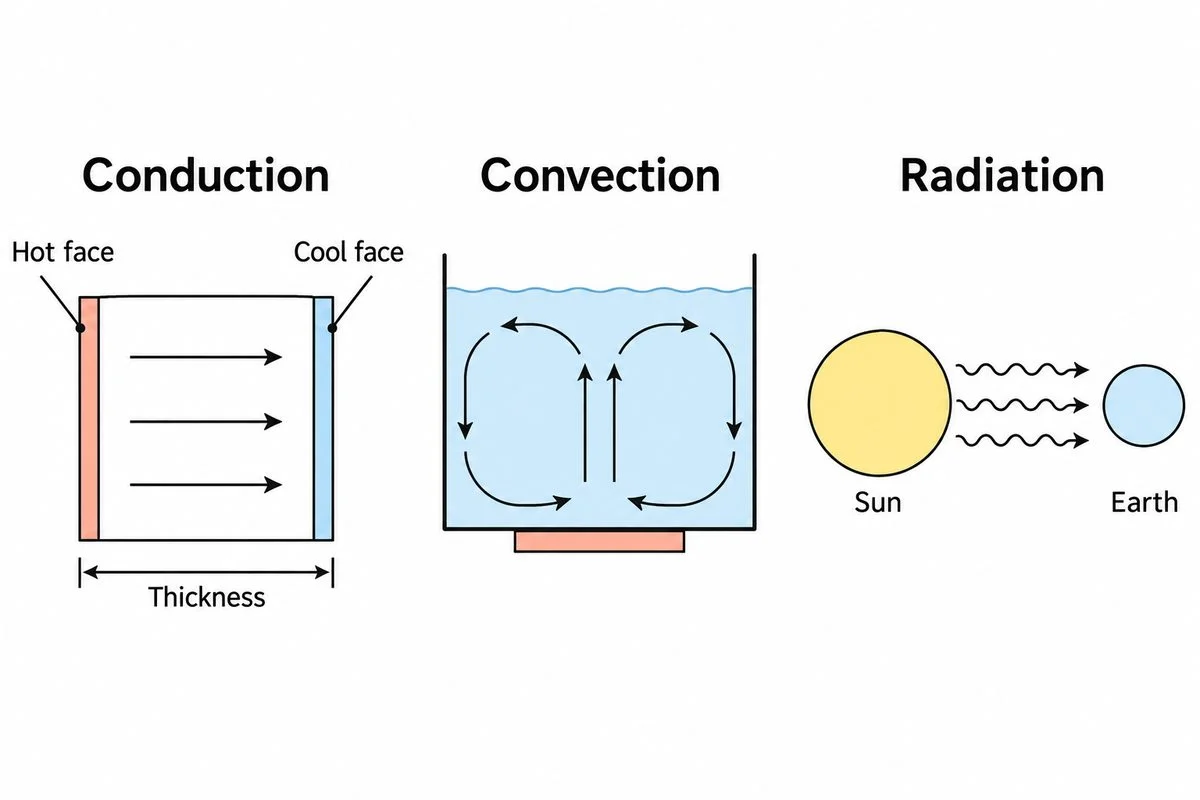
Energy crosses a slab, moves with circulating water, and reaches Earth through space.

6. Conduction, convection and radiation

Heat travels through matter, moving fluids or empty space.

Show
Find the solid slab in the diagram. Follow the water's circulation arrows, then the radiation arrows between Sun and Earth.
Ask
If this slab becomes thicker, what happens to steady heat flow with other conditions unchanged?
Say
A thicker slab reduces steady conduction, with material, area and face temperatures unchanged. Convection carries energy with moving water. Radiation crosses space without matter.
Used in
A flask's vacuum reduces conduction and convection, keeping drinks cold.
If your child says…“Vacuum blocks every kind of heat.”
Ask
How does the Sun's energy cross space?
What’s true
Radiation carries energy across empty space.
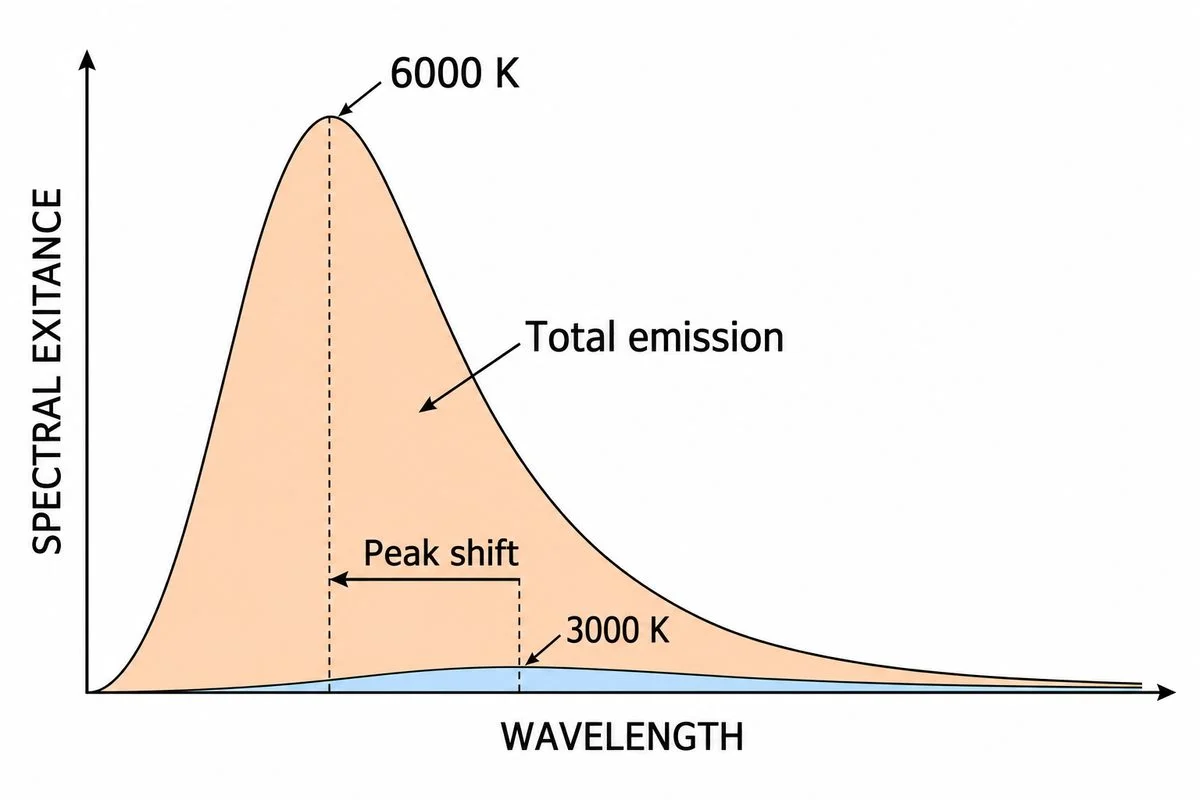
Hotter blackbody spectrum peaks at shorter wavelength and encloses a larger area.

7. Wien's law and Stefan–Boltzmann law

Temperature sets blackbody peak wavelength and emitted power per unit area.

Show
Compare the diagram's peaks, then the areas beneath both curves.
Ask
When kelvin temperature doubles, how will peak wavelength and emission change?
Say
Peak wavelength halves; emitted power per unit area increases sixteenfold. Total emission comes from the whole shaded area, not peak height.
Used in
A star's radiation spectrum reveals its temperature without sending a thermometer there.
If your child says…“Hotter bodies peak at longer wavelengths.”
Ask
If wavelength times temperature stays constant, can both increase?
What’s true
Doubling a blackbody's kelvin temperature halves its peak wavelength.
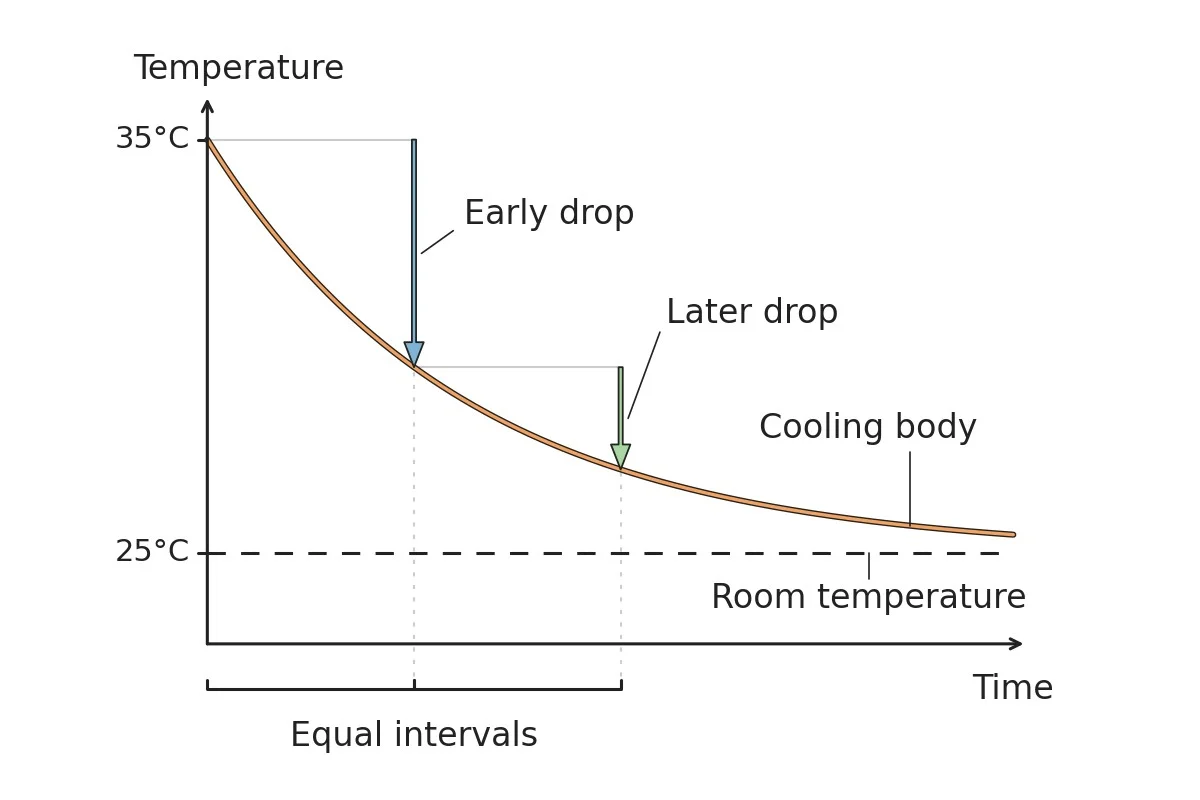
Cooling curve approaches room temperature, with smaller drops over equal time intervals.

8. Newton's law of cooling

Cooling slows as the temperature difference from the surroundings shrinks.

Show
Find the room-temperature line in the diagram. Compare the cooling curve's drops over the two equal intervals.
Ask
As this drink nears room temperature, how will its drop over the next interval change?
Say
The later drop is smaller because the drink is closer to room temperature.
Used in
Cooling estimates help predict when drinks approach room temperature.
If your child says…“It loses the same degrees each minute.”
Ask
Does the temperature difference stay unchanged as the water cools?
What’s true
Equal intervals give progressively smaller temperature drops.

A real problem

A vacuum flask kept cold liquids cold.

Dewar's flask was first exhibited at the Royal Institution in 1892.

Its insulation kept the contents cold and slowed evaporation.

The vacuum reduced heat transfer by conduction and convection.

Royal InstitutionWikipedia

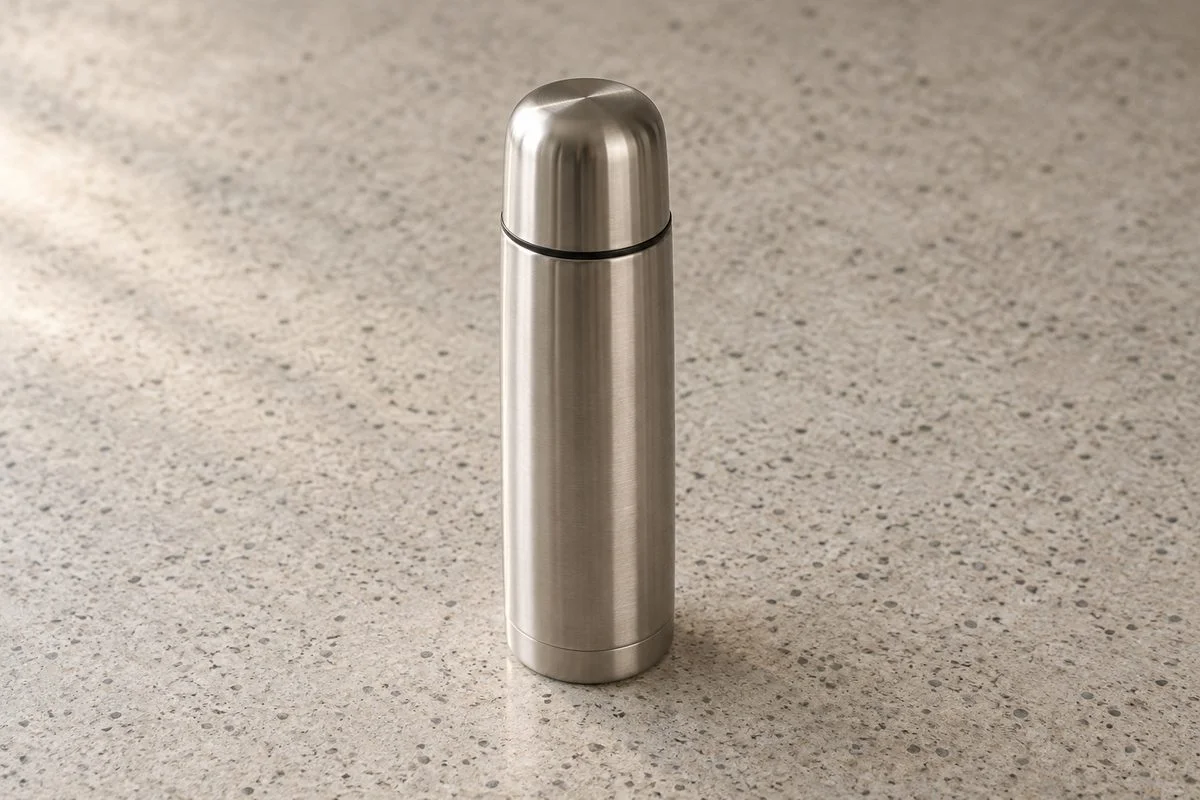
Closed, unbranded vacuum flask on a kitchen table.

Concept Lab · Common misconception

The tempting mistake in Thermal Properties of Matter

Open standalone misconception page →

Can a temperature rise be used as the only measure of energy added?

Wrong

If ice stays at 0 °C while melting, it absorbs no energy.

Why it feels right. The temperature reading stays fixed.

Right

Energy can change the state at constant temperature.

Worked example

The flat part is the melting interval. Heat is added while the mixture stays near 0 °C.
  1. Heat a mixture of ice and water near 0 °C at atmospheric pressure.
  2. The ice melts before the mixture’s temperature rises.

Ask your child eight quick questions.

One per step. The answer and the reason are given.

  1. The thermometer rises by 10°C. How large is the rise in kelvin?

    10 K. The scales have different starting points but equal-sized temperature steps.

  2. Heating a rigidly clamped metal rod produces what kind of stress?

    Compressive stress. The clamps oppose the expansion that heating would otherwise produce.

  3. A liquid expands without losing mass. What happens to its density?

    It decreases. The same mass occupies more volume.

  4. For water at the same temperature, what happens to specific heat when its mass doubles?

    It stays unchanged. Doubling mass doubles total heat capacity, not specific heat.

  5. What happens to pure ice's temperature while it melts at constant pressure?

    It stays constant. Energy changes ice into water without raising its temperature.

  6. Which heat-transfer process crosses the empty gap between a flask's walls?

    Radiation. Radiation needs no matter to carry energy.

  7. A blackbody's kelvin temperature doubles. What happens to its peak wavelength?

    It halves. Wien's law keeps peak wavelength times kelvin temperature constant.

  8. Under these conditions, how do temperature drops compare over equal time intervals as cooling continues?

    The drops get smaller. The temperature difference from the surroundings shrinks, so cooling slows.

15 more questions with answers, 2 with pictures