Skip to content

Teach Oscillations in eight steps.

For each idea: show it, ask before you tell, then say one line.

Gather a spoon, thread, a heavy book, a stable table, a small steel bowl, a basin, water, paper and a pencil.

Common misconceptions & worked visual for this chapter · 15 practice questions with answers

How to teach it

Describe the motion

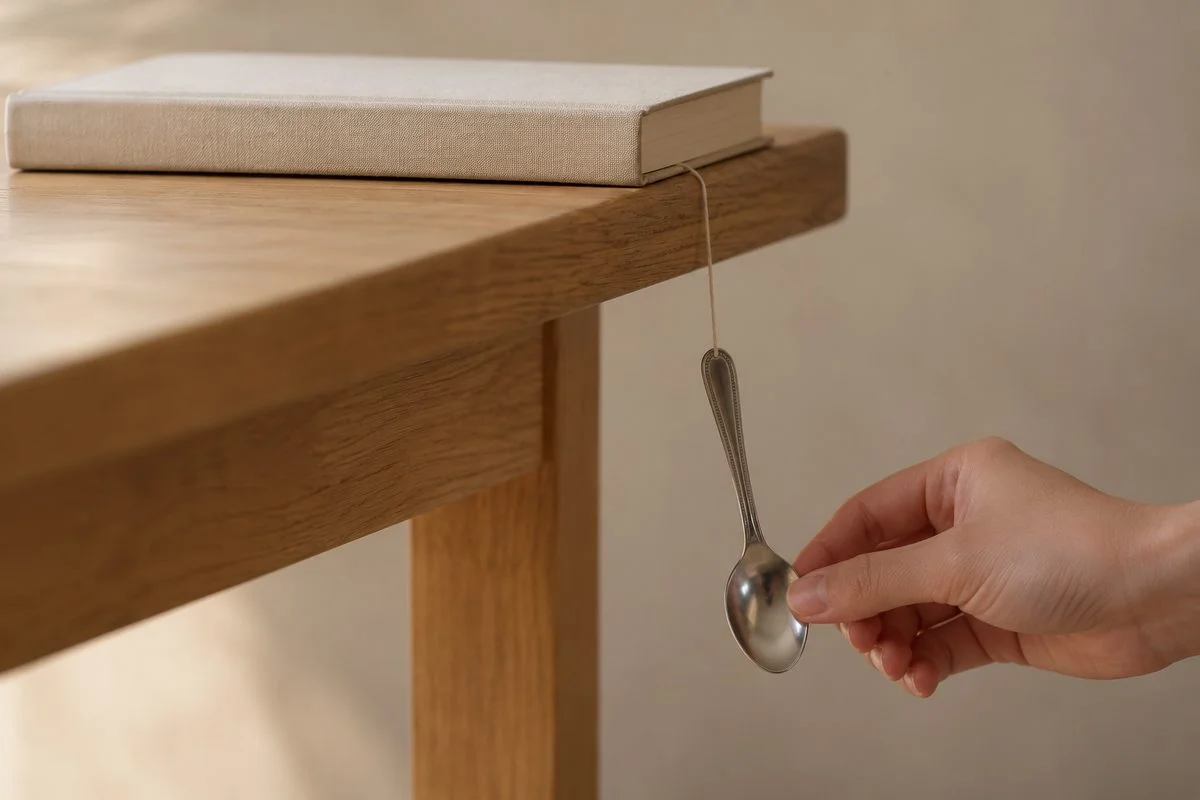
A spoon suspended by thread, held slightly aside.

1. Period, frequency and amplitude

Describe how motion repeats, how often, and how far it reaches.

Show
Suspend a spoon securely from thread beneath a heavy book. Hold it slightly aside before releasing it.
Ask
Will reaching the centre again complete a whole cycle?
Say
No; period measures one complete cycle’s time.
Used in
Pendulum clocks use repeated swings to regulate timekeeping.
If your child says…“It has returned to the centre, so the cycle is finished.”
Ask
Is the spoon travelling the same way on these two centre crossings?
What’s true
Passing the centre in the opposite direction does not complete a cycle.
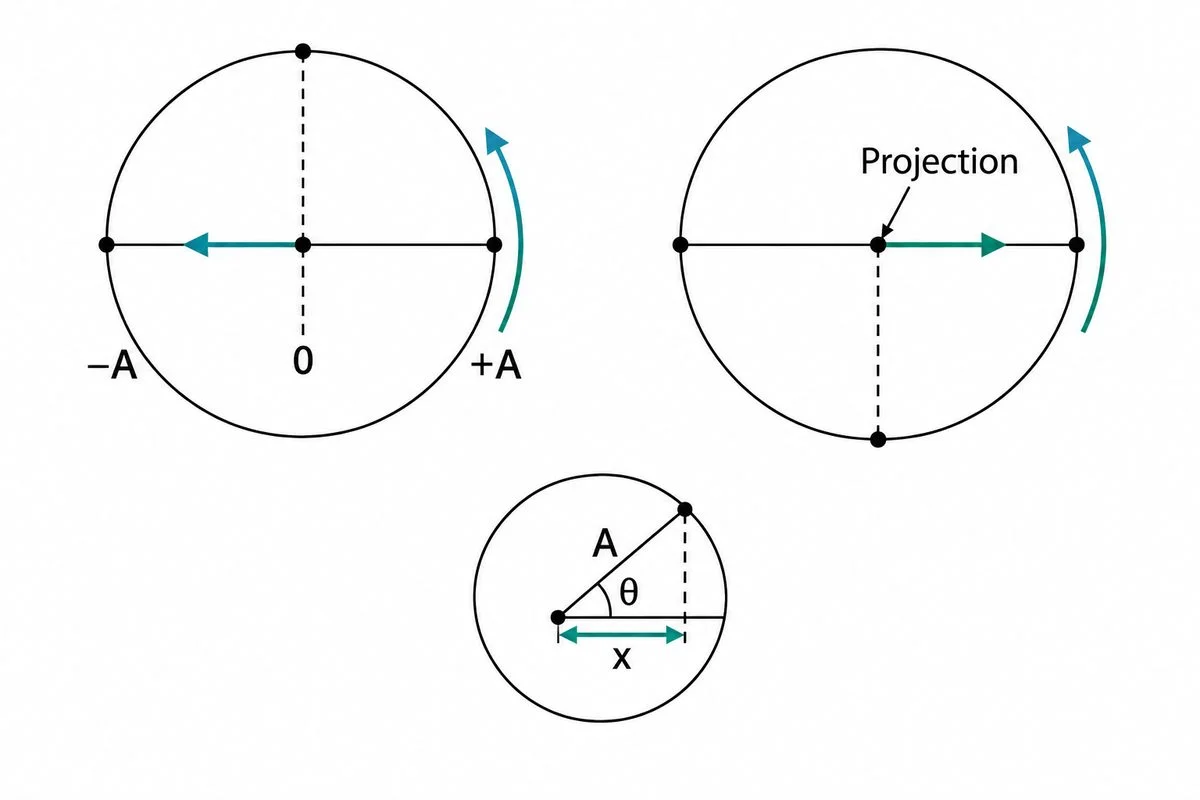
Circular points project to the same position but move in opposite directions.

2. Phase and circular projections

Phase tells where a motion has reached in its cycle.

Show
Look at the diagram’s top and bottom points. Follow each dashed line to the horizontal diameter. Compare the rotation arrows.
Ask
Will these two central projections move the same way next?
Say
Uniform circling gives SHM along the diameter, with opposite velocities at these centre crossings. Direction therefore helps identify phase.
Used in
Noise-cancelling headphones combine opposing sound oscillations to reduce unwanted noise.
If your child says…“The starting position tells us the phase.”
Ask
Do these matching projection positions have matching directions?
What’s true
Between the ends, the same position occurs at different phases when travelling in opposite directions.

Explain the motion

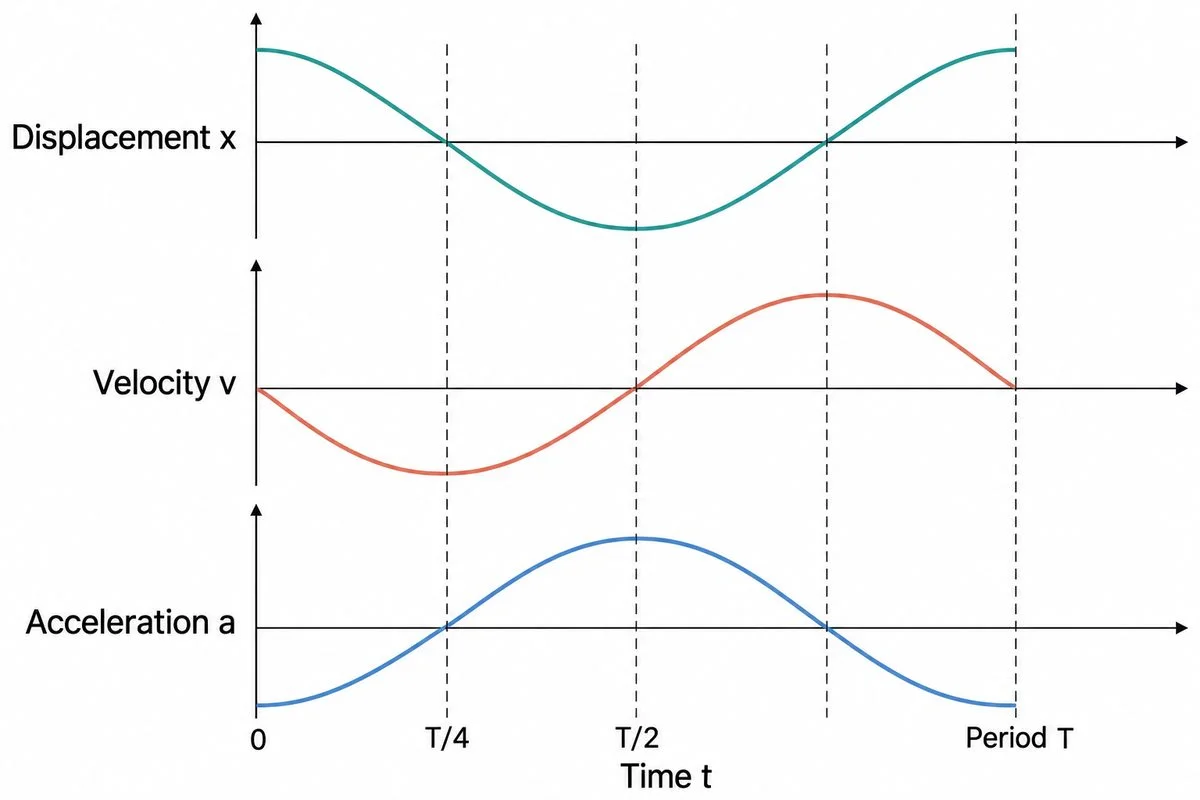
Aligned displacement, velocity and acceleration graphs show their values throughout one cycle.

3. Velocity and acceleration in SHM

Speed peaks at equilibrium; acceleration magnitude peaks at the turning points.

Show
Look at the diagram’s three graphs at the starting time. Follow their aligned guides through a quarter-cycle to the centre crossing.
Ask
At the starting extreme, will zero speed also mean zero acceleration?
Say
At the starting extreme, speed is zero but acceleration is greatest towards equilibrium. At the centre, speed is greatest and acceleration is zero.
Used in
Engine designers estimate piston speeds to choose parts that can withstand the motion.
If your child says…“When it stops at an end, its acceleration is zero.”
Ask
Where is the acceleration curve when the velocity curve starts at zero?
What’s true
At either end, speed is zero but acceleration has its greatest magnitude, directed towards equilibrium.
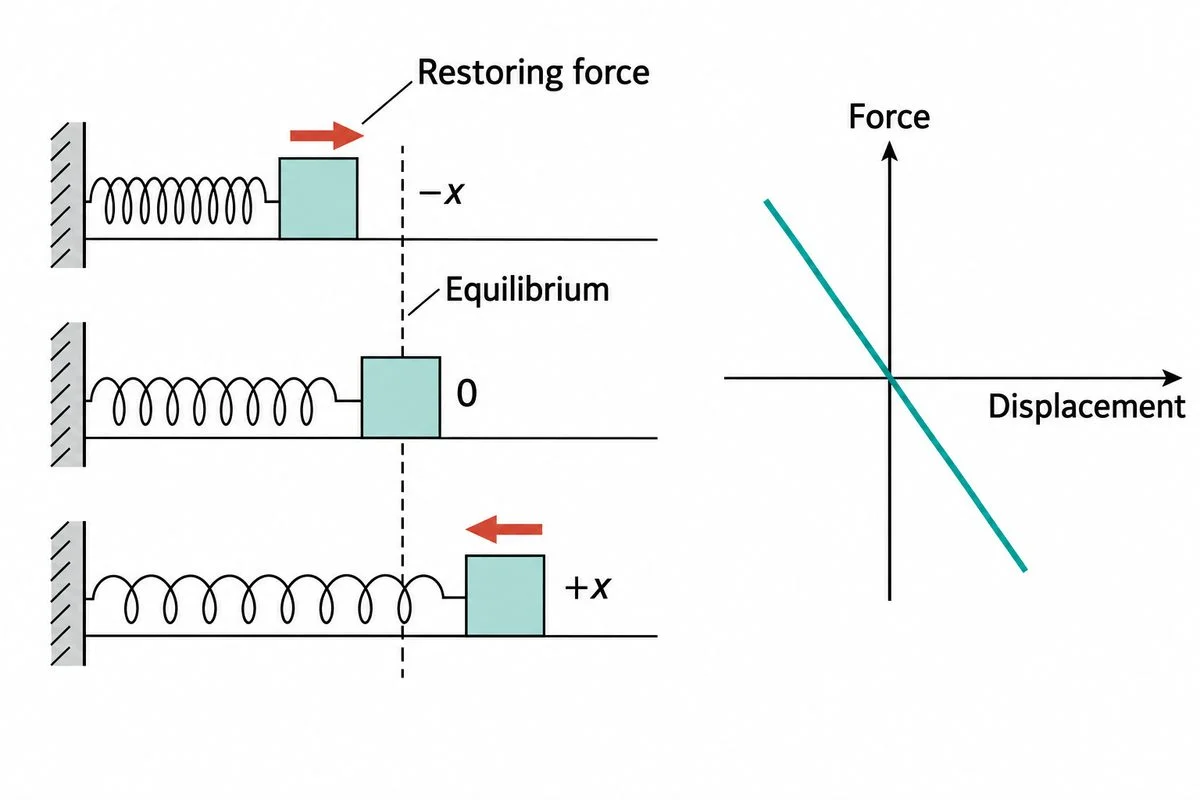
Spring forces point towards equilibrium beside a straight, downward-sloping force–displacement graph.

4. Restoring force

SHM needs a force towards equilibrium, proportional to displacement.

Show
Look at the diagram’s equilibrium row, then the displaced blocks. Follow the force arrows towards equilibrium. Read the straight force–displacement graph.
Ask
If displacement doubles, how must this spring’s force change to keep the motion simple harmonic?
Say
The force must double and still point towards equilibrium. The straight graph through zero shows this proportional change.
Used in
A spring balance uses its force–stretch relation to measure force.
If your child says…“Any force pulling back gives exact SHM.”
Ask
Would a force growing eightfold when displacement doubles satisfy that requirement?
What’s true
A restoring force must also vary directly with displacement for exact SHM.
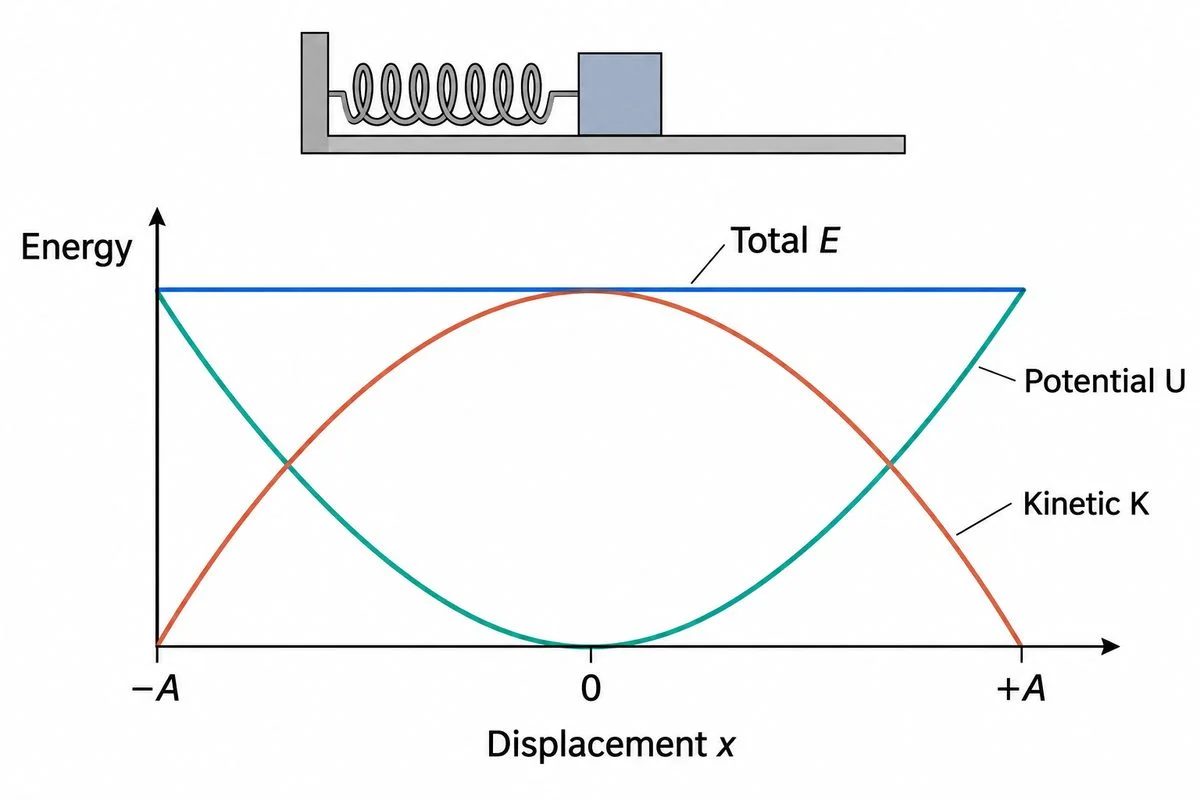
Potential and kinetic energy curves exchange height beneath a constant total-energy line.

5. Energy in SHM

Kinetic and potential energy exchange; total energy depends on amplitude squared.

Show
Look at the diagram. Follow the energy curves from the centre to the right turning point.
Ask
Where does the energy go when the mass stops?
Say
The spring stores all the energy at an end. Total energy stays constant throughout this ideal oscillation.
Used in
A playground swing exchanges kinetic and potential energy, carrying its rider between pushes.
If your child says…“Twice the amplitude means twice the energy.”
Ask
How much does the square of a number increase when that number doubles?
What’s true
For the same ideal spring, doubling amplitude requires four times the energy.

Compare oscillating systems

k=100 N m−1k=100\,\mathrm{N\,m^{-1}}

T1=2π1100 s≈0.63 sT_1=2\pi\sqrt{\frac{1}{100}}\,\mathrm{s}\approx0.63\,\mathrm{s}

T2=2π4100 s≈1.26 sT_2=2\pi\sqrt{\frac{4}{100}}\,\mathrm{s}\approx1.26\,\mathrm{s}

6. Spring oscillations

More mass lengthens the period; greater spring stiffness shortens it.

Show
Write these lines for a fixed-end ideal spring. Say: “Stiffness is k; T₁ and T₂ are periods for 1 kg and 4 kg.”
Ask
How many times longer is the second period?
Say
The second period is twice the first. Period grows with the square root of mass.
Used in
An ideal spring clock’s period stays unchanged when gravity changes.
If your child says…“Four times the mass means four times the period.”
Ask
What does taking the square root do to the fourfold mass increase?
What’s true
On the same ideal spring, period grows with the square root of mass.
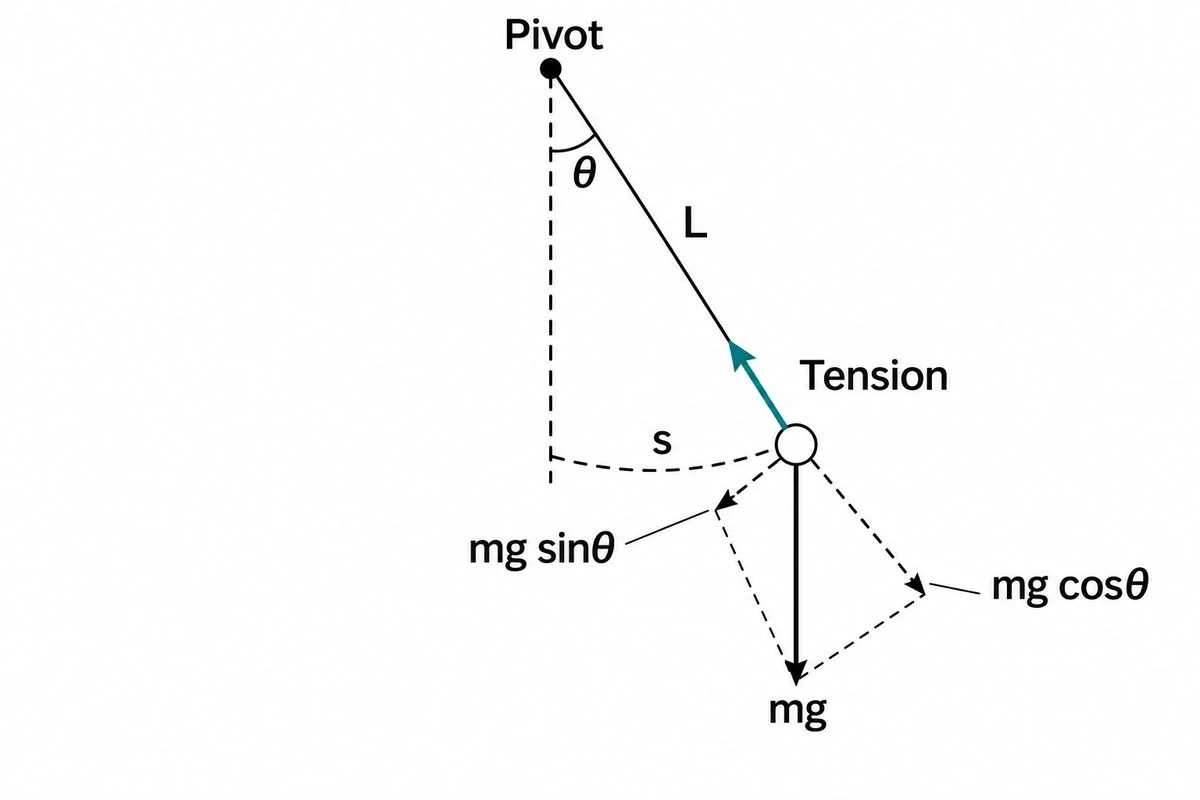
A slightly displaced pendulum shows weight, tension and the restoring component along its arc.

7. Simple pendulum

Small-swing periods depend on length and gravity, not bob mass.

Show
Look at the diagram’s string length and small angle. Follow the restoring component towards equilibrium.
Ask
Would a heavier bob change the ticking rate?
Say
No: restoring force and inertia increase equally.
Used in
Pendulum control improved the accuracy of mechanical clocks.
If your child says…“Four times the length means four times the period.”
Ask
What is the square root of four?
What’s true
At fixed gravity, small-swing period grows with the square root of length.
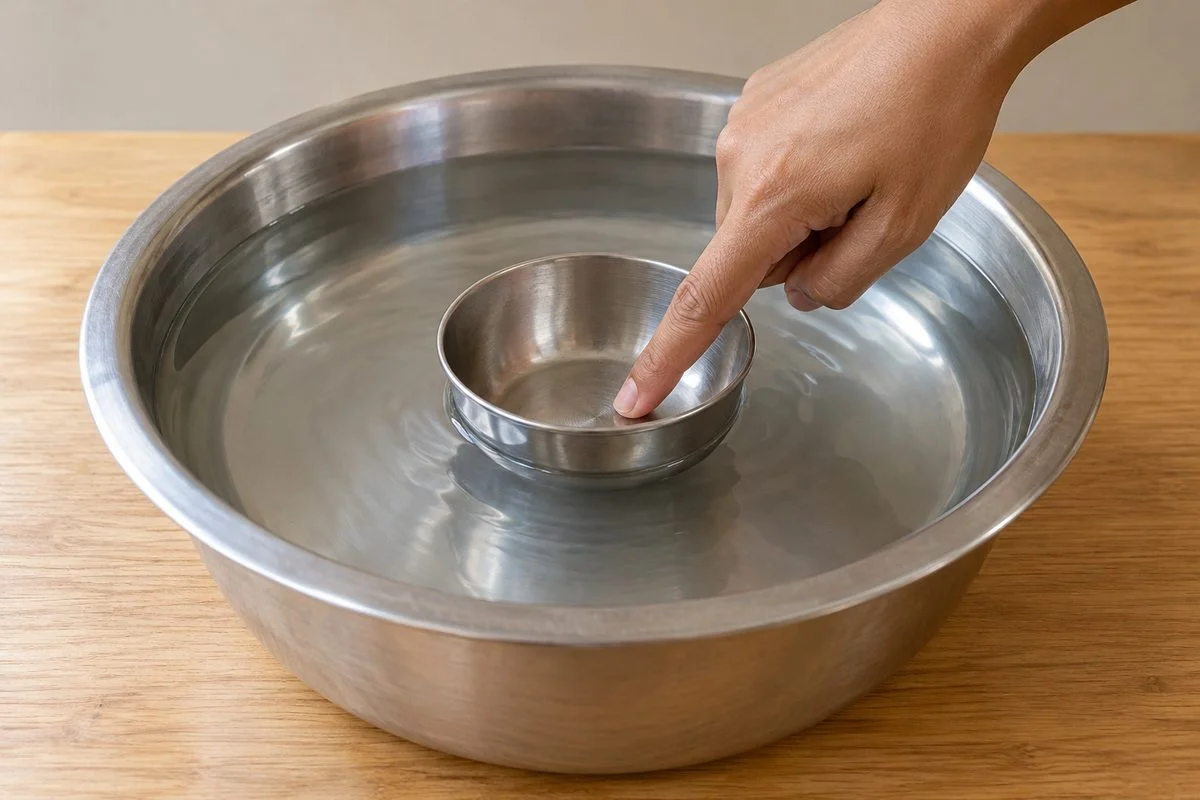
One hand pressing a floating steel bowl slightly deeper, with its rim above water.

8. Oscillations in liquids

Changing immersion or liquid levels produces a restoring force.

Show
Float an empty steel bowl in water. Let it settle. Press down slightly, keeping its rim dry. Release it.
Ask
Which way will the bowl first move when released?
Say
Deeper immersion increases buoyancy. This extra upward force makes the released bowl rise and bob.
Used in
Fishing floats bob around their resting position, helping anglers notice a fish pulling the line.
If your child says…“A wider cork bobs faster because water pushes harder.”
Ask
If the water pushes harder, what also makes the wider cork harder to accelerate?
What’s true
Wider uniform corks have unchanged ideal periods for equal heights, equal densities and small bobs.

A real problem

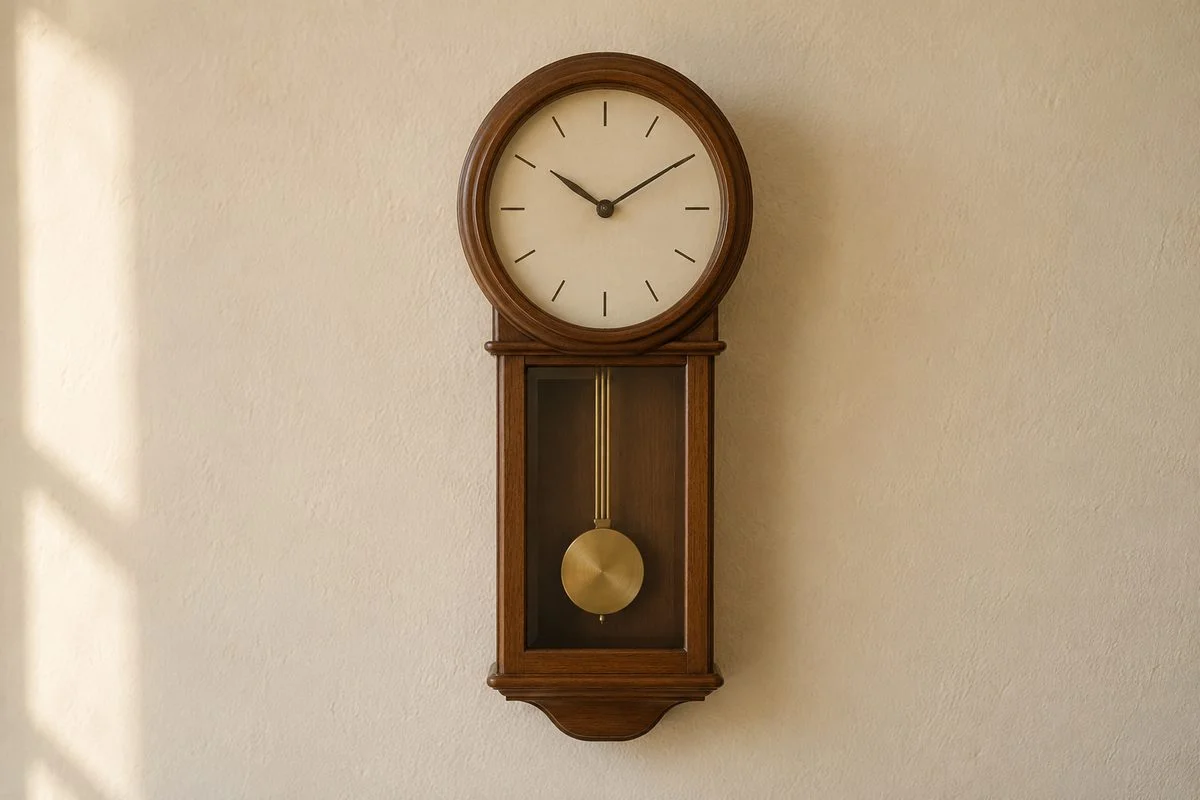
Pendulum control improved mechanical timekeeping.

Christiaan Huygens developed his pendulum clock in 1656.

A mechanism’s natural oscillation period regulated the clock.

Pendulum control gave greater accuracy than older clock mechanisms.

NISTMuseums Victoria

A wooden wall clock with its pendulum visible.

Concept Lab · Common misconception

The tempting mistake in Oscillations

Open standalone misconception page →

Where does a spring mass move fastest?

Wrong

The mass moves fastest at maximum stretch because the spring pulls hardest there.

Why it feels right. I connect the biggest force with the biggest speed.

Right

The mass changes direction at maximum displacement. In ideal spring motion its speed peaks at equilibrium.

Worked example

The mass is momentarily at rest at both ends. Its speed is greatest as it crosses equilibrium.
  1. Release a mass from maximum stretch.
  2. It starts at rest.
  3. At equilibrium, spring potential energy is at a minimum and speed is at a maximum.
  4. The mass then slows to rest at the opposite end.

Ask your child eight quick questions.

One per step. The answer and the reason are given.

  1. After crossing the centre rightwards, which centre crossing completes the cycle in ideal periodic motion?

    The next rightwards crossing. The position and velocity must both return to their starting values.

  2. Between the ends, what distinguishes the two phases at the same position?

    The direction of motion. The same position occurs twice per cycle, with opposite directions.

  3. At the positive turning point, which way does acceleration point, and how large is it?

    Towards equilibrium, with greatest magnitude. The restoring force is greatest there, although the mass briefly stops.

  4. Doubling displacement makes the restoring force eight times larger. Is this exact SHM?

    No. Exact SHM requires the force to double when displacement doubles.

  5. On the same ideal spring, how much energy does twice the amplitude require?

    Four times as much. Energy depends on amplitude squared.

  6. On the same spring, how must the mass change to double the period?

    Become four times larger. The square root of four is two.

  7. At unchanged gravity, what happens to a small-swing period when pendulum length becomes fourfold?

    It doubles. Period depends on the square root of length.

  8. For equal-height corks of the same material, how does greater width change the ideal period?

    It stays the same. Restoring force and mass increase in the same proportion.

15 more questions with answers, 1 with pictures