Skip to content

Teach Mechanical Properties of Fluids in eight steps.

For each idea: show it, ask before you tell, then say one line.

Gather paper and a pencil near a cold-water tap and sink.

Common misconceptions & worked visual for this chapter · 15 practice questions with answers

How to teach it

Pressure in still liquids

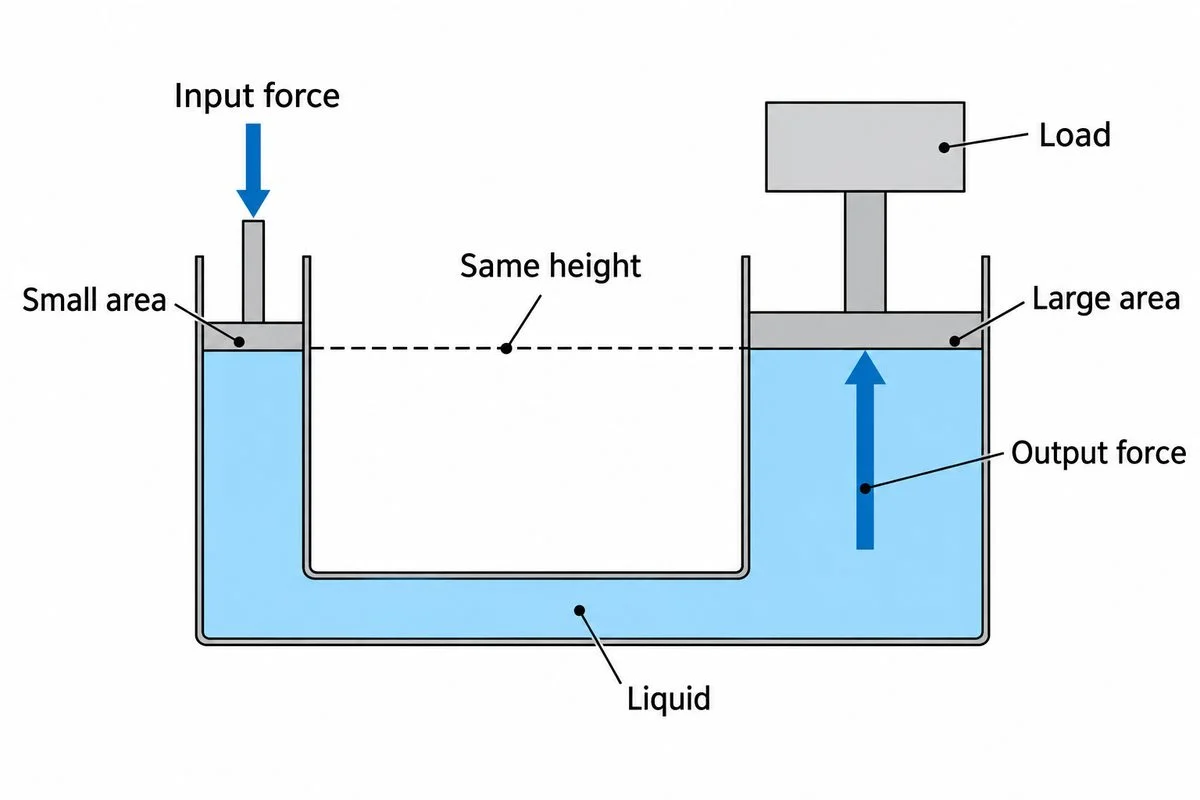
Connected unequal pistons with level faces and perpendicular force arrows.

1. Pressure and Pascal’s law

Pressure is the perpendicular force per unit area.

Show
Look at the diagram’s small piston on the left. Follow the enclosed liquid to the larger piston. Compare their level contact faces.
Ask
With the same input push, would a larger output piston support more or less weight?
Say
The enclosed liquid passes the added pressure throughout. That same added pressure produces greater force over the larger area.
Used in
A hydraulic lift’s larger piston provides greater force, allowing it to support heavy loads.
If your child says…“The big piston gets the same force.”
Ask
If pressure matches, what does a larger piston area change?
What’s true
A larger piston pushes harder but travels less for the same displaced liquid volume.
pg=ρgh=1000×10×2=20000 Pap_g=\rho gh=1000\times10\times2=20000\,\mathrm{Pa}

pg=20 kPap_g=20\,\mathrm{kPa}

2. Hydrostatic pressure and gauge pressure

Depth adds pressure; gauges subtract atmospheric pressure.

Show
Write these lines. Say, “Water density times gravitational acceleration times depth gives gauge pressure.”
Ask
Including the air’s 101 kPa, what total pressure acts here?
Say
Absolute pressure is 121 kPa. Add atmospheric pressure to the water’s contribution.
Used in
Barometers track atmospheric pressure through liquid height.
If your child says…“A gauge includes the atmosphere’s pressure.”
Ask
When a gauge reads zero in open air, has the air stopped pressing?
What’s true
Absolute pressure includes atmospheric pressure, while gauge pressure subtracts it.

Moving fluids

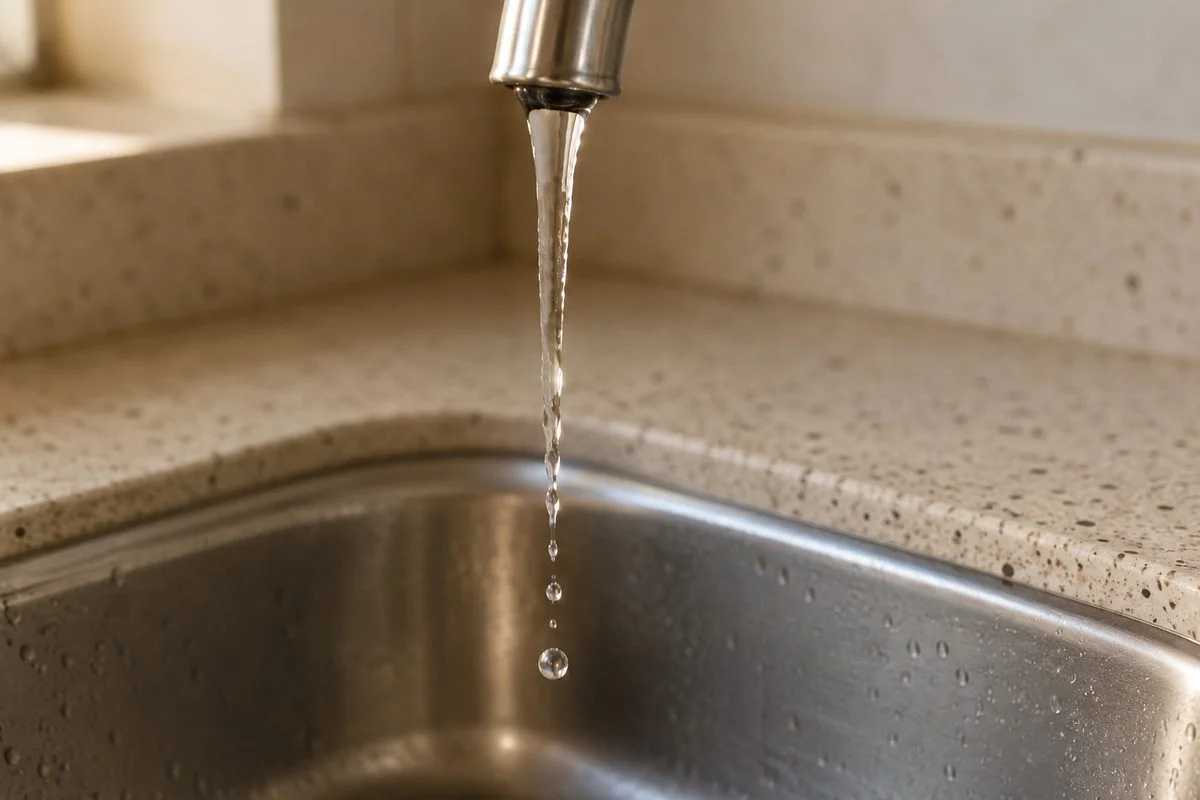
A smooth stream narrows as it falls from a kitchen tap.

3. Continuity and Bernoulli’s principle

Flow carries mass while energy shifts between pressure, motion and height.

Show
Run a smooth cold tap stream. Compare its width near the outlet and below.
Ask
Must falling water’s pressure increase?
Say
No; water gains motion energy and narrows, preserving volume flow.
Used in
In the simple wing model, unequal pressures produce lift.
If your child says…“Faster water must have higher pressure.”
Ask
What supplies this water’s extra motion energy as it falls?
What’s true
This exposed stream stays near atmospheric pressure even as it speeds up.
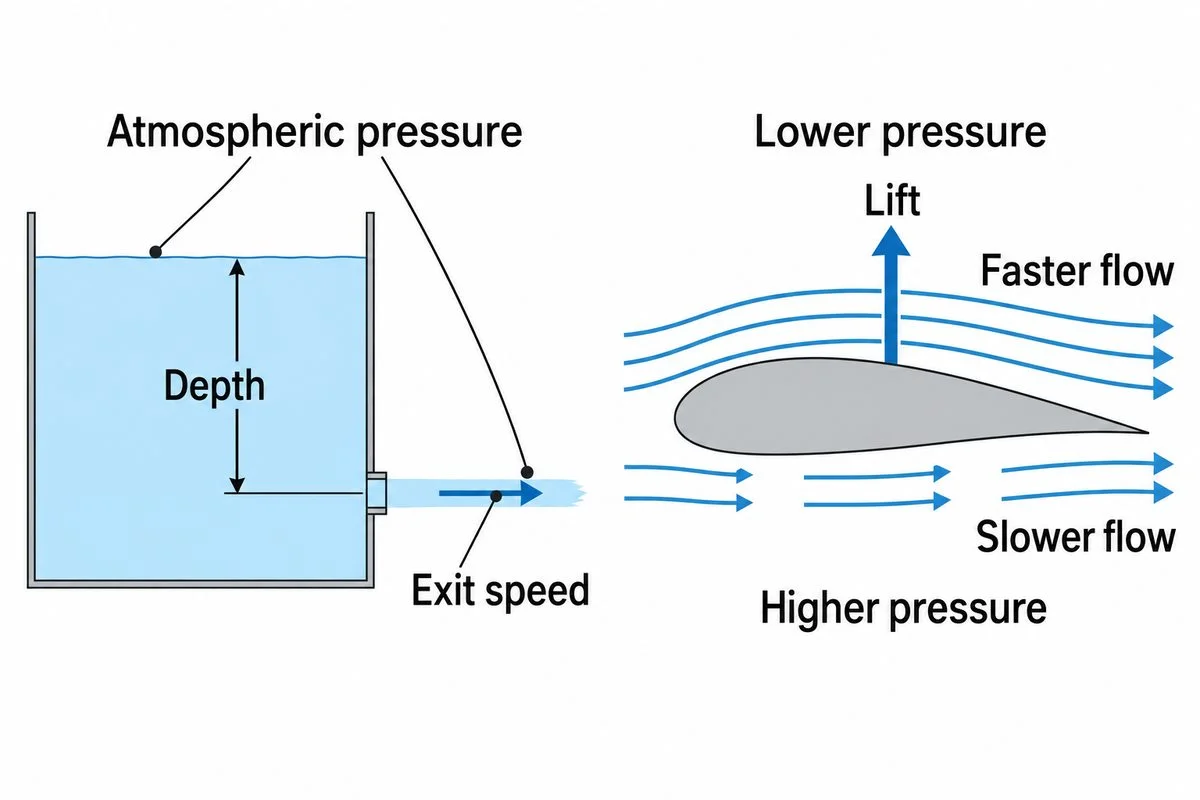
Tank outlet depth beside a wing with unequal airflow speeds and pressures.

4. Efflux and dynamic lift

Height supplies outflow energy; unequal pressures can lift a wing.

Show
Find the outlet depth in the diagram. Compare pressures around the wing.
Ask
Which way will the pressure difference push this wing?
Say
Higher pressure beneath this wing produces upward lift.
Used in
Pressure differences can curve a spinning ball’s path.
If your child says…“The hole’s height above the bottle’s base sets the speed.”
Ask
Would raising the whole tank change the water depth above its hole?
What’s true
The relevant height runs from the outlet up to the water surface.
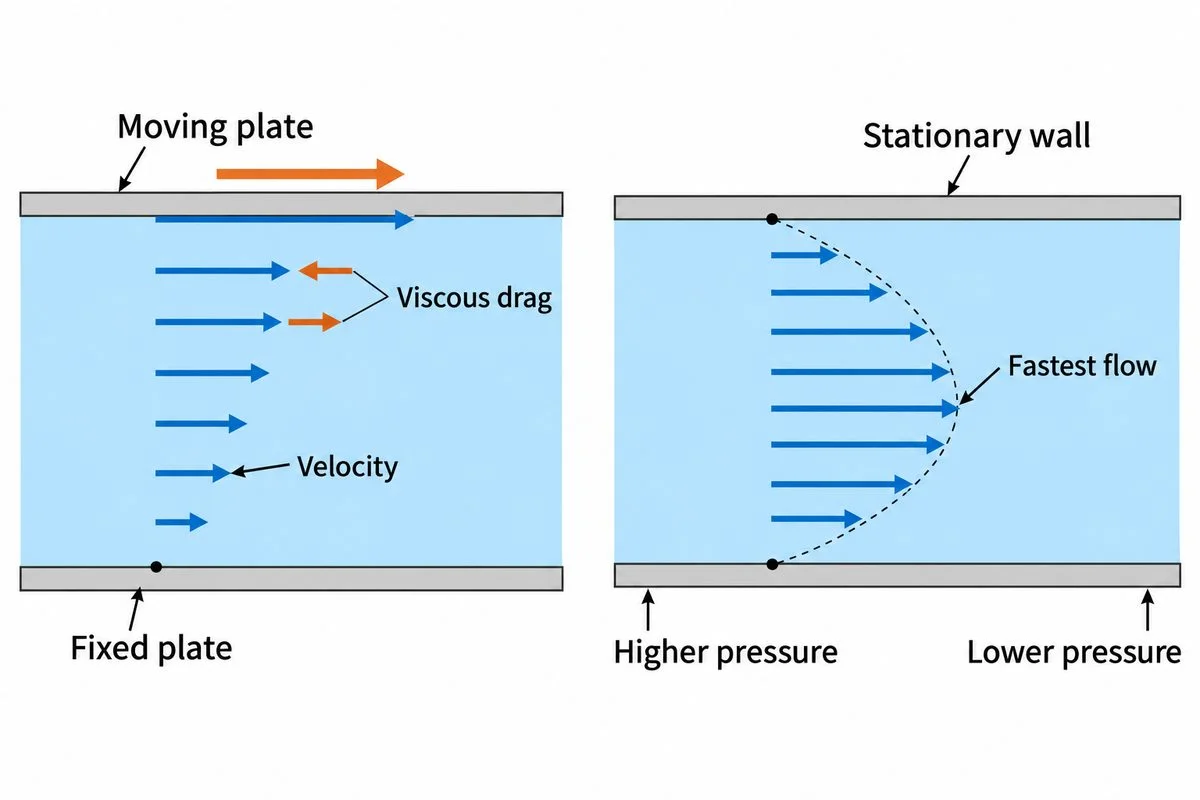
Sliding liquid layers beside pipe flow with maximum speed at the centre.

5. Viscosity and laminar pipe flow

Viscosity resists sliding layers and limits flow through pipes.

Show
Compare the diagram’s velocity arrows between plates, then across the pipe.
Ask
Why must pressure keep driving this flow?
Say
Viscosity resists sliding layers. Pipe flow is fastest centrally and stationary at the walls.
Used in
Wider tubes carry glycerine with less pressure loss.
If your child says…“Doubling the radius only quadruples the flow.”
Ask
What does the fourth power give when the radius doubles?
What’s true
Laminar flow follows radius to the fourth power when pressure drop, viscosity and length stay fixed.
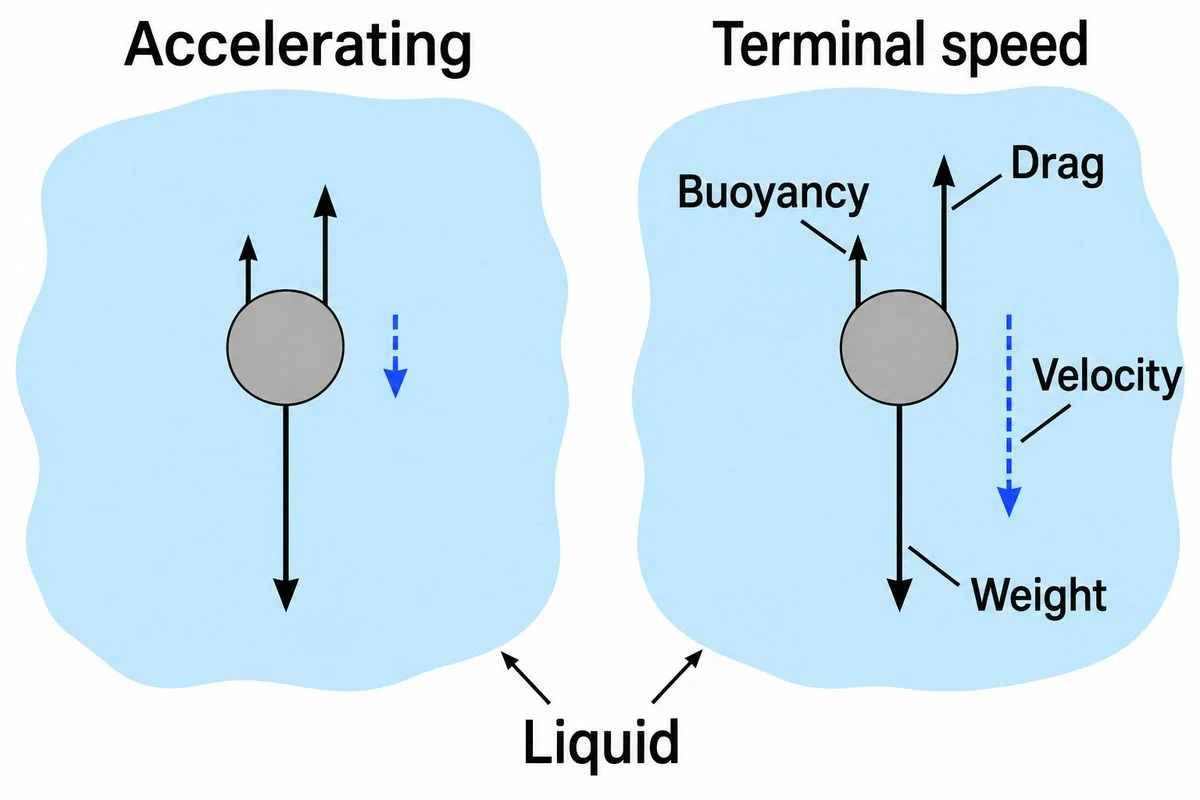
Falling sphere force diagrams show increasing drag until upward forces balance weight.

6. Stokes’ law and terminal speed

Viscous drag and buoyancy can balance a falling sphere’s weight.

Show
Compare the diagram’s force arrows before and at terminal speed.
Ask
Will increasing drag reduce downward acceleration?
Say
Increasing drag reduces downward acceleration until drag and buoyancy balance weight.
Used in
Settling tanks let particles sink, clearing water.
If your child says…“Gravity keeps making it faster, even at terminal speed.”
Ask
How could its speed stay constant if the downward force remained greater?
What’s true
Gravity still acts, but balanced forces give zero acceleration.

Liquid surfaces

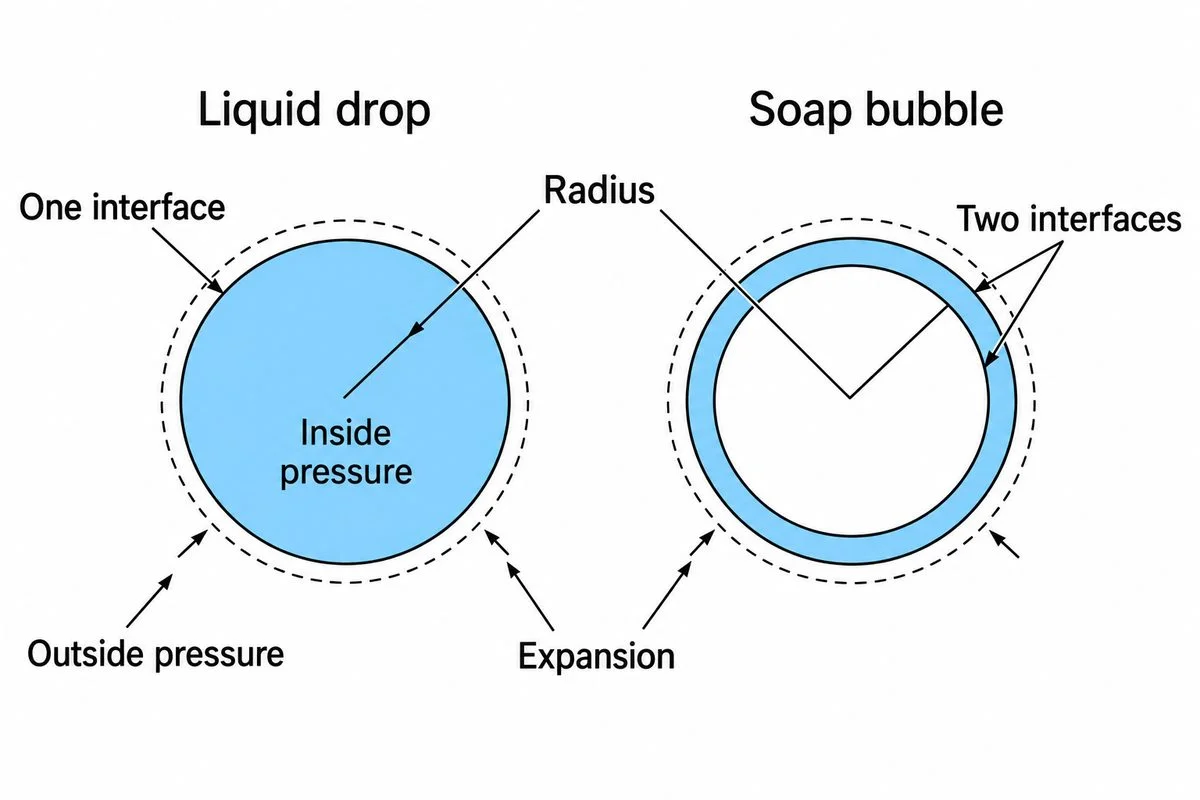
Liquid drop and soap bubble sections compare one surface with two surfaces.

7. Surface tension and excess pressure

Surfaces need energy, and curved surfaces produce pressure differences.

Show
Count surfaces in the diagram’s drop and bubble.
Ask
With matching radius and surface tension, which needs greater excess pressure?
Say
The bubble’s two surfaces double the drop’s excess pressure.
Used in
Soap lowers surface tension, helping water spread.
If your child says…“A bigger bubble has more excess pressure.”
Ask
Which surface is more tightly curved: a small bubble’s or a large bubble’s?
What’s true
For matching bubbles, excess pressure decreases as radius increases.
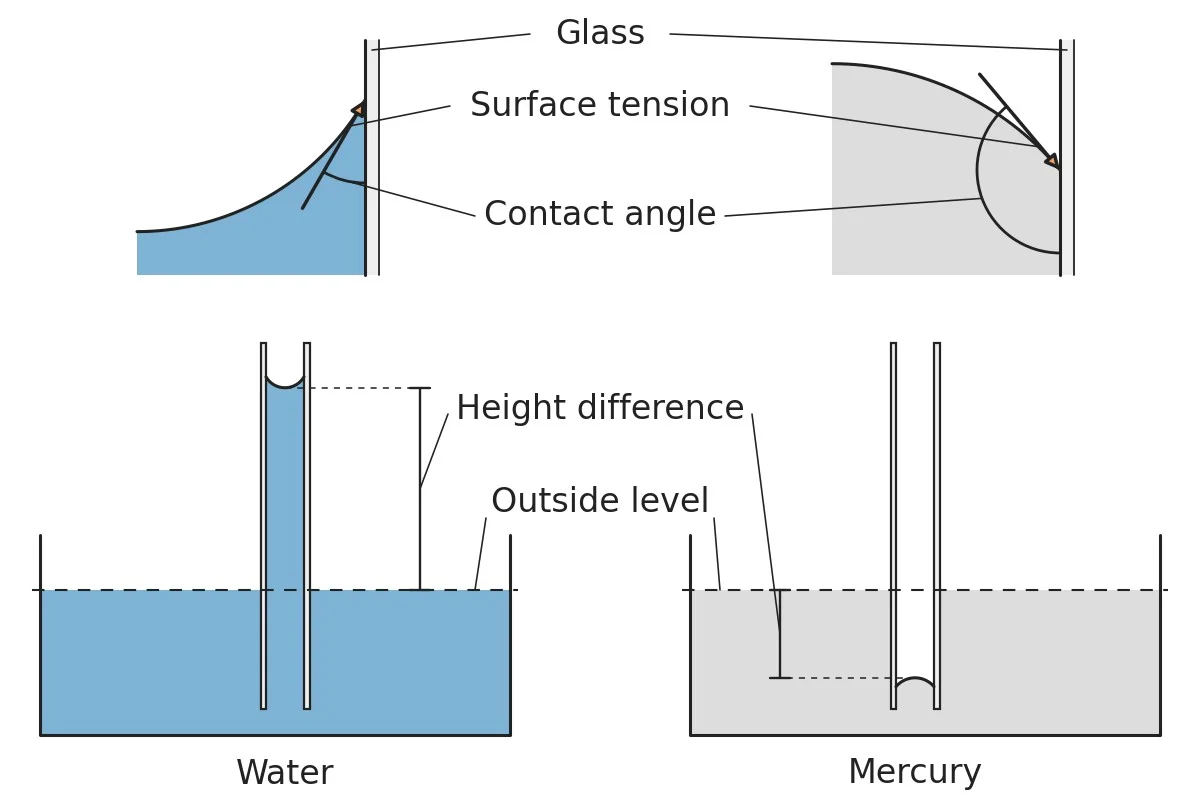
Water rises and mercury falls in glass tubes, with contact angles measured inside.

8. Contact angle and capillarity

Wetting determines whether liquid rises or falls inside narrow tubes.

Show
Compare the diagram’s liquid levels, then contact angles.
Ask
Would wider tubes increase these height differences?
Say
No, they would not. Water rises; mercury’s contact angle produces depression.
Used in
Wetting agents lower contact angles, helping liquids spread.
If your child says…“Wider tubes pull water higher.”
Ask
As a tube widens, does the water’s weight grow faster than the surface pull?
What’s true
With matching liquid and contact angle, narrower tubes give greater rise if tall enough.

A real problem

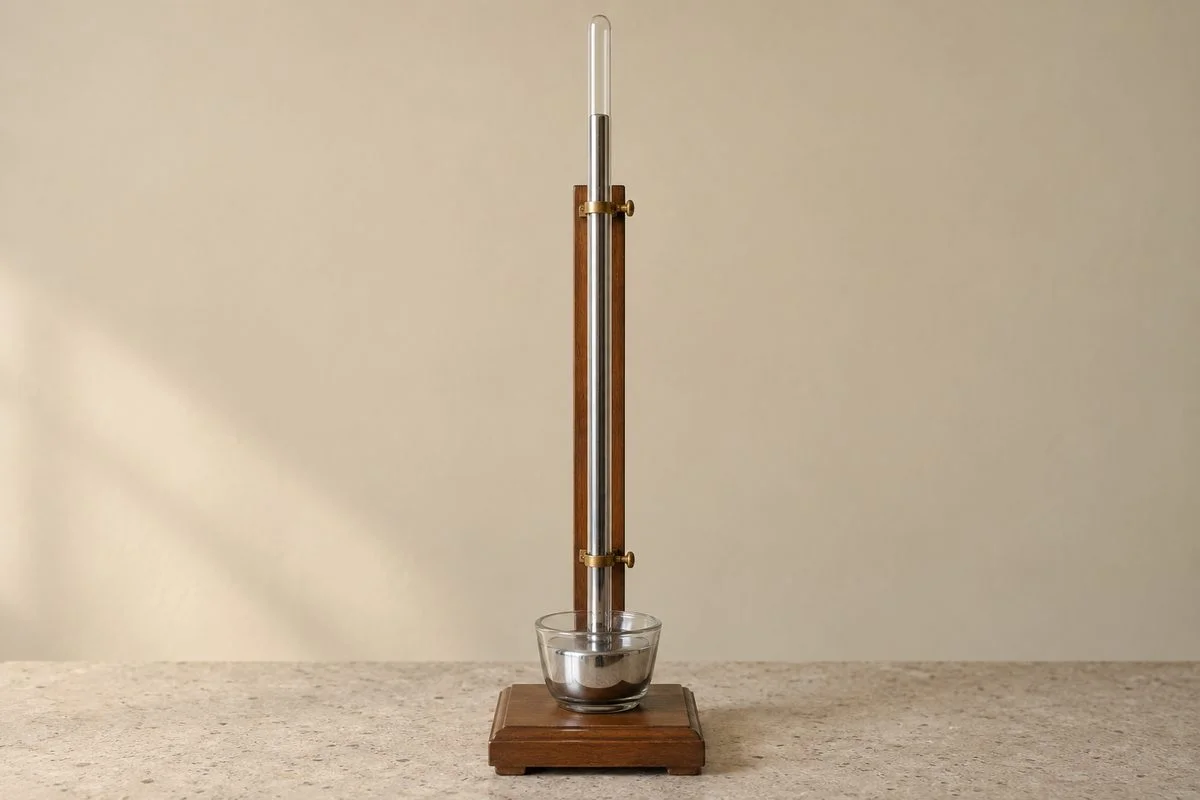
Torricelli’s barometer made atmospheric pressure measurable.

His first barometer dates to 1643.

Atmospheric pressure sets the liquid column’s height inside the inverted tube.

Changes in mercury height reveal changes in atmospheric pressure.

Science Museum GroupPurdue University

Torricelli’s barometer replica with its mercury column and reservoir.

Concept Lab · Common misconception

The tempting mistake in Mechanical Properties of Fluids

Open standalone misconception page →

Does liquid pressure depend on container shape?

Wrong

The wide tank has greater water pressure at the same depth.

Why it feels right. It holds more water.

Right

At a fixed depth, hydrostatic pressure depends on density and depth.

Worked example

The marked points are the same vertical distance below their water surfaces. Width does not change pressure at that depth.
  1. In open narrow and wide tanks with the same water depth, pressure at equal depth is the same.
  2. It can exert different total force over different areas.

Ask your child eight quick questions.

One per step. The answer and the reason are given.

  1. With equal added pressure, which piston provides greater force?

    The larger-area piston. The same pressure acts across a larger area.

  2. What does a gauge subtract?

    Atmospheric pressure. Surrounding air provides its reference.

  3. In steady, frictionless water flow through a level pipe, what happens to pressure where speed increases?

    Pressure falls. Pressure energy becomes motion energy.

  4. Refilling the tank changes exit speed how?

    It increases. Water depth above the outlet increases.

  5. With pressure drop, viscosity and length fixed, what does doubling radius do to laminar flow?

    It increases sixteenfold. Flow follows radius’s fourth power.

  6. At terminal speed, how do upward forces compare with weight?

    They equal its weight. Balanced forces give zero acceleration.

  7. At equal surface tension, which soap bubble has greater excess pressure?

    The smaller bubble. Tighter curvature produces greater excess pressure.

  8. With matching wetting conditions and sufficient height, which tube gives greater rise?

    The narrower tube. Surface pull supports a taller column relative to its weight.

15 more questions with answers, 2 with pictures