Skip to content

Teach Laws of Motion in eight steps.

For each idea: show it, ask before you tell, then say one line.

Gather a steel spoon, balloon, eraser, book, paper and a pencil.

Common misconceptions & worked visual for this chapter · 15 practice questions with answers

How to teach it

Forces and changes in motion

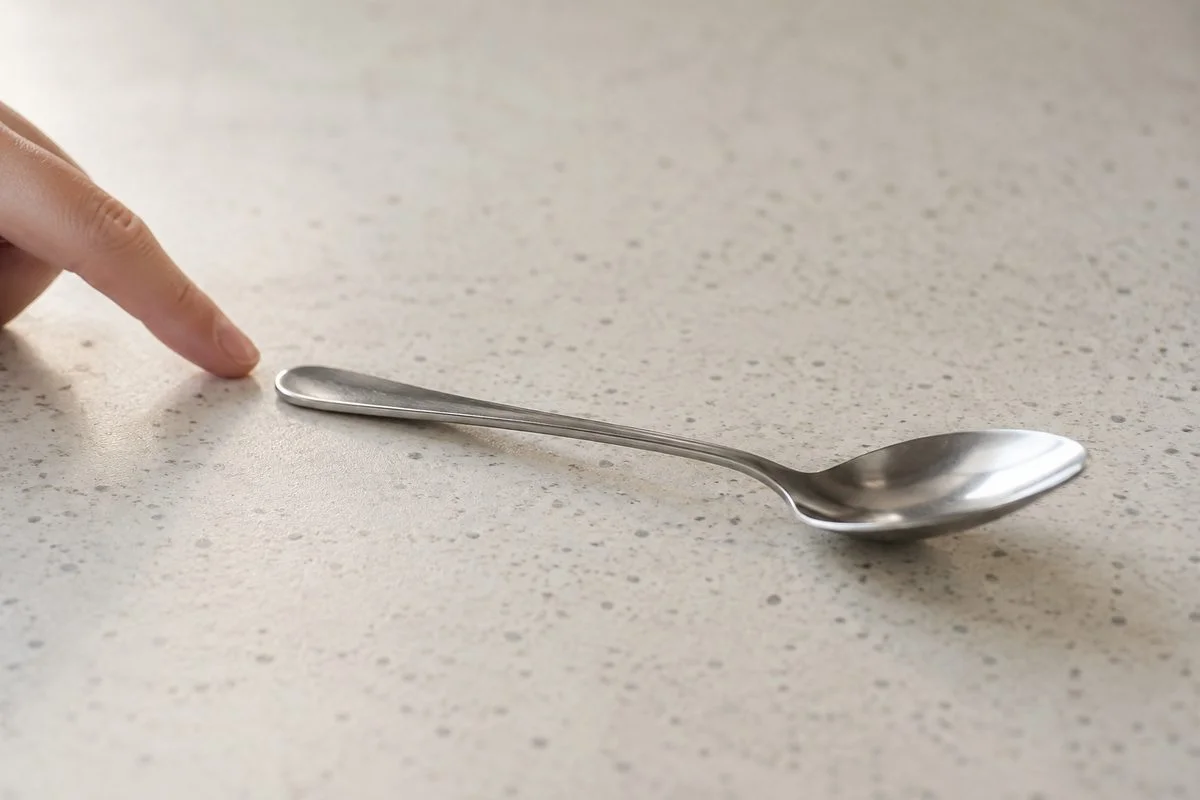
A fingertip poised to push a steel spoon across a table.

1. Inertia

Balanced forces leave velocity unchanged, including rest.

Show
Set a steel spoon on a smooth table. After the prediction, push it gently and let go.
Ask
After the push ends, will the spoon stop immediately?
Say
The spoon keeps moving, then friction slows it.
Used in
At constant velocity, a car’s driving force balances resistance, giving zero net force.
If your child says…“Moving things need a forward force.”
Ask
After your hand leaves, what keeps pushing the spoon forward?
What’s true
A net force changes velocity; steady motion needs balanced forces.

F=2−6=−4 NF=2-6=-4\,\mathrm{N}

a=−42 m s−2a=\frac{-4}{2}\,\mathrm{m\,s^{-2}}

2. Newton’s second law

Acceleration follows net force, not velocity.

Show
Write these lines. Say: “A 2 kg box slides right. Forces are 2 N rightward and 6 N leftward. Vertical forces balance. Right is positive. Acceleration a equals net force F divided by mass.”
Ask
What acceleration results?
Say
It accelerates leftward at 2 metres per second squared, slowing its rightward motion.
Used in
Rocket thrust overcomes weight to accelerate the rocket upward.
If your child says…“The box moves right, so its acceleration must point right.”
Ask
Which way does the stronger horizontal force pull?
What’s true
Acceleration follows the net force, which can oppose the current velocity.

pi=0.10(2)=+0.20 kg m s−1p_i=0.10(2)=+0.20\,\mathrm{kg\,m\,s^{-1}}

pf=0.10(−2)=−0.20 kg m s−1p_f=0.10(-2)=-0.20\,\mathrm{kg\,m\,s^{-1}}

J=(−0.20)−(+0.20) N sJ=(-0.20)-(+0.20)\,\mathrm{N\,s}

3. Impulse

Impulse measures momentum change, including direction.

Show
Write these lines. Say: “Momentum p equals mass times velocity. A 0.10 kg ball rebounds at unchanged speed, 2 m/s. Towards the wall is positive. Impulse J is final momentum minus initial momentum.”
Ask
What impulse results?
Say
The impulse is −0.40 N s.
Used in
Longer catches reduce average stopping force.
If your child says…“The same speed means no impulse.”
Ask
Which way does momentum point before and after the rebound?
What’s true
Reversing direction changes momentum even when speed stays unchanged.
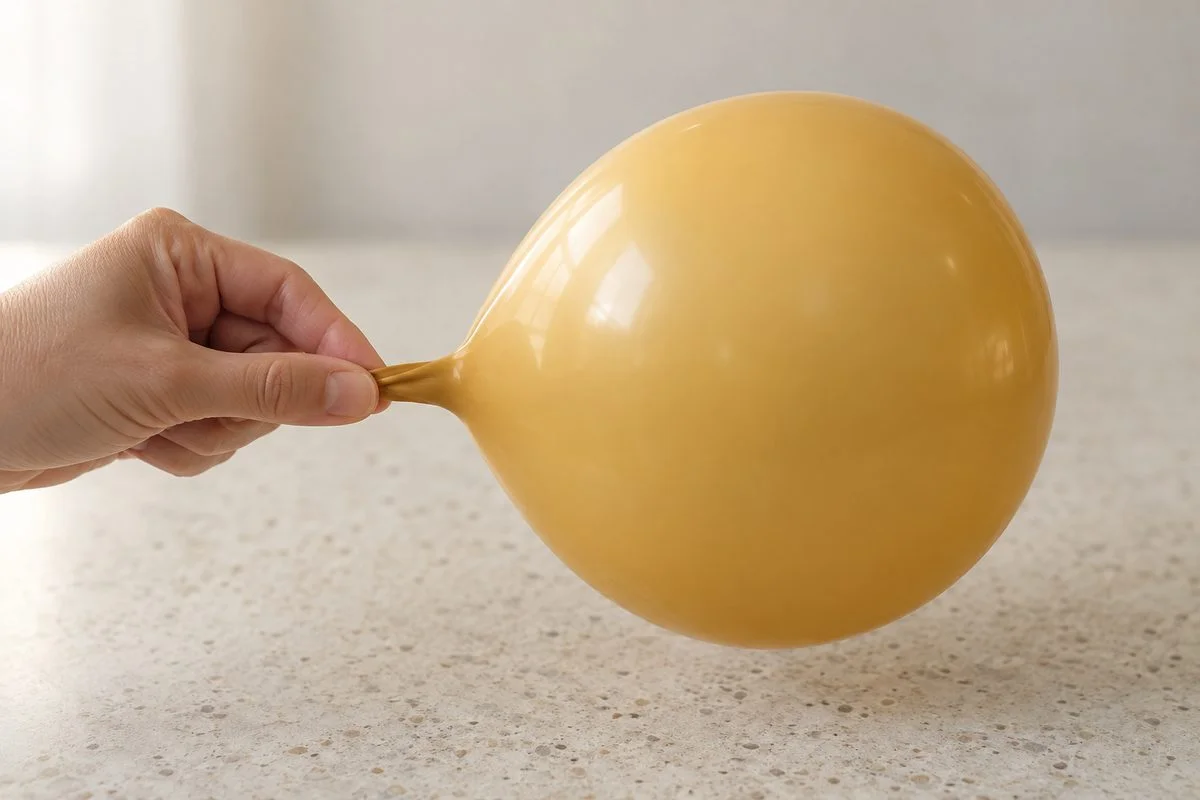
One hand pinching an inflated balloon’s neck, pointing left.

4. Newton’s third law and conservation of momentum

Mutual pushes redistribute momentum; external impulse changes the total.

Show
Inflate a balloon and hold its neck closed, pointing left. After the prediction, release it.
Ask
Which way will the balloon initially move when air escapes left?
Say
Balloon and air push oppositely on each other; these forces act on different bodies. With negligible external impulse, their combined momentum stays unchanged.
Used in
The ground pushes a walking foot forward, helping the walker move ahead.
If your child says…“Things pushing apart must have equal speeds.”
Ask
If their momenta match in size, can unequal masses have equal speeds?
What’s true
Two unequal parts separating from rest have opposite, equal-sized momenta when external impulse is absent.

Forces on connected and supported objects

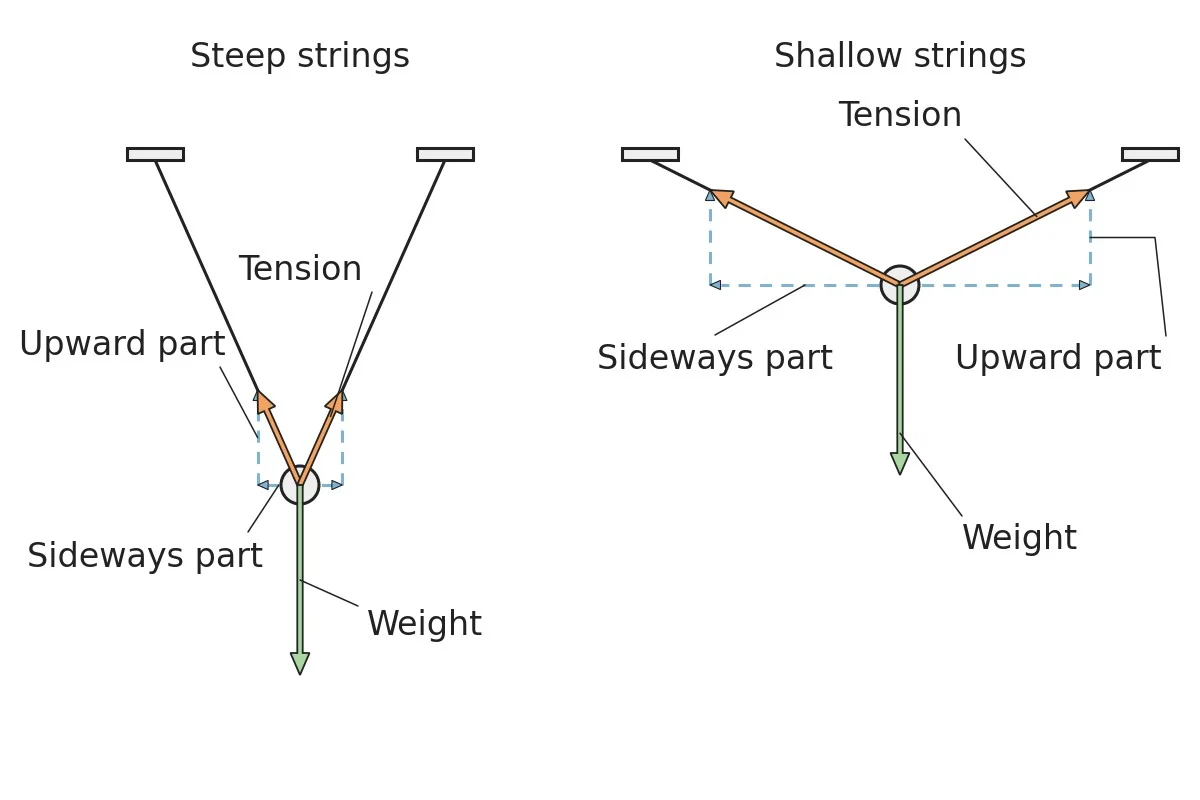
Steep and shallow supporting strings with tension arrows and their upward and sideways parts.

5. Tension and equilibrium

A string pulls along its length.

Show
Look at the diagram’s identical loads, first with steep strings, then shallow strings. Follow each tension arrow along its string. Find its upward and sideways parts.
Ask
For the same load, will each string pull harder when the strings become shallower?
Say
They pull harder because less of each pull points upward. The upward parts balance weight; the sideways parts cancel.
Used in
A hanging load can pull a trolley, allowing gravity to drive horizontal motion.
If your child says…“For the same tension, the upward part grows as the string gets closer to horizontal.”
Ask
If the string were horizontal, how much of its pull would point upward?
What’s true
For the same tension, the upward part shrinks as the string approaches horizontal.
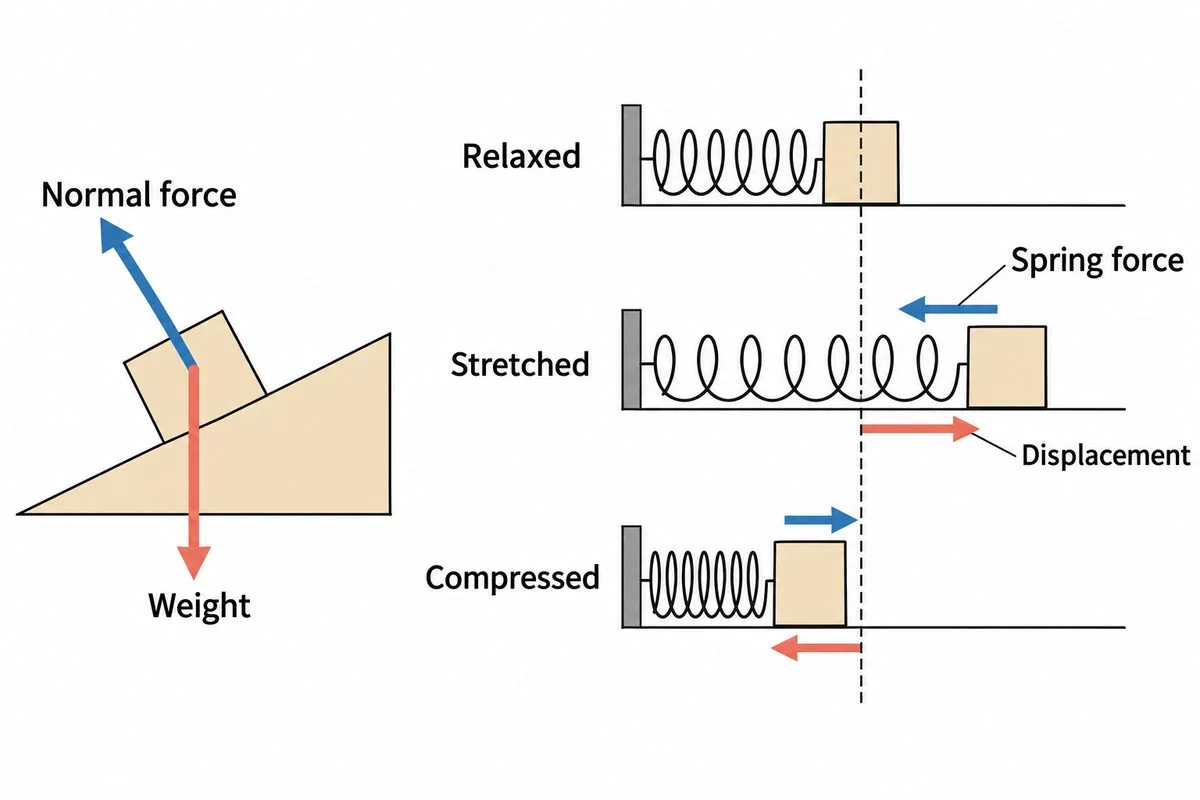
Normal force on a slope beside relaxed, stretched and compressed springs.

6. Normal force and spring force

Surfaces push perpendicularly; springs restore their natural length.

Show
Find the slope’s force arrows in the diagram. Compare each spring with its relaxed position.
Ask
Which way will each contact force act?
Say
The slope pushes perpendicularly. Spring force opposes displacement.
Used in
A lift floor supports passengers; its push increases during upward acceleration.
If your child says…“A surface always pushes with exactly the object’s weight.”
Ask
Does the weight arrow point directly into the slope?
What’s true
On this slope, the normal force balances only the perpendicular part of weight.

Friction and turning

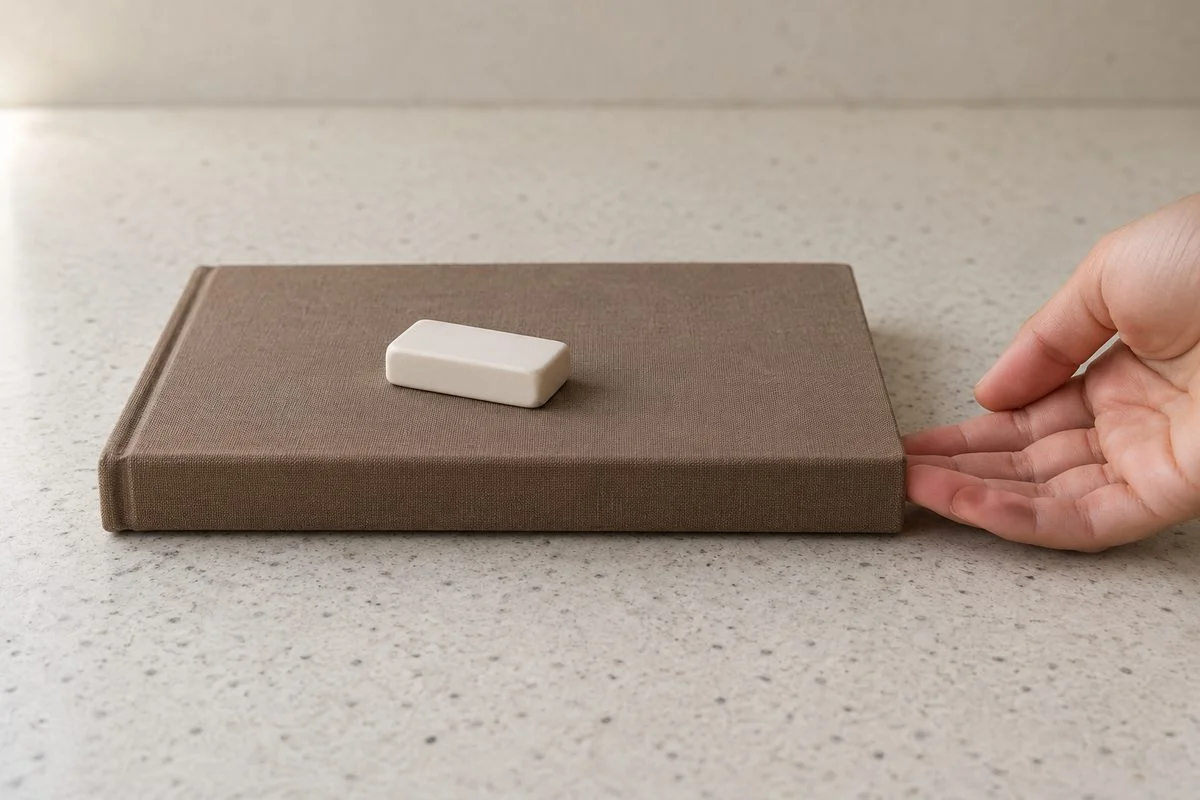
Eraser on a level book, with one hand ready to lift its right edge.

7. Static friction on an inclined plane

Friction resists relative slipping; tilting changes the support force.

Show
Place an eraser on a book. After the prediction, slowly raise one end until the eraser starts sliding.
Ask
Will friction reach its greatest value as soon as tilting begins?
Say
The eraser stays still because friction balances the downhill pull. Tilting reduces perpendicular support; slipping begins when the needed friction exceeds its limit.
Used in
Tyre grip holds a parked vehicle on a slope, keeping it from sliding.
If your child says…“Friction is always at its maximum when nothing slips.”
Ask
On the level book, what sideways force would friction need to balance?
What’s true
Static friction supplies only what prevents slipping, up to its limit.
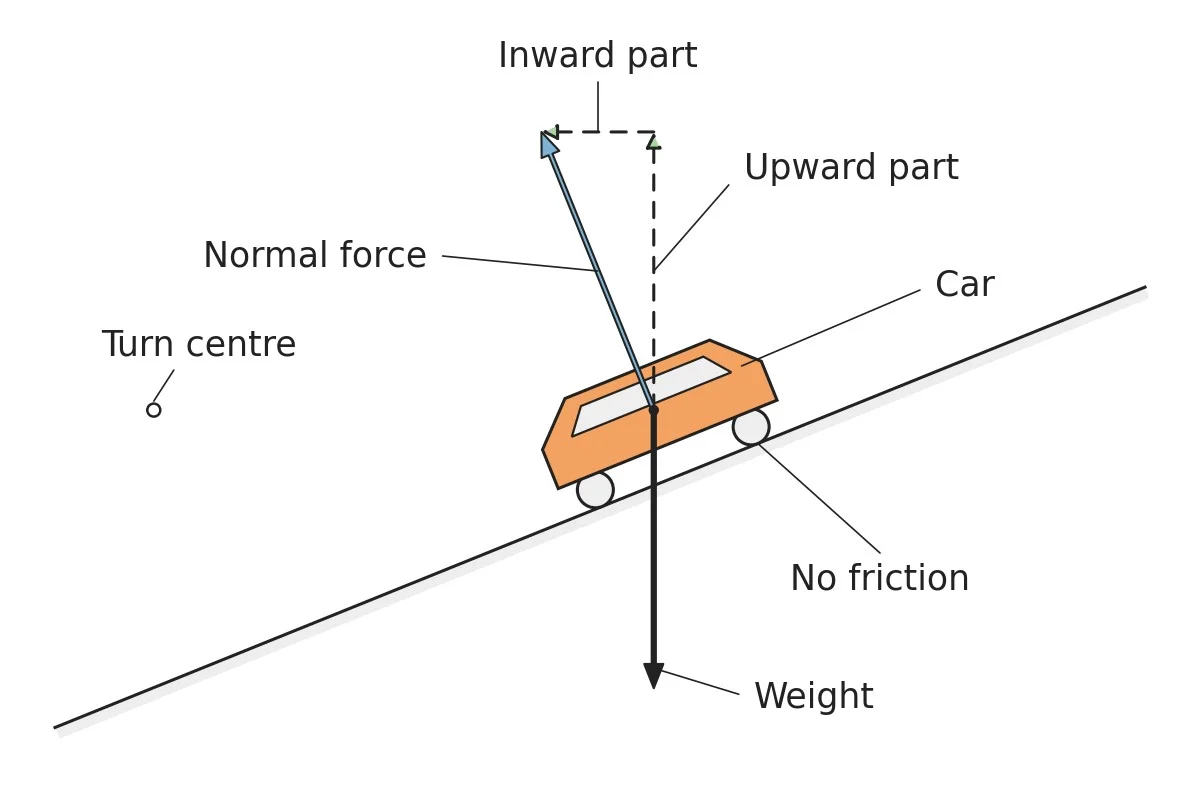
A banked road’s normal force resolves into upward support and an inward turning force.

8. Centripetal force and banked roads

Turning needs an inward push or pull.

Show
Find the road’s perpendicular push in the diagram. Follow its upward and inward parts.
Ask
Can this road turn the car without friction?
Say
At the design speed, the upward part balances weight; the inward part turns the car.
Used in
Banked roads provide an inward push, reducing the tyre friction needed at their design speed.
If your child says…“A separate turning force keeps things circling.”
Ask
Which actual interaction supplies the inward push in this diagram?
What’s true
Centripetal force names the inward resultant; it adds no new interaction.

A real problem

An Indian launch vehicle carried Rohini into orbit.

Rohini reached orbit on 18 July 1980.

Rocket thrust comes from equal and opposite forces between the rocket and its exhaust.

A rocket can produce thrust even in the vacuum of space.

ISRONASA

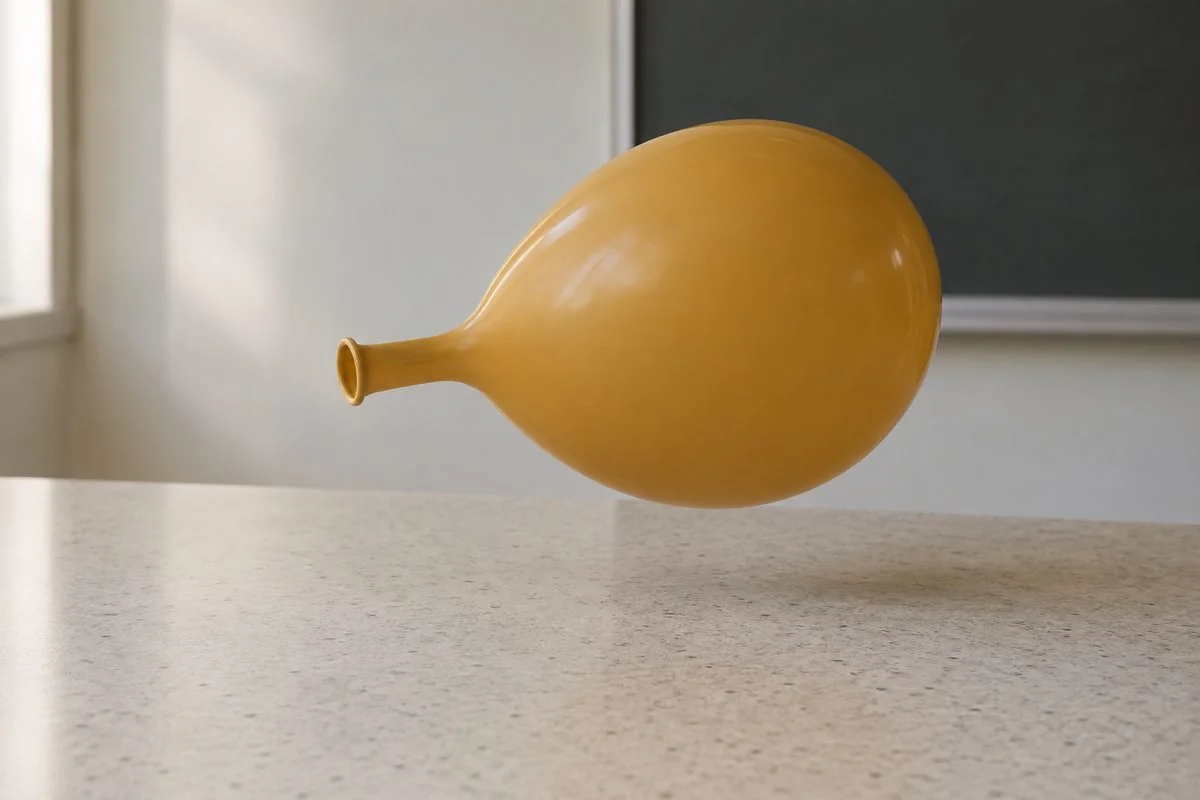
A released balloon in midair, with its open neck pointing left.

Concept Lab · Common misconception

The tempting mistake in Laws of Motion

Open standalone misconception page →

Do action and reaction cancel on one object?

Wrong

Equal action and reaction forces cancel, so nothing accelerates.

Why it feels right. I add both arrows as if they act on one body.

Right

Third-law force pairs act on different bodies.

Worked example

Each skater feels one of the two forces. They are on different bodies, so they cannot cancel on either skater.
  1. A skater pushes another skater.
  2. Each skater feels one force from the other and can accelerate in the opposite direction.

Ask your child eight quick questions.

One per step. The answer and the reason are given.

  1. A puck moves at constant velocity on a smooth, level surface. What is its net force?

    Zero. Balanced forces allow steady motion as well as rest.

  2. The box momentarily stops while both applied forces continue. Which way does its acceleration point?

    Leftward. The net force still points left when velocity reaches zero.

  3. A ball rebounds at unchanged speed. Is its impulse zero?

    No. Its momentum changes direction, so its impulse is nonzero.

  4. Two unequal parts separate from rest without external impulse. Which part moves faster?

    The lighter part. Matching momentum sizes requires the smaller mass to have the greater speed.

  5. What happens to each string’s tension when the same load hangs from shallower strings?

    It increases. A smaller upward share of each pull must still support the same weight.

  6. On this smooth slope, how does the normal force compare with the block’s weight?

    It is smaller. It balances only the part of weight perpendicular to the slope.

  7. At rest on a level book, what friction acts without any sideways push?

    Zero. No sideways force needs balancing.

  8. Without tyre friction, what supplies the car’s inward force at the design speed?

    The road’s tilted push. The normal force has an inward part; centripetal force is no additional interaction.

15 more questions with answers, 7 with pictures