Skip to content

Teach Waves in eight steps.

For each idea: show it, ask before you tell, then say one line.

Gather a long soft cotton cord, paper and a pencil. Use a clear, smooth floor.

Common misconceptions & worked visual for this chapter · 15 practice questions with answers

How to teach it

Travelling waves

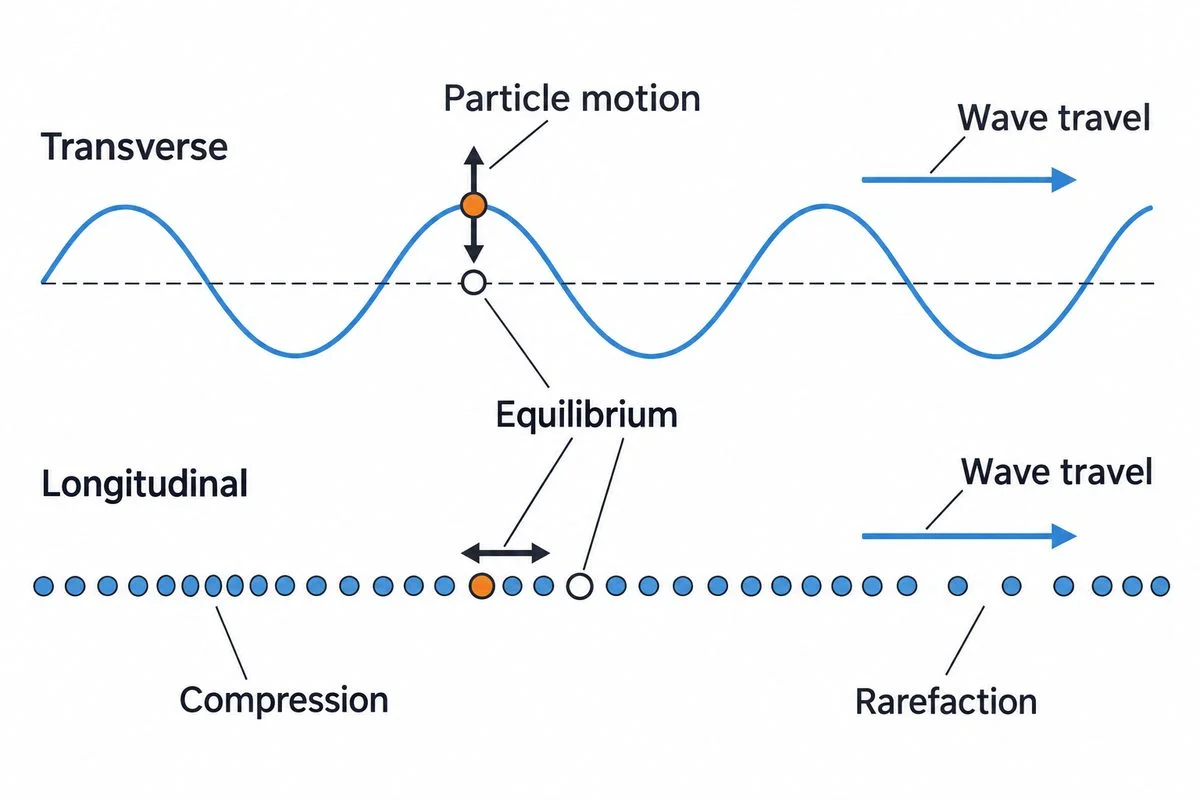
Transverse and longitudinal waves compare particle motion with rightward wave travel.

1. Mechanical disturbances and wave types

Particles oscillate perpendicular (transverse) or parallel (longitudinal) to wave travel.

Show
Look at the diagram’s rightward wave arrows. Follow the marked string particle, then the marked particle below. Compare their motion arrows.
Ask
Will either marked particle travel right with the disturbance?
Say
Neither particle travels right with the disturbance. Particles move across the wave’s path above, and along it below, while oscillating near their original positions.
Used in
Sound carries concert music through air to listeners.
If your child says…“Every wave needs matter.”
Ask
Would removing air from a bell jar also block its lamp’s light?
What’s true
Mechanical waves need matter; electromagnetic waves do not.
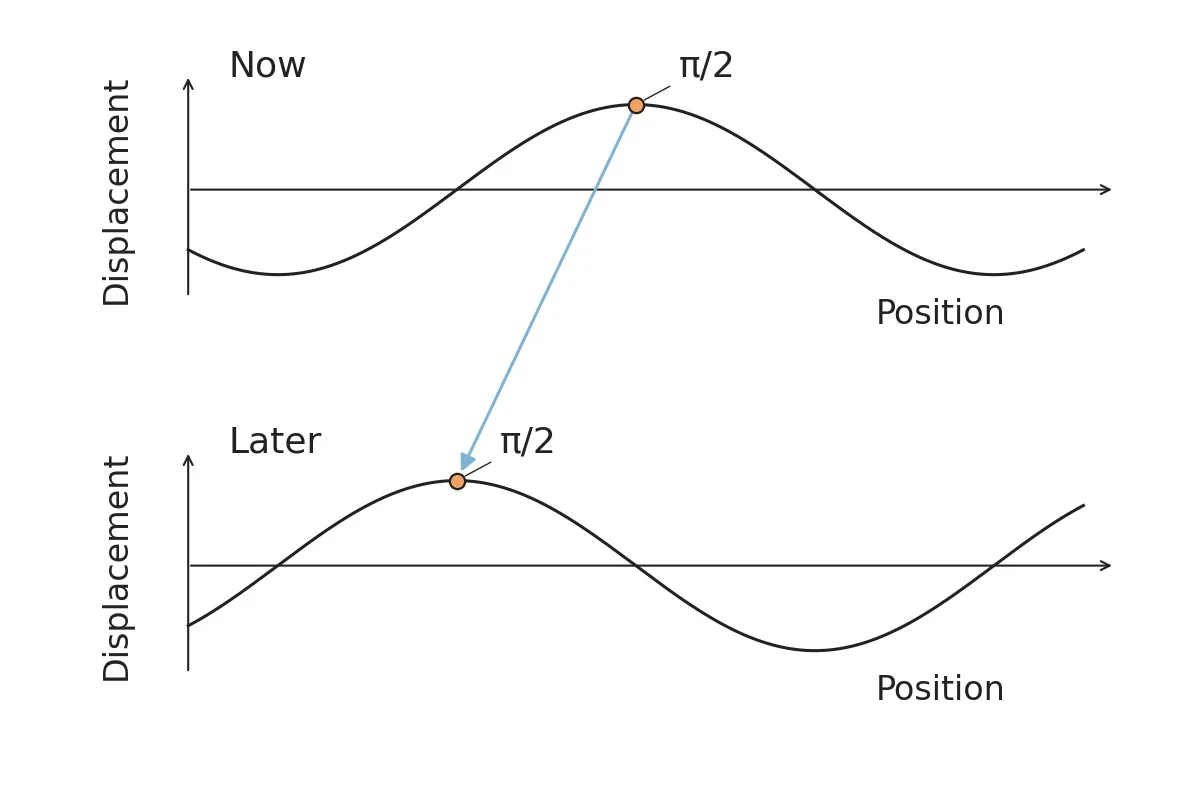
Two wave snapshots show the same crest moving left while its phase stays unchanged.

2. Progressive wave equations and phase

An equation tracks displacement as position and time change.

Show
Look at the diagram. Find the marked crest in each snapshot. Compare its position now and a quarter-period later.
Ask
Where will this crest move next?
Say
The crest travels left. Increasing time requires decreasing position to keep the crest’s phase unchanged.
Used in
Electronic keyboards use wave equations to generate notes with chosen frequencies.
If your child says…“The plus sign means rightwards.”
Ask
If ωt grows, what must happen to kx to keep their sum unchanged?
What’s true
The time sign alone does not name the travel direction.

v=F/μv=\sqrt{F/\mu}

v=100 m s−1v=100\,\mathrm{m\,s^{-1}}

3. Wave speed on a string

A string’s tension and linear density determine how fast disturbances travel.

Show
Write these lines. Use tension F of 40 N and mass per length μ of 0.004 kg/m. Name v as speed. At 5 Hz, wavelength is 20 m.
Ask
At 10 Hz, what wavelength follows from this unchanged speed?
Say
The wavelength is 10 m. Doubling frequency halves wavelength because speed stays unchanged.
Used in
String makers adjust tension and thickness to obtain the required pitch.
If your child says…“Faster shaking makes faster waves.”
Ask
Which changed here: the source frequency or the string’s tension?
What’s true
The source sets frequency, while the string sets speed.

vL=vNγv_{\mathrm L}=v_{\mathrm N}\sqrt{\gamma}

vL≈2801.4 m s−1v_{\mathrm L}\approx280\sqrt{1.4}\,\mathrm{m\,s^{-1}}

4. Sound speed and Laplace correction

Resistance to compression and density together determine sound speed.

Show
Write these lines. Newton’s speed vN is 280 m/s. The heat-capacity ratio γ is 1.4. Name vL as Laplace’s speed.
Ask
What speed does Laplace’s correction predict, compared with the measured 331 m/s?
Say
It predicts about 331 m/s, close to measurements.
Used in
Wind instrument makers use sound speed to choose tube lengths that produce the intended notes.
If your child says…“Air stays at the same temperature as sound compresses it.”
Ask
Can heat escape fast enough to keep each rapid compression at constant temperature?
What’s true
Sound compressions are too rapid for much heat exchange, so temperature changes.

Overlapping waves and boundaries

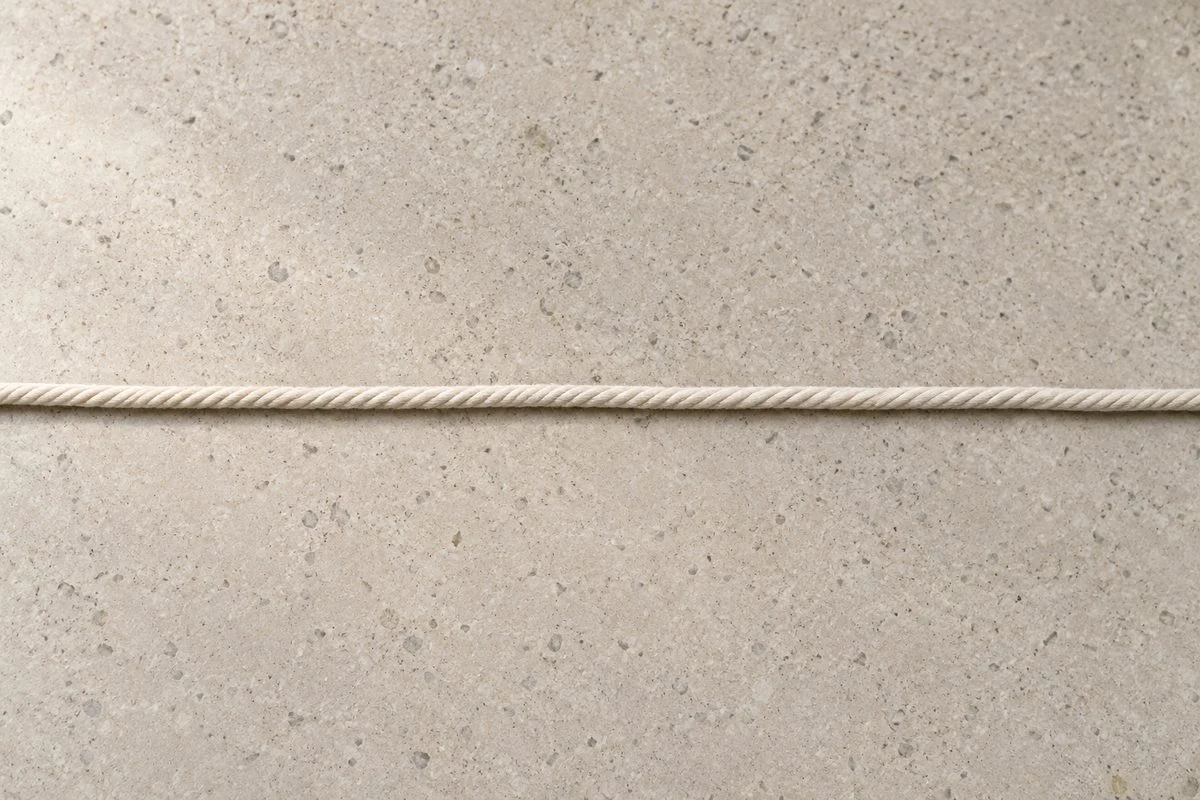
A soft cord stretched horizontally across a clear floor, ready for opposing pulses.

5. Superposition

Overlapping waves combine their signed displacements at each point.

Show
Hold opposite ends of a long, soft cord across a smooth floor under light tension. After the prediction, each send a broad sideways pulse towards the same side. Repeat towards opposite sides, watching the pulses meet and pass.
Ask
Will pulses bending towards the same side make a larger or smaller bend when they meet?
Say
Matching displacements make a larger bend; opposite displacements reduce each other. The pulses continue after crossing.
Used in
Noise-cancelling headphones add opposing sound waves to reduce unwanted noise at the ears.
If your child says…“Up three and down two make five.”
Ask
Does the opposite bend increase the displacement or reduce it?
What’s true
Opposite displacements subtract rather than add their sizes.
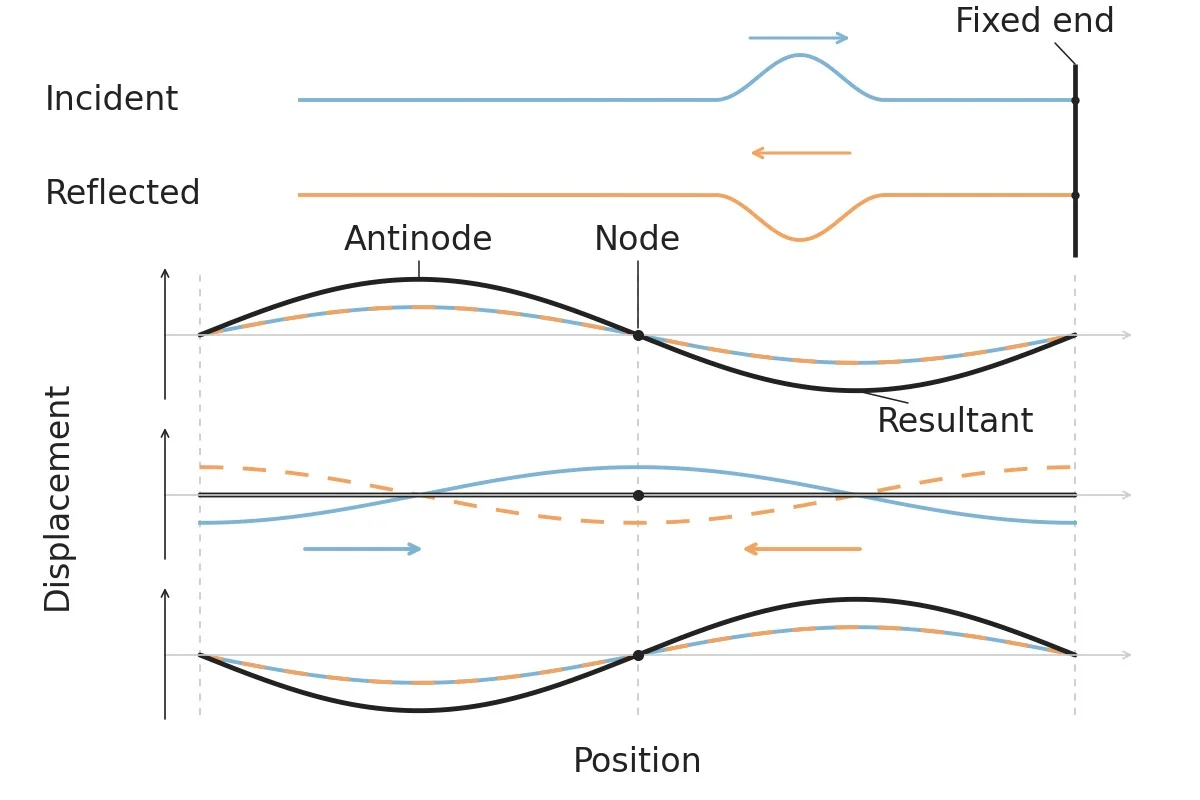
Fixed-end reflection and successive wave sums show nodes remaining still.

6. Reflection and standing waves

Waves travelling in opposite directions can form permanently still nodes.

Show
Look at the diagram’s pulse approaching and returning from the fixed end. Below, follow the opposite travelling waves and their bold sum. Track the marked node through each snapshot.
Ask
Will that node move as the component waves travel past it?
Say
The fixed end stays still, so its reflected pulse turns upside down. Opposite waves with matching frequencies and amplitudes form this standing pattern. At nodes, their displacements always cancel.
Used in
Irregular auditorium surfaces break up reflections, reducing intrusive echoes.
If your child says…“Any point at zero is a node.”
Ask
Does that point stay still through the whole cycle?
What’s true
A node stays at zero throughout the motion.
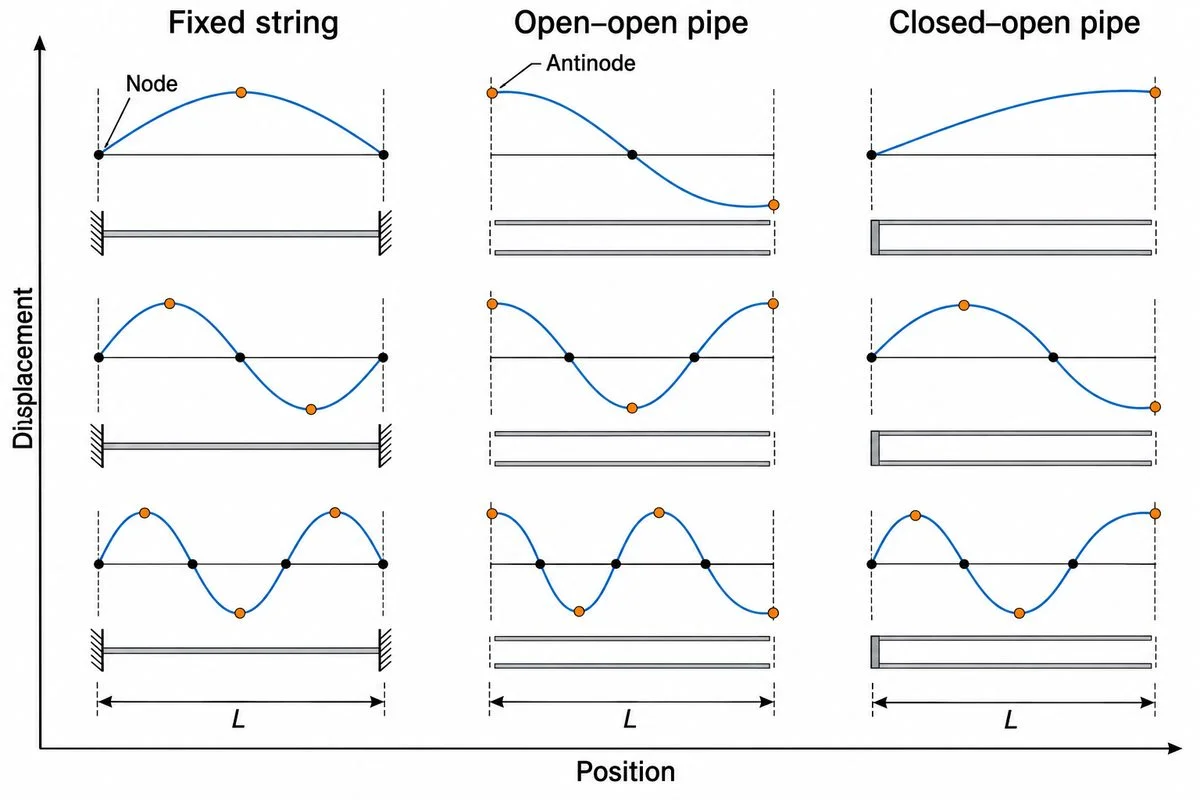
Allowed string and pipe displacement patterns fit their different end conditions.

7. String and air-column normal modes

The ends determine which vibration frequencies can build up.

Show
Look at the diagram’s string, open pipe and pipe closed at one end. Find each end’s node or antinode. Follow the allowed displacement patterns down each column.
Ask
Would the closed–open pipe accept the open pipe’s second pattern?
Say
No: that pattern would require movement at the closed end. String and open-pipe patterns allow every harmonic; closed–open pipes allow only odd harmonics. Their end conditions select which wavelengths fit.
Used in
Different harmonic strengths give instruments recognisable sounds.
If your child says…“Closed pipes have every harmonic.”
Ask
Can identical standing-wave patterns satisfy those different end conditions?
What’s true
Displacement amplitude is zero at the closed end and greatest at the open end.

Nearly matching frequencies

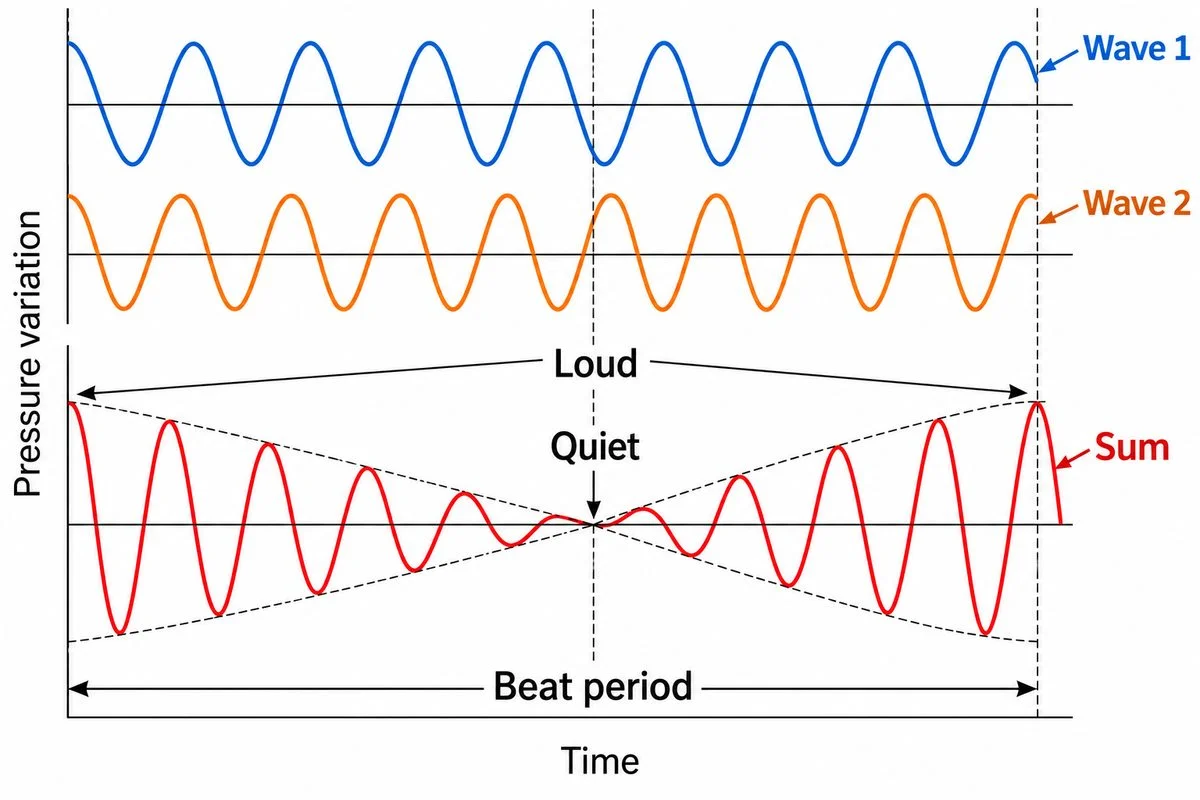
Two steady sound traces combine into alternating large and small pressure oscillations.

8. Beats

Close frequencies combine to make loudness rise and fall repeatedly.

Show
Look at the diagram’s two steady sound traces. Follow their agreement, opposition and renewed agreement. Match these moments to the summed trace below.
Ask
As the waves return to agreement, will their combined sound grow louder or softer?
Say
It grows louder because matching pressure changes reinforce each other. Between agreements, the waves oppose each other and the sound softens.
Used in
Beats help compare a musical string’s frequency with a reference.
If your child says…“Beats occur at half the frequency difference.”
Ask
Would skipping alternate loudness peaks count all the beats you hear?
What’s true
Count every loudness peak, because reversing the pressure swings does not reduce their size.

A real problem

A concert hall shaped its reflections

Boston Symphony Hall opened in 1900.

Its stage walls slope inward to help focus sound.

Its irregular interior surfaces scatter reflected sound in different directions, helping reduce intrusive echoes.

American Physical SocietyBoston Symphony OrchestraNational Park Service

An empty concert auditorium viewed towards its stage and surrounding walls.

Concept Lab · Common misconception

The tempting mistake in Waves

Open standalone misconception page →

Do particles travel along a wave?

Wrong

A pulse carries the particles of a string to the far end.

Why it feels right. The bump travels across the string.

Right

The disturbance propagates and each small part of the string moves locally.

Worked example

The pulse travels along the string. The ribbon moves mainly vertically near the marked position.
  1. Tie a ribbon to one point on a stretched string.
  2. A pulse travels along it, and the ribbon moves mainly up and down near its starting position.

Ask your child eight quick questions.

One per step. The answer and the reason are given.

  1. A lamp and ringing bell occupy an emptied bell jar. Which signal crosses the vacuum?

    Light. Light travels without matter, while sound requires a medium.

  2. For positive k and ω, where does a crest of sin(kx + ωt) travel?

    Towards decreasing x. Increasing time requires decreasing position to preserve the crest’s phase.

  3. Frequency doubles while string tension and mass per length stay unchanged. What happens to wavelength?

    It halves. Unchanged speed requires frequency and wavelength to change in opposite proportions.

  4. What happens to air’s temperature during a rapid sound compression?

    It rises. Compression warms the air before much heat can escape.

  5. Two pulses contribute +3 mm and −2 mm at one point. What is its displacement?

    +1 mm. Signed addition accounts for the opposite directions.

  6. A point reads 0, +2, 0, −2 mm at successive quarter-cycles. Is it a node?

    No. A node stays at zero throughout the motion.

  7. An ideal pipe closed at one end has a 100 Hz fundamental. What is its first overtone?

    300 Hz. The next allowed mode is the third harmonic, because even harmonics cannot fit.

  8. Tones at 256 Hz and 260 Hz overlap. How many beats occur each second?

    Four. The beat rate equals the full difference between the two frequencies.

15 more questions with answers, 2 with pictures