Skip to content

Teach Thermodynamics in eight steps.

For each idea: show it, ask before you tell, then say one line.

Gather paper and a pencil.

Common misconceptions & worked visual for this chapter · 15 practice questions with answers

How to teach it

Temperature and energy

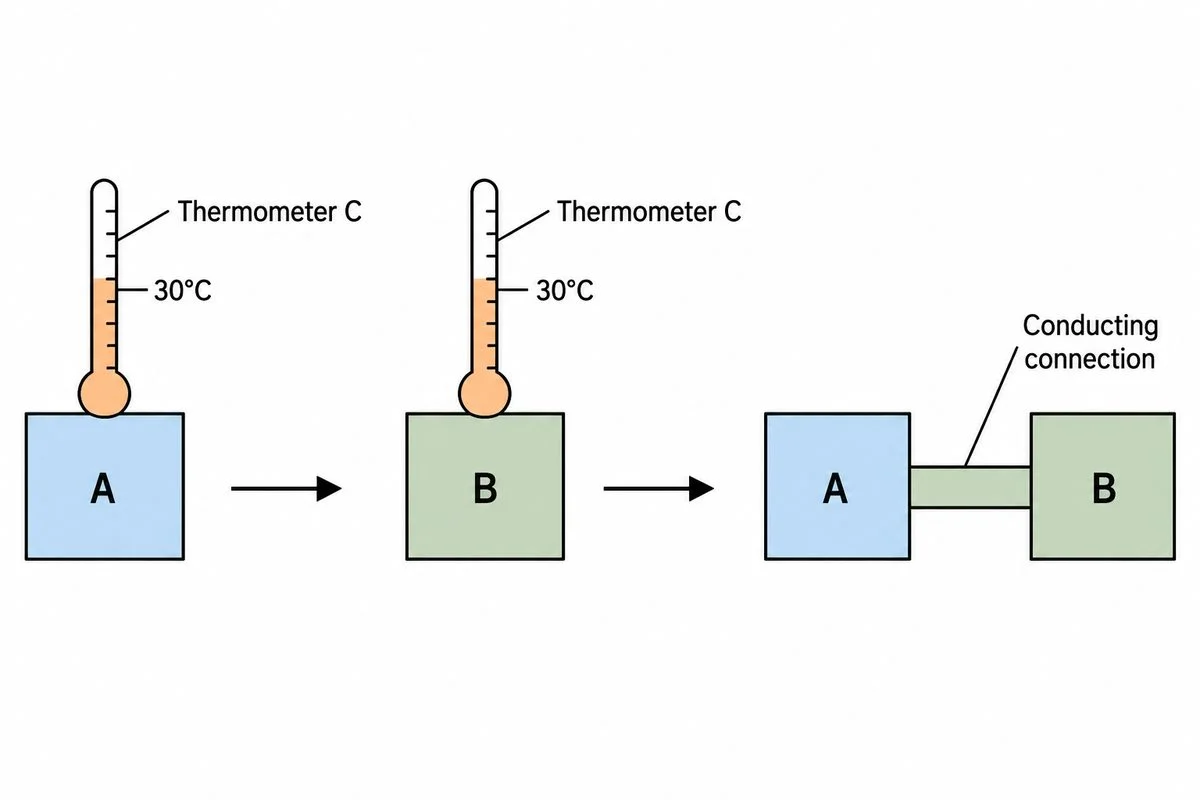
Matching thermometer readings for two bodies, followed by their conducting connection.

1. Thermal equilibrium and zeroth law

Bodies at matching temperatures exchange no net heat.

Show
Look at the diagram's thermometer readings for A, then B. Each reading settles without changing the body's temperature. Finally, find A and B touching through a conducting connection.
Ask
What heat transfer would you predict when these bodies touch?
Say
Both bodies match the thermometer's temperature, so they match each other. When they touch, neither gains heat overall.
Used in
Thermometers use thermal equilibrium to measure temperature.
If your child says…“No heat passes, so the temperatures must match.”
Ask
Could insulation keep two bodies at different temperatures?
What’s true
Insulation can limit heat transfer even when temperatures differ.
Q=+400 JQ=+400\,\mathrm{J}

W=+100 JW=+100\,\mathrm{J}

ΔU=Q−W\Delta U=Q-W

2. Internal energy and first law

Heat and work transfer energy; internal energy belongs to the system.

Show
Write these lines. Name heat received Q, work delivered W, and internal-energy change delta U.
Ask
How much energy remains inside?
Say
Internal energy rises by 300 J; the rest leaves as work.
Used in
An engine's energy balance accounts for heat received, work delivered and internal-energy changes.
If your child says…“The gas stores the heat it receives.”
Ask
If work also increases internal energy, why call all that energy stored heat?
What’s true
Heat transfers energy across the boundary; internal energy belongs to the gas.
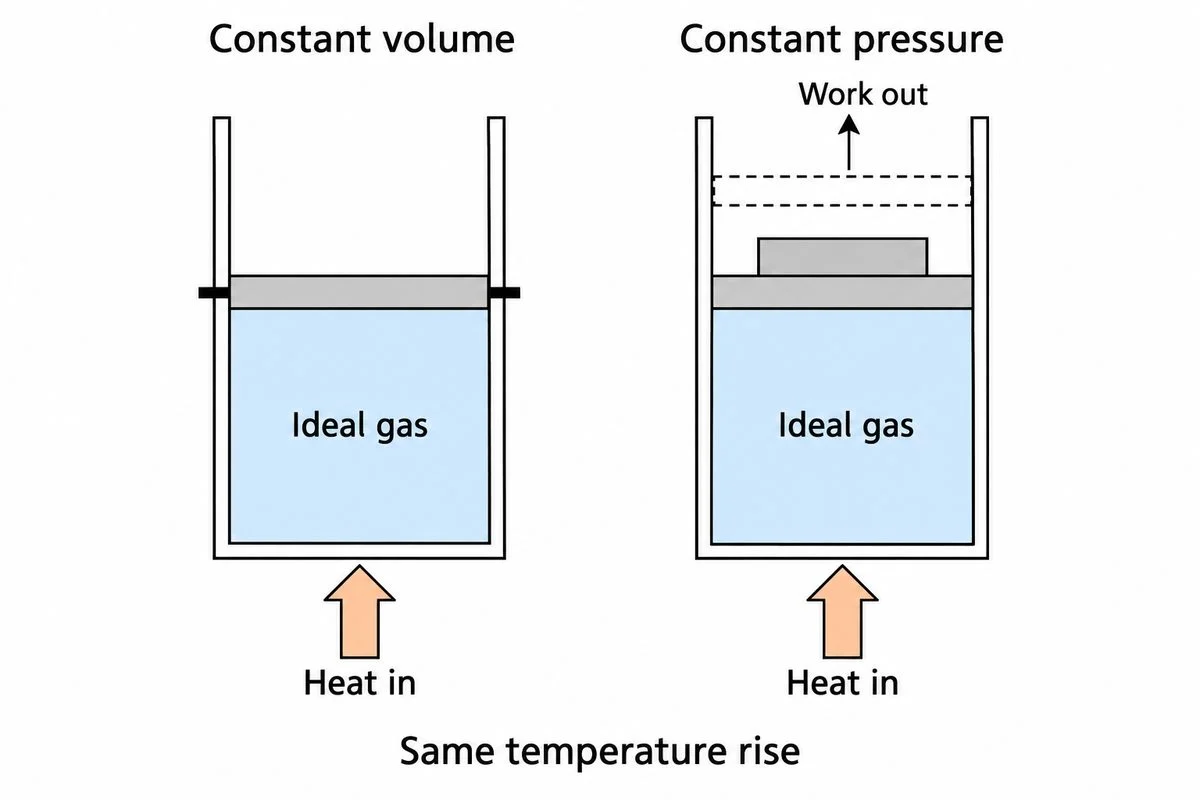
Equal gas samples heated beneath fixed and freely moving pistons.

3. Heat capacities at constant volume and pressure

Heat needed depends on heating conditions.

Show
Look at the diagram's equal samples of the same ideal gas, initially at identical conditions. Find the fixed piston, then the freely moving piston under a constant load. Find the heat and work arrows for equal warming; they show direction, not energy amounts.
Ask
Which sample will need more heat for the same temperature rise?
Say
Both samples gain equal internal energy. The moving piston also does work, so constant-pressure heating needs more heat.
Used in
Faster water flow needs more heater power for equal warming.
If your child says…“Both heat capacities must match.”
Ask
What supplies the energy lifting the loaded piston?
What’s true
Fixed-volume heating increases internal energy without expansion work.

Changing a gas

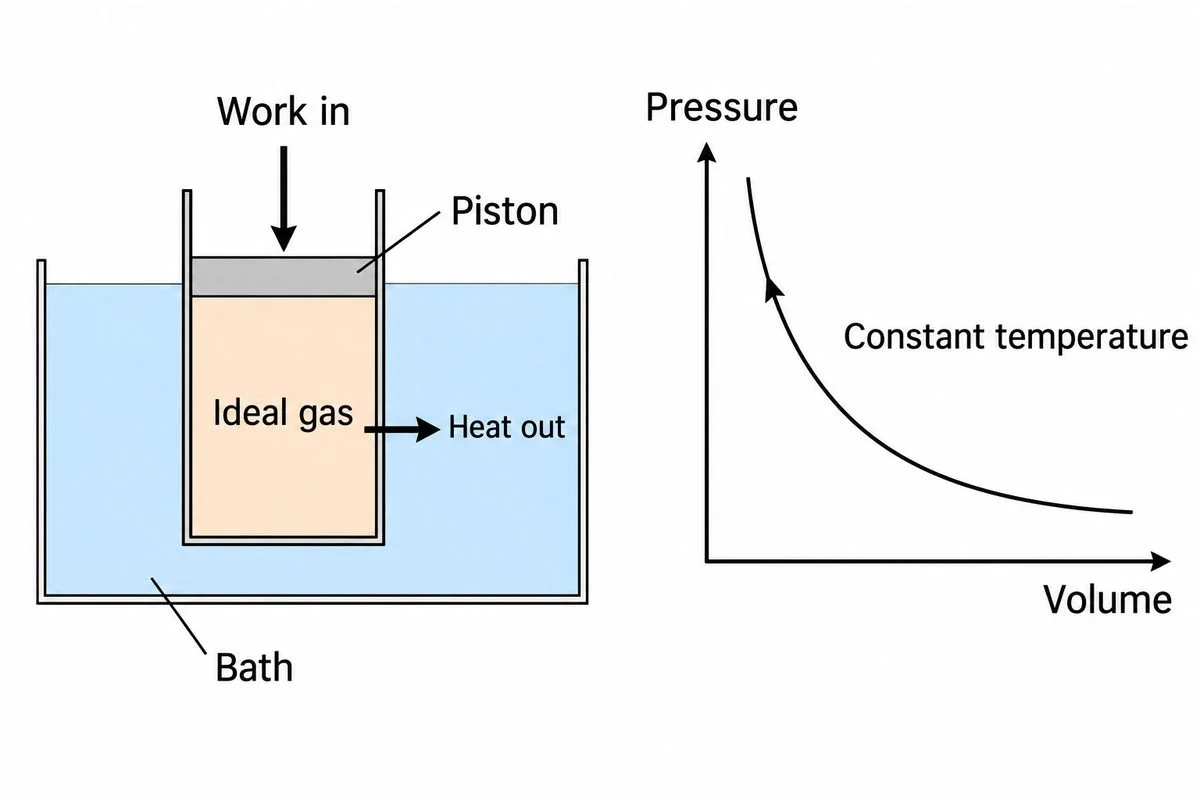
Gas compressed in a temperature-controlled bath beside its pressure–volume curve.

4. State variables and isothermal changes

Pressure, volume and temperature are linked; constant temperature still allows heat.

Show
Find the diagram's gas and bath. Follow compression toward smaller volume on the graph.
Ask
Where does compression energy go at constant temperature?
Say
It leaves as heat because the ideal gas's internal energy stays unchanged. Compression raises its pressure.
Used in
Nearly fixed tyre volume means warming raises pressure, helping explain pressure changes during driving.
If your child says…“The temperature stays fixed, so no heat moves.”
Ask
Where can compression energy go if the gas's internal energy stays unchanged?
What’s true
An ideal gas compressed at constant temperature releases heat equal to the work supplied.
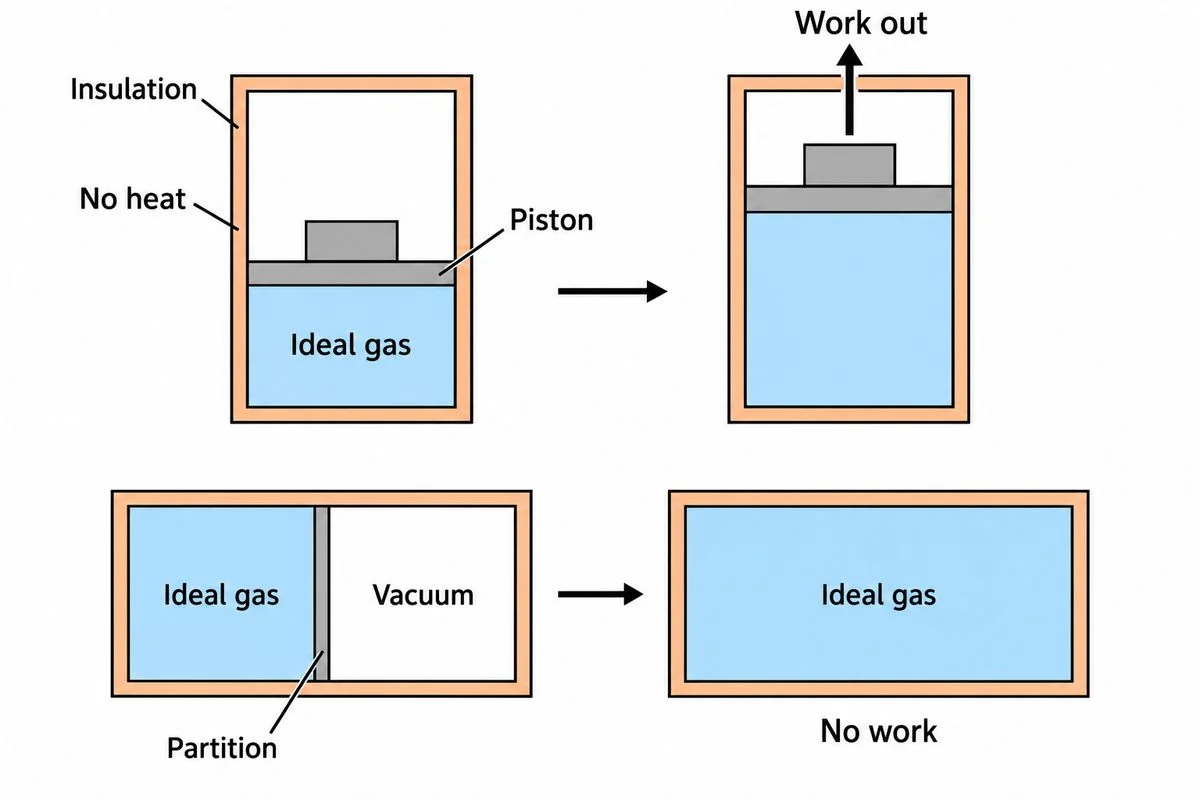
Insulated gas lifts a piston or spreads into an evacuated compartment.

5. Adiabatic changes and free expansion

Without heat transfer, work determines whether an ideal gas changes temperature.

Show
Look at the diagram's insulated piston above and divided vessel below. Follow the piston outward, then the gas into the vacuum. The piston moves slowly without friction; the gas below rushes into empty space.
Ask
Will both insulated gases cool when they expand?
Say
The gas cools when it lifts the piston because it supplies work. Expansion into vacuum does no work, so that gas's temperature stays unchanged. Neither gas exchanges heat.
Used in
Air compressors need cooling because compression warms the air.
If your child says…“Insulation keeps the temperature fixed.”
Ask
If heat cannot enter, where does the energy for expansion work come from?
What’s true
Insulated ideal gas cools while doing work, but keeps its temperature during expansion into vacuum.
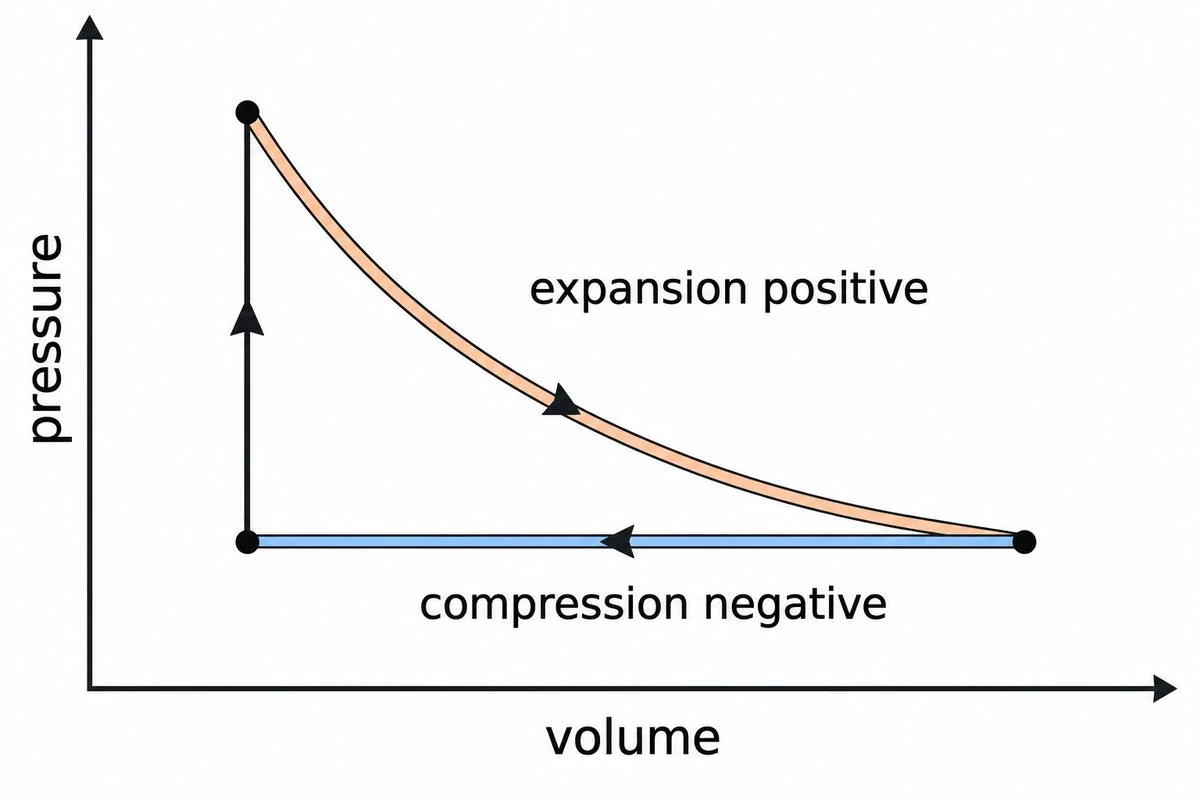
Pressure–volume diagram with a clockwise loop and labelled expansion and compression.

6. Cyclic processes and signed work

Cycles restore internal energy; net work need not be zero.

Show
Find pressure vertically and volume horizontally in the diagram. Follow expansion rightward, compression leftward, and the return upward. Find the positive expansion and negative compression labels.
Ask
Will the areas below the expansion and compression paths cancel?
Say
Add positive expansion work and negative compression work. Their sum equals this loop's enclosed area.
Used in
Engine calculations subtract compression work to find useful output.
If your child says…“A cycle means zero heat and zero work.”
Ask
Could equal incoming heat and outgoing work leave internal energy unchanged?
What’s true
Internal energy returns to its starting value, while net heat and work can remain nonzero.

What engines can achieve

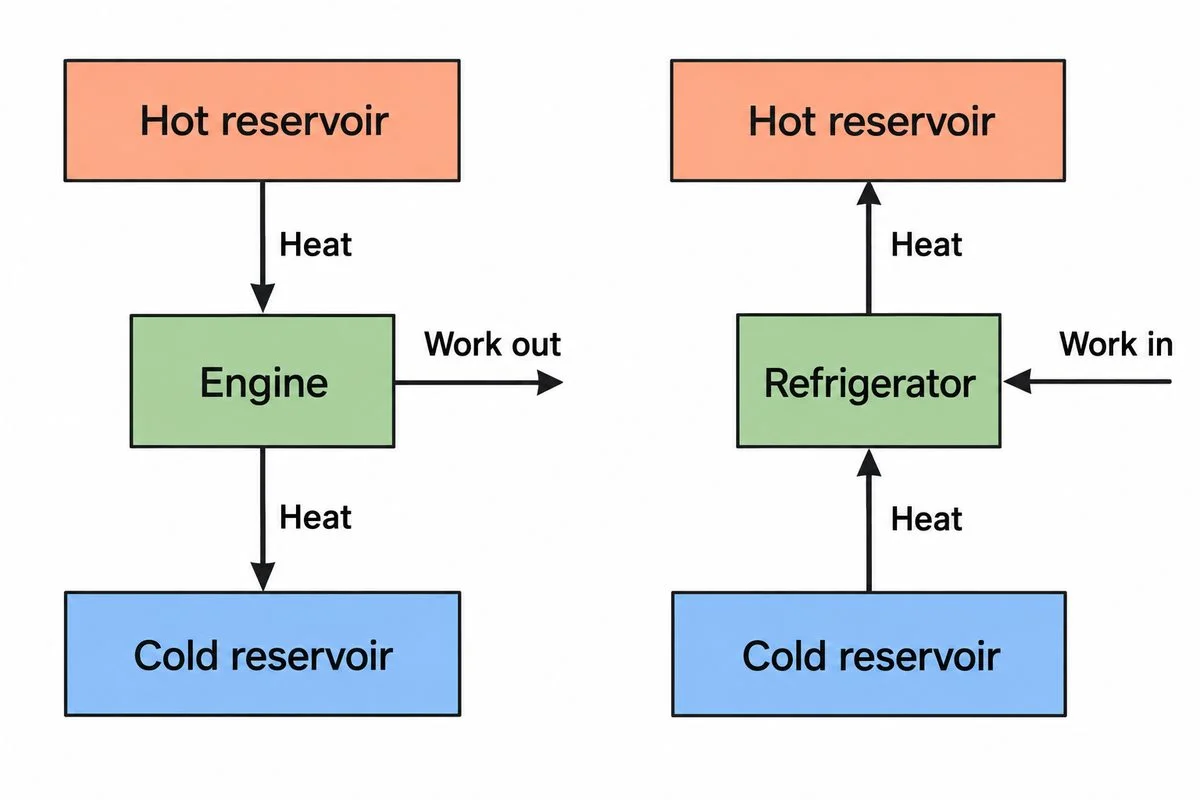
Engine and refrigerator diagrams showing heat routes and opposite work directions.

7. Second law, engines and refrigerators

Energy conservation alone does not make every heat transfer possible.

Show
Follow the diagram's engine arrows, then the refrigerator arrows.
Ask
Could the refrigerator keep cooling without work input?
Say
It needs work, which joins removed heat at the warm side. A cyclic engine must reject heat to a colder reservoir.
Used in
A refrigerator uses work to transfer heat from its cold interior to warmer surroundings.
If your child says…“The fridge only releases the heat it removes.”
Ask
Where does the supplied work's energy go?
What’s true
The refrigerator also releases the energy supplied through work.
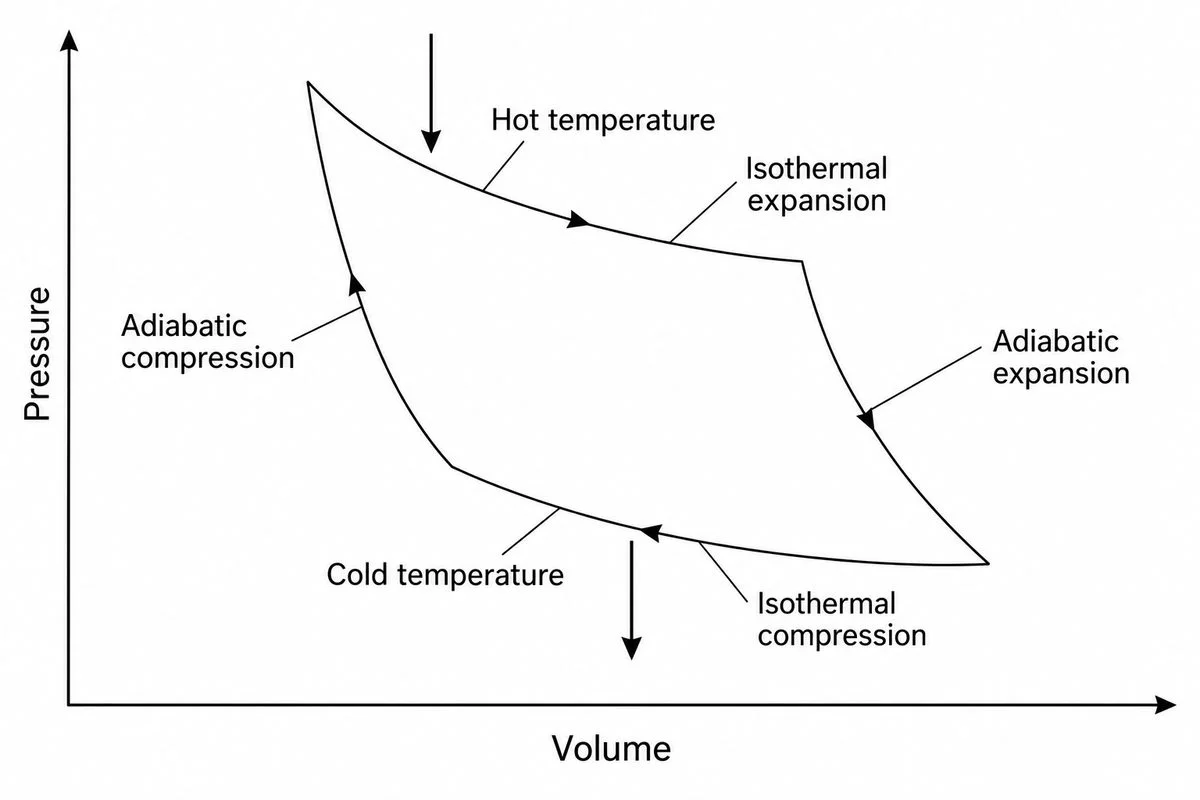
Carnot loop with two isothermal stages connected by two adiabatic stages.

8. Reversibility and Carnot cycle

Reversible engines set the efficiency limit between two reservoir temperatures.

Show
Trace the diagram's four stages clockwise. Find heat entering above and leaving below.
Ask
Could another gas beat this reversible engine's efficiency?
Say
No gas can beat this limit: one minus cold temperature divided by hot temperature, in kelvin.
Used in
Engine designers use the Carnot limit to judge how much heat could become useful work.
If your child says…“Anything done slowly is reversible.”
Ask
Would friction's warming disappear simply because the gas returns to its starting state?
What’s true
Reversal must restore both the gas and its surroundings, leaving no change.

A real problem

A separate condenser reduced steam-engine fuel waste.

James Watt devised the separate condenser in 1765.

Earlier engines wasted fuel repeatedly warming and cooling their cylinders.

Condensing steam in another vessel reduced wasted heat and improved engine efficiency.

University of GlasgowScience Museum GroupUniversity of Glasgow

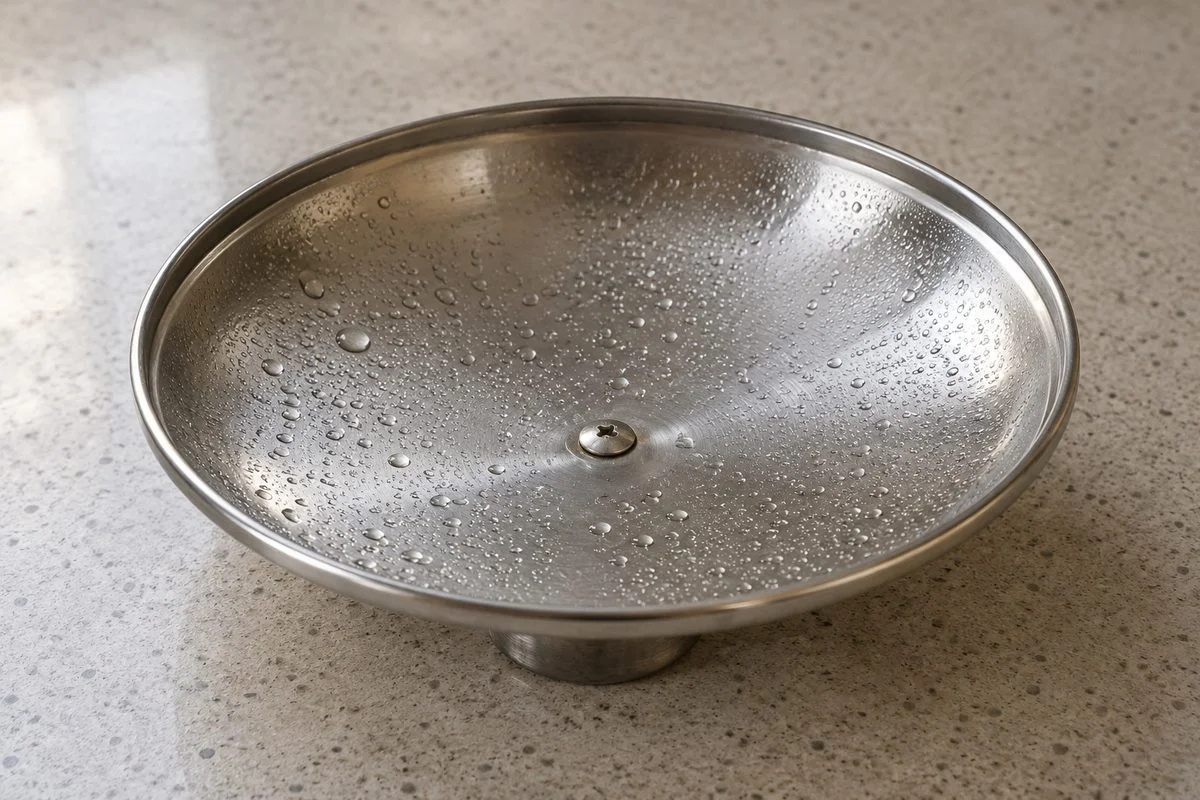
Condensation droplets on the inner surface of a saucepan lid.

Concept Lab · Common misconception

The tempting mistake in Thermodynamics

Open standalone misconception page →

Does zero heat transfer mean constant temperature?

Wrong

An insulated gas stays at the same temperature when compressed.

Why it feels right. I associate temperature change with heating only.

Right

Work can change internal energy even when heat transfer is zero.

Worked example

Insulated compression
Heat transfer ≈ 0→Piston does work on gas→Internal energy and ideal-gas temperature rise
Insulation stops heat crossing the boundary. The moving piston still transfers energy by work.
  1. Compress a gas in an insulated cylinder.
  2. Work done on the gas raises its internal energy.
  3. For an ideal gas this raises temperature.

Ask your child eight quick questions.

One per step. The answer and the reason are given.

  1. No heat crosses an ideal insulating wall between two gases. Must their temperatures match?

    No. Insulation alone tells us nothing about whether temperatures match.

  2. What property of the gas increases by 300 J after these transfers?

    Internal energy. Heat and work describe transfers; internal energy describes the gas's state.

  3. Identical gas samples warm equally at fixed pressure and fixed volume. Which needs more heat?

    The constant-pressure sample. It also supplies energy for expansion work.

  4. An ideal gas expands at constant temperature and does 200 J of work. What heat enters?

    200 J. Its internal energy stays unchanged, so incoming heat supplies the work.

  5. An insulated ideal gas does 150 J of work. What happens to its temperature?

    It falls. With no incoming heat, work reduces internal energy and therefore temperature.

  6. A gas absorbs 800 J and releases 500 J during a cycle. What work results?

    300 J delivered. The cycle restores internal energy, so net heat becomes net work.

  7. A refrigerator removes 300 J and receives 100 J through work. What reaches the warm surroundings?

    400 J. The released energy includes both removed heat and supplied work.

  8. A piston moves slowly with friction. Can reversing its motion restore everything?

    No. Friction's effects remain in the surroundings even when the gas returns.

15 more questions with answers, 2 with pictures