Skip to content

Teach Motion in a Plane in eight steps.

For each idea: show it, ask before you tell, then say one line.

Gather a pencil, ruler and paper.

Common misconceptions & worked visual for this chapter · 15 practice questions with answers

How to teach it

Vectors and their components

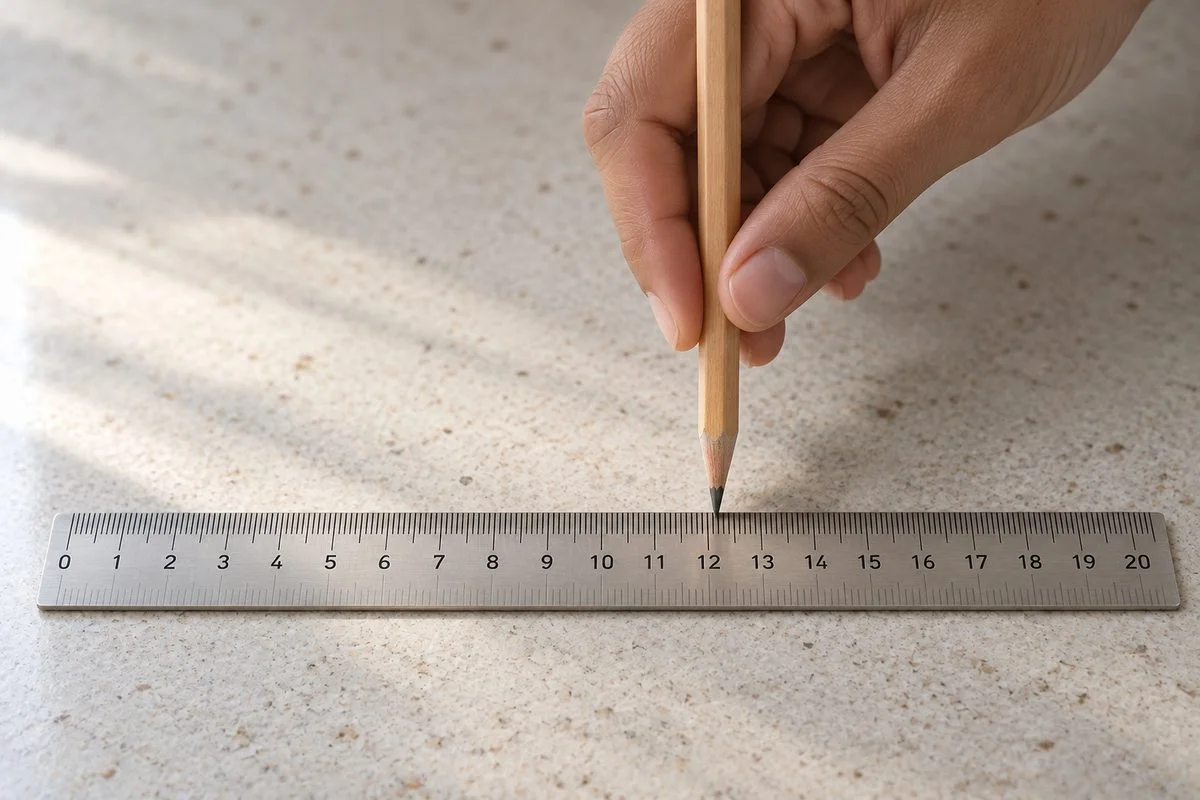
One hand sliding a pencil right beside a ruler.

1. Scalars and vectors

Scalars lack direction; vectors have magnitude, direction, and add head-to-tail.

Show
Align the pencil tip with 5 cm on the ruler. Pause for the prediction before sliding to 15 cm and back.
Ask
After returning, will its distance travelled equal its displacement?
Say
No, its distance travelled will not equal its displacement. Distance is a scalar; displacement includes direction and is a vector.
Used in
Boat velocities include direction to describe motion relative to shore.
If your child says…“Matching lengths mean equal vectors.”
Ask
Do the outward and return moves point the same way?
What’s true
Equal vectors need matching magnitudes and directions.
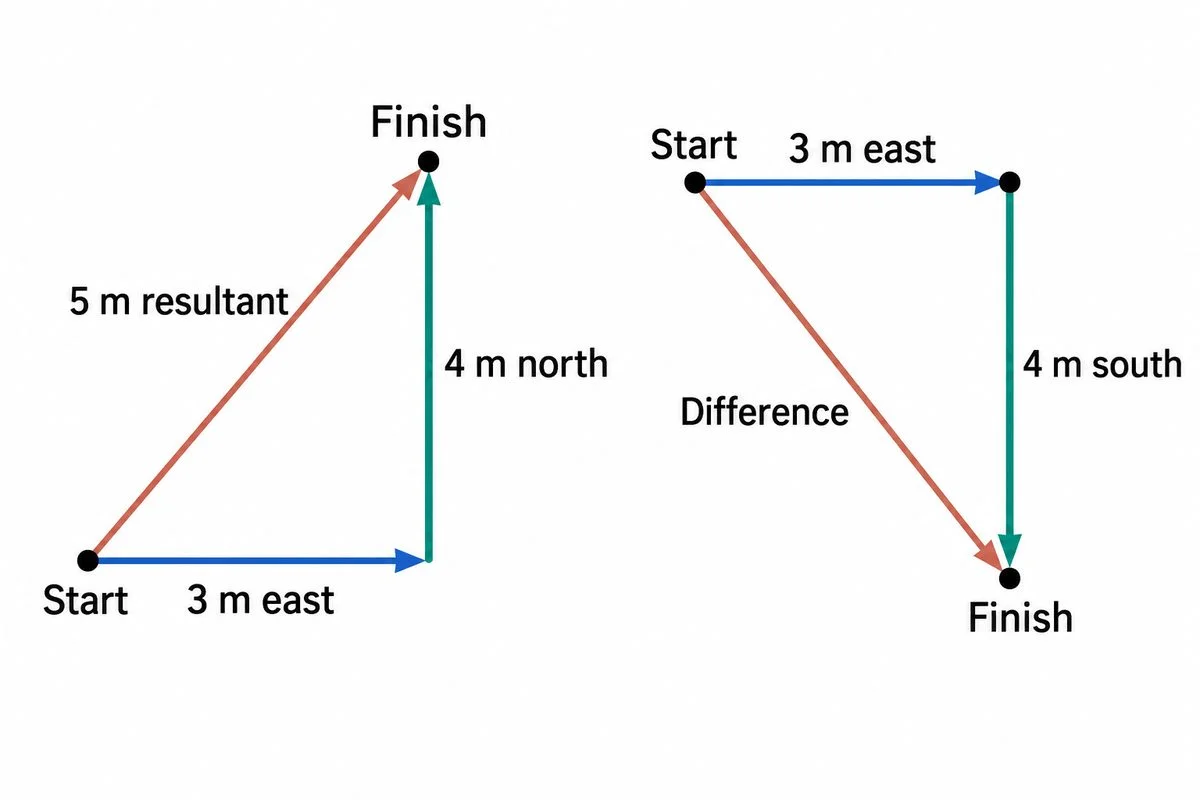
Displacement arrows show an eastward move followed by northward addition or southward subtraction.

2. Vector addition and displacement

Add displacements; to subtract one, reverse it before adding.

Show
Follow the left diagram’s successive arrows, then its diagonal. Find the reversed arrow on the right.
Ask
What single displacement replaces the eastward and northward moves?
Say
The diagonal gives 5 m towards the finish. Subtraction reverses the second arrow.
Used in
Taxi fares use route length, which can exceed displacement.
If your child says…“The lengths always add.”
Ask
Is the diagonal as long as the two sides together?
What’s true
After a turn, displacement is shorter than the total distance travelled.
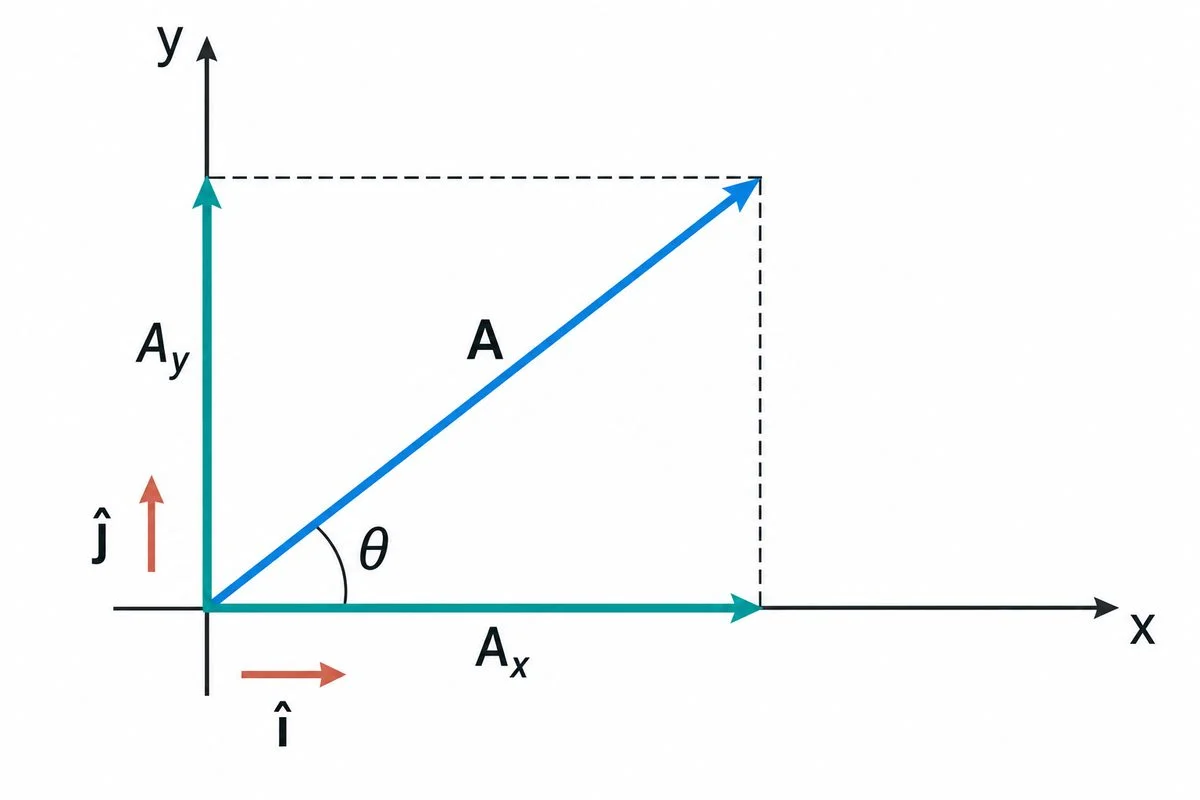
A diagonal vector projects onto perpendicular axes beside horizontal and vertical unit arrows.

3. Resolution and unit vectors

Signed components measure a vector along separate axes.

Show
Find vector A and angle θ from the diagram’s positive horizontal axis. Follow its projections to horizontal component Aₓ and vertical component Aᵧ. Find unit arrows î and ĵ.
Ask
How will reversing this vector change its horizontal and vertical components?
Say
Multiply A’s magnitude by cosine of θ for Aₓ, and by sine for Aᵧ. Unit vectors î and ĵ have magnitude one and specify positive axis directions. Reversing A reverses both component signs.
Used in
Rain’s velocity components help us tilt umbrellas into incoming rain.
If your child says…“Adding two unit vectors still gives magnitude one.”
Ask
Is a square’s diagonal the same length as its side?
What’s true
Two perpendicular unit vectors add to a vector of magnitude 2\sqrt{2}.

Motion in two directions

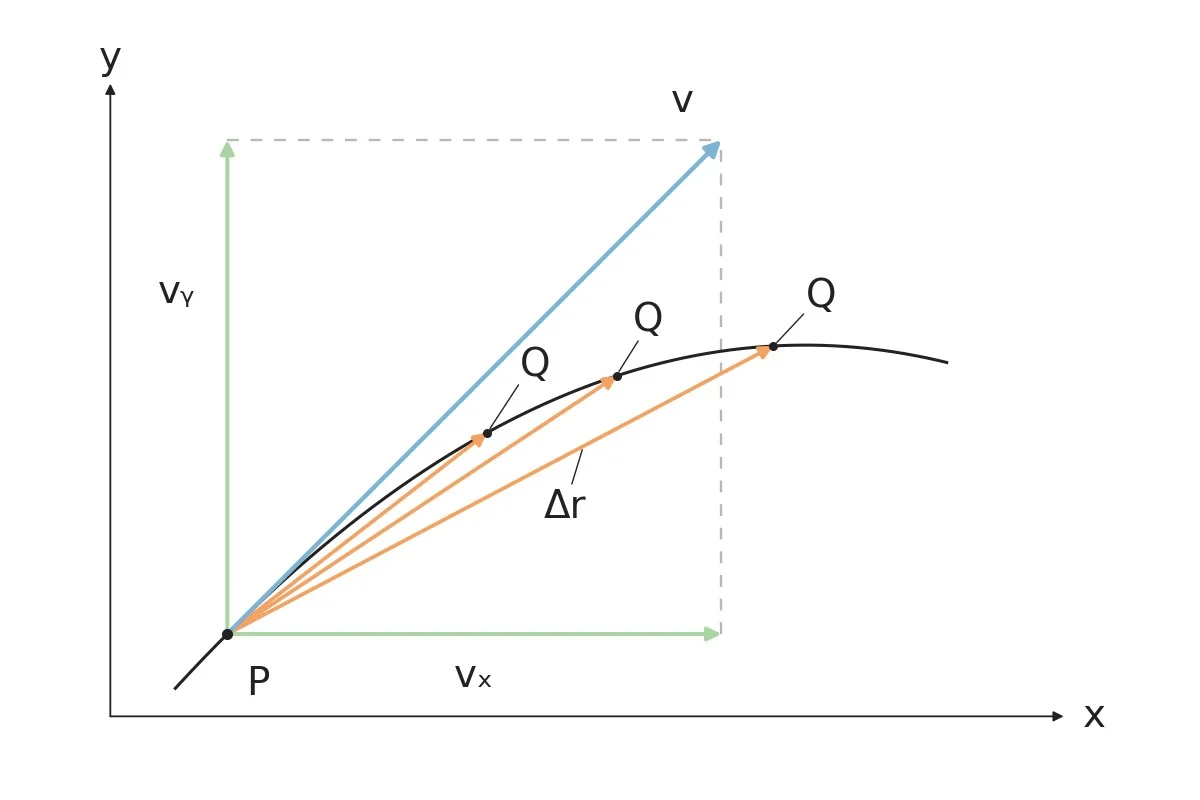
Shortening displacement chords approach a tangent velocity arrow with horizontal and vertical components.

4. Instantaneous velocity and component motion

Velocity follows position changes, and acceleration follows velocity changes.

Show
Find P in the diagram. Follow chords towards nearer Q positions, then find the tangent’s components.
Ask
Which direction will the shrinking chords approach?
Say
They approach the tangent: velocity’s direction now. Both components describe motion over the same time.
Used in
Aircraft navigation tracks motion in separate directions to keep a plane on course.
If your child says…“Acceleration is velocity divided by time.”
Ask
If a velocity component stays constant, what change would you divide by time?
What’s true
Acceleration uses velocity change.

vA/G=+10 m s−1v_{A/G}=+10\,\mathrm{m\,s^{-1}}

vB/G=+15 m s−1v_{B/G}=+15\,\mathrm{m\,s^{-1}}

vA/B=vA/G−vB/Gv_{A/B}=v_{A/G}-v_{B/G}

5. Relative velocity

Subtract the observer’s velocity to find motion relative to them.

Show
Write these lines for train A and observer B. Say: “v means velocity, G means ground, and east is positive.”
Ask
What velocity will A have relative to B in the next line?
Say
The result is −5 m/s, so A moves west relative to B.
Used in
A boat’s motion through water combines with the current, helping predict its arrival.
If your child says…“Relative velocities always add.”
Ask
As B overtakes A, does A move ahead of B or fall behind?
What’s true
Relative velocity subtracts the observer’s velocity from the object’s, using the same reference frame.

Projectiles and circular motion

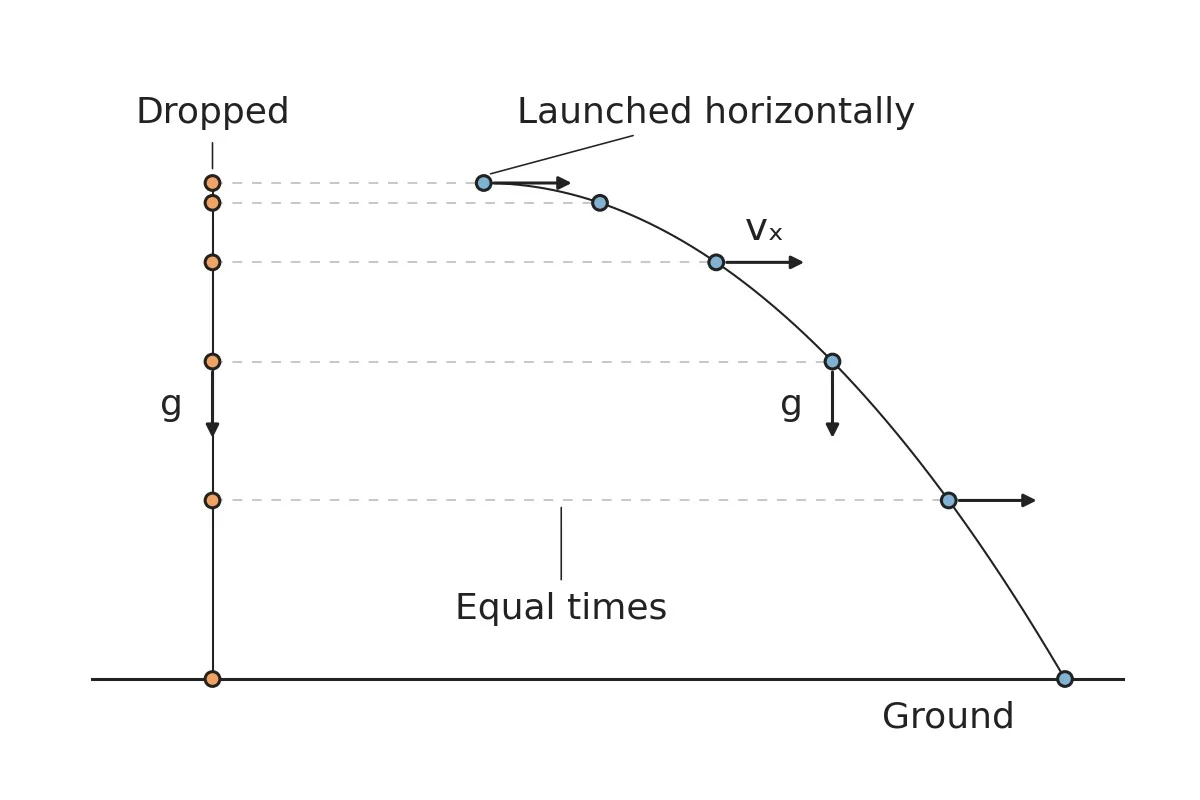
Dropped and horizontally launched balls share equal heights at matching times throughout their falls.

6. Projectile motion

With horizontal motion, uniform gravity produces a parabola, ignoring air resistance.

Show
Find the diagram’s two balls starting at equal heights. Follow matching dots showing equal times after release. Compare their heights, then the sideways and downward gaps.
Ask
Ignoring air resistance, will sideways speed make the launched ball land later?
Say
Both land together because their initial vertical velocities and downward accelerations match. With uniform gravity, the launched ball keeps its sideways speed.
Used in
A basin catches water below a horizontal spout because the stream curves downward.
If your child says…“Sideways speed delays the fall.”
Ask
At each matching time, which ball has fallen farther?
What’s true
Their vertical motions match.

H=1022×10 mH=\frac{10^2}{2\times10}\,\mathrm{m}

H=5 mH=5\,\mathrm{m}

7. Projectile height and range

Upward speed sets height; sideways speed helps set range.

Show
Write these lines. Say: “Ignore air resistance. Launch speeds are 8 m/s sideways and 10 m/s upwards. Gravity reduces upward speed by 10 m/s each second. H means maximum rise.”
Ask
How far sideways will it travel before returning to launch height?
Say
It travels 16 m: 8 m/s for two seconds. Ascent and descent each take one second.
Used in
Players limit throw height to avoid hitting a hall’s ceiling.
If your child says…“Steeper always goes farther.”
Ask
Does throwing straight upwards give horizontal range?
What’s true
At equal launch speeds, steeper throws do not always travel farther.
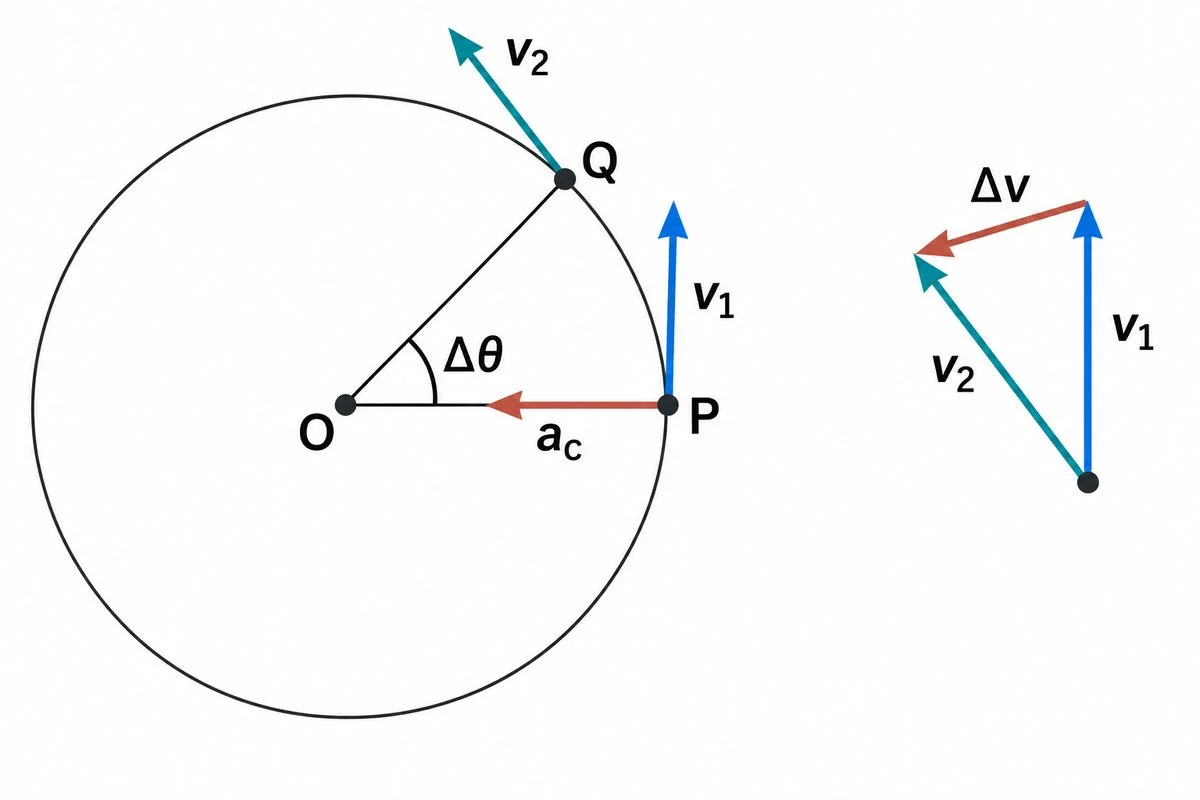
Tangent velocities and their difference show why steady circular motion has inward acceleration.

8. Uniform circular motion

Speed stays steady while velocity turns.

Show
Find the diagram’s tangent velocities. Follow their copies to the inset’s difference arrow.
Ask
How can these equal-speed velocities produce acceleration?
Say
Their directions differ; the shrinking interval reveals inward acceleration.
Used in
Geostationary satellites let ground antennas keep pointing without turning.
If your child says…“Unchanged speed means no acceleration.”
Ask
Do the equal-length velocity arrows point the same way?
What’s true
Changing direction changes velocity.

A real problem

An experimental satellite helped develop geostationary communication.

An Indian experimental communication satellite launched on 19 June 1981.

It helped India learn to develop geostationary communication satellites.

Geostationary satellites match Earth’s rotation.

Ground antennas can therefore stay fixed while pointing at the satellite.

ISROESA

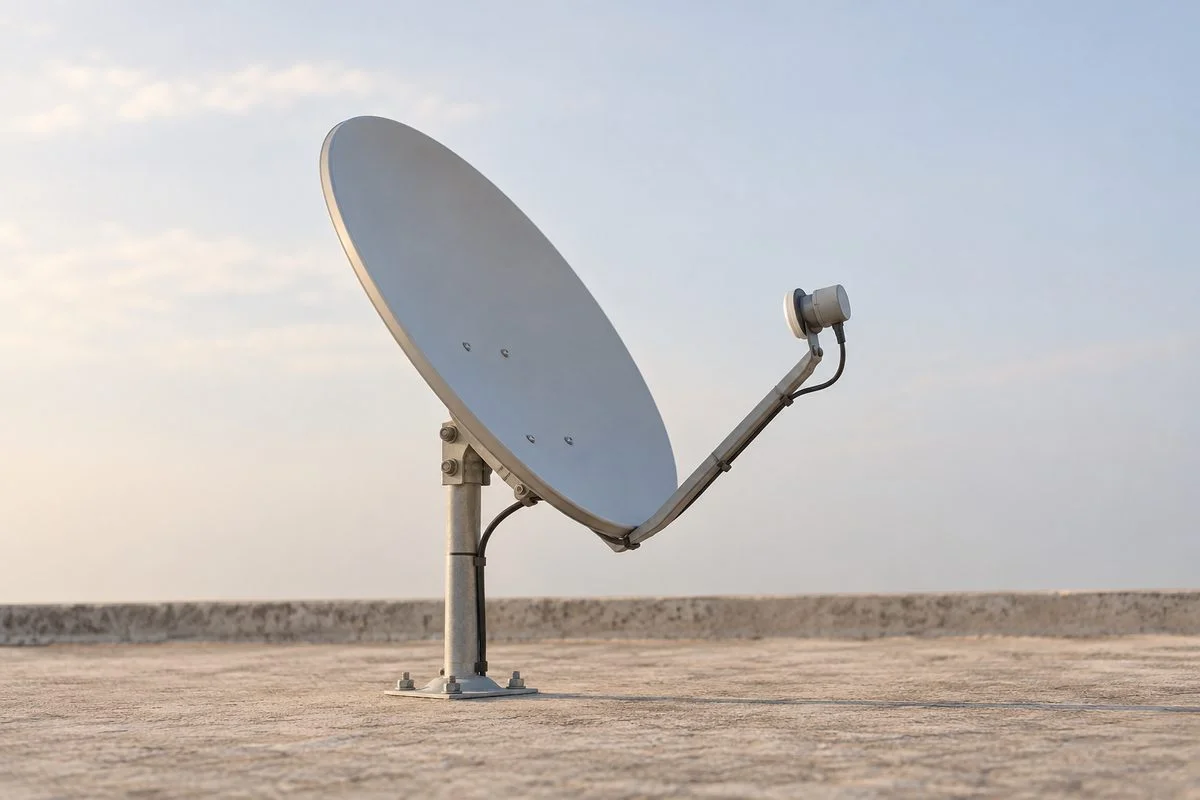
An unbranded rooftop satellite dish pointing into the sky.

Concept Lab · Common misconception

The tempting mistake in Motion in a Plane

Open standalone misconception page →

Does a projectile have upward acceleration while rising?

Wrong

An upward-moving projectile accelerates upward.

Why it feels right. Its motion and acceleration seem to point the same way.

Right

With air resistance neglected, gravity accelerates the projectile downward throughout flight.

Worked example

Vertical velocity falls at the same rate while the projectile rises, at its highest point, and as it falls.

Successive vertical velocities can be +20, +10, 0, −10 m/s at equal time intervals in an illustrative model with g = 10 m/s².

Ask your child eight quick questions.

One per step. The answer and the reason are given.

  1. Are equal-length eastward and westward displacements equal vectors?

    No. Equal vectors must match both size and direction.

  2. Displacements are 3 m east, then 4 m north. What is their resultant’s magnitude?

    5 m. Use Pythagoras for perpendicular vectors; their magnitudes do not simply add.

  3. What is the magnitude of î + ĵ when the unit vectors are perpendicular?

    2\sqrt{2}. Their sum follows a diagonal, whose length comes from Pythagoras.

  4. Rightward velocity rises from 4 m/s to 10 m/s in 3 s. What is average acceleration?

    2 m/s² rightward. Divide the velocity change by the elapsed time.

  5. Both trains move east. Which direction does the faster train’s observer see the slower train move?

    West. Subtracting the faster observer’s eastward velocity gives a westward relative velocity.

  6. Without air resistance, which ball reaches the diagram’s level ground first?

    They land together. Their initial vertical velocities and downward accelerations match.

  7. Does reaching a greater height guarantee a longer range?

    No. Range also depends on horizontal speed, which may decrease for a higher throw.

  8. At steady speed around a circle, where does the acceleration point?

    Towards the centre. Velocity changes direction, and its change over a shrinking interval points inward.

15 more questions with answers, 5 with pictures