Skip to content

Teach Motion in a Straight Line in eight steps.

For each idea: show it, ask before you tell, then say one line.

Gather a spoon, ruler, soft ball, paper and pencil.

Common misconceptions & worked visual for this chapter · 15 practice questions with answers

How to teach it

Describing motion

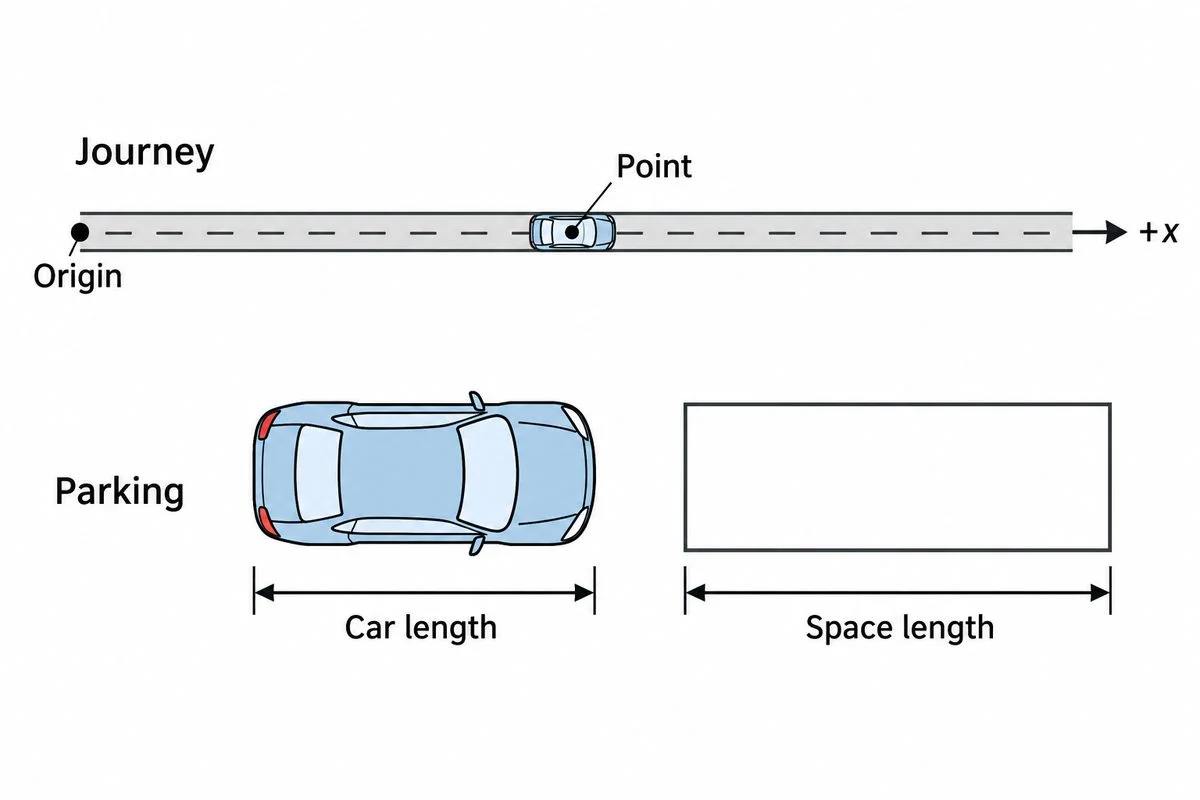
Car represented by a point during travel, with dimensions shown beside a parking space.

1. Point-object approximation

Track one point when size and turning do not matter.

Show
Find the diagram's origin and rightward positive arrow. Compare the trip's dot with the car beside the parking space.
Ask
When will one position describe the car adequately: during this trip or when checking parking space?
Say
For this long trip, one point tracks the car well enough. Parking needs the car's length, so a point cannot tell us whether it fits.
Used in
A carriage travelling between stations can be represented by a point, simplifying calculations.
If your child says…“Only tiny objects can count as points.”
Ask
Does a carriage's length matter when tracking its travel between distant stations?
What’s true
The motion being studied decides which details matter.
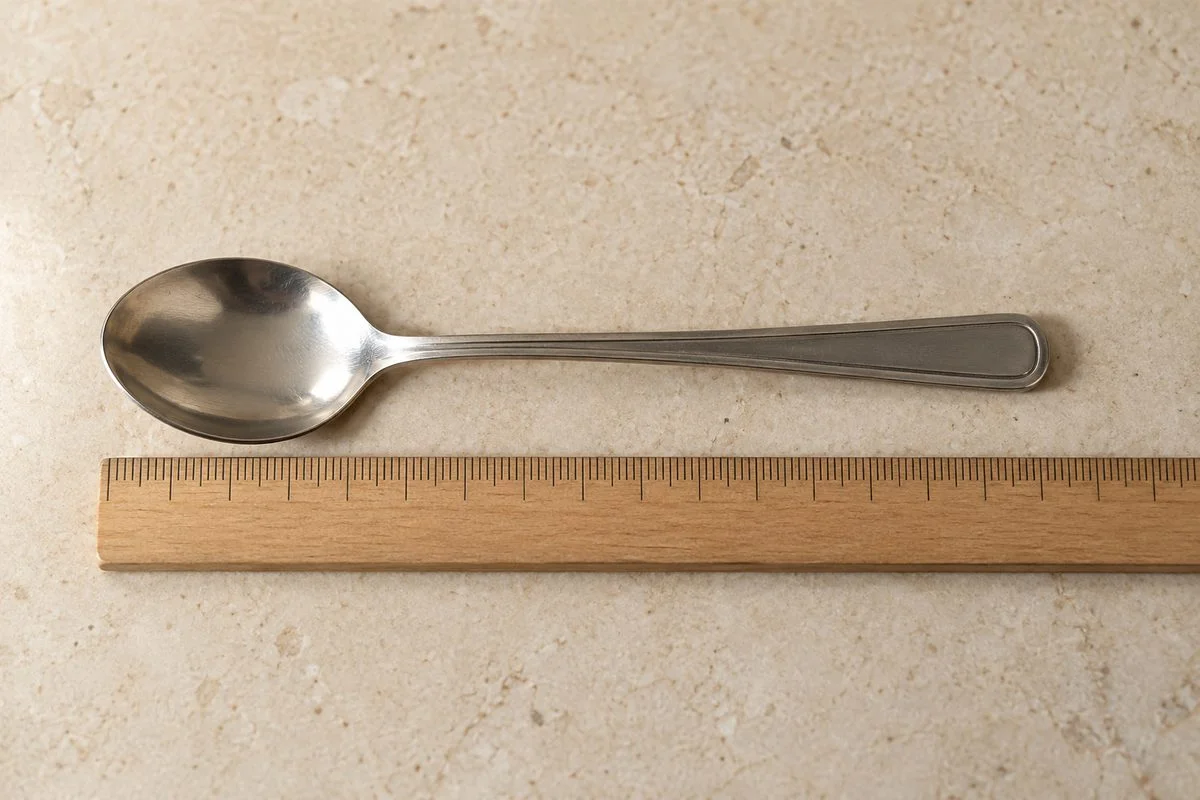
Steel spoon beside the left end of a ruler.

2. Displacement, distance and average velocity

Displacement tracks position change; distance counts every part travelled.

Show
Place a spoon beside a ruler. Slide it away along the ruler, then return it to its starting position.
Ask
After returning, which becomes zero: displacement or distance travelled?
Say
The spoon returns, so its displacement and average velocity are zero. Its distance and average speed are positive.
Used in
Average speed describes a whole trip, including return travel.
If your child says…“Coming back subtracts the distance I travelled.”
Ask
Can returning erase the outward part of the trip?
What’s true
Travel adds distance; each instant still has just one position.
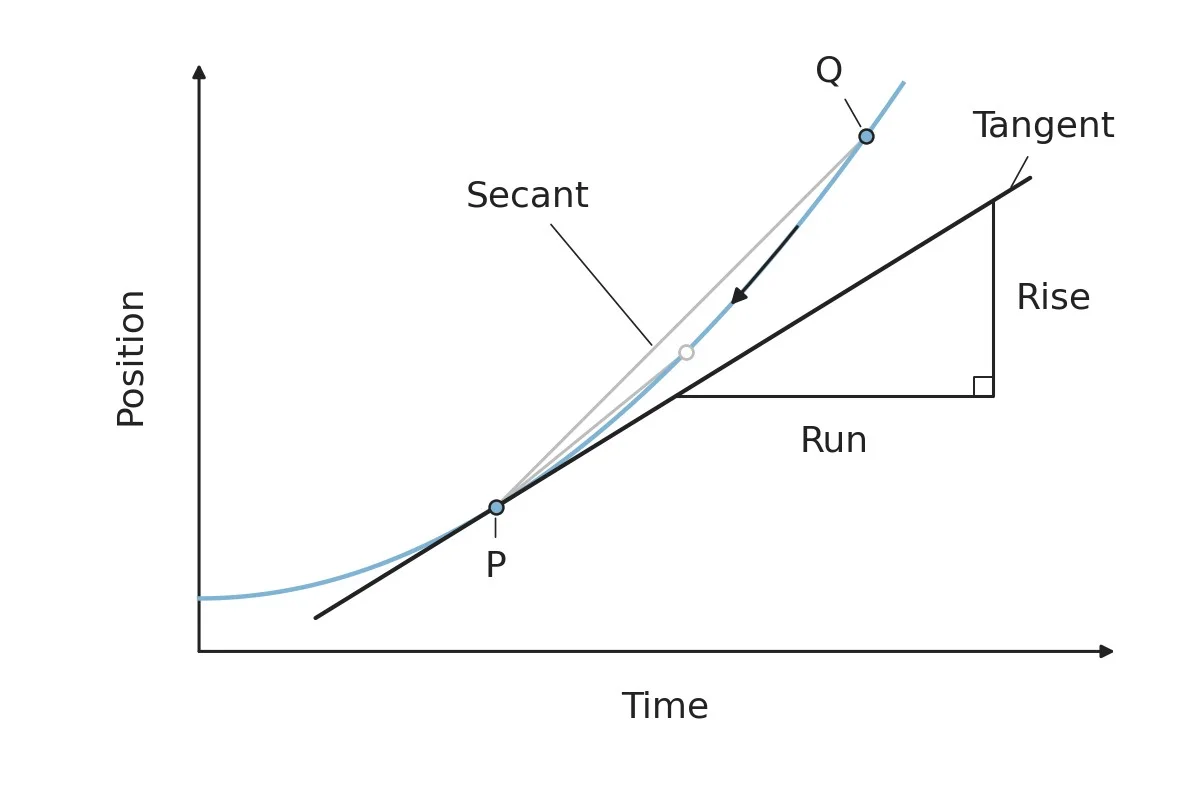
Secants approach a tangent on a position-time curve, with rise and run marked.

3. Position-time graphs and instantaneous velocity

Graph height gives position; tangent slope gives current velocity.

Show
Find P and Q on the diagram's curve and the secant joining them. Follow Q towards P, then find the tangent's rise and run.
Ask
Which line will give velocity at P as Q gets closer?
Say
The secant approaches the tangent as the time interval shrinks. The tangent's rise divided by its run gives velocity at P.
Used in
Train speed monitoring helps enforce speed restrictions.
If your child says…“A curved graph means a curved path.”
Ask
Does the horizontal axis show time or another direction in space?
What’s true
This graph pairs position with time, not another spatial direction.

Changing velocity

Δv=−6−(−2)=−4 m s−1\Delta v=-6-(-2)=-4\,\mathrm{m\,s^{-1}}

Δt=2 s\Delta t=2\,\mathrm{s}

4. Acceleration

How quickly velocity changes, including its direction.

Show
Write these lines. Say, “Right is positive; the car changes velocity uniformly. Delta v means velocity change; delta t means elapsed time.”
Ask
What acceleration will you calculate while this car gains speed?
Say
Its acceleration is −2 metres per second squared, but its speed increases. Both velocity and acceleration point left.
Used in
Train braking curves describe slowing under different operating conditions, helping control speed.
If your child says…“Negative acceleration always means slowing.”
Ask
From −2 m/s to −6 m/s, does the speed grow or shrink?
What’s true
Negative acceleration can increase leftward speed when right is positive.
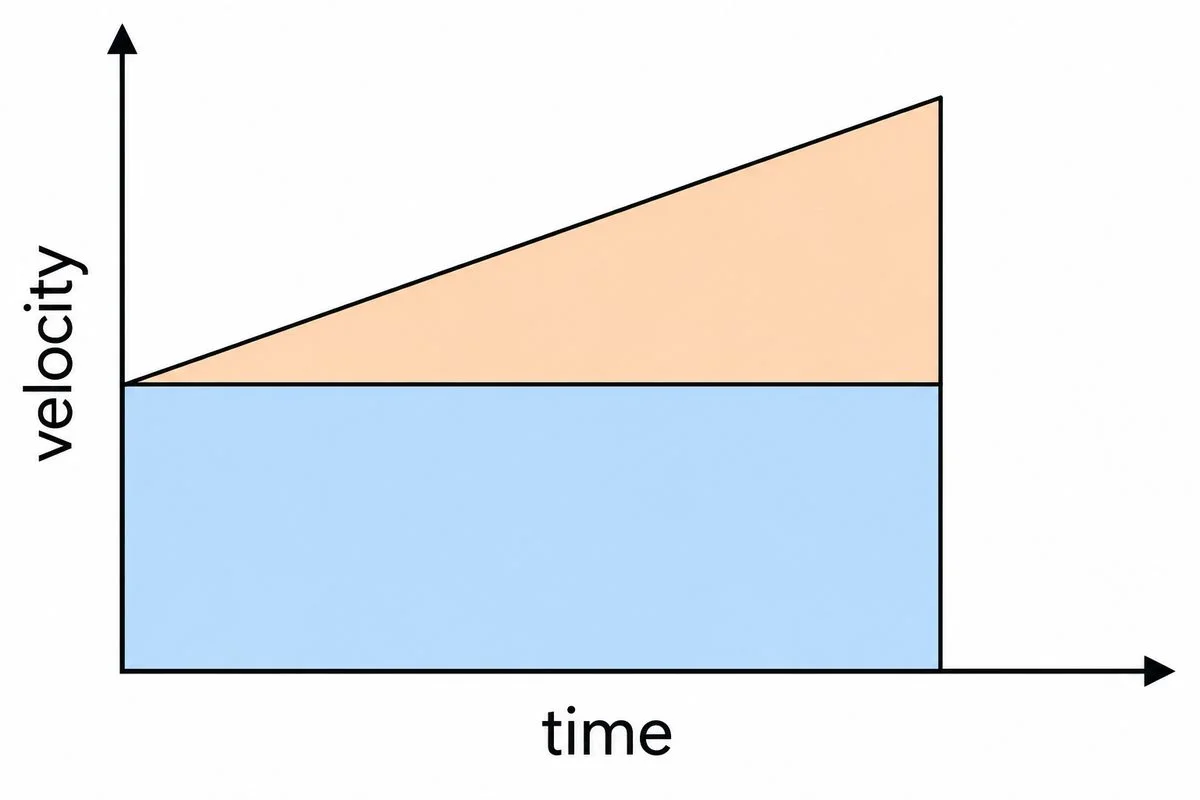
Pencil velocity-time graph with shaded rectangle and triangle beneath a straight rising line.

5. Graph areas and equations of motion

Velocity-time areas give displacement.

Show
Find the diagram's time and velocity axes. Find the shaded rectangle and triangle beneath the rising line.
Ask
If the same motion starts farther right, will this graph's shaded area change?
Say
No, its shaded area will not change; signed area gives displacement.
Used in
Constant-slowing calculations estimate braking distance.
If your child says…“Displacement is the final position.”
Ask
What must you add to the displacement to find the final position?
What’s true
Final position includes where the object started.
One hand holds a soft ball above a clear floor.

6. Vertical motion under gravity

During free flight, gravity accelerates the ball downward throughout.

Show
Hold a soft ball above a clear floor. Toss it gently upward and watch it slow as it rises.
Ask
Which way will it accelerate while rising?
Say
Near Earth, ignoring air resistance, acceleration stays constant and downward while the ball rises.
Used in
Including launch height gives an upward throw's highest position above ground.
If your child says…“Gravity points upward while the ball rises.”
Ask
If acceleration pointed upward, why would the rising ball slow?
What’s true
At the top, velocity vanishes while acceleration remains downward.
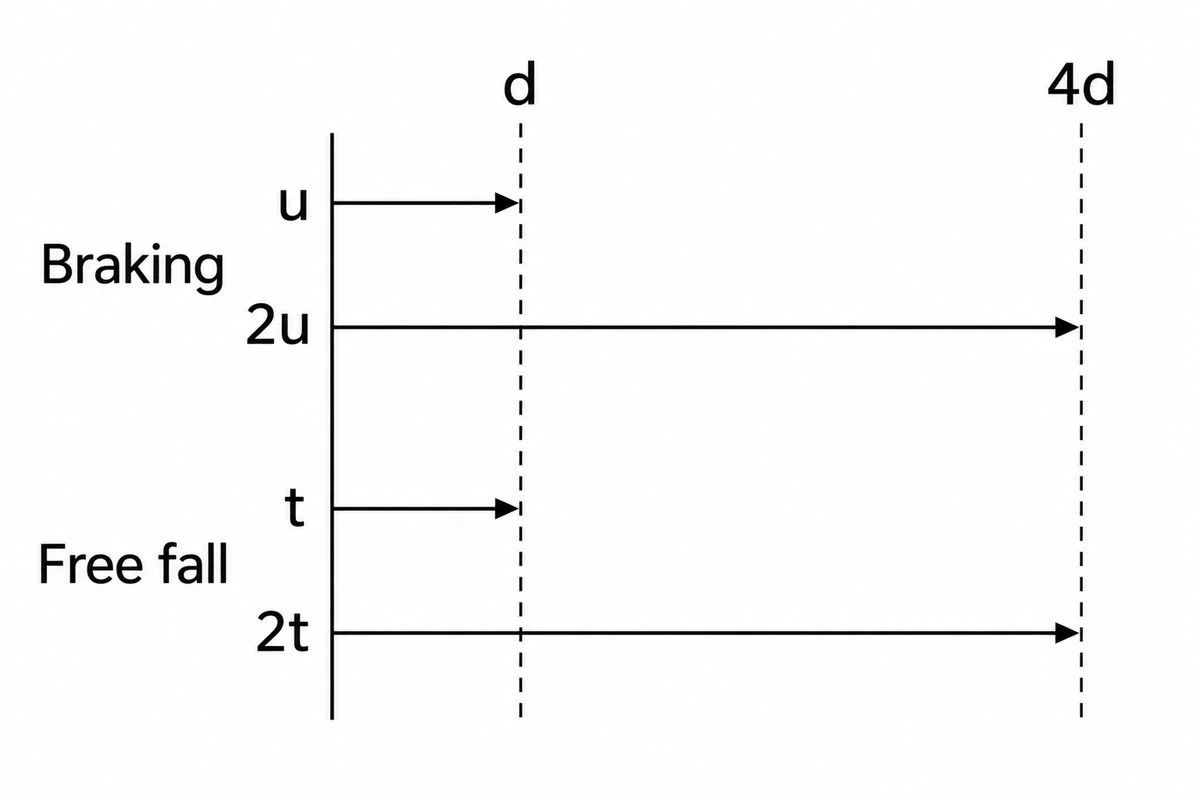
Paired arrows compare fourfold braking and falling distances after doubling speed or time.

7. Stopping distance and free-fall scaling

Doubling speed or fall time can quadruple distance.

Show
Compare the diagram's arrow pairs. Here, u means initial speed, t means time, and d means distance.
Ask
How will each distance change when speed or fall time doubles?
Say
At constant slowing, doubling speed quadruples braking distance. Under constant gravity, doubling fall time from rest quadruples distance.
Used in
Allowing for reaction travel and braking distance helps drivers leave enough space to stop.
If your child says…“Twice the falling time means twice the distance.”
Ask
During the longer fall, is the average speed unchanged or greater?
What’s true
From rest, constant gravity makes distance grow as time squared, ignoring air resistance.

Comparing moving objects

vA=+10 m s−1v_A=+10\,\mathrm{m\,s^{-1}}

vB=+15 m s−1v_B=+15\,\mathrm{m\,s^{-1}}

8. Relative velocity

An object's velocity measured relative to a chosen observer.

Show
Write these lines. Say, “Both trains move east relative to the ground; east is positive. These symbols give each train's ground velocity.”
Ask
What velocity will a passenger in B measure for A?
Say
Subtract B's velocity from A's: the result is −5 m/s. A moves west relative to B because B moves east faster.
Used in
A pursuing car's relative velocity gives its closing rate, helping calculate catch-up time.
If your child says…“Add speeds when both objects move the same way.”
Ask
How does A's position change compared with B as B travels faster east?
What’s true
B gains on A, so A moves west relative to B.

A real problem

Automatic train protection helps enforce speed restrictions.

Kavach began development in 2012 under the name Train Collision Avoidance System.

The onboard system monitors train speed continuously.

It generates braking curves for different operating conditions.

It applies brakes automatically when the driver fails to keep within speed restrictions.

The Indian ExpressPress Information BureauMinistry of Railways

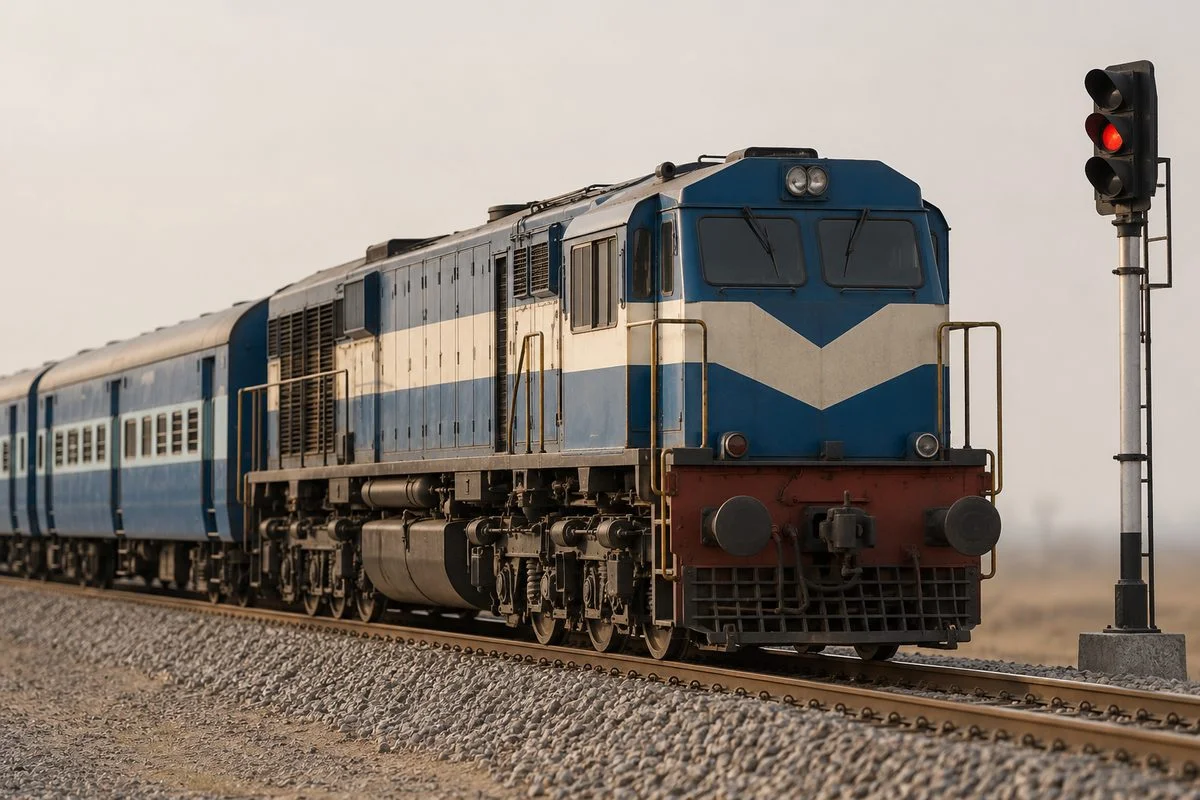
Indian passenger train stopped before a red railway signal.

Concept Lab · Common misconception

The tempting mistake in Motion in a Straight Line

Open standalone misconception page →

Does negative acceleration always mean slowing down?

Wrong

A car with acceleration −2 m/s² is slowing down.

Why it feels right. Negative sounds like a reduction in speed.

Right

Speed increases when velocity and acceleration point in the same direction.

Worked example

Both velocities point left. The longer arrow after one second represents greater speed.
  1. With right positive, a car moves left at −3 m/s and has acceleration −2 m/s².
  2. One second later its velocity is −5 m/s.

Ask your child eight quick questions.

One per step. The answer and the reason are given.

  1. Which matters: actual size alone, or size compared with the travel being studied?

    Size compared with the travel. A large object can qualify when its dimensions and turning are irrelevant.

  2. You walk 10 m away, then 4 m back. What distance have you travelled?

    14 m. Returning adds travel; 6 m may also confuse distance with displacement.

  3. A ball's position-time graph curves. Must its physical path curve too?

    No. The axes represent position and time, not two directions in space.

  4. Velocity changes from −2 m/s to −6 m/s. What happens to speed?

    It increases: 2–6 m/s. Both velocity and acceleration point left, so the car gains speed.

  5. Start at 10 m and move right at 2 m/s for 3 s. Where do you finish?

    At 16 m. The 6 m displacement must be added to the 10 m starting position.

  6. Ignoring air resistance, which way does acceleration point while the ball rises after release?

    Downward. Gravity stays downward during ascent; it does not follow the ball's motion.

  7. A ruler falls four times as far from rest. How does its fall time change?

    It doubles. Under constant gravity, distance grows as time squared, ignoring air resistance.

  8. What is A's velocity relative to B?

    −5 m/s, westward. Subtract the observer's velocity from the object's velocity; adding would give the wrong direction.

15 more questions with answers, 4 with pictures