Skip to content

Teach Alternating Current in eight steps.

For each idea: show it, ask before you tell, then say one line.

Gather paper and a pencil.

Common misconceptions & worked visual for this chapter · 15 practice questions with answers

How to teach it

Current and voltage

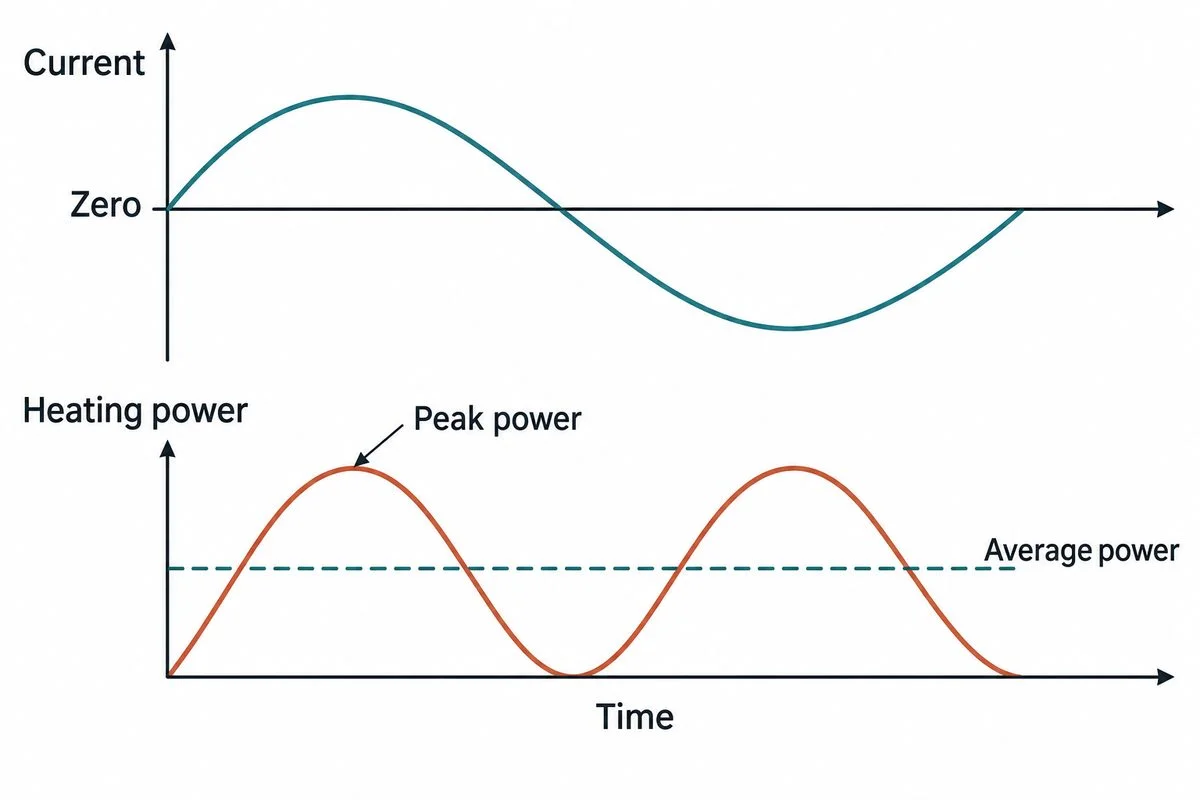
Alternating current above heating power, with positive humps during both current directions.

1. Sinusoidal current and rms values

Effective current matches direct current’s heating in the same resistor.

Show
Look at the diagram’s current curve above zero, then below it. Follow the corresponding heating-power humps underneath.
Ask
When this current reverses, will its heating power become negative?
Say
Both directions heat the resistor, so heating never cancels.
Used in
Electric heater ratings use rms voltage to describe their heating on an alternating supply.
If your child says…“The average current is zero, so there is no heating.”
Ask
Does the power curve fall below zero when current reverses?
What’s true
Heating depends on the average squared current, which stays positive for a nonzero sine wave.
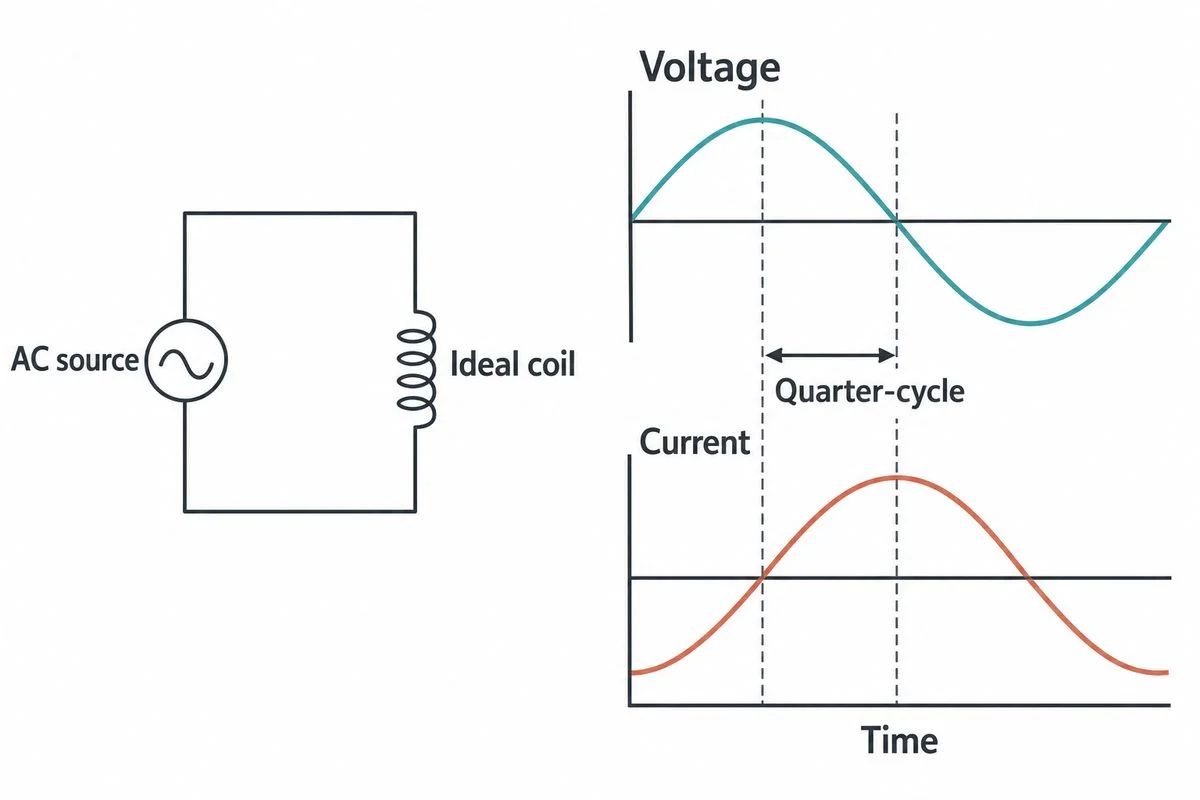
Ideal coil circuit beside graphs showing current peaking a quarter-cycle after voltage.

2. Ideal inductor

Current peaks later, and opposition grows with frequency.

Show
Look at the diagram’s source and coil. Find the voltage peak, then the later current peak.
Ask
For this coil at unchanged rms voltage, will doubling frequency increase or decrease current?
Say
The coil opposes changes in current, even without resistance. Current peaks a quarter-cycle after voltage. At fixed voltage and inductance, doubling frequency halves current.
Used in
Coils limit current in some fluorescent lamps, helping protect the tube.
If your child says…“A higher frequency makes more current flow through the inductor.”
Ask
If opposition doubles while voltage stays unchanged, what happens to current?
What’s true
Higher frequency increases inductive reactance when inductance stays fixed.
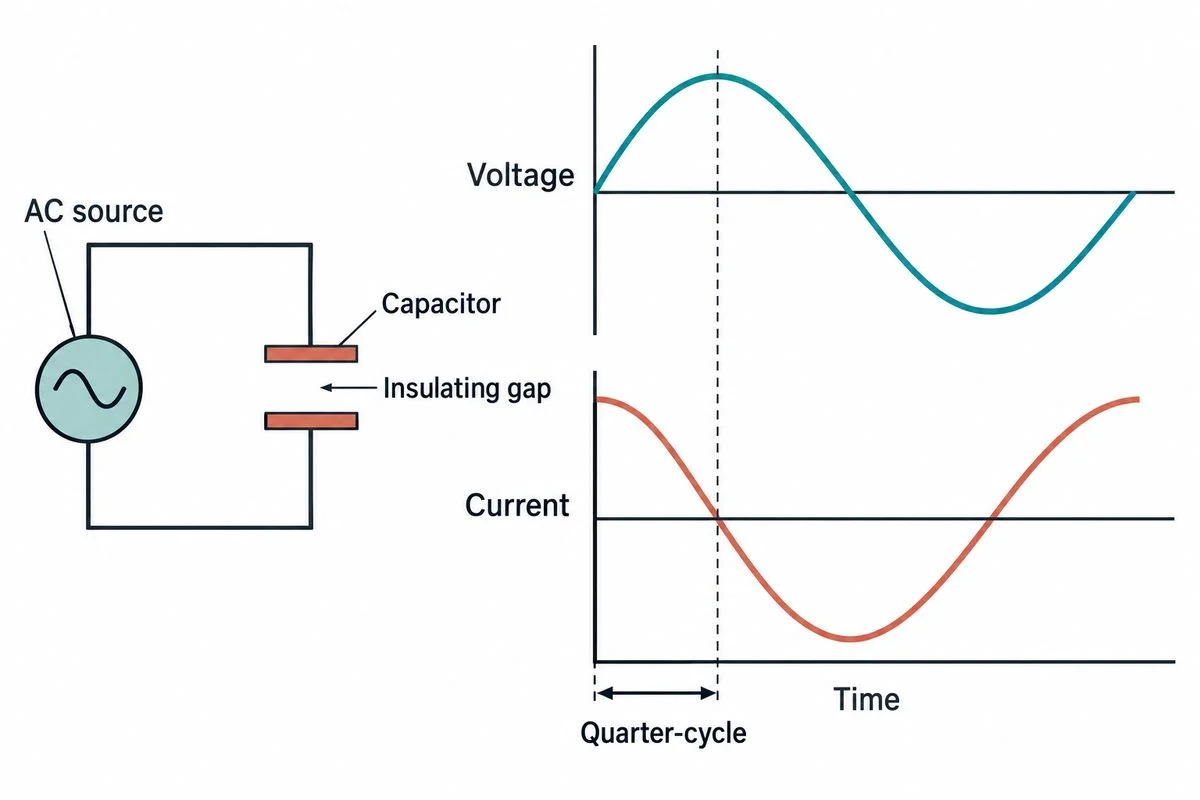
Capacitor circuit beside graphs showing current peaking before voltage.

3. Ideal capacitor

Faster voltage changes need more current.

Show
Look at the diagram’s separated capacitor plates. Follow their wires to the source. Compare the current and voltage peaks.
Ask
If this source keeps alternating, will current continue in the wires despite the insulating gap?
Say
Charge gathers on each plate and then leaves through its wire, without crossing the gap. Current peaks a quarter-cycle before voltage.
Used in
Capacitors pass changing audio signals between circuits while keeping their steady voltages separate.
If your child says…“A higher frequency makes less current flow through the capacitor.”
Ask
Does changing the plate charge faster require more current or less?
What’s true
Higher frequency means faster voltage changes and more current at unchanged rms voltage and capacitance.

Combining circuit components

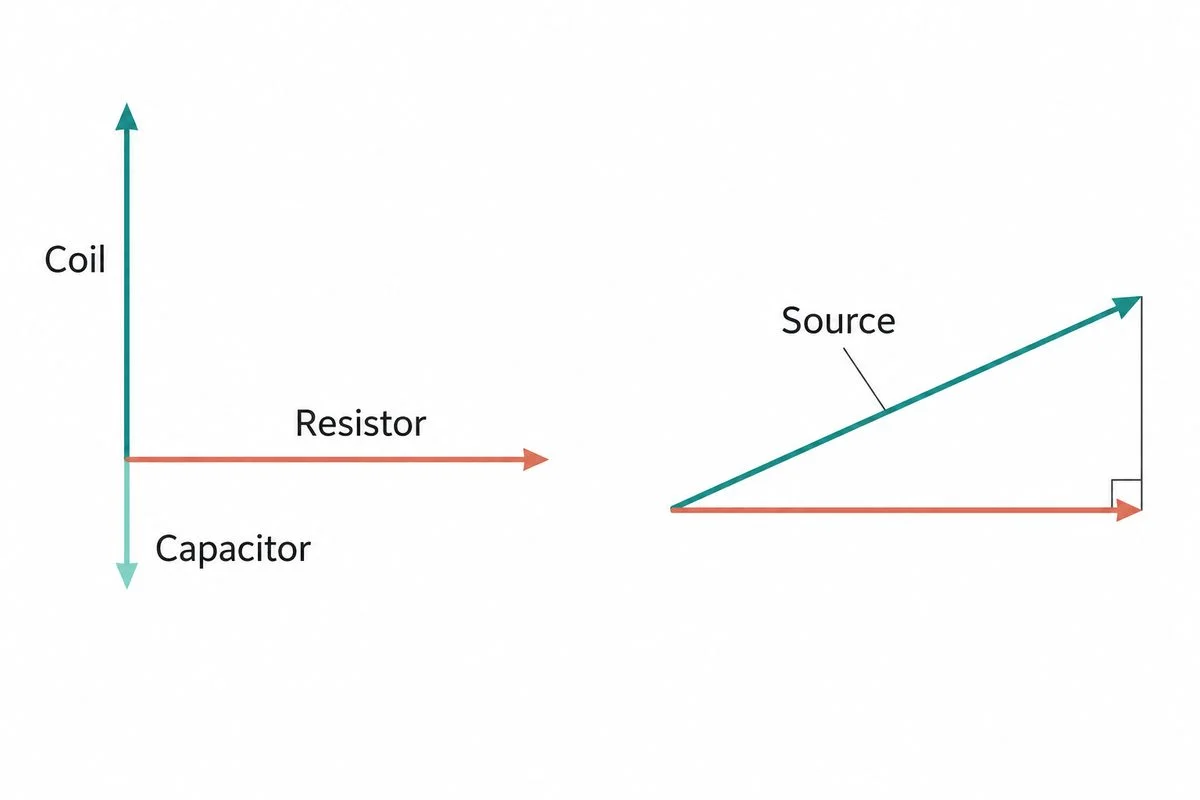
Voltage arrows beside a right triangle whose diagonal gives the source voltage.

4. Series LCR impedance and phasors

Series components share current, but their voltages peak at different times.

Show
Find the opposing coil and capacitor voltage arrows in the diagram. Match their remaining upward length to the triangle’s vertical side. Find the source diagonal.
Ask
If the vertical arrows become equal, which voltage will remain?
Say
The equal vertical arrows cancel, so only the resistor voltage remains.
Used in
Speaker filters use impedance to control current at different sound frequencies.
If your child says…“I can add all three voltage readings to get the source voltage.”
Ask
If equal coil and capacitor arrows cancel, which arrow remains?
What’s true
Coil and capacitor voltages oppose each other, while resistor voltage differs by a quarter-cycle.
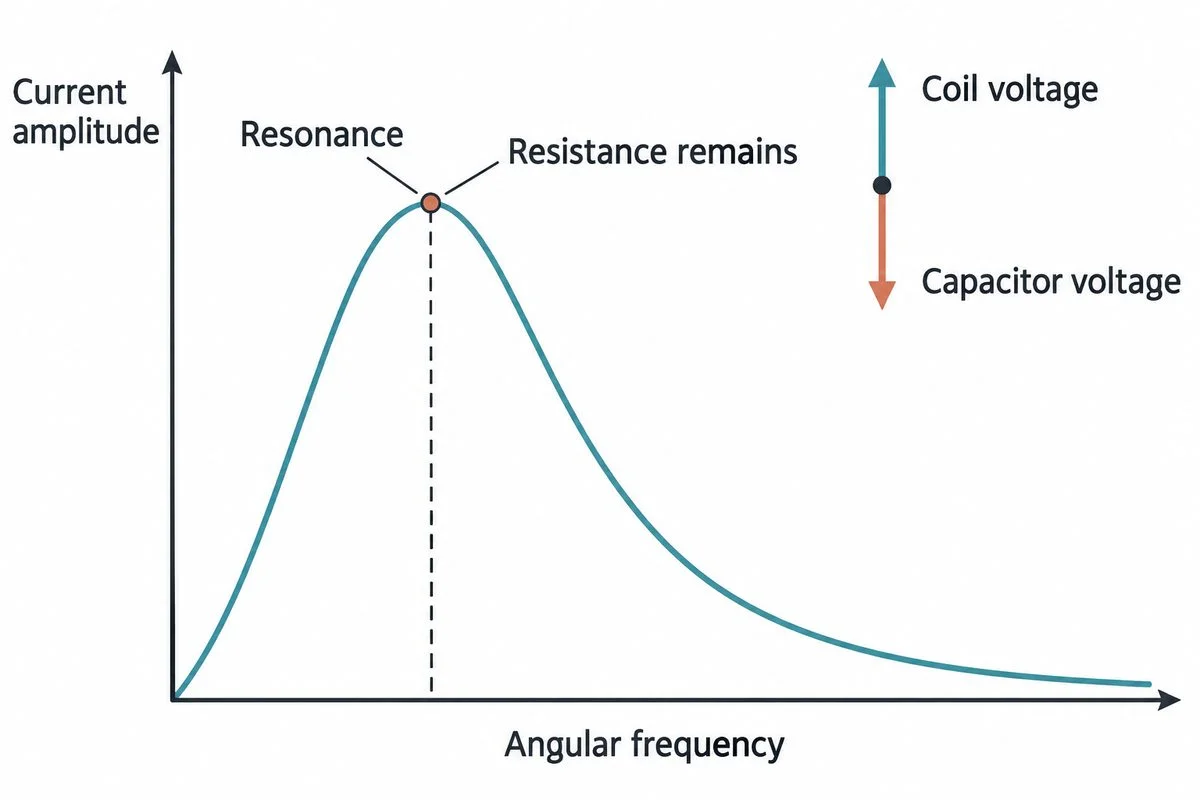
Finite resonance peak beside equal, opposite coil and capacitor voltage arrows.

5. Series resonance and natural angular frequency

At fixed voltage, balanced reactances give maximum current, limited by resistance.

Show
Look at the diagram’s rising current curve. Follow it towards the marked resonance frequency. Compare the equal, opposite voltage arrows.
Ask
With voltage fixed, what happens to current as frequency approaches resonance?
Say
Current rises to its maximum, still limited by resistance, when coil and capacitor reactances are equal.
Used in
Radio tuning uses resonance to select the wanted station’s signal.
If your child says…“At resonance, nothing limits the current.”
Ask
Which component still turns electrical energy into heat when the two voltage arrows cancel?
What’s true
Only the coil and capacitor effects cancel, leaving the resistor to limit current.
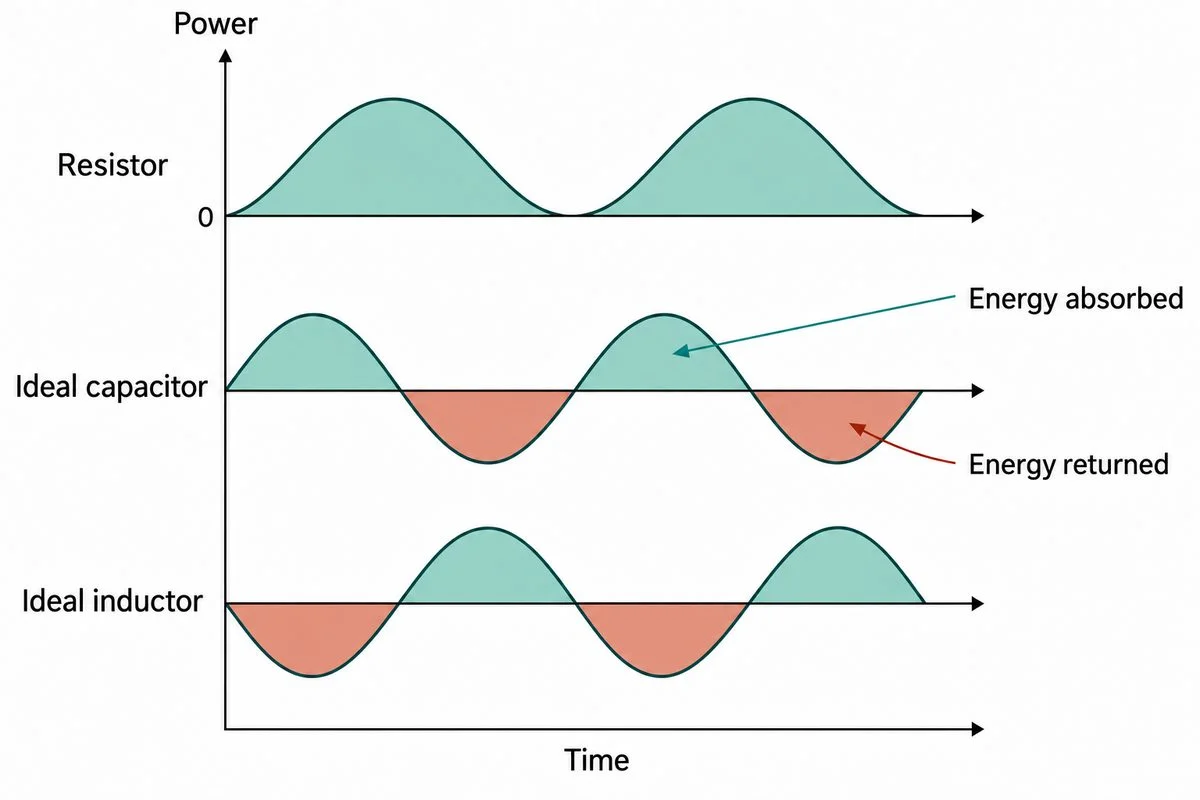
Power graphs compare resistor heating with energy absorbed and returned by ideal reactive components.

6. Average power, wattless current and power factor

For sine waves, power factor links rms readings to average power.

Show
Compare the diagram’s resistor curve with both curves below.
Ask
What net energy remains when equal opposite areas cancel?
Say
No net energy remains. Ideal coils and capacitors return absorbed energy, giving zero average power.
Used in
Correctly sized capacitors across inductive motors reduce supply current and wire heating.
If your child says…“Voltage times current always gives average power.”
Ask
For an ideal coil, can rms voltage times rms current equal its zero average power?
What’s true
Multiplying rms voltage by rms current gives average power only when power factor is one.

Transformers and transmission

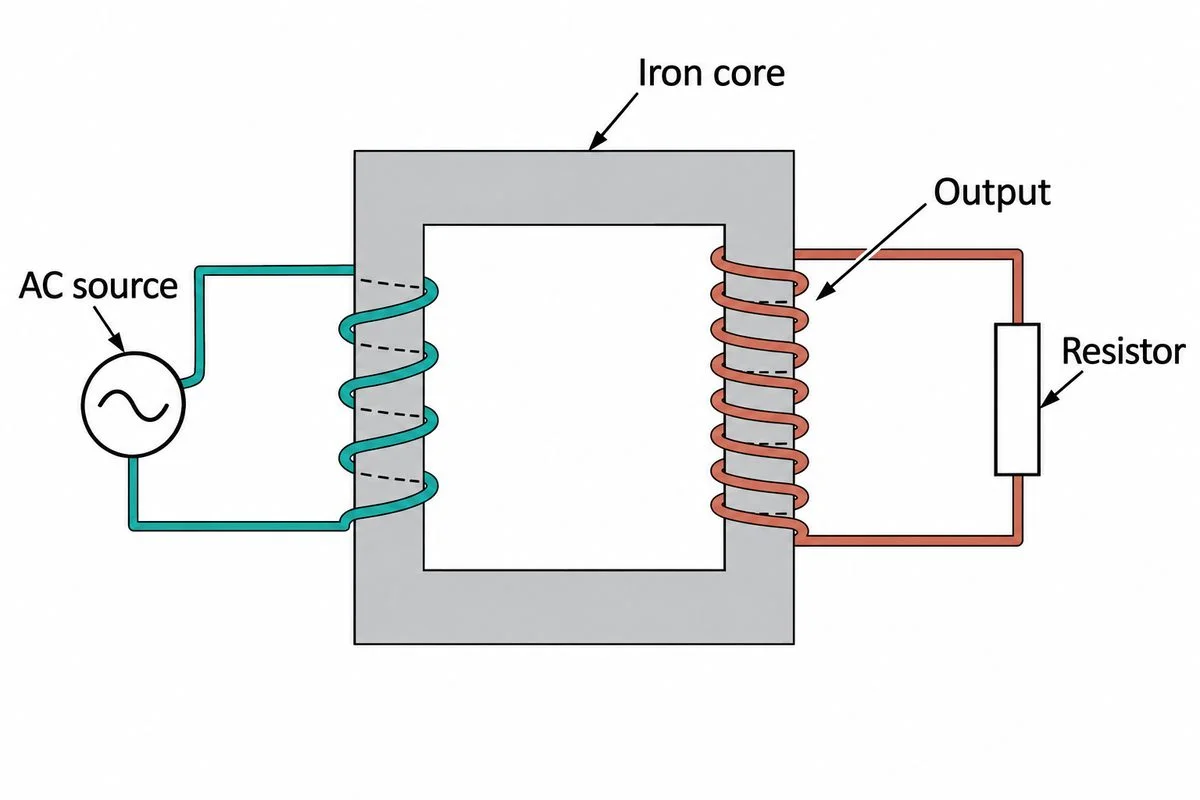
Transformer diagram with separate coils sharing one closed rectangular iron core.

7. Ideal transformer

Linked coils change voltage while an ideal transformer conserves power.

Show
Count each coil’s turns in the diagram. Trace their shared iron core. Find the AC source on the left and the resistor on the right.
Ask
Which coil gives higher voltage?
Say
The coil with more turns gives higher voltage. The changing core field gives equal voltage per turn.
Used in
Transformers lower transmitted voltage for lighting and transport.
If your child says…“A transformer doubles voltage and current together.”
Ask
Would doubling both voltage and current leave their product unchanged?
What’s true
For unchanged power and a resistive load, doubling voltage halves current.

Current at 10 kV: 100000 W10000 V=10 A\frac{100000\,\mathrm{W}}{10000\,\mathrm{V}}=10\,\mathrm{A}

Initial line heating: (10 A)2×10 Ω=1000 W(10\,\mathrm{A})^2\times10\,\Omega=1000\,\mathrm{W}

Current at 20 kV: 100000 W20000 V=5 A\frac{100000\,\mathrm{W}}{20000\,\mathrm{V}}=5\,\mathrm{A}

8. Transmission losses

Lower line current reduces heating according to current squared.

Show
Write these lines for 100 kW sent through a 10 Ω line. Say, “Power factor stays one as rms voltage doubles from 10 kV to 20 kV.”
Ask
At the higher voltage, what heating loss will this smaller current produce?
Say
The new heating loss is 250 W because heating depends on current squared. Doubling voltage halves current and quarters heating for this unchanged power and line resistance.
Used in
Lower transmission losses leave more of the supplied power available at the receiving end.
If your child says…“Halving the current only halves the heating.”
Ask
What happens when both factors in current times current are halved?
What’s true
At fixed resistance, halving current quarters heating because current is squared.

A real problem

Transformers helped Niagara power reach Buffalo.

Niagara began sending electricity to Buffalo in 1896.

Transformers raised the voltage before transmission and lowered it at the receiving end.

The electricity supplied Buffalo’s lighting and streetcars.

National Park ServiceElectrical Doings archiveSmithsonian

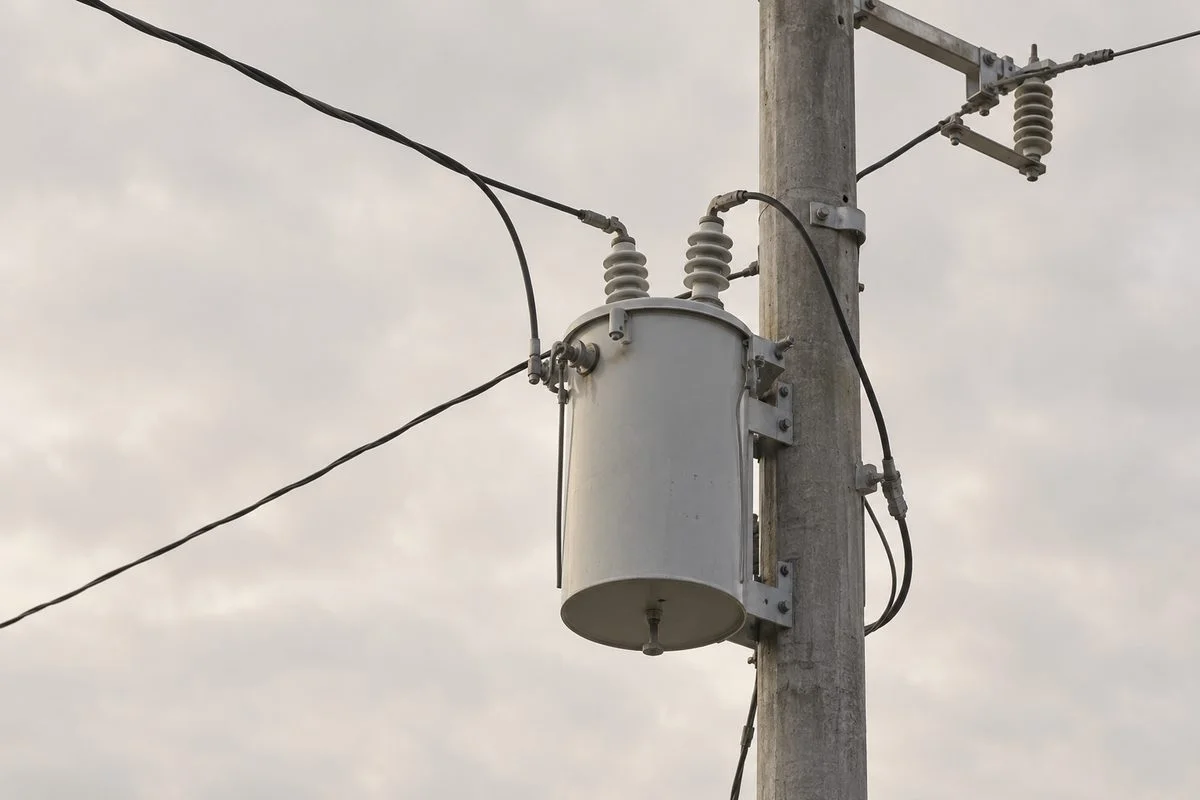
Electricity transformer mounted on a utility pole beside overhead power lines.

Concept Lab · Common misconception

The tempting mistake in Alternating Current

Open standalone misconception page →

Can AC with zero average current still heat a resistor?

Wrong

A resistor on AC cannot heat because the current averages to zero.

Why it feels right. I assume positive and negative half cycles cancel their heating.

Right

Resistive heating depends on I²R, which is positive for nonzero current in either direction.

Worked example

The dashed current changes sign. The solid heating curve stays at or above zero in both half cycles.
  1. Through 2 Ω, the instantaneous currents +3 A and −3 A each produce 18 W.
  2. A sinusoid with peak current 3 A has root-mean-square current 3/√2 A and average power 9 W.

Ask your child eight quick questions.

One per step. The answer and the reason are given.

  1. A nonzero sinusoidal current has zero signed average. Does it heat a resistor?

    Yes. Squaring current makes both directions contribute positively to average heating.

  2. At unchanged rms voltage and inductance, what happens to current when frequency doubles?

    It halves. Doubling frequency doubles inductive opposition, so current halves.

  3. At unchanged rms voltage, what happens to a fixed capacitor’s current when frequency doubles?

    It doubles. Faster voltage changes require more charging and discharging current.

  4. The resistor reads 100 V, and the coil and capacitor each read 200 V. What does the source read?

    100 V. Equal coil and capacitor voltages cancel, leaving the resistor’s voltage.

  5. At series resonance, the rms supply is 100 V and resistance is 10 Ω. What is the rms current?

    10 A. The remaining opposition is 10 Ω, so current equals voltage divided by resistance.

  6. The rms readings are 100 V and 2 A. The power factor is 0.6. What is the average power?

    120 W. Multiply the rms readings together, then multiply by the power factor once.

  7. An ideal transformer doubles voltage and supplies a resistor with 5 A. What is its input current?

    10 A. The input voltage is half, so its current doubles to preserve power.

  8. Line current halves while line resistance stays unchanged. What fraction of the heating remains?

    One-quarter. Heating follows current squared, so halving current multiplies heating by one-quarter.

15 more questions with answers, 1 with pictures