Skip to content

Teach Moving Charges and Magnetism in eight steps.

For each idea: show it, ask before you tell, then say one line.

Gather paper and a pencil.

Common misconceptions & worked visual for this chapter · 15 practice questions with answers

How to teach it

Forces on moving charges

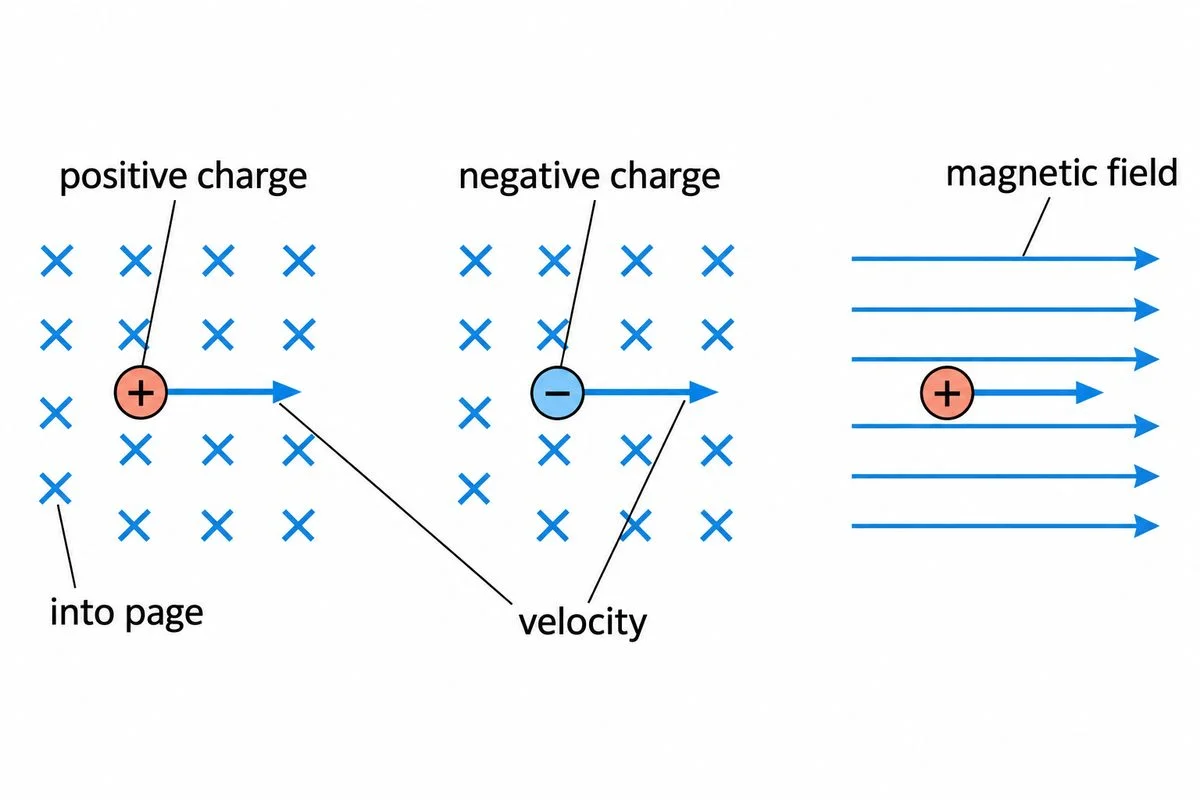
Three charges moving across or along a magnetic field, ready for force predictions.

1. Magnetic force

Moving charges and currents can feel a sideways magnetic force.

Show
Look at the diagram’s charge signs. Follow each velocity arrow, then check the magnetic field’s direction.
Ask
Which way will the magnetic field push each charge?
Say
Across this field, the positive charge feels an upward force; the negative charge feels a downward force.
Used in
Loudspeakers use magnetic forces to move a cone and produce sound.
If your child says…“The wire feels the same force at every angle.”
Ask
If current runs along the field, how much of it runs across the field?
What’s true
A straight wire carrying current parallel to a magnetic field feels no magnetic force.
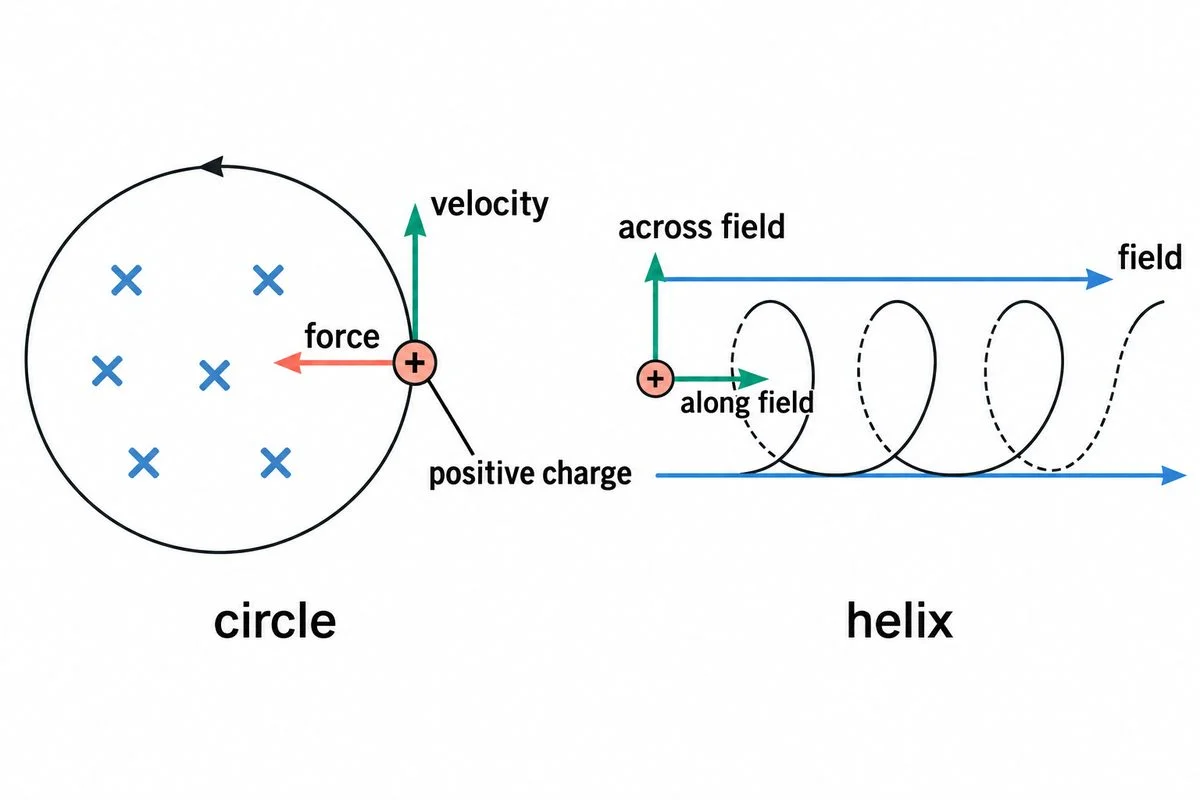
Circular and helical paths with inward force and velocity components.

2. Circular and helical motion

Magnetic fields can bend particle paths into circles or helices.

Show
Look at the diagram’s circle and inward force. On the helix, find motion across and along the field.
Ask
How will this helix change if only the speed along the field increases?
Say
The sideways force bends motion into a circle without changing speed. Steady motion along the field makes a helix. Faster motion along the field spreads its turns farther apart.
Used in
Cyclotrons bend charged particles into circles to help produce medical substances.
If your child says…“The speed across the field sets the spacing between turns.”
Ask
Which motion carries the charge forward along the helix?
What’s true
Spacing equals speed along the field multiplied by the time for one turn.

Fields made by currents

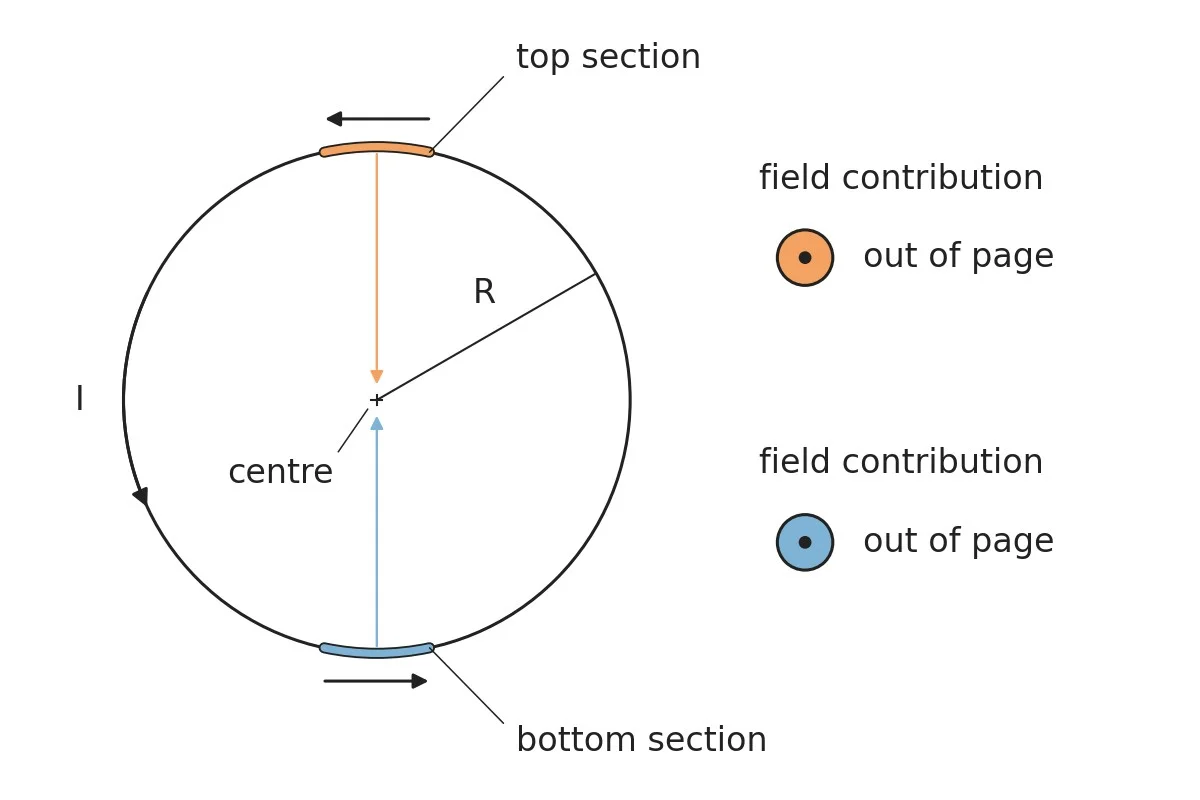
Opposite loop sections produce centre-field contributions pointing out of the page.

3. Biot–Savart law and superposition

Wire sections make fields that add.

Show
Find the opposite current sections in the diagram. Follow their contributions to the centre. Read I as current, R as radius, B as field, and μ₀ as free-space permeability.
Ask
Will these opposite sections reinforce or cancel each other’s field at the centre?
Say
Both contributions point out of the page, so they reinforce.
Used in
Coils let wireless chargers charge phones.
If your child says…“Extra turns add nothing.”
Ask
Would another matching turn oppose this field?
What’s true
Matching turns strengthen the field.
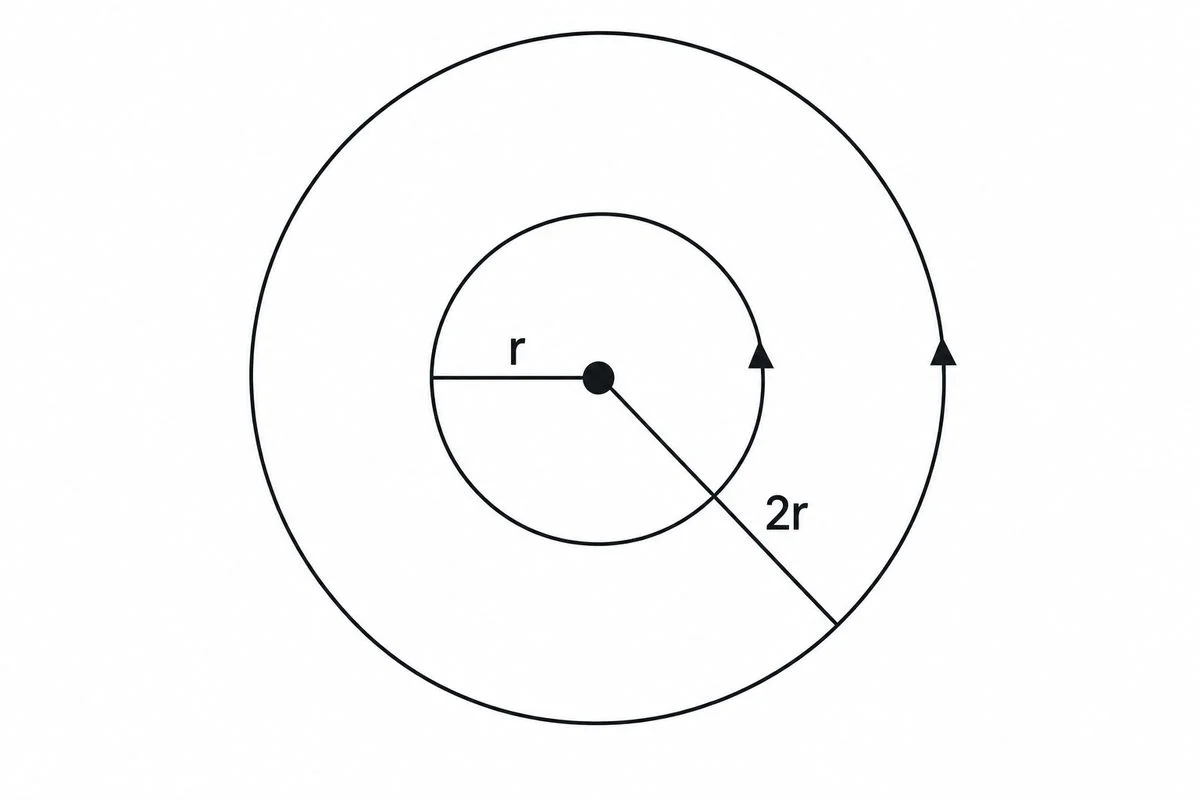
Pencil sketch of two concentric circles with anticlockwise arrows around a central dot.

4. Ampere’s law

Enclosed current sets magnetic circulation.

Show
Find the diagram’s current dot and anticlockwise circles. Compare radii r and 2r. Here, r means distance from the wire.
Ask
Which circle has the weaker field?
Say
The circle at 2r has the weaker field; field strength times circumference stays equal for unchanged current.
Used in
Clamp meters measure current without disconnecting wires.
If your child says…“Twice as far means one-quarter.”
Ask
Does the outer circumference double or quadruple?
What’s true
Doubling distance halves this field.
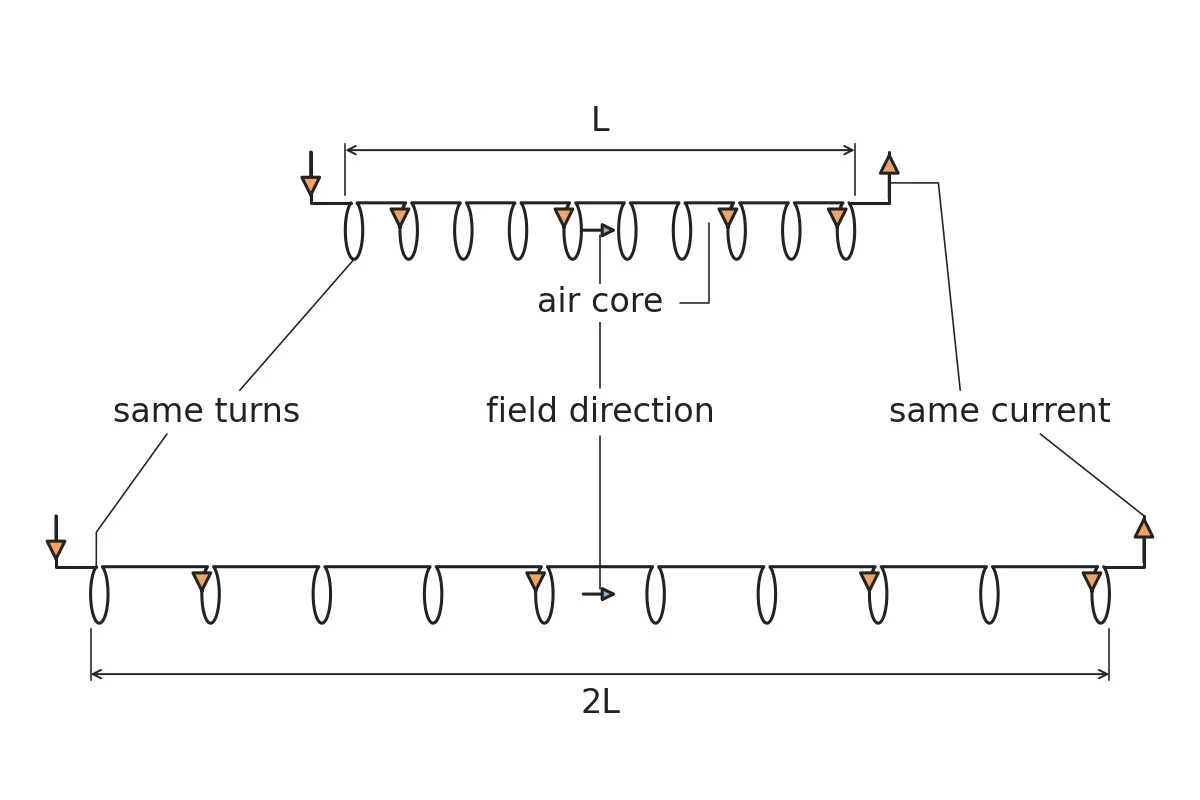
Equal-turn air-core solenoids carrying equal currents, with the lower coil twice as long.

5. Solenoid

A long coil’s central field depends on how tightly turns fit.

Show
Compare the long air-core coils in the diagram. Count their turns, then compare their lengths. Both carry the same current.
Ask
Which coil will produce the stronger field near its centre?
Say
The shorter coil produces approximately twice the central field. It packs twice as many turns into each unit of length.
Used in
Washing machines use solenoid valves to control water entering the drum.
If your child says…“The same total turns always give the same field.”
Ask
How many turns now fit into the same length?
What’s true
For a long air-core coil, fewer turns per unit length mean a weaker central field.
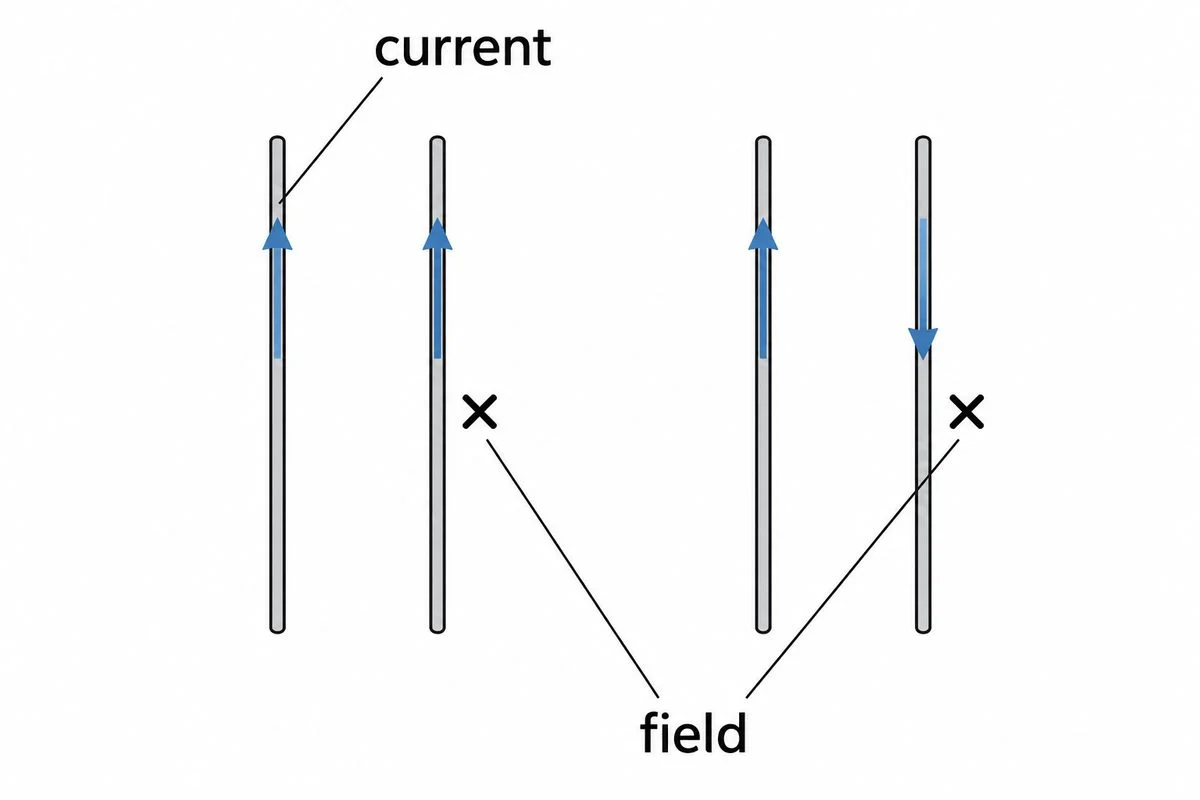
Two pencil sketches of parallel wires, with matching and opposite current arrows.

6. Force between parallel currents

Current directions decide attraction or repulsion.

Show
Compare the diagram’s two wire pairs and their current arrows. Each cross marks the left wire’s field at the right wire, directed into the page.
Ask
Will reversing current reverse force?
Say
Matching parallel currents attract; opposite currents repel.
Used in
Switchboard braces withstand forces between conductors.
If your child says…“Matching currents repel.”
Ask
With left index finger into paper and middle finger upwards, where does your perpendicular thumb point?
What’s true
Matching currents attract.

Turning coils and measuring current

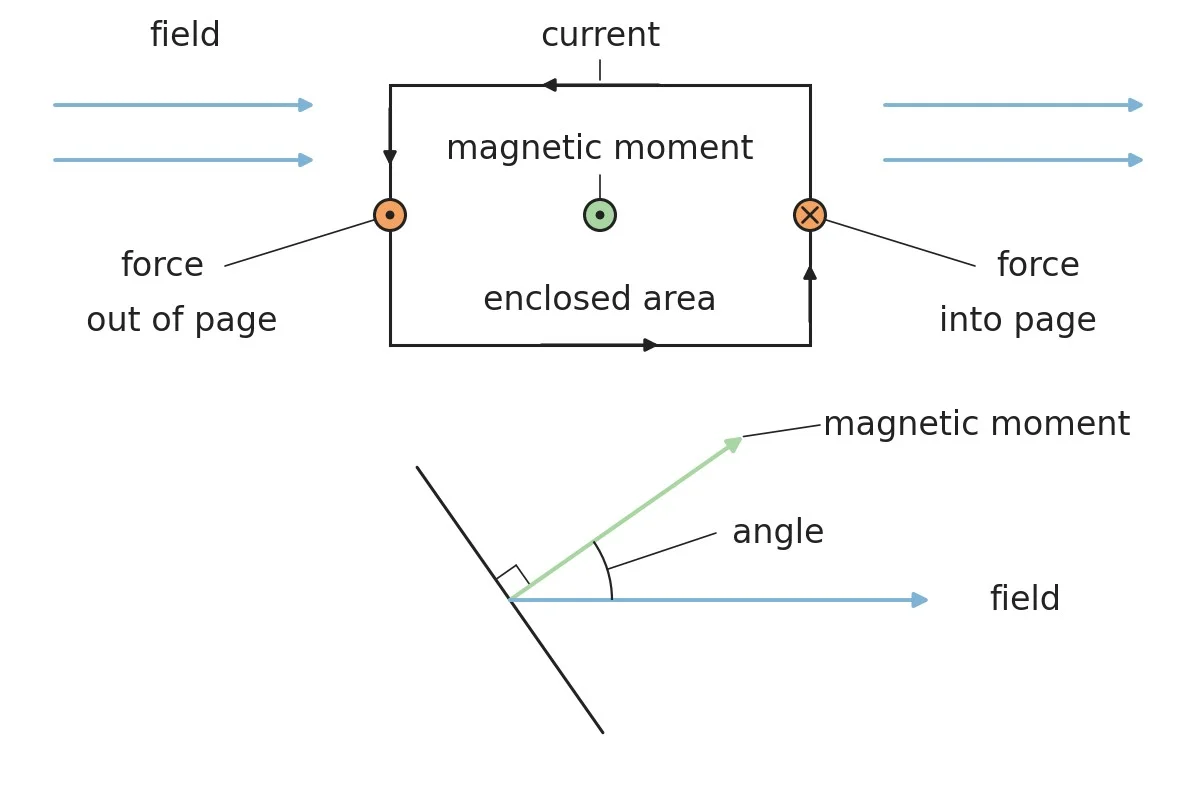
Opposite forces on separated loop sides, with magnetic moment perpendicular to the loop.

7. Magnetic moment and torque

A current loop’s magnetic moment sets its turning response.

Show
Find the opposite forces in the diagram. Locate the magnetic moment perpendicular to the loop. Compare its direction with the field.
Ask
Will these equal, opposite forces keep the loop still?
Say
The forces cancel overall, but they act on separate sides and turn the loop. Its magnetic moment points perpendicular to its face. The turning effect tends to align that moment with the field.
Used in
Galvanometers use coil deflection to measure current.
If your child says…“The field lies along the coil’s face, so torque vanishes.”
Ask
When the field runs along the loop’s face, is its magnetic moment along the field?
What’s true
The loop’s magnetic moment points perpendicular to its face, so measure the angle from that direction.
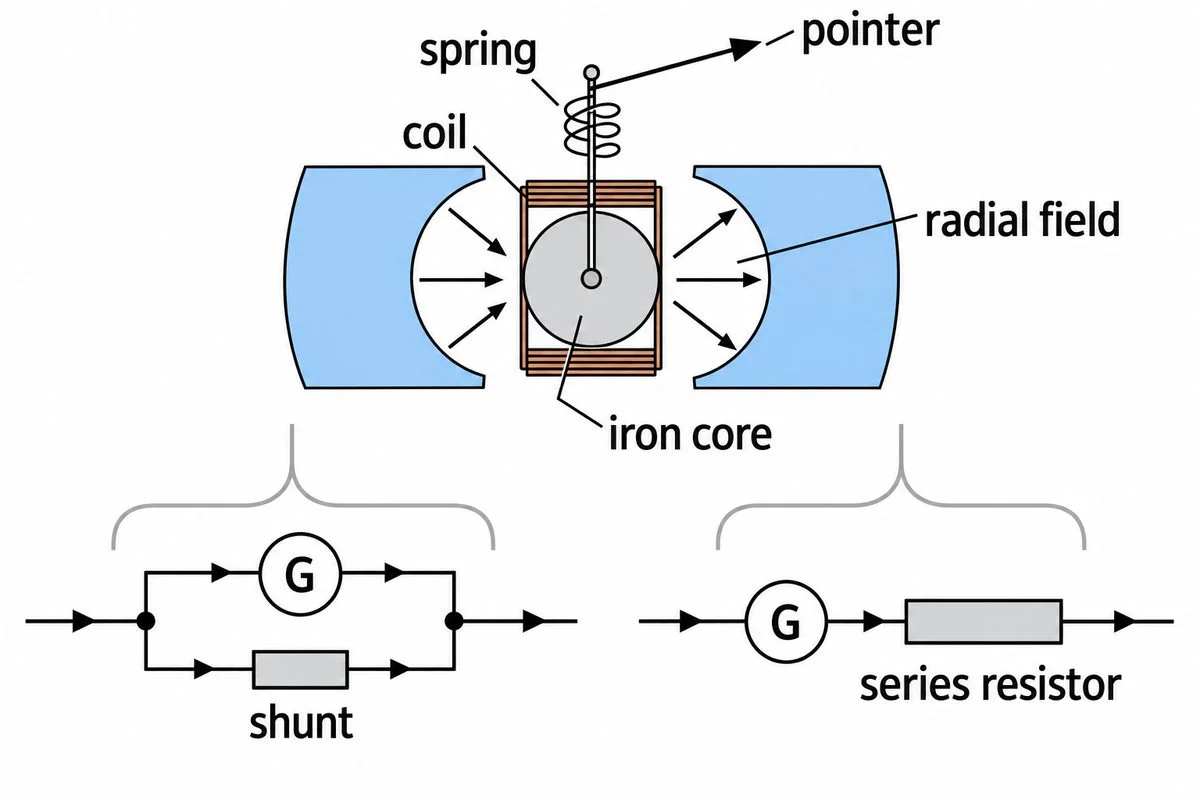
Moving-coil mechanism above parallel-shunt and series-resistor circuits.

8. Moving-coil galvanometer and meter conversion

Added resistance lets a sensitive coil measure larger currents or voltages.

Show
Find the diagram’s coil, spring and pointer. Trace both circuits; G marks the galvanometer.
Ask
Which circuit diverts most current around the coil?
Say
The spring balances magnetic torque, making deflection proportional to current. A parallel shunt bypasses most current. Large series resistance limits current for voltage measurement.
Used in
A large series resistance lets a galvanometer measure voltage while limiting current through its coil.
If your child says…“The bypass carries all the current.”
Ask
If the shunt carried everything, what current would remain to move the pointer?
What’s true
Incoming current equals coil current plus bypass current.

A real problem

Magnetic bending supports cancer diagnosis in Kolkata.

Kolkata’s Medical Cyclotron Facility began operating in 2018.

It produces and supplies FDG, a substance used to diagnose cancer.

A cyclotron’s magnetic field curves moving charged particles into circular paths.

The project aimed to make medical radioisotopes affordable, especially in eastern India.

VECCIAEAPress Information Bureau

An empty hospital scanning table.

Concept Lab · Common misconception

The tempting mistake in Moving Charges and Magnetism

Open standalone misconception page →

Does a magnetic field push a moving charge along the field?

Wrong

A positive charge is pushed in the direction the magnetic field points.

Why it feels right. An electric force on a positive charge points along the electric field, so I reuse that rule.

Right

The magnetic force is perpendicular to velocity and field and vanishes when they are parallel.

Worked example

For a positive charge, eastward motion in a northward field produces force out of this map. Motion along the field produces zero force.
  1. With a positive charge moving east in a field pointing north, the right-hand rule gives an upward force.
  2. If it instead moves north, the magnetic force is zero.

Ask your child eight quick questions.

One per step. The answer and the reason are given.

  1. What magnetic force acts on a straight wire carrying current parallel to a uniform field?

    Zero. Only the current across the field contributes to magnetic force.

  2. Which velocity component sets turn spacing when the time per turn stays fixed?

    The component along the field. Forward travel during each turn comes from motion along the field.

  3. What happens to the centre field when identical, closely packed turns double at unchanged current?

    It doubles. Each added turn supplies an equal field in the same direction.

  4. Outside a long straight wire, what happens to field strength when distance halves at unchanged current?

    It doubles. Halving distance halves the circumference, while field strength times circumference stays unchanged.

  5. A long air-core solenoid doubles in length without changing turns or current. What happens to its central field?

    It approximately halves. Doubling length halves the number of turns in each unit of length.

  6. Current runs down one long wire and up its parallel neighbour. Which way do they push?

    Away from each other. Oppositely directed parallel currents repel.

  7. What torque acts when a current loop’s magnetic moment points along a uniform magnetic field?

    Zero. The angle between magnetic moment and field is zero.

  8. A meter receives 10 mA while its coil carries 1 mA. What passes through the shunt?

    9 mA. The shunt carries incoming current minus the coil’s share.

15 more questions with answers, 1 with pictures