Skip to content

Teach Current Electricity in eight steps.

For each idea: show it, ask before you tell, then say one line.

Gather paper and a pencil.

Common misconceptions & worked visual for this chapter · 15 practice questions with answers

How to teach it

Current and resistance

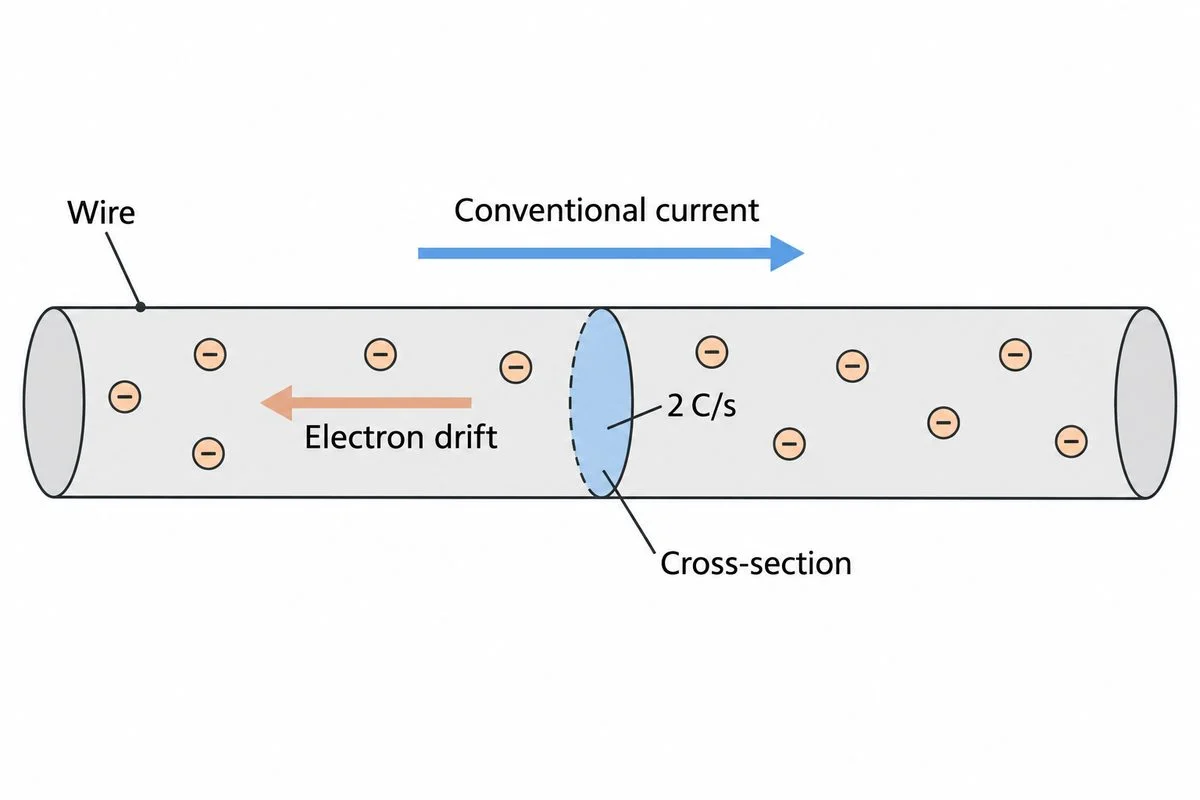
A wire shows charge crossing a section and opposite electron and current directions.

1. Electric current

Current measures how much charge passes each second.

Show
Look at the diagram's marked cross-section. Find the charge crossing each second, then compare the electron and current arrows.
Ask
At 2 amperes, how much charge will cross this section in the next second?
Say
Two amperes means two coulombs of net charge cross this section each second. Conventional current points opposite to electron drift.
Used in
A battery supplies current to keep a lamp shining.
If your child says…“Current goes the same way as electrons.”
Ask
Which current direction matches negative charges moving left?
What’s true
Electrons carry negative charge, so conventional current points opposite to their movement.
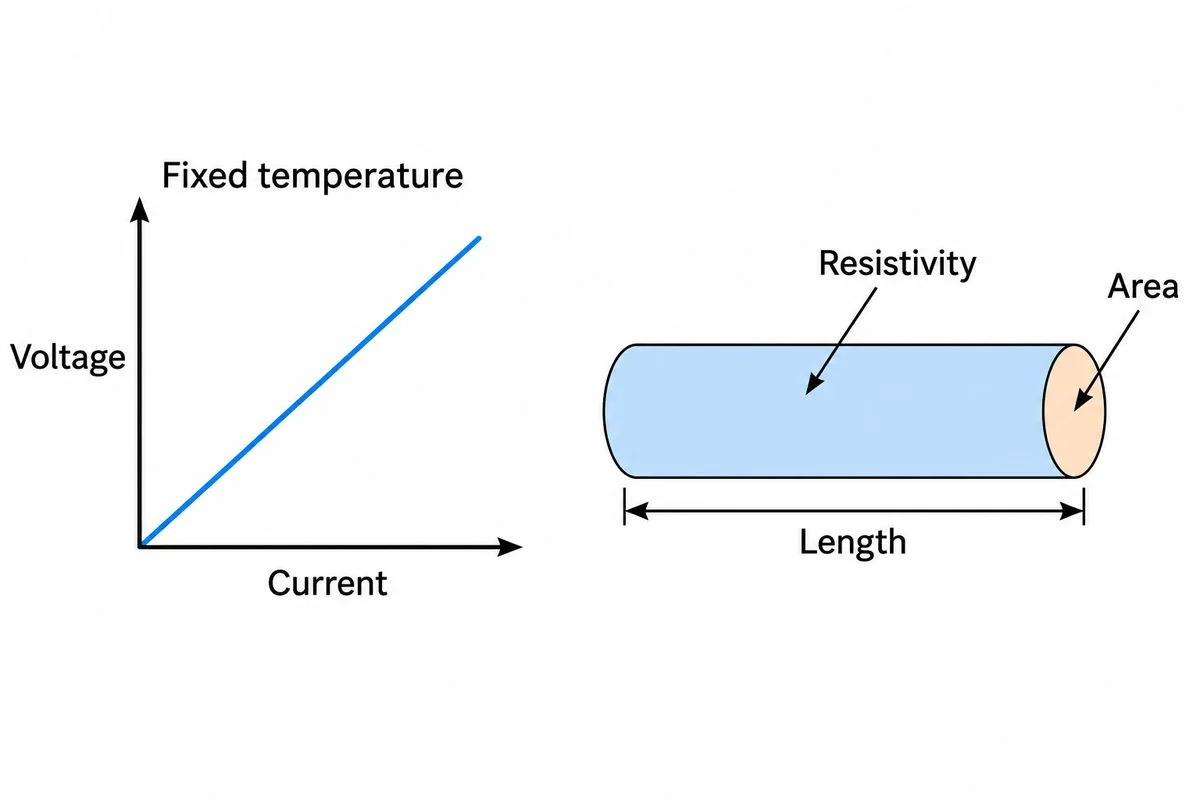
A straight voltage–current graph sits beside a wire with its dimensions marked.

2. Ohm's law, resistance and resistivity

Resistance depends on wire dimensions; resistivity describes material at a temperature.

Show
Read the diagram's voltage–current graph, then find the wire's length and area. Temperature stays fixed.
Ask
If voltage doubles here, what happens to current?
Say
Current doubles because resistance stays constant.
Used in
Ohmic resistors make current predictable from voltage while physical conditions stay fixed.
If your child says…“The longer wire has greater resistivity.”
Ask
Does making this wire longer change its material or temperature?
What’s true
Changing wire dimensions changes resistance, while resistivity stays unchanged at the same temperature.
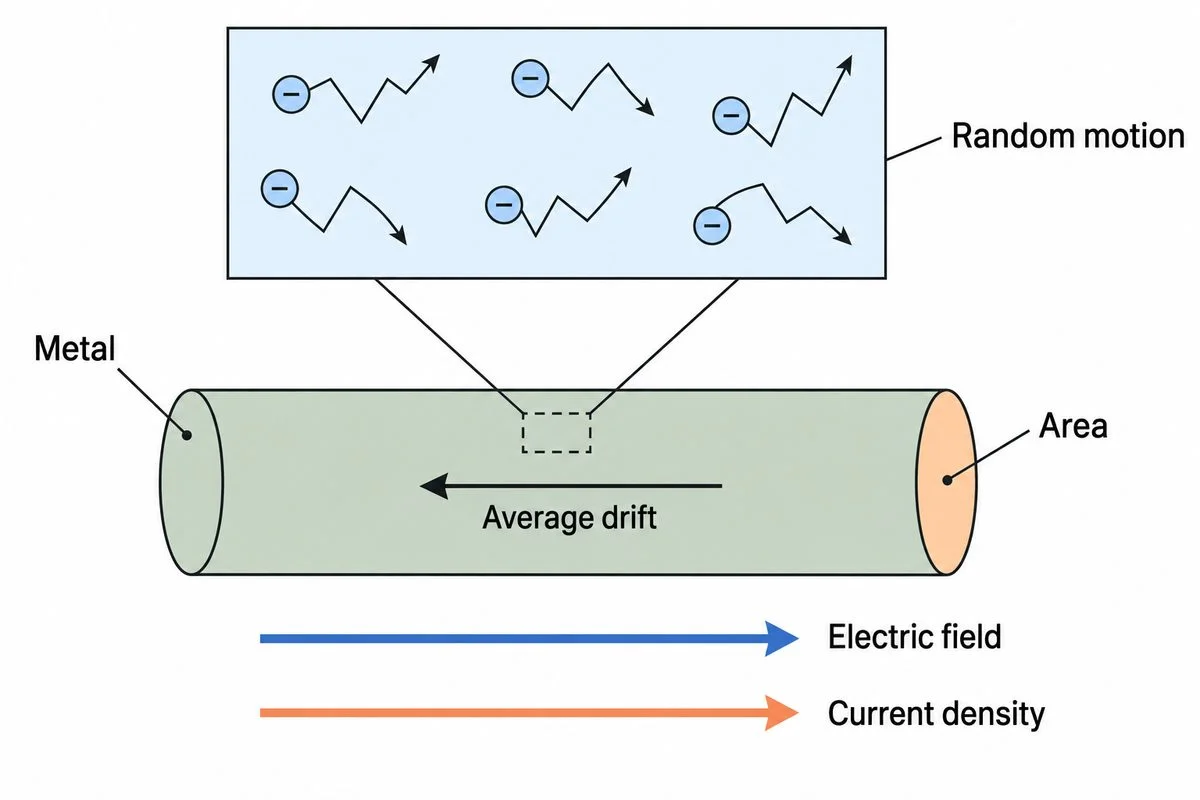
Irregular electron paths accompany average drift opposite to field and current density.

3. Drift speed, current density and mobility

Current density compares current with area; mobility compares drift with field.

Show
Find the diagram's random paths, drift arrow and field arrow.
Ask
How will stronger fields change this metal's drift?
Say
At fixed temperature, stronger fields increase drift in this ohmic metal.
Used in
For the same current, thicker appliance wires reduce current density and heating per metre.
If your child says…“A stronger field increases electron mobility.”
Ask
If drift speed and field both double, does their ratio change?
What’s true
At fixed temperature, drift speed rises with field, but mobility stays constant in an ohmic metal.
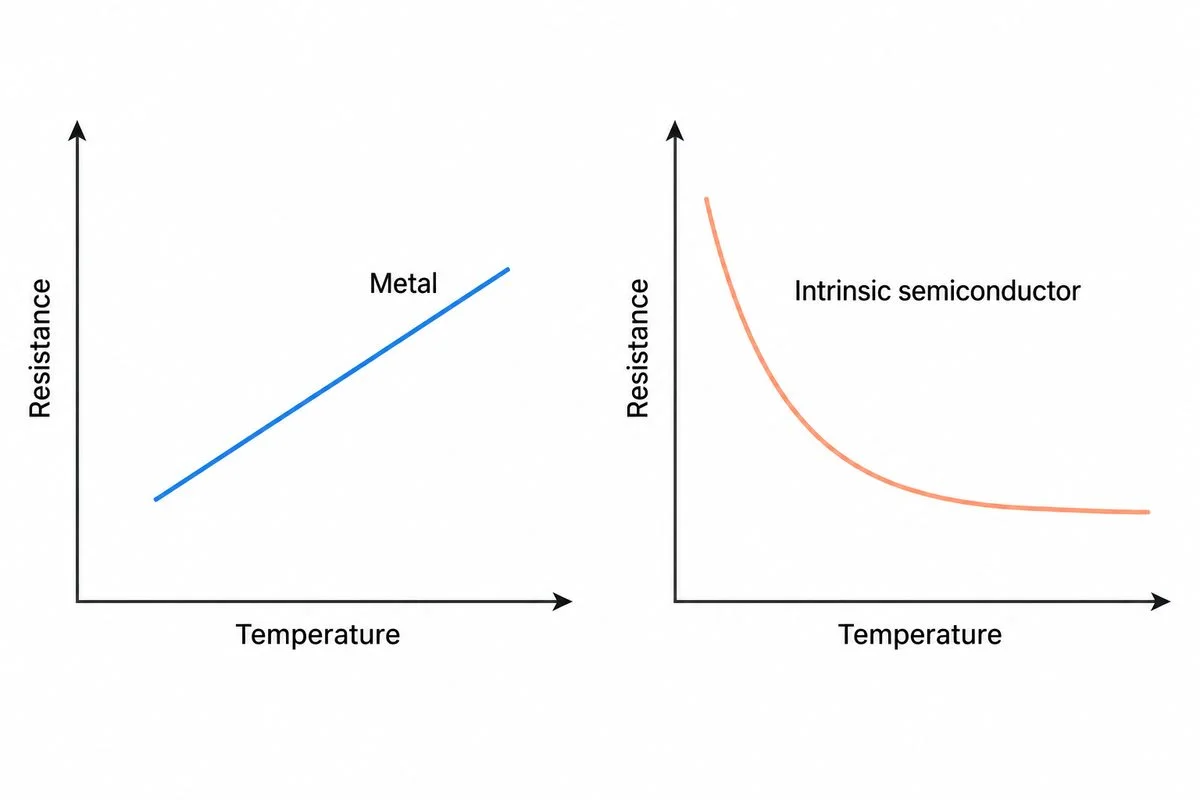
Resistance rises with temperature for a metal and falls for an intrinsic semiconductor.

4. Temperature dependence of resistance

Resistance can change when the material's temperature changes.

Show
Look at the diagram's metal graph on the left. Follow its curve towards higher temperature, then compare the semiconductor curve.
Ask
At unchanged voltage, what happens to current as the metal warms?
Say
The metal carries less current: heating usually increases electron scattering and resistance. In an intrinsic semiconductor, heating creates more mobile charges, so resistance falls.
Used in
Manganin resistors keep electrical measurements steadier because their resistance changes little with temperature.
If your child says…“Warmer electrons move faster, so metal conducts better.”
Ask
Which way does the metal's resistance curve go as temperature rises?
What’s true
In a heated metal, increased scattering hinders drift despite faster random electron motion.

Power and cells

P=VI=(6 V)(2 A)=12 WP=VI=(6\,\mathrm{V})(2\,\mathrm{A})=12\,\mathrm{W}

12 W=12 J s−112\,\mathrm{W}=12\,\mathrm{J\,s^{-1}}

5. Electrical power and energy

Power measures how quickly electrical energy is transferred.

Show
Write these lines. Say: 'Power P is voltage V times current I; watts mean joules per second.'
Ask
How much energy will this resistor transfer in 30 seconds at this steady power?
Say
It transfers 360 joules: 12 joules each second for 30 seconds.
Used in
Higher transmission voltage reduces current, cutting wire losses for the same delivered power.
If your child says…“My heater always uses its rated power.”
Ask
Would the same resistor still draw 2 amperes if its voltage were halved?
What’s true
With resistance unchanged, half the rated voltage gives one quarter of the rated power.
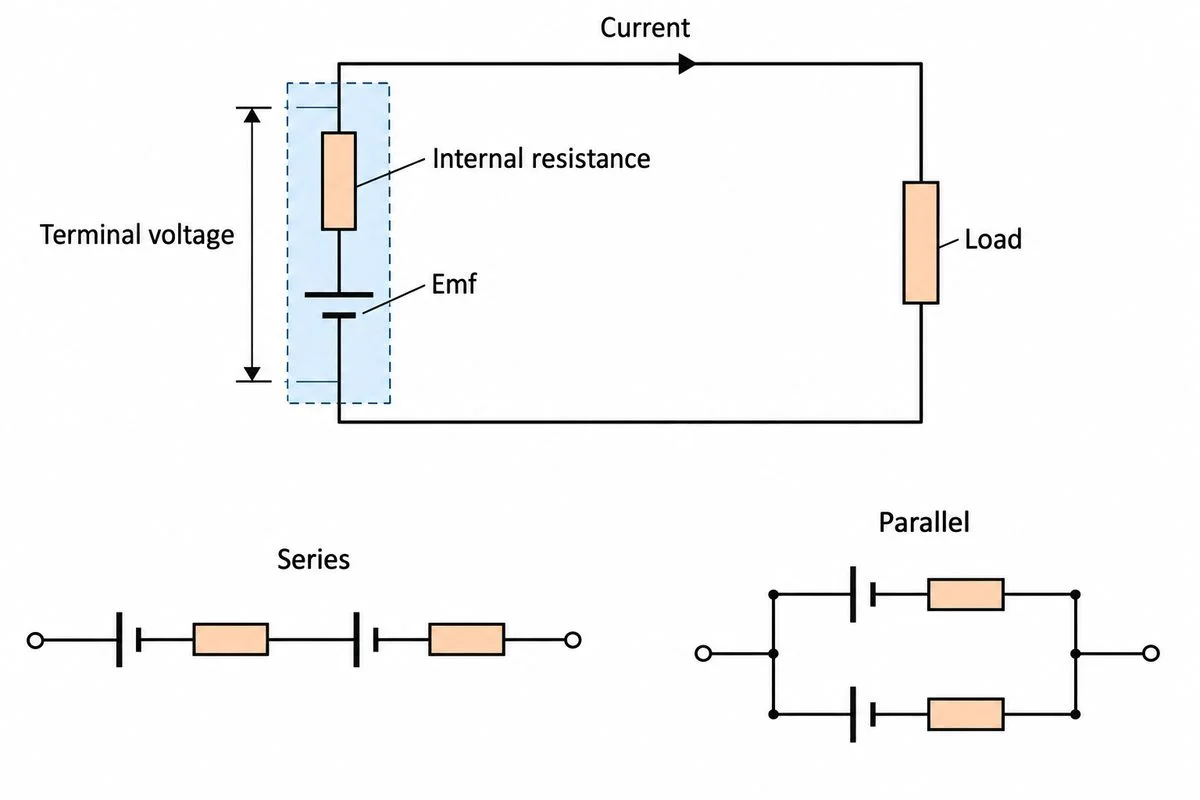
A cell's internal resistance and load appear above series and parallel cell connections.

6. Emf, internal resistance and combinations of cells

Cells supply energy per charge; internal resistance affects their delivered voltage.

Show
Trace the diagram's cell circuit. Compare the identical cell pairs below.
Ask
Will more current raise or lower this cell's terminal voltage?
Say
More current causes a larger internal voltage drop. Two identical aiding series cells double emf and internal resistance. Matching parallel cells retain emf but halve internal resistance.
Used in
A series resistor limits battery charging current.
If your child says…“Every cell adds its emf, whichever way it faces.”
Ask
Would turning the cell around change which way it drives charge?
What’s true
In series, a reversed cell's emf subtracts, but its internal resistance still adds.

Circuit connections

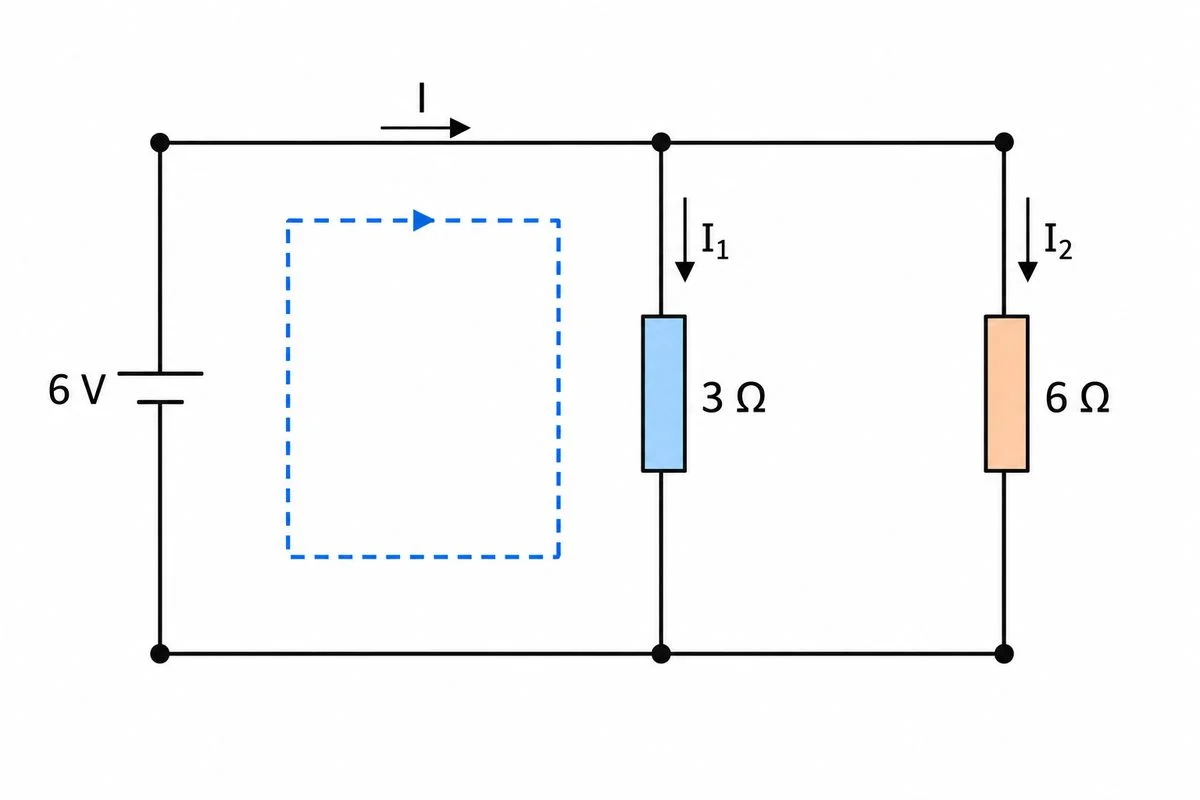
A source feeds two parallel resistors, with branch-current arrows and a marked loop.

7. Resistor networks and Kirchhoff's rules

Connections set currents and voltages, while charge and energy remain conserved.

Show
Trace the diagram's split, both branches, then the dashed loop.
Ask
How much current must the source supply?
Say
Each branch receives 6 volts, drawing 2 amperes and 1 ampere. Their sum, 3 amperes, leaves the source because charge cannot accumulate. Each loop's voltage rise equals its drop.
Used in
Parallel resistors allow greater current at unchanged voltage.
If your child says…“Currents meeting at right angles add like arrow lengths.”
Ask
Would turning either resistor branch change the charge arriving at the junction?
What’s true
Charge entering a steady junction must leave it, regardless of wire angles.
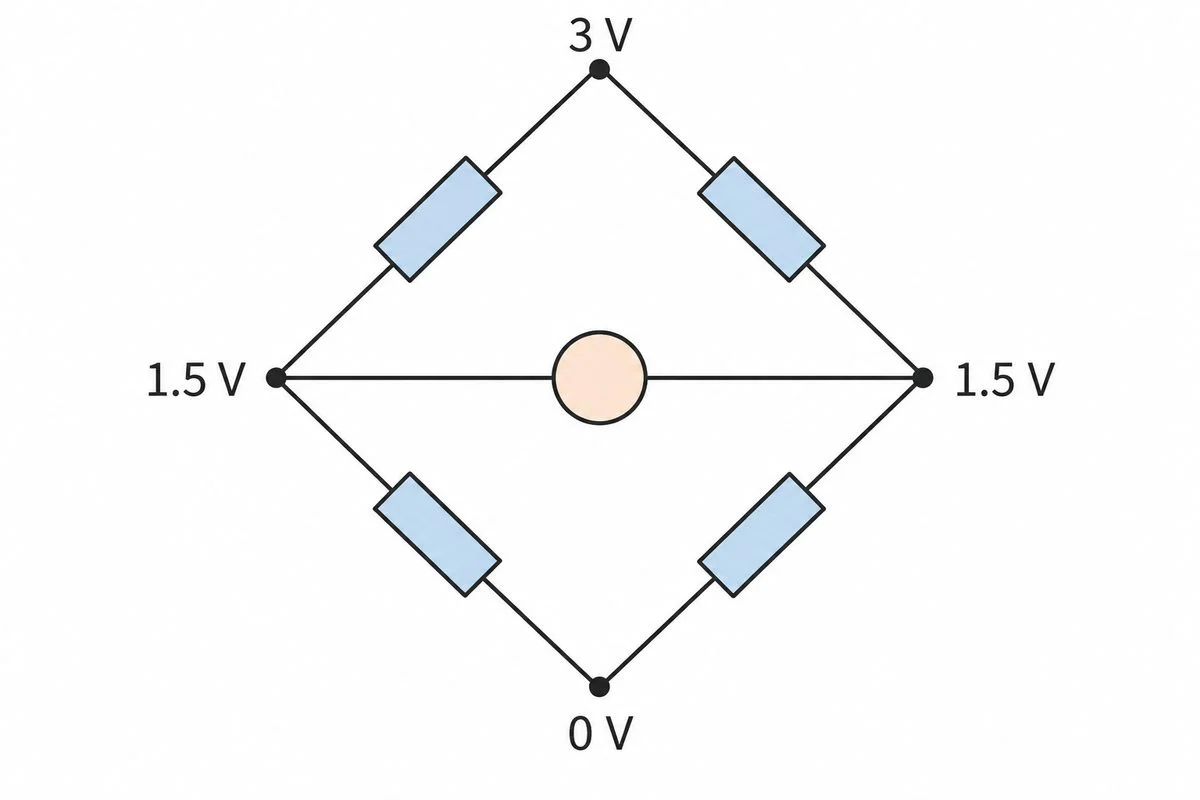
A diamond bridge circuit shows equal midpoint voltages and a detector between them.

8. Wheatstone bridge balance

Matching resistance ratios equalise midpoint voltages.

Show
Find the four resistors in the diagram. Compare the two midpoint voltages. Say: 'Each left resistor is 1 ohm; each right resistor is 2 ohms.'
Ask
Will current cross the detector?
Say
Equal midpoint voltages mean zero detector current. Both outer paths still carry current.
Used in
Bridges measure unknown resistance.
If your child says…“A balanced bridge has no current anywhere.”
Ask
What voltage difference remains across each complete outer path?
What’s true
Balance removes detector current, while both resistive paths remain across the supply.

A real problem

Volta's pile supplied sustained electric current.

Alessandro Volta announced his battery invention in 1800.

The battery supplied sustained current, whose size could change during use.

Its cells were connected in series, so their emfs added.

SmithsonianOpen University

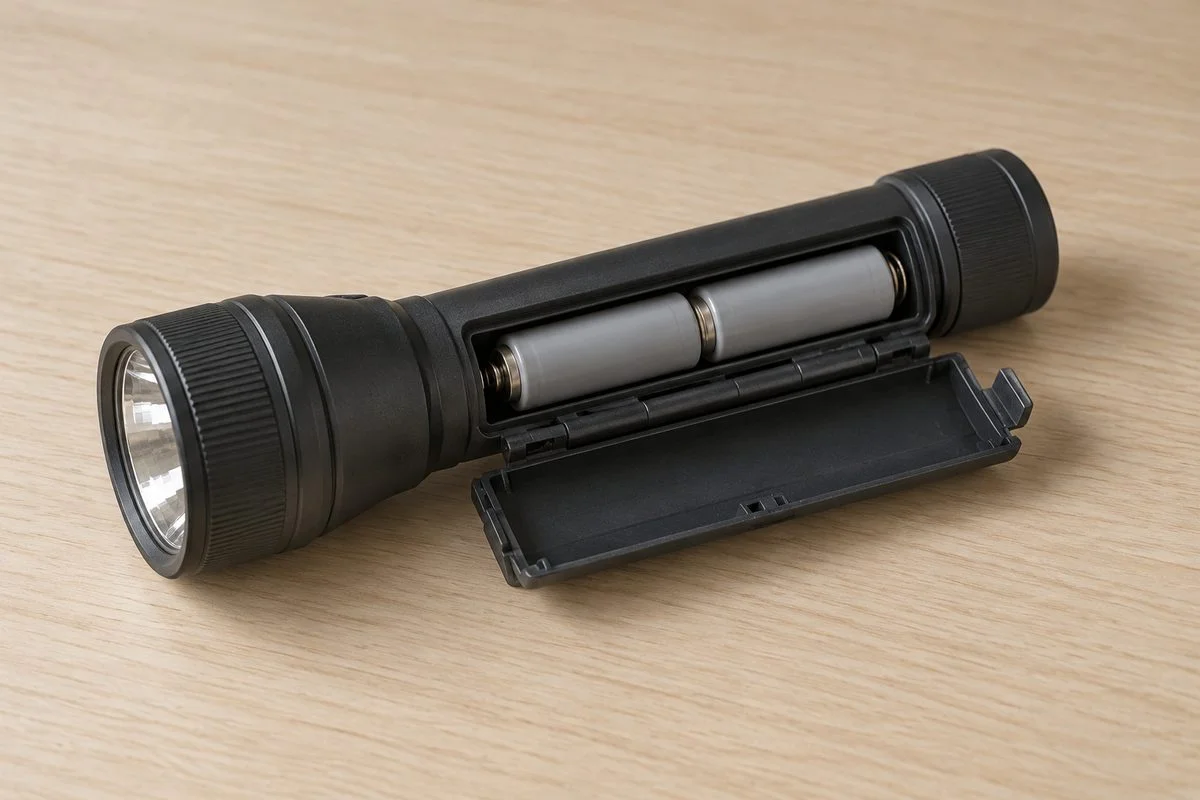
An open torch battery compartment shows cells arranged end to end.

Concept Lab · Common misconception

The tempting mistake in Current Electricity

Open standalone misconception page →

Is the same current through two resistors proof of the same voltage drop?

Wrong

Two resistors in series have identical voltage drops because they carry the same current.

Why it feels right. I treat current and potential difference as interchangeable measures of electricity.

Right

Series resistors carry the same current. Each drop is set by V = IR for that resistor.

Worked example

One ampere flows through both resistors. At that current the larger resistance has the larger voltage drop.
  1. In an ideal 6 V circuit with 2 Ω and 4 Ω in series, the current is 1 A everywhere.
  2. The voltage drops are 2 V and 4 V.

Ask your child eight quick questions.

One per step. The answer and the reason are given.

  1. Electrons drift left through a metal wire. Which way does conventional current point?

    Right. Negative charges contribute current opposite to their motion.

  2. A wire becomes longer; its material and temperature stay unchanged. What happens to its resistivity?

    It stays unchanged. Wire dimensions affect resistance, while material and temperature determine resistivity.

  3. An ohmic wire stays at fixed temperature. What happens to mobility when the field doubles?

    It stays unchanged. Drift speed and field double together, leaving their ratio unchanged.

  4. An ordinary metal wire warms within its usual operating range. What happens to its resistivity?

    It increases. Increased scattering hinders directed electron motion.

  5. A heater runs at half its rated voltage, with unchanged resistance. What fraction of rated power does it use?

    One quarter. With resistance unchanged, halving voltage halves current, so power falls to one quarter.

  6. Five identical cells, each with emf E, are in series. One is reversed. What emf results?

    3E. The reversed cell opposes the other four.

  7. Currents of 3 A and 4 A enter a steady junction through perpendicular wires. What total current leaves?

    7 A. Charge cannot accumulate at a steady junction, so incoming currents add.

  8. The left outer branch contains two 1-ohm resistors across 3 volts. What current flows through it at balance?

    1.5 amperes. The branch has 2 ohms, so 3 volts drives 1.5 amperes.

15 more questions with answers, 1 with pictures